The asburd reading challenge of 2025

Each year, I come up with an absurd reading challenge, such as reading books published in unnecessarily large formats (2023) or by specific authors (2023 and 2024) or in specific series (2024) or for completism’s sake (2024). For 2025, something a little different:

To be unsystematic.

To not work through lists.

To choose randomly, according to whims, sudden enthusiasms and the rediscovery of books I’d forgotten I had.

To not plough through everything at the same relentless pace.

To take time to pause, to relish, to reflect.

To see how long I can persist in such hippy nonsense.

My top 28 films of 2024

This year I have seen 416 films, 257 of them for the first time, and of those 257 these are my top 28, in roughly this order:

Comrades (Bill Douglas 1986)
Wanda (Barbara Loden 1970)
Yukinojô henge/An Actor’s Revenge (Kon Ichikawa 1963)
Rhymes for Young Ghouls (Jeff Barnaby 2013)
The Zone of Interest (Jonathan Glazer 2023)
The Substance (Coralie Fargeat 2024)
Blood Quantum (Jeff Barnaby 2019)
The Circus (Charles Chaplin 1928)
El Bruto/The Brute (Luis Buñuel 1953)
Joy Ride (Adele Lim 2023)
Hundreds of Beavers (Mike Cheslik 2022)
Jui kuen/Drunken Master (Yuen Woo-Ping 1978)
Manbiki Kazoku/Shoplifters ((Hirokazu Kore-eda 2018)
Pouring Water on Troubled Oil (Nariman Massoumi 2023)
Shao Lin da peng da shi/Return to the 36th Chamber (Chia-Liang Liu 1980)
Street Scene (King Vidor 1931)
Strictly Ballroom (Baz Luhrmann 1992)
Sandome no satsujin/The Third Murder (Hirokazu Koreeda 2017)
Tai gik Cheung Sam Fung/Tai Chi Master (Woo-Ping Yuen 1993)
Biruma no tategoto/The Burmese Harp (Kon Ichikawa 1956)
Umi yori mo mada fukaku/After the Storm (Hirokazu Koreeda 2016)
Llévame en tus Brazo (Julio Bracho 1954)
Bastarden/The Promised Land (Nikolaj Arcel 2023)
Bound for Glory (Hal Ashby 1976)
Eshtebak/Clash (Mohamed Diab 2016)
The Garment Jungle (Vincent Sherman and Robert Aldrich 1957)
Unrueh/Unrest (Cyril Schäublin 2022)
Coming Home (Hal Ashby 1978)

Should anyone care, here is the full list of titles:

3-4 x jûgatsu/Boiling Point (Takeshi Kitano 1990)
5 Against the House (Phil Karlson 1955)
7 jin gong/Wonder Seven (Siu-Tung Ching 1994)
1990: I guerrieri del Bronx/1990: Bronx Warriors (Enzo G Castellari 1982)
2019: Dopo la caduta di New York/2019: After the Fall of New York (Sergio Martino 1983)

Against All Flags (George Sherman 1952)
Ak Kam/The Stunt Woman (Ann Hui 1996)
Akô-jô danzetsu/The Fall of Ako Castle (Kinji Fukasaku 1978)
Alien: Romulus (Fede Alvarez 2024)
All of Us Strangers (Andrew Haigh 2023)
The Amazing Transparent Man (Edgar G. Ulmer 1960)
À Meia Noite Levarei Sua Alma/At Midnight I will Take Your Soul (José Mojica Marins 1964)
An American Werewolf in London (John Landis 1981)
Anatomie d’un chute/Anatomy of a Fall (Justine Triet 2023)
The Annihilation of Fish (Charles Burnett 1999)
Another Day in Buenoseres (Cameron Medford-Hawkins and Benjamin Scrase 2023)
Antebellum (Gerard Bush and Christopher Renz 2020)
Aquaman and the Lost Kingdom (James Wan 2023)
Are You There God? It’s Me, Margaret (Kelly Fremon Craig 2023)
Arson, Inc. (William Berke 1949)
The Atomic Café (Jayne Loader, Kevin Rafferty and Pierce Rafferty 1982)
Attack of the 50 Foot Woman (Nathan Juran 1958)
Aventurera/The Adventuress (Alberto Gout 1950)
The Awful Truth (Leo McCarey 1937)

Baby It’s You (John Sayles 1983)
Bad Boys: Ride or Die (Adil El Arbi and Bilall Fallah 2024)
Ball of Fire (Howard Hawks 1941)
El barón del terror/The Brainiac (Chano Urueta 1962)
Bastarden/The Promised Land (Nikolaj Arcel 2023)
Ba wong fa/The Inspector Wears Skirts (Wellson Chin 1988)
The Beast from 20,000 Fathoms (Eugène Lourié 1953)
The Beekeeper (David Ayer 2024)
Being John Malkovich (Spike Jonze 1999)
The Big Country (William Wyler 1958)
The Big Heat (Fritz Lang 1953)
The Big Sleep (Howard Hawks 1946)
Birdman or (The Unexpected Virtue of Ignorance) (Alejandro González Iñárritu 2014)
Biruma no tategoto/The Burmese Harp (Kon Ichikawa 1956)
Black Friday (Arthur Lubin 1940)
Black Jack (Ken Loach 1979)
Blackmail Alfred Hitchcock 1929)
Blink Twice (Zoë Kravitz 2024)
Blood Quantum (Jeff Barnaby 2019)
Blue Beetle (Angel Manuel Soto 2023)
Blue Velvet (David Lynch 1986)
Bodigâdo Kiba/The Bodyguard (Ryûichi Takamori 1973)
Bogart: Life Comes in Flashes (Kathryn Ferguson 2024)
Born in Flames (Lizzie Borden 1983)
Bottle Shock (Randall Miller 2008)
Bound for Glory (Hal Ashby 1976)
Boxcar Bertha (Martin Scorsese 1972)
Boyhood (Richard Linklater 2014)
Brian and Charles (Jim Archer 2022)
Broken Arrow (John Woo 1996)
The Brother from Another Planet (John Sayles 1984)
El Bruto/The Brute (Luis Buñuel 1953)

Cadaveri eccelenti/Illustrious Corpses (Francesco Rosi 1976)
Capricorn One (Peter Hyams 1977)
Carita de Cielo (José Díaz Morales 1947)
Carnosaur (Adam Simon and Darren Patrick Moloney 1993)
Casa de los Babys (John Sayles 2003)
Champagne (Alfred Hitchcock 1928)
Christmas in July (Preston Sturges 1940)
Cinerama Adventure (David Strohmaier 2002)
El cine soy yo (Luis Armando Roche 1977)
Circle of Danger (Jacques Tourneur 1951)
The Circus (Charles Chaplin 1928)
City Girl (FW Murnau 1930)
City of Hope (John Sayles 1991)
The City of the Dead (John Llewllyn Moxey 1960)
Civil War (Alex Garland 2024)
Cocoon (Ron Howard 1985)
Cocoon: The Return (Daniel Petrie 1988)
Coffee and Cigarettes (Jim Jarmusch 2003)
The Colony (Jeff Barnaby 2007)
Coming Home (Hal Ashby 1978)
Comrades (Bill Douglas 1986)
Cops (Edward F. Cline and Buster Keaton 1922)
The Creator (Gareth Edwards 2023)
The Creature from the Black Lagoon (Jack Arnold 1954)
The Creature Walks Among Us (John Sherwood 1956)

Danger: Diabolik (Mario Bava 1968)
Dark Passage (Delmer Daves 1947)
Dead Man (Jim Jarmusch 1995)
Deadpool (Tim Miller 2016)
Deadpool 2 (David Leitch 2018)
Deadpool & Wolverine (Shawn Levy 2024)
Dead Slow Ahead (Mauro Herce 2015)
Death Becomes Her (Robert Zemeckis 1992)
Deep Blue Sea (Renny Harlin 1999)
Desperately Seeking Susan (Susan Seidelman 1985)
Detour (Edgar G. Ulmer 1945)
Diary of a Mad Housewife (Frank Perry 1970)
Die Hard  (John McTiernan 1988)
Dolls (Stuart Gordon 1986)
Domino (Tony Scott 2005)
Don’t Fuck with Dolphins (Nick Hearne 2024)
Don’t Worry Darling (Olivia Wilde 2022)
Down by Law (Jim Jarmusch 1986)
Downhill (Alfred Hitchcock 1927)
Drive-Away Dolls (Ethan Coen 2024)
The Drop (Michaël R. Roskam 2014)
Dune: Part Two (Denis Villeneuve 2024)
Dünyayi Kurtaran Adam/The Man Who Saved the World (Çetin Ínanç 1982)

Easy Rider (Dennis Hopper 1969)
Eight Men Out (John Sayles 1988)
The Elephant Man (David Lynch 1980)
Eraserhead (David Lynch 1977)
Eshtebak/Clash (Mohamed Diab 2016)
Etlinisigu’niet (Bleed Down) (Jeff Barnaby 2015)

The Fall Guy (David Leitch 2024)
The Fantastic Four (Oley Sassone 1994)
Far from the Madding Crowd (Thomas Vinterberg 2015)
The Farmer’s Wife (Alfred Hitchcock 1928)
Feng hou/Mad Monkey Kung Fu (Chia-Liang Liu 1979)
File Under Miscellaneous (Jeff Barnaby 2010)
Fingerprints Don’t Lie (Sam Newfield 1951)
Fisshu sutôrî/Fish Story (Yoshihiro Nakamura 2009)
The Flash (Andy Muschietti 2023)
Flash Gordon (Frederick Stephani 1936)
Flash Gordon (Mike Hodges 1980)
The Florida Project (Sean Baker 2017)
Fong Sai-Yuk/The Legend (Corey Yuen 1993)
Foreign Correspondent (Alfred Hitchcock 1940)
Frankenstein: The True Story (Jack Smight 1973)
Frankenstein Unbound (Roger Corman 1990)
From Cherry English (Jeff Barnaby 2004)
Fuga dal Bronx/Escape from the Bronx (Enzo G Castellari 1983)
Furiosa: A Mad Max Saga (George Miller 2024)

Ganja & Hess (Bill Gunn 1973)
The Garment Jungle (Vincent Sherman and Robert Aldrich 1957)
Gerry (Gus Van Sant 2002)
Ghostbusters: Frozen Empire (Gil Kenan 2024)
Ghost Dog: The Way of the Samurai (Jim Jarmusch 1999)
Gilda (Charles Vidor 1946)
Girl in the Headlines (Michael Truman 1963)
Godzilla x Kong: The New Empire (Adam Wingard 2023)
Gojira – 1.0/Godzilla Minus One (Takashi Yamazaki 2023)
Golok Setan/The Devil’s Sword (Ratno Timoer 1984)
The Grand Budapest Hotel (Wes Anderson 2014)
Guillermo del Toro’s Pinocchio (Guillermo del Toro and Mark Gustafson 2022)
Guangdong shi hu xing yi wu xi/Ten Tigers of Kwangtung (Cheh Chang 1980)
Gunpowder (Norman J. Warren 1986)
Gwok chaan Ling Ling Chat/From Beijing with Love (Lik-Chi Lee and Stephen Chow 1994)

Happy-Go-Lucky (Mike Leigh 2008)
Häxan (Benjamin Christensen 1922)
High Noon (Fred Zinnemann 1952)
The Hitch-Hiker (Ida Lupino 1953)
The Hitman and the Assassin (Will Axtel 2023)
Holiday (George Cukor 1938)
Un homme et une femme/A Man and  a Woman (Claude Lelouch 1966)
The Hounds of Annwn (Bryony Evans and Beth Hughes 2023)
How the West Was Won (John Ford, Henry Hathaway, George Marshall and Richard Thorpe 1962)
How to Have Sex (Molly Manning Walker 2023)
Huang jia shi jie/Yes, Madam! aka Police Assassins (Corey Yuen 1985)
Hundreds of Beavers (Mike Cheslik 2022)
The Hunger Games: Catching Fire (Francis Lawrence 2013)
The Hunger Games: Mockingjay – Part 1 (Francis Lawrence 2014)
The Hunger Games: Mockingjay – Part 2 (Francis Lawrence 2015)

I’ll Get You (Seymour Friedman and Peter Graham Scott 1952)
I Married a Witch (René Clair 1942)
The Incredible Petrified World (Jerry Warren 1959)
Incubo sulla città contaminato/Nightmare City (Umberto Lenzi 1980)
In the Soup (Alexandre Rockwell 1992)
L’invenzione di Morel/The Invention of Morel (Emido Greco 1974)
The Invisible Ray (Lambert Hillyer 1935)
The Iron Claw (Sean Durkin 2023)
I Saw the TV Glow (Jane Schoenbrun 2024)

Jane Eyre (Cary Joji Fukunaga 2011)
Jason X (James Isaac 2001)
Jennifer’s Body (Kaaryn Kusama 2009)
Jin bi tong/Kid with the Golden Arm (Cheh Chang 1979)
Joy Ride (Adele Lim 2023)
Jui kuen/Drunken Master (Yuen Woo-Ping 1978)
Juno and the Paycock (Alfred Hitchcock 1929)
Just Mercy (Destin Daniel Cretton 2019)

Kaette kita onna hissatsu ken/Return of the Sister Street Fighter (Kazuhiko Yamaguchi 1975)
Kaibutsu/Monster (Hirokazu Koreeda 2023)
Kanashimi no Beradonna/Belladonn of Sadness (Eiichi Yamamoto 1973)
Key Largo (John Huston 1948)
Killer Klowns from Outer Space (Stephen Chiodo 1988)
Killers of the Flower Moon (Martin Scorsese 2023)
Kimitachi wa dô ikiru ka/The Boy and the Heron (Hayao Miyazaki 2023)
Kin-dza-dza! (Georgiy Daneliya 1986)
King Kong (Merian C. Cooper and Ernest B. Schoedsack 1933)
King of Thieves (James Marsh 2018)
Kozure Ôkami: Ko wo kashi ude kashi tsukamatsuru/Lone Wolf and Cub: Sword of Vengeance (Kenji Misumi 1972)

Lady Godiva of Coventry (Arthur Lubin 1955)
The Lady Vanishes (Alfred Hitchcock 1938)
The Last Detail (Hal Ashby 1973)
Late Night with the Devil (Cameron and Colin Cairnes 2023)
Lat sau san taam/Hard Boiled (John Woo 1992)
Le Donk & Scor-zay-zee (Shane Meadows 2009)
LEGO Batman: The Movie – DC Super Heroes Unite (Jon Burton 2013)
Lianna (John Sayles 1983)
Limbo (John Sayles 1999)
Llévame en tus Brazo (Julio Bracho 1954)
Loan Shark (Seymour Friedman 1952)
The Lodger: A Story of the London Fog (Alfred Hitchcock 1927)
Lone Star (John Sayles 1996)
Lost in the Sky (Simon Öster 2023)
The Lost World (Irwin Allen 1960)
Love Lies Bleeding (Rose Glass 2024)
Luca (Enrico Casarosa 2021)

Machibuse/Ambush at Blood Pass (Hiroshi Inagaki 1970)
Madame Web (SJ Clarkson 2024)
Mai ming xiao zi/The Magnificent Ruffians (Cheh Chang 1979)
La maldición de la Llorona/The Curse of the Crying Woman (Rafael Baledón 1963)
The Maltese Falcon (John Huston 1941)
Manbiki Kazoku/Shoplifters ((Hirokazu Kore-eda 2018)
Mandy (Panos Cosmatos 2018)
The Man from Hong Kong (Brian Trenchard-Smith 1975)
Mannequins für Rio/They Were So Young (Kurt Neumann 1954)
The Man Who Knew Too Much (Alfred Hitchcock 1934)
The Manxman (Alfred Hitchcock 1929)
Marie Antionette (Sofia Coppola 2006)
Mary Shelley’s Frankenstein (Kenneth Branagh 1994)
Matewan (John Sayles 1987)
MaXXXine (Ti West 2024)
Meek’s Cut-Off (Kelly Reichardt 2010)
Menschen am Sonntag/People on Sunday (Robert Siodmak and Edgar G. Ulmer 1930)
Men with Guns (John Sayles 1997)
Midnight Run (Martin Brest 1988)
Mo him wong/Dr Wai in the Scripture with No Words (Siu-Tung Ching 1996)
Mondocane/Dogworld (Allesandro Celli 2021)
Monkey Man (Dev Patel 2024)
Monstrosity (Joseph V. Mascelli and Jack Pollexfen 1963)
Moon of the Wolf (Daniel Petrie 1972)
Las mujeras panteras/The Panther Women (René Cardona 1967)
Multiple Maniacs (John Waters 1970)
Murder! (Alfred Hitchcock 1930)
My Favorite Wife (Garson Kanin 1940)

Nan Shao Lin yu bei Shao Lin/Invincible Shaolin (Cheh Chang 1978)
Nekojiru-sô/Cat Soup (Tatsuo Satô and Masaaki Yuasa 2001)
Neptune Frost (Saul Williams and Anisia Uzeyman 2021)
Night and the City (Jules Dassin 1950)
The Nightcomers (Michael Winner 1971)
A Nightingale Sang in Berkeley Square (Ralph Thomas 1979)
Night on Earth (Jim Jarmusch 1991)
No Trees in the Street (J. Lee Thompson 1959)
Nou fo/Raging Fire (Benny Chan 2021)
Nowhere to Go (Seth Holt and Basil Dearden 1958)
Number Seventeen (Alfred Hitchcock 1932)
I nuovi barbari/The New Barbarians aka Warriors of the Wasteland Enzo G Castellari 1983)
Nuovo Cinema Paradiso/Cinema Paradiso (Giuseppe Tornatore 1988)

The Old Oak (Ken Loach 2023)
Once Upon a Time in the Midlands (Shane Meadows 2002)
One Flew Over the Cuckoo’s Nest (Milos Forman 1975)
On Her Majesty’s Secret Service (Peter R. Hunt 1969)
Onna hissatsu ken: Kiki ippatsu/Sister Street Fighter: Hanging by a Thread (Kazuhiko Yamaguchi 1974)
Onna hissatsu godan ken/Sister Street Fighter: Fifth Level Fist (Shigehira Ozawa 1976)
Our Man in Havana (Carol Reed 1959)
Out of the Past (Jacques Tourneur 1947)
Outland (Peter Hyams 1981)

Pale Rider (Clint Eastwood 1985)
The Parallax View (Alan J. Pakula 1974)
Passion Fish (John Sayles 1992)
Past Lives (Celine Song 2023)
The Phantom (Simon Wincer 1996)
The Phantom of the Opera (Dwight H. Little 1989)
Pi li shi jie/Disciples of the 36th Chamber (Chia-Liang Liu 1985)
Pillow Talk (Michael Gordon 1959)
The Pirate (Vincente Minnelli 1948)
Plane (Jean-François Richet 2023)
Plan 9 from Outer Space (Edward D. Wood Jr 1957)
Pleasure (Ninja Thyberg 2021)
The Pleasure Garden (Alfred Hitchcock 1925)
Point Blank (John Boorman 1968)
Point Break (Kathryn Bigelow 1991)
Poor Things (Yorgos Lanthimos 2023)
Il Postino (Michael Radford and Massimo Troisi 1994)
Pote tin Kyriaki/Never on Sunday (Jules Dassin 1960)
Pouring Water on Troubled Oil (Nariman Massoumi 2023)
The Power of the Dog (Jane Campion 2021)
Pride & Prejudice (Joe Wright 2005)
Primal (Nick Powell 2019)
The Punisher (Jonathan Hensleigh 2004)
Punisher: War Zone (Lexi Alexander 2008)
Puromea/Promare (Hiroyuki Imaishi 2019)

Q – The Winged Serpent (Larry Cohen 1982)
Queen of the Amazons (Edward Finney 1946)
A Quiet Place: Day One (Michael Sarnoski 2024)

Radio On (Chris Petit 1979)
Ralph Breaks the Internet (Phil Johnston and Rich Moore 2018)
The Rare Breed (Andrew V. McLaglen 1966)
Rats – Notte di terrore/Rats: Night of Terror (Bruno Mattei and Claudiio Fragasso 1984)
Raumpatrouille Orion – Rücksturz ins Kino (Theo Metzger and Micahel Braun 1968/2003)
Red One (Jake Kasdan 2024)
Regan (Tom Clegg 1974)
Relatos salvajes/Wild Tales (Damián Szifron 2014)
Retfærdighedens ryttere/Riders of Justice (Anders Thomas Jensen 2020)
Return of the Secaucus Seven (John Sayles 1980)
Revenge of the Creature (Jack Arnold 1955)
Rhymes for Young Ghouls (Jeff Barnaby 2013)
Rich and Strange (Alfred Hitchcock 1931)
The Right Stuff (Philip Kaufman 1983)
The Ring (Alfred Hitchcock 1927)
Rio Bravo (Howard Hawks 1959)
Robot Dreams (Pablo Berger 2023)
The Rocky Horror Picture Show (Jim Sharman 1975)

Safety Not Guaranteed (Colin Trevorrow 2012)
Le samouraï (Jean-Pierre Melville 1967)
Sandome no satsujin/The Third Murder (Hirokazu Koreeda 2017)
Santo contre los jinetes del terror/Santo vs. The Riders of Terror (René Cardona 1970)
Sasquatch Sunset (David and Nathan Zellner 2024)
Saw X (Kevin Greutert 2023)
Scrapper (Charlotte Regan 2023)
The Searchers (John Ford 1956)
The Secret of Roan Inish (John Sayles 1994)
The Set-Up (Robert Wise 1949)
Shadow Man (Richard Vernon 1953)
Shao Lin da peng da shi/Return to the 36th Chamber (Chia-Liang Liu 1980)
Shao Lin san shi liu fang/The 36th Chamber of Shaolin (Chia-Liang Liu 1978)
Sharpe’s Sword (Tom Clegg 1995)
Sharpe’s Regiment (Tom Clegg 1996)
Sharpe’s Siege (Tom Clegg 1996)
Sharpe’s Mission (Tom Clegg 1996)
Sharpe’s Revenge (Tom Clegg 1997)
Sharpe’s Justice (Tom Clegg 1997)
Sharpe’s Waterloo (Tom Clegg 1997)
She (Avi Nesher 1984)
She Gods of Shark Reef (Roger Corman 1958)
Shin Zatôichi: Yabure! Tôjin-ken/Zatoichi Meets the One-Armed Swordsman (Kimiyoshi Yasuda 1971)
Shin Zatôichi monogatari: Oreta tsue/Zatoichi in Desperation (Shintarô Katsu 1972)
Shin Zatôichi monogatari: Kasama no chimatsuri/Zatoichi’s Conspiracy (Kimiyoshi Yasuda 1973)
Shoot to Kill (William Berke 1947)
The Shop Around the Corner (Ernst Lubitsch 1940)
Showgirls (Paul Verhoeven 1995)
Shuang ma lian huan/The Mystery of Chess Boxing (Joseph Kuo 1979)
Silver City (John Sayles 2004)
Singin’ in the Rain (Gene Kelly and Stanley Donen 1952)
The Skeleton Twins (Craig Johnson 2014)
The Skin Game (Alfred Hitchcok 1931)
Sleepaway Camp (Robert Holtzik 1983)
Somers Town (Shane Meadows 2008)
Sono otoko, kyôbô nit suki/Violent Cop (Takeshi Kitano 1989)
The Sound of Music (Robert Wise 1965)
Source Code (Duncan Jones 2011)
Spark of Being (Bill Morrison 2010)
Speed (Jan de Bont 1994)
Stargate (Roland Emmerich 1994)
Star Wars (George Lucas 1977)
Star Wars: The Empire Strikes Back (Irvin Kershner 1980)
Star Wars: Return of the Jedi (Richard Marquand 1983)
Step Up (Anne Fletcher 2006)
Street Scene (King Vidor 1931)
Strictly Ballroom (Baz Luhrmann 1992)
Strike: An Uncivil War (Daniel Gordon 2024)
The Student Nurses (Stephanie Rothman 1970)
Studio 666 (BJ McDonnell 2022)
The Substance (Coralie Fargeat 2024)
Suffragette (Sarah Gavron 2015)
Sunset Blvd. (Billy Wilder 1950)
Sunshine State (John Sayles 2002)

Tai gik Cheung Sam Fung/Tai Chi Master (Woo-Ping Yuen 1993)
Talk to Me (Danny and Michael Philippou 2022)
También la Lluvia/Even the Rain (Icíar Bollaín 2010)
Tang shan wu hu/Five Superfigthers (Mar Lo 1975)
Tenet (Christopher Nolan 2020)
The Texas Chain Saw Massacre (Tobe Hooper 1974)
Thank You For Smoking (Jason Reitman 2005)
Three Baths (Rafael De Leon Jr 2023)
Timecop (Peter Hyams 1994)
Timestalker (Alice Lowe 2024)
Tin lung baat bou/Sakra (Donnie Yen and Ka-Wai Kam 2023)
To Be Or Not To Be (Ernst Lubitsch 1942)
To Have and Have Not (Howard Hawks 1944)
To Kill a Mockingbird (Robert Mulligan 1962)
To Live and Die in L.A. (William Friedkin 1985)
Ein Toter hing in Netz/Horrors of Spider Island (Fritz Böttger 1960)
The Toxic Avenger (Michael Herz and Lloyd Kaufman 1984)
Transformers: Rise of the Beasts (Steven Caple Jr 2023)
Les trois mousquetaires: Milady/The Three Musketeers: Milady (Martin Bourboulon 2023)
Tucker and Dale vs Evil (Eli Craig 2010)
Twisters (Lee Isaac Chung 2024)

Uchu kara no messeji/Message from Space (Kinji Fukasaku 1978)
Umi yori mo mada fukaku/After the Storm (Hirokazu Koreeda 2016)
Unrueh/Unrest (Cyril Schäublin 2022)

Victimas del Pecado/Victims of Sin (Emilio Fernández 1951)
Video Days (Spike Jonze 1991)
Virus: L’inferno dei morti viventi/Zombie Creeping Flesh (Bruno Mattei 1980)
Voyage to the Prehistoric Planet (Pavel Klushantsev and Curtis Harrington 1965)

Wanda (Barbara Loden 1970)
The Wasp Woman (Roger Corman 1959)
The Weak and the Wicked (J. Lee Thompson 1954)
Werckmeister harmóniák/Werckmeister Harmonies (Béla Tarr 2000)
The Westerner (William Wyler 1940)
Wicked Little Letters (Thea Sharrock 2023)
The Wild Party (Dorothy Arzner 1929)
The Woman in Question (Anthony Asquith 1950)
Woodlands Dark and Days Bewitched: A History of Folk Horror (Kier-La Janisse 2021)
Working Girls (Lizzie Borden 1986)

Yod ai jian wang/The Swordsman of All Swordsmen (Joseph Kuo 1968)
You and Me (Fritz Lang 1938)
Yukinojô henge/An Actor’s Revenge (Kon Ichikawa 1963)

Zatôichi tekka-tabi/Zatoichi’s Cane Sword (Kimiyoshi Yasuda 1966)
Zatôichi umi o wataru/Zatoichi’s Pilgrimage (Kazuo Ikehiro 1966)
Zatôichi rôyaburi/Zatoichi the Outlaw (Satsuo Yamamoto 1967)
Zatôichi chikemuri kaidô/Zatoichi Challenged (Kenji Misumi 1967)
Zatôichi hatashi-jô/Zatoichi and the Fugitives (Kimiyoshi Yasuda 1968)
Zatôichi kenka-daiko/Samaritan Zatoichi (Kenji Misumi 1968)
Zatôichi to yôjinbô/Zatoichi Meets Yojimbo (Kihachi Okamoto 1970)
Zatôichi abare-himatsuri/Zatoichi Goes to the Fire Festival (Kenji Misumi 1970)
Zatôichi goyô-tabi/Zatoichi at Large (Kazuo Mori 1972)
Zhang bei/My Young Auntie (Chia-liang Liu 1981)
Zimna wojna/Cold War (Pawel Pawlikowski 2018)
Zombi 2/Zombie Flesh Eaters (Lucio Fulci 1979)
The Zone of Interest (Jonathan Glazer 2023)

My top 21 (or 29) books of 2024

This year, I have read 277 books, 268 of them for the first time:

Majority world 132 (though only 64 by women)
Straight white men writing in English 118
Multi-authored or otherwise don’t fit 27

Of those 268 titles, here are my top 21 (or 29) books

Fiction
Marlon James, A Brief History of Seven Killings (2015)
Geoff Ryman, Him (2023)

and then in alphabetical order:

Nina Allan, Conquest (2023)
Wilkie Collins, The Woman in White (1859–1860)
Joseph Conrad, Lord Jim (1900)
Jessie Greengrass, The High House (2021)
Lauren Groff, Matrix (2021)
Sarah Hall, Burntcoat (2021)
Daniel Mason, North Woods (2023)
Benjamin Myers, Cuddy (2023)
Ray Nayler, The Mountain in the Sea (2022)
Abraham Polonsky, The World Above (1951)
–. A Season of Fear (1956)
Max Porter, Shy (2023)
Keanu Reeves and China Miéville, The Book of Elsewhere (2024)

and somewhat to my surprise, John Galsworthy’s The Forsyte Chronicles (1906–1933), most especially every moment spent in the company of Soames Forsyte.

Non-fiction
Rebecca Giblin and Cory Doctorow, Chokepoint Capitalism (2022)
Dan Hassler-Forest, Fast and Furious Franchising (2025)
Paul B. Preciado, Can the Monster Speak? A Report to an Academy of Psychoanalysts (2020)
Steven Shaviro, Fluid Futures: Science Fiction and Potentiality (2024)
Julie A. Turnock, Plastic Reality: Special Effects, Technology, and the Emergence of the 1970s Blockbuster Aesthetic (2015)

And, should anyone care, here’s the complete list of titles

John Joseph Adams, ed., Loosed Upon the World: The Saga Anthology of Climate Fiction (2015)
Nana Kwame Adjei-Brenyah, Chain-Gang All-Stars (2023)
Roma Agrawal, Built: The Hidden Stories Behind our Structures (2018)
Louisa May Alcott, Little Women (1868)
–. Good Wives (1869)
Nina Allan, Conquest (2023)
Nicolò Ammaniti, Anna (2015)
Anonymous, ed., The New Economy Starter Pack (2019)
Stephen T. Asma, On Monsters: An Unnatural History of Our Worst Fears (2009)
Anushka Asthana, Taken as Red: How Labour Won Big and the Tories Crashed the Party (2024)

D.A. Baden, ed., No More Fairy Tales: Stories to Save Our Planet (2022)
Neil Badmington, Perpetual Movement: Alfred Hitchcock’s Rope (2021)
Arturo Barea, The Forge (1941)
–. The Track (1943)
–. The Clash (1946)
Becky Bartlett, Badfilm: Incompetence, Intention and Failure (2021)
Giorgio Bassani, The Gold-Rimmed Spectacles (1958)
H.E. Bates, Love for Lydia (1952)
Kate Beaton, Ducks: Two Years in the Oil Sands (2022)
Ned Beauman, Venomous Lumpsucker (2022)
William Beckford, Vathek (1786)
Hannah Berry, Adamtine (2012)
Mark Bould, Andrew M. Butler and Sherryl Vint, eds, The New Routledge Companion to Science Fiction (2024)
Chris Beckett, America City (2017)
–. Beneath the World, a Sea (2019)
–. Two Tribes (2020)
–. Tomorrow (2021)
Guy Boothby, Pharos the Egyptian: A Romance (1899)
Joanna Bourke, Fear: A Cultural History (2005)
Ken Bruen, Galway Girl (2019)
Gary Budden and Marian Womack, eds. Invite to Eternity: Tales of Nature Disrupted. (2019)
Samuel Butler, The Way of All Flesh (1903)
Season Butler, Cygnet (2019)

Josef and Karel Čapek, The Insect Play (1921)
Karel Čapek, R.U.R. (1920)
J.L. Carr, A Month in the Country (1980)
B. Catling, The Vorrh (2015)
Eleanor Catton, The Luminaries (2013)
Christophe Chambouté, Herman Melville’s Moby Dick (2014)
Anton Chekhov, Ivanov (1887)
–. The Bear (1888)
–. The Proposal (1889)
–. The Festivities (1891)
–. The Seagull (1896)
–. Uncle Vanya (1897)
–. The Three Sisters (1901)
–. The Cherry Orchard (1904)
Joseph Conrad, Lord Jim (1900)
Steen Ledet Christiansen, Drone Age Cinema: Action Films and Sensory Assault (2017)
Edmund Crispin, The Case of the Gilded Fly (1944)
Kateřina Čupová, R.U.R.: The Karel Čapek Classic (2020)

Angela Y. Davis, Freedom is a Constant Struggle: Ferguson, Palestine and the Foundations of a Movement (2016)
Don DeLillo, Great Jones Street (1973)
Charles Dickens, A Tale of Two Cities (1859)
Joël Dicker, The Disappearance of Stephanie Mailer (2018)
Thomas M. Disch, ed., The Ruins of Earth (1971)
Cory Doctorow, A Place So Foreign, and Eight More (2003)
–. Eastern Standard Tribe (2004)
–. With a Little Help (2009)
–. Context: Further Selected Essays on Productivity, Creativity, Parenting, and Politics in the 21st Century (2011)
–. Homeland (2013)
–. Attack Surface (2020)
–. How to Destroy Surveillance Capitalism (2020)
–. The Internet Con: How to Seize the Means of Computation (2023)
Anthony Doerr, Cloud Cuckoo Land (2021)
Thomas Doherty, Hollywood and Hitler, 1933–1939 (2013)
Arthur Conan Doyle, His Last Bow (1917)

Keller Easterling, Extrastatecraft: The Power of Infrastructure Space (2014)
George Eliot, The Mill on the Floss (1860)
David Ellis, Byron in Geneva: That Summer of 1816 (2011)
Percival Everett, Assumption (2011)
Rupert Everett, Vanished Years (2012)
Chukwunonso Ezeiyoke, Nigerian Speculative Fiction: The Evolution (2025)

J. Jefferson Farjeon, The Z Murders (1932)
Anna Feigenbaum, Tear Gas: From the Battlefields of World War I to the Streets of Today (2017)
Gretchen Felker-Martin, Cuckoo (2024)
Emil Ferris, My Favorite Thing is Monsters, Book Two (2024)
Ford Madox Ford, Some Do Not . . . (1924)
–. No More Parades (1925)
–. A Man Could Stand Up–– (1926)
–. The Last Post (1928)
E.M. Forster, A Passage to India (1924)
Friedrich de la Motte Fouqué, Undine (1811)
Nancy Fraser, Cannibal Capitalism: How Our System Is Devouring Democracy, Care, and the Planet – and What We Can Do About It (2022)

Anthony Galluzo, Against the Vortex: Zardoz and Degrowth Utopias in the Seventies and Today (2023)
John Galsworthy, The Man of Property (1906)
–. In Chancery (1920)
–. To Let (1921)
–. The White Monkey (1924)
–. The Silver Spoon (1926)
–. Swan Song (1928)
–. Maid in Waiting (1931)
–. Flowering Wilderness (1932)
–. Over the River (1933)
Elizabeth Gaskell, Cranford (1853)
Rebecca Giblin and Cory Doctorow, Chokepoint Capitalism (2022)
William Godwin, Things as They Are; or, The Adventures of Caleb Williams (1794)
Robert Graves, I, Claudius (1934)
Jon Greenaway, Capitalism, A Horror Story: Gothic Marxism and the Dark Side of the Radical Imagination (2024)
Graham Greene, The Comedians (1966)
Jessie Greengrass, The High House (2021)
Lauren Groff, Matrix (2021)

Andrea Hairston, Archangels of Funk (2024)
Sarah Hall, Burntcoat (2021)
Patrick Hamilton, The Slaves of Solitude (1947)
Indrek Hargla, Apothecary Melchior and the Mystery of St Olaf’s Church (2010)
–. Apothecary Melchior and the Ghost of Rataskaevu Street (2010)
Dan Hassler-Forest, Fast and Furious Franchising (2025)
Ernest Hemingway, For Whom the Bell Tolls (1941)
Mick Herron, The List (2015)
–. The Drop (2018)
Ben Highmore, The Great Indoors: At Home in the Modern British House (2014)
Susan Hill, The Woman in Black (1983)
E.T.A. Hoffmann, The Devil’s Elixir (1815)
James Hogg, The Private Memoirs and Confessions of a Justified Sinner: Written by Himself: With a detail of curious traditionary facts and other evidence by the editor (1824)
Matthew Holness (as Garth Marenghi), Garth Marenghi’s TerrorTome (2022)

Henrik Ibsen, Peer Gynt (1867)
–. The Pillars of Society (1877)
–. A Doll House (1879)
–. Ghosts (1881)
–. An Enemy of the People (1882)
–. The Wild Duck (1884)
–. Rosmersholm (1886)
–. The Lady from the Sea (1888)
–. Hedda Gabler (1890)
–. The Master Builder (1892)
–. Little Eyolf (1894)
–. John Gabriel Borkman (1896)
–. When We Dead Wake (1899)
Rachel Ingalls, Mrs Caliban (1982)
Kotaro Isaka, Three Assassins (2004)

Henry James, The Portrait of a Lady (1881)
Marlon James, A Brief History of Seven Killings (2015)
N.K. Jemisin, The City We Became (2020)
Alexia Kannas, Giallo! Genre, Modernity and Detection in Italian Horror Cinema (2020)
Jan Kaplinski, The Same River (2007)
Malaika Kegode, Body Buffet (2023)
Kim Bo-Young, I’m Waiting for You, and Other Stories (2021)
Jessie Kinding, Mark Krotov and Marco Roth, eds, There Is No Outside: Covid-19 Dispatches (2020)
Lucy Kissick, Plutoshine (2022)
Paul Klee, On Modern Art (1924)
–. Pedagogical Sketchbook (1925)
Naomi Klein, The Battle for Paradise: Puerto Rico Takes on the Disaster Capitalists (2018)
Bill Krohn, Letters from Hollywood, 1977–2017 (2020)
Jaan Kross, The Ropewalker, book one (1970?)
–. The Ropewalker, book two (197?)
–. A People without a Past (197?)
–. A Book of Falsehoods (1980?)
R.F. Kuang, Babel, or the Necessity of Violence: An Arcane History of the Oxford Translators’ Revolution (2022)
Rachel Kushner, Creation Lake (2024)

Jake Lamar, Viper’s Dream (2021)
Francis Lathom, The Midnight Bell, A German Story, Founded on Incidents in Real Life (1798)
Isiah Lavender III, Critical Race Theory and Science Fiction (2025)
D.H. Lawrence, The Virgin and the Gipsy and Other Stories (1930)
John Le Carré, Call for the Dead (1961)
Ann Leckie, Translation State (2023)
Roger Luckhurst, Gothic: An Illustrated History (2021)

Aric McBay, Kraken Calling (2022)
Ross Macdonald, Blue City (1947)
Martin MacInnes, In Ascension (2023)
Sir John Mandeville, The Book of Marvels and Travels (c.1357–1371)
Florence Marryat, The Blood of the Vampire (1897)
Helen Marshall, The Migration (2019)
Daniel Mason, North Woods (2023)
W. Somerset Maugham, Of Human Bondage (1915)
So Mayer, A Nazi Word for a Nazi Thing (2020)
Gavin Miller, Anna McFarlane and Donna McCormack, eds, The Edinburgh Companion to Science Fiction and the Medical Humanities (2025)
Denise Mina, Gods and Beasts (2012)
David Mitchell, The Bone Clocks (2014)
Michael Moorcock, Byzantium Endures (1981)
–. The Laughter of Carthage (1984)
–. Jerusalem Commands (1992)
–. The Vengeance of Rome (2006)
Glyn Morgan, ed., Science Fiction: Voyage to the Edge of the Imagination (2022)
Mark Morris, ed., I’m with the Bears: Short Stories from a Damaged Planet (2011)
Benjamin Myers, Cuddy (2023)

Ray Nayler, The Mountain in the Sea (2022)
–. The Tusks of Extinction (2023)
Annalee Newitz, The Terraformers (2023)
Gregory Norminton, ed., Beacons: Stories Four Our Not So Distant Future (2013)

Malka Older, Null States (2017)
–. State Tectonics (2018)–.
The Mimicking of Known Successes (2023)

Chris Pallant, Beyond Bagpuss: A History of Smallfilms Animation Studio (2022)
Drew Pendergrass and Troy Vettesse, Half-Earth Socialism: A Plan to Save the Future from Extinction, Climate Change and Pandemics (2022)
Karen Pinkus, Subsurface (2023)
Frederik Pohl, Slave Ship (1956)
Abraham Polonsky, The Enemy Sea (1943)
–. The World Above (1951)
–. A Season of Fear (1956)
–. Zenia’s Way (1980)
Max Porter, Shy (2023)
Paul B. Preciado, Can the Monster Speak? A Report to an Academy of Psychoanalysts (2020)

Ann Radcliffe, A Sicilian Romance (1790)
–. The Romance of the Forest: interspersed with some pieces of poetry (1791)
–. The Italian, or The Confessional of the Black Penitents: A Romance (1796)
Clara Reeve, The Old English Baron (1777)
Keanu Reeves and China Miéville, The Book of Elsewhere (2024)
Keanu Reeves et al, Brzrkr, volume one (2021)
–. Brzrkr, volume two (2022)
–. Brzrkr, volume three (2023)
Brzrkr Bloodlines, volume one (2024)
Alastair Reynolds, Blue Remembered Earth (2012)
–. On the Steel Breeze (2013)
–. Poseidon’s Wake (2015)
Phil Rickman, The House of Susan Lulham (2014)
Ben Rivers, ed., Collected Stories (2023)
Adam Roberts, The Real-Town Murders (2017)
Regina Maria Roche, The Children of the Abbey: A Tale (1796)
James Rose, The Texas Chain Saw Massacre (2013)
Geoff Ryman, Him (2023)
–. The Many Different Kinds of Love (2023)

Sathnam Sanghera, Empireland: How Imperialism Shaped Modern Britain (2021)
George Saunders, Liberation Day (2022)
Miranda Sawyer, Mary Shelley (2000)
Friedrich Schiller, The Ghost-Seer (1789)
Walter Scott, Walter Scott, Marmion (1808)
–. Ivanhoe (1819)
Max Sexton and Dominic Lees, Seeing It On Television: Televisuality in the Contemporary US ‘High-End’ Series (2021)
Steven Shaviro, Fluid Futures: Science Fiction and Potentiality (2024)
R.C. Sheriff, Journey’s End (1928)
Scott Cutler Shershow and Scott Michaelsen, The Love of Ruins: Letters on Lovecraft (2017)
Vernon Shetley, Dark Film, Blood Money: The Economic Unconscious of American Neo-Noir Cinema (2025)
Lewis Shiner, Say Goodbye: The Laurie Moss Story (1999)
Georges Simenon, Pietr the Latvian (1930)
–. A Maigret Christmas (1951)
–. Maigret’s Memoirs (1951)
–. Maigret Sets A Trap (1955)
Greg Singh, Dark Mirror (2025)
Francis Spufford, Cahokia Jazz (2023)
Peter Stamm, To the Back of Beyond (2017)
John Steinbeck, The Grapes of Wrath (1939)
Bram Stoker, Dracula (1897)
Jonathan Strahan, ed., Drowned Worlds: Tales from the Anthropocene and Beyond (2016)

Wole Talabi, Shigidi and the Brass Head of Obalufon (2023)
Shaun Tan, Cicada (2018)
–. Eric (2008)
–. The Lost Thing (2000)
–. The Red Tree (2001)
–. Rules of Summer (2013)
Shaun Tan and John Marsden, The Rabbits (1998)
Emily Tesh, Some Desperate Glory (2023)
Josephine Tey, The Franchise Affair (1948)
William Makepeace Thackeray, Vanity Fair (1847–8)
Rosemary Tonks, The Bloater (1968)
Francine Toon, Pine (2020)
Anthony Trollope, Barchester Towers (1857)
Julie A. Turnock, Plastic Reality: Special Effects, Technology, and the Emergence of the 1970s Blockbuster Aesthetic (2015)

Gordon Van Gelder, ed., Welcome to the Greenhouse: New Science Fiction on Climate Change (2011)
Peter Van Greenaway, The Crucified City (1962)
–. The Evening Fool (1964)
–. Doppelganger (1975)
–. Take the War to Washington (1975)
–. Suffer! Little Children (1976)
–. ‘Cassandra’ Bell (1981)
–. Manrissa Man (1982)
–. Graffiti (1983)
–. The Immortal Coil (1985)
–. Mutants (1986)
–. The Killing Cup (1987)
Francesco Verso, Nexhuman (2013)
Tony M. Vinci, Ghost, Android, Machine: Trauma and Literature Beyond the Human (2020)
Paul Virilio, The Administration of Fear (2012)
Nghi Vo, The Empress of Salt and Fortune (2020)
–. When the Tiger Came Down the Mountain (2020)
–. Into the Riverlands (2022)
–. Mammoths at the Gate (2023)
–. The Brides of High Hill (2024)

Edgar Wallace, The Feathered Serpent (1927)
Horace Walpole, The Castle of Otranto (1764)
Ruth Ware, The Woman in Cabin 10 (2016)
Rosie Warren, ed., Salvage #14: Shrouded in Darkness (2024)
Evelyn Waugh, Vile Bodies (1930)
Martha Wells, System Collapse (2023)
Mary Woodbury, ed. Winds of Change: Short Stories about Our Climate (2015)
Virginia Woolf, Kew Gardens and Other Short Fiction (2022; 1917–1929)
–. Reviewing, with a Note by Leonard Woolf (1939)

The stuff what I done in 2024

This has been an oddly exhausting year, although it feels like I haven’t done as much as usual.

Partly that’s because for the first time in two decades I have spent most of the year without publishing contracts or other writing commitments, so there’s been less external pressure to slog on through stuff. Plus I dug deep and eventually found the good sense to walk away from a potential project. And I also had to pull out of three conferences  (one for political reasons, two for health reasons) but in each case did so early enough to steer the replacement invitations to others every bit as, if not more, qualified than me, apart from not being middle-aged white guys.

Also, everything slowed down and became more complicated because we had builders working on the house for nearly four months, and then in November my still-undiagnosed-after-a-decade seizures returned, with a longer tail of fatigue and sludgy cognitive processing. (To add to the fun, NHS Wales has no access to NHS England records, so they know nothing in terms of the results of previous neurological and cardiological investigations. Which means I am right back at the start of the whole process, with a slew of hospital visits to look forward to in the new year.)

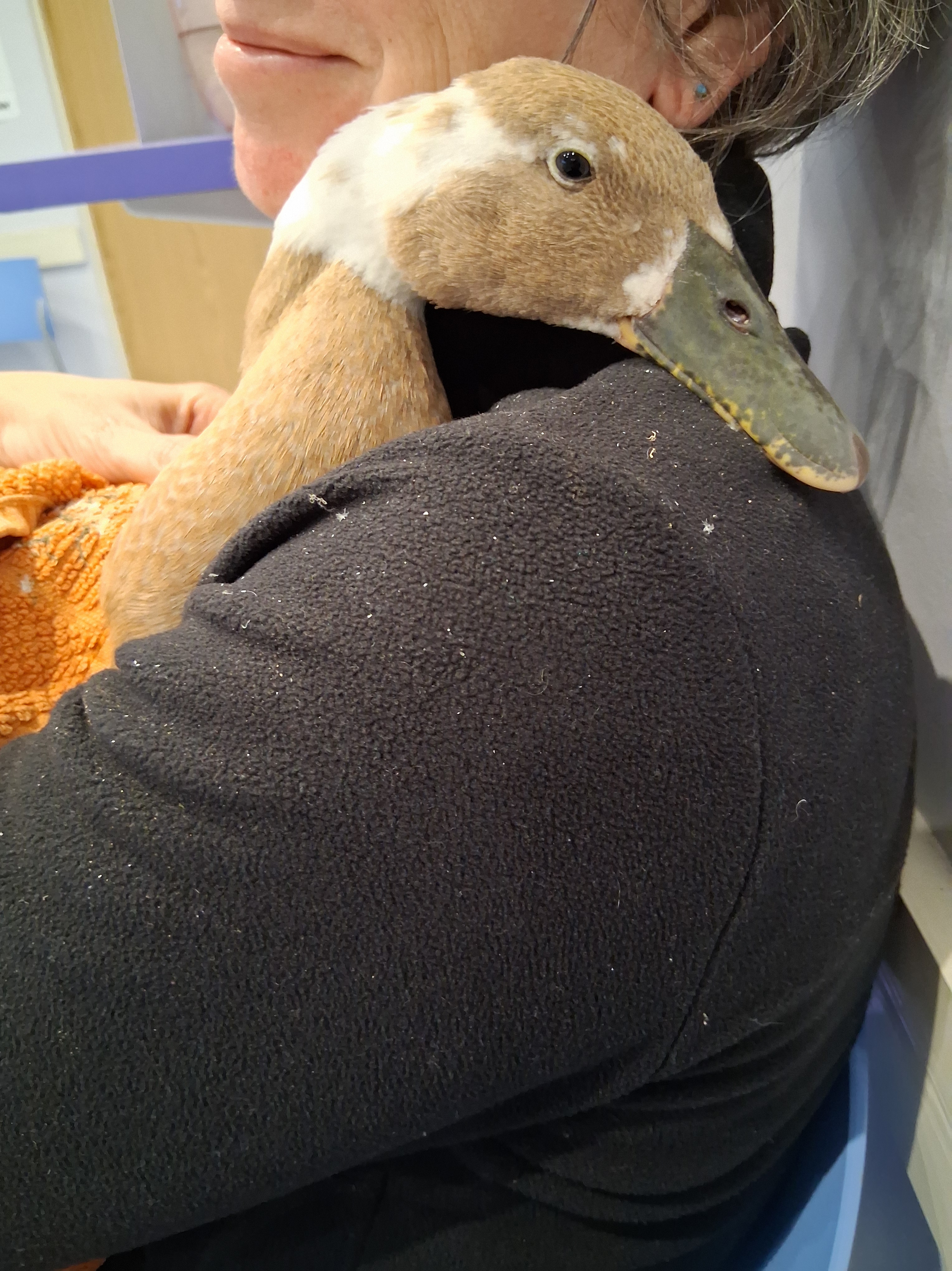
But it was also the year in which we got a pair of Indian runner ducks, Sarah Jane and Servalan, who lived in the house with us from the age of five days until their feathers came through properly six or seven weeks later, shitting everywhere and insisting on trying to stand on our shoulders to make us look like particularly crap pirates. With duck crap down their backs. (Thanks Dave and Daisy for bringing them home to us, and for unexpectedly turning them into a housewarming gift from the world’s oldest continuously operating video store.)

And it was, as that parenthesis skilfully foreshadows, the year in which we belatedly had our housewarming party.

It was also the year in which, in the same week, I got to introduce a 50th anniversary IMAX screening of The Texas Chain Saw Massacre and to meet John Sayles and Maggie Renzi (sort of). Oh, and we went to a party with Keanu Reeves (sort of, but in a different way).

Thanks to an invitation from Sarah Lohmann to speak about cinema, time-travel and sf for the Speculative Temporalities Literaturwissenschaftliches Kolloquim at ETH Zürich, we got to spend an April week in Switzerland, during which I could have died on an alp from my own stupidity and we saw, an hour later in an unrelated incident, an avalanche.

Thanks to a bunch of invitations from Jaak Tomberg (initially via David Hartley), we got to spend a May week in Estonia, mostly Tartu, where I: 

  • gave a paper on 150 climate fiction short stories at SFRA 2024: Transitions (the above-mentioned wisely abandoned project I’d backed myself into for the conference I ended up pulling out of for political reasons)
  • hosted an event with Cory Doctorow on the enshittification of the internet (for The Grand Futurological Congress literary festival)
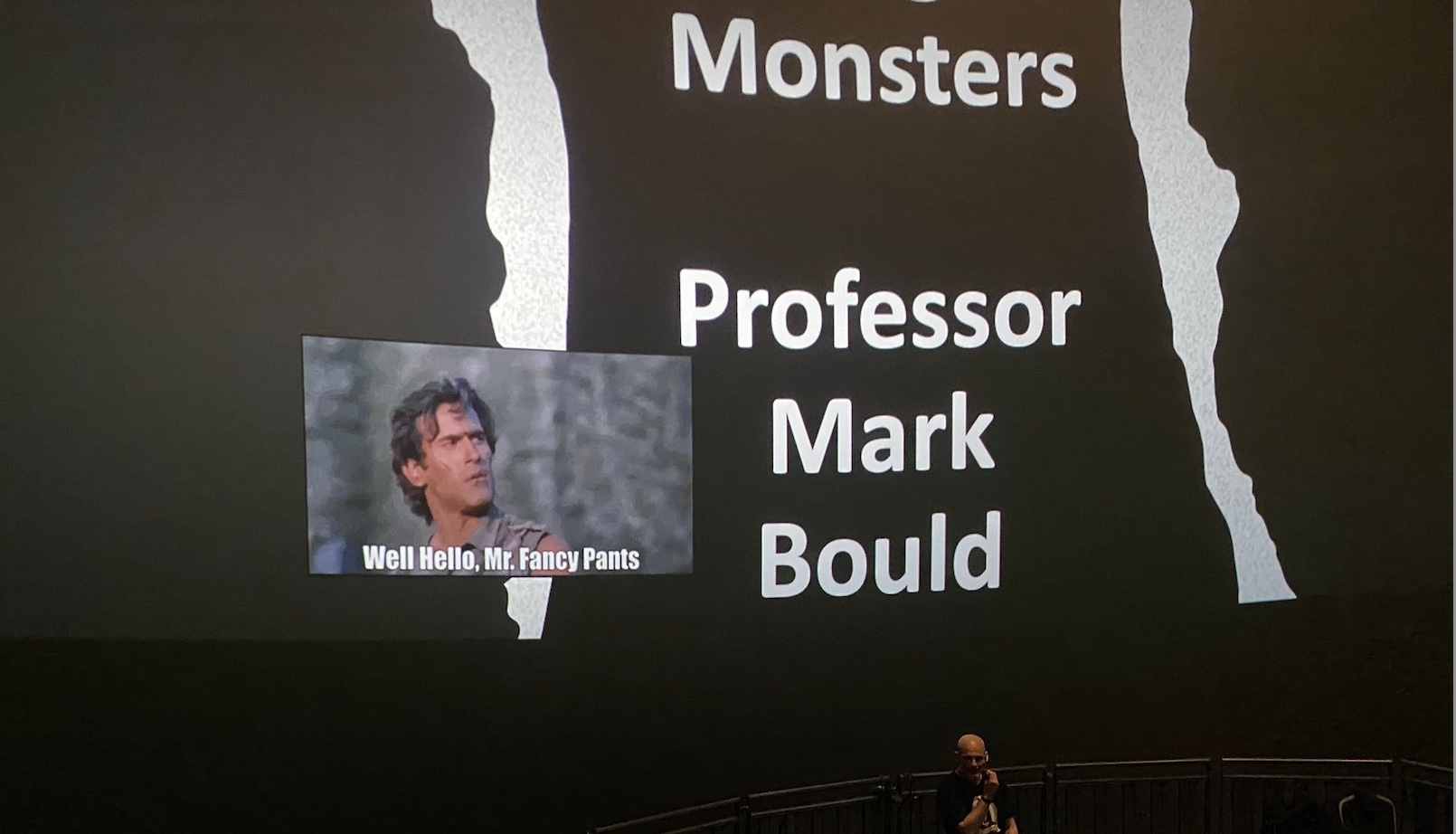
  • gave a reading from The Anthropocene Unconscious and, embarrassed by quite how long I’ve been dining out on that book (whether counted from the 2016 Cardiff keynote where I first started talking about the Anthropocene or the 2018 Liverpool keynote where I first presented a version of the book’s key idea to a room full of people), also read the first three paragraphs, written that morning, hopefully my next book, Climate Monsters (for Translation Agency, the guerilla programming running alongside the literature festival)
  • was interviewed, along with Amy Cutler and David M. Higgins by the Estonian equivalent of the BBC (at least, that’s how it was described to me)

And thanks to María Abizanda Cardona, I spent a couple of October hours in Spain (sadly only virtually) in conversation with the Association for American Studies/ Sociedad española para el estudio de los Estados Unidos de América Young Scholars Reading Group at the University of Zaragoza.

Late 2023 and early 2024 were taken up with line-editing, copy-editing and proof-reading a pair of edited volumes with old friends, both of which were then published within a couple of months, which is freakily swift and rather disorienting for academic publishing:

I suspect the latter is the last book I will ever do with a for-profit academic press – Routledge have always been okay to work with apart from the outrageous exploitation of authors/editors and the sometime shoddy subcontracting of production work, but I’m just so fed up and disgusted with the whole sector’s naked profiteering and increasingly obvious lack of interest in the content of what they publish. So I’m kinda done with that, I guess.

I also

  • wrote my first ever introduction to a graphic novel, the English translation of Kateřina Čupová’s adaptation R.U.R.: The Karel Čapek Classic (Rosarium 2024)
  • published a review of ‘Steven Rawle, Transnational Kaiju: Exploitation, Globalisation and Cult Monster Movies’, Transnational Screens 15.1 (2024): 118–119
  • drafted a chapter on contemporary dystopian cinema, with which I remain deeply dissatisfied but hopeful that my editor and fellow contributors can help me figure out why it doesn’t work – and how to fix it
  • examined Tom Andrews’s PhD, Climate Change in Anthropo-Temporal Quasi-Fantasy and New Weird Fiction (Anglia Ruskin University 2024).

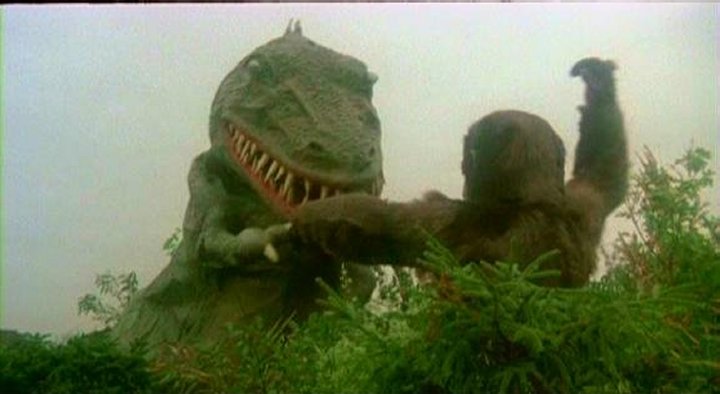
I have also been a guest on three Every Single Sci-Fi Film Ever podcasts – on King Kong, Flash Gordon and The Creature from the Black Lagoon – and am currently sidling up to doing prep for a different podcast series to talk about Solaris and for my first ever DVD extra, where I will be talking about…oh, wait, I’m not supposed to tell anyone about that yet…

On 17 May, I introduced Georgiy Daneliya’s bonkers Kin-dza-dza! for Forbidden Worlds festival at Bristol Megascreen, and on 21 July Tobe Hooper’s The Texas Chain Saw Massacre at Dale and Tucker vs. The Texas Chain Saw Massacre: A Double Bill of Hicksploitation Classics for Horror Without End/Forbidden Worlds at Bristol Megascreen (21 July) – and just four days later (25 July) I finally met John Sayles. Sort of.

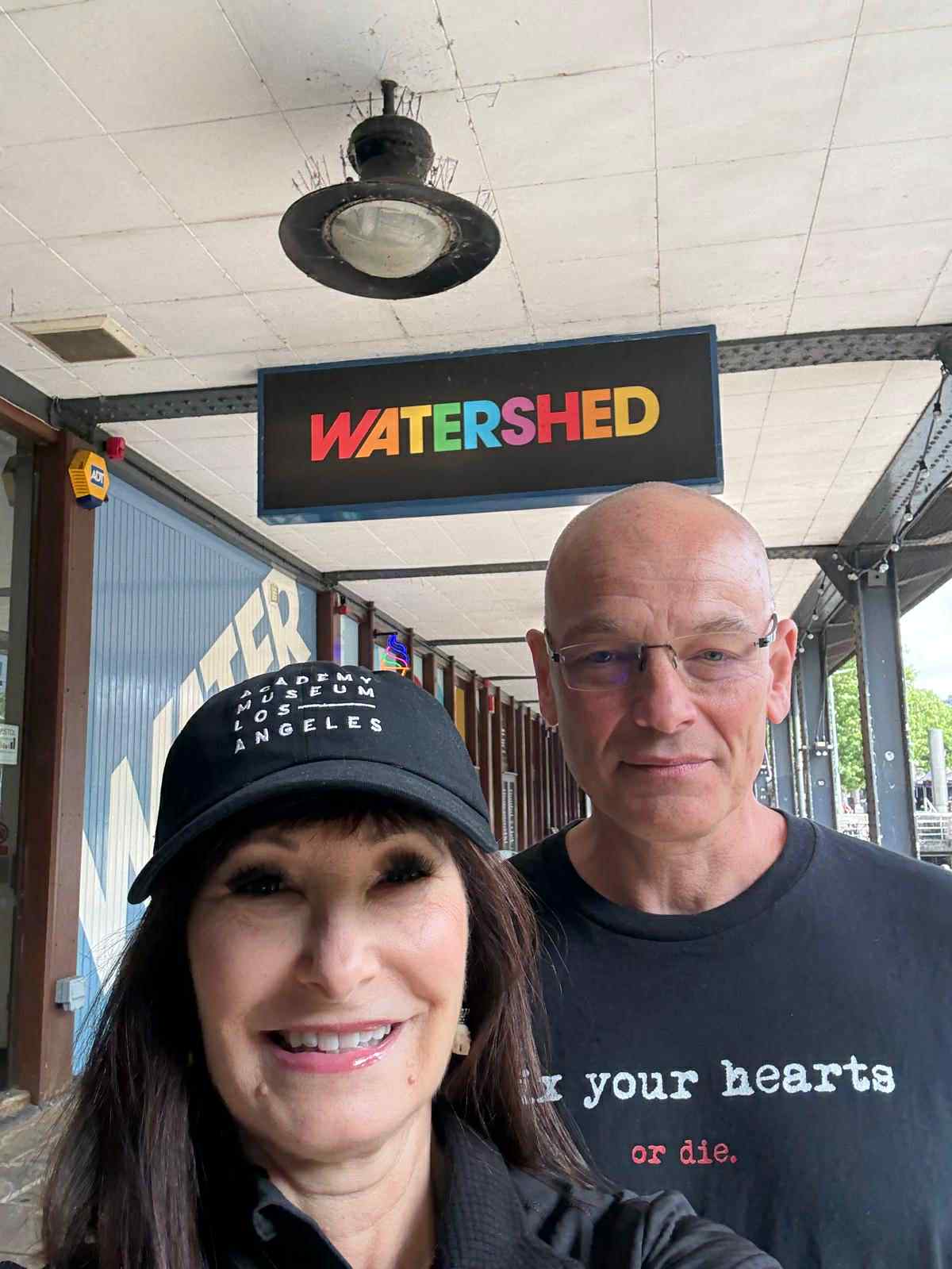
I was supposed to meet him back in the late 2000s for a TV thing back when I was writing The Cinema of John Sayles: Lone Star but that fell through. And then I was supposed to do a live on-stage event with him for the UK premiere of the 4K restoration of Matewan, but Covid hit and he caught it and the festival was cancelled for lockdown anyway. But now finally, albeit via Zoom, I was going to interview him and Maggie Renzi for 15 minutes at the Cinema Rediscovered festival at the Watershed directly before the UK premiere of the 4K restoration of Lone Star (the first of his films I actually saw in a cinema, back in 1996).

So I’m sat there, at the front of an absolutely packed cinema, with half a minute to go, when the tech guy comes down for one final check of my mic, and says ‘You know he’s still not there, but Maggie’s happy to go ahead with it anyway’.

Reader, this was the first I’d heard of John’s absence. Apparently, he was out playing basketball (he’s 73!) but was on his way back and would join us – and no sooner than I’d been told this than it was time to begin.

Fortunately, I’m so fucking woke I’d already planned for my first question to be for Maggie. Who was beyond fabulous. And we had fifteen minutes of fun. The crowd loved it. And then sadly it was time to wrap up.

And I was just about to say “Sadly, it’s time to wrap up” when suddenly John appears in the background in a basketball shirt and the kind of tiny tiny shorts you see him wearing in photos back in the 1970s and 1980s, prompting some discussion later as to whether he was actually wearing any. I’ve checked the footage: he was, but it was all a bit Basic Instinct, especially when – 16 minutes into a 15 minute interview – he Will Rikered over the back of the chair next to Maggie. There was just time to ask one question: while you’re still obviously active as a writer, it’s been 11 years since Go For Sisters, so is there ever going to be another John Sayles movie?

Which is when, at Maggie’s prompting, he told us about the western they hope to start filming in February. Based on a pulp story from the 1920s (presumably unearthed while researching his new novel, To Save the Man, due out next month). Shot on Leone’s old sets in Spain. With Chris Cooper. All they needed was a saleable name to play the younger cowboy and the money would fall into place…

I have now read all the great writers!

Or, more accurately, I have now read the last 22 titles in the Marshall Cavendish 54-installment Great Writers partwork that I bought, but did not read, religiously every week for a year in the mid/late 1980s, and which I blogged about last year.

And since those blogs were really about transclass identity and cultural capital, what better way to report my findings than star ratings!

In ascending order:

☆☆☆☆☆☆☆☆☆☆
Evelyn Waugh, Vile Bodies

★☆☆☆☆☆☆☆☆☆
Charles Dickens, A Tale of Two Cities
Walter Scott, Ivanhoe 

★★☆☆☆☆☆☆☆☆
H.E. Bates, Love for Lydia
W Somerset Maugham, Of Human Bondage

★★★☆☆☆☆☆☆☆
Louisa May Alcott, Little Women

★★★★☆☆☆☆☆☆
Elizabeth Gaskell, Cranford
DH Lawrence, The Virgin and the Gypsy, and Other Stories
William Makepeace Thackeray, Vanity Fair 

★★★★★☆☆☆☆☆
Samuel Butler, The Way of All Flesh
Graham Greene, The Comedians 
EM Forster, A Passage to India 
Henry James, The Portrait of a Lady 
Anthony Trollope, Barchester Towers

★★★★★★☆☆☆☆
Anthology of Fear: 20 Haunting Stories for Winter Nights

★★★★★★★☆☆☆
George Eliot, The Mill on the Floss 
Robert Graves, I, Claudius 
Ernest Hemingway, For Whom the Bell Tolls

★★★★★★★★
Joseph Conrad, Lord Jim 
Wilkie Collins, The Woman in White
John Galsworthy, The Forsyte Saga 
John Steinbeck, The Grapes of Wrath

I will not be taking any questions at this time.

Beyond the Canon, part two

Last year, I was one of 839 people who contributed lists of 100 ‘great’ films not nominated by anyone at all in the latest BFI/Sight and Sound decadal poll.

Today, the result are out.

I am of course mortified to discover that only twenty of my choices went unnamed by any of those other 838 respondents

Furthermore, my taste has become so mainstream and debased that a further 27 made it onto the A-list, and that my other 53 selections were mentioned 181 times by others in (that’s 3.4 times each).

How vulgar and commonplace I’ve become!

My orphan films
Movie Crazy (Clyde Bruckman 1932)
First A Girl (Victor Saville 1935)
The Invisible Ray (Lambert Hillyer 1935)
The Mad Miss Manton (Leigh Jason 1938)
The Wind-of-Youth Group Crosses the Mountain Pass (Seijun Suzuki 1961)
Bushman (David Schickele 1971)
Hapkido (Feng Huang 1972)
Death Line aka Raw Meat (Gary Sherman 1972)
Way of the Dragon (Bruce Lee 1972)
The Soul of N***** Charley (Larry G Spangler 1973)
The Terminal Man (Mike Hodges 1974)
The Trial of Billy Jack (Tom Laughlin 1974)
Queen Kong (Frank Agrama 1976)
Diggstown aka Midnight Sting (Michael Ritchie 1992)
Fish Story (Yoshihiro Nakamura 2009)
Animal Factory (Steve Buscemi 2000)
The Last Winter (Larry Fessenden 2006)
Crumbs (Miguel Llansó 2015)
Rams (Grímur Hákonarson 2015)
Keanu (Peter Atencio 2016)

My A-list films (with total number of mentions)
The Thief of Bagdad (Raoul Walsh 1924) 12
The Italian Straw Hat (René Clair 1928) 8
Storm Over Asia (Vsevolod Pudovkin 1928) 8
Under the Roofs of Paris (René Clair 1930) 7
Emil and the Detectives (Gerhard Lamprecht 1931) 4
Le Million (René Clair 1931) 22
La kermesse héroïque (Jacques Feyder 1935) 7
The Million Ryo Pot (Sadao Yamanaka 1935) 22
Murder, My Sweet (Edward Dmytryk 1944) 13
Death of a Cyclist (Juan Antonio Bardem 1955) 15
Rififi (Jules Dassin 1955) 75
The Deadly Invention (Karel Zeman 1958) 9
Plein Soleil (René Clément 1960) 34
The Face of Another (Hiroshi Teshigahara 1966) 29
The Dirty Dozen (Robert Aldrich 1967) 10
God Told Me To (Larry Cohen 1976) 11
Violent Cop (Takeshi Kitano 1989) 10
King of New York (Abel Ferrara 1990) 33
Matinee (Joe Dante 1993) 23
True Romance (Tony Scott 1993) 21
Tears of the Black Tiger (Wisit Sasanatieng 2000) 6
Lagaan (Ashutosh Gowariker 2001) 12
Primer (Shane Carruth 2004) 22
My Winnipeg (Guy Maddin 2007) 50
The Raid (Gareth Evans 2011) 12
The Neon Demon (Nicolas Winding Refn 2016) 20
Shin Godzilla (Hideaki Anno and Shinji Higuchi 2016) 18

My non-orphan, non-A-list films (with total number of mentions (including mine))
The Black Pirate (Albert Parker 1926) 3
The Emperor Jones (Dudley Murphy 1933) 2
Captain Blood (Michael Curtiz 1935) 5
The Talk of the Town (George Stevens 1942) 4
Crossfire (Edward Dmytryk 1947) 7
The Big Knife (Robert Aldrich 1955) 4
Bloody Spear at Mount Fuji (Tomu Uchida 1955) 3
Ilya Muromets (Aleksandr Ptushko 1956) 3
The League of Gentlemen (Basil Dearden 1960) 2
The Damned (Joseph Losey 1962) 7
Pitfall (Hiroshi Teshigahara 1962) 9
It Happened Here (Kevin Brownlow and Andrew Mollo 1964) 2
How to Steal a Million (William Wyler 1966) 5
Support Your Local Sheriff (Burt Kennedy 1969) 3
Bone (Larry Cohen 1972) 5
The Longest Yard aka The Mean Machine (Robert Aldrich 1974) 6
Long Weekend (Colin Eggleston 1978) 7
Bush Mama (Haile Gerima 1979) 10
Flash Gordon (Mike Hodges 1980) 6
The Quiet Earth (Geoff Murphy 1985) 6
Celia (Ann Turner 1989) 8
Roadkill (Bruce McDonald 1989) 3
Highway 61 (Bruce McDonald 1991) 2
Suture (Scott McGehee and David Siegel 1993) 4
Three Kings (David O. Russell 1999) 9
Little Otik (Jan Svankmajer 2000) 7
The Grudge aka Ju-on 3 (Takashi Shimizu 2002) 5
A Snake of June (Shinya Tsukamoto 2002) 9
Blind Shaft (Yang Li 2003) 6
Big Man Japan (Hitoshi Matsumoto 2007) 3
The Brothers Bloom (Rian Johnson 2008) 2
Frozen River (Courtney Hunt 2008) 3
JCVD (Mabrouk El Mechri 2008) 3
The House of the Devil (Ti West 2009) 6
Stingray Sam (Cory McAbee 2009) 2
Valhalla Rising (Nicolas Winding Refn 2009) 8
Las Acacias (Pablo Giorgelli 2011) 2
Two Years at Sea (Ben Rivers 2011) 2
The Angel’s Share (Ken Loach 2012) 3
Beasts of the Southern Wild (Benh Zeitlin 2012) 12
Dead Slow Ahead (Mauro Herce 2015) 3
Men & Chicken (Anders Thomas Jensen 2015) 2
Mustang (Deniz Gamze Ergüven 2015) 6
Creepy (Kiyoshi Kurosawa 2016) 5
The Nothing Factory (Pedro Pinho 2017) 2
Blindspotting (Carlos López Estrada 2018) 4
Mandy (Panos Cosmatos 2018) 9
Bait (Mark Jenkin 2019) 6
Possessor (Brandon Cronenberg 2020) 7
Earwig (Lucille Hadzihalilovic 2021) 2
Summer of Soul (Questlove 2021) 9
Judas and the Black Messiah (Shaka King 2021) 5
Enys Men (Mark Jenkin 2022) 4

Socialism or Barbara-ism

so while watching Barbara Loder’s materialist-feminist road movie Wanda (1970) last night, I came up with the idea for a new module, Socialism or Barbara-ism: The Cinematic Critique of Capitalist Patriarchy, focusing on:
Barbara Bach in The Spy Who Loved Me (Gilbert 1977)
Barbara Bel Geddes in Caught (Ophuls 1949) and Vertigo (Hitchcock 1958)
Barbara Carrera in Embryo (Nelson 1976),
Barbara Eden in The Feminist and the Fuzz (Paris 1971)
Barbara Flynn in A Very Peculiar Practice (1986–88)
Barbara Hershey in Boxcar Bertha (Scorsese 1972)
Barbara Kopple’s Harlan County, USA (1976)
Barbara Loden in Barbara Loden’s Wanda (1970)
Barbara Stanwyck in Baby Face (Green 1933), Double Indemnity (Wilder 1944) and Cattle Queen of Montana (Dwan 1954)
Barbara Steele in Shivers (Cronenberg 1975)
Barb(a)ra Streisand in The Way We Were (Pollack 1973)
Barbara Windsor in Carry On Girls (Thomas 1973) and Comrades (Douglas 1986)
oh, and Barbara Bain in Commander Xenophobe and His Rogue Moon (1975–77)
plus
Barbie (Gerwig 2023)
Barbara (Petzold 2012)
Bubbara Ho-Tep (Coscarelli 2002)
Barb Wire (Hogan 1996)
Barbara-ian Queen (Olivera 1985)
Barbaraella (Vadim 1968)
Nights of Carbarbara (Fellini 1957)
Major Barbara (Pascal, French and Lean 1941)
The Winning of Barbara Worth (King 1926)
and Barbaraship Potemkin (Eisenstein 1925)

Drafting an essay on contemporary dystopian cinema 3: Antebellum (Gerard Bush and Christopher Renz 2020)

Drafting an essay on contemporary dystopian cinema 2: Don’t Worry Darling (Wilde 2022) with some Barbie (Gerwig 2023)

To be honest, I thought I was going to have a lot more to say about this film, but it seemed even thinner on a rewatch, and I’m not at all sure I’ve managed to satisfactorily express the difficult-to-express point I wanted to make. But here goes, anyway…

Antebellum (Gerard Bush and Christopher Renz 2020), set on a slave plantation during the Civil War, opens with a long tracking shot that culminates in the beating of a captured runaway and the fatal shooting of another. For the next half hour, the often poorly-scripted film wallows in images ‘enact[ing] black suffering for a shocked and titillated audience’,[1] but with little of the insidious visual artistry of the always picturesque and thus superficially more palatable 12 Years A Slave (Steve McQueen 2013). (That said, it does contain three striking shots: the long opening tracking shot through the plantation; the final shot of the abduction sequence as the other Uber carrying Veronica’s friends passes and turns away; the closing slow-motion shots of an axe-wielding Eden, riding on horseback through Confederate lines.)

As with Don’t Worry Darling and Barbie, something is clearly amiss in this fictional world. Is it just budgetary constraints that make the cotton field so small, the slaves’ labour in it so unhurried? Why are the slaves forbidden to speak? Did Confederate soldiers really run ‘reform’ plantations, or chant about ‘blood and soil’?

The illusion of this world breaks definitively when Him (Eric Lange), the confederate officer who repeatedly rapes Eden (Janelle Monáe), receives a call on his hitherto concealed cell phone.

Is this an alternate history, like CSA: The Confederate States of America (Willmott 2004)?

A time-travel story, like Sankofa (Gerima 1993) or Octavia Butler’s Kindred (1979)?

Spoiler alert: no.

The middle section of the film follows celebrity scholar–activist Veronica (Janelle Monáe). Away from home promoting her latest book, she is abducted by white supremacists and transported to the plantation from the opening section of the film – which exists in the present, adjacent to a Civil War theme park and battle re-enactment site, owned by Senator Denton (Eric Lange). There, carefully targeted and abducted Black people are forced into the role of slaves, so white supremacists can play at being Confederate soldiers and, unhindered, visit racist and sexual violence upon them.

In the final section of the film, Eden/Veronica orchestrates her escape, taking murderous revenge on her captors and bringing in police and FBI to shut the place down.

Often clumsy, Antebellum attempts to address the way America’s racial history continues to play out in the present. Perhaps its sole innovation, whether intentional or not, is in the first section to position the audience to sympathise with the slave characters, but then in the second section to depict Veronica, and her friend Dawn (Gaborey Sidibe), as (at least potentially) really irritating characters.

Veronica’s relentlessly bourgeois life – fabulous fashion, sentimental motherhood – helps to normalise the image of Black people being wealthy and middle class, something with which microaggressive minor white characters – a concierge, a waitress – are disgruntled. But it also really drives home how her avowed Black intersectional feminism, which consists of shallow clichés and therapeutic affirmations, has a major blind spot: she mentions ‘class, race and gender’ but (surprise!) class is completely absent from anything she says or does.

Dawn is self-consciously loud, quick to express appetite and desire and – in contrast to Veronica – to put down microaggressions. But she sails awfully close to the stereotype of a pushy Black woman.

The two women’s different kinds of outspoken-ness (or perhaps merely spoken-ness) is clearly intended to contrast with the silence and (performance of) subservience forced upon the ‘slaves’ in the face of macro-aggressions.

Some audiences will rejoice in the depiction of such strong Black women; others will accept them as comic exaggerations intended to drive home the film’s admittedly unsubtle point. And, of course, while it is not incumbent on filmmakers to present uncomplicatedly positive images of Black women, other audiences will find Veronica and Dawn considerably less sympathetic than Eden and the other the slave characters.

It is for this last group that the film presents the greatest challenge: it does not matter what Veronica and Dawn are like, it does not matter whether you sympathise/identify with them or not. Nothing can validate this slavery re-enactment or, more importantly, slavery itself and its ongoing legacies.

But in that uncertain zone of (potential) irritation, one must face up to the possibility/extent that one’s negative response to these Black middle class women is in some way structured by racism and sexism.


[1] Weheliye, Alexander G. Habeas Viscus: Racializing Assemblages, Biopolitics, and Black Feminist Theories of the Human. Duke UP, 2014. 90

Drafting an essay on contemporary dystopian cinema 2: Don’t Worry Darling (Wilde 2022) with some Barbie (Gerwig 2023)

Drafting an essay on contemporary dystopian cinema 1: 65 (Beck and Woods 2023)

The sense of relative privilege is perhaps nowhere clearer than in contemporary retrotopian tendencies, since such evocations of mythical pasts as models of utopian futures hinge upon hierarchical differences of class, race and gender. Zygmunt Bauman[1] identifies four interwoven tendencies in contemporary real-world politics which offer some kind of utopian sensation by focusing on (1) tribalism, which can mediate between the individual and wider forces in a world imagined as a (2) Hobbesian war of all against all while also offering some kind of (3) return-to-the-womb consolation, even if it means (4) perpetuating, reinforcing and increasing existing inequalities.

Don’t Worry Darling (Olivia Wilde 2022) appears initially to be set in the Victory Project, a wealthy 1950s American suburb, moderately and monogamously debauched, given over to libidinal–consumerist pleasures and rigid gender roles.

Something is clearly amiss, though. The world is too brightly lit, the colours too vibrant, to be true. The houses are show-home immaculate; every surface gleams or invites sensuous tactility. The women are too content as housewives, and their husbands too prompt to initiate and perform expert cunnilingus. There is no trace of discontent, of restriction, of suffocation. It is as if Betty Friedan never existed, as if the feminine mystique were true.

Also, the setting is (slightly) more ethnically diverse than it would actually have been, with suburbanites of Asian, African American and Jewish descent in supporting and background roles.

It is the dream image of the white suburban 1950s – that ‘emblem of happier times, when family values and small-town American were concrete manifestations of the triumph of capitalism and the “end of ideology”’ – but adjusted to take some account of the period’s ‘repressed [racial, patriarchal and sexual, but never class] realities’[2] and of more contemporary blandly middle-of-the-road liberal sensibilities.

In this way, Don’t Worry Darling ‘calcifies the current state of affairs in America and presents it as a future that we should be excited for’, as Clark Seanor writes of Becky Chambers’s Wayfarers series of novels (2014–21), and it is not alone in doing so. For example, Barbie (Greta Gerwig 2023) surrounds stereotypical Barbie (Margot Robbie) with ethnically diverse, albeit mostly light-skinned, Barbies and signals a queer presence in the-sexless-because-they-have-no-genitals Barbieland through Weird Barbie (Kate McKinnon) and Allan (Michael Cera); the Kens are similarly diverse.

Moreover, Barbie is careful to put the key speech about ‘the cognitive dissonance required to be a woman under the patriarchy’ into the mouth of Gloria, played by America Ferrara, a Honduran American with Indigenous (Lenca) ancestry. Powerful and affecting as her delivery is, the speech is cast in terms so broad and vague as to seem inclusive, but really just (once more) presents white bourgeois liberal feminist plaints as if they are universal. There is no sense of women’s differential material experiences of patriarchal (and other intersecting) systems of oppression. Gloria’s daughter Sasha (Ariana Greenblatt) is right to dub stereotypical Barbie ‘white saviour Barbie’, even if she demurs in favour of Sasha’s mother who just delivered the speech and thus found a way to deprogram the other Barbies, who’ve been brainwashed into subservience through the Kens’ plot to institute patriarchy in Barbieland (‘It’s like I’ve been in a dream where I was really invested in the Zack Snyder cut of Justice League’).

Just as Barbie begins to realise something is rotten in the state of Barbieland when she wakes up tired and headachey with bad breath and ‘irrepressible thoughts of death’, to a cold shower, a burnt waffle, milk that’s gone off, gravity, flat feet and traces of cellulite, so Alice (Florence Pugh), the protagonist of Don’t Worry Darling, begins to experience glitches in the Matrix. There are flashes of traumatic images within the glossy Victory Project and from the desert outside; brief moments of anamnesis, coded through lighting, colour and design to suggest some other locale, but always in close-ups that to deny Alice (and the viewer) sufficient information to make sense of them; and black-and-white glimpses of corseted dancers, choreographed in some eerie Busby Berkeley-style reduction of women to interchangeable elements in a machine. Moments of crisis end unresolved, with Alice waking up later and elsewhere, not knowing how she got there and uncertain about the reality of what she witnessed. When she is distracted by a stubborn speck of dirt on the window she is cleaning, the wall behind glides forward to crush her against the glass; and in the film’s most Phildickian moment, she opens a box of eggs only to discover that each one is just an empty shell.

She is, of course, in a virtual world.

In real reality, Alice is an overworked surgeon, even more exhausted than usual from having to take on additional shifts since her husband lost his job. Jack (Harry Styles) whines about how Alice, who is constantly working, neglects him and their relationship, and has no luck finding employment – but he is drawn to the ‘philosophy’ of Frank (Chris Pine), an online tech-millionaire guru partly based on Jordan Peterson. Without Alice’s knowledge or consent, he signs them up to the real Victory Project, which inserts them both into the virtual world and suppresses her memories and identity to prevent her from realising the truth. In exchange, when Jack and the other husbands head off to their top-secret engineering work every day, they actually exit the virtual world for jobs in the real work that pay enough to sustain their illusory existence (the details of this are unclear, but it looks a lot like the indentured servitude Elon Musk seems to have in mind for his Martian colonists).

In the virtual world, variations in costume design and the mid-century modern architecture and décor emphasise, although less overtly than the wryly synchronised departure of husbands for work each morning, superficial differences within uniformity. This can probably be extended to variations in ethnicity, body shape and so on; like Barbie, Don’t Worry Darling often seems to intersectionality-wash cherry-picked elements of second-wave and post-feminist liberal feminisms; like Barbie, it possesses no actual vision.

This is not, however, to dismiss the significance of these movies, whether they flop (Don’t Worry Darling took $87.6 million off a $35 million budget) or are global blockbusters (Barbie took $.144 billion off a $145 million budget, the biggest domestic, foreign and worldwide box-office of the year). The outraged responses to such films indicate the extent to which the anti-feminist backlash, often tied to ethnonationalism, is entrenched in mainstream political and alt-victimhood[3] discourses, and thus the extent to which even such modest acts of liberal feminism (Alice is often barefoot, her friend Peg (Kate Berlant) continually pregnant) and anti-racism are necessary portals to a better world.

Drafting an essay on contemporary dystopian cinema 3: Antebellum (Gerard Bush and Christopher Renz 2020)


[1] In his rather mediocre Retrotopia. John Wiley, 2017.

[2] Peter Fitting, writing about Pleasantville (Gary Ross 1998) in ‘Unmasking the Real? Critique and Utopia in Recent SF Film’. Dark Horizons: Science Fiction and the Utopian Imagination. Ed. Raffaella Baccolini and Tom Moylan, Routledge, 2003. 155–166. 163.

[3] See David M. Higgins’s rather good book, Reverse Colonization: Science Fiction, Imperial Fantasy and Alt-Victimhood. University of Iowa Press, 2021.

The absurd reading challenge(s) of 2024

Last year, I challenged myself to read (alongside whatever else) a very specific 12.427kg or (I think) 33908.807cm3 of books – i.e., twelve absurdly outsized volumes, of which I will now concede the physical dimensions of Tale of Genji and Vollmann’s Imperial were not necessarily disproportionate. (Unheralded, and at the other end of the scale, I also decided to read one Clifford Simak and one John Dickson Carr per month, even though they were all sensibly scaled A-format paperbacks.)

This year, my only writing-related reading commitment is 200 contemporary short stories about climate change (eleven collections), for which I will also read three older classic anthologies.

So I feel the urge to multiply the challenges this year:

  1. Read all 20 remaining titles in the Great Writers series (which I blogged about quite a bit last month, beginning here)

2. Read more of the trilogies/series that are languishing in all these boxes, still unpacked fifteen months after moving house: Ford Madox Ford’s Parade’s End tetralogy (1924–26 ); Arturo Barea’s The Forging of a Rebel trilogy (1941–46); Michael Moorcock’s Pyat Quartet (1981–2006); Madison Smarrt Bell’s Haiti trilogy (1995–2004), of which I have the first two volumes; Alastair Reynolds’s Poseidon’s Children trilogy (2012–15); Malka Older’s Centennial Cycle (2016–18), of which I’ve already read and liked the first book; and B. Catling’s Vorrh trilogy (2012–18), or at least the unnecessarily large hardback edition I have of the first volume. And depending on how reading Galsworthy’s Forsyte Saga (1906–21) for 1. goes, I’ll probably read the other Forsyte trilogies: A Modern Comedy (1925–28) and End of the Chapter (1931–32).

3. I will continue to make my way through the stacks of Simak and Carr, but at a slower pace this year. Instead, I will read at the rate of slightly more than one a month, eleven Peter Van Greenaways and four Abraham Polonskys.

All of these plans are subject to change.

And probably doomed to failure.

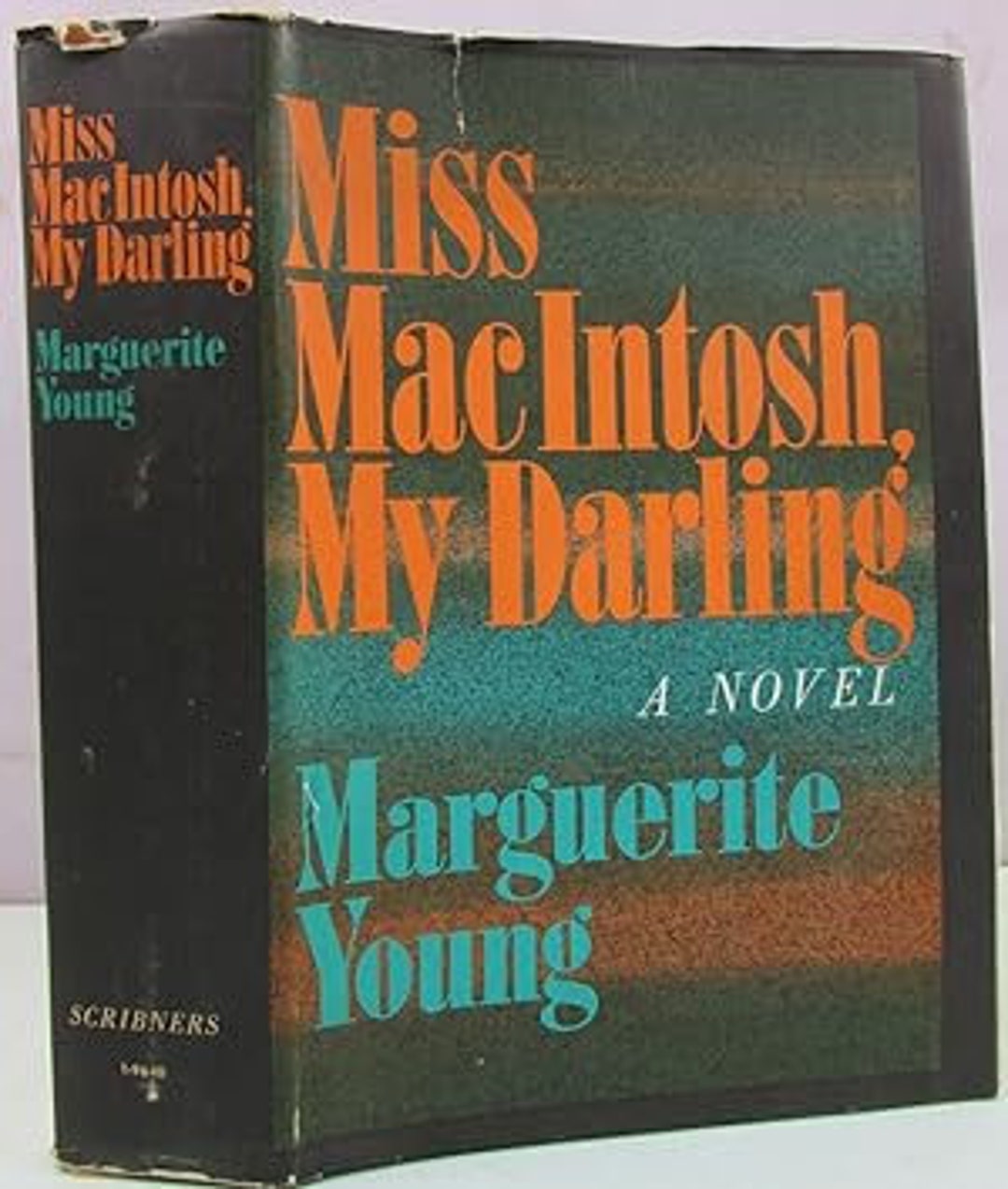
Especially when thing like this arrive in the post.