The City in Fiction and Film, week three

tumblr_l30hu35gF41qz6k9qo1_1280Week 2

One of the issues in designing a coherent new programme is working out at which level, in which module and when in that module (in relation to the other modules) to deliver certain kinds of material. When we designed the BA Film Studies twelve years ago, we decided to concentrate a lot of the film theory and critical theory in a compulsory level two (i.e., second year) module, whimsically entitled Currents in Film Theory. On the new BA Literature and Film Studies, in which students will encounter literary theory as well as film theory and critical theory, such a module seemed inappropriate, so part of our design process involved deciding what of this kind of material students needed to encounter and how best to divide it up between modules and levels.

All of which is a long way round to saying that today’s class involved an introduction to semiotics, ably supported by the first chapter of Jonathan Bignell’s Media Semiotics: An Introduction, still by far the best book of its kind – and I’m not just saying that because he used to teach me. (There will some structuralism, Marxism and feminism soon.)

By the end of the lecture, we had covered these terms/ideas from Saussure and Peirce:

Semiotics
diachronic vs. synchronic
langue and parole
the sign is arbitrary and conventional
sign = signifier + signified
the referent
syntagmatic vs. paradigmatic
symbol, icon and index
denotation and connotation

There was, as always, much exemplification through the medium of cats. (Back in the day, it was always trees, but over the last couple of decades this arboreal hegemony has fallen to a relentless feline insurgency – probably something to do with the internet and the ‘mind-control’ parasite Toxoplasma gondii.)

We’ll nail down these terms with a test at the start of class next week. A revision aid can be found here.

We looked at three texts this week – John Huston’s film of The Maltese Falcon (1941), Edgar Allan Poe’s story ‘The Man of the Crowd’ (1940) and Virginia Woolf’s essay ‘Street Haunting: A London Adventure’ (1927).

The vagaries of timetabling mean that each week the screening comes before the lecture, which is normally not a problem, but the challenge today was to come up with screening questions that are basically asking questions about semiotics without using semiotic terminology. Such as:

What kind of man is Sam Spade (Humphrey Bogart)? How do we know these things about him? How does he differ from Miles Archer (Jerome Cowan)?
How do we know Joel Cairo (Peter Lorre) is gay?
How do we know Kasper Gutman (Sidney Greenstreet) cannot be trusted? Is he also gay? Is Wilmer (Elisha Cook Jr) his lover?
How many roles does Brigid O’Shaughnessy (Mary Astor) play? How does she imply these differences?
How does Brigid differ from Iva Archer (Gladys George)? How do they both differ from Effie Perrine (Lee Patrick)?
How do we tell Lt. Detective Dundy (Barton McLane) and Detective Polhaus (Ward Bond) apart? In what ways does Polhaus resemble Sam Spade? In what ways does he resemble Dundy?

Although we did not get to work through all these questions in detail, it became very clear very quickly how much information is conveyed by costume and manner. We were obviously in the realm of signs – of signifiers and signifieds, of denotations and connotations.

When Miles walks into the office and finds Spade interviewing Brigid, the contrasts between the two men are clear and shape our understanding of each of them in relation to the other. Spade is in a tailored suit with subtle stripes, buttoned up with a precisely knotted tie; his manner thus far has been similarly professional, slightly patronising. Miles, a taller and slightly gangly figure, wears a baggier suit, unbuttoned, his shirt and tie not as neat; he makes no effort to conceal his sexual interest in Brigid, seating himself on the edge of Spade’s desk. Archer’s desk faces the window, Spade’s the door. He lacks Spade’s composure, his air of competence; Archer’s death, then, comes as little surprise.

Joel Cairo’s card smells of gardenias. He is small and feminised, his costume dapper, his hair neatly oiled curls. He wears gloves to keep his hands soft; he fiddles nervously with his cane, constantly positioning it near his mouth, suggesting some kind of oral fixation. His accent is exotic, as are the overseas places he has visited – and his surname. It is difficult to tell how much of his ‘deviant’ persona from M, which had been a hit in the US, is carried over, but it is clear that The Maltese Falcon – like many American crime films – uses queerness to connote wrongness and villainy. Some of this is evident in the corpulent Gutman, too, with Wilmer just the latest in what appears to be a succession of young men he picks up to work as his henchmen (and catamites?). However, there is an intriguing countercurrent at work. Perhaps it is the appeal of the exotic, perhaps just the brilliant performances of Lorre and Greenstreet, but neither character is particularly loathsome – and both in various ways are quite likeable.

We also noted the importance of transience and anonymity again in the representation of the city: Brigid goes by three names and at least that many personas; no-one knows their neighbours or lives in a discernible community; the closest thing to a friendship we see is between Spade and Effie (boss and employee).

Walter Benjamin says that Poe’s ‘A Man of the Crowd’

is something like an X-ray of a detective story. It does away with all the drapery that a crime represents. Only the armature remains: the pursuer, the crowd, and an unknown man who manages to walk through London in such a way that he always remains in the middle of the crowd.

We began with the moment in which the narrator first spots this mysterious man – whose appearance is a parole (speech-act) which the narrator struggles to filter through the available langue (sign system):

As I endeavoured, during the brief minute of my original survey, to form some analysis of the meaning conveyed, there arose confusedly and paradoxically within my mind, the ideas of vast mental powers, of caution, of penuriousness, of avarice, of coolness, of malice, of blood-thirstiness, of triumph, of merriment, of excessive terror, of intense–of supreme despair.

And then we took a step back to the start of the story, in which the narrator describes looking out at the crowd on a London street, abstracting himself from it, presenting himself as some kind of disembodied neutral observer, who fantasises about his ability to see without being seen. For two pages, he divides the crowd into distinct groups, and distinguishes between them by their costume, demeanour and behaviour, producing a catalogue of types, descending from the respectable professional classes down through clerks and swells, gamblers and pickpockets, prostitutes and drunks. The narrator reads the character of these people from their appearance; and the author persuades us of its accuracy and truthfulness through his careful selection of signs (words) for their denotative and, perhaps more importantly, connotative powers. No wonder, then, that ‘the man of the crowd’ comes as a shock, an epistemological limit that might undermine the certainty with which the narrator has described everyone else.

We also had a think about the following:

How does the story express the anonymity of life in the city?
How does it contrast day/night, different districts, different social or economic classes?
Who is the man the narrator follows?
What does the ending mean?

Virginia Woolf’s essay does some similar things. We thought about the connotations of the place names she includes:

the area between Holborn and the Strand
Oxford Street
Mayfair
Brixton
Waterloo Bridge
Barnes
Surbiton

Some of them retain similar connotations; others, such as ‘Brixton’, which then evoked a middle class suburb with green spaces, connotes something very different now. (Next semester we will look at some Windrush era and post-Windrush representations of London.)

Woolf begins by talking about the very personal connotations of items in one’s own room, where

we sit surrounded by objects which perpetually express the oddity of our own temperaments and enforce the memories of our own experience.

But there is an important slippage between this investment of personal meanings in a bowl or a stain on the carpet, and the connotations for readers. For the narrator, the bowl recalls the holiday in Mantua where is was purchased. For the reader, the buyer’s fond memory of the woman who sold it reeks of English class condescension, and the bowl connotes wealth, because who but the well-off could afford to spend a summer in Italy?

There is a curious passage also when the narrator visits a shoe store. A female dwarf, accompanied by two regular-sized women, reveals her perfect, full-sized, ‘arched and aristocratic’ foot. Its revelation alters her demeanour, and thus that of the people in the store. At the same time, the narrator is infected by the fantastical imagery of dwarves and giants (the regular-sized companions), and this spills over into her phantasmagorical description of the often-foreign working class denizens of the area around Seven Dials and Covent Garden. It is as if she cannot bring herself to directly describe this area and the people there. And, like Poe’s narrator, Woolf’s narrator is suddenly shocked by the appearance of a stereotypical Jew, with all the long and terrible anti-semitic baggage that evokes.

Woolf also fantasises about seeing without being seen – she describes herself as stripping away the shell of her home and becoming like the pearl in the oyster, which promptly transmutes into a giant eye, capable of observing the surfaces of things, the plane of signification. As a consequence of which, I now imagine Virginia Woolf looks like this:

Untitled-1


I also had the opening of chapter 25, ‘A Tie With a Windsor Knot’, from Ian Fleming’s From Russia with Love (1957) to hand, but time as always was our enemy – will probably kick off next week’s class with it. (My colleague teaching the Cultural Value, Literature, Film and Consumption module will be doing some work on James Bond in the coming weeks, so it will make a nice crossover; she has been working on Sherlock Holmes this week, so I will be building on that next week.)

Recommended critical reading
Bignell, Jonathan. Media Semiotics: An Introduction. 2nd ed. Manchester: Manchester University Press, 2002.
Chandler, Daniel. Semiotics: The Basics. London: Routledge, 2002.
Monaco, James. How to Read a Film. 4th ed. Oxford: Oxford University Press, 2009. See chapter 3, “The Language of Film: Signs and Syntax.”
Stam, Robert, ed. New Vocabularies in Film Semiotics: Structuralism, Post-Structuralism and Beyond. London: Routledge, 1992. See part II, “Cine-Semiology,” on how semiotics was developed in relation to film.
Turner, Graeme. Film as Social Practice. 4th ed. London: Routledge, 2006. See chapter 3, “Film Languages.”

Recommended reading
The opening and closing pages of Nikolai Gogol’s “Nevsky Prospect” (1835) capture the bustle and variety of a modern city street.
Virginia Woolf’s Mrs Dalloway (1925) repeatedly leaps from the mind of one character to another as they walk across London.
John Huston’s film is based on Dashiell Hammett’s hard-boiled crime novel, The Maltese Falcon (1929).

Recommended viewing
Women take on the role of detectives and attempt to make sense of the city, solve crimes or discover their own identities in Phantom Lady (Siodmak 1944), Desperately Seeking Susan (Seidelman 1985) and In the Cut (Campion 2003).

Week four


Afrocyberpunk 1: The enervated ghosts of Zion

In the South Atlantic Quarterly interviews most famous for coining the term ‘Afrofuturism’, Mark Dery asks Samuel Delany why, in a recent piece on William Gibson’s Neuromancer called ‘Is Cyberpunk a Good Thing or a Bad Thing?’, he did not comment on the representation of the Rastas on the Zion space station.

Dery sees them as bricoleurs offering a quite utopian potential for imagining a harmonious relationship with technology. Delany schools him on how ‘a black reader’ might respond to these marginal, withered figures, concluding

You’ll forgive me if, as a black reader, I didn’t leap up to proclaim this passing representation of a powerless and wholly non-oppositional set of black dropouts, by a Virginia-born white writer, as the coming of the black millennium in science fiction: but maybe that’s just a black thang… (751)

Delany promptly steps back from the ad hominem aspect of this to praise Gibson and Neuromancer’s achievements. And to point out that while the three pages or so devoted to Zion and its inhabitants are problematic, there are far more problematic (Heinlein’s Farnham’s Freehold) and interesting (Disch’s Camp Concentration) white authored sf novels to deal with, let alone the sf produced by black writers – himself, Octavia Butler, Steve Barnes. (He also argues that the dry-run for the Rastas – the Lo-Teks of Gibson’s ‘Johnny Mnemonic’ – are ‘Gibson’s real romantic bricoleurs: they were not specifically black, but rather “fourth world” whites’ (753).)

But there is something interesting about Gibson’s Rastas. In a globe-trotting (and cislunar-trotting) novel, they are the only black people mentioned. In a novel depicting a globalised future in which capitalism has consolidated its hold on the planet, and in which the quality of a commodity is indicated either by its make and model or by reference to its country of origin, there are no corporations or trade names of African origin, and not a single mention of Africa or any of the countries in Africa.

Those enervated orbital ghosts – brittle-boned from calcium deficiency, their hearts ‘shrunken’ from so much time in low-gravity, their Rastafarianism reduced to a Rasta lifestyle of ganja and dub, and their dub easily replicated by computers – are all that are left. A spectral remnant of yet another world-building genocide.

At least in Philip K Dick’s The Man in the High Castle, we learn in passing that the Nazis are in the closing stages of a continent-wide final solution to the ‘problem’ of Africans. It is a cold comfort, but at least he doesn’t just leave them out.

***

I am currently re-reading a bunch of cyberpunk novels, some of them for the first time in twenty years, as background for an essay I am writing this winter on Afrocyberpunk film (Les Saignantes, Bedwin Hacker, Tetra Vaal, Adicolor Yellow, Alive in Joburg, Tempbot, perhaps Crumbs if I can ever get hold of a copy, perhaps Africa Paradis).

The focus of this reading is on the representation of Africa/Africans/Afrodiaspora in cyberpunk, and cyberpunk by African and Afrodiasporic writers, and I will inflict my thoughts/notes on the world here when I can. My provisional reading list is below, though I cannot promise to get to them all. Please point out the things I’ve overlooked.  (And do we ever find out whether the Effinger novels are set in North Africa? Or are they in the Middle East? (And yes, I know they are ‘really’ set in New Orleans.))

Steven Barnes, Streetlethal (1983)
–. Gorgon Child (1989)
–. Firedance (1994)
Lauren Beukes, Moxyland (2008)
–. Zoo City (2010)
George Alec Effinger, When Gravity Fails (1987)
–. A Fire in the Sun (1989)
–. The Exile Kiss (1991)
–. Budayeen Nights (2003)
Jon Courtenay Grimwood, Pashazade (2001)
–. Effendi (2002)
–. Felaheen (2005)
Andrea Hairston, Mindscape (2006)
Anthony Joseph, The African Origins of UFOs (2009)
B Kojo Laing, Major Gentl and the Achimoto Wars (1992)
Bruce Sterling, Islands in the Net (1988)
G. Willow Wilson, Cairo (2007)
–. Alif, the Unseen (2012)
plus various stores from Afro-Sf, Lagos 2060, omenana and other collections/sites

Afrocyberpunk 2


The City in Fiction and Film, week two

really

lorrem

Week one

This week we took on Fritz Lang’s M (1931).

We began with a quotation from Anton Kaes’s BFI classic, which describes the film as embodying:

‘the tension between the forces of modernity, with their emphasis on time, discipline, rationality, seriality, law and order and those recalcitrant counterforces – trauma, passion, illness, loss and, finally, death – that defy reason and resist integration’ (76)

Our discussion of these various concepts in relation to the film was supported by a number of clues and questions presented before the screening:

Look out for clocks, files, records, book-keeping, accounts and other evidence of bureaucracy in action.
Look out for communications networks and mass media.
Look out for shop windows and other displays of commodities.
Look out for mirror images/reflections and doublings.
What is going on with the narrative structure? To what extent is this a film about the contest between a protagonist and an antagonist? To what extent is classical narrative structure subordinated to a series of images of the city connected by sound? How are those images arranged? How do they relate to each other?
Pay attention to the ways the film uses sound (offscreen sound, sound from the following shot/scene present in the current scene, unusual sources of sound, silences).
At the end of the film, is there any conclusive evidence of Hans Beckert’s (Peter Lorre) guilt?

Clocks abound in this film (and other Lang films – see the Paternoster Machine in Metropolis for example) – from the child’s game that opens the film with clock-like movement to the pickpocket who calls the talking clock and then corrects all the stolen watches he is carrying; from the cuckoo clock in Frau Beckman’s apartment that signals the time as she waits for little Elsie to return home to the clocktower bells that drown it out. They signify the imposition of clock time on our experience of the world – imposed so the trains could run on time, to organize commerce, to discipline and control labour – and the ways in which this ordering of subjectivity also disorders us.

Building on this, the police investigation evokes the instrumentalisation, rationalisation and bureaucratisation of everyday life – files kept on people, fingerprinting, forensic procedures. The police amass information and process it in an orderly manner, an image graphically captured by the concentric circles drawn on a map to indicate the expanding radii of the investigation around a crime scene. The state panopticon’s vast archives of signifiers are bureaucratic abstractions of actual people – this is, as Foucault would argue, evidence of the growing management of populations by statistics. (Though we didn’t get on to Foucault or the panopticon or biopolitics in class!)

Likewise, the gang of criminals come up with their own systematic means of finding the killer (because he is bad for business) – surveillance conducted by the army of beggars in the street; and then, when Beckert is trapped in the factory/office building, despatching teams of men to work through it in an orderly manner.

This parallel between the police/administration and the criminals/beggars has already been indicated by the sequence which repeatedly cuts between them, in their respective smoke-filled rooms, as they plan their respective campaigns. (And boy, are those rooms smoke-filled – like the studio is on fire or something.)

We also thought about seriality – the children’s game, the serial fiction delivered to Frau Beckman as she waits for Elsie, the ordering of cigarettes and cigars and other objects in the beggars’ hideout, where food prices are listed in chalk as if share prices at a stock exchange. And of course serial killers, that modern and largely urban phenomenon, the US variety of which is typically said to start with HH Holmes in Chicago at the time of the 1893 World’s Fair (the subject of one of Edison’s early phonographs). The early twentieth century saw several notorious examples in Germany (Kürten, Grossmann, Denke, Haarmann), and they crop up in other German films of this period, such as Paul Leni’s Waxworks (1924), and The Lodger (1927), made under the influence of expressionism by Hitchcock shortly after his return from Germany to England (and remade in 1932 with sound by Maurice Elvey).

The idea of the serial killer returned us to the anonymity offered by cities – and the film’s recurring idea that anyone could be the killer. An idea that flips immediately into unreason – we three times see groups of people mistake someone for the killer, unleashing irrational violence, twice by mobs. (This is why it is important, I think, that we see no real evidence that Beckert is guilty. All the police know is that they have traced the man who wrote a letter to the newspapers confessing to the crimes – as many others have done. All the criminals know is that a blind man recognised a tune that was being whistled by someone to whom he sold a balloon for a little girl on the day Elsie went missing. Beckert’s own not entirely convincing confession is clearly that of a deranged man. And yet we, too, generally assume that he is guilty, leaping to conclusions.)

Violence lurks everywhere in this film. The streets are populated with men injured in the war: limbs are missing, and the one set of fingerprints we see are those of a man with only four fingers; there are blind people and deaf people, people who fake being blind and a blind man who sometimes wishes he was deaf so as to cut out the constant noise of the city. There are also psychological traumas: the anxiety of parents (shared to an extent by the viewer who joins them in being worried about their children) and the bereavements they suffer. Lang at one point considered including a flashback to explain the origins of Beckert’s derangement in the horrors of World War One; but that would psychologise him, and like Brecht, Lang is more interested here in moving from ‘psychology to sociology, from empathy to critical distance, from organic development to montage, from suggestion to argument’.

This is why the film narrative is decentred into montages of city scenes, without real protagonist or antagonist. It is about the social circumstances which enable serial killers (and other modern urban figures) to emerge, to thrive, to become a media spectacle. This is why we are not permitted – until the final scene – to develop any real sense of Beckert as a person with whom we might sympathise in some way.

We also situated the film in relation to
— expressionist art (Edvard Munch’s The Scream, Paul Klee’s Castle and Sun, Ernst Ludwig Kirchner’s Nollendorfplatz and Self-Portrait as Soldier, Wassilly Kandinsky’s progression from The Rider to Composition 6 to On White II, James N. Rosenberg’s Oct 29 Dies Irae)
— German expressionist film (Wiene’s Cabinet of Dr CaligariGenuineRaskolnikov, Hands of Orlac, Martin’s From Morn to Midnight, Robison’s Warning Shadows) – though we only had time for clips from Caligari and the opening of Joe May’s Asphalt, which moves from actuality footage to expressionist images of the city, cuts to a calm domestic space, and then returns to expressionist images of the city (you can see it here.) Unlike Caligari, which films expressionist spaces and performances, Asphalt in places uses the camera and editing in an expressionist manner.
Neue Sachlichkeit (New Objectivity or New Matter-of-factness, New Sobriety or New Dispassion), a post-impressionist movement that tried to get away from subjective expression to a more political art intended to provoke collective action (examples included Otto Dix’s verist Salon, War Cripples and The Trench, and Alexander Kanoldt’s classicist Still Life II and Der rote Gürtel). We also took  quick look at some footage from the great New Objectivity film People on Sunday (see it here).

Lang, after all, called a documentary!

The conclusion that I did not have time to get to included the sneaky reference to Foucault mentioned above, and one to the Adorno and Horkheimer – their argument that in capitalist modernity economics and politics become increasingly intertwined: business interests intervene in the running of the state for their own ends; the state intervenes in the economy to maintain conditions favourable to business. This leads to centralised instrumentalist bureaucracies and administration. As instrumental reason dominates, social life becomes increasingly rationalised.

Which kind of captures a large chunk of what M is up to. As in others of Lang’s German and US films, the city is the site of modernity, and this is what modernity looks (and sounds) like.

Additional information from the module handbook
Recommended critical reading
– Gunning, Tom. The Films of Fritz Lang: Allegories of Visions and    Modernity. London: BFI, 2000. See 163–199 on M.
– Kaes, Anton. M. London: BFI, 2000.
– Mennel, Barbara. Cities and Cinema. London: Routledge, 2008. See chapter 1, “Modernity and the City Film: Berlin.”
– Roberts, Ian. German Expressionism. London: Wallflower, 2008.
Recommended reading
The key German expressionist novel is Alfred Döblin’s Berlin Alexanderplatz (1929). A more accessible vision of Germany in the Weimar period can be found in Christopher Isherwood’s Mr Norris Changes Trains (1935) and Goodbye to Berlin (1939), often bound together as The Berlin Stories or The Berlin Novels and adapted for film as I Am A Camera (Cornelius 1955) and Cabaret (Fosse 1972). Other serial killer fiction of interest includes Robert Louis Stevenson’s Strange Case of Dr Jekyll and Mr Hyde (1886), Patrick Hamilton’s Hangover Square: A Tale of Darkest Earl’s Court (1941), Dorothy B Hughes’s In a Lonely Place (1947), Jim Thompson’s The Killer Inside Me (1952), David Grubb’s The Night of the Hunter (1953), Bret Easton Ellis’s American Psycho (1991) and Susanna Moore’s In the Cut (1995). Erik Larson’s non-fiction account of HH Holmes and the Chicago World’s Fair, The Devil in the White City (2003), is also of interest.
One of the innovations of American hardboiled crime fiction was the introduction of the detective who could go anywhere in the city, crossing physical space as well as class barriers – such as Raymond Chandler’s Philip Marlowe, introduced in The Big Sleep (1939) – which enables a similar overview of society as that offered in M.
Recommended viewing
Other German expressionist films about the city include The Last Laugh (Murnau 1924), Metropolis (Lang 1927), The Blue Angel (von Sternberg 1930) and – made in the US – Sunrise: A Song of Two Humans (Murnau 1927).
German expressionism visually influenced American film noir, including adaptations of Chandler novels, such as Murder My Sweet (Dmytryk 1944) and The Big Sleep (Hawks 1946). Its impact can also be seen in such British films as Odd Man Out (Reed 1947) and The Third Man (Reed 1949).
Point Blank (Boorman 1967), Se7en (Fincher 1995), The Underneath (Soderbergh 1995), Dark City (Proyas 1998), Fight Club (Fincher 1999) and The Deep End (McGehee and Siegel 2001) find ways to create expressionist effects in colour.
Although it has expressionist elements, at the time of its release in Germany M was considered and example of New Objectivism, like People on Sunday (Siodmak and Ulmer 1930) and GW Pabst’s films of this period – Diary of a Lost Girl (1929), Pandora’s Box (1929), Westfront 1918 (1930) and The Threepenny Opera (19321 .
The Wire (HBO 2002–08) maps the urban complexity behind crime, from street-level drug-dealing to corporate and political corruption. Spiral (Canal+ 2005–), The Killing (DR/ZDF 2007–12) and Peaky Blinders (BBC 2013 – ) do some similar things, although they are less astute about economics.

Week three

The City in Fiction and Film, week one

This year we launched the new single honours BA Literature and Film Studies. The single honours bit is important. In a joint honours with a name like this, generally students could expect to take a couple of modules in the English department and a couple in the Film Studies department each year, with the relationships between literature and film largely unexplored (beyond, perhaps, a module on adaptation). So we set out to do something rather different – to continue to recognise medium-specificities and disciplinary knowledges/practices/skills, but also to bring them together. Various practicalities (staff specialisms and availability, institutional structures, etc) shaped the form this has taken. Basically, each year, students on the degree take one literary studies module, one film studies module, and two modules organised around a particular set of ideas that study both film and literature together; and none of these are shared with other programmes.

In the first year, one of the ‘combined’ modules looks at issues of cultural value and the other one – my one – is about representations of the city in fiction and film. Each week we have a two-hour screening slot, and a three-hour session which combines lecture and seminar activities in various mixes.

I will try to find time each week to blog about what we have been up to.

The first week of a module with new students always has particular tensions between:

1) all the institutional and organisational information that at least needs to be said aloud;
2) icebreaking;
3) encouraging students to start talking to each other and with the whole group;
and 4) actually studying something together

Fortunately, we were able to keep the first intake onto the degree quite small, and the students have already had induction sessions and a class together, so 2) could at least be folded into 3) and 4). Bureaucracies, however, tend to proliferate the items for 1) and drop them in the programme leader’s lap – in this instance, mine. Fortunately, I have great colleagues and we were able to share that load out a bit across the modules. Otherwise we might never have got to 4).

And at least everyone now knows what to do in case of fires or medical emergencies…

There is a further tension between introducing the module as a whole and meaningfully studying something quite specific that week.

In preparation for class, we read China Miéville’s London’s Overthrow and watched The Long Good Friday (Mackenzie 1981).

We began with some general questions:

  • How are cities defined?
  • How do cities differ from towns?
  • What are the relationships between the city and the country? Between the city and the conurbation or megalopolis? Between ‘the city’ and actual cities?
  • Is the city merely a physical, architectural phenomenon?
  • How are cities experienced and imagined?

Which inevitably lead to our first run-in with that student-frustrating formula: there is no definitive answer.

Louis Wirth in the 1930s defined cities in terms of permanence, large population, high population density and social heterogeneity. The UN seems to be moving away from thinking in terms of cities to mapping space in terms of intensive urban agglomerations and extensive metropolition regions. In the UK, unless you happen to have an Anglican diocesan cathedral, city status is awarded by the monarch – usually after some kind of competition tied to a celebration of the monarchy, such as a jubilee or royal wedding.

Probably the most useful definition in terms of the coming weeks is Richard Sennett’s self-consciously ‘simple’ attempt from 1977: ‘a city is a human settlement where strangers are likely to meet’. Which we unpicked for a while.

The Long Good Friday
Crime movies are often good for social and political commentary. The urban crime movie, particularly as it builds on hardboiled fiction, makes use of physical mobility across the city to explore social, political and economic relationships; and by moving across class and race barriers, it is able to depict crime as mirroring and/or paralleling ‘legitimate’culture. Hollywood’s ‘ethnic’ gangster movie protagonist (Scarface, The Public Enemy, Little Caesar in the 1930s through to, say, Dead Presidents in the 1990s) pursued individual wealth and personal success but because of race/ethnic/class exclusion had to rely on ‘illegitimate’ means. In the 1940s, with High Sierra and Force of Evil there is a shift to depicting organised crime as not really any different from capitalist corporations – a tendency which reaches a high point in especially the second Godfather film, and which results in bankers becoming indistinguishable from criminals in The International. Against that genre history, The Long Good Friday takes on a British neoliberal – or Thatcherite – specificity in the way it maps out relations between between crime, politics, policing, urban redevelopment and international finance. Gangland boss Harold Shand (Bob Hoskins) captures something of the Conservative’s ideological contradiction between

  • a there-is-no-such-thing-as-society neoliberalism of competitive economic self-interest and ‘freedom’
  • a social conservatism (family, nation, social order, white privilege, etc)

The depiction of the Irish and especially the IRA is informative in this regard. The film came out as the Conservative government and their media lackeys were changing the treatment and representation of the IRA from political dissidents to nothing more than a violent criminal gang. This process began much earlier but had a particular resonance at the time – the film was released on 2 February 1981, less than a month before Bobby Sands and others began the second hunger strike in the Maze Prison. The film also sees politics and political commitment treated as an utterly inexplicable black box, and self-serving economic competition as natural, normal common-sense everyone understands and agrees with – a straight-up Thatcher move (that also involves pretending neoliberalism is not a political project, and accelerating the transition, that Adorno and Horkheimer wrote about years earlier, from government to governance).

We also thought about the film’s treatment of urban gay culture – on the one hand, a little bit seedy and secretive; on the other, everyone knows but no one much cares that Colin (Paul Freeman), Shand’s right-hand man, is gay; on the third hand, if you are gay in this movie you do die violently.

The representation of Brixton is also marked by contradictions: multi-ethnic streets (including a baby Dexter Fletcher!), but Shand implies that it is a black neighbourhood and that is why it has gone downhill; he also expresses disbelief at people being forced to live in such conditions, but it is not entirely clear whether this is empathy or a wannabe property developer seeing an opportunity – not an opportunity to build regular folks better homes, but an opportunity to get rich from property speculation.

London’s Overthrow
The Long Good Friday‘s unredeveloped docklands setting and the anticipation of a 1988 London Olympics make it increasingly timely – and a good match for Miéville’s essay. London’s Overthrow was written partly as a response to the propaganda surrounding the London Olympics development, and in the long shadow cast by the police killing of Mark Duggan and the popular protests (or ‘riots’) that swept British cities 6-11 August 2011.

Sadly, all the Olympics promos I could find online contained some airbrushed images of London but focused much more on athletes doing athletics – understandable, if unhelpful in this context. So we took a look at this short London tourism video from 2014 – all iconic architecture, tradition and (financial) modernity, almost entirely North of the Thames, bustling but never crowded, multi-ethnic but quite astonishingly white-looking, prettified. (Frankly, this video is more fun, especially the way it cons you into outrage at seeming to miss the entire point of The Clash, but I am still not sure what to make of this one.)

We didn’t have enough time to do more than some headline points about Miéville’s essay:

  • the publicity image of London contrasted with apocalyptic imagery;
  • the publicity image of London contrasted with imagery of a more diverse and stratified London;
  • the city transformed by technologies: the phone camera, advertising and other screens;
  • the city transformed by ownership: public space, privatised spaces, ASBOs (PSPOs);
  • planned London and unplanned London;
  • and, because there is something delightfully wrong about mentioning Jacques Derrida in the first week of an undergraduate degree, controlling the future (l’futur) and leaving potentials open (l’avenir)

If there were world enough and time, it would have been good to contrast some of the youtube footage of the 1985 Broadwater Farm uprising with Wretch 32’s ‘Unorthodox’ video that Miéville discusses. But as it was, there was barely time even to conclude with this image:

235c38c23a9a4c38109ed2b073365b84

From the too-much-information section of the module handbook:
Recommended reading
China Miéville’s novels are usually set in an alternative London (King Rat (1998), Un Lun Dun (2007), Kraken (2010)), or in one of the cities in the fantasy world of Bas Lag (Perdido Street Station (2000), The Scar (2002), Iron Council (2004)). The City & the City (2009) is a murder-mystery set in two different cities that occupy the same physical space.
Elizabeth Bowen’s “Mysterious Kôr” (1944) contrasts an imaginary city with wartime London as an unmarried couple try to find somewhere they can sleep together.
This concern with the relationships between real and unreal cities is also central to Arthur Machen’s The Three Impostors (1895), Alasdair Gray’s Lanark: A Life in Four Books (1981), Megan Lindholm’s Wizard of the Pigeons (1985), Iain Banks’s The Bridge (1986), Karen Tei Yamashita’s Tropic of Orange (1997), G. Willow Wilson’s Cairo (2007) and David Eggers’s A Hologram for the King (2012).

Recommended viewing
Other movies about the murky connections between crime, business and politics include The Bad Sleep Well (Kurosawa 1960), Get Carter (Hodges 1971), The Godfather (Coppola 1972), Chinatown (Polanski 1974), The Godfather: Part II (Coppola 1974), City of Hope (Sayles 1991), Face (Bird 1997), The Baader-Meinhof Complex (Edel 2008), Mesrine (Richet 2008) and The International (Tykwer 2009).
Julien Temple’s documentary London: The Modern Babylon (2012) offers a history of the city through found footage – taken from films, newsreels, television, etc – that is useful for thinking about the ways in which moving images shape our understanding, expectations and memories of cities. Thom Andersen’s documentary Los Angeles Plays Itself (2003) uses movie footage to explore the ways in which Los Angeles is represented (and represents other cities) in Hollywood films – and to contrast this virtual or imaginary ‘Los Angeles’ with his own experience of living in the ‘real’ Los Angeles. Guy Maddin’s pseudo-documentary My Winnipeg (2007) concocts a fictional history of his hometown.

Week two

Loathe others, loathe yourself: the Gerald Kersh school of characterisation

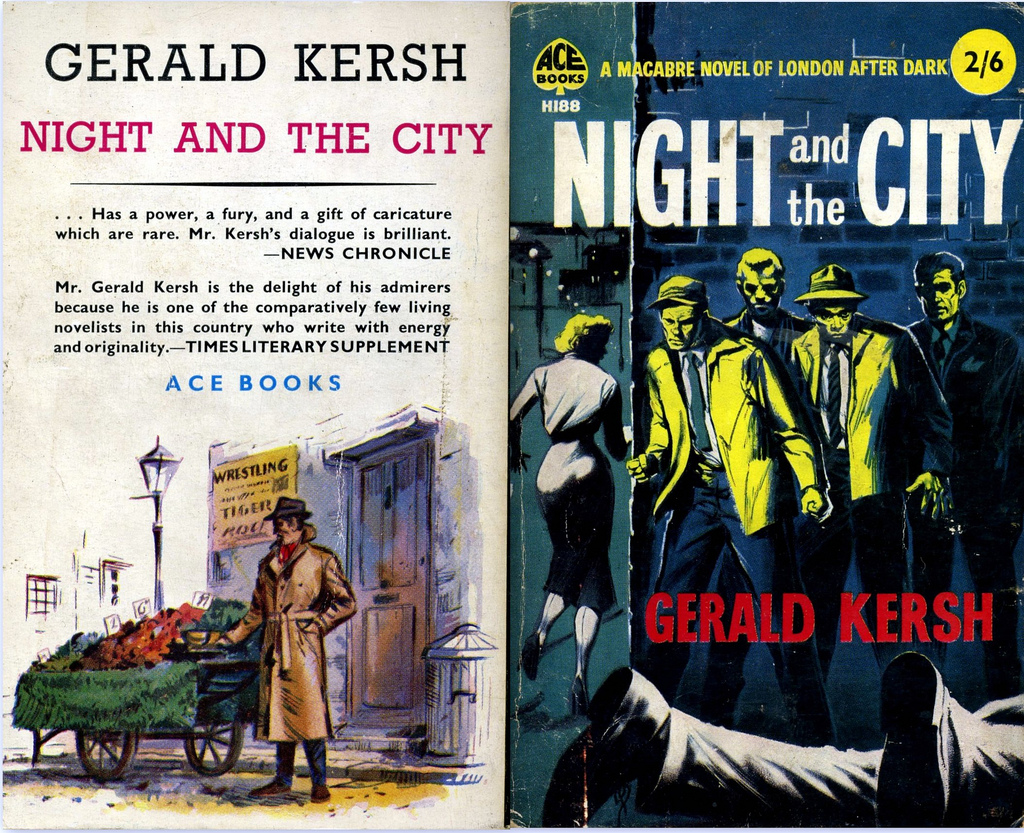
Gerald Kersh does not like other people. Or himself. (Or cats.) Let us consider his classic novel of low-life London, Night and the City (1938).

Night-in-the-City-bookFirst, the grotesquerie of people glimpsed in passing. Harry Fabian, a ponce (i.e., pimp) living off the immoral earnings of a woman, Zoë, trails one of her blackmail-able gentleman callers to the Turkish baths. Looking around, he sees

An old gentleman, abominably naked, looking like a Surrealist vision of pumpkins, marrows and varicose veins, turned the steam on higher, and began to smack himself in the belly. Another man, young and exceedingly drunk, stood trembling under the cold shower and mumbled something about forgetting his umbrella. (57)

Kersh has a thing about booze – and about all of mankind:

Man spends the first half of his life trying to find himself, and the other half trying to lose himself. He runs in little circles, like a pup trying to nuzzle its own behind; he catches up with himself, sniffs, is disgusted, and runs away from his own smell. He fears life; he flies from it. … He can always kill himself, of course, but he never does. He lacks the courage to put his head in the gas-oven, so he says: ‘That’s the coward’s way out’ – and even thinks himself a hero for living on. … above all give him a drink. Stuff his howling mouth with the nipples of oblivion! … Anesthetise him: that is his greatest comfort – poor simulacrum; soft white maggot still unformed! (104-5)

Later, heartbroken night club owner Phil Nosseros will pour

out the brandy with the grim concentration of one who believed that truth, happiness and the consummation of human endeavour lie at the bottom of a bottle. (256)

Does Harry Fabian ever have any regrets about the life he has chosen for himself? Well, at one point he finds himself swearing to a woman ‘On my honour!’

As he said this, Fabian experienced a curious sensation of misery. What was it? Was it that for the first time in his life he had become aware of the appalling burden of accumulating lies with which he loaded his soul from hour to hour – the closing coils of deceit which he spun about himself day by day? There passed through his mind a vision of life free from vanity, fiction and subterfuge … But all this passed in the blink of an eye. (204)

As Greta, one of the novel’s several women working as prostitutes, says ‘philosophically’:

All men are marvelous till you find them out. (242)

Wait, there is more than one prostitute in the novel? Yes. This is how Kersh introduces Vi, a B-girl who sometimes goes a little farther. It initially seems like she will just be a bit of background colour but later she becomes one of the viewpoint characters

She was a tall, slender, red-haired girl in a black lace evening gown. Under her rouge, one could distinguish the papery greyish pallor of the night-bird – the dead opacity born of dark dance-halls, where, in thick blue smoke and the exhalations of steamy bodies, the crude, raw rhythms of red-hot gut-bucket jazz seem to shake the blood out of women. … Vi yawned, and from between her pale, painted lips there proceeded a breath such as might come from a pathological specimen in a jar when the alcohol is evaporating. (77, 87-8)

Kersh even has a low opinion of her wallpaper

It was lined with brownish paper – mottled, sickening brown paper with stripes like the tracks of balloon-tyres in rose-pink, and wide bands dotted with circles, crosses and things like broken fans in pale green. You can get such wallpaper for sixpence a roll in the region of Somers Town; but who can sit down at a drawing-board and actually design it? (89)

The virginal and financially struggling shorthand-typist Helen lives in the same boarding house as Vi, who eventually persuades her to make a quick buck as a B-girl, just until her situation improves a little… Helen falls for Adam, the nearest to a consistently decent person in the book, but by the time they finally get it on they are both caught up in and deeply conflicted by the life, so when they make love

They appeared like enraged enemies, locked in a last desperate struggle. (154)

While Adam tries to get out, Helen finds ways to justify abandoning her sense of decency and embracing a life she previously saw as degrading. She quickly learns to use sex to manipulate all men, including the one she loves:

She kissed him, pressing her whole body against him; and in spite of the fact this kiss, and Adam’s immediate response to it, stirred up in her a veritable maelstrom of desire, she retained, deep in her consciousness, a little cold corner from which her critical faculties watched him. (177)

Later she will say,

It’s all very well talking about prostitution, but is sleeping with a man for money any worse than marrying him for money? (262-263)

Which might have passed as Kersh being insightful if he had not already made such pronouncements as

The prostitute is sentimental and unhappy. Why does she walk interminably, in utter degradation, and then give all her money to a man? Because he … is, in her consciousness, the last human being in the world to whom, by virtue of her self-sacrifice, she can feel superior, and therefore she loves him with a curious desperate love.
And now,’ thought Zoë, ‘he’s got hold of somebody else with my money.’
Rage, the hysterical rage of the prostitute rose within her. (244)

Kersh loves to elaborate upon the grotesquerie of his characters, and has a field day describing the wrestlers Fabian recruits for his newest venture as a fight promoter. There is the Cypriot, Kration, a deeply conflicted character at war with himself, as his physiognomy and follicles attest:

as soon as his mouth closed his face changed. Savagery came into it. He looked strong and ferocious enough to tear himself apart. His hair crouched low on his forehead, trying to obliterate his eyebrows; his eyebrows, colliding over his nose in a spray of black hair, endeavoured to smother his eyes; and only the flat, heavy prow of his nose kept his eyes apart – otherwise, they would have snapped at each other. Meanwhile they waited, smouldering, while his upper lip snarled in triumph over the lower, which, from time to time, jumped up and clamped down on it. Turkey, Greece and Africa waged war in his veins. Even his hair carried on ancient warfare. There was antagonism in his very follicles, and the hair writhed out, enormously thick, twisted, rebellious, kinked, frizzled and dried up. (211)

Actually, Kration has no inner conflict whatsoever. Though, thanks to Fabian’s manipulations, he does have a conflict with aged ex-champion Charlie Bamboo, the Black Strangler. Kersh’s description of this ‘colossus’ is even more racialised – but the hammer is a great touch, even if I cannot quite picture the sausages:

The man whom Fabian called Strangler was a colossus. You must imagine the Farnese Hercules in ebony, dressed in a nigger-brown suit with a yellow-chalk stripe, a sky-blue shirt and a crimson tie with a greenish domino motif. He had an extraordinary head. You could reproduce it by shaving the head of a Neanderthal man, polishing it with stove-polish and then smashing up the features with a hammer. The ears no longer resembled ears – they had been beaten and rubbed into indescribable shapelessness – while the nose, a dozen times broken and never repaired, spread in a two-inch width almost flush with the rest of the face. Beneath it a pair of vast pink lips, remarkably pale and prominent and as thick as beef sausages, sucked at the sodden remains of a dead cigar. (41-2)

So is there anybody or anything Kersh does not loathe? No. Not even the earth, the moon or the night sky:

Outside, the dull moon – little, fickle satellite – trails after the advancing earth like a prostitute at the heels of a batter soldier, marching on in blind obedience to incomprehensible orders, across the desert of the skies. (276)

Coda – some amusing stuff for the film buffs out there
At one point, Fabian goes into a gentleman’s outfitters and finds himself discarding the ‘little pale green hat which he had bought only a week before: the Fred MacMurray, for which he had yearned with all his soul’ in favour of the Cicero, ‘exactly as worn by Al Capone’. The sales assistant also tempts him with ‘the Humphrey Bogart shirt, exactly as worn in The Petrified Forest’, but has rather less success when he asks ‘would you care to see the Stepin Fetchit bowtie? … the Barrymore sock?’ (240-241)

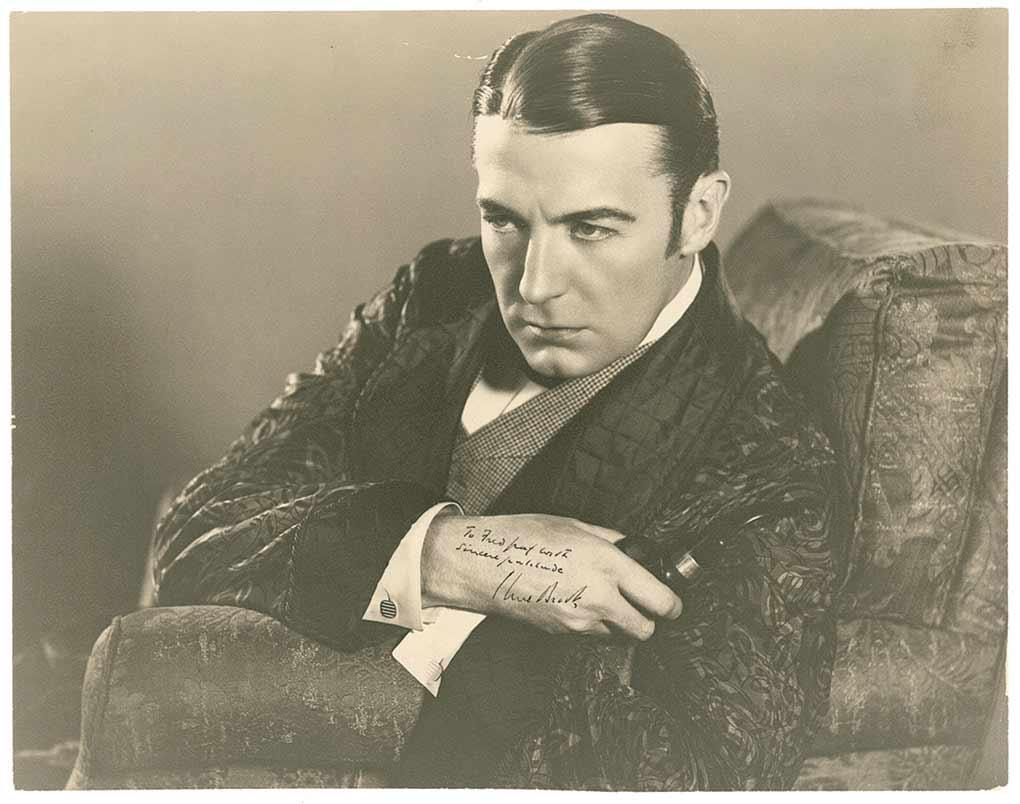
Clive Brook. Swoon.
Clive Brook. Swoon.

In an early conversation, Helen protests that unlike Vi, she’s got ‘high standards’ when it comes to men:

‘Ah,’ said Vi, with an air of infinite experience, ‘I used to talk like that, too. I used to be crazy about Clive Brook–’ (96)

And later, when Zoë admires Harry, we learn that

Robert Taylor. What women want.

There is nothing a woman loves more in a man than self-confidence. A man who appears to know precisely what he wants, and how to get it, can win more hearts than Robert Taylor. (237)


Gerald Kersh on the subject of cats – no, really, it is only cats he is writing about, nothing else at all

imagesI have always been fascinated by the way Gerald Kersh describes characters. Descriptions full of loathing that very quickly slide into self-loathing. I’m currently part-way through Night and the City (1938) – the source of Jules Dassin’s rather good 1950 film with Richard Widmark and of Irwin Winkler’s rather terrible 1992 film with Robert De Niro – and cataloguing a selection I will share when I am done. But in the meantime, in one of Kersh’s rather characteristic digressions, he has decided to tackle the subject of cats in nighttime London.

I swear it is only cats he is talking about. Nothing else.

First, he obviously prefers dogs to cats. And to women from villages.

Cats may be terrible to mice, but they have no equipment for heavier game. If they had long claws, cats would be extinct: they dilate with hatred, they shriek with hatred – they want to rend, devour, torture, and obliterate each other; but they can’t. So they pour out all their venom in their voices, their howling and malevolent voices; exactly like the gossiping women of the villages. (80)

He then moves on to the subject of tom cats howling and shrieking in the night. Their motivations, their anguish. At no point is this about anything other than tom cats.

Why do tom-cats do this thing? For them, love is by no means all moonlight and roses. The genital organ of a tom-cat bristles with spikes, like a pip-scraper; it is a severe surgical instrument of reproduction, not pleasure. He loses blood and fur in frenzies of impotent rage, and almost bursts with bitterness, simply to achieve a torture-chamber.
What good does it do? It generates more cats.
Who wants more cats? (80)

But what, you ask, about the female of the species? Ah, there’s a grey female there. Let’s follow her for three pages, remembering at all times that this is only about cats, nothing else – not even the image of religious transcendence culminating in a pun you might not believe he could have got away with in 1938.

What did she not know about sex and motherhood? She had had fifty kittens and forgotten about them. Tom-cats … were all right; but for her part, she found more sensual pleasure in an empty sardine-tin…

The grey cat was unable to suppress a yawn. How monotonous, how miserably familiar, were the oscillations and outcries of these passion-intoxicated males! They were all alike…

It was impossible to embarrass this cat.
She was shameless and heartless, a cat of the city; elusive as an eel, resilient as rubber, indestructible and persistent as chewing-gum; a tile-begotten hybrid, born among salmon tins and broken bottles, whose pedigree had slunk in offal from dustbin to dustbin since Egypt. … Every muscle in her body seemed to have been designed for prowling, sneaking, ducking and running away. She lived for herself, parasitically … In hundreds of homes her presence had been suspected by a smell, proved by the disappearance of food and disposed of by hisses and blows. Ratepayers often took her in and christened her with fancy names; but in the end, they always gave her away, with false and hypocritical eulogies and regrets. She had no idea of the significance of a box of ashes, and regarded the practice of Rubbing Her Nose In It as a charming human eccentricity rather than a lesson, or punishment.

Why hunt mice? Only fools work. There is always food. The city is full of people, most of whom are mad. Poor crazed creatures – they give away food! The only proper thing to do with food is eat it all. Give nothing away. Preserve yourself! Preserve yourself! The world is your cat’s-meat. The Great Tom-Cat, who plays with the world like a ball of wool, created man to give you warmth, milk and chicken-bones, and put the sun in the sky to make you purr . . . You are the Great Tom-Cat’s Chosen Pussies. (81-82)

[Quotations from London Books edition, 2007]


Edmund White’s The Flaneur: A Stroll through the Paradoxes of Paris (2001); or, another night of insomnia, another short book

511krl1ZVELEarly on, White offers a hostage to fortune when he quotes Loius Sébastien Mercier:

Like a true flâneur, Mercier found his ‘research’, disorganized and fragmented as it might be, endlessly absorbing. As he put it, ‘I haven’t been bored once since I started writing books. If I’ve bored my readers, may they forgive me, since I myself have been hugely amused’. (35)

However, White knows how to create the impression of flattering his reader when really he is flattering no-one but himself. Describing Théophile Gautier’s attendance at a monthly meeting of Le Club de Hachichins, who basically ate huge lumps of jellied hash, he writes:

All the signs of being totally, deliriously, even dangerously stoned, so well known to my readers, were already familiar to the arty denizens of Hôtel de Lauzun. (132)

He then goes on to quote the position Baudelaire, who likely only took hashish once or twice, in the great wine vs. hash debate that raged through probably very few fashionable salons:

he compared hasish  unfavourably to wine, which he thought was more ‘democratic’ because more cheaper and more widely available… To be precise he praised both wine and hashish for promoting ‘the excessive poetic development of mankind’, but he pointed out that ‘wine exalts the will, hashish annihilates it. Wine is a support to the body, hashish is a weapon for suicide. Wine makes people good and friendly, hashish isolates. One is hard-working, so to speak, whereas the other is essentially lazy. … Wine is for those people who work and deserve to drink it. Hashish belongs to the category of solitary pleasures; it is made for the unhappy idle. Wine is useful, it produces fruitful results. Hashish is useless and dangerous.’ (133-4).

And to end on a bitchy note, after several pages snarkily but not inaccurately lambasting the lifeless artworks of Gustave Moreau, he concludes the chapter:

Moreau once declared: ‘I love my art so much that I’ll be happy only when I make it for myself’. His wish came true. (144)

With luck I’ll sleep tonight…


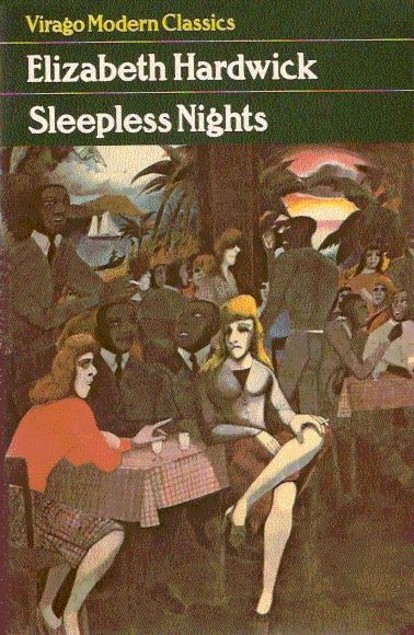
Top three quotes from Elizabeth Hardwick’s rather good Sleepless Nights (1979)

sleeplessnightsWhile I did not really appreciate the irony of reading this short novel while lying awake in the small hours of the morning, unable to sleep, that is not to say that there is not much to admire about it. Here are my three favourite bits.

In third place, describing young Louisa, who has the good sense to lie her way into a job for which she is not exactly qualified:

She spoke to someone of having been to college, spoke of typing, of odd experience, meaning only previous work. She said untruthfully that she could certainly take dictation. They put her in a room and turned on a machine. When it went too fast for her rapid longhand, she stopped the machine and played the difficult part once more. Her typed-up dictation was well-received.

She will not do too much or too little and this is what is wanted. She will have an apartment, a lover, will take a few drugs, will listen to the phonograph, buy clothes, and something will happen. Perhaps it will be good – or at least what she likes. (95–96)

In second place, describing the inhabitants of a residential hotel:

Tell me, is it true that a bad artist suffers as greatly as a good one? There were many performers at the Hotel Schuyler, but they gave no hint of suffering from the failure of their art. Perhaps the art had changed its name and came to their minds as something else – employment. (44)

And the winner, found in a passage about a boozy train journey from Montreal to Kingston, but applicable in all aspects of life:

Canadians, do not vomit on me! (9)

Khairy Shalaby, The Time-Travels of the Man Who Sold Pickles and Sweets (1991; trans 2010)

51BDxwqGg+LThis is a slippery one.

On the one hand, there is the depth of my ignorance of Egyptian history and Arab cultures (which is considerably more profound than anything I am about to say here). On the other, there is – unless something is lost (or added) in translation – a playful author who likes to keep his reader in a state of constant uncertainty.

In the opening paragraph, Ibn Shalaby is invited by the Fatimid caliph Mu‘izz to break the Ramadan fast – the first ever in the new city of Cairo. The second paragraph tells how he first met Mu‘izz in Qayrawan some years earlier, and how several centuries later he met the British historian of Cairo, Stanley Lane-Pool – they immediately recognised each other but it takes them a moment to recall that it was in Mu‘izz’s court in Qayrawan. In the third paragraph, they go to drink tea and smoke a pipe together so that in the fourth paragraph Lane-Pool can outline some Egyptian history before disappearing in the fifth paragraph so as to stiff Ibn Shalaby with the bill. When he tries to do a runner he timeslips into an earlier and unfamiliar version of the city, where he recognises Maqrizi, a 13th/14th century historian – only it soon transpires that the Mamluk-era author of the famous Topography is also capable of timeslipping, since the year is 358 AH (969 AD). Which means Ibn Shalaby is actually on time for the founding of Cairo, after all – as are other timeslipped historical figures, such as the historian Ibn Taghribirdi and the novelist Naguib Mahfouz.

And so the novel unfurls, a concatenation of comic incidents and episodes, many of which are interrupted by timeslips (both unintended and deliberate), constantly looping around and back and through the Fatimid, Ayyubid and Mamluk periods, with an occasional return to the 1990s. It is not always clear when or where we are, and even when Ibn Shalaby looks at his watch that tells him the date, you cannot always be certain how soon before he notes the new date that he timeslipped. At one point, even he confesses that ‘because of all my bouncing around in history, I tended to confuse one period with another’ (121) – and he’s the narrator!

Eventually this all settles down for a stretch when Ibn Shalaby finds himself stuck in the early 740s AH (1340s AD). He tries the well-worn time-traveller’s trick of trying to impress the locals with modern technology, which works until his batteries run flat. He flees the court and takes shelter in the Storehouse of Banners, which rapidly grows into an alternative state (of cannibals, prisoners of war, barbarians) within the Caliphate. And then, as one would expect of such a hapless, venal, opportunistic – above all, flexible – comic protagonists, he soon finds himself working for both sides against the other. This flexibility further destabilises the narrative by unfixing the protagonist-narrator, but it is also essential to the often-bleak comedy. When approached by someone self-evidently contemptuous of him, Ibn Shalaby

put on [his] own expression of arrogant contempt – the one [he] had picked up from the pictures of American politicians [he] saw in the papers every day. (45)

When a Persian guard in 380 AH (990 AD) fails to defer to the authority signified by the briefcase Ibn Shalaby carries – why would he, not knowing what it is? – the protagonist notes his surprise that ‘American industry had lost its magic touch’ and makes

a mental note to report the incident to the Arab opposition papers so they could use it as an example of the disappointing performance of foreign imports. (42)

The slipperiness of historical settings is held together by a strong sense that complicated, competing and largely pointless bureaucracies will establish themselves anywhere and anytime, given half a chance. That position is always precarious. That behind any façade of governance you will always find brutal, self-serving thugs. That, in the words of emir Khazaal,

Power is like sea monsters, or perfume: it rises to the surface sooner or later. (144)

And that it always pays

to side with the strong against the weak, [because] there’s no such thing as justice except among the strong – and even then, only when one of the strong slips up for a moment. (85)

This jaded view of humanity and of Egyptian history and life, this combination of bitterness, resignation and loss, fills the best lines in the novel:

News travels as fast as you can fill an Egyptian street with victims of abuse. (116)

and

Patience isn’t the only virtue we have in Egypt. It’s not just the ability to endure pain and suffering, it’s the ability to endure the remedy. (43)

***

The Time Travels of the Man Who Sold Pickles and Sweets is not the first African time-travel story.

The earliest African sf I have yet found is a time-travel novel, Muhammad al-Muwaylihi’s A Period of Time, which began newspaper serialisation in Misbah al-Sharq/Light of the East in 1898, was published in book form in 1907 and saw a sequel in 1927 (it has just been translated and published in its entirety for the first time, and I should be reviewing it later this year).

Salam Musa’s Khimi (1926) time-travels into a soulless future (apparently – it is not translated as far as I can discover), as more or less does Tawfiq Al-Hakim’s Ahl al-kahf/Sleepers in the Cave (1933; translated 1989), which I have not yet read.

And there is the 1998 movie Risala ila al-wali, which seems similar to the French comedy Les Visiteurs (Poiré 1993), but I have yet to unearth a subtitled version.

Oh, and the full title of Khairy Shalaby’s novel is The Time-Travels of the Man Who Sold Pickles and Sweets. A Narrative Comprising Events to Dazzle and Astound, Meditations to Divert and Confound, Histories to Edify and Incidents to Horrify. By the Pen of God’s Neediest Creature, the Knowing but Unlearned, the Tutored by Unwise Ibn Shalby, the Hanafi and Egyptian, The Seller of Pickles and Sweets. May God Guard Us from His Ignorance, Amen!

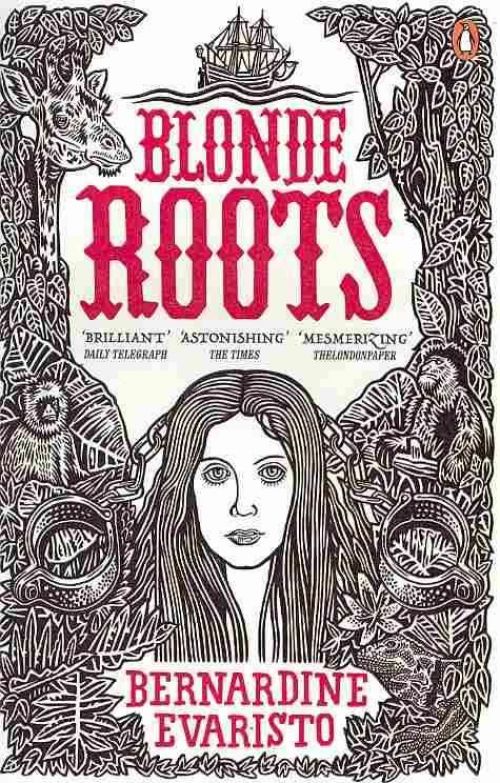
Bernardine Evaristo, Blonde Roots (2008)

9780141031521It takes a while to get your head around the generic cues and fictional world of this comical and fantastical neo-slave narrative. It flickers between an alternate history and (race) role-reversal satire, each seeming to conflict with the other. A long succession of gags about Africanised London place names – gags which are not particularly funny (such as Mayfah, Paddinto, Golda’s Green, Brixtane and, settled by Chinese seamen, To Ten Ha Ma) but which ultimately pay off with a geological reference to the Essex massif – clashes with a growing certainty that this Londolo is not in the country called England. And so you turn back to the map in the front-matter and everything becomes clear.

Blonde Roots is not a role-reversal narrative in which everything stays the same apart from race relations, as in, say, Desmond Nakano’s 1995 film, White Man’s Burden. Nor is it an alternate history like, say, Steven Barnes’ Insh’Allah novels (2002–3), in which some not-unreasonable extrapolation underpins a relatively rigorously worked-out world dominated by an Islamic Africa for two millennia, and in which Europeans are the victims of an alternative Triangular Trade, abducted and sold into slavery in Bilalistan (as North America is called).

No, what that map reveals is an alternative terrestrial geography.

An island shaped like Britain (unaccompanied by Ireland), but perhaps larger and called the United Kingdom of Great Ambossa spans the equator off the western coast of north Africa, which is also located further south than in our world. It is not quite clear what has happened to the rest of Africa since it is squeezed off the edge of the map by a Europe, here called Europa, displaced to the south of the Gulf of Guinea. England and Wales, but not Scotland, are wedged into the gap between this relocated northwest Europe and Scandinavia.

While it is entertaining to imagine a seasoned sf pro labouring to establish some geophysical perturbation causing this alternative dispersal of the Pangaea supercontinent, and in turn leading to this inverted social order, that is not where Bernadine Evaristo’s interests lie – nor is doing so as much fun as reading the novel itself.

A comedy about slavery is no easy thing to pull off, as the disastrously misogynist and not terribly funny French timeslip comedy Case départ (2011), directed by Lional Steketee and its co-starring co-writers Fabrice Eboué and Thomas N’Gijol, demonstrates. But it is by no means impossible. Ishmael Reed manages it (more or less) in Flight to Canada (1976), as does Charles Johnson (less than more) in Middle Passage (1990).

From the outset, Blonde Roots has some nice comic touches – in its world, the West Indies are called the ‘West Japanese Islands … because when the “great” explorer and adventurer, Chinua Chikwuemeka, was trying to find a new route to Asia, he mistook those islands for the legendary isles of Japan, and the name stuck’ (5) – but sometimes the comedy sits a little uneasily. For example, the protagonist, Doris Snagglethorpe, abducted from the Cabbage Coast (i.e., Yorkshire), transported to Great Ambossa, sold into slavery and renamed Omorenomwara, is branded with the initials of her owner, Kaga Konata Katamba, and his daughter, her first mistress, Panyin Ige Ghika.

Omorenomwara, who hates Panyin, no doubt gets the PIG half the joke, but the KKK half – and the entire joke, if a white slave being branded KKK PIG is a joke – only works for the reader.

Role reversals and inversions come thick and fast to begin with – monogamy is condemned by the polygamous Ambossans as ‘uneconomical, selfish, typically hypocritical and just plain backwards’ (19); house slaves are known as ‘wiggers’ (24); prosperous Ambrossan urban centres are known as ‘Chocolate Cities’ and ‘the tumbledown ghettos on the outskirts’ where ‘free whytes’ live in ‘squalor’ are called ‘Vanilla Suburbs’ (29) – but as the world is established and the narrative begins to come together, the comedy becomes less gag-oriented and  Evaristo expands her comic vision to capture also the pain and tragedy. Misgivings fade.

The novel switches between three strands: Omorenomwara’s present, as she attempts to flee on the Underground Railroad but ends up exiled to a West Japanese sugar plantation and must try to make some kind of life for herself there; Omorenomwara’s memories of her life as Doris and of her years as a house wigger; and an autobiographical pamphlet by Kaga Konata Katamba which includes his justifications for enslaving the self-evidently inferior Caucasians.

Families and lovers long separated by the slave system reunite, sometimes only fleetingly, and a sense of community thrives among brutalised slaves because they are dependent on each other. And in this final section of the novel, Evaristo gets the tone perfect. She reproduces that tired old cliché of slaves singing together in the fields, but makes it clear they do so out of mutual care and to support each other, not because they are happy. She shows them singing on command to welcome their visiting owner, and counterpoints it with them singing for themselves. And she includes the eleven-year-old slave Dingiswayo, ‘strutt[ing] about the quarter in a pair of outsized, hand-me-down cotton pants worn so that the waist hung (somehow) beneath his bum’ (204).

There is always a danger with role-reversal satire that the reader or viewer’s sense of injustice will be aroused for the wrong reason. Not by patriarchy and misogyny, but because men are being treated like women. Not by slavery and racism, but because people of pallor are being treated like people of colour. Blonde Roots’ fractured structure of narrators and temporalities helps it to avoid this pitfall, but for me there was something else, something curious, going on.

I kept forgetting that the slave characters were white.

I suppose this is because the novel mostly uses their Ambossan slave names, rather than their European names; and because so much of the cultural imagery around slavery features enslaved Africans; and because, being a novel rather than a film, there was an absence of concrete visual detail to fix their appearance.

Then every few pages I was brought up short as I remembered, as this potent anamnesis – this remembering of things forgotten – swept over me.

I have no idea whether the novel will work in this way for other people, and I have yet to figure out what it means. But it was powerful and disorientating. The way a good book should affect you.