Eden Log (Franck Vestiel France 2007)

[A version of this review appeared in Science Fiction Film and Television 3.1 (2010), 157–61]

edenlogEden Log begins in darkness.

Water drips into water.

Ragged breaths.

Flashes of light reveal a man (Clovis Cornillac), caked in mud, waking, staggering to his feet. (Later, much later, we – and he – will learn that his name is Tolbiac, but for now he has no idea who or where he is.)

He finds a torch on a nearby corpse and in its intermittent light he creeps and crawls and climbs up out of this cave into the lower levels of a seemingly derelict industrial complex. Cables and roots, difficult to tell apart, hang from the ceiling, industrial detritus devolving into, merging with, the subterranean-organic. On the wall behind him, a half-seen diagram describes a process which seems to involve humans descending below ground and then later ascending. He presses through heavy turnstiles and is greeted by projections of half a dozen women, immaculately clothed and coiffed, who address him in multiple languages. In the ominously bland idiolect of a corporate shill, one of them states,

The contract is fair. It is thanks to your work below that you will build your paradise above. Look after the plant and it will look after you.

This pun on plant, which works in French as well as in English, opens up one of the several fields of ambiguity in which this often elliptical film nestles. The plant is both a miraculous tree of vast proportions, its roots reaching far underground, and the industrial complex which extracts sap with ‘infinite energetic properties’ from the tree so as to power a city.

eden-log-clovis-cornillacAs Tolbiac ascends through underground levels – a trajectory that materialises the vertical integration upon which the Eden Log corporation’s gradually unveiled monopoly depends – he encounters various others from whom he begins to piece together the world and its story. One man, suspended from a wall, claims to have brought down the system, but it is not entirely clear where he ends and the plant (in either sense) begins. Tolbiac triggers a recording of the final confrontation between the technicians and the guards: when faced with an information leak over their corporate malfeasance, the nature and extent of which will only later become clear(er), Eden Log overrode all protocols about the relative autonomy of the subterranean levels and sent in guards to destroy the evidence and eradicate the threat.

1242613626_3The plant has been responding to its escalating exploitation by releasing a toxin that mutates the workers into strange, no-longer human creatures. Tolbiac’s struggle against transformation wavers when he finds an uninfected woman (Vimala Pons) and, suddenly abhuman, rapes her. He is appalled by what he has done, and what he is becoming. She elects to accompany him up to the surface, not knowing that he has infected her.

Eventually, having pieced together most of the puzzle, Tolbiac is recognised – and, at last, named – by the guards he used to command. Pretending to be himself, he cons his way past the guards and plugs himself into the plant, which has always been sterile, infecting it with life. It erupts, shattering the dome that contained it, and expands to take over the deserted city, transforming it into a beautiful – and colour-filled – landscape.

Eden Log actually begins not in darkness but with a quotation:

Therefore the Lord God sent him forth from the garden of Eden to till the ground from whence he was taken. (Genesis 3:23)

Tolbiac’s initial emergence from the mud might be taken as a reworking of the creation of Adam in The Bible: In The Beginning… (US/Italy 1966), replacing John Huston’s achingly – and thus camply – tasteful images of an inspirited wind blowing aside yellow sand to reveal the first man with birthing imagery that is rather more fecal, fluid and feminine. Eden Log certainly invites psychoanalytical readings: its setting recalls the maternal interiors of Alien (Scott UK/US 1979), the rape carries strong overtones of a primal scene fantasy, and Tolbiac’s ascent into realms of language and control, the realm from which he fathered himself, plays out an Oedipal entry into the Symbolic.

The biblical quotation can also be interpreted as Vestiel’s announcement of his transition to directing feature films. Previously, he had directed three episodes of the French cop show, Central Nuit (Night Squad 2001– ), and gathered assistant director credits on numerous films, including Blueberry (Renegade; Kounen France/Mexico/UK 2004), adapted from Jean ‘Moebius’ Giraud’s bande desinée, and Ils (Them; Moreau and Palud France/Romania 2006). Such experience undoubtedly prepared him well for shooting a film in the dark, in confined spaces[1] and with an elusive – some have claimed incomprehensible – narrative with religious overtones.[2] Many of the reviews of Eden Log struggled to make sense of a film with the narrative structure of a Paul W.S. Anderson video game adaptation but stripped of his prolonged action sequences and clearly-defined (if one-dimensional) characters, motives and goals. Struggling to make sense of their disappointed expectations, reviewers typically drew fairly insubstantial comparisons with THX 1138 (Lucas US 1971), Le dernier combat (The Last Battle; Besson France 1983), Cube (Natali Canada 1997), Pi (Aronofsky US 1998) and Primer (Carruth US 2004), among others – often for no better reasons than Eden Log being a first film, French, black-and-white (sort of), low-budget, visually striking and/or elliptically plotted.

A more productive comparison might be drawn with Tsukamoto Shinya. Although Eden Log lacks the viscerality of Haze (Japan 2005), in which a man likewise drags himself through a mysterious subterranean location, Vestiel shares Tsukamoto’s eye for post-industrial landscapes – for once-essential components mutating into something almost-organic – along with his taste for apocalyptic rebirth and a posthuman otherness that defies eutopian-dystopian binaries.

Vestiel’s decision to begin the action in overwhelming darkness, with intermittent flashes of light that reveal less than they show, recalls the opening of The Texas Chain Saw Massacre (Hooper US 1974), with which Eden Log shares an energy crisis narrative about the dehumanising effects of capital. But it also announces that Eden Log is self-consciously a film. Garrett Stewart argues that

cinema exists in the interval between two absences, the one whose loss is marked by any and all photographic images and the one brought on by tossing away each image in instantaneous turn. (xi)

For him, the presence of still photographs within the diegesis functions as a reminder of the photogram, the still image that is held in front of the viewer for a twenty-fourth of a second as the film is projected but which is never seen or experienced as a still image. Vestiel’s prolonged stretches of darkness between each flash of light work in a similar manner, to remind us of the unseen dark absence which replaces each photogram in succession.

This filmic self-consciousness is further developed by the projection of images within the diegesis. For example, in the sequence in which Tolbiac replays the recording of the final attempt at negotiation before the guards invaded the subterranean levels, he must scurry to raise into the air a variety of surfaces so that the recorded dialogue can be accompanied by images projected onto these détourned screens, rematerialising a profilmic moment that is no more and reminding us that the

filmic medium is the once having been there of the represented spaces themselves, absented by necessity to make possible the materiality of their moving image on the track. (Stewart 5)

Later, a wizened figure, attached to the plant but slumped as if dead, is eerily animated as an earlier recording of him is projected onto his unmoving face. This play between the inanimate and the animated – which resonates strongly with the decision to strip the film stock of all colour, apart from the occasional revenant touch of red and green[3] – confronts us once more with the interplay between the substrate and the surface of the filmic experience itself. As Stewart notes,

photography engraves the death it resembles, [whereas] cinema defers the death whose escape it simulates. (xi)

Vestiel’s striking use of light and darkness, his flickering between presence and absence, the visible and the invisible, is matched by a refusal fully to explicate the world of the film or the narrative. By adhering to Tolbiac’s amnesiac perspective as he pieces together information from the thinnest and most elusive of expository clues, Vestiel situates the viewer in the space between obscurity and illumination. Even those adept in the relevant genre conventions will find themselves frustrated by Vestiel’s grimly playful evasion of specificity – a strategy clearly announced in the rape scene.

Having raced together into a room-sized elevator, Tolbiac removes his unknown companion’s helmet, revealing that she is a woman. With increasing passion – and apparently in flashforward – they begin to make love. This is soon intercut with another image stream in which the sex is reconfigured as Tolbiac violently raping the woman, and with a third in which he seems to be looking on in disgust at himself. The scene ends with Tolbiac slumped against a wall in dismay, and with the woman curled up in a corner, crying; and yet when he finds a way out, repeating to himself, ‘It’s not me, it’s not me’, she accompanies him.

While it remains unclear what has actually happened between Tolbiac and the woman, the frequent complaint in online commentary that the scene is gratuitous and that it makes no sense for the woman to follow her rapist indicates the extent to which generic framings can override the indeterminacy of the specific. This troubling conjuncture of community and violence, the flicker between affective intersubjectivity and aggressive domination, between what might be and what is, is at the core of the film’s critique of contemporary power.

Eden_LogThe Eden Log corporation’s circular logo which reappears throughout the film contains a diagram of tree as an intricate network, branching out in all directions. This potentially rhizomatic image is disrupted by the corporation’s name, which bisects the circle horizontally, turning the network into a tree with branches above ground and roots below. It forces verticality and thus hierarchy onto the image. The tree, as Deleuze and Guattari argue,

plots a point, fixes an order (7)

even as the rhizome that this tree places under erasure

expose[s] arborescent pseudomultiplicities for what they are. (8)

Indeed, the film’s working title, Network Zero, suggests the point at which vertical hierarchy severs and deforms lateral multiplicity. The plant – both the tree and the factory housing it – is a synecdoche for the Eden Log corporation which owns it, part of the biopolitical order that, according to Michel Foucault, extends and veils the disciplinary sovereign power of the state to

make live and let die. (241)

In the closing minutes of the film it is revealed that Eden Log has promised immigrants who labour in the plant will be rewarded with citizenship, and concealed from the citizens that the plant is feeding on its workers. Eden Log has a vision of ‘a new social order’ built upon this ‘integration’ of non-citizen outsiders into ‘our civilisation’, and believes that when the truth is revealed that ‘our citizens will accept what our needs impose on these populations’. This exemplifies the manner in which biopolitical governance moulds populations to serve the economy. It can be seen as the logic of the Holocaust, in which the

death of the bad race, of the inferior race (or the degenerate, or the abnormal) is something that will make life in general healthier. (Foucault 255)

But it is also the logic of the supposedly free market.

And to this sovereign power Eden Log counterposes zoē, the

simple act of living common to all living beings (Agamben 1)

which is shared by the abhuman not-death-but-continuation of the mutated workers and the plant-human-machines, and by the climactic, uncanny efflorescence of computer-generated nature.

Notes
[1]
Eden Log was shot in a damp, freezing ten-acre mushroom bed sixty feet below ground, as well as water decontamination stations and sewers.

[2]
Vestiel co-authored the screenplay with Pierre Bordage, co-writer of Marc Caro’s less-than-coherent Dante 01 (France 2008), on which Vestiel also worked as assistant director.

[3]
There are two other bursts of (rather artificial-looking) colour when, courtesy of CGI, the plant effloresces. Stewart suggests that

in the second half of this century, science fiction has continued, more and more vividly, to imagine the technologies that would outdo it, do it in. In the digital era, however, futurist cinema has for the first time mobilized rather than merely evoked its own self-anachronizing upgrades. Engineered by computer enhancements, the super-annuation of a suddenly hybrid medium has become manifestly planned obsolescence, performed from within rather than simply foreseen. (222)

Works cited
Agamben, Giorgio. Homo Sacer: Sovereign Power and Bare Life. Trans. Daniel Heller-Roazen, Stanford: Stanford UP, 1998.
Deleuze, Gilles and Félix Guattari. A Thousand Plateaus: Capitalism and Schizophrenia. Trans. Brian Massumi. London: Athlone, 1988.
Foucault, Michel. Society Must Be Defended: Lectures at the Collège de France 1975–1976. Ed. Mauro Bertani. Trans. David Macey. New York: Picador, 2003.
Stewart, Garrett. Between Film and Screen: Modernism’s Photo Synthesis. Chicago: The University of Chicago Press, 1999.

120 years of sf cinema, part three: 1935-1954

2015 marks the 120th anniversary of sf cinema. This is the third part of a year-by-year list of films I’d recommend (not always for the same reasons), and there are a few years where there is little to recommend for any reason.

Part one (1895-1914), part two (1915-1934) – both of which have lots of links to actual films rather than just occasional pictures…

1935Bride-of-Frankenstein1
Bride of Frankenstein (James Whale)
Kosmitchesky Reis/The Space Ship (Vasili Zhuravlev)
Mad Love (Karl Freund)

1936
The Devil Doll (Tod Browning)
Flash Gordon (Frederick Stephani)
The Invisible Ray (Lambert Hillyer)
The Man Who Changed His Mind (Robert Stevenson)
Things to Come (William Cameron Menzies)

Flash-Gordon-1936-great-old-show-to-watch-on-a-saturday-night1937
Q Planes (Tim Whelan, Arthur Woods)

1938
The Big Broadcast of 1938 (Mitchell Leisen)

1939
The Man They Could Not Hang (Nick Grinde)
Return of Dr X (Vincent Sherman)

1940
Before I Hang (Nick Grinde)
Black Friday (Arthur Lubin)
Dr Cyclops (Ernest B. Schoedsack)
The Man with Nine Lives (Nick Grinde)
Son of Frankenstein (Rowland Lee)

1941
Dr Jekyll and Mr Hyde (Victor Fleming)

1943
The Mad Ghoul (James P. Hogan)

1944
Time Flies (Walter Forde)
The Man in Half Moon Street (Ralph M. Murphy)

1949The_Perfect_Woman_FilmPoster
The Perfect Woman (Bernard Knowles)
Siren of Atlantis (Greg Tallas)

1950
Destination Moon (Irving Pichel)

1951
The Day the Earth Stood Still (Robert Wise)
Five (Arch Oboler)
The Man from Planet X (Edgar G. Ulmer)Gort
The Man in the White Suit (Alexander Mackendrick)
The Thing (from another World) (Christian Nyby)

1952
Monkey Business (Howard Hawks)

1953
The Beast from 20,000 Fathoms (Eugene Lourié)
Four-Sided Triangle (Terence Fisher)
Invaders from Mars (William Cameron Menzies)
It Came from Outer Space (Jack Arnold)

1954creature-from-the-black-lagoon
The Creature from the Black Lagoon (Jack Arnold)
Gojira (Ishirô Honda)
Them! (Gordon Douglas)

Part four (1955-64)

Gojira

120 years of sf cinema, part two: 1915-1934 (links galore!)

2015 marks the 120th anniversary of sf cinema. This is the second part of a year-by-year list of films I’d recommend (not always for the same reasons), and there are a few years where there is little to recommend for any reason.

Part one, 1895-1914

1915
Les vampires (Louis Feuillade)

1916
Verdens Undergang/The End of the World (August Blom)
20,000 Leagues under the Sea (Stuart Paton)

1917
Ever Been Had (Dudley Buxton)

1918
Himmelskibet/A Trip to Mars (Holger-Madsen)

1919
Die puppe/The Doll (Ernst Lubitsch)
Die Spinnen/The Spiders (Fritz Lang)

1920
Dr Jekyll and Mr Hyde (John S. Robertson)
One Week (Edward F. Cline and Buster Keaton)
Der Golem: Wie Er in die Welt Kam/The Golem (Paul Wegener and Carl Boese)

1921
L’Atlantide/Queen of Atlantis (Jacques Feyder)

1922
The Electric House (Edward F. Cline and Buster Keaton)

1923
Paris Qui Dort/The Crazy Ray (René Clair)

1924
Aelita (Jakov Protazanov)

1925
Orlacs Haende/The Hands of Orlac (Robert Wiene)
The Lost World (Harry O. Hoyt)

1926
The Magician (Rex Ingram)

1927
Metropolis (Fritz Lang)
Sur un Air de Charleston/Charleston (Jean Renoir)

1928
Spione/Spies (Fritz Lang)
Alraune (Heinrich Galeen)

1929
Frau im Mond/Woman in the Moon (Fritz Lang)
The Mysterious Island (Lucien Hubbard)
High Treason (Maurice Elvey) – silent and talkie versions on pay per view at BFI player

1930
Just Imagine (David Butler)

1931
Frankenstein (James Whale)
A Connecticut Yankee (David Butler)

1932
Island of Lost Souls (Erle C. Kenton)
Doctor Jekyll and Mr Hyde (Rouben Mamoulian)
F.P.1 Antwortet Nicht/F.P.1 Doesn’t Answer (Karl Hartl)

1933
King Kong (Ernest B. Schoedsack and Merian C. Cooper)
The Invisible Man (James Whale)
Das Testament des Dr Mabuse (Fritz Lang)
Der Tunnel (Curtis Bernhardt) – French version

1934
Gold (Karl Hartl)

Part three, 1935-54

The Reef (Andrew Traucki 2010)

The-reef-poster-2010jpgand so anyway it turns out the best thing about The Reef (2010), a based-on-a-true-story shark attack movie, is the side betting on the shark’s or sharks’ (it remains unclear) taste in television when it/they eventually show up; will it/they go for the actors who’ve been in Neighbours first, or those who’ve been in Home Away, or the one who has been in both, or the one who has been in neither but was one of McLeod’s Daughters?

Mutant Chronicles (Simon Hunter 2008)

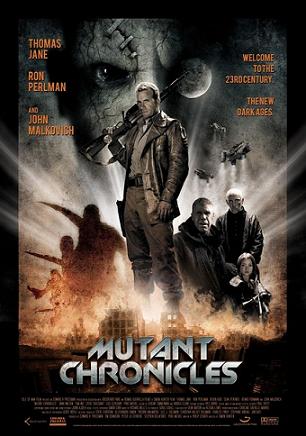
The_Mutant_Chroniclesand so anyway it turns out that the best thing about Mutant Chronicles (2008) is not Ron Perlman’s Oirish accent (to be sure), nor is it the film’s unwillingness to leave any cliché unturned in the pursuit of mediocrity; no, the best thing about Mutant Chronicles is Sean Pertwee, for it is one of the fundamental laws of cinema that, regardless of the thing he is in, Sean Pertwee will be the best thing in the thing he is in…and that he will die more horribly and with greater inevitability than Sean Bean…

Out of the Unknown: ‘Come Buttercup, Come Daisy, Come…’ BBC2 8 November 1965

Patricia 'Paddy' Russell
Patricia ‘Paddy’ Russell

The second original script for the series has, like ‘Stranger in the Family’, a contemporary setting (but is rather less adventurous in its use of location shooting – just the exterior of an old suburban home and the Putney street outside). The writer, Mike Watts, had primarily worked for various ITV companies, although in 1965 he also scripted a couple of episodes of the BBC’s The Troubleshooters (1965–72); in addition to writing original dramas and episodes, he wrote or co-wrote several British crime movies, all of them comedies, The Pot Carriers (1962), The Cracksman (1963), Crooks in Cloisters (1964), which I remember fondly but haven’t seen in about a million years, and Joey Boy (1965). The director was Paddy Russell, one of the first two women directors at the BBC. Originally an actress, she appeared in a 1950 adaptation of Karel Capek’s The Insect Play for BBC Sunday-Night Theatre (1950–59) and in two different and uncredited roles in a couple of episodes of Nigel Kneale/Rudolph Cartier’s The Quatermass Experiment (1953); she quit acting to become Cartier’s floor manager and then a director. Despite a long and varied career that lasted until around 1980, and included everything from 55 episodes of Z Cars (1962–78) to 15 instalments of the gameshow 3-2-1 (1978–87), she is probably best remembered as the director of Doctor Who’s The Massacre of St Bartholomew’s Eve (1966), Invasion of the Dinosaurs (1974), The Pyramids of Mars (1975) and The Horror of Fang Rock (1997). Here, she does an excellent job of never letting the potentially ridiculous aspects of the story teeter over into the comical.

OOTU Come buttercup Repeat 12th August 1966‘Come Buttercup, Come Daisy, Come…’ tells the story of Henry Wilkes (Milo O’Shea), a fishmonger and an obsessive gardener who, thanks to his weekly, year-long correspondence with the mysterious Mr Pringle, has managed to grow a number of exotic species which should not even survive in the UK. He has, in fact, grown them to monstrous size, feeding them experimental foodstuffs as well as diced rabbit and cockles. There is something odd about them, though. Birds stay away from the garden. Wilkes, who has given the plants names, also talks to them, and they respond, although we do not hear their voices or what they say; their sentience, however, is confirmed for viewers by their physical responses to his proximity and touch, and the way they extend feelers to grasp at the food he scatters on the soil. Wilkes goes as far as to steal hextellenium, a dangerous chemical, from the pharmacy next to his shop to use in an experimental formula to make Nobby, his favourite among the plants, grow even bigger and stronger.

come-04Indeed, Wilkes is so obsessed with plants as living beings that he berates his new shop assistant, Anne Lovejoy (Patsy Rowlands), for dressing the displays of fish with parsley – he refuses to stock the herb in an effort to discourage his customers from making parsley sauce – and for putting tomato and lettuce in her cheese sandwiches. She is extremely devoted to her new boss, ever so slightly a-quiver when he is around.

come-01Monica Wilkes (Christine Hargreaves) is a nervous mess, concerned her husband no longer loves her and driven to distraction by the weirdness the garden exudes. Although she has witnessed nothing in particular to distress her so, she senses it is somehow unnatural. She suffers from headaches and depression, and her only comfort is her pet dog, Mina, an obvious child surrogate whom she obsessively sketches and paints. (If the story was told from Monica’s point of view, it might be rather like Charlotte Perkins Gilman’s ‘The Yellow Wallpaper’ (1892).)

This potential middle-class love triangle comes to the fore when Dr Chambers (Desmond Jordan) is brought in to consult on Monica’s ‘nerves’. (He is a private specialist, rather than an NHS doctor, which is significant to the class politics of the story: there are clear social hierarchies, including ones around education, the amateur and the professional.) Chambers bluntly asks Wilkes whether the source of Monica’s anxiety could be that he is having an affair with another woman.

But something else entirely is going on. Something rather queer.

comeThere is a tradition of sf/horror stories about sentient plants, from HG Wells’s ‘The Flowering of the Strange Orchid’ (1894) to John Wyndham’s The Day of the Triffids (1951) to The Thing (from another World) (Nyby 1951) to Scott Smith’s The Ruins (2006). Many of these stories are obsessed with reproduction, especially Don Siegel’s version of Invasion of the Body Snatchers (1956), in which the peculiarities of human sexual reproduction are mapped onto a post-war world world being transformed by commodity production. In ‘Come Buttercup, Come Daisy, Come…’,  though, the plants are partly about masturbation and all about homosexual desire.

Wilkes comforts Monica with transparent – to us – lies. He is oblivious to Anne, even as he seeks her collusion in his secretive schemes; in a quite agonising scene, his efforts to make up for snapping at her lead to an intimate conversation, during which he is completely unaware of quite how likely she might be to misinterpret his sudden attention (Rowlands excels, as always, at combining self-deprecation, class aspiration, timidity and repressed desire). He has been engaged in a secretive correspondence with Pringle, a man whom no one has met and who regularly sends him odd packages. Wilkes takes special pleasure in the plant he calls Nobby. He thrusts his hands deep into Nobby’s leaves to administer a ‘morning tickle’, during which he calls the plant what sounds like ‘a little old plonker’ and then unquestionably a ‘great big silly old faggot’. And when he plunges a syringe full of his special formula into Nobby’s roots to make his favourite even bigger, the framing of the shot makes it look as if Wilkes is fumbling with his penis. Elsewhere, he describes himself to Anne as ‘the biggest cockle-eater in the business’.

And Nobby is a jealous lover. He devours Mina, and then barks like the dog so as to lure Monica to her death; and then when Anne turns up, laden with cockles for Wilkes…

outunknown8bigThe script was originally commissioned as a seventy-five minute drama; cutting it down to sixty-minutes (even then, it overruns by a minute), might be why the end seems a little rushed, fizzles a little. On the one hand, there is no revelation that Pringle is really an intelligent plant, which is probably a good thing; but there is certainly left open the unexplored possibility that Nobby or the other plants are telepathically controlling Wilkes and others…

Other things to watch out for
— Patsy Rowland’s reverse acting when the plant wraps its tendrils around her neck
— The quite astonishing line after Wilkes tears a plastic flower off one his customer’s bosoms: You can’t go out for a pair of kippers nowadays without getting raped.
— The expression on Patsy Rowland’s face when she walks out of the shop just in time to hear that line being delivered.
come-03— And Norman. Watch out for Norman. He is the pharmacist. He is also Eric Thompson, Emma’s dad and, far more significantly for world culture, the narrator of the English-language dub of  The Magic Roundabout (1965–77).

Previous episode, ‘Time in Advance

Next episode, ‘Sucker Bait

Sources
Out of the Unknown DVD boxset. BFI, 2014.

On Matters Locomotive and Tentacular; or, Four or Five (More) Things About China Miéville

[After finding yesterday’s old piece on China, I remembered doing this one, too. But on reading it, I have no memory at all of writing it. It’s from the Readercon 17 programme, back in 2006 when China and James Morrow were GoHs.]

This was the plan, the plan was this: I would get the first post-rush hour train from Bristol to London and be there by noon.

tentacles‘There’ is the Starbucks in Borders bookstore on Oxford Street, our default meeting-up place in central London, and we would leave ‘there’ as soon as possible, and grab some pizza at a place around the corner (where, a year earlier, our arrival had been greeted with rapturous applause from the staff – not because they recognised China, but because they’d been open for almost an hour and we were their first customers that day). And after lunch, although the pretext for meeting up was discussing essay proposals for a book we are editing on Marxism and sf, we would head to the Natural History Museum to see the thirty-foot long, newly-on-display, giant squid.

That was the plan, the plan was that.

So of course that was not what happened.

Readers of King Rat and the stories in Looking for Jake (and a forthcoming project, as yet still a secret [Un Lun Dun, I guess]) will know that London is a strange place, where all kinds of unexpected things can happen; that the fabric of the city itself is fantastical. Strange chimera flit through the crowds, pausing to take fliers advertising clubs and bars and language schools from fastidiously scruffy young men and women being paid way less than minimum wage for their cash-in-hand labour, and roar in anguish, in bafflement, at this world which is no longer theirs, and retreat temporarily into the interstices, before emerging once more, hooked on it. Creatures, remnants from another time, can be glimpsed in the reflective surfaces of department stores and sandwich shops, phone booths and passing buses. Others dance across the rooftops. And then there’s the people, who are pretty fucking strange.

But our delays and derailments are far more mundane. Family. Trains. And by the time we get ‘there’ it is gone two o’clock. (There was an amusing incident involving a borrowed phone in case China needed to contact me, which he does, but by text, which my quick briefing on this new-fangled technology did not cover. I manage to find the message but am uncertain how to reply. I amaze myself by finding China’s number in the phone’s address book, so I call and leave him a message. The number later transpires to be that of his old phone. But I will omit this is at makes me sound much too old yet insufficiently curmudgeonly. And has nothing to do with trains or cephalapods.)

Lunch is relocated to an Italian restaurant, which does a pasta dish China likes involving little balls of fried courgette and spinach. Our arrival prompts neither adulation nor irony.

51M+qPPQDFL._SY344_BO1,204,203,200_‘Trains,’ I tut, to boost my curmudgeon-score as we share a mezze and several varieties of bread. But we have been talking about trains a lot, lately. I have a crazy notion that there is a book to be written about trains and early cinema and time-travel (but very distinctly not about early railroad films or time-travel movies), and China’s voracious reading, especially the research for Iron Council (and for his review of Stefan Grabinski’s The Motion Demon), keeps throwing up gems. It’s like having a really good research assistant I don’t have to supervise or pay (although he has still not returned my copies of The Iron Horse, Once Upon a Time in the West and Emperor of the North Pole).

These are the three things he tells me.

‘The seemingly obvious use of the railroad to “mean” Manifest Destiny, as in Zane Grey’s The U.P. Trail, is only permissible because of the peculiarity of that particular railroad. It really did only have one line, at least for a brief moment, but much longer iconically, and that’s been the source of a lot of notions of the unilinearity of the railroad, which are completely spurious. Not even a consideration of the siding or even the parallelism of tracks (necessary unless all trains are going only one way, a patent absurdity). So railroads aren’t even a misused symbol – they only work symbolically because of a lie.’

‘Of a failure, no, a refusal, to observe accurately,’ I suggest, ‘because that would strip the metaphor of its political potency.’

The mezze is really good.

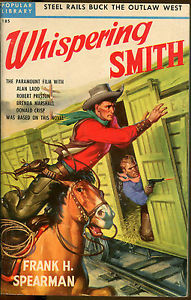
$_35Iron Council riffed heavily on Frank Spearman’s Whispering Smith. Spearman was a sort-of libertarian, reportedly Ayn Rand’s favourite writer, did lots of stuff about rugged railwaymen. Whispering Smith is a troubleshooter for the railroad who is allowed to go anywhere and do more or less anything, including kill anyone necessary, to “fix problems”. It is an extremely perspicacious critique of rugged individualist/libertarian railroadism (as I’ve christened the ideology), because contrary to the “enlightened self-interest” of the Randists and half of Spearman’s own characters, the thrusting of the rails is only possible with a roving assassin – a man in a permanent state of Schmittian law-making exception! – bringing peace for capital-expansion at the end of a gun beyond the bounds of the rails. So the railroad relies for the always-spurious solidity of even its semiotic status to the right on an implicit awareness of beyond-railroad coercion of the most violent kind. Spearman, a cunning writer, recognises this and rather than attempt to conceal it, hides its in plain view.’

‘Agamben,’ I mutter, sipping a rather non-descript red wine, knowing that his Schmitt reference is more astute than my name-drop (but then he did study – and write a book on – legal theory). I refill my glass and reflect on how it is possible for China to talk so enthusiastically about stuff despite his rather non-committal approach to drinking.

220px-Sanatoriumpodklepsydra‘And then there’s Bruno Schulz, using trains (in several different ways – history as both inside and outside the train itself, on the rails as well as in the corridors) to think about the alterity of history and alternate possibilities. I’m increasingly interested by the idea of the multi-track nature of railroads, let alone Grabinski’s sidings, as key to their importance. There’s this astonishing passage in his ‘The Age of Genius’ in The Sanitorium under the Sign of the Hourglass:

Ordinary facts are arranged within time, strung along its length as on a thread. There they have their antecedents and their consequences, which crowd tightly together and press hard one upon the other without any pause. This has its importance for any narrative, of which continuity and successiveness are the soul.

Yet what is to be done with events that have no place of their own in time; events that have occurred too late, after the whole of time has been distributed, divided and allotted; events that have been left in the cold, unregistered, hanging in the air, homeless and errant?

Could it be that time is too narrow for all events? Could it happen that all the seats within time might have been sold? Worried, we run along the train of events, preparing ourselves for the journey.

For heaven’s sake, is there perhaps some kind of bidding for time? Conductor, where are you?

Don’t let’s get excited. Don’t let’s panic; we can settle it all calmly within our own terms of reference. Have you ever heard of parallel streams of time within a two-track time? Yes, there are such branch lines of time, somewhat illegal and suspect, but when, like us, one is burdened with contraband of supernumerary events which cannot be registered, one cannot be too fussy. Let us try to find at some point of history such a branch line, a blind track onto which to shunt these illegal events. There is nothing to fear. It will all happen imperceptibly: the reader won’t feel any shock. Who knows? Perhaps even now, while we mention it, the doubtful manoeuvre is already behind us and we are, in fact, proceeding into a cul-de-sac.

‘Isn’t that fucking amazing?”

I have to agree.

I also have to confess.

This was the plan, the plan was this: over lunch we would talk wisely and wittily about arcane things, scare the children at the next table with our profanity and their parents with out erudition (or vice versa). It is not that China is scarily geeky (although he does know his shit), nor that I cannot write convincing dialogue (although I cannot); but rather that China’s words come from a long and almost painfully helpful email he sent me after a phone conversation about matters locomotive.

Conversation over lunch that day really focused on our childish enthusiasm for all things cephalopodic and tentacular. I’d recently rewatched Jon Lurie’s series of fake fishing documentaries, Fishing With John, in which he takes various celebrities – Jim Jarmusch, Tom Waits, Matt Dillon, Willem Dafoe – on improbable fishing expeditions. The series ends with a two-parter in which John – who died while ice-fishing with Willem in the previous instalment, a fitting punishment considering they used the proper equipment rather than chainsaws to cut through the ice – is discovered to be not only alive and well but taking Dennis Hopper fishing for giant squid in the Andaman Sea. After arduous travels, unsuccessful angling, a sidetrip to see some squid-worshipping monks who warn of the giant squid’s hypnotic powers, they finally meet with success, of a sort. A giant squid rises to the surface. But all is not well. Disorientation strikes Dennis and John. What is going on? Has something happened? They leave Asia disconsolate, because despite seeing their prey up close, it hypnotised them, and they believe their expedition a complete failure.

Jeff VanderMeer’s name of course crops up, as it always does in squidversations. But a new potential source of delight is introduced. An aside about James Woods not sleepwalking through a performance but actually sleeping through a performance in ER triggers a memory deep in China.

‘Have you ever,’ he asked, ‘seen Tentacles? I’ve only heard about it – a 70s Jaws rip-off about a giant octopus – in which John Huston literally phones in his performance. Apparently, he finally gave in and agreed to appear in it on the condition that he didn’t have to leave his own home to do so. So his performance consists of him sitting on a lawn-chair on his own lawn, saying things over his own phone like, “Hmmm, yes, that does sound like it could be the work of a giant octopus”.’

Neither wise nor witty, neither arcane nor profane; more geeky than erudite; but it certainly did scare the children sat at the table next to us. And their parents.

***

Coda 1. We did actually discuss the proposals and finalise the line-up for Red Planets: Marxism and Science Fiction.

Coda 2. The little balls of courgette and spinach are really rather good.

Coda 3. While China’s books are available at all good bookstores, it is worth noting that Tentacles is also available on region 1 DVD, but while I was able to pick up a copy for just five bucks, there is a heavy price to pay: it comes with the Joan Collins movie Empire of the Ants, a low point in a career hardly distinguished by its heights.

Coda 4. We never did get to the Natural History Museum to see the giant squid.

Coda 5. Unless we did but just can’t remember. Hypnotic powers, y’know.

Stephen King, Doctor Sleep (2013)

514NhnvVinL._SY344_BO1,204,203,200_This is, I shit you not, the one about evil gypsies abducting children.

Admittedly, the gypsies are actually some kind of energy-vampires, who traverse the US in the guise of middle-aged people in RVs. And they don’t merely abduct the infants, but slowly torture them to death to release more of whatever kind of energy it is they chow down on. And one of the infants in their sights is a girl in her teens who can shine way more powerfully than anyone else. And she knows Danny Torrance, who has grown up to become, like his father, an alcoholic, but is in Alcoholics Anonymous and sober for most of the book.

But mainly it is about gypsies abducting children. I shit you not.

Despite being a sequel to The Shining, it mostly isn’t. It shares Danny and one location and some references to Hallorann and Wendy (in whom King still cannot muster any interest) and inserts them into a mildly and differently fantastical version of the contemporary US. It is smoothly competent – the riff on Jerome Bixby’s ‘It’s a  Good Life’ (1953) is nicely done, but the allusion to The Silence of the Lambs sits there for no reason like a lump in your pablum – but it is hardly gripping, suspenseful or scary. It is like bathing in a cup of tea the way my mum makes it.

King’s semi-autobiographical account of Danny’s experience of AA, of its practices and processes, suggests a strong resonance with neoliberal culture’s emphasis on getting the individual to surveil and manage him/herself, to hope for little more than surviving daily, to self-scrutinise, to locate responsibility within the self – anything rather than fix the society that produces alcoholism. But this is thin stuff, too.

Not everyone agrees. For example, Margaret Atwood says that ‘by the end of this book your fingers will be mere stubs of their former selves’.

Presumably because gypsies stole the tops of them.

PS My other Shining-related posts can be found here, here, here and here. (And boy am I kicking myself for forgetting when writing about Room 237 that Yanis Varoufakis’ book is called The Global Minotaur: America, Europe and the Future of the Global Economy.)

The Shining (Stanley Kubrick 1980)

shiningIt is difficult to know what to say about The Shining, especially as so much has already been said, some of it of dubious merit.

Like Stephen King, I am baffled as to why people find it so scary; unlike him, I rate it way more highly than his original novel (and the miniseries does not even get a look in).

It is a film I never used to like much, although I always admired its soundtrack and steadicam (Kubrick is so very effective when tracking-in that you can forgive him for his lesser parallel tracking, but, to be fair, Jean-Luc Godard’s not as good at the former as he is at the latter). And I have always been a little taken by the simple tricks Kubrick deploys – an omission here, an ambiguity there, and what Michel Chion describes as his ‘commutative editing’ – to make his films seem enigmatic and profound.

This time round, the film grew on me. I have no idea if this is because I finally watched the 25 minute longer US cut (although some months ago Roger Luckhurst predicted such an outcome, and I learned a long time ago he is usually right about stuff). I was struck very forcefully this time round by the visual and aural resonances with 2001 – and partway through the job interview scene, I stopped hearing the dialogue as being badly-delivered and started hearing it as a development of the earlier film’s depiction of linguistic thinning and debasement. Stuart Ullman (Barry Nelson) channels the performance of sincerity and the platitudinous corporate drone of Heywood Floyd (William Sylvester), and everyone sounds like they are delivering lines because that is what so much of human identity and interaction consists of – performativity.

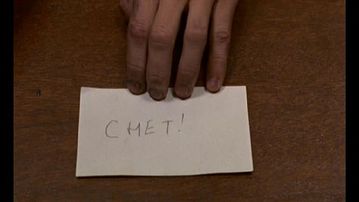
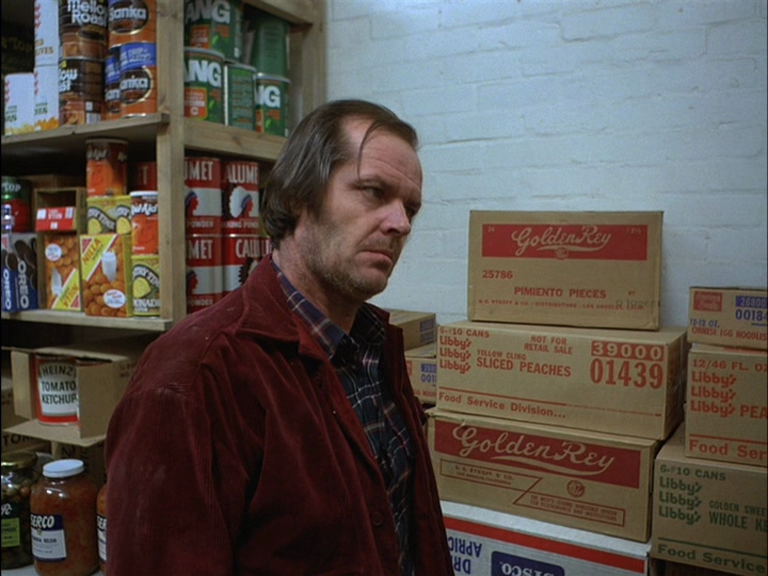
When I recently read King’s novel, I posted about its proleptic depiction of precarious, disciplined neo-liberal labour. This is developed in Kubrick’s film. The Overlook itself, despite it age, resembles one of the non-places of hypermodernity described by Marc Augé: those spaces that are the opposite of utopia because they exist and do not contain any organic society. For all the historical markers we see on display – from those big cans of kosher dill pickles in a hotel that would once have been restricted, to the Native American designs and images on the walls, to the very 1970s purple penis carpet – it is oddly dehistoricised. It is a space that might even confound Steve Buscemi’s5609791_std CHET! in its obscure blurring of ‘trans’ and ‘res’. The Torrance family, that signifier of a private realm outside the world of work and exchange, that gesture towards organic society, is destroyed by the relentless demands of the Overlook, which is only concerned with Jack as labour-power.

The Shining shows the coming proletarianisation of the American middle class, or perhaps merely charts the delusion of social mobility at the core of the American Dream. This is Jack – the terrorised and terrorising, self-surveilling, self-disciplining and other-discipling sadomasochistic subject of a monstrous power. Just the way capital likes it.

shiningAnd management doesn’t care for one moment that he has produced the treatise on work-life balance. To the Overlook, it’s just a paper trail to prove the staff have been consulted at.

Room 237 (Rodney Ascher 2012)

large_7EDxLdQ8bBG8YC2JAnhvoVhTe3This is easily the most fun and interesting, and least time-consuming, of the various associated texts I’m working through in preparation for teaching The Shining as a cult movie (King’s novel, the miniseries, and Doctor Sleep, which should be done soon). It is a documentary in which five people explain what they think the film is really about: the Native American genocide; the Holocaust; Kubrick’s faking of the Moon landing film; the legend of the minotaur; and the dark violent sexual nature of human beings. (The latter two are the sketchiest, so it is hard to be certain what their central claims are, or if they actually have central claims – and I am sure I must have missed something about the last one since that’s hardly unusual material for a horror movie.)

Students anxious about analysing films often frame their suggestions with a nervous ‘I’m probably reading too much into it, but…’, while also seeming to assume that the process of analysing a film is to dig down and find a secret hidden meaning. Their development as critics usually involves learning to think differently about the nature of texts and the processes by which meanings are made. Meanings aren’t hidden deep within, like pirate treasure, but are the product of engaging with the details of the film in relation to various contexts. There is no ‘reading into’, there is just ‘reading’, because all the information is there on the surface to see and hear.

However, on listening to the (admittedly fragmented) presentation of Room 237’s five featured exegeses, I began to think that maybe I was wrong – that maybe there is such a thing as ‘reading into’ a text.

room-237-1And I admit, when the NASA conspiracy guy explained that the letters on the key tag, ROOM No 237, were able to spell just two words, ROOM and MOON, I did blurt out ‘moron’.

But that is a little unfair.

Room 237 gives us a fascinating if largely unwitting exploration of textual heuristics, epistemological limits and the uneven distribution of cultural capital.

sh_monarchTake, for example, Juli Kearns’ claim that the image of a skier on a poster is actually the silhouette of a minotaur. It does not look like one to me, but when she explained what she sees I understood what she meant. It is more convincing than someone else’s claim that the clouds in the opening titles contain an image of Kubrick, but it is still utterly unconvincing. The disproportionate bull-like upper torso is very obviously a hunched figure in a bulky ski jacket.

But perhaps she does not mean it is actually a picture of a minotaur, merely that it was deliberately chosen because it resembled one.

On the opposite side of the doorway, she notes, is a picture of a cowboy on horseback. A centaur, you might think, but no. Her point is that it is a mirror image: a cowboy opposite a bull-man. And it seems that it was only after noticing this ‘picture of a minotaur’ that she began to notice all the labyrinth imagery in the film: the maze, the model of the maze, the corridors and sometimes contradictory layout of the Overlook. What remains not just unclear but downright mystifying is why she needs to build her argument on a questionable interpretation of the skier poster rather than on, say, the film’s obvious and undeniabe labyrinths – and why she never seems to ask why Kubrick organised his version of the story around mazes, corridors and horizontality.

Part of the answer to the constricted nature of these five interpretations lies in the suggestion made by one of the exegetes that Kubrick was a bored genius who he decided to fill The Shining with puzzles and/or clues. A disappearing chair, the disappearing Dopey sticker, a mid-sequence costume change, an apparent reversal of the pattern in the carpet, all of which can be explained as continuity errors, are suddenly transformed into acts of conscious intent. Which enables you to continue believing in Kubrick as a genius who controlled absolutely everything that appears in his films. Which in turn separates from the dull herd those viewers who can pieces together his clues. Which brings the elect into the sacred presence of the author-genius, who slays ambiguity, guarantees meaning and dispenses certainty.

However, the whole proposition that this is what a genius would choose to do suggests a poor understanding of genius, and of creative endeavour. Kubrick ceases to be a person and becomes like that magical autistic guy in Cube (1997), able to do really hard maths without any of the visible effort the female character must put into calculating primes and primes of primes. Kubrick becomes a black box, a monolith, and only some primates get uplifted. Understanding how texts generate meanings is transformed into a paranoid-autistic hermeneutics, like in The Da Vinci Code, with one true meaning to be unearthed. Or, as Dick Hallorann (Scatman Crothers) says to Danny (Danny Lloyd), this is ‘not [about] things that anyone can notice but things that people that can shine can see’.

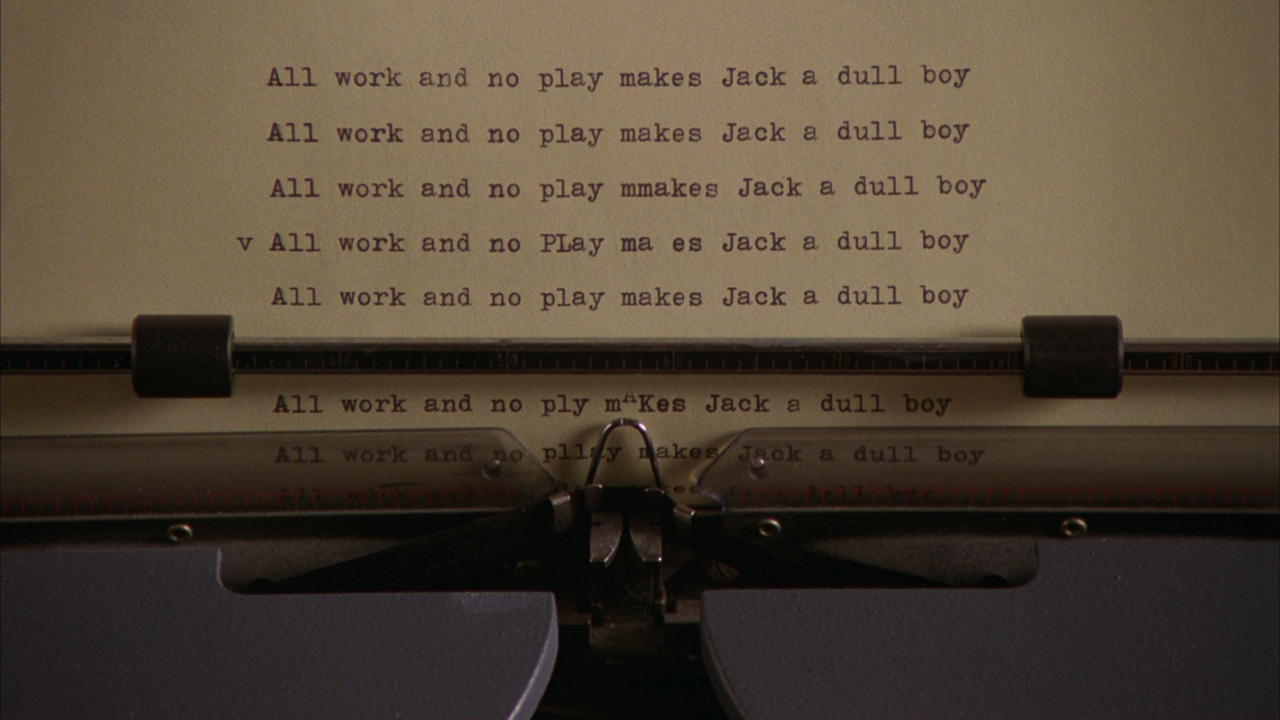
Like when one of the exegetes argues that the recurrence of the number 42, the fact that Jack Torrance (Jack Nicholson) uses a German-made typewriter and the graphic match evident in the dissolve from  a pile of luggage to a group of guests is more than enough to prove the film is about the Holocaust.

The paranoid aspect of this spills out beyond the film when the NASA conspiracy guy claims that he is under state surveillance and that he fully expects an IRS audit next year. (Intriguingly, he insists that the Moon-landing itself was not faked, just the Moon-landing footage, but he never explains why NASA would do this – although he does dismiss someone else’s claim that it was to keep us from seeing the towering alien city in the Sea of Tranquillity.)

vlcsnap-2012-11-03-17h36m26s183While watching Room 237, I could not resist constructing my own version of its real secret meaning which is also clearly bullshit. The exegete who sees the film as being about the genocide of Native Americans makes much of the prominence afforded to cans of Calumet baking powder. However, he completely misses the genuinely prominent placing of packets of Oreos – next to Jack when he wakes up on the sacks of salt, and then on the extreme left of this shot, clearly mis-shelved behind Jack and the baking powder cans (misdirection!). ‘Oreo’ is slang for a middle class African American, who might look black on the outside but is really white on the inside. Such conservative figures, who align themselves with white culture, function to conceal the supposed threat to white hegemony – especially white masculinity – posed by African Americans.

The same exegete notes that the five o’clock shadow of Bill Watson (Barry Dennen) makes him look mixed race, but quite ludicrously suggests that this aligns him with the native American, when clearly his major domo status – which includes walking behind hotel manager Stuart Ullman (Barry Nelson), being expected to sit quietly to one side, and being ordered to perform menial tasks – positions him as an African American servant, like the butlers played by Bill ‘Bojangles’ Robinson.

6336382_f260But the task of  looking after Danny, The Shining‘s Shirley Temple equivalent, is displaced on to Hallorann. Significantly, it is only after Danny – who, like Hallorann and Hallorann’s grandmother can, ‘shine’ – states his preference for ‘chocolate’ ice cream that Hallorann calls him ‘son’. No wonder Grady, in the red bathroom, warns Jack about this ‘nigger’ interloper, coming to replace him as Danny’s ‘real’ father. (And since ‘the shining’ seems to skip a generation, Hallorann is simultaneously positioned as Danny’s grandfather – that is, Jack’s father.) No wonder Kubrick replaces Jack’s light-coloured typewriter, a symbol of paternal authority and of entry into the Lacanian symbolic order, with a darker model partway through the film…

1350845502845114This explains also Kubrick’s decision about the final images of the film. White masculinity, frozen out of the picture, stuck in a lost past.

This is – of course – not remotely what the film is about. And I really hope no-one takes it seriously, but y’know how the internet is…