My Holiday in the Peak District, day three

Dark-clouds-over-Chrome-landscapeDay one, two.

I have much to report, yet of substance little.

When Charteris finally stirred he was much preoccupied with Sprake. All that could be gathered from the latter’s ramblings and peculiar reticence was that he had left the pub in the company of the barmaid, but that something had intervened in their dalliance. Something that caused him to reel away in such horror that he was left with no conscious capability, merely an instinct that returned him to us.

It was MacReady’s turn to collect supplies from the farm. It was a daily chore, Dyson explained, because the food did not last. He showed me the apples left over from last night, shrivelled now and wormy, then threw them away.

On MacReady’s return we breakfasted, in silence except for when the muttering audible from Sprake’s room rose in volume or pitch, prompting us to drown it out as best we could with meaningless but loud conversation. The others were still intent on keeping something from me, and once our brief meal was over they hastened to leave about their day’s work. I could draw from them no hints as to its nature, and when I made as if to join them they insisted I wait and talk to Charteris. I acceded begrudgingly (I had no wish to join them in their labours but urgently wanted to escape that accursed cottage for a while).

Left with nothing to do, I pretended to myself that I was making further progress on my translation of the codex and its implications. I allowed Charteris, when he descended with the news that Sprake was sleeping once more, to believe he was interrupting me, but in truth I had no idea where the previous hour or so had gone. The sheet on which I was working was a mass of barely legible scrawls, so different form my common hand, that I could not recall making – nor, indeed, make much sense of – them.

Charteris pecked at his breakfast. He refused to answer any of my questions directly, but he did indicate that my supposition was correct – he did have need of my expertise. He claimed it had never been his intention to reveal anything to me until tomorrow, and now Sprake’s obscure malady prevented him even from showing me the lay of land, which is how he had wanted us to spend this first full day together. But there was no reason it would not be safe for me to walk the circle of the hills around Lower Wirklesworth alone. He would lend me boots, if I needed them, and a stout jacket, ‘You need to get a sense of the place,’ he said, ‘of its shape and antiquity, the ages that are gathered here.’

He thrust a battered old map at me. It dated from the 1870s. ‘By far the most reliable one,’ he explained. ‘Places might not always seem to be where they should. But as long as you stay on the marked paths you should always find your way back into the village. Remember, though, the map is never the territory, and sometimes the territory does not want to be known.’

It was nonsense of the highest order, but the rain had ceased , the skies seemed clear, and some fresh air would be welcome. I did not like to admit to myself that I was anxious to be out of that house.

‘Take some apples,’ he advised. ‘Throw them away if you don’t eat them – they will be bitter by nightfall and rotten by dawn.’

And so I walked up the main road out of the village until it peaked and then left it to commence a widdershins circuit high above Lower Wirklesworth. By noon I was skirting the edge of a gritstone moor. Even to the untrained eye, it was clearly a ceremonial landscape, Neolithic stone circles and burial chambers and other cyclopean remnants bulging here and there out of the riotous heather and ferns. It was there that I noticed the contrast I had not perceived on my arrival as Charteris had driven me over the ridge and into the bowl-shaped valley below. Beyond, the land was full of colour, rich and full, but the peaks of the hills seemed to provide a barrier of sorts, and within them colours faded into a greyness, from fruitful verdure to a grim vegetal enervation.

The moorland gave way to a black tarn, ominous in its placidity. I threw an apple as far out as I could, and it slipped into the opaque waters with barely a ripple.

Emaciated cattle, their sickly eyes a milky white, parted before me, skittish but bone weary.

Within an hour, a thick mist descended and it was all I could do to keep to the path. The grass grew wet and treacherous underfoot. Long before reaching the ruins of Upper Wirklesworth, I made my way down to the village, the circuit incomplete.

At the cottage, Charteris was nowhere to be seen. I found Sprake huddled in an armchair.

Now was not the time, I realised, to fumble my condolences over his wife’s death. I sat with him, though at first he barely acknowledged me. He picked at a patch of mould on the blanket in which he was wrapped. I could not help but stare. When he became aware of my gaze, he smiled and explained: ‘It is everywhere in this valley. Leave your clothes hanging for more than a day and it will appear. If you find it on your skin , scrub it out like the very devil.’ He picked up a twig and showed me the curious growth mottling every inch of it. ‘It’s not a mould or a fungus, not a lichen, not a moss, according to Dyson,’ he said. ‘And every time he sends off a sample to a lab it deliquesces before it reaches them. He is trying to get the equipment here to do his own analysis. Look closely and you will see it on the grass and the trees, even on those rickety cows. It is indiscriminate.’ Somehow in his mouth that word seemed filthy.

He lapsed into silence and soon fell asleep. I, too, was in need of rest. I went inside and lay on my bed. I drifted in and out of consciousness, disturbed once more by that animal scratching. I grew convinced that it was not outside in the eaves as I had thought during the night, but inside the walls. I might have been dreaming.

I awoke at dusk, disturbed no doubt by the sound of the others returning. I threw open my attic window to let some of the mustiness out of the air. It must have startled the squirrel, still gathering food for her young, on the guttering below me. Whatever was in her mouth was still alive.

She turned on me, dropping her prey and rearing up in fury. Through the dull lactescence of her eyes a rage burned. It seemed sentient, prompted by an affront aeons old.

Stifling a scream, I slammed the window shut.

I longed for company yet could not bring myself to join the others.

Later, Charteris brought me up a tray of supper. He looked at me with a knowingness I could not bear. ‘Get some sleep,’ he said, ‘we will speak in the morning.’

I could sense something buried deep inside me emerging.

Not merely the hatred I felt for him in that moment, but something that was not quite part of me. Something that had been summoned.

Day 4 (morning)

My Holiday in the Peak District, day two

Dark-clouds-over-Chrome-landscapeDay one.

Thanks to my rather ascetic scholarly ways I am accustomed to starting the day while half the world is still a-bed, but this morning I am awake far earlier than I intended. After the events of last night I am unsurprised that my sleep was so fitful, but it was the sound of tiny animals scrabbling among the eaves that finally woke me. I have dim memories of such noises repeatedly disturbing me during the night. As the sun laboured into the sky I finally abandoned my bed and made my way stealthily down through the tight, creaking stairway to the kitchen. I put on the kettle for a fresh pot of tea.

Overnight, to my disgust, the milk had gone off. Its stench turned my stomach.

I drank my tea black. It was bitter stuff. A spoonful of honey made it more palatable.

My first thoughts were, as always, of the translation on which I am working, but as I had left my notes in my luggage and did not fancy stirring from the armchair that looked out over the puddled driveway and into a sodden orchard, I fell to pondering what must have befallen Sprake after we left him at the pub last night.

As with Charteris, I knew Sprake from my undergraduate days at the University of M––––––. An archeologist by training, he had always seemed to take his ancient Anglo-Saxon name – with its connotations of agility and liveliness – quite seriously, devoting considerable energy to carousing in low houses and pursuing women of questionable virtue. As a postgraduate he had developed a more sober persona, and his subsequent academic career saw him metamorphose into something of a ladies’ man, bedding a succession of female students with a discretion that I did not expect. There had been a sudden marriage to a Classics scholar from another university, and within a year he had with equal abruptness found himself a widower. I was not clear how she had died. There was talk of a wasting illness, a lengthy confinement. That was some years ago. I had not attended the funeral and when he returned to the cottage with the others there was no private moment in which to express my belated condolences. The opportunity passed, but I knew at some point I would mutter something awkward that would make us both uncomfortable. There had been a definite decline in the quality of his work since her death, and there was plentiful gossip about his rather unconvincing sexual renaissance as a tweedy, balding lothario.

After a peremptory dinner of bread and cheese, some small tart apples and a rather dry fruitcake purchased at the neighbouring farm, I accompanied Charteris, Sprake and the others through the rain, which was heavier now, into the leaden heart of the village.

Lower Wirklesworth is hidden away low in an odd fold of land. It clings to the banks of a small river prone to flooding when the encircling moorland is sodden, and climbs unsteadily up the steep hills on either side. Like all such villages, it is presided over by a church built on a site whose links to Christian worship can be traced back more than a millennium. Deposited heavily among the higgledy-piggledy houses are several stolid lumps of Victorian civic architecture – a town hall, a school, meeting rooms – provided by the philanthropy of an eminent industrialist who made his fortune from the exploitation of local workers, lured off their failing farms to be indentured, more or less, into his pits and quarries, mills and factories. There used to be a pub on each of the three sides of the triangular marketplace, but only one remains in business. Long and low, it rather resembles a barrow. On entering the dim public bar, I half expected to find the funereal accoutrements and cursed treasure of an ancient king from some race that walked these lands before the coming of Rome.

While the others supped brimming foamy tankards of a local ale, I contented myself with a half-pint of port stout, relishing its slightly bitter tang. They chattered on about this and that, but as if by common consent there was something about which my companions clearly avoided talking. Something they had decided to keep from me, at least for now. I had anticipated this so it did not trouble me greatly. Charteris had obviously invited me here with a purpose in mind. He had unearthed something requiring my expertise, of that I was certain.

Soon Sprake’s attention was drawn to the barmaid, and he began to spend as much time propping up the bar as sitting with us. She had a pallid complexion, and I felt sure that in the barroom’s peculiar light he, up so close, would not be able to discern its rather jaundiced tinge.

Over my second drink, I fell to observing the locals. There was something unappetising about them. Blocky features seemed to blur together, and recur from face to face. Something in their heavy brows hinted at abnormality. They rarely blinked. Their milky eyes indicated a shared, generations-deep imbecility. The village’s isolation and limited gene pool, reaching back through meaningless and obscure centuries divorced from the currents of history, had undoubtedly played its part, and I recalled Charteris mentioning centuries of lead mining in the district. Perhaps the water – and thus the local crops and livestock – had been contaminated, concentrating toxins in the blood and bones – and wombs! – year after year.

They were an unattractive people on the whole, dark and surly. Their thick-fingered clumsy gestures were quite brutish – expressions of their dumb animal nature – yet in the crowded bar they moved around each other with a disturbing grace. Elbows never collided. There was no jostling, and no drinks were spilled. They moved around like bees communicating with each other, as if some ancient shared consciousness animated and choreographed them all. Their mumbled conversation, slurring words together into an incomprehensible hum, only served to confirm this impression. It was only with the greatest of efforts that any would stir themselves to respond to my companions’ attempts to engage with them, but from the little I overheard it was hardly worth the effort involved.

Except, that is, for the barmaid, with whom Sprake seemed to be making his inevitable unsavoury progress.

I attempted to excuse myself early, claiming fatigue from the day’s journey, but Charteris and the others insisted on returning to the cottage with me. Sprake stayed behind.

In truth, I was relieved to have their company. Something about the night had made me anxious about running into the locals when I was on my own. One half expected to find them in the jumbled streets, staring dully at their own reflections in dirty puddles, or yelping at the thin moonlight breaking through the clouds here and there. I dreaded some such encounter.

As we walked, my companions fell silent, as if exhausted.

I was already in bed when he returned a mere hour or so after closing times. He was ashen-faced and gibbering. I have never seen anyone so unmanned. We could get no sense from him.

Charteris eventually got him to his bed and sat with him until he slept.

Little wonder that my night was so disturbed, or that I am up so early.

I have half a mind to return home. Yet I am, I confess, curious about why Charteris summoned me. I realise now that that is what his invitation really was – a summoning. And there is something here that intrigues every bit as much as it repels me.

I will see what the day holds and then make a decision.

Day 3

My Holiday in the Peak District, day one

Dark-clouds-over-Chrome-landscapeMy decision to join Charteris and his friends was rather a last minute affair. His cryptic invitation arrived several weeks ago, but sat unanswered on the mantlepiece. I was determined to take advantage of the summer’s respite to pursue the more laborious aspects of translating an ancient codex, the identity of which I prefer not to reveal until my work is complete. This is no mere academic prissiness or pretension. The codex has been translated before – indeed, by one of my more illustrious predecessors at the university. My researches among the incunabula he bequeathed the library that are held in its sealed room  led me to conclude – at first – that his work, based on a series of peculiar errors, was fatally flawed. However, as during the long hot evenings I pondered these mistakes and the paths down which they had taken him, I began to perceive that it was not a case of mistranslation at all but one of misdirection.

I confess, I was frightened by this realisation. I dispatched a hasty message to Charteris, advising him of the time of my arrival at the nearest train station, on the edge of the Peak district. I packed a bag, shut up the house and, not to put too fine a point on it, fled.

I remember little of the journey. My mind was in such turmoil that even the several changes of train, with all the loitering on draughty, dank and increasingly rural platforms they involved, barely registered. At some point, a fellow traveller commented on a stretch of one of the branch lines supposedly being the most beautiful in the country. I grunted concurrence though in truth I had not noticed.

Charteris met me at the station and whisked me away past fields and through country lanes, the verdancy of which seemed somehow obscene.

We had not spoken in a number of years, and conversation did not seem inclined to flow.

The cottage Charteris has rented is rather narrow. It strikes me as too small for all of us. We shall see when his companions return from their day’s excursion. I can always book into a local inn if their presence and proximity becomes too onerous.

In truth, I am beginning to feel rather foolish. I am not one to act in haste, nor am I commonly prey to the weird fancies that now preoccupy me.

Outside, dark clouds are massed in the sky and the rain has started. It is the kind of thin drizzle, little more than a mist, which will soak through everything and leave the place smelling of damp wool. In the tree by my window, a squirrel is busy bringing in food to its nest. Perhaps it has young to feed? I shake my head – the habits of Rodentia are hardly within the purview of my concerns. Besides, Charteris tells me as we struggle to converse over the pot of thick black tea he made while I unpacked, it is the wrong season.

Day 2


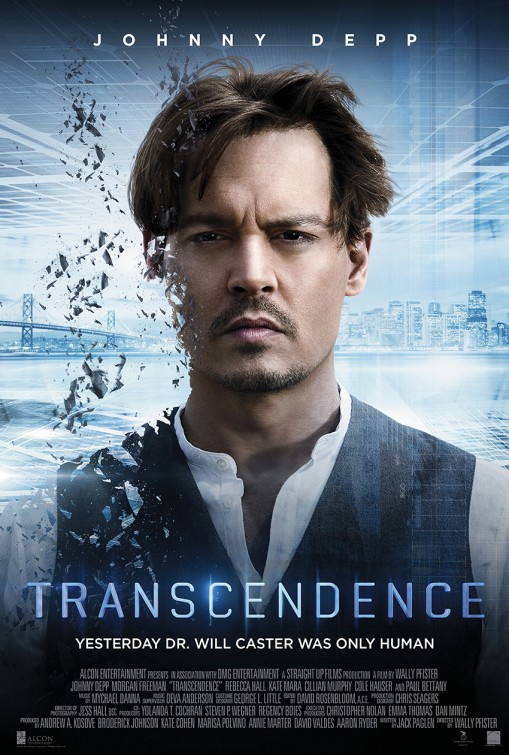
Transcendence (Wally Pfister 2014)

transcendence_ver11and so anyway it turns out that the best thing about Transcendence (2014) is not the sub-Kubrickian but nonetheless quite fascinating commutative editing, which results in a film with only half a dozen scenes dispersed among its 105-minute stream of images replacing one another with no memory of what appeared before each of them and no necessary connection to what appears after each of them, nor is it the the moment when you begin to imagine an alternative version in which Rebecca Hall’s character was played by Miranda Hart, nor the moment when you begin to imagine Johnny Depp’s character was played by an actor and resembled a character, nor the bit when you start aching for the AI, having hooked itself up to the internets, to come across an online copy of Colossus: The Forbin Project and become depressed or The Lawnmower Man and become really depressed or Demon Seed and start building something really nasty in the basement, nor is it the end credit which says ‘A WALLY PFISTER FILM’ when even then surely they must have know it was really a case of ‘THE WALLY PFISTER FILM’, no, the very best thing about Transcendence is the bit right near the end when the soldier played by Cole Hauser exclaims ‘it didn’t kill anyone’, which was basically my complaint, too…


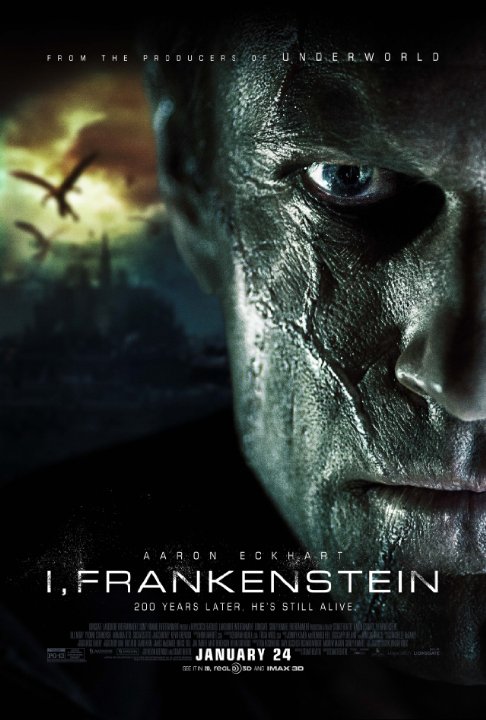
I, Frankenstein (Stuart Beattie 2014)

MV5BMjM3Mzk2MDU3N15BMl5BanBnXkFtZTgwMzg1NTI4MDE@._V1_SX640_SY720_and so anyway it turns out that the best thing about I, Frankenstein (2014) is not (the German) Victor Frankenstein’s misbegotten scheme two centuries ago in Ingolstadt (Germany) to add an extra layer of security to the details of his reanimation process by writing his journal in English so no one could read it, but that very kindly, just over halfway through the movie, Aaron Eckhart takes the time to reassure the viewer that ‘whatever happens, it ends tonight’, which was frankly a relief…

China Miéville, The Scar (London: Macmillan, 2002)

200px-TheScar(1stEd)[A version of this review appeared in Foundation 86 (2002), 132–4]

The Scar returns to Perdido Street Station’s Bas Lag, but it is not a novel about return: it is about departure and loss. Part of that loss is the sense that the author, with his bold opening move of denying New Crobuzon, has learned all he can from Mervyn Peake; and consequently it wobbles, or seems to wobble, in the first 60 pages.

Peake has often been criticised for leaving Gormeghast in the final volume of his trilogy – a criticism with which Miéville does not necessarily agree but to which he has clearly paid attention. New Crobuzon, that brilliant invention and potential albatross, does not appear in The Scar. For the reader wanting a consolatory return, New Crobuzon has become like M. John Harrison’s Egnaro; indeed, an alternative title for the novel might have been ‘A Young Man’s Journey to New Crobuzon’. Miéville is too ambitious to serve up just more of the same, and that is why the novel wobbles at the start (or seems to: I am not exempt from wanting consolation), why the world seems a little thin to begin with, why the visit to Salkrikaltor City seems skimped, curtailed. The opening pages reek of impatience. Like the protagonist Bellis Coldwine, the author needs to depart, to move on, and through her he transforms his refusal to return to New Crobuzon into part of his thematic complex about a mature regard for the universe and the compassionate identification with others that it demands of ethico-political beings.

Which is not to say that those pages are not full of the restless invention, exemplary prose and visualisation we have so quickly come to expect from Miéville. And even when Bas Lag does not seem as dense and filled as it might, there is still the sense of a dense, full world lurking out of sight, of whole other volumes that can only be hinted at. On the very first page we read that ‘Presences something between molluscs and deities squat patiently below eight miles of water’; and on the next page that ‘There is heroism and brute warfare on the ocean floor, unnoticed by land-dwellers. There are gods and catastrophes’. But that is all we are told.

Forced to flee New Crobuzon, Bellis (a former lover of Perdido’s Isaac Dan der Grimnebulin) plans to settle for a while in the colony of Nova Esperium, but her journey is interrupted, diverted, hi-jacked. She finds herself caught up in the plans of the Lovers, the sado-masochistic and megalomaniac rulers of Armada, and in the conspiracies and counter-conspiracies of Silas Fennec (aka Simon Fench), a secret agent, and Uther Doul, the Lovers’ right-hand man. She witness scab-mettlers fight in the mortu crutt style and displays of stamp-fighting; she walks upon Machinery Beach; she eavesdrops upon the Lovers sexualised scarifications; she is courted by Doul and hears him play the Perhapsadian; she learns about oceanic megafauna, the Ghosthead Empire and possibility mining. And she is used, and punished, and used some more.

But that is a mere fraction. There is the magnitude of the Lovers’ hubristic designs for Armada; the resistance of the Brucolac, the ab-dead vampir ruler of Dry Fall; the grindylows’ pursuit of Fennec; the story of Crawfoot and the Conch Assassins; the Remaking of Tanner Sack; Bastard John, the dolphin; the education of Shekel and his romance with the Remade Angevine; the peculiar adventure of the cactacae Hedrigall; awkward friendships and alliances; there is a none-too-secret message hidden in the open, an extraordinarily bad pun (471) involving the Maguffin which drives one strand of the action, and an obscure joke about the author’s doctoral thesis (417–21), which he was completing alongside the novel. There are moments of great tenderness (Bellis teaching Shekel to read; Sack repairing Angevine’s boiler) and tremendous set-pieces (the attack of the she-anophelii; the Brucolac’s revolt and punishment; breaking into the Compass Factory; Hedrigall’s vision). And there is the anxiety of influence, manifested in numerous allusions to The Matrix (a character called Carrianne, Uther Doul’s sword-fighting in bullet-time) and to other nautical fantasies (the Aronnax Lab, the Pinchermarn, Tintinnabulum, Captain Princip Cecasan of the Morning Walker, a godwhale). There are various echoes of Bruce Sterling’s Involution Ocean and a game of pitch and toss borrowed from Tim Powers’s The Stress of Her Regard.

And, most importantly, there is a sustained critique of colonialism. The anophelii, isolated and under military guard, are remorselessly exploited by the Samheri cactacae, their access to information tightly circumscribed and their intellectual labours expropriated without reward. There are questions about who are the real slaves and who are the real pirates. There is a clear-headed explication of the mercantile motivation of exploration, and a revelation that changes our perspective on the grindylow. There is Machinery Beach, a complex image of ruination and potential, of the colonised world as both dumping ground and source of commodities:

Some way off were shapes she had taken to be boulders, huge things the size of rooms, breking up the shoreline. They were engines. Squat and enormous and coated with rust and verdigris, long-forgotten appliances for unknown purposes, their pistons seized by age and salt.
There were smaller rocks too, and Bellis saw that these were shards of the larger machines, bolts and pipework junctions; or finer, more intricate and complete pieces, gauges and glass work and compact steampower engines. The pebbles were gears, cogs, flywheels, bolts and screws … thousands of minuscule ratchets and gearwheels and ossified springs, like the innards of inconceivably tiny clocks. … The beach was an imitation, a found-sculpture mimicking nature in the materials of the junkyard. Every atom from some shattered machine. … She imagined the seafloor around the bay – reclaimed reef of decaying industry, the contents of a city’s factories allowed to collapse, pounded by waves and sun, oxidizing, bleeding with rust, breaking into their constituent parts and then into smaller shards, thrown back by the water onto the island’s edge, evolving into this freakish shore. … This is the flotsam Hedrigall meant, she realized. This is a graveyard of dead devices. There must be millions of secrets mouldering here into rust-dust. They must sift through it, and scrub it clean, and offer the most promising bits for trade, two or three pieces picked randomly from a thousand piece-puzzle. Opaque and impenetrable, but if you could put it together, if you could make sense of it, what might you have? (274-5)

And most of all there is the Lovers’ plan for Armada, in which they convince and cajole many to believe, regardless of its tremendous environmental and human consequences, because it might just bring wealth and power.

The Scar represents a further maturation of Miéville as a writer. If the novel lacks some of the profligacy which made Perdido Street Station such a joy it is made up for by a more disciplined approach to narrative and tighter control over intertextual riffs. His emotional and affective range has expanded, without abandoning the eyeball-kicks.

The Scar is the best nautical fantasy since John Calvin Batchelor’s The Birth of the People’s Republic of Antarctica and the most important one since B Traven’s The Death Ship.

It is arguably the first major novel of the anti-capitalist movement, and as I’ve said elsewhere, it makes Moby Dick look like a big fat book about whales.


China Miéville, Perdido Street Station (Macmillan 2000)

PerdidoStreetStation(1stEd)[A version of this review appeared in Foundation 79 (2000), 88–90. Which I think makes it the first thing on China to appear in an academic journal. Yay me!]

Vivid as a comic book, Miéville’s King Rat (1998), with its funky London and splendid conceit, and its passages of grace, charm and glee, was one of the most assured fantasy debuts of the 1990s. Like the bass beneath the treble, its narrative momentum and crafter prose danced the enchanted reader past the slipperiness of plot logic and duration. His second novel, Perdido Street Station, dwarfs King Rat – in words, weight, ambition, invention, accomplishment. It is a garuda to the former’s wyrman, and eagle to its flying monkey. Let me explain.

North of Myrshock, Shankell, Perrick Nigh and the Mandrake Islands; north-east of the Cacatopic Stain and the Shards; east of Bered Kai Nev, the Swollen Ocean, Gnur Kett and the Jheshull Islands; at the confluence of the rivers Tar and Canker, where they become the Gross tar: there lies the city of New Crobuzon, magnificent and squalid, powerful and corrupt, home to humans and others. A mysterious figure approaches. Isaac Dan der Grimnebulin, outcast scientist and corpulent dilettante, receives an unusual commission, as does his khepri partner, a renegade spit-artist. And so connections begin. Evil, irresponsibly cultivated, is accidentally unleashed. A company – neither quite a Seven Samurai nor a Dirty Dozen – gathers, although they do not all meet. Things emerge: winged rippers, artificial intelligence, the dancing mad god, class consciousness. Chaos theory is transmuted into crisis science. Dirigibles and aerostats criss-cross the troubled sky. The identity of a serial killer is slyly revealed. A vigilante steps in when it counts. Decisions, ethical and otherwise, are taken. People change and changed. Some die. All suffer.

The story told is a familiar one, yet different. It grips and exhausts. The birds, spiders, sewers, rooftops and hybrids of King Rat reappear exfoliated, as do the city’s alternative architectures, the shared worlds existing within but different from the built environment. The appetite for language that occasionally strained the earlier novel has grown to remarkable proportions but is disciplined by the clarity and efficiency of Miéville’s tempered prose; he delineates characters and settings with precision and compassion, building layers of texture rather than ornamentation. Some have suggested that New Crobuzon itself is the novel’s main achievement, but it is difficult to separate city from novel. Their fabric is intertwined and full of echoes: Gormenghast and Viriconium are here, and Cinnabar, Cirque, Dhalgren, Lankhmar, Malacia. London, too, both steampunk and contemporary; and where the lived music of King Rat captured coming-of-age in the late 1980s and 1990s, Perdido Street Station evokes the dark days of Thatcher, Major and Blair. Amid the ghettos and squalor, poverty and the appearance of difference are used as tools of state oppression. Secretive paramilitary forces who police ‘by decentralised fear’ (269) brutally suppress a strike and redefine it as a riot. Government, big business and organised crime are in cahoots. Military funding perverts scientific research and education. A suffrage lottery preserves privilege, and evil resides in a dome built on rubble-strewn wasteground.

Comparisons to Mervyn Peake and M. John Harrison are inevitable – Miéville acknowledges them both and even sneaks in ‘a storm of wings’ (159) – so here are some others. Miéville’s obsessive invention rivals William Gibson and Bruce Sterling, and, like Neal Stephenson, he wants to tell use everything (but for more important reasons). He writes with the compassion of Philip K. Dick at his best but without his misogyny and crude moral certainty. His gorgeous, tainted images match those of Elizabeth Hand, Storm Constantine and Poppy Z. Brite, but without the cloying atmosphere or swamping effect on narrative that sometimes mars their work. He depicts and art-world as well-realised as Misha’s, but more concrete and lacking in preciosity. He places the maimings and torments one expects to find only in Tim Powers within a political and ethical rather than mythopoeic framework. And he writes better prose than any of them.

He also mock the anxieties of sf’s ‘scientific’ patter and hand-waving, essays political doggerel and children’s songs, pastiches political journalism, satirises Judaeo-Christian despite for women, lampoons academic doublespeak, nods to Jonathan Swift and Ursula Le Guin, canonises the Jabberwocky – and still that is not all.

In King Rat, when the protagonist, Saul, briefly takes up with Deborah, a young homeless woman, he instructs himself not to patronise her but to treat her as a real person; and because the London Saul has come to inhabit is a fantastical one, this passage, with its conscious effort to bridge between textual and extratextual worlds, seems clumsy, a touch too didactic. Noentheless, it provides an important key to understanding the ethical fiction is attempting to construct. Similar moments, lacking in overt trans-diegetical moves and more smoothly executed, occur in Perdido Street Station: a brothel full of Remade whores and an act of betrayal offer mutual understanding; a trip to a freakshow, undertaken after some ninety pages of astonishments, refuses to conjure still more fabulous grotesques but instead portrays degradation, misanthropy and complacency. The nature of Perdido Street Station is such that it cannot gain King Rat’s purchase, however, awkward, on the extratextual world. Instead, these ethical and empathic moments occur within networks of interconnection. The key metaphor is provided by Isaac’s crisis science, which sees through consensual reality to the perpetual moment of crisis, to a precarious potential energy with which to drive revolutionary engines. It is, therefore, no coincidence that it is the striking vodyanoi dockers whose watercræft draws, albeit unconsciously, on this power. There are connections, Miéville insists, and in those connections, in shated being, there is hopeful energy; and, as Isaac, disgusted by the attitudes of other people at the freakshow, is reminded by a radical friend, ‘It turns … It turns quickly’ (88).

Of course the novel has flaws – some might find the Alien movies cast too large a shadow, or that Isaac’s mourning seems skimped (but not without reason), or that Miéville cares too much about his characters (whatever the hell that means), or that the reader is left as battered and drained as the company – but make no mistake: Perdido Street Station is the rich hallucinogenic dreamshit of genre, mutating into socialist fiction.

Wake up and smell the ordure.

Big Ass Spider! (Mike Mendez 2013)

MV5BMTk4OTU3NzY0MV5BMl5BanBnXkFtZTcwMDU5MTgwOQ@@._V1_SX640_SY720_and so anyway it turns out the best thing about Big Ass Spider! is not, as you might assume, its title, which, like Eight Legged Freaks (2002), no film could possibly live up to, nor is it the pleasure of seeing Lombardo Boyar, playing the offensively-written comedy ethnic sidekick, steal every scene he is in, because sadly that is not really much of an accomplishment, nor is it the unexpected Lloyd Kaufman cameo, no, the very best thing about Big Ass Spider! is that they seem to have brought it in on time and budget, more or less, I guess…

Eden Log (Franck Vestiel France 2007)

[A version of this review appeared in Science Fiction Film and Television 3.1 (2010), 157–61]

edenlogEden Log begins in darkness.

Water drips into water.

Ragged breaths.

Flashes of light reveal a man (Clovis Cornillac), caked in mud, waking, staggering to his feet. (Later, much later, we – and he – will learn that his name is Tolbiac, but for now he has no idea who or where he is.)

He finds a torch on a nearby corpse and in its intermittent light he creeps and crawls and climbs up out of this cave into the lower levels of a seemingly derelict industrial complex. Cables and roots, difficult to tell apart, hang from the ceiling, industrial detritus devolving into, merging with, the subterranean-organic. On the wall behind him, a half-seen diagram describes a process which seems to involve humans descending below ground and then later ascending. He presses through heavy turnstiles and is greeted by projections of half a dozen women, immaculately clothed and coiffed, who address him in multiple languages. In the ominously bland idiolect of a corporate shill, one of them states,

The contract is fair. It is thanks to your work below that you will build your paradise above. Look after the plant and it will look after you.

This pun on plant, which works in French as well as in English, opens up one of the several fields of ambiguity in which this often elliptical film nestles. The plant is both a miraculous tree of vast proportions, its roots reaching far underground, and the industrial complex which extracts sap with ‘infinite energetic properties’ from the tree so as to power a city.

eden-log-clovis-cornillacAs Tolbiac ascends through underground levels – a trajectory that materialises the vertical integration upon which the Eden Log corporation’s gradually unveiled monopoly depends – he encounters various others from whom he begins to piece together the world and its story. One man, suspended from a wall, claims to have brought down the system, but it is not entirely clear where he ends and the plant (in either sense) begins. Tolbiac triggers a recording of the final confrontation between the technicians and the guards: when faced with an information leak over their corporate malfeasance, the nature and extent of which will only later become clear(er), Eden Log overrode all protocols about the relative autonomy of the subterranean levels and sent in guards to destroy the evidence and eradicate the threat.

1242613626_3The plant has been responding to its escalating exploitation by releasing a toxin that mutates the workers into strange, no-longer human creatures. Tolbiac’s struggle against transformation wavers when he finds an uninfected woman (Vimala Pons) and, suddenly abhuman, rapes her. He is appalled by what he has done, and what he is becoming. She elects to accompany him up to the surface, not knowing that he has infected her.

Eventually, having pieced together most of the puzzle, Tolbiac is recognised – and, at last, named – by the guards he used to command. Pretending to be himself, he cons his way past the guards and plugs himself into the plant, which has always been sterile, infecting it with life. It erupts, shattering the dome that contained it, and expands to take over the deserted city, transforming it into a beautiful – and colour-filled – landscape.

Eden Log actually begins not in darkness but with a quotation:

Therefore the Lord God sent him forth from the garden of Eden to till the ground from whence he was taken. (Genesis 3:23)

Tolbiac’s initial emergence from the mud might be taken as a reworking of the creation of Adam in The Bible: In The Beginning… (US/Italy 1966), replacing John Huston’s achingly – and thus camply – tasteful images of an inspirited wind blowing aside yellow sand to reveal the first man with birthing imagery that is rather more fecal, fluid and feminine. Eden Log certainly invites psychoanalytical readings: its setting recalls the maternal interiors of Alien (Scott UK/US 1979), the rape carries strong overtones of a primal scene fantasy, and Tolbiac’s ascent into realms of language and control, the realm from which he fathered himself, plays out an Oedipal entry into the Symbolic.

The biblical quotation can also be interpreted as Vestiel’s announcement of his transition to directing feature films. Previously, he had directed three episodes of the French cop show, Central Nuit (Night Squad 2001– ), and gathered assistant director credits on numerous films, including Blueberry (Renegade; Kounen France/Mexico/UK 2004), adapted from Jean ‘Moebius’ Giraud’s bande desinée, and Ils (Them; Moreau and Palud France/Romania 2006). Such experience undoubtedly prepared him well for shooting a film in the dark, in confined spaces[1] and with an elusive – some have claimed incomprehensible – narrative with religious overtones.[2] Many of the reviews of Eden Log struggled to make sense of a film with the narrative structure of a Paul W.S. Anderson video game adaptation but stripped of his prolonged action sequences and clearly-defined (if one-dimensional) characters, motives and goals. Struggling to make sense of their disappointed expectations, reviewers typically drew fairly insubstantial comparisons with THX 1138 (Lucas US 1971), Le dernier combat (The Last Battle; Besson France 1983), Cube (Natali Canada 1997), Pi (Aronofsky US 1998) and Primer (Carruth US 2004), among others – often for no better reasons than Eden Log being a first film, French, black-and-white (sort of), low-budget, visually striking and/or elliptically plotted.

A more productive comparison might be drawn with Tsukamoto Shinya. Although Eden Log lacks the viscerality of Haze (Japan 2005), in which a man likewise drags himself through a mysterious subterranean location, Vestiel shares Tsukamoto’s eye for post-industrial landscapes – for once-essential components mutating into something almost-organic – along with his taste for apocalyptic rebirth and a posthuman otherness that defies eutopian-dystopian binaries.

Vestiel’s decision to begin the action in overwhelming darkness, with intermittent flashes of light that reveal less than they show, recalls the opening of The Texas Chain Saw Massacre (Hooper US 1974), with which Eden Log shares an energy crisis narrative about the dehumanising effects of capital. But it also announces that Eden Log is self-consciously a film. Garrett Stewart argues that

cinema exists in the interval between two absences, the one whose loss is marked by any and all photographic images and the one brought on by tossing away each image in instantaneous turn. (xi)

For him, the presence of still photographs within the diegesis functions as a reminder of the photogram, the still image that is held in front of the viewer for a twenty-fourth of a second as the film is projected but which is never seen or experienced as a still image. Vestiel’s prolonged stretches of darkness between each flash of light work in a similar manner, to remind us of the unseen dark absence which replaces each photogram in succession.

This filmic self-consciousness is further developed by the projection of images within the diegesis. For example, in the sequence in which Tolbiac replays the recording of the final attempt at negotiation before the guards invaded the subterranean levels, he must scurry to raise into the air a variety of surfaces so that the recorded dialogue can be accompanied by images projected onto these détourned screens, rematerialising a profilmic moment that is no more and reminding us that the

filmic medium is the once having been there of the represented spaces themselves, absented by necessity to make possible the materiality of their moving image on the track. (Stewart 5)

Later, a wizened figure, attached to the plant but slumped as if dead, is eerily animated as an earlier recording of him is projected onto his unmoving face. This play between the inanimate and the animated – which resonates strongly with the decision to strip the film stock of all colour, apart from the occasional revenant touch of red and green[3] – confronts us once more with the interplay between the substrate and the surface of the filmic experience itself. As Stewart notes,

photography engraves the death it resembles, [whereas] cinema defers the death whose escape it simulates. (xi)

Vestiel’s striking use of light and darkness, his flickering between presence and absence, the visible and the invisible, is matched by a refusal fully to explicate the world of the film or the narrative. By adhering to Tolbiac’s amnesiac perspective as he pieces together information from the thinnest and most elusive of expository clues, Vestiel situates the viewer in the space between obscurity and illumination. Even those adept in the relevant genre conventions will find themselves frustrated by Vestiel’s grimly playful evasion of specificity – a strategy clearly announced in the rape scene.

Having raced together into a room-sized elevator, Tolbiac removes his unknown companion’s helmet, revealing that she is a woman. With increasing passion – and apparently in flashforward – they begin to make love. This is soon intercut with another image stream in which the sex is reconfigured as Tolbiac violently raping the woman, and with a third in which he seems to be looking on in disgust at himself. The scene ends with Tolbiac slumped against a wall in dismay, and with the woman curled up in a corner, crying; and yet when he finds a way out, repeating to himself, ‘It’s not me, it’s not me’, she accompanies him.

While it remains unclear what has actually happened between Tolbiac and the woman, the frequent complaint in online commentary that the scene is gratuitous and that it makes no sense for the woman to follow her rapist indicates the extent to which generic framings can override the indeterminacy of the specific. This troubling conjuncture of community and violence, the flicker between affective intersubjectivity and aggressive domination, between what might be and what is, is at the core of the film’s critique of contemporary power.

Eden_LogThe Eden Log corporation’s circular logo which reappears throughout the film contains a diagram of tree as an intricate network, branching out in all directions. This potentially rhizomatic image is disrupted by the corporation’s name, which bisects the circle horizontally, turning the network into a tree with branches above ground and roots below. It forces verticality and thus hierarchy onto the image. The tree, as Deleuze and Guattari argue,

plots a point, fixes an order (7)

even as the rhizome that this tree places under erasure

expose[s] arborescent pseudomultiplicities for what they are. (8)

Indeed, the film’s working title, Network Zero, suggests the point at which vertical hierarchy severs and deforms lateral multiplicity. The plant – both the tree and the factory housing it – is a synecdoche for the Eden Log corporation which owns it, part of the biopolitical order that, according to Michel Foucault, extends and veils the disciplinary sovereign power of the state to

make live and let die. (241)

In the closing minutes of the film it is revealed that Eden Log has promised immigrants who labour in the plant will be rewarded with citizenship, and concealed from the citizens that the plant is feeding on its workers. Eden Log has a vision of ‘a new social order’ built upon this ‘integration’ of non-citizen outsiders into ‘our civilisation’, and believes that when the truth is revealed that ‘our citizens will accept what our needs impose on these populations’. This exemplifies the manner in which biopolitical governance moulds populations to serve the economy. It can be seen as the logic of the Holocaust, in which the

death of the bad race, of the inferior race (or the degenerate, or the abnormal) is something that will make life in general healthier. (Foucault 255)

But it is also the logic of the supposedly free market.

And to this sovereign power Eden Log counterposes zoē, the

simple act of living common to all living beings (Agamben 1)

which is shared by the abhuman not-death-but-continuation of the mutated workers and the plant-human-machines, and by the climactic, uncanny efflorescence of computer-generated nature.

Notes
[1]
Eden Log was shot in a damp, freezing ten-acre mushroom bed sixty feet below ground, as well as water decontamination stations and sewers.

[2]
Vestiel co-authored the screenplay with Pierre Bordage, co-writer of Marc Caro’s less-than-coherent Dante 01 (France 2008), on which Vestiel also worked as assistant director.

[3]
There are two other bursts of (rather artificial-looking) colour when, courtesy of CGI, the plant effloresces. Stewart suggests that

in the second half of this century, science fiction has continued, more and more vividly, to imagine the technologies that would outdo it, do it in. In the digital era, however, futurist cinema has for the first time mobilized rather than merely evoked its own self-anachronizing upgrades. Engineered by computer enhancements, the super-annuation of a suddenly hybrid medium has become manifestly planned obsolescence, performed from within rather than simply foreseen. (222)

Works cited
Agamben, Giorgio. Homo Sacer: Sovereign Power and Bare Life. Trans. Daniel Heller-Roazen, Stanford: Stanford UP, 1998.
Deleuze, Gilles and Félix Guattari. A Thousand Plateaus: Capitalism and Schizophrenia. Trans. Brian Massumi. London: Athlone, 1988.
Foucault, Michel. Society Must Be Defended: Lectures at the Collège de France 1975–1976. Ed. Mauro Bertani. Trans. David Macey. New York: Picador, 2003.
Stewart, Garrett. Between Film and Screen: Modernism’s Photo Synthesis. Chicago: The University of Chicago Press, 1999.