120 years of sf cinema, part two: 1915-1934 (links galore!)

2015 marks the 120th anniversary of sf cinema. This is the second part of a year-by-year list of films I’d recommend (not always for the same reasons), and there are a few years where there is little to recommend for any reason.

Part one, 1895-1914

1915
Les vampires (Louis Feuillade)

1916
Verdens Undergang/The End of the World (August Blom)
20,000 Leagues under the Sea (Stuart Paton)

1917
Ever Been Had (Dudley Buxton)

1918
Himmelskibet/A Trip to Mars (Holger-Madsen)

1919
Die puppe/The Doll (Ernst Lubitsch)
Die Spinnen/The Spiders (Fritz Lang)

1920
Dr Jekyll and Mr Hyde (John S. Robertson)
One Week (Edward F. Cline and Buster Keaton)
Der Golem: Wie Er in die Welt Kam/The Golem (Paul Wegener and Carl Boese)

1921
L’Atlantide/Queen of Atlantis (Jacques Feyder)

1922
The Electric House (Edward F. Cline and Buster Keaton)

1923
Paris Qui Dort/The Crazy Ray (René Clair)

1924
Aelita (Jakov Protazanov)

1925
Orlacs Haende/The Hands of Orlac (Robert Wiene)
The Lost World (Harry O. Hoyt)

1926
The Magician (Rex Ingram)

1927
Metropolis (Fritz Lang)
Sur un Air de Charleston/Charleston (Jean Renoir)

1928
Spione/Spies (Fritz Lang)
Alraune (Heinrich Galeen)

1929
Frau im Mond/Woman in the Moon (Fritz Lang)
The Mysterious Island (Lucien Hubbard)
High Treason (Maurice Elvey) – silent and talkie versions on pay per view at BFI player

1930
Just Imagine (David Butler)

1931
Frankenstein (James Whale)
A Connecticut Yankee (David Butler)

1932
Island of Lost Souls (Erle C. Kenton)
Doctor Jekyll and Mr Hyde (Rouben Mamoulian)
F.P.1 Antwortet Nicht/F.P.1 Doesn’t Answer (Karl Hartl)

1933
King Kong (Ernest B. Schoedsack and Merian C. Cooper)
The Invisible Man (James Whale)
Das Testament des Dr Mabuse (Fritz Lang)
Der Tunnel (Curtis Bernhardt) – French version

1934
Gold (Karl Hartl)

Part three, 1935-54

The Reef (Andrew Traucki 2010)

The-reef-poster-2010jpgand so anyway it turns out the best thing about The Reef (2010), a based-on-a-true-story shark attack movie, is the side betting on the shark’s or sharks’ (it remains unclear) taste in television when it/they eventually show up; will it/they go for the actors who’ve been in Neighbours first, or those who’ve been in Home Away, or the one who has been in both, or the one who has been in neither but was one of McLeod’s Daughters?

The robot dinosaurs of Bristol

During the Triassic period, the parts of Pangaea which now constitute Britain drifted from the equator to more or less its current location. But with the break-up of the prehistoric supercontinent, ‘Britain’, which had spent much of the Permian underwater, dropped below sea-level once more. And although that is where it spent most of the Jurassic and Cretaceous, there were periods when the land was above sea-level, some of which lasted for as many as twenty million years.

And during those dry years, dinosaurs walked the land. Not just any dinosaurs – but, as recent fossil evidence reveals, robot dinosaurs!

dino1

dino2

dino3

dino4


Fehér isten a.k.a. White God (Kornél Mundruczó Hungary 2014)

whitegodIf you like dogs, and you like revolution…

If Jupiter Ascending has whetted your appetite for films in which a girl and her dog fight against tyranny and longueurs…

Trailer

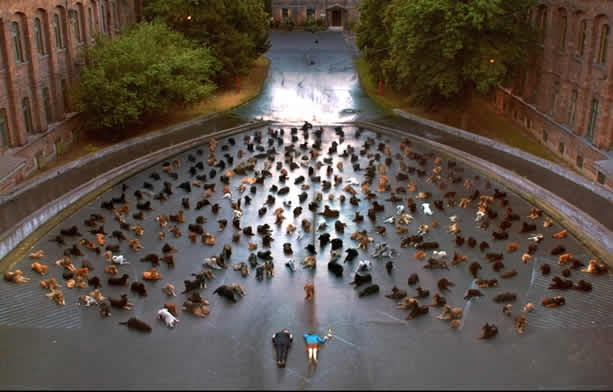
White God begins with a beautifully composed aerial shot of a major Budapest intersection. The streets are deserted. A tiny figure cycles up onto the flyover.

It has a familiar eeriness to it – like the deserted Waterloo Bridge near the start of 28 Days Later…, but without the graininess, the obvious digital compositing. And, shot from so far above, it is as much about the construction of urban spaces and the ways they channel us as it is about the shocking emptiness of this particular space at this moment.

The cyclist – a young girl, Lili, maybe thirteen years old – passes an abandoned car, its doors wide open, and descends into the city streets. Through intersection after intersection. Patient, determined. As if searching, cautiously and with trepidation.

Then the dogs appear.

Dozens of them.

Running.

Not from something, but toward something. With purpose.

They barely even notice her.

The film leaps back a few weeks. Lili’s mother and her partner are off to Australia for three months, so she is left with her father – once a professor, now a meat inspector at an abattoir, dishevelled and disgruntled. (He is inspired by David Lurie, the protagonist of JM Coetzee’s Disgrace (1991)). Lili insists on taking her dog, Hagen, with her.

The tension between estranged father and daughter soon focuses on the dog, culminating in Hagen being abandoned by a busy roadside.

The film then follows two paths.

white god-feher isten-zsofia psotta-hagenAn oh-so-arthouse mildly prurient exploration of the occasionally sexualised Lili’s pubescent struggles – with her father, with older teenagers from the orchestra in which she plays trumpet – as she tries to find Hagen and ultimately reconciles with her father.

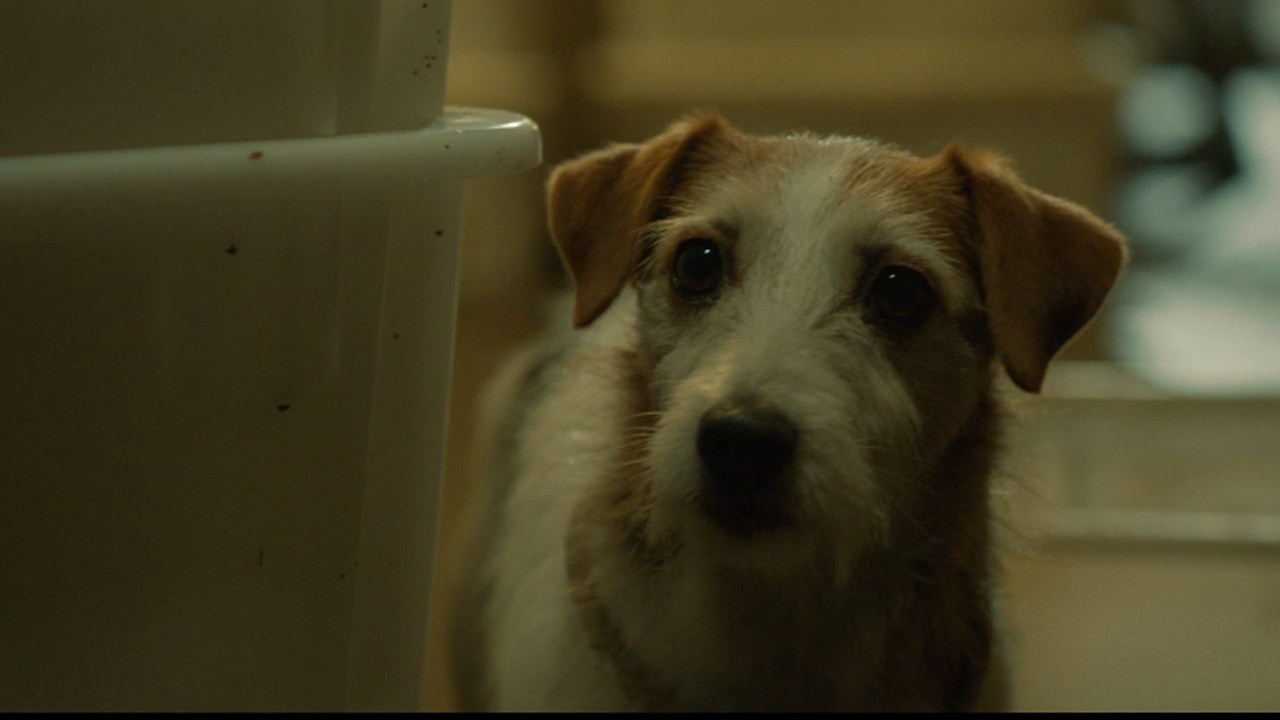
And the story of Hagen’s life as a stray. He is befriended by a dog_THUMB-1418155236944scruffy terrier, who teaches him about life on the streets, how to find food and water and shelter. How to avoid the city dogcatchers. Le barkour. But Hagen is eventually caught and sold into the world of dogfighting.

In the arena he quickly learns the horrible cost of this so-called sport.

Soon, Hagen finds himself in the dog pound, facing a lethal injection. He rebels, rather bloodily, and frees the other dogs.

He is Barktacus; they have nothing to lose but their chains.

The canine uprising has begun.

A lot of the criticism the film faced after winning the Un Certain Regard prize at Cannes last year has to do with the supposed murkiness of its metaphor. This is typical of critics who don’t quite get how fantasy works, and who are incapable of finding value in the fantastic until they have translated it into the mundane. What exactly do the dogs stand for? They don’t have to stand for anything. Let them just be dogs; they will accrue meaning(s) regardless.

In complaining about the purported failure of White God‘s symbolism to symbolise some particular thing clearly, critics unwittingly clamour for an unambiguous one-to-one allegorical correspondence between manifest and latent content. Which is precisely what they would complain about if the film actually did do something so lunkheaded. That would be like  valuing Orwell’s Animal Farm (1945) so highly solely because it is a roman à clef of the Bolshevik revolution and the emergence of Stalinism, rather than because it is also much richer and more ambiguous than that.

Kornél Mundruczó has cited a range of sf influences – Alien, Blade Runner, Terminator – although his film probably comes closer to Conquest of the Planet of the Apes (1972). He inevitably mentions Bresson’s Au hazard Balthazar (1966), and more surprisingly the films of Fassbinder and of Sirk:

For me, White God and All That Heaven Allows is the same story. Both discuss how society confines and forces people to behave.

The genius of Sirk’s film is to move between the constraints faced by a middle-aged widow and the repressiveness of an entire society. Mundruczó’s film is perhaps less successful, but the alternation between the two narrative strands creates a similar critical resonance. It is about race and about immiseration and about state power and about the tyranny of free markets; about family, gender and generation; about species; about surviving and providing and being better than the unhomely world we daily build will allow.

It is also about crossing The Incredible Journey (1963) with The Birds (1963) with Zéro de conduite (1933) or, better yet, Hue and Cry (1947), and throwing in a little Pied Piper of Hamelin, so as to rework, as its anagrammatical title suggests, Sam Fuller’s White Dog (1982).

Does it work? Not quite. But that did not keep me from enjoying loads of it, mostly the doggy parts.

Some might complain about the film’s typical liberal substitution of a vague warm fuzzy feeling for the coherent revolutionary politics it is incapable of imagining. But it is a film that functions primarily on an affective level. There is so much simple joy to beb9114194-0ea0-4e19-8aa1-312cd5d19455-460x276 found in seeing dozens of dogs, all different sizes and shapes and colours, running freely together, in fast motion and slow, that the image of revolution undergoes a quite radical transformation – it is violent and scary, but it is also comical and energetic and charming and delightful, as any worthwhile revolution must surely be.

And almost incidentally it does have some good politics in the mix. According to dog-trainer Teresa Miller, the two dogs playing Hagen don’t quite understand that they are dogs, and so simply did not get that they were supposed to be leading the pack. So although Hagen runs near the front of the pack, he never leads it. He is no Bane, which helps keep the canine rebels from becoming some clumsy reactionary representation of Occupy or Indignado or Tahrir or Syntagma, and which helps keep him unmuzzled. white-godAnd the film ends in media res, not with a Butch Cassidy and the Sundance Kid (1969) memorialisation of an already foreclosed future but, like The Birds, with the future still open … and if Hagen and his dogged comrades can just get to the horses, the cows, the sheep, the birds….

Note While leaving the cinema, I was momentarily thrown by the end credit I thought read ADDITIONAL CATS.

Out of the Unknown: ‘Come Buttercup, Come Daisy, Come…’ BBC2 8 November 1965

Patricia 'Paddy' Russell
Patricia ‘Paddy’ Russell

The second original script for the series has, like ‘Stranger in the Family’, a contemporary setting (but is rather less adventurous in its use of location shooting – just the exterior of an old suburban home and the Putney street outside). The writer, Mike Watts, had primarily worked for various ITV companies, although in 1965 he also scripted a couple of episodes of the BBC’s The Troubleshooters (1965–72); in addition to writing original dramas and episodes, he wrote or co-wrote several British crime movies, all of them comedies, The Pot Carriers (1962), The Cracksman (1963), Crooks in Cloisters (1964), which I remember fondly but haven’t seen in about a million years, and Joey Boy (1965). The director was Paddy Russell, one of the first two women directors at the BBC. Originally an actress, she appeared in a 1950 adaptation of Karel Capek’s The Insect Play for BBC Sunday-Night Theatre (1950–59) and in two different and uncredited roles in a couple of episodes of Nigel Kneale/Rudolph Cartier’s The Quatermass Experiment (1953); she quit acting to become Cartier’s floor manager and then a director. Despite a long and varied career that lasted until around 1980, and included everything from 55 episodes of Z Cars (1962–78) to 15 instalments of the gameshow 3-2-1 (1978–87), she is probably best remembered as the director of Doctor Who’s The Massacre of St Bartholomew’s Eve (1966), Invasion of the Dinosaurs (1974), The Pyramids of Mars (1975) and The Horror of Fang Rock (1997). Here, she does an excellent job of never letting the potentially ridiculous aspects of the story teeter over into the comical.

OOTU Come buttercup Repeat 12th August 1966‘Come Buttercup, Come Daisy, Come…’ tells the story of Henry Wilkes (Milo O’Shea), a fishmonger and an obsessive gardener who, thanks to his weekly, year-long correspondence with the mysterious Mr Pringle, has managed to grow a number of exotic species which should not even survive in the UK. He has, in fact, grown them to monstrous size, feeding them experimental foodstuffs as well as diced rabbit and cockles. There is something odd about them, though. Birds stay away from the garden. Wilkes, who has given the plants names, also talks to them, and they respond, although we do not hear their voices or what they say; their sentience, however, is confirmed for viewers by their physical responses to his proximity and touch, and the way they extend feelers to grasp at the food he scatters on the soil. Wilkes goes as far as to steal hextellenium, a dangerous chemical, from the pharmacy next to his shop to use in an experimental formula to make Nobby, his favourite among the plants, grow even bigger and stronger.

come-04Indeed, Wilkes is so obsessed with plants as living beings that he berates his new shop assistant, Anne Lovejoy (Patsy Rowlands), for dressing the displays of fish with parsley – he refuses to stock the herb in an effort to discourage his customers from making parsley sauce – and for putting tomato and lettuce in her cheese sandwiches. She is extremely devoted to her new boss, ever so slightly a-quiver when he is around.

come-01Monica Wilkes (Christine Hargreaves) is a nervous mess, concerned her husband no longer loves her and driven to distraction by the weirdness the garden exudes. Although she has witnessed nothing in particular to distress her so, she senses it is somehow unnatural. She suffers from headaches and depression, and her only comfort is her pet dog, Mina, an obvious child surrogate whom she obsessively sketches and paints. (If the story was told from Monica’s point of view, it might be rather like Charlotte Perkins Gilman’s ‘The Yellow Wallpaper’ (1892).)

This potential middle-class love triangle comes to the fore when Dr Chambers (Desmond Jordan) is brought in to consult on Monica’s ‘nerves’. (He is a private specialist, rather than an NHS doctor, which is significant to the class politics of the story: there are clear social hierarchies, including ones around education, the amateur and the professional.) Chambers bluntly asks Wilkes whether the source of Monica’s anxiety could be that he is having an affair with another woman.

But something else entirely is going on. Something rather queer.

comeThere is a tradition of sf/horror stories about sentient plants, from HG Wells’s ‘The Flowering of the Strange Orchid’ (1894) to John Wyndham’s The Day of the Triffids (1951) to The Thing (from another World) (Nyby 1951) to Scott Smith’s The Ruins (2006). Many of these stories are obsessed with reproduction, especially Don Siegel’s version of Invasion of the Body Snatchers (1956), in which the peculiarities of human sexual reproduction are mapped onto a post-war world world being transformed by commodity production. In ‘Come Buttercup, Come Daisy, Come…’,  though, the plants are partly about masturbation and all about homosexual desire.

Wilkes comforts Monica with transparent – to us – lies. He is oblivious to Anne, even as he seeks her collusion in his secretive schemes; in a quite agonising scene, his efforts to make up for snapping at her lead to an intimate conversation, during which he is completely unaware of quite how likely she might be to misinterpret his sudden attention (Rowlands excels, as always, at combining self-deprecation, class aspiration, timidity and repressed desire). He has been engaged in a secretive correspondence with Pringle, a man whom no one has met and who regularly sends him odd packages. Wilkes takes special pleasure in the plant he calls Nobby. He thrusts his hands deep into Nobby’s leaves to administer a ‘morning tickle’, during which he calls the plant what sounds like ‘a little old plonker’ and then unquestionably a ‘great big silly old faggot’. And when he plunges a syringe full of his special formula into Nobby’s roots to make his favourite even bigger, the framing of the shot makes it look as if Wilkes is fumbling with his penis. Elsewhere, he describes himself to Anne as ‘the biggest cockle-eater in the business’.

And Nobby is a jealous lover. He devours Mina, and then barks like the dog so as to lure Monica to her death; and then when Anne turns up, laden with cockles for Wilkes…

outunknown8bigThe script was originally commissioned as a seventy-five minute drama; cutting it down to sixty-minutes (even then, it overruns by a minute), might be why the end seems a little rushed, fizzles a little. On the one hand, there is no revelation that Pringle is really an intelligent plant, which is probably a good thing; but there is certainly left open the unexplored possibility that Nobby or the other plants are telepathically controlling Wilkes and others…

Other things to watch out for
— Patsy Rowland’s reverse acting when the plant wraps its tendrils around her neck
— The quite astonishing line after Wilkes tears a plastic flower off one his customer’s bosoms: You can’t go out for a pair of kippers nowadays without getting raped.
— The expression on Patsy Rowland’s face when she walks out of the shop just in time to hear that line being delivered.
come-03— And Norman. Watch out for Norman. He is the pharmacist. He is also Eric Thompson, Emma’s dad and, far more significantly for world culture, the narrator of the English-language dub of  The Magic Roundabout (1965–77).

Previous episode, ‘Time in Advance

Next episode, ‘Sucker Bait

Sources
Out of the Unknown DVD boxset. BFI, 2014.

On Matters Locomotive and Tentacular; or, Four or Five (More) Things About China Miéville

[After finding yesterday’s old piece on China, I remembered doing this one, too. But on reading it, I have no memory at all of writing it. It’s from the Readercon 17 programme, back in 2006 when China and James Morrow were GoHs.]

This was the plan, the plan was this: I would get the first post-rush hour train from Bristol to London and be there by noon.
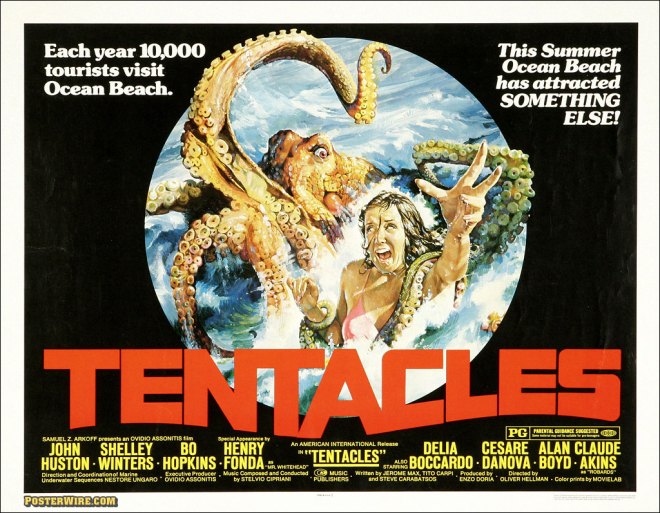
tentacles‘There’ is the Starbucks in Borders bookstore on Oxford Street, our default meeting-up place in central London, and we would leave ‘there’ as soon as possible, and grab some pizza at a place around the corner (where, a year earlier, our arrival had been greeted with rapturous applause from the staff – not because they recognised China, but because they’d been open for almost an hour and we were their first customers that day). And after lunch, although the pretext for meeting up was discussing essay proposals for a book we are editing on Marxism and sf, we would head to the Natural History Museum to see the thirty-foot long, newly-on-display, giant squid.

That was the plan, the plan was that.

So of course that was not what happened.

Readers of King Rat and the stories in Looking for Jake (and a forthcoming project, as yet still a secret [Un Lun Dun, I guess]) will know that London is a strange place, where all kinds of unexpected things can happen; that the fabric of the city itself is fantastical. Strange chimera flit through the crowds, pausing to take fliers advertising clubs and bars and language schools from fastidiously scruffy young men and women being paid way less than minimum wage for their cash-in-hand labour, and roar in anguish, in bafflement, at this world which is no longer theirs, and retreat temporarily into the interstices, before emerging once more, hooked on it. Creatures, remnants from another time, can be glimpsed in the reflective surfaces of department stores and sandwich shops, phone booths and passing buses. Others dance across the rooftops. And then there’s the people, who are pretty fucking strange.

But our delays and derailments are far more mundane. Family. Trains. And by the time we get ‘there’ it is gone two o’clock. (There was an amusing incident involving a borrowed phone in case China needed to contact me, which he does, but by text, which my quick briefing on this new-fangled technology did not cover. I manage to find the message but am uncertain how to reply. I amaze myself by finding China’s number in the phone’s address book, so I call and leave him a message. The number later transpires to be that of his old phone. But I will omit this is at makes me sound much too old yet insufficiently curmudgeonly. And has nothing to do with trains or cephalapods.)

Lunch is relocated to an Italian restaurant, which does a pasta dish China likes involving little balls of fried courgette and spinach. Our arrival prompts neither adulation nor irony.
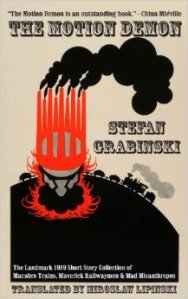
51M+qPPQDFL._SY344_BO1,204,203,200_‘Trains,’ I tut, to boost my curmudgeon-score as we share a mezze and several varieties of bread. But we have been talking about trains a lot, lately. I have a crazy notion that there is a book to be written about trains and early cinema and time-travel (but very distinctly not about early railroad films or time-travel movies), and China’s voracious reading, especially the research for Iron Council (and for his review of Stefan Grabinski’s The Motion Demon), keeps throwing up gems. It’s like having a really good research assistant I don’t have to supervise or pay (although he has still not returned my copies of The Iron Horse, Once Upon a Time in the West and Emperor of the North Pole).

These are the three things he tells me.

‘The seemingly obvious use of the railroad to “mean” Manifest Destiny, as in Zane Grey’s The U.P. Trail, is only permissible because of the peculiarity of that particular railroad. It really did only have one line, at least for a brief moment, but much longer iconically, and that’s been the source of a lot of notions of the unilinearity of the railroad, which are completely spurious. Not even a consideration of the siding or even the parallelism of tracks (necessary unless all trains are going only one way, a patent absurdity). So railroads aren’t even a misused symbol – they only work symbolically because of a lie.’

‘Of a failure, no, a refusal, to observe accurately,’ I suggest, ‘because that would strip the metaphor of its political potency.’

The mezze is really good.
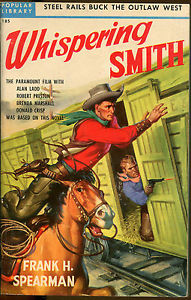
$_35Iron Council riffed heavily on Frank Spearman’s Whispering Smith. Spearman was a sort-of libertarian, reportedly Ayn Rand’s favourite writer, did lots of stuff about rugged railwaymen. Whispering Smith is a troubleshooter for the railroad who is allowed to go anywhere and do more or less anything, including kill anyone necessary, to “fix problems”. It is an extremely perspicacious critique of rugged individualist/libertarian railroadism (as I’ve christened the ideology), because contrary to the “enlightened self-interest” of the Randists and half of Spearman’s own characters, the thrusting of the rails is only possible with a roving assassin – a man in a permanent state of Schmittian law-making exception! – bringing peace for capital-expansion at the end of a gun beyond the bounds of the rails. So the railroad relies for the always-spurious solidity of even its semiotic status to the right on an implicit awareness of beyond-railroad coercion of the most violent kind. Spearman, a cunning writer, recognises this and rather than attempt to conceal it, hides its in plain view.’

‘Agamben,’ I mutter, sipping a rather non-descript red wine, knowing that his Schmitt reference is more astute than my name-drop (but then he did study – and write a book on – legal theory). I refill my glass and reflect on how it is possible for China to talk so enthusiastically about stuff despite his rather non-committal approach to drinking.

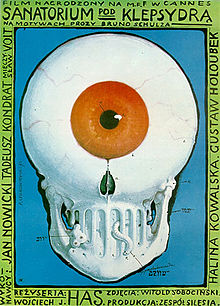
220px-Sanatoriumpodklepsydra‘And then there’s Bruno Schulz, using trains (in several different ways – history as both inside and outside the train itself, on the rails as well as in the corridors) to think about the alterity of history and alternate possibilities. I’m increasingly interested by the idea of the multi-track nature of railroads, let alone Grabinski’s sidings, as key to their importance. There’s this astonishing passage in his ‘The Age of Genius’ in The Sanitorium under the Sign of the Hourglass:

Ordinary facts are arranged within time, strung along its length as on a thread. There they have their antecedents and their consequences, which crowd tightly together and press hard one upon the other without any pause. This has its importance for any narrative, of which continuity and successiveness are the soul.

Yet what is to be done with events that have no place of their own in time; events that have occurred too late, after the whole of time has been distributed, divided and allotted; events that have been left in the cold, unregistered, hanging in the air, homeless and errant?

Could it be that time is too narrow for all events? Could it happen that all the seats within time might have been sold? Worried, we run along the train of events, preparing ourselves for the journey.

For heaven’s sake, is there perhaps some kind of bidding for time? Conductor, where are you?

Don’t let’s get excited. Don’t let’s panic; we can settle it all calmly within our own terms of reference. Have you ever heard of parallel streams of time within a two-track time? Yes, there are such branch lines of time, somewhat illegal and suspect, but when, like us, one is burdened with contraband of supernumerary events which cannot be registered, one cannot be too fussy. Let us try to find at some point of history such a branch line, a blind track onto which to shunt these illegal events. There is nothing to fear. It will all happen imperceptibly: the reader won’t feel any shock. Who knows? Perhaps even now, while we mention it, the doubtful manoeuvre is already behind us and we are, in fact, proceeding into a cul-de-sac.

‘Isn’t that fucking amazing?”

I have to agree.

I also have to confess.

This was the plan, the plan was this: over lunch we would talk wisely and wittily about arcane things, scare the children at the next table with our profanity and their parents with out erudition (or vice versa). It is not that China is scarily geeky (although he does know his shit), nor that I cannot write convincing dialogue (although I cannot); but rather that China’s words come from a long and almost painfully helpful email he sent me after a phone conversation about matters locomotive.

Conversation over lunch that day really focused on our childish enthusiasm for all things cephalopodic and tentacular. I’d recently rewatched Jon Lurie’s series of fake fishing documentaries, Fishing With John, in which he takes various celebrities – Jim Jarmusch, Tom Waits, Matt Dillon, Willem Dafoe – on improbable fishing expeditions. The series ends with a two-parter in which John – who died while ice-fishing with Willem in the previous instalment, a fitting punishment considering they used the proper equipment rather than chainsaws to cut through the ice – is discovered to be not only alive and well but taking Dennis Hopper fishing for giant squid in the Andaman Sea. After arduous travels, unsuccessful angling, a sidetrip to see some squid-worshipping monks who warn of the giant squid’s hypnotic powers, they finally meet with success, of a sort. A giant squid rises to the surface. But all is not well. Disorientation strikes Dennis and John. What is going on? Has something happened? They leave Asia disconsolate, because despite seeing their prey up close, it hypnotised them, and they believe their expedition a complete failure.

Jeff VanderMeer’s name of course crops up, as it always does in squidversations. But a new potential source of delight is introduced. An aside about James Woods not sleepwalking through a performance but actually sleeping through a performance in ER triggers a memory deep in China.

‘Have you ever,’ he asked, ‘seen Tentacles? I’ve only heard about it – a 70s Jaws rip-off about a giant octopus – in which John Huston literally phones in his performance. Apparently, he finally gave in and agreed to appear in it on the condition that he didn’t have to leave his own home to do so. So his performance consists of him sitting on a lawn-chair on his own lawn, saying things over his own phone like, “Hmmm, yes, that does sound like it could be the work of a giant octopus”.’

Neither wise nor witty, neither arcane nor profane; more geeky than erudite; but it certainly did scare the children sat at the table next to us. And their parents.

***

Coda 1. We did actually discuss the proposals and finalise the line-up for Red Planets: Marxism and Science Fiction.

Coda 2. The little balls of courgette and spinach are really rather good.

Coda 3. While China’s books are available at all good bookstores, it is worth noting that Tentacles is also available on region 1 DVD, but while I was able to pick up a copy for just five bucks, there is a heavy price to pay: it comes with the Joan Collins movie Empire of the Ants, a low point in a career hardly distinguished by its heights.

Coda 4. We never did get to the Natural History Museum to see the giant squid.

Coda 5. Unless we did but just can’t remember. Hypnotic powers, y’know.

Four or Five Things About China Miéville

[Just stumbled across this old thing I wrote for the Wiscon 17 Programme Booklet in 2003, when China and Carol Emshwiller were GOHs]

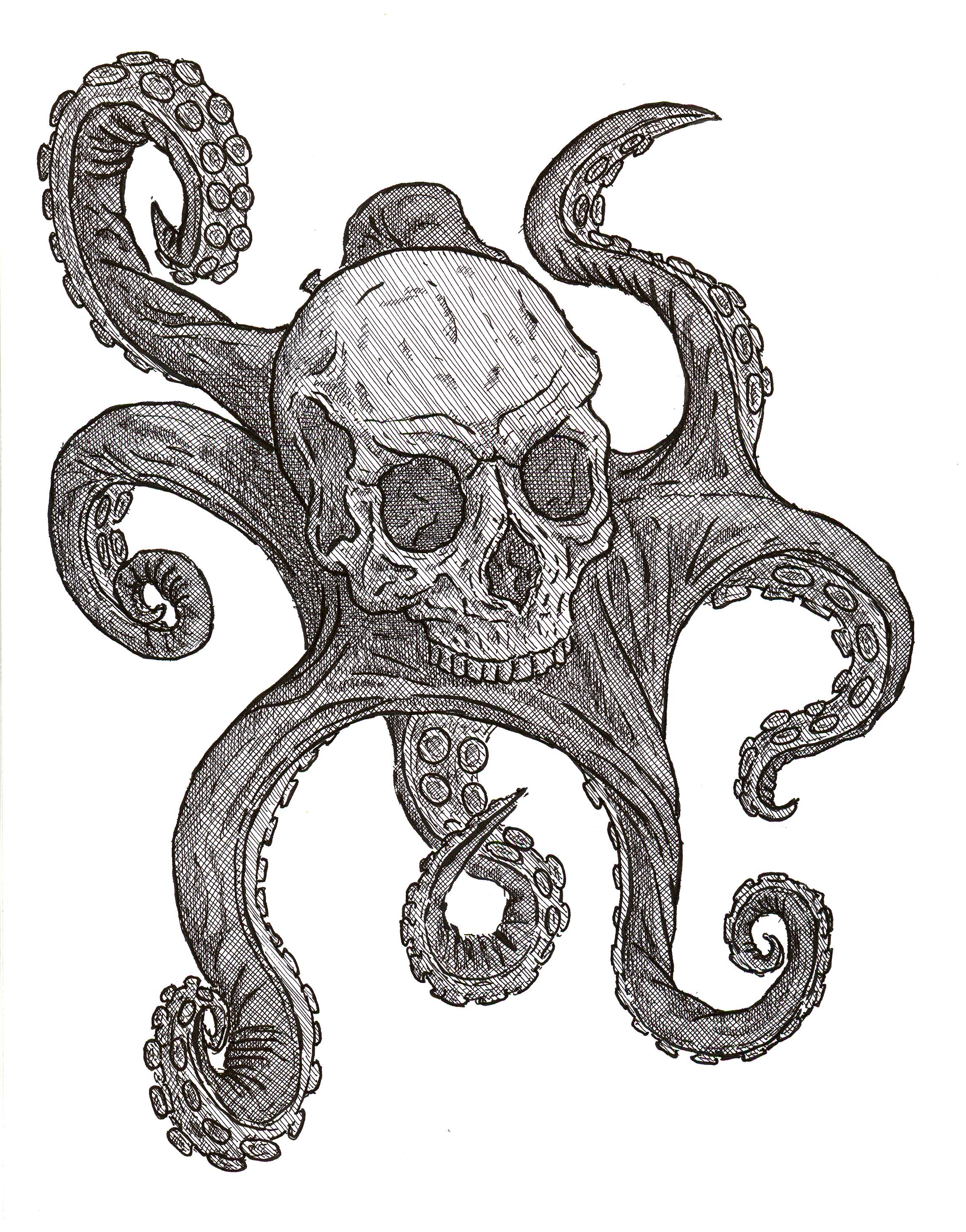
Skulltopus011 Saturday September 28th 2002 was a bright and clear day in London. Which was just as well, because China and Emma were late. A group of us had arranged to meet at the National Film Theatre’s Café on the South Bank of the Thames at 12.30. From there, we would cross the river to the Embankment to join the protest march against war on Iraq and for a free Palestine.

In a way, though, the delay didn’t matter. Despite early police claims that there were only 40,000 protestors, it was clear there were ten times that number. It’s not like anyone would have noticed if we were late.

But coffee had been drunk and impatience was setting in and the crowd on the opposite bank was swelling and China wasn’t answering his mobile phone.

Suddenly, in the distance, a sighting.

Arms were waved. Watches were pointed at extravagantly. Tutting noises were made.

China and Emma arrived. China was breathless, not from rushing but from excitement. ‘Sorry we’re late, but you won’t believe what we’ve just seen. We had to stop and watch. We were walking through the park, and there was this pelican. Fucking huge, and it just swooped down and ate a pigeon. It was gross. You could see the pigeon struggling in its gullet.’

China was right. Nobody believed him.

Not that the story was completely implausible. It’s just that impish Mike Harrison had already started the rumour that en route they had popped into John Lewis – an irredeemably bourgeois department store – to buy some things for their new flat.

To this day, nobody believes China’s story about the pelican and the pigeon. But for some reason everybody seems to take a special delight in preferring to believe Mike’s version of events.

***

One of China’s favourite passages of our sf explanation is to be found in Eric Flint’s 1632. It goes like this:

So that’s about it folks … Somehow – nobody knows how – we’ve been planted somewhere in the middle of Germany almost four hundred years ago. With no way back.

It seems like this passage might soon occupy that special place in China’s heart once reserved for a line from the underrated Prince of Darkness:

Nothing anywhere ever should be able to do what it is doing.

***

China’s taste in movies is a bit hit-and-miss.

He’s right about Prince of Darkness – it is underrated. He’s right about Being John Malkovich – the more you think about it the worse it becomes. He’s right about Donnie Darko – it is a little too knowing for its own good. And he’s right about Daredevil – even it if was identical in every other respect, it would have been massively improved by casting Eric Stoltz instead of Ben Affleck.

But he will insist on the genius of the first five minutes of X-Men.

And that Fight Club is a great movie.

***

One of China’s favourite comic book panels is to be found in an old Trigan Empire strip from Look and Learn. It is night-time. On a roof in a city an old man and a young lad are stargazing. Suddenly there is a noise. They both look alarmed.

What was that?

say the old man. The boy replies:

It sounded like a large party of men rushing stealthily down the alley!

***

Last autumn, I was diagnosed with Hodgkins lymphoma. We got home from my first session of chemotherapy about 3.30pm on Friday 15th November. Around 4.00pm the doorbell rang. China and Emma had sent me a huge bouquet of flowers with a hope-it-went-okay kind of message. Later that evening I phoned to thank them, and the first thing China did was apologise in case receiving flowers from a male friend made me feel awkward.

It was a rugged, ironic, manly thing to do; but, in truth, I’d never before received flowers from a male friend and I’d no idea feeling awkward about it was even an option.

***

Perhaps these tidbits, incidents and events will provide a future biographer with things around which to drape some insights into China’s character. But I will leave it to you to decide what it all might mean.

[A sort of sequel piece can be found here.]

Stephen King, Doctor Sleep (2013)

514NhnvVinL._SY344_BO1,204,203,200_This is, I shit you not, the one about evil gypsies abducting children.

Admittedly, the gypsies are actually some kind of energy-vampires, who traverse the US in the guise of middle-aged people in RVs. And they don’t merely abduct the infants, but slowly torture them to death to release more of whatever kind of energy it is they chow down on. And one of the infants in their sights is a girl in her teens who can shine way more powerfully than anyone else. And she knows Danny Torrance, who has grown up to become, like his father, an alcoholic, but is in Alcoholics Anonymous and sober for most of the book.

But mainly it is about gypsies abducting children. I shit you not.

Despite being a sequel to The Shining, it mostly isn’t. It shares Danny and one location and some references to Hallorann and Wendy (in whom King still cannot muster any interest) and inserts them into a mildly and differently fantastical version of the contemporary US. It is smoothly competent – the riff on Jerome Bixby’s ‘It’s a  Good Life’ (1953) is nicely done, but the allusion to The Silence of the Lambs sits there for no reason like a lump in your pablum – but it is hardly gripping, suspenseful or scary. It is like bathing in a cup of tea the way my mum makes it.

King’s semi-autobiographical account of Danny’s experience of AA, of its practices and processes, suggests a strong resonance with neoliberal culture’s emphasis on getting the individual to surveil and manage him/herself, to hope for little more than surviving daily, to self-scrutinise, to locate responsibility within the self – anything rather than fix the society that produces alcoholism. But this is thin stuff, too.

Not everyone agrees. For example, Margaret Atwood says that ‘by the end of this book your fingers will be mere stubs of their former selves’.

Presumably because gypsies stole the tops of them.

PS My other Shining-related posts can be found here, here, here and here. (And boy am I kicking myself for forgetting when writing about Room 237 that Yanis Varoufakis’ book is called The Global Minotaur: America, Europe and the Future of the Global Economy.)

The Shining (Mick Garris 1997)

Stephen_King's_THE_SHINING_(mini-series_intertitle)Stephen King just won’t let it go.

There is an ‘Author’s Note’ at the end of Doctor Sleep (2013) that, under the guise of clarifying that it is a sequel-by-popular-demand to his 1977 novel rather than to Kubrick’s 1980 film of The Shining, says of the latter: ‘many seem to remember [it] – for reasons I have never quite understood – as one of the scariest movies they have ever seen’ (483). The next paragraph does not proclaim the TV miniseries King himself adapted as superior to the movie, but it does sing the praises of his more-or-less-reliable-hack director Mick Garris’s Psycho IV, as if to trump Kubrick with a Hitchcock.

It is coyly done, as if King knows it is not at all convincing.

But anyway, as part of my ongoing preparation for teaching Kubrick’s film as a cult movie, after reading the novel I watched the miniseries over several nights. I would have got through it sooner, but after episode one my ever-patient housemate cried no más, and scheduling became an issue – poor thing missed out completely on the slightly less terrible second and third episodes…

The main problems with the miniseries are its plodding adherence to the novel and the deadening literalness of its treatment of the supernatural elements. All it takes is that first glimpse of Danny’s (Courtland Mead) imaginary friend Tony (Wil Horneff) bobbing about in the air to realise quite how brilliant Kubrick was to have Danny (Danny Lloyd) talking to his finger instead. (Probably didn’t help that it immediately took me back to being thirteen and watching Tobe Hooper’s Salem’s Lot (1979) miniseries and bursting out laughing at the supposedly scary bit when the fat vampire kid taps on the window.)

These two intertwined problems began to fill me with dread when the first episode started obsessing about the topiary animals, trying to make them ominous. Will they be brought to life as badly as the cgi hosepipe? How could the bush-animal attack sequences – presumably originally inspired by Ray Bradbury’s ‘The Veldt’ (1950) – possibly work?

I generally find Bradbury overrated, but even I must concede the novel’s reworking of this material makes make him seem subtle.

Screen shot 2012-02-29 at 13.50.16Garris very sensibly, if not very effectively, relies on camera movements, editing and switching-in props to bring the topiary lions to life. Until the ‘cliffhanger’ ending of episode two, the final shot of which shows Danny being stalked unaware by three cgi shrubs. (They do not appear again except fleetingly in the climax of episode three. Thankfully.) To be clear, this is not ragging on the special effects because they are bad, but because they are badly chosen.

Generally, the physical effects work best, but there is something so amiss about the individual episodes’ and the series’  pacing that they too become a problem. The first couple of times a door opens or closes or an object moves mysteriously is fine, but you pretty quickly find yourself wondering whether it is always the same bloke hidden just out of shot pushing the door, how much he gets paid, what he had for lunch… Not so much ‘how did they do that?’ as ‘why?’ And it does make you wonder what exactly they spent the $25 million budget on.

I guess, in part, the format is the problem. Economics dictate that a network TV miniseries made in the 1990s can’t be too scary or unnerving or disturbing, so the supernatural horror has to be blandly by-the-numbers and the domestic abuse material has to be displaced as far as possible.

So I have a lot of sympathy for the cast.

Winifred Torrance is a badly underwritten character in the novel – all I can really remember is King banging on about her breasts – and she is no better served by a script that slaps on a bunch of embarrassing clichés. Garris does not seem to have any idea what to do with her, and Rebecca De Mornay struggles. Indeed, in episode one, she even seems to struggle to walk across rooms, although she does do one brilliant bit of almost indiscernible crabstepping down a hotel corridor that is simply not wide enough to accommodate three or four actors walking abreast.

Steve Weber, as Jack, has the easier job – do what Jack Nicholson did but not the way he did it. Even so, it is only when the later episodes allow Weber to ham it up that he becomes even remotely effective, and in the second half of episode theshining1997three, this is largely down to his make-up – which gives him the appearance of a beaten-up, tear-stained clown.

As Danny, basin-cut Courtland Mead clearly shares no genetic material with either of his parents. He looks like one of those profoundly unattractive children who used to get cast in Dallas or Dynasty for no reason other than that their dad was a producer on the show. His performance does get better in the later episodes, and his unexpected ‘I love snow’ song is a bizarre delight, but I kept finding myself wondering whether the alcoholic, physically abusive Jack ever used his son’s enormous teeth to open beer bottles.

Most of the time the three principals, especially De Mornay, have the air of people wondering how much longer they are going to have to keep this up for…

The decision to play Ullman (Elliot Gould) as a mincing lisper is a really poor choice, but not as badly judged as Stephen King’s cameo as bandleader Gage Creed – at least he didn’t black up for his terrible Cab Calloway impersonation. (There is a chummy array of horror-related cameos: Frank Darabont, Peter James, Richard Christian Matheson, David J. Schow – and Sam Raimi stealing the bread from his brother, Ted’s, mouth.)

Pat Hingle, as Pete Watson, is probably the only actor to escape with his dignity intact, professionally ploughing through this nonsense the same way he has done since the 1950s.

But it is Melvin Van Peebles, as Dick Halloran, who has the best line:

911 ain’t the answer, ma’am, only wish it was.

Good to know that baadasssss is still out there.

The_Shining_Melvin_Van_Peebles_01

The Clay’s the Thing

From Bailiwick: Bristol’s Independent Listings Magazine

Jason Wyngarde talks to playwright Peter King about filming, feminism – and working with Ray Harryhausen

Peter King
Peter King

Local playwright and university lecturer Peter King is just back from Hollywood, where stop-motion animation legend Ray Harryhausen is putting the finishing touches to an adaptation of his play, Consciousness Rising.

‘Being home is disorientating,’ King explains, ‘because Los Angeles is so weird.’ His plane only landed this morning and he is feeling rather dishevelled. ‘Half the time you’re astonished the people talking to you can look you in the eye; the rest of the time you’re surrounded by talented, hard-working folks whose names appear so far down the credits not even their mums stick around to see them. And LA’s so familiar from films and TV that you constantly have these moments of epiphany. I was in a bookstore on Venice Beach and I suddenly realised, “My god, this is exactly where the Rock stood in Southland Tales!”’ He laughs. ‘I’m not going to convince anyone that that was an epiphany, am I? I won’t tell the story about traipsing around the Westin Bonaventure, trying to find the spot where Gil Gerard stood in Buck Rogers…’

Ray Harryhausen
Ray Harryhausen

The question everyone’s asking, though, is not about LA but about how he got to work with Harryhausen. ‘Ray’s amazing. He’s been doing this for seventy years and he still loves it. His stuff is an indelible part of my childhood. The sword-fighting skeletons, of course, like everyone else. And I really loved the octopus in It Came from Beneath the Sea – the effects budget was so tight on

Terror of the sextopus

that movie it only has six tentacles. Ray was doing a talk about his work at the Watershed, and we just kind of started chatting. He was visiting Aardman animation while he was in town because he was thinking about coming out of retirement one last time and he really, really wanted to do a film in claymation. Something different, something focused on human interactions, and when I mentioned Consciousness Rising – which he’d actually heard of, from a granddaughter, I think – he asked to see a copy of the script. Serendipity. Nothing in life is ever that easy.’

Nothing?

‘Well, we also had amazing luck with the voice cast. I had this list in my head of actresses who could play each of the characters, and we got all my first choices: Isabel Adjani, Holly Hunter, Jennifer Jason Leigh and Sarah Polley. There were two minor male characters we added for the film, only a few lines each, but Holly got us John Goodman, and Sarah and Jennifer picked on Don McKellar until he joined in. They all turned down scale, which was all we could afford, for a cut of the box-office, so really they worked for free because they believed in the movie, thought it was important. And once we had those names – along with Harryhausen and Aardman – the financing came together almost overnight.’

Skeleton army
Skeleton army

The film represents quite a departure for Harryhausen, and not just in the style of animation. ‘Well, it does have a fantasy premise of sorts, but yes, it is basically four women sitting, talking and drinking coffee. No mythological beasts, giant apes, Venusian lizards. No dinosaurs.’

So what is it about?

‘I spent years working with students who thought feminism was just this kind of dreary, dungareed monolith, this thing that happened in the past and was over and done with now. I wanted to find other ways to open up its liveliness and diversity, and its relevance. I spent a year working on a novel about Simone de Beauvoir’s relationship with Nelson Algren, but that was really about learning to imaginatively invest in the material, to make it come alive. And then I saw this Russian film, Chetyre, at the Arnolfini. It has this fabulous opening section with four strangers meeting in a bar and idly talking to each other – and that’s when the whole play came to me in a flash. It takes some counterfactual juggling of biographies, but basically, sheltering from the rain one day, de Beauvoir (Adjani) runs into Mary McCarthy (Hunter), Betty Friedan (Leigh) and Helen Gurley Brown (Polley) in a New York hotel. You have these four amazing women: a French existentialist philosopher; an anti-Stalinist socialist writer and critic; the author of The Feminine Mystique and first president of the National Organization of Women; and the author of Sex and the Single Girl and editor of Cosmopolitan. Four women who don’t know each other, the younger two yet to make their marks, all of them feminists but in profoundly different ways. And in their conversation over coffee, their differences of opinion and their common ground emerges. Second-wave feminism coalesces. It’s like the first consciousness-raising session, hence the title.’

Consciousness Rising premiered at the Tobacco Factory to impressive reviews, and the production toured all around the world. ‘I had a great group of women to work with there, as well. I borrowed a trick from Peter Watkins and gave each of them a huge pile of stuff to read about the women they were playing, about the society and culture in which they grew up. And then we just kept on workshopping until we had transformed my rough script into a play. It’s why they get co-writing credits; there is so much in the play that would not have been there without them. For the film, there was a different kind of workshopping – basically me learning from smart and experienced people how to make this into a movie. We opened it up, added some blokes and a couple of musical daydream/fantasy sequences. It’s the same story, but also a whole other can of fish, kettle of worms, now. I saw an almost finished cut two days ago – no, wait, that was yesterday – and Ray had organised a real surprise for me. He only went and put Joseph Gordon-Levitt singing “Natural Woman” over the end credits!

Kaffeeklatsch of the Titans opens in the spring.

It is not in 3D and does not star Sam Worthington.

13/12/10
This is the last of the old ‘by Jason Wyngarde’ pieces I will post here. It is all rather Mary Sue and doesn’t really work, but I have a fondness for it because when China Miéville posted a version on his old blog back in 2010 a whole bunch of people thought it was real. Go figure. (Actually one bit of it is sort of real only it happened differently. I saw Southland Tales weeks after being in the Venice Beach bookstore, but me and The Rock were both once in the same physical space, just sadly not at the same time, and I did get all excited about it. Same thing happened once with Cory McAbee, more or less, and a hotel in Perth.)