African Science Fiction 101: update 2

The months since my last update have been crazily busy with other things, so there has been little time for research and even less time for actually reading any of the goodies I’ve uncovered. Most of which are annoyingly inconvenient sizes and shapes to lug around with me over my Xmas perambulations. But I thought I would post another list before Xmas (and before that teetering pile of books in the corner falls over on top of me).

First up, I should mention the hugely embarrassing omission of Amos Tutuola from the article that started all this (and my indebtedness to Paul March-Russell for drawing it to my attention   in such a generous way). Truth is, I have never read anything by him, though The Palm-Wine Drinkard (1952), My Life in the Bush of Ghosts (1954) and Feather Woman of the Jungle (1962) may well 51ZoowIE8gL._SY344_BO1,204,203,200_be squeezed into the suitcase. As might D.O. Fagunwa’s Forest of a Thousand Daemons: A Hunter’s Saga (1939), translated by Wole Soyinka(!) – the first Yoruba-language novel, said to be an influence on Tutuola, not least in its fantastical landscape in which the supernatural is as real and present as the natural world.

While we’re in the margins of what might be considered sf, I have had a load of things recommended to me that might be more appropriately labelled ‘weird’ or ‘slipstream’:

  • Tawfiq Al-Hakim, The People of the Cave (1933) – a play based on the seven sleepers of Ephesus, who sleep their way into the future; their story is told in the eighteenth surah of the Qu’ran
  • Bertène Juminer, Bozambo’s Revenge (1968)41yjzEc0m9L._SY344_BO1,204,203,200_ – satirical alternate history in which Africans have colonised a swampy Europe full of idle, childish, pallid natives
  • Gamal al-Ghitani, The Zafarini Files (1976) – in a crowded corner of Sadat-era Cairo, a sheikh uses magic to take away men’s sexual potency
  • Olympe Bhêly-Quénum, Snares without End (1978) – there is an essay about him at Weird Fiction Review
  • Ivan Vladislavić, The Folly (1993), which seems to have a nice salvage vibe to it, if not exactly salvagepunk
  • Calixthe Beyala, How to Cook Your Husband the African Way (2002) – begins with a black woman explaining how she turned white, but not in quite the way I initially thought it was going to go
  • José Eduardo Agualusa, The Book of Chameleons (2004) – a murder mystery involving a trader in memories and identity creation
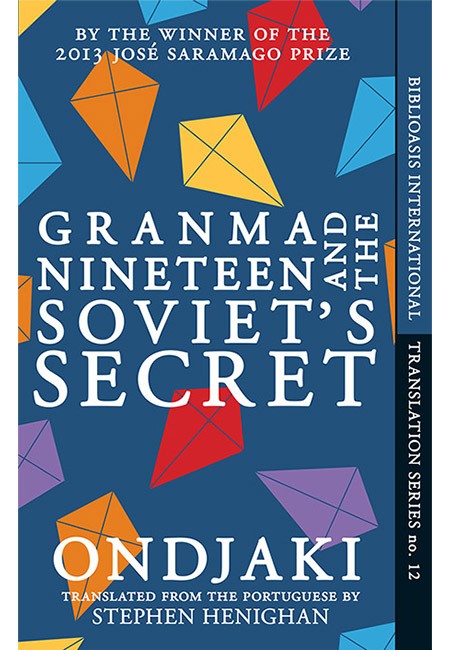
  • Ondjaki, Granma Nineteen and the Soviet’s Secret (2008) – a wonderful poetic novel, one of the best things I’ve read this year; there is something fantastical about it, but there is not any fantasy in it…
  • Franklin Rosemont and Robin DG Kelley, eds, Black, Brown and Beige: Surrealist Writings from Africa and the Diaspora (2009) – does what it says on the tin
  • Fiston Mwanza Mujilla, Tram 83 (2014)Tram-83-310px-square – according to reviewers it is ‘Blade Runner in Africa with a John Coltrane soundtrack’ that ‘transfigures harsh reality with a bounding, inventive, bebop-style prose’ and depicts ‘a world so anarchic it would leave even Ted Cruz begging for more government’
  • A. Igoni Barrett, Blackass (2015) – Furi Wakiboko wakes up one morning to discover he has turned white; well, all but one part of him has…

The more obviously genre works that have come my way include:

  • Charlie Human, Apocalypse Now Now (2013) – an urban fantasy thriller in Cape Town’s supernatural underworld
  • Masha du Toit, Crooks & Straights (2014)51Jp-br-R1L._SX310_BO1,204,203,200_ – YA urban fantasy in which Cape Town provides a home for magical refugees
  • Sarah Lotz, The Three (2014) – global thriller with horror/fantasy edge
  • SL Grey, Under Ground (2015) – while a lethal virus sweeps the world, the folks hiding out in a plush subterranean survival bunker find they have brought horror with them
  • Rob Boffard, Tracer (2015) – set on the falling-apart space station housing the last of humanity above a devastated Earth
  • Ivor W. Hartmann, ed., AfroSF volume 2 (2015)afrosf2 – contains five novellas by Tade Thompson and Nick Wood, Mame Bougouma Diene, Dilman Dila, Andrew Dakalira, and Efe Tokunbo Okogu
  • Jo Thomas and Margrét Helgadóttir, eds, African Monsters (2015) – contains fifteen stories and a comic strip by, among others, Dilman Dila, Nerine Dorman, Tendai Huchu, Sarah Lotz, Nnedi Okorafor, Tade Thompson, Nick Wood

(Should also mention Tade Thompson’s debut novel, Making Wolf (2015), although it is a crime thriller, not sf/f.)

One of the things I am interested in starting to trace is the role of speculation and futurity in African political discourse, which has recently led me to:

  • JE Casely Hayford (aka Ekra-Agiman), Ethiopia Unbound: Studies in Race Emancipation (1911) – a novel which apparently includes a vision of a future pan-Africa
  • Camara Laye, A Dream of Africa (1966) – a novel which apparently does the same

Taking of awkwardly shaped and sized books, as I was some time back, one final goody I stumbled across, which provides some useful context for thinking about African sf/f is Readings in African Popular Literature (2002), edited by Stephanie Newell. It reprints some critical articles, but also some fiction and comics and various pages from Drum magazine.


Lucy (Luc Besson 2014)

MV5BODcxMzY3ODY1NF5BMl5BanBnXkFtZTgwNzg1NDY4MTE@._V1_SX214_AL_and so anyway it turns out that the best thing about Lucy (2014) is the way in which Luc ‘the death of cinema’ Besson takes everything French cinema has ever learned from the Cinéma du look to Gaspar Noé, even down to borrowing the latter’s borrowings from Kubrick, and in a profoundly contemporary innovation uses it all to produce the most luridly hyperreal kinetic and yet astonishingly dull – not to mention hilariously literalist and just plain silly – powerpoint presentation imaginable, and yet thanks to the existence of Her (Jonze 2013) still fails to make the worst sf movie starring Scarlett Johansson…

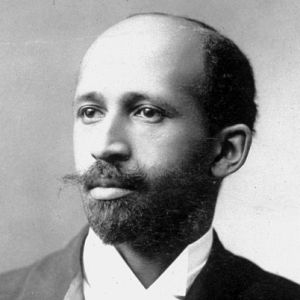
On W.E.B. Du Bois’s ‘The Princess Steel’ – his newly discovered sf/fantasy story

MTE5NTU2MzE2MjA2MDQwNTg3‘The Princess Steel’, a previously unpublished sf/fantasy story by W.E.B. Du Bois, can be found in the most recent issue of the PMLA (130.3: 819-829). It was written some time between 1908 and 1910, and there is an earlier draft called ‘The Megascope: A Tale of Tales’.

The earlier title acknowledges Du Bois’s self-conscious embedding of one tale within another within another. It also shows a clear sense of how the introduction of a science-fictional innovation (not really what Suvin means by the novum) functions as a narratological device to generate fictions. The Megascope shifts the story from one genre/diegesis into another and then into another – or, perhaps more accurately, revises the reader’s expectations of the story as it rewrites the rules of the world in which the story takes place.

‘The Princess Steel’ begins as an apparently realist story in contemporary New York, told with a certain wry humour, as the unnamed protagonist and his wife, in response to a newspaper advertisement, go to witness a scientific demonstration by the sociologist Professor Hannibal Johnson:

Now my wife and I were interested in Sociology; we had studied together at Chicago, so diligently indeed that we had just married and were spending our honeymoon in New York. … it certainly seemed very opportune to hear almost immediately upon our arrival of a great lecturer in Sociology albeit his name, to our chagrin, was new to us. (822)

To their even greater chagrin, Johnson is black (and initially they assume he must be the Professor’s servant). On reflection, however,

One would not for a moment have hesitated to call him a gentleman had it not been for his color. His voice, his manner, everything showed training and refinement. Naturally my wife stiffened and drew back and yet she felt me smiling and hated to acknowledge the failure of our expedition. (822)

This is an intriguing passage in that it is also the one at which we realise that the newly-weds are white. Their studies provide a clue to the likelihood of this, but it is only their assertion of the colour line that definitively places them on one side of it. By making it manifest in this way, Du Bois prepares the ground for a story that will use fantasy so as to imagine some of the determining forces of everyday life that many varieties of realism and naturalism, with their emphasis on surface detail, interpersonal relations and individual psychology, struggle to capture. Like naturalist Frank Norris’s incomplete trilogy of wheat (The Octopus (1901), The Pit (1903)), Du Bois’s first novel, The Quest of the Silver Fleece (1911), is an epic that attempts to map out the complex social relations of a single industry (for Du Bois, cotton); but even Norris, especially in his first novel, bows under the weight of the task and includes weirdly ecstatic visions, as if the real were too complex for mere realism. In this context, one cannot help but also recall the fantastical spirit that imbues Du Bois’s second novel, The Dark Princess (1928), especially when it draws closest to heavy industry in the stunning passage when protagonist Matthew Towns chucks it all in to become a manual labourer digging the subway tunnels:

Lakes and rivers flow … pouring from the hills down to the kitchen sinks with steady pulse beneath the iron street [and] great steel Genii, a hundred feet high, lumber blindly along at out neck and call to dig, lift, talk, push, weep, and swear [and us] houses sag, stagger, and reel … but …do not fall: we hold them, force them and prop them up [even as we] tak[e] away the foundations of the city and leav[e] it delicately swaying on air. (265, 266).

In ‘The Princess Steel’, however, Du Bois approaches the problem from the other side. His broadly realistic opening is just a frame for an exercise in the fantastic, using sf to access the allegorical as a means to draw out the unseen determinants of an exploitative patriarchal-colonial-capitalist modernity and contemporary social life.

Johnson’s library contains volume upon volume of The Great Chronicle – a record he discovered a quarter century earlier of the ‘everyday facts of life but kept with surprising accuracy by a Silent Brotherhood for 200 years’ (823). We learn no more about this surveillant order – perhaps for Du Bois an imaginative precursor to The Dark Princess’s secretive revolutionary Great Central Committee of Yellow, Brown and Black – but their copious records have enabled Johnson to develop the Megascope.

Rather than plunge into directly into allegory or deploy the kind of slippery kind transition into an alternative realm deployed in A Connecticut Yankee in King Arthur’s Court (1889) – I am insufficiently familiar with Du Bois’s biography to know whether he had read Mark Twain’s novel, but it does seem to me to lurk in the background of what is to come – Du Bois turns to scientific innovation, the very stuff of modernity, to investigate modernity. (Foucault scholars will be excited to learn that Du Bois begins with technologies of statistics and surveillance; Hegelians will have to wait a few moments longer for their fix.)

Professor Johnson first shows his visitors a mechanism by which a human deed can be represented in two dimensions on a ‘thin transparent film’ (823). Layering such films one on top of another produces a representation of the ‘history of these deeds in days and months and years’ (823) and, he explains, if

“these planes be curved about one center and reflected to and fro we get a curve of infinite curvings which is—”—he paused impressively—“which is the Law of Life.” (823)

He next reveals the ‘vast solid crystal globe’, ‘fifty feet in diameter’, on which he has spent twenty years plotting the curves of life; and for twenty years he has been thwarted in his quest for the ‘Great Curve … by curious counter-curves and shadow and crossing’ (823). This endless frustration has led him to hypothesise that

Human life is not alone on earth—there is an Over-life—nay—nay I mean nothing metaphysical or theological—I mean a social Over-life—a life of Over-men, Super men, not merely Captains of Industry but field marshalls of the Zeit-geist, who today are guiding the world events and dominating the lives of men. It is a Life so near ourselves that we think it is ourselves, and yet so vast that we vaguely identify it with the universe. (823)

And so he reveals the Megascope, with which he will reveal an Over-Man. First they see

the Curve of Steel—the sum of all the facts and quantities and times and lives that go to make Steel, that skeleton of the Modern World … the Spirit of the wonderful metal which is the center of our modern life, and the inner life of the Over-life that dominates this vast industry— (824)

I love this slightly awkward description of imaginary technology. It beautifully captures the extent to which all language – including and perhaps especially scientific language, for all its pretensions otherwise – is inherently and unavoidably metaphorical. Du Bois transition from more or less mundane descriptions of physical objects

with one more swinging of the lever there swept down before the window a great tube, like a great golden trumpet with the flare toward us and the mouth-piece pointed toward the glit[t]ering sphere; laced round it ran silken cords like coiled electric wire ending in handles, globes and collar like appendages (824)

to the heightened and elusive description of their purpose introduces an ineffable tone that eases the next generic switch.

The great tube’s window displays a vision of New York that transforms before the viewers. The landscape becoming apocalyptically fantastical as the view rushes towards Pittsburg, where steel mills rise like cyclopean castles or ‘the Mills of the Gods’ and between them move obscure and terrifying Things – the ‘Things of this New World, the World of Steel’ (824).

A giant knight emerges. He is the Lord of the Golden Way, a disembodied Voice explains, and then tells in some detail a cod-epic story – part medieval romance, part allegory. (It is only loosely allegorical – there is not the direct one-to-one correspondence between manifest and latent content insisted upon by allegory proper, so it might be more accurate to think of it as a symbolic story, but only so long as you then don’t fall into the trap of expecting each symbol to directly correspond to one specific symbolised thing in a clearly delineated overarching scheme (because that would be allegory proper, horribly reductive and maddeningly dull).)

The Over-Man Sir Guess of Londonton captures the Witch Knowal – the wife of the ogre Evilhood – and she tells him of ‘the dark Queen of the Iron Isles—she that of old came out of Africa’ (825) and who is held captive in the Pits of Pittsburg, along with her enchanted daughter, Princess Steel, fathered by the Sun-God . The Lord of the Golden Way agrees to help Guess rescue the Princess Steel from her enchantment in exchange for her treasure. This leads to inevitable conflict. Guess promptly falls in love with the freed Princess, but the Lord realises her treasure resides in her body:

her hair is silver and her eyes are golden, and … mayhap there be jewels crusted on her heart. (828)

Guess is defeated, and as the Princess watches over her fallen lover, the Lord of the Golden Way begins to spin strands of her hair, which is the steel upon which the modern world is built. The San Franciso and Valparaiso earthquakes of 1906 are signs of her rage at the Lord of the Golden Way and she warns him

I watch and ward above my sleeping Lord till he awake and then woe World! when I shake my curls a-loose. (829)

On this note – presaging the dire consequences of industrial modernity, of capitalist and colonial and gendered exploitation, which include the violent overthrow of such a world – the vision ends.

The wife has seen none of this because, a little troublingly, the megascope ‘was not tuned delicately enough for her’ (829). (Even in The Dark Princess, Du Bois tends to push Princess Kautilya, one of the key members of the revolutionary Committee, into domestic roles.)

The couple make a hasty exit.

In the PMLA, ‘The Princess Steel’ is introduced by Britt Rusert and Adrienne Brown, who are currently co-editing a collection of Du Bois’s sf, fantasy, mystery and crime fiction. The story is locked behind the journal’s pay-wall – but there are bound to be people out there whose universities have institutional access.

High-Rise (Ben Wheatley UK 2015)

highrise2After the varying degrees of self-importance, humourlessness and bloat Spielberg, Cronenberg and Weiss brought to their respective Empires, Crashes and Exhibitions, the very first thing screenwriter Amy Jump and director Ben Wheatley get right with their High-Rise is that Ballard is a comic writer.

A master of the modestly proposed deadpan preposterous, his dry technician’s prose fakes repression, barely concealing the glee with which he drones shock and flattens affect. This is pretty much impossible to reproduce in film. Cronenberg attempted it with Crash, and failed (Shivers got a lot closer, and is still the best version of High Rise that is not actually a version of High Rise).

Jump/Wheatley’s humour is much more their own, and they are sufficiently confident about it to have some fun with Ballard. There is, for example, a nicely played moment when Laing (Tom Hiddlestone) says something to Royal (Jeremy Irons) which is precisely the kind of impossible-thing-for-a-real-person-to-say that a character in a Ballard novel would say, prompting bemusement and discomfort in them both.

The second major thing Jump/Wheatley get right is to not update the setting of the film. Instead, we get a slightly different version of the 1970s, as if the decade went on a little bit longer and somehow became as attractive to look at as it clearly – and mistakenly – thought it was.

But this also reveals a problem with the film as an adaptation (as a Jump/Wheatley film, it is second only to Sightseers).

Ballard’s novel is very specifically about that moment in the early 1970s, when decrying post-war Corbusier-spawned high-rise developments was transforming from merely a fashionable posture to received wisdom (typically and conveniently forgetting that for many people moving from the slums to the new developments was headily utopian – indoor plumbing!). It was written when councils were withdrawing maintenance from post-war housing projects, and their residents were being blamed for the disrepair into which the untended buildings inevitably fell. It was written when working class residents were being demonised as intoxicated, glue-sniffing, violent, criminal – as creatures incapable of not fouling their own nests. It was written when the extent of the corruption behind many housing schemes was being uncovered (as in the John Poulson case, which reached all the way up to Home Secretary Reginald Maudling – you know, like in Our Friends in the North).

And so whether or not Ballard bought into this potent myth, nothing could have seemed more natural than to retell it, but with a cast of middle class professionals, with yuppies avant la lettre. The closing moments of the film do nod to Thatcher, and it is certainly the case that she – conveniently forgetting that many of the worst post-war developments were built by private companies, not by the state or local councils – drew on this myth to drive through her ideological war on council housing, thus creating the ongoing housing crisis in the UK.

But the conditions in which Ballard’s novel was written no longer exists, and the film – despite the way it captures middle-class social sadism – lacks that element of specificity that would provide a vital resonance. Consequently, Ballard, who should be shocking the bourgeosie, is suddenly heritage cinema, and that is just plain wrong.

Probably the most telling moment for me in this regard comes in the sequence when Richard (Luke Evans), slowly making his battered way up the building to exact his revenge, assaults Charlotte (Sienna Miller). A montage, which includes her timidly serving him a tin of dog food for breakfast the next day, plays out to Portishead’s cover version of ABBA’s ‘S.O.S.’. It is a beautiful version, transforming the pop song into a languid, mournful piece of music, as self-consciously ‘serious’ as one would expect from them. And in all kinds of ways it works brilliantly.

But it is completely the wrong choice.

They should have gone with the original version; not because it is better, but because the last thing the film needed was to fall into such clichéd caution. This is not to say that rape, even if only implied rather than depicted, should be treated frivolously; but rather that the film loses something by choosing to treat this particular moment as so very exceptional. At least using ABBA’s version might have been sufficiently inappropriate to shock audiences out of their complacency. But that was never going to happen. Despite all the potentially offensive material the film contains, it also wants to be respectable, and that is budget speaking, not art.

Don’t get me wrong. It’s an enjoyable film, and full of nice little touches, from sets which bring the brutalist concrete inside the apartments to an unexpected nod to Aladdin Sane and some great dancing.

But you know the way The Cabinet of Dr Caligari‘s static camerawork makes it not so much an expressionist film as a film of expressionist sets and performances? So High-Rise is a film of a Ballard novel, not a Ballardian film.

[Thanks to Mark Cosgrove for blagging me into the preview after the ticketing fiasco.]

Crumbs (Miguel Llansó Ethiopia/Spain/Finland 2015)

crumbs-the-first-ever-ethiopian-post-apocalyptic-surreal-sci-fi-feature-length-filmUltimately, the opening text tells us, the war became unnecessary. Perhaps it was a mutation, or perhaps bone-deep ideology just changed. But people gave up on survival, on perpetuating the species. (The cost, after all, had proven terrible.) The remnant population

slowly started to decrease, wane and languish like the dying flame of a candle that barely resists extinguishing itself. … The elderly passed on and the young became elderly. The news of the sporadic birth of a child, probably conceived out of neglect, was received with condescending smiles the same as in those who mock ignorant people who with pride show off their out of style garments.

Crumbs begins with a series of gently floating shots, starting with a broad view of the peculiar mineral structures in volcanic landscape of Dallol,[1] before moving in to detail their folded textures and colours. Water washes over the surface, as in something by Tarkovsky; the shots commute each other, as in something by Kubrick. A desert wind blows, accompanied by Atomizador’s throbbing alien score. There are mountains in the distance. A lone figure in a light shirt and darker trousers, with a satchel slung over his shoulder, makes his way through this alien yet terrestrial landscape. He is dwarfish, hunchbacked, deformed in some way. We will learn he is called Candy (Daniel Tardesse).

Among the rusting vehicle carcasses and other long-abandoned matériel are the remnants of a pipeline. In the ruins of the salt-block buildings he finds an artificial Christmas tree, its spindly green plastic branches still furled close to its metal trunk. In the distance he spots a figure (Quino Piñero). A man in a military uniform: a medal on his chest, a swastika on his armband, and a rat mask covering his head, grey ears visible above the gas mask covering his face. Candy flees. Distortion fills the soundtrack. Above the salt flats across which Candy runs floats a spaceship, an immense citadel hovering in these post-apocalyptic Ethiopian skies.

The tree is a gift for his lover, a young black woman called Sayat or Birdy (Selam Tesfayie) who makes sculptures from salvaged metal. In the derelict bowling alley in which they live – surrounded by fetishes hanging from trees like those in The Texas Chain Saw Massacre (Hooper 1974) – the ball return mechanism has started to activate itself. Sayat suggests that there must be a magnetic field being directed at it, as if someone, maybe the spaceship, which has been ‘rusting in the sky since the beginning of the big war’, is trying to send them a message. When Candy investigates the mechanism – like Henry (Jack Nance) in Eraserhead (Lynch 1977) looking behind the radiator – he finds something unexpected down inside it: a voice, that will later be revealed as that of a skinny black Santa (Tsegaye Abegaz) who might be very small or just a long way away.

Candy undertakes a quest to find out what is going on – a quest that will take him through the stunning green highlands around the Wenchi crater-lake, to a witch who won’t let him pay for her insights with the pristine copy of Michael Jackson’s Dangerous LP which is supposed to finance his wedding, and then on through an abandoned rail depot to the old city, and through it to a derelict lakeside zoo and a violent encounter with Santa Claus…

I have no idea whether there is a specific folktale lurking in the back of all this, an Ethiopian legend akin to the Malian epic of the crippled warrior-king Sundjata, and accounts of  Llansó’s improvisational style of direction – responding to what he finds on location – suggest that while there might be some such narrative armature the final film is unlikely to map onto it with any kind of precision.

It is a film full of allusions: Candy is challenged by a masked warrior on horseback who gallops up like something out of Zardoz (Boorman 1974) or The Planet of the Apes (Schaffner 1968); a bowling ball rolls mysteriously across the floor, like something from The Shining (Kubrick 1980); a rail line subsiding on a narrow stretch of land built across the middle of a lake recalls China Miéville’s Railsea (2012). There are also bits that reminded me of Space is the Place (Coney 1974) and Save the Green Planet! (Joon-Hwan Jang 2003).

There is the detritus of a lost world, given fresh meaning: a plastic figurine of TMNT Donatello, a Max Steel ‘Force Sword’ still attached to its colourful cardboard backing, a Michael Jackson album, a figure of a child asleep on a mattress, all of which are seen within the story world; and then once more, floating in Earth orbit as gracefully as a Kubrick weapons platform or space shuttle, while the voice of the shopkeeper (Mengistu Bermanu) describes them in relation to their production in the pre-apocalypse and their use by the legendary Molegon warriors – an amulet, an instiller of courage before battles, a reminder of the adored Andromeda baby and of its twin who lived in the pyramid of Cheops. There is an altar to Michael Jordan. Sayat, perhaps awaking from a dream, intones a fervent prayer to a string of deities: ‘Einstein IV, San Pablo Picasso, Stephen Hawking III, Justin Bieber VI, Paul McCartney XI, Carrefour!’ (Though the film is as dark as the storm raging outside, and it is possible she is chanting this litany as she masturbates.) There are also a lot of plastic dinosaurs, and a plastic lion. There are children’s superhero costumes. There is a cinema that has screened Süpermen Dönüyor, Kunt Tulgar’s 1979 Turkish Superman knock-off, every day for forty years, including the day on which we get a glimpse inside.

Candy’s quest brings him to a landscape littered with abandoned trains, rusting wheel-less cadavers, somehow both modern and prehistoric – like the rotting symbols of earlier waves of (failed) colonial expansion Conrad describes in Heart of Darkness (1899). Among them he finds a man who used to work for the railway (Girma Gebrehiwot), but the man does not speak. When Candy starts claiming that he is from another world – rocky, frozen, windswept – the man does not hear him; the discordant soundtrack – part Sun Ra, appropriately enough, part Texas Chain Saw Massacre – drowns his voice (a little like the bar scene in Twin Peaks: Fire Walk with Me (Lynch 1992)).

Candy moves on, past corroding watertowers that resemble abandoned Martian war machines. All he wants is to be able to return to his home planet, taking Sayat – and the child he intuits she is carrying – with him.

Some reviews of Crumbs suggest that its elliptical narrative, its congeries and clusters of salvage and allusion, defy meaning. That this rather gentle, beautiful, endearing film is somehow impenetrable. Such reviews are simply and straightforwardly wrong. Crumbs – probably  the best sf film to come out of Africa so far, and by a wide margin the best sf film of 2015 – is as easy to follow as the autobahn down which we are pellmelling to the end of the world.

We are living in the capitalocene moment, the gutted shell that is the present of the future Llansó depicts. The toys and costumes and other absurd relics, some in their original packaging, represent what Evan Calder Williams calls salvagepunk’s returning-repressed ‘idiosyncrasy of outmoded things’.

If I have one anxiety about this film it is that the unfamiliar landscapes it shows us are so beautiful they seem desirable. In this, it speaks to something dark in us. The thanatopic social sadism, recently anatomised by Miéville, the ‘thuggish idiot’s prometheanism’ that proclaims climate change is good for business; that longs with ‘spiteful glee’ for the further ruination of developing countries and the additional edge it will give to first-world corporations.  That yearning to wipe the slate clean. To purge the Earth of the human stain.

[Many thanks to Miguel Llansó, Ewa Bojanowska and New Europe Film Sales for giving me access to a copy of the film; and to China for flexing his celebrity to make it happen.]

Bibliography
Miéville, China. ‘On Social Sadism’, Salvage # 2: Awaiting the Furies. 17-49. 
Williams, Evan Calder. Combined and Uneven Apocalypse: Luciferian Marxism. Ropley: Zero Books, 2010.

[1] A ghost town in northern Ethiopia, build for potash mining in the early twentieth century. Photos here  – also google ‘Dallol’ for images of the astonishing landscape. And while you’re at it, take a look at ‘Wenchi crater-lake’.

Interstellar (Christopher Nolan 2014)

MV5BMjIxNTU4MzY4MF5BMl5BanBnXkFtZTgwMzM4ODI3MjE@._V1_SX640_SY720_and so anyway it turns out that the best thing about Interstellar (2014), a film in which Matthew McConaughey both keeps his shirt on and plays a magical bookcase from a galaxy far, far away, is not that they gave the bloke responsible for Clippy, the annoying Word for Windows Office Assistant, a second chance – this time to design robots – but that, even without a credited science advisor, Christopher Nolan and his brother Jonathan managed to grasp relativistic time-dilation effects with such precise and unrelenting hard-sf rigour that for every hour spent on the sofa watching the movie an eternity seemed to pass…

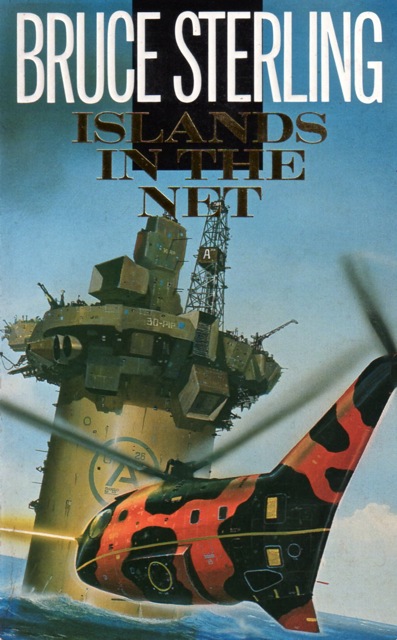
Afrocyberpunk 2: Bruce Sterling, Islands in the Net (1988), part one

BKTG17418If Gibson’s Neuromancer omits Africa and its peoples, including the diaspora, Bruce Sterling’s Islands in the Net (1988) might seem like a step in the right direction, at least inasmuch as it spends one long section in Grenada and (after visiting Singapore) another in Mali (with a brief snatch of coda passing through Algeria to Morocco). Intended as – or at least praised for being – a more realistic take on a global cyberpunk future, the novel offers an improbable variant on that old saw attributed to Fredric Jameson and Slavoj Žižek: it is easier for Sterling to imagine Americans happily giving up their guns than it is to imagine the end of capitalism. The novel is set in the 2020s, after the ‘Abolition’ (of nuclear weapons and conventional small arms). Under a new world order (that is pretty much the old world order but with fewer issues of national sovereignty getting in the way of a liberal-ish neoliberal hegemony) dominated by the ‘developed world’ which at least makes a point of feeding the ‘developing world’, albeit on ‘scop’, a cheaply produced single cell protein – ‘the national food of the Third World’ (38). If no one is exactly racing home to enjoy their dinner, no one need go hungry any more. Except in Africa, where such ‘aid’ enables the unscrupulous to accumulate power.

And that’s the problem. The future in Sterling’s novel is of the demoralising, predatory kind projected by the futures industry. As Kodwo Eshun writes, in such projections, typically produced by NGOs and multinationals,

African social reality is overdetermined by intimidating global scenarios, doomsday economic projections, weather predictions, medical reports on AIDS, and life-expectancy forecasts, all of which predict decades of immiserization. … Within an economy that runs on SF capital and market futurism, Africa is always the zone of the absolute dystopia. There is always a reliable trade in market projections for Africa’s socioeconomic crises. (291-2)

Such projections usually propose corporate intervention – the extension and intensification of the market – as the only possible solution.

Sterling introduces his future Africa through precisely such a modelling tool, David’s Worldrun game,

a global simulation. Worldrun has been invented as a forecasting tool for development agencies, but a glamorized version had found its way onto the street. … Long strips of the Earth’s surface peeled by in a simulated satellite view. Cities glowed green with health or red with social disruption. Cryptic readouts raced across the bottom of the screen. Africa was a mess. ‘It’s always Africa, isn’t it?’ [Laura] said. (10)

Later, David explains to a Pole called Andrei Tarkovsky (!) that in the game,

Protein tech, like [scop], is one of your major tools for world stability. Without it, there are food riots, cities crumble, governments go down . . . And not just in Africa, either. (137)

The sense, implicit in this comment, of Africa’s desperate exceptionalism, that it is the benchmark against which to measure the extent to which you have escaped disaster, barbarism, backwardness is everywhere in the novel. Describing the wired world of 2020 – a passage which is quite endearingly clunky in so badly missing the extrapolative mark – Sterling notes (more or less focalised through Laura) that ‘Most of the world, even Africa, was wired for telex these days’ (22). Rizome, the multinational for which David and Laura work, has decided to ‘negotiate’ with the data havens; Emerson explains

‘That’s a modern solution. It worked for the arms race, after all. It has been working for the Third World.’
‘Except for Africa,’ David said. (45)

After the lodge David and Laura run near Galveston is attacked, the mayor, Magruder, objects that terrorism ‘isn’t supposed to come down any more. … Maybe in Africa. … Not here.’ (70-71). The spook sent by Vienna (a metonym for the international conventions/agencies keeping the new world order in order) to investigate the attack muses about all ‘of those millions and millions of unfired NATO bullets … Too many even for the African market, eh?’ (77) – a point reiterated when Laura, in a Malian jail, overhears an execution:

They would often shoot a single man with five or six machine guns; their ammunition was old, with a lot of duds that tended to choke up the guns. They had a worldful of ammunition, though. All the ammunition of fifty years of the Cold War had ended up here in African war zones. Along with the rest of the junk. (355)

When Laura speaks obliquely about the attack to a mercenary, saying ‘I saw a man killed by a machine gun, once’, he replies ‘Oh, really? You’ve been to Africa?’ (270). Later, on the rogue nuclear sub that takes her to Mali, another mercenary tells her the story of how he ‘ended up in Africa’:

‘Africa,’ Laura repeated. The very sound of it scared her. (331)

There has also been a devastating AIDS-like retrovirus, spread by horny sailors and ‘harbor hookers’:

But the world had the virus pretty much whipped now. Contained anyway. Under control.
Except in Africa. (334)

When Laura demands that her accidental rescuer Gresham helps Katje, a ‘dying woman’, he replies: ‘You’re in Africa now. Dying women aren’t rare here.’ (382)

Lying behind all the globetrotting shenanigans is a group called FACT (not the Federation Against Copyright Theft, but the Free Army of Counter-Terrorism) who have effectively taken over Mali and are at war with Azania (as South Africa is now called). FACT not only have a nuclear sub, but have tested one of their warheads in the desert and are – with the collusion of an embroiled Vienna – contemplating using it in the war. Laura and Katje were being taken to the test-site to appear in a propaganda video about this nuclear capacity when Gresham and his Tuareg warriors attacked the convoy in which they were prisoners. Fleeing with her unintentional rescuers through the Sahara, Laura eventually looks around her:

Time passed, and the heat mounted sullenly as the miles passed. They were leaving the deep Sahara and crossing country with something more akin to soil. This had been grazing land once – they passed the mummies of dead cattle, ancient bone stick-puppets in cracked rags of leather.
She had never realised the scale of the African disaster. It was continental, plantery. They had travelled hundreds of miles without glimpsing another human being, without seeing anything but a few wheeling birds and the tracks of lizards. She’d though Gresham was being cavalier, deliberately brutal, but she understood now how truly little he must care for FACT and their weaponry. They lived here, it was their home. Atomic bombardment could hardly have made it worse. It would only make more of it. (386-387)

There is more to say about Islands in the Net, and I will do so. But for the moment, let that stand as its futures-industry-style representation of Africa: atomic bombardment could hardly have made it worse.

Works cited
Kodwo Eshun, ‘Further Considerations of Afrofuturism’. CR: The New Centennial Review 3.2 (2003), 287-302.
Bruce Sterling, Islands in the Net. London: Legend, 1989.

Forgotten Spaces 2013

a_lost_world__draw_2598564kFrom 4 October to 10 November 2013, London’s Somerset House, which stretches from the Strand to the Embankment, was home to Forgotten Spaces 2013, an exhibition showcasing the 26 shortlisted (of 147) entries in the Royal Institute of British Architects’ competition of the same name. Located in the Lightwells (the two meter wide subterranean passageway that runs between three of the House’s inner walls and the sides of the fountain court) and in the Deadhouse (the tunnels beneath the fountain court where gravestones were relocated during the Georgian rebuilding of the House), it is fairly minimalist: a pair of information boards per entry, including artists’ impressions and, perhaps, photographs of the location as it currently appears or as it used to be fifty or a hundred or more years ago; occasional architects’ models or dioramas; several small installations. It is as if William Gibson’s cool hunters raided the Bridge for ideas to commodify but ended up doing school projects instead.

Forgotten Spaces is a rather spectral affair. Ghosts of London’s multiple pasts appear in glimpses; histories that played out differently than expected flicker and flit among the Deadhouse stands; and each display conjures a possible future that, like the dirigible cheekily lofting in the blue evening sky above A Lost World, is never seriously intended to become reality. (Meanwhile, dancing just out of reach are reputation and the possibility of actual commissions.) The exhibition inserts possibility into deeply sedimented urban spacetime. Each entry refuses to accept that a city’s retrofitting must succumb to the dystopianism of Syd Mead’s Blade Runner Los Angeles. But utopian desire is everywhere haunted by the phantasm of corporate co-optation. Neoliberal capital frames every project. Few of them would have any chance without corporate sponsorship, and those that might get by without it—such as Urban Agri-Aqua Culture’s plan to convert an abandoned Kingston Upon Thames sewage works into a fish, fruit and vegetable farm—cannot hope to escape the inertia of property and the menace of land values.

The scale of the projects varies considerably. Bikebox wants to create a network of emergency cycle repair stations from the iconic K6 red telephone boxes falling into relative disuse across the city, while In the Canopy raises ladders up to treetop perches, opening up new vistas for adults reliving childhood tree-climbing antics. The Lepidopterium is an exotic butterfly house, situated on a patch of ground next to a railway line, itself already a haven to native species. Recalling some of London’s earliest streetlights, fuelled by methane from the sewers, Hidden Light imagines pipes that slowly telescope up into the air as they fill with sewer gas and, on reaching their full extension, burn it off in a spectacular flare before telescoping down to ground level once more.

Another piece of outmoded gas technology, the gasometer, fascinates entrants. The Gasworks retains the cylindrical lattice that used to frame the gasholder when it was above ground, and decorates it with panels off which light can be bounced, creating the effect of a giant lantern, while the cavernous space below, which held the retracted gasholder, becomes a gallery, with a long ramp sweeping down around the outer wall. A Lost World envisions several adjacent gasometers housing a zoo and aquarium, with their anaerobically digested waste sustaining a lake and wetlands. Reclaiming the Canalside has its eye on gasometers as the centerpiece of an urban park, while Sculpture & Sons seems happy merely to have a gasometer visible in the background of its five-storey reconfigurable sculpture park.

dwwarmachines1Every bit as iconic as a phone box or gasometer is the BT Tower, which (when it was the Post Office Tower and tallest building in London) housed the megalomaniacal WOTAN supercomputer (at least according to Doctor Who’s “The War Machines” (1966)). It once had a revolving restaurant and viewing galleries open to the public, but for more than thirty years public access to this monument to the 1960s’ optimism of Harold Wilson’s “white heat of technology” has been restricted. An Aerial View wishes to convert the Tower’s aerial platforms into a public space once more, with multi-storey curtains to be pulled back to reveal the city. (Sadly, there is no plan to turn its pinnacle into a mooring mast for A Lost World’s rogue airship.)

Plunging beneath the ground, Museum of Memories is an archive of artifacts situated in the terminus of the old London Necropolis Railway (which, I swear, is, or was, a real thing). With more than a hint of Passport to Pimlico (Cornelius UK 1949) about it, Aldwych Baths is a decommissioned tube station turned swimming baths; Aquadocks is a similar, if rather more up-market, scheme for the airy, columned space fleeting-memories-4orm_webbeneath the Royal Docks. In contrast, Fleeting Memories wants to bring water above ground, returning the River Fleet to the surface near St. Pancras where, according to the crafty artists’ impression, Seurat’s Bathers at Asnières (1884) will idle away London days; and The Centre for Forgotten Beer wants to recover London’s brewing history and bring long abandoned beers—their flavors and smells—back into circulation.

While some projects prioritize recycled and reusable materials, others seem mostly to harvest buzzwords (“responsive,” “innovative,” “permeable public realm”). Some are difficult to distinguish from the ongoing gentrification of Docklands and other rising boroughs. Many of those that want to recover river and canal banks seem little different—give or take a tree or two, some wetlands, or a strip of garden—to the soulless piazza behind the new Paddington Station development. A number of entries seem to belie their nature as hypermodern spaces by imagining themselves as, in Marc Augé’s terms, places. Guerrilla gardening and other urban insubordinations are pre-empted by the occasional bed devoted to urban agriculture, and innovation from below becomes draped in the discourse of increasing “food security” against a backdrop of rising global populations (as if produce from an urban fish farm might actually end up on regular folks’ dinner tables rather than the menu of a boutique restaurant).

Other, related dystopianisms lurk in equally plain view. Many entries talk about providing spaces for “the community,” but no one seems even to have consulted with actually existing communities in which these forgotten spaces exist. Has the ideological commitment to neoliberal regeneration reached the point where “the community” is always-already in the subjunctive tense? Are incoming hipsters always-already gathering, like Hitchcock’s birds? About halfway around the displays, I realized that in all the artists’ impressions there had not been a single person of color, and the only one I subsequently spotted in any of the exhibition’s images was in a “before,” rather than an “after,” picture. Is this the real future of London to be found in Forgotten Spaces 2013?

Artists’ impressions of the 26 shortlisted entries can be seen at the RIBA London website.

A version of this review appeared in Science Fiction Studies 123 (2014): 467–9.

Ondjaki, Granma Nineteen and the Soviet’s Secret (2008; trans 2014)

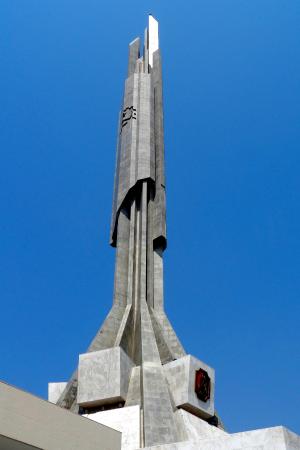
9781927428658.Cover_-450x650Granma Nineteen and the Soviet’s Secret by the Angolan Ondjaki is one of those books I picked up for the Speculative Africas project because it sounded like it might be sf. It isn’t. At least not in any straighforward sense. But it is one of the best books I’ve read this year, and there is something fantastical about it. And it features the astonishing mausoleum of António Agostinho Neto, which I have become mildly obsessed with since seeing photos of it in Kiluanji Kia Henda Icarus 13 installation.

The novel is set sometime in the early 1980s: Reagan is in power in the US; Jackie Chan’s The Big Brawl has reached Angola; and the mausoleum-of-agostinhomausoleum of Angola’s first president is under construction. (In reality, it ground to a halt because Neto’s successor, Jonas Savimbi, was a member of UNITA, backed by South Africa, rather than of Neto’s Soviet- and Cuban-backed MPLA. (There was a third-side in the post-independence civil war, the Mobutu-backed FNLA.) During Savimbi’s thirty year reign, he saw no reason to support its completion, and the possibility of further Soviet financing collapsed with the end of the Cold War. When the MPLA regained power in 2008, they used oil revenue to complete the structure on a much less grand scale than initially planned, and it was inaugurated in 2012, on the ninetieth anniversary of Neto’s birth. (See, I told you, mildly obsessed. Back to the book.))

It starts with an explosion in the sky over polyglot Bishop’s Beach, next to the mausoleum’s constructions site, that

woke up even the birds asleep in the trees and the dozy fish in the sea. Colours came out that had never been seen before: yellow mixed with red pretending to be orange in a bluish green, flares that mimicked the strength of the stars reclining in the sky and a warlike rumble of the kind made by the MiG planes. In the end it was a beautiful explosion that lingered in the noises of the pretty colours that our eyes looked upon and never again forgot. (9)

This is the first of several synaesthetic prefigurations – where colours and sounds get jumbled, as do birds, fish, kites and stars – in the initially episodic account of everyday life in the Bishop Beach. The cast of characters include the young protagonist’s several abuelas (Granma nineteen is not his nineteenth Granma – when Dr Rafael KnockKnock amputates her toe, she is left with nineteen digits and a new nickname); his friends Charlita and 3.14, whose real name, Pinduca, was first shortened to Pi; Comrade Gas Jockey, who faithfully, if lethargically, mans the local petrol station even though there is never any petrol; Sea Foam, who is more mad than wise, but sometimes it seems the other way around; and Soviet Comrade Gudafterov, really called Bilhardov, who is in charge of the blue lobsters, as the children call the Russian troops, and who longs to return to his snowy homeland. All of these characters have stories, and Ondjaki laces his story with glimpses of this much-storied world:

Granma Agnette … sang the music of slow Fado tunes, adapted to put us to sleep, and nobody slept. She told crazy stories about her friend Carmen Fernández who had become pregnant, but had given birth to a huge bag of ants that bit the inside of her stomach. The second time she got pregnant she finally had a baby, but it had the head and wings of a bird and, as the window was open, it flew away and escaped. Granma said that Carmen Fernández was afraid of becoming pregnant a third time, but even then we didn’t fall asleep. Then Granma started with her threats. (26)

When the young protagonist learns that Bishop Beach is going to be demolished, their houses ‘dexploded’, to make way for the elaborate grounds around the base of the mausoleum, he and 3.14 decide their only course of action is to beat the builders to it – they must steal dynamite from the construction site and blow up the mausoleum instead.

This slender narrative is made delightful by comical encounters and episodes; a bittersweet treatment of the civil war, which the children do not quite get; a romance which they do not quite perceive, either; by references to Brazilian soap operas and popular movies; and by a linguistic playfulness in which ‘gangrene’ can be misheard as ‘gangrenades’ and Sea Foam can persuasively argue that the sky is occasionally lit up by ‘fouling stars’:

a phenomena of the skies of the dark universe, the cosmic dust and so on… there are two skies: the blue sky that belongs to our eyes and to the wings of planes and little birds. And then there’s a black sky that’s as big as a desert. … Fouling stars melted in the heat of the sun and that’s why they fall towards planet world. Our planet is the only one that has water where they can cool down again. They’re fouling stars, and one day, after cooling off, I swear, those stars are going to want to return home … We’re still going to see those stars rise up from the earth to way up there, in the skies that sleep far away dressed in bright brightnesses… (12)

Needless to day, it offers an alternative explanation as to why work on the mausoleum stopped in the early eighties. A happier, if not entirely happy, one. And it is appropriate that such poetry surrounds the mausoleum of a president who was once a poet, even if he is not actually buried there.


Memory Palace

Kunzru1

From 18 June to 20 October 2013, the Porter gallery in London’s Victoria and Albert Museum was home to Memory Palace. Sponsored by Sky Arts Ignition, it is the first graphic arts exhibition at the venue in over a decade. It features one eponymous novella by Hari Kunzru (published separately) and twenty installations by as many artists or studios, and attempts to see “how far [you can] push the format and still call it a book,” to provide “an experiential reading format for a story,” to “create an exhibition that can be read’ (Newell and Salazar, “Curating a Book,” Memory Palace 84, 85). It is also a work of sf.

Curators Laurie Britton Newell and Ligaya Salazar commissioned Kunzru to outline a story that would then be developed in collaboration with the artists, who would be co-creators rather than mere illustrators: Abäke, Peter Bil’ak, Alexis Deacon, Sara De Bondt studio, Oded Ezer, Francesco Franchi, Isabel Greenberg, Hansje van Halem, Robert Hunter, Jim Kay, Johnny Kelly, Erik Kessels, Na Kim, Stuart Kolakovic, Frank Laws, Le Gun, CJ Lim, Luke Pearson, Stefanie Posavec, Némo Tral, Henning Wagenbreth, Mario Wagner, and Sam Winston. This process is recounted in Hunter’s dialog-free, short graphic comic, “Making Memory Palace,” appended to Kunzru’s novella.

The British-Indian Kunzru, a former magazine journalist, who wrote about travel, music, culture, and technology, is, like David Mitchell, one of that generation of authors relatively untroubled by genre-policing. His second novel, Transmission (2005), is about a computer virus, and reads like a slimmed-down, nearer-future version of Ian McDonald’s River of Gods (2004) spliced together with one of William Gibson’s Bigend novels; his fourth and most recent novel, the historically-sprawling Gods without Men (2012), includes UFOs and aliens, kinda. A rather trendy literary author, his first novel, The Impressionist (2003), attracted a £1 million+ advance, and he has won several major awards and prizes. The central concerns of his particular brand of popular, not exactly demanding postmodernism, sometimes described as “hysterical realism” or “translit,” are non-linearity and connectivity. Kunzru’s commissioning by Sky Arts is, then, relatively unsurprising (especially as he also used to be a presenter on The Lounge, Sky TV’s own electronic arts program).

His co-creators are rather less well known. Intriguingly, in their brief biographies at the end of the Memory Palace book, not one of them self-describes as an artist. They are all graphic designers, graphic artists, typographers, illustrators, comics artists, book designers, creative directors, art directors, editors, and/or architects. One is left with a strong sense of a smug and slightly shadowy commercial world of professionals, talented but perhaps a bit glib, for whom this is just another commission to be turned in on budget and on time. This perhaps explains why the exhibition’s satirical attack on neo-liberal hegemony and state-imposed regimes of austerity and amnesia is so muted.

Kunzru’s novella, Memory Palace, is set in a post-apocalyptic London. A magnetic storm destroyed the global information infrastructure and brought the Withering, a post-literate Dark Age of totalitarian theocracy, in which Westminster is known as Waste Monster, and other moderately amusing sub-Riddley Walker (1980) wordplay thrives. The Thing (as the council of leaders is known) wants to bring about the Wilding, a future in which the remnants of humanity will live in harmony with nature. The Thing has outlawed writing and recording, thereby criminalizing the Memorialists, those who are devoted to collecting and recollecting the past, whom they now hunt. Appropriately, then, the story, while nicely written and more than competent, stirs with faint echoes: of post-apocalyptic fiction by John Wyndham, John Christopher, and Walter M. Miller; of the television series Survivors (UK 1975-1977) and the coda to the film Threads (Jackson UK/Australia/US 1984); of M. John Harrison’s seedy bedsit entropy, China Miéville’s rejectamentalism, and Evan Calder Wood’s salvagepunk.

The book version of Memory Palace is, as one would expect from such a project, a gorgeous object, lavishly illustrated with selected work from the exhibition and pictures of the physical and electronic installations. If you have read the book, though, the exhibition itself is a little disappointing (I cannot gauge what it would be like to see the exhibition before, or without, reading the book). Le Gun’s life-size model of what someone from the post-apocalypse imagines an ambulance to have looked like – part medicine show, part museum of curiosities, drawn by wolves and driven by a Día de Muertos cross between Baron Samedi and the Child Catcher – is impressively detailed,kunzru2 as is Jim Kay’s reliquary cabinet devoted to Milord Darwing, the author of Origin of the Species (1859), who is misremembered as a rogue GM scientist. In contrast, Oded Ezer’s eight short films, looped on eight separate screens, are all concept with little art, and Erik Kessel’s enormous temple built from bundles of newspapers and advertising fliers, recalling the pre-apocalyptic religious ritual of aakgo9fm2Recycling, has even less art and barely even a concept. The more straightforward illustrations – whether blown up on large light boxes (Tral), arranged in a narrative thread on a white wall so you have to move to follow them (Pearson), or presented on zinc letterpress plates (Winston) – do benefit from exhibition. And it is quite pleasing – after all the corporate profligacy, the privatization and militarization of public spaces, the peonage of cleaners and others, the jingoism and spitefulness, that the London Olympics involved – to see the stadium reduced to slums (Tral) and Anish Kapoor and Arups’ 115-meter tall ArcelorMittal Orbit, a kind of flying spaghetti Eiffel Tower, being ceremonially burned to the ground (Greenberg).

Newell and Salazar write that “Unlike reading a printed book, visiting an exhibition is not usually a linear experience” (85). In this case, however, the layout of the space, and the clearly marked entrance and exit, do produce a linear exhibit, whereas reading the book, with its out-of-order narrative and illustrations that tempt one to flick back and forth between them, is more successfully non-linear. Consequently, I would recommend the book over the exhibition, especially as it is available from online stores for less than £10, and unless you live in South Kensington (or “South Keen Singtown,” as it will be known during the Withering), getting to and seeing the exhibition will cost you more than that.

A version of this review appeared in Science Fiction Studies 121 (2013), 596–8.