The City in Fiction and Film, week 12

australian_db_passport_to_pimlico_HP07238_Lweek 11

This was a nice gentle week, beginning with watching Passport to Pimlico (Henry Cornelius 1949) and then turning to other matters before discussing it.

First up was some general feedback on the student’s first essays. They all get extensive individual written feedback, but it is good to pool together some more general points, since individual feedback can sometimes feel very isolating – as if you alone are the only person making errors. Overall, though, the class has done pretty well, and we pretty much focused on essay structure, quoting and paraphrasing more effectively, and presentational conventions.

Second, I presented a broad strokes overview of what we have done this semester – it is good to remind students of quite how much ground they have covered, and to make more explicit the connections between weeks, especially if you can also not-so-subtly tailor it towards the upcoming exam in January.

Third, we took a look at the exam paper, ensuring that everyone understood what is required of them – and pointing out that it would be a good idea to ensure they had access to a copy of the film they were going to write about before they go home for the Xmas break.

Then, at last, we discussed Passport to Pimlico – which to my bemusement no-one much liked. So we spent some time off-topic digging into that:

  • partly it was that it is more of a comic film than a comedy, genial rather than guffaw-inducing;
  • partly it was the historical specificity of the film and thus of much of the humour;
  • partly it was that the humour depends so heavily on types which are no longer commonplace, and on the casting of specific actors. For example, if you don’t know Margaret Rutherford, her character is probably quite mystifying, but if you do know her she is a delight to watch because she is up there on the screen being Margaret Rutherford; Basil Radford and Naunton Wayne are only quite so funny because of the way they turn up in yet another film as basically those guys from The Lady Vanishes (Hitchcock 1938); and so on;
  • partly it was a lack of someone to identify with – something I would have liked to have more time to talk about because I am never quite sure a) what it means, and b) why people feel it is necessary to find someone like themselves in a film in order to enjoy it (if that is what it means). It is, however, worth noting that this – whatever this is – is probably compounded by the film being sort of centred on Arthur Pemberton (Stanley Holloway) but dispersing its narrative among an ensemble cast.

It must have all seemed even more baffling when I mentioned that one part of the film – when ordinary Londoners turn up to feed the besieged Burgundians – always chokes me up, the way those I-am- Spartacus moments tend to do (although oddly, not in Spartacus (Kubrick 1960)).

Thank goodness I didn’t get on to talking about the apparent influence of the film on late-60s/early-70s black power sf  – Warren Miller’s The Siege of Harlem (1965) in particular seems to borrow a chunk of it – or to pointing out that when imdb trivia says ‘Some historians, for some reason, have considered this to be a borderline science-fiction film’ I think it is referring to something I once wrote.

So, alone in a room full of people who did not even remotely plain love the movie, I found myself thinking, ‘Blimey, I’m a furriner’. And no one airlifted me a pig for company…

Building on last week’s discussion of Bicycle Thieves, we considered the film in relation to postwar experience and to the emerging conflicted programmes of rebuilding bombed cities and  slum clearance. The film opens with a lovely bit of contrast and misdirection: a dedication to the end of rationing (which would not end for another five years) cuts to a little bit of Latin nightlife, possibly in Havana – only it is not Havana at all, but Pimlico (actually Lambeth), and the music is only ‘Les Norman and his Bethnal Green Bambinos’ on the radio. So we cut from the exotic to the mundane, to a world not of languid plenty but to a period of austerity languishing in a heatwave. (This contrast is returned to throughout the film: when communal eating is instituted, but takes the form of sidewalk cafés, but they don’t like French cuisine; when Shirley Pemberton (Barbara Murray), out courting the impoverished duke (Paul Dupuis), dreams of the orange orchards where he lives, only for him to point our there is really only a cement factory there now; etc.

One of things I like about Passport to Pimlico and Ealing’s Hue and Cry (Charles Crichton 1947) is their willingness to show bomb-damaged London – unlike, say, The Perfect Woman (Knowles 1949), which opts for the rather fantastical London of a West End farce where it seems like there is not a trace of the war (although it too articulates a utopian vision of plenitude in the midst of austerity).

The Pimlico community, a mix of lower middle class shopkeepers and their more working class neighbours, also contrasts well with the working-class communities of Bicycle Thieves. The community is disjointed, primarily along class lines, as the council meeting demonstrates – Arthur presents his lovingly crafted plan to convert the bomb-site into a swimming pool and park so the neighbourhood kids have somewhere safer to play and the adults have somewhere to relax, but the proposal is outvoted by the local bank manager Mr Wix (Raymond Huntley) and others who wish merely to sell the land to the highest bidder. This kind of conflict between a community’s needs/wishes and the (apparently) easy money to be made off property developers forms a pretty constant current in postwar development, including things such as Lambeth councils recent dodgy campaign against the residents of Cressingham Gardens.

The community, however, is brought together by conflict – the film makes very pointed use of WWII imagery, evoking the already-mythologised spirit of the Blitz as much as it does the Berlin airlift. And the film positions us on the side of the community against Whitehall bureaucracy, against jobsworth coppers and customs agents – but also, a little problematically, other Londoners, conceived of as spivs and black-marketeers trespassing on the Burgundians new position of exceptionality and privilege, as too much chaos and disorder, as not-being-from-around-here. Sadly, the film never ceases to be timely in this regard. But on the bright side, a kind of border-defying, working-class internationalism based on sharing breaks out among Londoners (and chokes me up), countering wealth and power, and opening out the Burgundian community once more.

And then it was time for mid-year module evaluation forms, and holiday wishes, and then home for a nice cup of tea (except the central computer controlling the phasing of Bristol’s traffic lights had gone haywire and that nice cup of tea was a couple of hours away).

Week 13


Crumbs (Miguel Llansó Ethiopia/Spain/Finland 2015)

crumbs-the-first-ever-ethiopian-post-apocalyptic-surreal-sci-fi-feature-length-filmUltimately, the opening text tells us, the war became unnecessary. Perhaps it was a mutation, or perhaps bone-deep ideology just changed. But people gave up on survival, on perpetuating the species. (The cost, after all, had proven terrible.) The remnant population

slowly started to decrease, wane and languish like the dying flame of a candle that barely resists extinguishing itself. … The elderly passed on and the young became elderly. The news of the sporadic birth of a child, probably conceived out of neglect, was received with condescending smiles the same as in those who mock ignorant people who with pride show off their out of style garments.

Crumbs begins with a series of gently floating shots, starting with a broad view of the peculiar mineral structures in volcanic landscape of Dallol,[1] before moving in to detail their folded textures and colours. Water washes over the surface, as in something by Tarkovsky; the shots commute each other, as in something by Kubrick. A desert wind blows, accompanied by Atomizador’s throbbing alien score. There are mountains in the distance. A lone figure in a light shirt and darker trousers, with a satchel slung over his shoulder, makes his way through this alien yet terrestrial landscape. He is dwarfish, hunchbacked, deformed in some way. We will learn he is called Candy (Daniel Tardesse).

Among the rusting vehicle carcasses and other long-abandoned matériel are the remnants of a pipeline. In the ruins of the salt-block buildings he finds an artificial Christmas tree, its spindly green plastic branches still furled close to its metal trunk. In the distance he spots a figure (Quino Piñero). A man in a military uniform: a medal on his chest, a swastika on his armband, and a rat mask covering his head, grey ears visible above the gas mask covering his face. Candy flees. Distortion fills the soundtrack. Above the salt flats across which Candy runs floats a spaceship, an immense citadel hovering in these post-apocalyptic Ethiopian skies.

The tree is a gift for his lover, a young black woman called Sayat or Birdy (Selam Tesfayie) who makes sculptures from salvaged metal. In the derelict bowling alley in which they live – surrounded by fetishes hanging from trees like those in The Texas Chain Saw Massacre (Hooper 1974) – the ball return mechanism has started to activate itself. Sayat suggests that there must be a magnetic field being directed at it, as if someone, maybe the spaceship, which has been ‘rusting in the sky since the beginning of the big war’, is trying to send them a message. When Candy investigates the mechanism – like Henry (Jack Nance) in Eraserhead (Lynch 1977) looking behind the radiator – he finds something unexpected down inside it: a voice, that will later be revealed as that of a skinny black Santa (Tsegaye Abegaz) who might be very small or just a long way away.

Candy undertakes a quest to find out what is going on – a quest that will take him through the stunning green highlands around the Wenchi crater-lake, to a witch who won’t let him pay for her insights with the pristine copy of Michael Jackson’s Dangerous LP which is supposed to finance his wedding, and then on through an abandoned rail depot to the old city, and through it to a derelict lakeside zoo and a violent encounter with Santa Claus…

I have no idea whether there is a specific folktale lurking in the back of all this, an Ethiopian legend akin to the Malian epic of the crippled warrior-king Sundjata, and accounts of  Llansó’s improvisational style of direction – responding to what he finds on location – suggest that while there might be some such narrative armature the final film is unlikely to map onto it with any kind of precision.

It is a film full of allusions: Candy is challenged by a masked warrior on horseback who gallops up like something out of Zardoz (Boorman 1974) or The Planet of the Apes (Schaffner 1968); a bowling ball rolls mysteriously across the floor, like something from The Shining (Kubrick 1980); a rail line subsiding on a narrow stretch of land built across the middle of a lake recalls China Miéville’s Railsea (2012). There are also bits that reminded me of Space is the Place (Coney 1974) and Save the Green Planet! (Joon-Hwan Jang 2003).

There is the detritus of a lost world, given fresh meaning: a plastic figurine of TMNT Donatello, a Max Steel ‘Force Sword’ still attached to its colourful cardboard backing, a Michael Jackson album, a figure of a child asleep on a mattress, all of which are seen within the story world; and then once more, floating in Earth orbit as gracefully as a Kubrick weapons platform or space shuttle, while the voice of the shopkeeper (Mengistu Bermanu) describes them in relation to their production in the pre-apocalypse and their use by the legendary Molegon warriors – an amulet, an instiller of courage before battles, a reminder of the adored Andromeda baby and of its twin who lived in the pyramid of Cheops. There is an altar to Michael Jordan. Sayat, perhaps awaking from a dream, intones a fervent prayer to a string of deities: ‘Einstein IV, San Pablo Picasso, Stephen Hawking III, Justin Bieber VI, Paul McCartney XI, Carrefour!’ (Though the film is as dark as the storm raging outside, and it is possible she is chanting this litany as she masturbates.) There are also a lot of plastic dinosaurs, and a plastic lion. There are children’s superhero costumes. There is a cinema that has screened Süpermen Dönüyor, Kunt Tulgar’s 1979 Turkish Superman knock-off, every day for forty years, including the day on which we get a glimpse inside.

Candy’s quest brings him to a landscape littered with abandoned trains, rusting wheel-less cadavers, somehow both modern and prehistoric – like the rotting symbols of earlier waves of (failed) colonial expansion Conrad describes in Heart of Darkness (1899). Among them he finds a man who used to work for the railway (Girma Gebrehiwot), but the man does not speak. When Candy starts claiming that he is from another world – rocky, frozen, windswept – the man does not hear him; the discordant soundtrack – part Sun Ra, appropriately enough, part Texas Chain Saw Massacre – drowns his voice (a little like the bar scene in Twin Peaks: Fire Walk with Me (Lynch 1992)).

Candy moves on, past corroding watertowers that resemble abandoned Martian war machines. All he wants is to be able to return to his home planet, taking Sayat – and the child he intuits she is carrying – with him.

Some reviews of Crumbs suggest that its elliptical narrative, its congeries and clusters of salvage and allusion, defy meaning. That this rather gentle, beautiful, endearing film is somehow impenetrable. Such reviews are simply and straightforwardly wrong. Crumbs – probably  the best sf film to come out of Africa so far, and by a wide margin the best sf film of 2015 – is as easy to follow as the autobahn down which we are pellmelling to the end of the world.

We are living in the capitalocene moment, the gutted shell that is the present of the future Llansó depicts. The toys and costumes and other absurd relics, some in their original packaging, represent what Evan Calder Williams calls salvagepunk’s returning-repressed ‘idiosyncrasy of outmoded things’.

If I have one anxiety about this film it is that the unfamiliar landscapes it shows us are so beautiful they seem desirable. In this, it speaks to something dark in us. The thanatopic social sadism, recently anatomised by Miéville, the ‘thuggish idiot’s prometheanism’ that proclaims climate change is good for business; that longs with ‘spiteful glee’ for the further ruination of developing countries and the additional edge it will give to first-world corporations.  That yearning to wipe the slate clean. To purge the Earth of the human stain.

[Many thanks to Miguel Llansó, Ewa Bojanowska and New Europe Film Sales for giving me access to a copy of the film; and to China for flexing his celebrity to make it happen.]

Bibliography
Miéville, China. ‘On Social Sadism’, Salvage # 2: Awaiting the Furies. 17-49. 
Williams, Evan Calder. Combined and Uneven Apocalypse: Luciferian Marxism. Ropley: Zero Books, 2010.

[1] A ghost town in northern Ethiopia, build for potash mining in the early twentieth century. Photos here  – also google ‘Dallol’ for images of the astonishing landscape. And while you’re at it, take a look at ‘Wenchi crater-lake’.

Crimson Peak (del Toro 2015)

MV5BNTY2OTI5MjAyOV5BMl5BanBnXkFtZTgwNTkzMjQ0NDE@._V1_SX640_SY720_Pretty much all the commentary so far has been about one of two things.

Critics have been unanimous in their praise of how gorgeous the film looks, from its gothicky design to its fabulous frocks and sumptuous colour palette (it also has some nice irises and cunning wipes).

Or they have echoed del Toro’s own point that it is not really a horror movie so much as a gothic romance, full of echoes and allusions, including: Poe’s ‘The Fall of the House of Usher’; the several versions of Jane Eyre and Silence of the Lambs; Du Maurier’s Rebecca; Hitchcock’s Rebecca and Notorious; Medak’s The Changeling; The Haunting, and Wises’s; King’s The Shining, and Kubrick’s; the Coen’s Barton Fink; del Toro’s own Devil’s Backbone; and so on.

All of these critics are right, and yet without exception they overlook del Toro’s major accomplishment.

Somehow, he manages constantly to keep this astonishing overblown confection of evil aristocrats, ghosts, forbidden rooms, gramophone cylinders, automata, letters, keys, ghosts, murder, incest, idiosyncratic grim-up-north grimness, peculiarly hardy Cumberland moths, violent assaults and revolutionary mining technology just this side of hilariously funny. And somehow he makes it a constant delight, grand guignol at its most operatic, all logic subordinated to production design.

But it would take just one person in the auditorium to start laughing, and it could all go disastrously wrong.

It is not the first time del Toro has walked this particular line. Much as I enjoyed them, Hellboy II and  Pacific Rim edge along a similar tightrope, and are rather less successful in keeping it together.

Early in the film, protagonist Edith Cushing (Mia Wasikowska) explains of a story she has written that it is not so much a ghost story as a story with ghosts in it, and that her ghosts are actually metaphors for the past. With the kind of New Weird chutzpah that China Miéville once championed, del Toro’s film takes completely the opposite tack. His ghosts are ghosts, not metaphors.

However, the logic of Miéville’s argument meant that while one should be absolutely committed to treating monsters as monsters rather than as metaphors, this should nonetheless leave their metaphorical potential open and even make for more effective metaphoricity. But with del Toro’s pastiche late-Victorian setting lacking the historical resonances of Devil’s and Pan’s Labyrinth‘s (not unproblematic) Spanish Civil War settings, there is nothing really for his ghosts to gain metaphorical purchase, even if they were so inclined. There is some stuff about aristocrats as parasites, and a whole Blut und Boden thing lying around should anyone want to make something of it, but no one does. And del Toro seems utterly uninterested in the gendered restrictions and sexual repression that seem so fundamental to gothic romance.

It is a film of many layers, all of them on the surface.

On the other hand, I loved every deliriously silly minute of it, and you get the impression del Toro did, too.

Oblivion (Joseph Kosinski 2013)

tom_cruise_in_oblivion_movie-2880x1800and so anyway it turns out the best thing about Oblivion (2013), a film which patches together bits from every other science fiction film ever, is the way in which flying spherical robot drones manage to combine 2001: A Space Odyssey’s shuttle pods with RoboCop’s ED209 and with The Black Hole’s V.I.N.CENT and Old Bob, though sadly this also brings us to the worst thing about the movie, the way in which a bunch of cowardly philistine corporate suits lacking Joseph Kosinki’s genius and vision refused to have the drones voiced by Windsor Davies, who voiced Sergeant Major Zero in the key sf text of the late twentieth-century, Terrahawks

120 years of sf cinema, part five: 1965-74

2015 marks the 120th anniversary of sf cinema. This is the fifth part of a year-by-year list of films I’d recommend (not always for the same reasons).

Part one (1895-1914), part two (1915-34), part three (1935-54), part four (1955-1964)

1965tumblr_ltx4g62J531qjfr7so1_r1_1280
Alphaville, une étrange aventure de Lemmy Caution (Jean-Luc Godard)
Giperboloid Ingenera Garina/Engineer Garin’s Death Ray (Alexander Gintsburg)
It Happened Here (Kevin Brownlow and Andrew Mollo)
Sins of the Fleshapoids (Mike Kuchar)
Terrore nello Spazio/Planet of the Vampires (Mario Bava)
The War Game (Peter Watkins)

1966
Daikaiju Gamera/Gamera (Noriaka Yurasa)
Fahrenheit 451 (François Truffaut)
Gamera Tai Barugon/Gamera versus Baragon (Shigeo Tanaka)
Konex Sprna v Hotelu Ozon/The End of August at the Hotel Ozone (Jan Schmidt)
Seconds (John Frankenheimer)
Sedmi Kontinent/The Seventh Continent (Dušan Vukotić)
Tanin no kao/The Face of Another (Hiroshi Teshigahara)
Ukradena Vzducholod/The Stolen Dirigible (Karel Zeman)

1967danger_diabolik
The Craven Sluck
(Mike Kuchar)
Diabolik (Mario Bava)
Je t’aime, je t’aime (Alain Resnais)
King Kong No Gyakushu/King Kong Escapes (Ishirô Honda)
Privilege (Peter Watkins)
Quatermass and the Pit (Roy Ward Baker)
Week End (Jean-Luc Godard)

1968
2001: A Space Odyssey (Stanley Kubrick)
Brasil Anno 2000 (Walter Lima, Jr)
Mister Freedom (William Klein)
Night of the Living Dead (George Romero)
Planet of the Apes (Franklin J. Schaffner)
Wild in the Streets (Barry Shear)

1969
Change of Mind (Robert Stevens)
Gladiatorerne/The Peace Game (Peter Watkins)
Scream and Scream Again (Gordon Hessler)
Stereo (David Cronenberg)
Yakeen (Brij)
Zeta One (Michael Cort)

1970
The Andromeda Strain (Robert Wise)
Crimes of the Future (David Cronenberg)
Na Komete/On the Comet (Karel Zeman)
THX 1138 (George Lucas)

1971713792kramerice
A Clockwork Orange (Stanley Kubrick)
Glen and Randa (Jim McBride)
The Hellstrom Chronicle (Walon Green and Ed Spiegel))
Ice (Robert Kramer)
Punishment Park (Peter Watkins)

1972
Conquest of the Planet of the Apes (J. Lee Thompson)
Death Line (Gary Sherman)
Solyaris/Solaris (Andrei Tarkovsky)

1973nuits rouges 3
The Asphyx (Peter Newbrook)
The Crazies (George Romero)
Flesh for Frankenstein (Paul Morrisey)
Una gota de sangre para morir amando/Murder in a Blue World (Eloy de la Iglesia)
It’s Alive (Larry Cohen)
Kala Dhandha/Black Mail (Vijay Anand)
Nippon Chinbotsu/Japan Sinks (Shirô Moritani)
Nuits rouges (Georges Franju)
Phase IV (Saul Bass)
La planète sauvage/Fantastic Planet (René Laloux)
The Spook Who Sat by the Door (Ivan Dixon)
Yilmayan seytan/The Deathless Devil (Yilmaz Atadeniz)

1974
The Cars that Ate Paris (Peter Weir)
Dark Star (John Carpenter)
The Parallax View (Alan J Pakula)
Space is the Place (John Coney)
The Stepford Wives (Bryan Forbes)
Terminal Man (Mike Hodges)

2013-03-22-1aterm

120 years of sf cinema, part four: 1955-64

2015 marks the 120th anniversary of sf cinema. This is the fourth part of a year-by-year list of films I’d recommend (not always for the same reasons).

Part one (1895-1914), part two (1915-1934), part three (1935-54)

1955
journey-to-the-beginning-of-time
Cesta do Praveku/Journey to the Beginning of Time (Karel Zeman)
Kiss Me Deadly (Robert Aldrich)
The Quatermass Xperiment (Val Guest)
Revenge of the Creature (Jack Arnold)
This Island Earth (Joseph Newman)

1956
Forbidden Planet (Fred M. Wilcox)
Invasion of the Body Snatchers (Don Siegel)
Not of this Earth (Roger Corman)
Plan 9 from Outer Space (Edward D. Wood, Jr)
X the Unknown (Leslie Norman)

1957cushing-in-close-up
The Abominable Snowman (Val Guest)
Chikyu Boeignu/The Mysterians (Ishirô Honda)
The Curse of Frankenstein (Terence Fisher)
The Incredible Shrinking Man (Jack Arnold)
Quatermass II (Val Guest)

1958
I Married a Monster from Outer Space (Gene Fowler, Jr)
The Revenge of Frankenstein (Terence Fisher)
Vynalez Zkazy/The Fabulous World of Jules Verne (Karel Zeman)

1959
The World, the Flesh and the Devil (Ranald MacDougall)
Les yeux sans visage/Eyes without a Face (Georges Franju)worldfleshdevil7

1960
Der Schweigende Stern/The Silent Star (Kurt Maetzig)
Die Tausend Augen des Dr Mabuse/The Thousand Eyes of Mr Mabuse (Fritz Lang)
Village of the Damned (Wolf Rilla)

1961220px-Amphibian_Man
L’Anée dernière à Marienbad/Last Year in Marienbad (Alain Resnais)
Chelovek Amfibia/The Amphibian Man (Guennadi Kazansky and Vladimir Chebotarev)
The Damned (Joseph Losey)
The Day the Earth Caught Fire (Val Guest)
Mosura/Mothra (Ishirô Honda)

1962
Gritos en la Noche/The Awful Dr Orloff (Jess Franco)
Planeta Bur/Cosmonauts on Venus (Pavel Klushantsev)
The Manchurian Candidate (John Frankenheimer)

1963
Children of the Damned (Anton M. Leader)
Ikarie XB-1 (Jindrich Polak)
La Jetée (Chris Marker)
King Kong Tai Gojira/King Kong versus Godzilla (Ishirô Honda)
Lord of the Flies (Peter Brook)
Matango/Attack of the Mushroom People (Ishirô Honda)
The Mind Benders (Basil Dearden)
X-The Man with X-Ray Eyes (Roger Corman)

matango_1963_01

1964
Dr Strangelove, or How I Learned to Stop Worrying and Love the Bomb (Stanley Kubrick)
Fail Safe (Sidney Lumet)
Seven Days in May (John Frankenheimer)

part five (1965-74)

The Shining (Stanley Kubrick 1980)

shiningIt is difficult to know what to say about The Shining, especially as so much has already been said, some of it of dubious merit.

Like Stephen King, I am baffled as to why people find it so scary; unlike him, I rate it way more highly than his original novel (and the miniseries does not even get a look in).

It is a film I never used to like much, although I always admired its soundtrack and steadicam (Kubrick is so very effective when tracking-in that you can forgive him for his lesser parallel tracking, but, to be fair, Jean-Luc Godard’s not as good at the former as he is at the latter). And I have always been a little taken by the simple tricks Kubrick deploys – an omission here, an ambiguity there, and what Michel Chion describes as his ‘commutative editing’ – to make his films seem enigmatic and profound.

This time round, the film grew on me. I have no idea if this is because I finally watched the 25 minute longer US cut (although some months ago Roger Luckhurst predicted such an outcome, and I learned a long time ago he is usually right about stuff). I was struck very forcefully this time round by the visual and aural resonances with 2001 – and partway through the job interview scene, I stopped hearing the dialogue as being badly-delivered and started hearing it as a development of the earlier film’s depiction of linguistic thinning and debasement. Stuart Ullman (Barry Nelson) channels the performance of sincerity and the platitudinous corporate drone of Heywood Floyd (William Sylvester), and everyone sounds like they are delivering lines because that is what so much of human identity and interaction consists of – performativity.

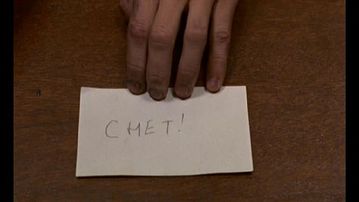
When I recently read King’s novel, I posted about its proleptic depiction of precarious, disciplined neo-liberal labour. This is developed in Kubrick’s film. The Overlook itself, despite it age, resembles one of the non-places of hypermodernity described by Marc Augé: those spaces that are the opposite of utopia because they exist and do not contain any organic society. For all the historical markers we see on display – from those big cans of kosher dill pickles in a hotel that would once have been restricted, to the Native American designs and images on the walls, to the very 1970s purple penis carpet – it is oddly dehistoricised. It is a space that might even confound Steve Buscemi’s5609791_std CHET! in its obscure blurring of ‘trans’ and ‘res’. The Torrance family, that signifier of a private realm outside the world of work and exchange, that gesture towards organic society, is destroyed by the relentless demands of the Overlook, which is only concerned with Jack as labour-power.

The Shining shows the coming proletarianisation of the American middle class, or perhaps merely charts the delusion of social mobility at the core of the American Dream. This is Jack – the terrorised and terrorising, self-surveilling, self-disciplining and other-discipling sadomasochistic subject of a monstrous power. Just the way capital likes it.

shiningAnd management doesn’t care for one moment that he has produced the treatise on work-life balance. To the Overlook, it’s just a paper trail to prove the staff have been consulted at.

Room 237 (Rodney Ascher 2012)

large_7EDxLdQ8bBG8YC2JAnhvoVhTe3This is easily the most fun and interesting, and least time-consuming, of the various associated texts I’m working through in preparation for teaching The Shining as a cult movie (King’s novel, the miniseries, and Doctor Sleep, which should be done soon). It is a documentary in which five people explain what they think the film is really about: the Native American genocide; the Holocaust; Kubrick’s faking of the Moon landing film; the legend of the minotaur; and the dark violent sexual nature of human beings. (The latter two are the sketchiest, so it is hard to be certain what their central claims are, or if they actually have central claims – and I am sure I must have missed something about the last one since that’s hardly unusual material for a horror movie.)

Students anxious about analysing films often frame their suggestions with a nervous ‘I’m probably reading too much into it, but…’, while also seeming to assume that the process of analysing a film is to dig down and find a secret hidden meaning. Their development as critics usually involves learning to think differently about the nature of texts and the processes by which meanings are made. Meanings aren’t hidden deep within, like pirate treasure, but are the product of engaging with the details of the film in relation to various contexts. There is no ‘reading into’, there is just ‘reading’, because all the information is there on the surface to see and hear.

However, on listening to the (admittedly fragmented) presentation of Room 237’s five featured exegeses, I began to think that maybe I was wrong – that maybe there is such a thing as ‘reading into’ a text.

room-237-1And I admit, when the NASA conspiracy guy explained that the letters on the key tag, ROOM No 237, were able to spell just two words, ROOM and MOON, I did blurt out ‘moron’.

But that is a little unfair.

Room 237 gives us a fascinating if largely unwitting exploration of textual heuristics, epistemological limits and the uneven distribution of cultural capital.

sh_monarchTake, for example, Juli Kearns’ claim that the image of a skier on a poster is actually the silhouette of a minotaur. It does not look like one to me, but when she explained what she sees I understood what she meant. It is more convincing than someone else’s claim that the clouds in the opening titles contain an image of Kubrick, but it is still utterly unconvincing. The disproportionate bull-like upper torso is very obviously a hunched figure in a bulky ski jacket.

But perhaps she does not mean it is actually a picture of a minotaur, merely that it was deliberately chosen because it resembled one.

On the opposite side of the doorway, she notes, is a picture of a cowboy on horseback. A centaur, you might think, but no. Her point is that it is a mirror image: a cowboy opposite a bull-man. And it seems that it was only after noticing this ‘picture of a minotaur’ that she began to notice all the labyrinth imagery in the film: the maze, the model of the maze, the corridors and sometimes contradictory layout of the Overlook. What remains not just unclear but downright mystifying is why she needs to build her argument on a questionable interpretation of the skier poster rather than on, say, the film’s obvious and undeniabe labyrinths – and why she never seems to ask why Kubrick organised his version of the story around mazes, corridors and horizontality.

Part of the answer to the constricted nature of these five interpretations lies in the suggestion made by one of the exegetes that Kubrick was a bored genius who he decided to fill The Shining with puzzles and/or clues. A disappearing chair, the disappearing Dopey sticker, a mid-sequence costume change, an apparent reversal of the pattern in the carpet, all of which can be explained as continuity errors, are suddenly transformed into acts of conscious intent. Which enables you to continue believing in Kubrick as a genius who controlled absolutely everything that appears in his films. Which in turn separates from the dull herd those viewers who can pieces together his clues. Which brings the elect into the sacred presence of the author-genius, who slays ambiguity, guarantees meaning and dispenses certainty.

However, the whole proposition that this is what a genius would choose to do suggests a poor understanding of genius, and of creative endeavour. Kubrick ceases to be a person and becomes like that magical autistic guy in Cube (1997), able to do really hard maths without any of the visible effort the female character must put into calculating primes and primes of primes. Kubrick becomes a black box, a monolith, and only some primates get uplifted. Understanding how texts generate meanings is transformed into a paranoid-autistic hermeneutics, like in The Da Vinci Code, with one true meaning to be unearthed. Or, as Dick Hallorann (Scatman Crothers) says to Danny (Danny Lloyd), this is ‘not [about] things that anyone can notice but things that people that can shine can see’.

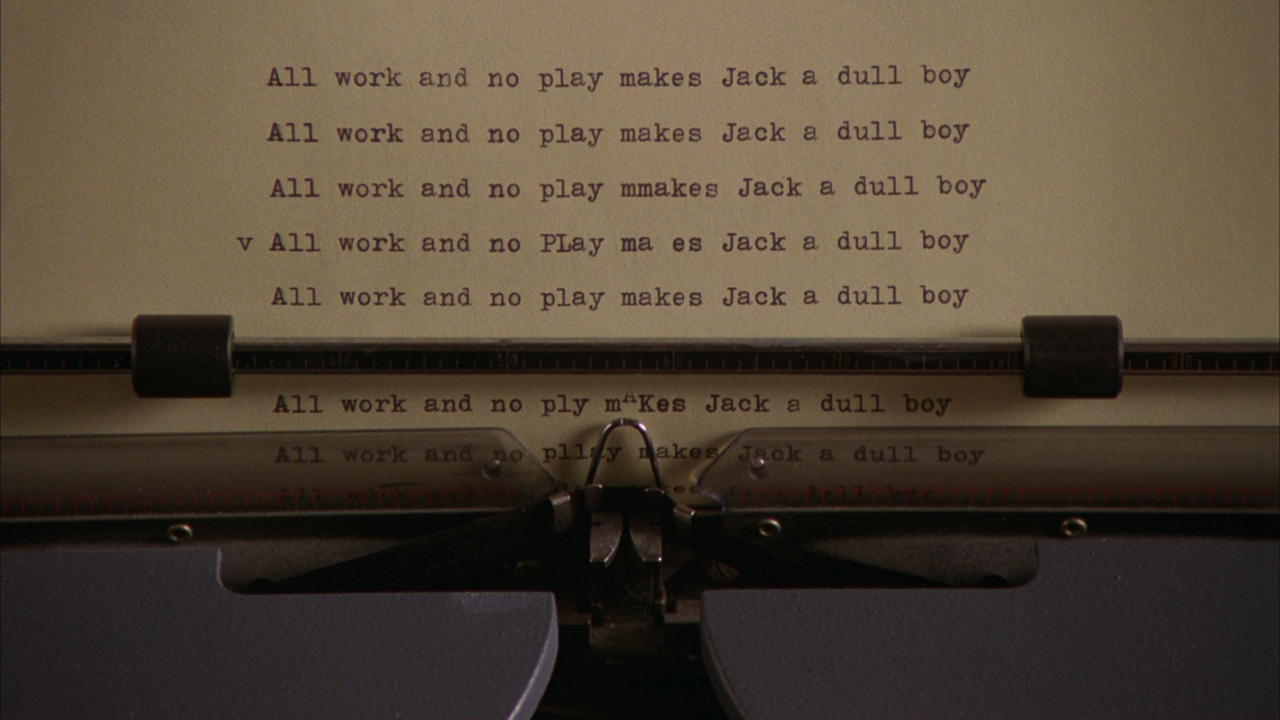
Like when one of the exegetes argues that the recurrence of the number 42, the fact that Jack Torrance (Jack Nicholson) uses a German-made typewriter and the graphic match evident in the dissolve from  a pile of luggage to a group of guests is more than enough to prove the film is about the Holocaust.

The paranoid aspect of this spills out beyond the film when the NASA conspiracy guy claims that he is under state surveillance and that he fully expects an IRS audit next year. (Intriguingly, he insists that the Moon-landing itself was not faked, just the Moon-landing footage, but he never explains why NASA would do this – although he does dismiss someone else’s claim that it was to keep us from seeing the towering alien city in the Sea of Tranquillity.)

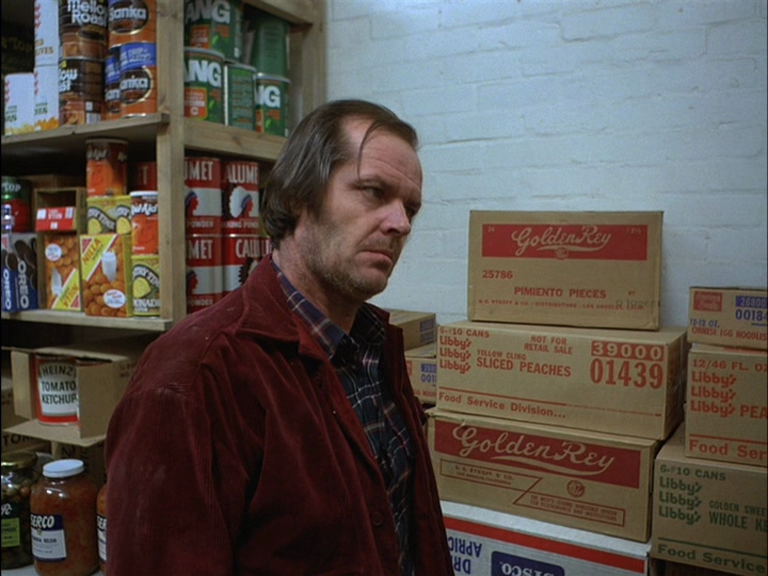
vlcsnap-2012-11-03-17h36m26s183While watching Room 237, I could not resist constructing my own version of its real secret meaning which is also clearly bullshit. The exegete who sees the film as being about the genocide of Native Americans makes much of the prominence afforded to cans of Calumet baking powder. However, he completely misses the genuinely prominent placing of packets of Oreos – next to Jack when he wakes up on the sacks of salt, and then on the extreme left of this shot, clearly mis-shelved behind Jack and the baking powder cans (misdirection!). ‘Oreo’ is slang for a middle class African American, who might look black on the outside but is really white on the inside. Such conservative figures, who align themselves with white culture, function to conceal the supposed threat to white hegemony – especially white masculinity – posed by African Americans.

The same exegete notes that the five o’clock shadow of Bill Watson (Barry Dennen) makes him look mixed race, but quite ludicrously suggests that this aligns him with the native American, when clearly his major domo status – which includes walking behind hotel manager Stuart Ullman (Barry Nelson), being expected to sit quietly to one side, and being ordered to perform menial tasks – positions him as an African American servant, like the butlers played by Bill ‘Bojangles’ Robinson.

6336382_f260But the task of  looking after Danny, The Shining‘s Shirley Temple equivalent, is displaced on to Hallorann. Significantly, it is only after Danny – who, like Hallorann and Hallorann’s grandmother can, ‘shine’ – states his preference for ‘chocolate’ ice cream that Hallorann calls him ‘son’. No wonder Grady, in the red bathroom, warns Jack about this ‘nigger’ interloper, coming to replace him as Danny’s ‘real’ father. (And since ‘the shining’ seems to skip a generation, Hallorann is simultaneously positioned as Danny’s grandfather – that is, Jack’s father.) No wonder Kubrick replaces Jack’s light-coloured typewriter, a symbol of paternal authority and of entry into the Lacanian symbolic order, with a darker model partway through the film…

1350845502845114This explains also Kubrick’s decision about the final images of the film. White masculinity, frozen out of the picture, stuck in a lost past.

This is – of course – not remotely what the film is about. And I really hope no-one takes it seriously, but y’know how the internet is…

The Shining (Mick Garris 1997)

Stephen_King's_THE_SHINING_(mini-series_intertitle)Stephen King just won’t let it go.

There is an ‘Author’s Note’ at the end of Doctor Sleep (2013) that, under the guise of clarifying that it is a sequel-by-popular-demand to his 1977 novel rather than to Kubrick’s 1980 film of The Shining, says of the latter: ‘many seem to remember [it] – for reasons I have never quite understood – as one of the scariest movies they have ever seen’ (483). The next paragraph does not proclaim the TV miniseries King himself adapted as superior to the movie, but it does sing the praises of his more-or-less-reliable-hack director Mick Garris’s Psycho IV, as if to trump Kubrick with a Hitchcock.

It is coyly done, as if King knows it is not at all convincing.

But anyway, as part of my ongoing preparation for teaching Kubrick’s film as a cult movie, after reading the novel I watched the miniseries over several nights. I would have got through it sooner, but after episode one my ever-patient housemate cried no más, and scheduling became an issue – poor thing missed out completely on the slightly less terrible second and third episodes…

The main problems with the miniseries are its plodding adherence to the novel and the deadening literalness of its treatment of the supernatural elements. All it takes is that first glimpse of Danny’s (Courtland Mead) imaginary friend Tony (Wil Horneff) bobbing about in the air to realise quite how brilliant Kubrick was to have Danny (Danny Lloyd) talking to his finger instead. (Probably didn’t help that it immediately took me back to being thirteen and watching Tobe Hooper’s Salem’s Lot (1979) miniseries and bursting out laughing at the supposedly scary bit when the fat vampire kid taps on the window.)

These two intertwined problems began to fill me with dread when the first episode started obsessing about the topiary animals, trying to make them ominous. Will they be brought to life as badly as the cgi hosepipe? How could the bush-animal attack sequences – presumably originally inspired by Ray Bradbury’s ‘The Veldt’ (1950) – possibly work?

I generally find Bradbury overrated, but even I must concede the novel’s reworking of this material makes make him seem subtle.

Screen shot 2012-02-29 at 13.50.16Garris very sensibly, if not very effectively, relies on camera movements, editing and switching-in props to bring the topiary lions to life. Until the ‘cliffhanger’ ending of episode two, the final shot of which shows Danny being stalked unaware by three cgi shrubs. (They do not appear again except fleetingly in the climax of episode three. Thankfully.) To be clear, this is not ragging on the special effects because they are bad, but because they are badly chosen.

Generally, the physical effects work best, but there is something so amiss about the individual episodes’ and the series’  pacing that they too become a problem. The first couple of times a door opens or closes or an object moves mysteriously is fine, but you pretty quickly find yourself wondering whether it is always the same bloke hidden just out of shot pushing the door, how much he gets paid, what he had for lunch… Not so much ‘how did they do that?’ as ‘why?’ And it does make you wonder what exactly they spent the $25 million budget on.

I guess, in part, the format is the problem. Economics dictate that a network TV miniseries made in the 1990s can’t be too scary or unnerving or disturbing, so the supernatural horror has to be blandly by-the-numbers and the domestic abuse material has to be displaced as far as possible.

So I have a lot of sympathy for the cast.

Winifred Torrance is a badly underwritten character in the novel – all I can really remember is King banging on about her breasts – and she is no better served by a script that slaps on a bunch of embarrassing clichés. Garris does not seem to have any idea what to do with her, and Rebecca De Mornay struggles. Indeed, in episode one, she even seems to struggle to walk across rooms, although she does do one brilliant bit of almost indiscernible crabstepping down a hotel corridor that is simply not wide enough to accommodate three or four actors walking abreast.

Steve Weber, as Jack, has the easier job – do what Jack Nicholson did but not the way he did it. Even so, it is only when the later episodes allow Weber to ham it up that he becomes even remotely effective, and in the second half of episode theshining1997three, this is largely down to his make-up – which gives him the appearance of a beaten-up, tear-stained clown.

As Danny, basin-cut Courtland Mead clearly shares no genetic material with either of his parents. He looks like one of those profoundly unattractive children who used to get cast in Dallas or Dynasty for no reason other than that their dad was a producer on the show. His performance does get better in the later episodes, and his unexpected ‘I love snow’ song is a bizarre delight, but I kept finding myself wondering whether the alcoholic, physically abusive Jack ever used his son’s enormous teeth to open beer bottles.

Most of the time the three principals, especially De Mornay, have the air of people wondering how much longer they are going to have to keep this up for…

The decision to play Ullman (Elliot Gould) as a mincing lisper is a really poor choice, but not as badly judged as Stephen King’s cameo as bandleader Gage Creed – at least he didn’t black up for his terrible Cab Calloway impersonation. (There is a chummy array of horror-related cameos: Frank Darabont, Peter James, Richard Christian Matheson, David J. Schow – and Sam Raimi stealing the bread from his brother, Ted’s, mouth.)

Pat Hingle, as Pete Watson, is probably the only actor to escape with his dignity intact, professionally ploughing through this nonsense the same way he has done since the 1950s.

But it is Melvin Van Peebles, as Dick Halloran, who has the best line:

911 ain’t the answer, ma’am, only wish it was.

Good to know that baadasssss is still out there.

The_Shining_Melvin_Van_Peebles_01

Stephen King, The Shining (1977)

1839lzdygndfmjpgFirst, the confession.

Until now, I have never read a Stephen King novel.

In my early teens, I just could not get into Christine (1983) or Carrie (1974) or, indeed, The Shining. Each time I gave up a few chapters in, and just figured he was not for me. Sure, I’ve read Danse Macabre (1981), his history of horror fiction, a couple of times, and have always cherished its description of Harold Robbins (he can’t tell the difference between a well-structured sentence and a shit-and-anchovy pizza). And I did read The Talisman (1984), King’s fat fantasy novel collaboration with Peter Straub, when it first came out – and since I enjoyed it, I attributed that to Straub (although not enough to actually read any of his solo novels).1 I even bought a copy of Dreamcatcher (2001) a couple of years ago, just to see if it is as hilariously inept as the William Goldman/Lawrence Kasdan film version, but gave it to a friend in the hope she would do the research for me. (She didn’t.)

But I am teaching the US cut of Kubrick’s movie this semester, so I figured alongside also watching Mick Garris’s 1997 King-scripted Shining miniseries and the Room 237 documentary, I should really give the novel another ago.

And you know what?

It’s all right.

It isn’t scary or suspenseful in any way, which might be because I already know the story. The prose only rises above workmanlike for literally – and I do not mean figuratively – a couple of nicely-crafted short sentences (which I failed to mark in the text so I can’t tell you what they were and may never find them again). But it is interesting in the way it is such a seventies novel.

That ain't no monolith...
That ain’t no monolith…

First, and least significantly, the cook, Dick Hallorann, often talks and thinks as if blaxploitation movies were King’s only source for imagining an African-American man – a quality Kubrick suppressed by

...and neither is that
…and neither is that

casting Scatman Crothers in the role, but which returns in the paintings decorating Hallorann’s Florida apartment.

Second, The Shining has something of Close Encounters of the Third Kind’s post-counterculture misogynistic whininess that pins the dissatisfactions of lower middle class white masculinity on women.2 Terri Garr’s performance in the margins of Spielberg’s movie can, if observed, prompt at least some sympathy for her character. But just as Spielberg is uninterested in Ronnie Neary, so King, despite giving Wendy Torrance some backstory, some viewpoint chapters and some noteworthy nipples, really could care less. Like Spielberg always, King here is obsessed with paternity and patrilineality, even using the word ‘patricide’ in the novel’s climax to describe Danny’s role in the destruction of the Overlook/Jack.

Third, and most intriguingly, The Shining anticipates neoliberalism’s particular intensification of demands on workers. Much as the novel is about the past – the ghosts of the Overlook hotel; the effect Jack and Wendy’s neglectful, manipulative and/or violent parents had on them; Jack’s alcoholism; Jack’s violence – haunting the present, it now also has an air of being haunted by the future. When one socio-economic structure subsumes another, it does not replace it completely but carries forward, mutatis mutandis, that which it needs, that which it can make use of, that which does not contradict its operation and expansion. Which is why early capitalism had its feudal robber barons, and why this social relation and the sociopaths it rewards are ever increasingly evident in the aftermath of 2008.

In the later stages of the novel, the Overlook is revealed as a kind of raging Old Testament god, cruelly demanding that Jack sacrifice his son. His reward will be acceptance into a great chain of being, presided over by this dark ancient power and populated by mobsters, killers, CEOs and other criminals. However, the contract underpinning his adoption by the hotel is repeatedly expressed in terms of climbing the corporate ladder, of Jack having to prove that he is management material. From caretaker to manager – the American Dream! – through subservience and self-abasement misdescribed as personal merit.3

But what is the nature of Jack’s actual job? It is not the mountain-top location that makes his employment so precarious. Unearned, it is within the gift of his millionaire ex-drinking-buddy, Al Shockley, who inherited his wealth; and, as Jack learns, if he steps out of line, Al will fire him without hesitation. It is a job that completely obliterates any line between work and not-work, between workplace and home. It relocates and dislocates his entire family, but will last only a few months, and if he is fired, they will all be homeless. It requires his constant presence, often in stand-by mode. It colonises his consciousness and creative human capacities, and subordinates him entirely to the extraction of his labour-power.

Jonathan Crary entitled his 2014 book on the ruinous human effects of contemporary capitalism and its attention economy 24/7: Late Capitalism and the End of Sleep; I guess I will now have to read King’s 2013 sequel to The Shining to see whether it is just a coincidence that he called it Doctor Sleep.

PS Even after reading The Shining, I have still read more Guy N. Smith novels and seen more Lawnmower Man movies than I have read King novels.

1 I got bogged down in the early pages of Koko (1988) years ago, and still have an unread Shadowland (1980) in a box somewhere. But I did once stay in a hotel room next to Peter Straub at a conference in Florida, and was (admittedly unintentionally) a considerate neighbour, which surely must count for something.
2 You will be glad to hear this kind of silly whinging and contrafactual scapegoating is a thing of the past. Oh. No, wait. See  this. And this excellent response.
3 As satirised in Frank Tashlin’s Will Success Spoil Rock Hunter? (1957) and Billy Wilder’s The Apartment (1960), and straightfacedly reiterated every day by all that bullshit about this being a meritocracy.