The lrb; or long, redundant beginning

This spring and summer, I spent several months reading for and writing a chapter on ‘Class and Horror’ for the forthcoming Routledge Companion to Horror. It was the first time I’ve dived deep into critical/theoretical work on class for probably the best part of twenty years. One key shift is the now general acceptance of the need to incorporate Bourdieu (or Bourdieu-like) work into models of class, which meant I found myself thinking a lot more about social and cultural capital. The other key trend was hardly new: marginalising/excluding Marxist traditions of work on economic class, often in favour of Weberian or neo-Weberian approaches, which is odd given how very little Weber actually said about class, but also for other very obvious reasons not remotely odd.
I also found myself baffled (i.e., not remotely baffled but fascinated) by social scientists who present social mobility as an absolutely incontrovertible good (even if the only argument they can muster is that it improves GDP) but are at the same time appalled by the notion of absolute social mobility. Even though it is the obvious end-point of their social mobility enthusiasm, they devote absolutely no words/time/energy to imagining what meaningful equality might look like. Instead, they just brandish terrifying (that is, hilariously clichéd) images of totalitarian states. Harrison Bergeron, eat your heart out! It’s almost as if their main interest is maintaining a slightly tweaked and marginally more palatable status quo (and securing future research income streams from similarly committed funding bodies).
Anyway, the point is, I found myself engaged in autobiographical ponderings about social capital, cultural capital and autodidactism.
I come from a dirt-poor West Midlands working-class family. I was born in Staffordshire but we moved to Devon when I was four years old, which further limited the already negligible social capital to be derived from my now attenuated extended kinship network.
My parents were Methodists (which is why I have absolutely no idea how to gamble although I did, after no struggle whatsoever, overcome teetotalism). And they were aspirational, at least to the extent of wanting a better life for me and my brother and of taking on a crippling mortgage to own a home rather than rent a house (they were so ripe, sadly, for Thatcher). Their new circle of church friends – middle class folks from the wealthier parts of the village – obviously lived in a different world to us and, despite many kindnesses, were defensive of their relative privilege. While my dad left school aged 15 and with no qualifications, they were mostly graduates from middle class families. Thus they had higher levels of economic, social and cultural capital, the latter of which was often deployed against my ‘uneducated’ dad. Especially when he did things like trying seriously to discuss with them that bit in Acts about the early church sharing all things in common. They were really not up for that! (In this mid-1970s context, my dad was quite radical in trying to square a Co-op/Labour upbringing with the evangelicalism into which he had fallen, which was only just then turning from a vaguely countercultural centrism to the pronounced right-wing attitudes that now define it – and which shifted my parents’ politics: they cried when Callaghan lost in 1979 but have voted Conservative ever since, albeit with growing disillusionment over the last decade of unignorable Tory corruption and incompetence.)
So I grew up with no economic capital to speak of, and very little social or cultural capital. But my parents’ aspirationalism bought into the post-war promise of social mobility (I am old enough to have benefitted from those limited openings, which have in real terms been whittled down to nothing since the 1980s) and thus they insisted on the importance of education and of reading. However, the latter, amply supported by school and especially public libraries, took place in something of a vacuum: limited cultural capital meant I had little idea of what to read.
Which I only really began to realise in my mid-teens, thanks to Rob. An extremely middle class friend met through church stuff, he was a couple of years older than me, went to a grammar school and was the most flamboyantly camp person I’d ever met: he ‘simply adored Dickens’ and, he declared, flaunting a Penguin paperback of Dostoevsky’s The Brothers Karamazov (1880), was ‘reading the Russians now’. How did he know about these things? They were simply part of the atmosphere in which he grew up, at home and in school. (He urged Ian McEwan’s The Comfort of Strangers (1981) on me, and something green-covered from Grove Press, but it only very slowly dawned on me that this was a kind of courtship: that he was using books – and cultural capital – to hit on me. Last I heard of him, he moved to South Africa at the turn of the 90s to become a croupier at – unforgivably – Sun City.)
In the absence of such social and institutional networks for inheriting the kinds of cultural capital Rob enjoyed, the only real alternative for me was autodidactism, with all its perils and pitfalls – and potentials for embarrassment: at some point in my mid-teens I asked Plymouth Central Library if they had a copy of ‘Aleksander Solzhenitsyn’s The Gulag Archipelago’ (1973) – I’d read, rather than heard, about it somewhere so only knew how to pronounce one of those five words. (It took a couple of decades before I could start to enjoy mispronouncing ‘archipelago’ as if it were a kind of sausage.)

Autodidactism took many forms:
- Discovering Anthony Burgess’s Ninety-Nine Novels: The Best in English since 1939 – A Personal Choice (1984) and trying with the aid of the library to work through its list of titles. A quick google of the contents page shows there there are still forty-odd of them I’ve not read. Andrea remains constantly appalled at me for never having read John Kennedy Toole’s A Confederacy of Dunces (1980), as now does my mate Dan since she blabbed to him this summer. But I did finally read Herman Wouk’s The Caine Mutiny (1952) last year in Brazil in the old densely-packed A-format paperback that had travelled tens of thousands of miles in my luggage over the years as my emergency back-up should I be ever stranded in an airport or train station with nothing to read.
- Watching The Great Philosophers (1987) on TV and reading Brian Magee’s book version and then finally finishing that copy of Betrand Russell’s A History of Western Philosophy I’d got bogged down in a couple of years earlier.
- Randomly picking up second-hand Penguin classics (or the usually cheaper imported American paperbacks of the same titles).
- Seeing a Vincent Price movie and setting out to read all of Poe.
- Hearing Apocalypse Now was based on Heart of Darkness so starting to read Conrad.
- Watching The Modern World: Ten Great Writers (1988), reading Malcolm Bradbury’s book version and turning them into reading lists….
Lists. All the time lists. And following up those leads in libraries and second-hand bookstores. (New books were things you received as gifts.)
Just in case any of this makes me sound adorably (or agonisingly or absurdly) precocious (or dunderheaded), let me be clear: I had not exactly left childish things behind.
I still regularly re-read my full set of The Incredible Hulk Weekly and my stack of movie novelisations (though some passages in Arthur Byron Cover’s Flash Gordon (1980) were definitely not intended for the younger reader).
And although I stopped buying second-hand Doctor Who novelisations with number 68, Terrance Dicks’s An Unearthly Child (1981), I carried on rereading my until-then complete set. And reading the new ones until, I think, number 113, Terence Dudley’s Black Orchid (1986), even though that entailed humiliating returns to the kids’ section of the library I’d eagerly abandoned half a dozen years earlier (and even though I’d freakishly stumbled upon, read and had the veil of illusion torn away by John Tulloch and Manuel Alvarado’s Doctor Who: The Unfolding Text (1983), the first proper academic book I’d encountered).
I was also, like every adolescent male I knew, although perhaps more assiduously, reading James Herbert and Richard Allen and Sven Hassel, and exercising an even less discerning penchant for Patrick Lee’s Six-Gun Samurai (1981–82) novels and Guy N. Smith (probably more for the knee-tremblers in alleys and doorways than the slime beasts and giant crabs). I’d given up on Agatha Christie after reading all the Marples I could find (I never liked Poirot) but was starting to read Raymond Chandler and Dashiell Hammett by about 1983. I discovered Mick Norman and Mick Farren, as well as Michael Moorcock (except Elric, could never get into Elric) and grumpy oddball Peter Van Greenaway. Curiously, although my mate Stewart was a huge fan, I never got into Stephen King, and I still find his fiction utterly unengaging. But I did get totally into JRR Tolkien in 1980. And out again completely by 1984 or thereabouts, after many re-reads, even of the appendices and The Silmarillion (1977). I gave up on David Eddings and Raymond Feist by 1985, the year I also ditched Frank Herbert: I was sufficiently loyal to slog through Chapterhouse: Dune (1985) but had been bored since at least God Emperor of Dune (1981). But the overlapping and intertwined story of my autodidactic route through sf and fantasy – similarly thrilling-yet-full-of-pathos – is something for another day.
Such omnivorous reading – more accurately described, in my case at least, as flailing around – is I think, characteristic of the autodidact. (By chance this morning, I read Michael Moorcock’s 2011 memoir-essay ‘A Child’s Christmas in the Blitz’ and recognised a little something of my own childhood in his ‘I learned from reading and not knowing what was respectable literature and what was not. I read everything.’) But it also resembles the ability to access both high and low culture now often attributed to middle class privilege, so perhaps this is not a story of autodidactism and cultural capital after all, but of ‘How I Became A Class Traitor’.

The strange thing is, the sense of being an autodidact has never gone away, even though I’ve been in formal education, as student or teacher, every year since the age of five. Apart, that is, from 1987–88, when I took a year off between A-levels and university (because I was so disgusted by what I witnessed during my Oxford interview, but that too is another story). For about 14 months, I toiled as a motor insurance claims handler for the Co-op Insurance Service and the Cornish Mutual Association. I was less than mediocre. I never got beyond processing windscreen claims, and every day I hated that my job mostly consisted of getting claimants to use language that implied their broken windscreen was made of toughened rather than laminated glass, which meant they were liable for the cost of the replacement’s upgrade in quality, even if there hadn’t actually been one (not that this was how my role was described to me). As careers go, it was clearly not for me.
And all these years later, I still don’t drive. Which would have probably undermined my prospects for advancement.
Around that time, Marshall Cavendish published the Great Writers partwork. It was an image-heavy magazine, with broad brush historical context and biographical commentary on that issue’s author(s), accompanied by a hardback edition of a novel or collection or other book-length work. The books came, with no apparent rhyme or reason, in red, navy blue, bright blue, black, brown or green covers. Each bore a vaguely illustrative image and ever so slightly embossed fancy gold writing. They were cheaply produced in Spain. I can’t remember whether it was published weekly for a year or fortnightly for two (either way, there seems to have been 54, rather than 52, issues). I purchased it – but did not read it – diligently.
The magazines and later the books were discarded years ago, during the many moves between rented accommodation familiar to any student and early career academic. But by chance this year I read two of the books included in the series for the first time – Charles Darwin’s The Voyage of the Beagle (1839) and Katherine Mansfield’s Bliss, and Other Stories (1920) – which started me wondering how many of the 54 volumes I’d actually read during the intervening 35 years.
Here, as far as I can reconstruct it, is the complete list of The Great Writers (not in order of publication). As you will see, ‘greatness’ is largely a function of having been dead long enough for your work to be in the public domain (although that does not explain the Bates, Forster, Greene, Hemingway, Huxley, Maugham, Steinbeck, Waugh, Wells or Woolf titles).
- Louisa May Alcott, Little Women (1868)
- Jane Austen, Pride and Prejudice (1813)
- HE Bates, Love for Lydia (1952)
- Charlotte Bronte, Jane Eyre (1847)
- Emily Bronte, Wuthering Heights (1847)
- John Bunyan, The Pilgrim’s Progress (1678)
- Samuel Butler, The Way of All Flesh (1903)
- Lewis Carroll, Alice in Wonderland (1865)
- Geoffrey Chaucer, The Canterbury Tales (1387–1400)
- Wilkie Collins, The Woman in White (1860)
- Joseph Conrad, Lord Jim (1900)
- Charles Darwin, The Voyage of the Beagle (1839)
- Daniel Defoe, Robinson Crusoe (1719)
- Charles Dickens, A Christmas Carol (1843)
- Charles Dickens, Great Expectations (1861)
- Charles Dickens, A Tale of Two Cities (1859)
- Arthur Conan Doyle, The Adventures of Sherlock Holmes (1892)
- George Eliot, The Mill on the Floss (1860)
- Henry Fielding, Tom Jones (1794)
- F Scott Fitzgerald, The Great Gatsby (1925)
- EM Forster, A Passage to India (1924)
- John Galsworthy, The Forsyte Saga (probably just The Man of Property (1906)
- Elizabeth Gaskell, Cranford (1851–3)
- Robert Graves, I, Claudius (1934)
- Graham Greene, The Comedians (1966)
- Thomas Hardy, Far from the Madding Crowd (1874)
- Thomas Hardy, Tess of the D’Urbervilles (1891)
- Ernest Hemingway, For Whom the Bell Tolls (1940)
- Aldous Huxley, Brave New World (1932)
- Henry James, The Portrait of a Lady (1880–1)
- Rudyard Kipling, Kim (1900–1)
- DH Lawrence, The Virgin and the Gypsy, and Other Stories (1930)
- Katherine Mansfield, Bliss, and Other Stories (1920)
- W Somerset Maugham, Of Human Bondage (1915)
- Herman Melville, Moby-Dick (1851)
- Samuel Pepys, The Diary of Samuel Pepys (1825)
- Edgar Allan Poe, The Fall of the House of Usher, and Other Stories (1830s/1840s)
- Walter Scott, Ivanhoe (1820)
- William Shakespeare, Comedies (1590s–1600s)
- William Shakespeare, Tragedies (1590s–1600s)
- Mary Shelley, Frankenstein, or the Modern Prometheus (1818)
- John Steinbeck, The Grapes of Wrath (1939)
- Robert Louis Stevenson, Treasure Island (1883)
- Jonathan Swift, Gulliver’s Travels (1726)
- William Makepeace Thackeray, Vanity Fair (1847–8)
- Anthony Trollope, Barchester Towers (1857)
- Mark Twain, Adventures of Huckleberry Finn (1885)
- Evelyn Waugh, Vile Bodies (1930)
- HG Wells, The War of the Worlds (1898)
- Oscar Wilde, The Picture of Dorian Gray (1890)
- Virginia Woolf, To the Lighthouse (1927)
- Anthology of Romantic Poets (early 1800s)
- Anthology of the War Poets (1914–8)
- Anthology of Fear (twenty ghost stories from 1824–1914)
I had, it turned out, already read 15 of them…
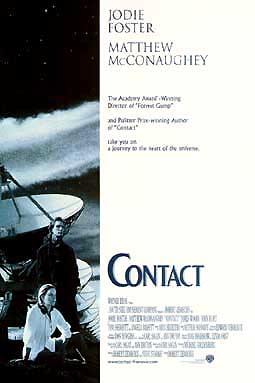 Last week I was invited to introduce a screening of Contact – a film I had seen twice in twenty years and then saw twice in the same week – as part of this
  Mark Bould