The City in Fiction and Film, week five

Ratcatcher_filmWeek four

This week, a lot of people, mostly children, died.

That is, this week we watched Ratcatcher (Lynne Ramsay 1999) and read chapters 5-7 of Elizabeth Gaskell’s Mary Barton: A Tale of Manchester Life (1848). And we did so through a (more or less) structuralist lens, so as to consolidate and build on the semiotic theory and terminology from the last couple of weeks.

So we began with revisiting the relationship between parole and langue, and thinking about how the latter structures the former. Borrowing from Lois Tyson’s not-entirely-accurately-subtitled Critical Theory Today: A User-Friendly Guide (1999), we looked at how utterances such as

tree appears green
Susan is tall
dog runs happily
clouds roll ominously
wisdom comes slowly

share the same parts of speech

noun, verb and descriptor (adjective or adverb)

and the same rule of combination

subject and predicate

So we moved from surface phenomena with very different meanings to the structures that make them comprehensible. We then refreshed our memories about the syntagmatic and paradigmatic axes of language, turning once more to an example from the first episode of Sherlock, in which Holmes is confronted by the word

RACHE

scratched in the floor by the victim. To fathom its meaning he changes paradigm, trying other languages until he finds one in which it is a word (‘revenge’ in German). And then he returns to English and scrolls through another paradigm, letters that could be placed at the end of the sytagm to make a word, until he comes to L and spells

RACHEL

So once more, the relationship between surface phenomena and the (potential) structure(s) underpinning it are made clear. After which we returned to some key sentences from our Sherlock and ‘The Blue Carbuncle’ examples from last week

‘How did you know I had a therapist?’
‘This hat is three years old. These flat brims curled at the edge came in then.’
‘his wife has ceased to love him’

and reconstructed Holmes’s reading of connotations in terms of the codes on which they draw, the myths they reiterate and the ideology they construct/articulate. (For the time being we are leaving ‘ideology’ dangling a little, defined as nothing more complex than ‘knowledge in the service of power’, which is already turning out to be more complex than I thought this simple definition would be…). So again, we move from surface to structure.

Next we turned to some new material, beginning with a brief description of Vladimir Propp’s formalist analysis of Russian folktales in Morphology of the Tale (1928), which finds the same recurring structure of 31 narrative ‘functions’ and seven character types in all the tales in his sample. We also thought about some of the problems with such methodologies – the violence they do to the narratives under consideration by treating the surface level of detail as somehow irrelevant, the violence that is done to narratives to force them to fit a predetermined pattern imposed by the critic. (One student was quite familiar with Propp, having encountered him on A-level Film Studies and being required – to my quiet horror – to undertake  a Proppian analysis of Fight Club (Fincher 1999), which is of course structured exactly like a centuries old oral tale from another culture thousands of miles away. Others had  heard of Joseph Campbell and the monomyth – undoubtedly the fault of George Lucas – but fortunately it didn’t seem appropriate to get into it too much in class, because it would have taken a while to get through the fundamentally racist logic underpinning the method. Maybe next year, in the module on genre theory and fantasy.)

We then took a look at James Damico’s 1978 description of the structure of a film noir:

Either because he is fated to do so by chance, or because he has been hired for a job specifically associated with her, a man whose experience of life has left him sanguine and often bitter meets a not-innocent woman of similar outlook to whom he is sexually and fatally attracted. Through this attraction, either because the woman induces him to it or because it is the natural result of their relationship, the man comes to cheat, attempt to murder, or actually murder a second man to whom the woman is unhappily or unwillingly attached (generally he is her husband or lover), an act which often leads to the woman’s betrayal of the protagonist, but which in any event brings about the sometimes metaphoric, but usually literal destruction of the woman, the man to whom she is attached, and frequently the protagonist himself.

This structure – derived from James M. Cain’s novels The Postman Always Rings Twice (1934) and Double Indemnity (1936), but already broadly familiar from, for example, Hardy’s Tess of the d’Urbervilles (1892) and Zola’s Thérèse Raquin (1867) – can be found in Double Indemnity (Wilder 1944), The Woman in the Window (Lang 1945), Scarlet Street (Lang 1945), The Killers (Siodmak 1946), The Lady from Shanghai (Welles 1948), The Postman Always Rings Twice (Garnett 1946), Out of the Past (Tourneur 1947), Pitfall (De Toth 1948) and Criss Cross (Siodmak 1949), and with variations in Murder, My Sweet (Dmytryk 1944), The Strange Love of Martha Ivers (Milestone 1946) and The Blue Dahlia (Marshall 1946). It mutates and collapses in In a Lonely Place (Ray 1950) and is anticipated by The Maltese Falcon (Huston 1941).

And since we watched the latter just a couple of weeks back, we were able to see how well – or poorly – it matches Damico’s narrative structure, and the violence that needs to be done to the film in order to make it fit.  Which was a useful exercise in reminding us that surface is as important as – if differently important to – structure. (Damico also gave us the opportunity in passing to think about how genre definitions work to privilege certain texts and marginalise others,  reorganising our understanding of groups of relatable texts rather than telling us some fixed truth about genre. But that was me wandering off topic a bit.)

From shared narrative structure we moved onto structuralist thinking about binary oppositions – and to run through this idea we left the city behind for a while and headed out west, as Jim Kitses’s Horizon’s West (1969) contains that fabulously useful (if problematic) discussion of the western in terms of the generative conflict between wilderness and civilisation (and 20 other related oppositions).

And (finally) this brought us to the series of oppositions I asked the class to think about while watching Ratcatcher:

city vs. country
urban tenements vs. suburb/new estate
male vs. female
adults/parents vs. children
rich vs. poor
English vs. Scots
freedom vs. confinement

The class were pretty quick to spot the ways in which most of these categories map onto each other, linking the urban tenement with varieties of confinement and the new estate out in the countryside with freedom: playing on piles of garbage vs. playing on a construction site; flats off shared stairwells vs. individual houses with interior staircases; outside loos and tin baths on the kitchen floor vs. fully plumbed inside bathrooms; the view out of the window onto a dirty dangerous canal vs. the view out of the window onto a rather improbably golden field; looking out of windows vs. climbing out through windows; etc – all  of which is peculiarly echoed in the odd digression about the mouse launched into space finding a new home safe from the cruelty of young boys among a community of mice (which is surely a Clangers homage).

And then there were the wealthy English represented by the received pronunciation of the television news reporters commenting on the dustmen’s strike and the filthy conditions the people of Glasgow endure vs. the actual characters whose lives disrupt this patrician colonial perspective upon them.

Then we turned to Mary Barton.

Chapter 5 begins with a passage that introduces two key oppositions: appearance vs. reality and the individual vs. the mass. Gaskell’s narrator describes the working class Mancunian men who defy middle class expectations (and the tendency to lose particularities when you homogenise people as members of a class) by being skilled mathematicians, botanists and entomologists (and should we doubt it, she invokes a partially-remembered record of botanist Sir JE Smith finding himself dependent on a porter and a hand-loom weaver for advice on a rare specimen he sought).

Margaret Legh brings her friend, Mary Barton, home to meet one such amateur natural historian, her father Jacob. It seems odd at first, but this encounter, focalised through Mary, throws out scientific imagery in favour of something more alchemical, comparing Jacob to a wizard, speaking of the uncanny, the cabalistic, the mysterious. Having just hinged the credibility of her fictional account around a real historical event, Gaskell switches genres, drawing on something closer to the gothic romance. Opposing science and superstition in this way reinforces the common cultural opposition of masculine rationality and feminine fancifulness. In the following pages, a recently widowed woman is described as lacking foresight when she borrows heavily so as to be able to bury her husband, and Margaret, who is losing her eyesight, faces a similar charge because she continues to take in sewing – especially since there are a lot of deaths this winter, which involves sewing black cloth with black thread, straining her eyes even further. Mary’s own romantic fantasies of marrying the wealthy mill-owner’s son (who is courting her but with no such honourable intention) in the hope of finally being able to provide properly for her own unemployed father is contextualised, at the end of chapter 7, in terms of reading too many cheap romances and is described with reference to the Arabian Nights and in terms of building castles in the air.

But we have leapt ahead.

On meeting Jacob, Mary is told the story of how one day he bought from a sailor a scorpion, apparently frozen to death, that when placed without thinking in front of the fire came to life (Jacob managed to kill it by putting it in a pan of boiling water, and then preserved the remains). This peculiar anecdote – for which the chapter up until that point is merely laying the groundwork – leads nowhere in narrative terms, but introduces further oppositions (fire and water, hot and cold, life and death, and once more appearance and reality). It also foreshadows events: the chapter will end with a perilous fire that burns down the mill, and in chapters six and seven Ben Davenport and Joe and Will Wilson die of cholera, burning up with fever.

Soon after the anecdote, there is a paragraph describing a winter so cold that it is impossible for poor people to find liquid water – the icy landscape is deathly, and it seems as if it will go on for ever, a kind of inverse of the scorpion story. And it is the cold that freezes the standing pipes which prevent the fire crews from being able to bring the blaze under control. This paragraph leads into conversations about mourning and death (and economics) and blindness and insight and darkness and light.

The crowd who gather to witness the blaze are described as a mindless, unruly mass – for all her sympathy for the poor, Gaskell seems terrified of the mob and despises working class political organisation and action. But a mass in which, once more, individuals are made to stand out – Magaret and Mary in particular. And there is a curious parallel between the crowd behaving as an unconscious mass, impelled here and there by a kind of mindless subordination to a collective desire for spectacle, and Mary, who in their midst faints – loses consciousness.

Chapter 6 returns to the crowd, when Mary’s father, John Barton, on a mission of mercy is made furious by the apparent unconcern of the people he passes. And yet at the same time, he recognises that he is being unjust, that he cannot tell the first thing about them or the realities of their lives just by looking at them.

The main oppositions in this chapter map class difference onto verticality (and reinforce it with warm/light/dry vs cold/dark/damp).

Barton is summoned by a friend to the aid of Ben Davenport, who has been out of work since the mill burned down. The mill-owners, the Carson family, talk about the need to tighten their belts, but frankly they are glad the fire happened – they are insured, their machinery was out of date and needed replacing, and as the market is not that good, they are relieved to not have any expenses, such as wages. The mill-workers, on the other hand, have nothing, and many are starving. Barton descends into the narrow well between the the filthy street and the housefrony, into which mud and sewage is leaking, and from there down another step into a cellar room that never gets much light (the windows are broken and stuffed with rags, anyway); the mud and sewage is also seeping up through the floor. There is no fire, nor is there any food for the children. Davenport is near death. His desperate wife, who still suckles one of her children even though he is too old and she is barely able to produce any milk, is repeatedly described as death-like, cadaverous. Davenport is spoken of as having sunk down in the world; later, he will sink into death.

Barton’s mission of mercy takes him first to a pharmacist – the night-time shop-windows are full of commodities, perfectly lit to make them seem even more desirable, and again there is a sense of a fantastical world parallel to all this misery – and then the next day to the Carson’s house, which is brightly lit, with blazing fires and plentiful food and drink.

Carson bemoans his loneliness – only the youngest of his daughters stayed home to keep him company the previous night, and this morning the others are all also late to rise after their late night out at the assembly rooms. The youngest daughter puts her hands over her father’s eyes, mocking Margaret’s impending blindness, just as Carson’s loneliness mocks the isolation of so many of the working class characters.

Although the Carsons’ house is above ground, there is no great emphasis on it being higher than the Davenport’s – as in the spatialisation of class evident in sf films such as Metropolis (Lang 1927) and Blade Runner (Scott 1982) – but its vertical distinction is, as already noted, made clear at the end of chapter seven. It is part of the castle in the air that Mary’s romantic fancy builds.

Recommended critical reading
Barry, Peter. Beginning Theory: An Introduction to Literary and Cultural Theory. 3rd ed. Manchester: Manchester University Press, 2009. See chapters on structuralism, Marxist criticism and feminist criticism.
Eagleton, Terry. Literary Theory: An Introduction. 2nd ed. Oxford: Blackwell 1996. 79–109.
Hawkes, Terence. Structuralism and Semiotics. London: Routledge 1977.
Scholes, Robert. Structuralism in Literature. New Haven: Yale University Press, 1975.
Stam, Robert, ed., New Vocabularies in Film Semiotics: Structuralism, Post-Structuralism and Beyond. London: Routledge, 1992. See part III , “Film Narratology,” especially 77–85.
Tyson, Lois. Critical Theory Today: A User-Friendly Guide. London: Routledge, 1998. See chapters on structuralist criticism, Marxist criticism and feminist criticism.
–. Using Critical Theory: How to Read and Write About Literature. London: Routledge, 2011. See chapters on Marxist theory and feminist theory.

Recommended reading
Novels concerned with urban poverty and class structures include Émile Zola’s L’Assommoir (1887), Stephen Crane’s Maggie: A Girl of the Streets (1893), Frank Norris’s McTeague: A Story of San Francisco (1899), Theodore Dreiser’s Sister Carrie (1900), Upton Sinclair’s The Jungle (1906), Robert Tressell’s The Ragged Trousered Philanthropists (1914) and Walter Greenwood’s Love on the Dole (1933).
H.G. Wells’s The Time Machine: An Invention (1895) contains a science-fictionalised vision of class difference.
Jack London’s The People of the Abyss (1903) and George Orwell’s Down and Out in Paris and London (1933) and The Road to Wigan Pier (1937) combine autobiographical writing with sociological reportage about living in poverty.

Recommended viewing
There is a long tradition of British social realist films about working class and lower middle class life, often in provincial towns, including such British New Wave films as Room at the Top (Clayton 1959), Saturday Night and Sunday Morning (Reisz 1960), A Taste of Honey (Richardson 1961), A Kind of Loving (Schlesinger 1962), The L-Shaped Room (Forbes 1962), Billy Liar (Schlesinger 1963) and This Sporting Life (Anderson 1963), all of which were adapted from novels or plays.
Later social realist films include Kes (Loach 1969), Nil by Mouth (Oldman 1997), Red Road (Arnold 2006) and Fish Tank (Arnold 2009).
A lighter tone can be found in Brassed Off (Herman 1996), The Full Monty (Cattaneo 1997), Billy Elliot (Daldry 2000), Son of Rambow (Jennnings 2007), Made in Dagenham (Cole 2010) and Pride (Warchus 2014).
Groundbreaking television series that pushed the limits of social realism are Jim Allen’s Days of Hope (1975), directed by Ken Loach, and Alan Bleasdale’s Boys from the Blackstuff, directed by Philip Saville.

Week six

The Atrocity Exhibition (Jonathan Weiss US 2001)

51K5H8KCA5LAssuming it is even possible, to what extent and in what ways should adapta­tions remain faithful to their sources? All manner of possibilities emerge when the adaptation is free of the constraints of respectability, accessibility and banal fidelity that a studio budget tends to entail, and when the source is supposedly ‘unfilmable’, as is the case with Weiss’s independently financed adaptation of JG Ballard’s novel.

Ballard’s and Ballardian prose is recited in voiceover and by carefully pos­itioned actors – affectless mannequins in static tableaux. The camera is locked or tracks slowly. Interspersed is footage of Hiroshima survivors, crash test dum­mies, nuclear tests, Kennedy’s assassination, plastic surgery, the Challenger dis­aster, the war in Vietnam, penetration, Marilyn Monroe. A voiceover posits that the film was shot by Dr Travis (Victor Slezak), misappropriating the institution’s equipment and funds, as therapy, but is uncertain for whom.

Often, however, this mixture of stock footage and re-enacted scenes feels more like a high-end BBC documentary profile of Ballard, with the talking heads and explicatory arc excised. Some shots are strikingly composed, particularly when situating humans among architecture, but they lack the clinical precision of Cronenberg’s adaptation of Ballard’s Crash (Canada/UK 1996) and never achieve the gor­geous insanities of Matthew Barney’s Cremaster cycle (1995–2002). The static set-ups and slow tracks suggest Tarkovksy, but lack his attention to rhythm, to sculpting in time. While the film is never as torpid as, say, a classical Hollywood adaptation of Hemingway, its languor is strangely at odds both with Ballard’s surrealist prose montage and the media landscape he dissected. Imagine what Godard or Tsukamoto could have done with such material.

Several times Weiss tilts his camera upwards from the ground at his feet to an object further away, opening up a wider perspective. This tension between the detail and the whole pins Weiss and his film in the angle between two depths of field. Take for example the long shot of Karen Novotny (Anna Juvander), being fucked from behind while leaning out of a car window, naked apart from a picture of Ronald Reagan strapped over her face. The camera tracks in slow­ly, the music on the soundtrack adding a sense of respectfulness rather than juxtaposition. Before we can make out the image over her appropriately bored face, we know it will be of Reagan. All the elements are there, but somehow together they become less than their sum. The sequence only comes alive when old movie footage of Reagan, apparently looking askance at these shenanigans, is briefly inserted. This captures something of Ballard’s impish absurdism but nothing that might shock, however fleetingly, the bourgeoisie.

 The Atrocity Exhibition is not so much an adaptation as an ambiguous memoriali­sation, turning Ballard into a suburb of European art cinema.

A version of this review originally appeared in Science Fiction Film and Television, 1.2 (2008), 359–60.

Crimson Peak (del Toro 2015)

MV5BNTY2OTI5MjAyOV5BMl5BanBnXkFtZTgwNTkzMjQ0NDE@._V1_SX640_SY720_Pretty much all the commentary so far has been about one of two things.

Critics have been unanimous in their praise of how gorgeous the film looks, from its gothicky design to its fabulous frocks and sumptuous colour palette (it also has some nice irises and cunning wipes).

Or they have echoed del Toro’s own point that it is not really a horror movie so much as a gothic romance, full of echoes and allusions, including: Poe’s ‘The Fall of the House of Usher’; the several versions of Jane Eyre and Silence of the Lambs; Du Maurier’s Rebecca; Hitchcock’s Rebecca and Notorious; Medak’s The Changeling; The Haunting, and Wises’s; King’s The Shining, and Kubrick’s; the Coen’s Barton Fink; del Toro’s own Devil’s Backbone; and so on.

All of these critics are right, and yet without exception they overlook del Toro’s major accomplishment.

Somehow, he manages constantly to keep this astonishing overblown confection of evil aristocrats, ghosts, forbidden rooms, gramophone cylinders, automata, letters, keys, ghosts, murder, incest, idiosyncratic grim-up-north grimness, peculiarly hardy Cumberland moths, violent assaults and revolutionary mining technology just this side of hilariously funny. And somehow he makes it a constant delight, grand guignol at its most operatic, all logic subordinated to production design.

But it would take just one person in the auditorium to start laughing, and it could all go disastrously wrong.

It is not the first time del Toro has walked this particular line. Much as I enjoyed them, Hellboy II and  Pacific Rim edge along a similar tightrope, and are rather less successful in keeping it together.

Early in the film, protagonist Edith Cushing (Mia Wasikowska) explains of a story she has written that it is not so much a ghost story as a story with ghosts in it, and that her ghosts are actually metaphors for the past. With the kind of New Weird chutzpah that China Miéville once championed, del Toro’s film takes completely the opposite tack. His ghosts are ghosts, not metaphors.

However, the logic of Miéville’s argument meant that while one should be absolutely committed to treating monsters as monsters rather than as metaphors, this should nonetheless leave their metaphorical potential open and even make for more effective metaphoricity. But with del Toro’s pastiche late-Victorian setting lacking the historical resonances of Devil’s and Pan’s Labyrinth‘s (not unproblematic) Spanish Civil War settings, there is nothing really for his ghosts to gain metaphorical purchase, even if they were so inclined. There is some stuff about aristocrats as parasites, and a whole Blut und Boden thing lying around should anyone want to make something of it, but no one does. And del Toro seems utterly uninterested in the gendered restrictions and sexual repression that seem so fundamental to gothic romance.

It is a film of many layers, all of them on the surface.

On the other hand, I loved every deliriously silly minute of it, and you get the impression del Toro did, too.

The City in Fiction and Film, week four

SH_BLUE-01One of the many other things to take into account when designing a coherent degree programme is when and where to fit in all the other things that a HEI is now often expected to provide during scheduled classes – things like study skills, careers, etc, etc. So rather than screen a film this week, this module was responsible for the first library training session, beginning with basics (such as where the library is and what resources and services it provides) and building up to a detailed online workbook (locating different kinds of sources, assessing their reliability, how – and why – to quote and/or paraphrase them, how to reference them, etc). The workbook takes maybe two hours to complete – and in a couple of weeks, students will have their first assignment – an online quiz that tests their knowledge of the library, referencing, etc. Our Faculty Librarian designs and presents this workbook and the quiz, and machines mark it for me!

Back in my day, you were given a library card and told the card catalogue was probably quicker to use and more reliable than the rather basic computer catalogue… Kids today, honestly they don’t know they’re born!

Class began with an informal test about all the semiotic terminology encountered last week – students were free to draw on any resources to help them reformulate the ideas in their own terms to a) probe their understanding of those ideas; b) probe the ideas themselves; and c) tame an alien vocabulary and make it useful.

Next, we took on the James Bond exercise we did not have time for last week. At the start of chapter 25 of Ian Fleming’s From Russia, With Love (1957), called ‘A Tie with a Windsor Knot’, Bond is joined on the Orient Express by psychopathic SMERSH assassin Red Grant posing as an MI6 agent sent by M called Captain Norman Nash. After an exchange of codewords, we are treated to a description of Nash through Bond’s eyes from which Bond extrapolates the character and life story of his new acquaintance. Several codes are evoked to suggest that Nash is untrustworthy or at least unseemly.

He has ‘thick lips’ which writhe briefly rather than forming a smile – whether a friendly greeting or an ironic grin at the ‘childish’ password ‘ritual’. Those lips suggest a racialised sensuality – rather than possessing the British character associated with a stiff upper lip, Nash has stayed behind in the Mediterranean after the war, to ‘avoid the rigours of England’ and to take a foreign girlfriend or marry an Italian.

It gets worse. Not only does he speaks with ‘a hint of … cheap brogue’, so perhaps his off-whiteness can be traced to Irish ancestry, his curious accent is probably also a consequence of speaking a ‘foreign language all the time’. He has simultaneously “gone native” and let the veneer of English civilisation slip sufficiently to reveal beneath it a not-Englishness. Perhaps that is why his calling card mentions his rank, Captain, and that he is a member of the RAC. They are desperate attempts to assert an identity he does not quite possess; and they give themselves  away as such to Bond’s trained – or perhaps merely bigoted –  eye.

Nash’s lips might be given to bestial writhing, but his eyes are at once dead – there is ‘no light in them’ – and a ‘very pale blue’, watery perhaps and lacking resolve. Certainly the career trajectory Bond imagines for him – from ‘minor public school’ (so not from one of the best English families, maybe even from an Irish family) through the Royal Engineers (perhaps not the most frontline of wartime active service, and a bit close to skilled manual labour) to stumbling into a position with MI6 because all the more senior and more qualified men returned to the ‘rigours of England’.

His clothing suggests some mismatching of colours – reddish-brown tweed, pale yellow shirt, blue and red regimental tie, a red bandana handkerchief (that flops out of his breast pocket), a ‘gold signet ring with an indecipherable crest’, a battered silver watch with a leather strap. And then there is that tie tied in a Windsor knot. To Bond, the knot signals Nash’s vanity; it is after all ‘the mark of the cad’ – and was in popular consciousness linked to Edward VII, who after his abdication was seen as a potential pretender to the throne (especially as he was not exactly as unsympathetic to Hitler as one might have hoped).

Throughout, the meanings generated by Nash’s appearance rely on the connotations evoked by specific word choices and combinations, which in turn rely on shared codes through which we understand those connotations. And we can push beyond codes to what Roland Barthes called ‘myth’ – especially around class, masculinity and the colonial imaginary – and thus to ideology.

As Jonathan Bignell explains, for Barthes, ‘myth’ refers

to ways of thinking about people, products, places or ideas which are structured to send particular messages to the reader or viewer of texts … Media texts often connect one signified idea with another, or one signifier with another, in order to attach connotations to people and things and endow them with mythic meaning. (Media Semiotics, 2nd edition, 16, 17)

Fortunately the British press, British Prime Ministers and Fox News never let you down when you want a contemporary examples, so we began by questioning why The Times (14 September 2015) described Jeremy Corbyn’s favoured mode of transport as a ‘Chairman Mao-style bicycle’. Why would a right-wing newspaper want to connect the new moderate centre-left leader of the Labour Party with the head of a brutal communist dictatorship?

We then took a look the first half at this segment from John Oliver, in which he explains why it is problematic for David Cameron to call refugees ‘a swarm’, and why Fox News cannot heavily imply all muslim men and/or refugees are terrorists while claiming that they are not implying precisely that.

In each of these examples, signifiers connote and those connotations draw upon and reinforce Barthesian myths. (We also took a look at Barthes’s own famous example of the Paris-Match cover in which a young black cadet salutes the French flag, thus apparently justifying colonialism.)

After all this (and a break!), it was time for some urban fiction, beginning with Arthur Conan Doyle’s ‘The Blue Carbuncle’ (1892) – the one in which a lost hat and abandoned Xmas goose lead Holmes to solve the theft of the eponymous gem. Our main focus was on the passage in which Holmes performs a semiotic analysis of the hat (though we also considered the simple techniques Doyle uses to persuade us of the accuracy of Holmes’s reading).

There were some indexical signs: several tallow splashes on the hat suggest its owner, Horner, lives in a house where gas-lighting has not yet been installed; and, more ridiculously, the size of the hat leads Holmes to conclude that Horner has a large head and therefore must be ‘highly intellectual’ – later, Horner’s mannered expression and use of the term ‘disjecta membra‘ will serve to confirm this absurdity. (The story was published the year before HG Wells’s essay ‘The Man of the Year Million’, which led to the design of his Martians and thus all those later big-brained aliens with puny bodies – so clearly something was in the air, not least because Horner is also sedentary and out of shape.)

There is also plenty of evidence of myth, as the connotations Holmes draws from his perusal of the hat reach out into the dimension of Victorian morality. Horner, who is no longer as foresightful as once he was, who has fallen on hard times, who  is not as attentive to his appearance as he used to be, and who has taken to drink, is obviously undergoing ‘a moral retrogression’ and has a ‘weakening nature’, though there are vague hopeful indications that ‘he has not entirely lost his self-respect’. In this aspect of Holmes’s analysis, meanings are converted into values – myth, and behind it ideology, in action.

This can be seen even more starkly in Holmes’s conclusion that Horner’s wife no longer loves him.

This hat has not been brushed for a week. When I see you, my dear Watson, with a week’s accumulation of dust upon your hat, and when your wife allows you to go out in such a state, I shall fear that you also have been unfortunate enough to lose your wife’s affection.

Patriarchy, anyone? Normative gender roles much? (It took mere seconds to come up with a half a dozen other reasons for Horner’s hat not having been dusted recently.)

We also took a quick look at the sequence from the first episode of Sherlock, in which Frumious Bandersnatch explains his initial reading of Bilbo’s character, history and current situation – culminating in a moment in which his reliance on heteronormative codes leads him to mistake the gender of his new friend’s sibling. (Other parts of his semiotic analysis were also questionable – were Iraq and Afghanistan really the only sunny places overseas British troops were stationed in 2009/10? why are scratches around the port on the phone evidence of the previous owner having a drink problem when we already know the current owner has a hand that sometimes shakes uncontrollably? Etc.)

We also took a look at the start of Holmes’ crime-scene analysis (damp clothes indexing rain, etc). And the handy bit when we see Holmes work along syntagmatic and paradigmatic axes to make sense of the victim’s message scratched in the floor with her fingernails: RACHE. In what languages is that a word? German, meaning revenge. Doesn’t seem very likely. What letter could be added to it to complete an English word? An L? Rachel! It’s a name. That’ll do nicely.

We finally took a look at William Gibson’s ‘The Gernsback Continuum’ (1981), but we were all flagging a little by this time. Its main significance for this class is twofold:

  • that there came a point – Gibson argues for the 1930s – when design started to dominate function in the construction of commodities and thus we started reorganising the way we purchase things in terms of their readable connotations;
  • and that that we live in built environments which are to varying degrees designed, and can thus be read for their meanings, which may well change over time. (And that all around us lurk semiotic ghosts.)


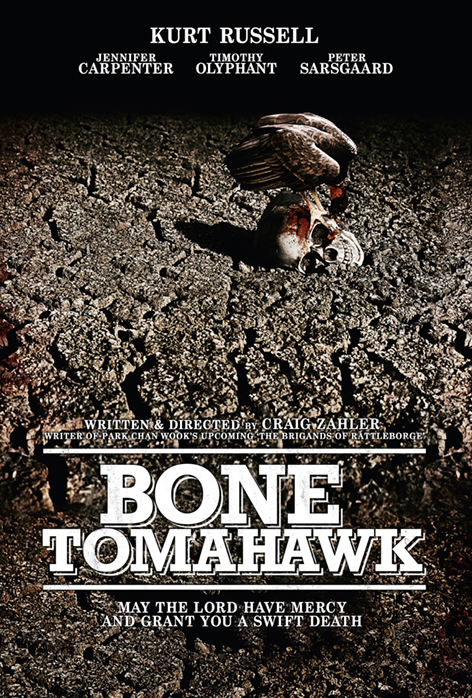
Bone Tomahawk (S. Craig Zahler 2015)

37128_1_largeBone Tomahawk is easily the best horror western I have seen – admittedly not an overcrowded field – since Antonia Bird’s Ravenous (1999). But it is also undone by one big problem.

Let us begin with the good things, before I point out the glass is half empty, throw the rest in your face and smash the glass.

Kurt Russell is finely grizzled, tough and thoughtful as the Sheriff, and Richard Jenkins, playing his not-exactly-the-sharpest-tool Replacement Assistant Deputy, is as engaging as I have ever seen him. David Arquette does a lot with the little he is given to do, and neither Patrick Wilson, as the broken-legged husband, nor Matthew Fox, as the wealthy loudmouth Indian-killer, who make up the rescue party manage to mess it up. The four of them would not be out of place in a Joe Lansdale story. Nor would Sean Young as the mayor’s wife, the real power in the small frontier town of Bright Hope. (Just realised that the image I’ve chosen shows off an earlier cast, which also included Jim Broadbent at one point.)

Bone Tomahawk is (mostly) well-constructed, with some very nicely written passages (the flea circus bit is especially good, if undermined a little by the exchange of looks at the end of it). For a brief while it even looks like the film might give Lili Simmons, as the wife, something to do (it does not). The unmistakably western landscape is also intriguingly unfamiliar. Most of the graphic violence is well done, with really effective sound effects. And there are some nice little touches, undwelled upon, such as how exactly Simmons’ character knows how many Troglodyte males there are in the clan. Indeed, in some respects it is the kind of solid B western and a solid little horror movie – and not so committed to the latter that it forgets to also do the former – that might tempt one to call it Lansdale-ian.

But there is that one big problem. And the film is really conscious of it.

You simply cannot tell this kind of story – the kind of abduction-by-injuns story that goes right back to Protestant settlers’ captivity narratives – without relying on a very long history of racist tales and depictions of native Americans. Bone Tomahawk does what it can to not be racist. It seems sincere about it. It creaks and groans in places with the effort.

And at least it doesn’t have Adam Sandler in it.

But it fails.

Perhaps this kind of story is always doomed to fail in this respect.

Bone Tomahawk begins with two westerners doing unspeakable things. Brutally, with inadequately sharpened knives, they kill men in their sleep so as to rob them. This is supposed to work, I think, so as to encourage us later not to judge all native Americans by what the set-aside inbred clan of savage pre-human Troglodytes do. Indeed, the Troglodytes are even given a mutation that suggests they might actually not be human but some isolated evolutionary spur (they resemble the diseased islanders of Peter Jackson’s King Kong, Immortan Joe and his warboys, The Descent‘s subterranean predators, the nuclear mutations of The Hills Have Eyes). Certainly, the well-dressed, assimilated native American who refuses to go along on the rescue mission –  he does provide the rescue party with information about where to find the Troglodytes, but with a quite admirable fuck-all-y’all, y’all-gonna-die kind of attitude – regards the Troglodytes as some kind of Other, just as the good townsfolk of Bright Hope might regard the robbers as utterly different from themselves.

But sadly none of this is sufficient to separate the Troglodytes from deeply racist stereotypes, or the film from siding with colonialist expansion into the American west. (And one of just two black characters is brutally slain the moment he wanders in front of the camera – but not eaten, because the cannibalistic Troglodytes, I think the explanation went, have no time for black folks. The Mexican characters fare no better.)

Which is not to say that the film lacks interesting potential.

With the only other native American assimilated into white culture, if spikily unforgiving, the Troglodytes – coated with white ash, accoutred with skulls, bones and tusks, wielding weapons made from sharpened bone – possess a spectral quality, despite their blunt materiality. They return as the repressed bad conscience of genocide. They scalp deputy Nick in front of the other captives and cram his scalp into his mouth, symbolically forcing him (arguably) to take back just one of the many slanders against native Americans that came from the mouth of white colonisers.

That the Troglodytes themselves cannot speak – they posses a mutated larynx and a boney, more-or-less sealed second mouth in their throats, through which they whistle and howl – communicates volumes. They are the subaltern. They are destined, it seems, never to speak. Nor, sadly, to win.

The City in Fiction and Film, week three

tumblr_l30hu35gF41qz6k9qo1_1280Week 2

One of the issues in designing a coherent new programme is working out at which level, in which module and when in that module (in relation to the other modules) to deliver certain kinds of material. When we designed the BA Film Studies twelve years ago, we decided to concentrate a lot of the film theory and critical theory in a compulsory level two (i.e., second year) module, whimsically entitled Currents in Film Theory. On the new BA Literature and Film Studies, in which students will encounter literary theory as well as film theory and critical theory, such a module seemed inappropriate, so part of our design process involved deciding what of this kind of material students needed to encounter and how best to divide it up between modules and levels.

All of which is a long way round to saying that today’s class involved an introduction to semiotics, ably supported by the first chapter of Jonathan Bignell’s Media Semiotics: An Introduction, still by far the best book of its kind – and I’m not just saying that because he used to teach me. (There will some structuralism, Marxism and feminism soon.)

By the end of the lecture, we had covered these terms/ideas from Saussure and Peirce:

Semiotics
diachronic vs. synchronic
langue and parole
the sign is arbitrary and conventional
sign = signifier + signified
the referent
syntagmatic vs. paradigmatic
symbol, icon and index
denotation and connotation

There was, as always, much exemplification through the medium of cats. (Back in the day, it was always trees, but over the last couple of decades this arboreal hegemony has fallen to a relentless feline insurgency – probably something to do with the internet and the ‘mind-control’ parasite Toxoplasma gondii.)

We’ll nail down these terms with a test at the start of class next week. A revision aid can be found here.

We looked at three texts this week – John Huston’s film of The Maltese Falcon (1941), Edgar Allan Poe’s story ‘The Man of the Crowd’ (1940) and Virginia Woolf’s essay ‘Street Haunting: A London Adventure’ (1927).

The vagaries of timetabling mean that each week the screening comes before the lecture, which is normally not a problem, but the challenge today was to come up with screening questions that are basically asking questions about semiotics without using semiotic terminology. Such as:

What kind of man is Sam Spade (Humphrey Bogart)? How do we know these things about him? How does he differ from Miles Archer (Jerome Cowan)?
How do we know Joel Cairo (Peter Lorre) is gay?
How do we know Kasper Gutman (Sidney Greenstreet) cannot be trusted? Is he also gay? Is Wilmer (Elisha Cook Jr) his lover?
How many roles does Brigid O’Shaughnessy (Mary Astor) play? How does she imply these differences?
How does Brigid differ from Iva Archer (Gladys George)? How do they both differ from Effie Perrine (Lee Patrick)?
How do we tell Lt. Detective Dundy (Barton McLane) and Detective Polhaus (Ward Bond) apart? In what ways does Polhaus resemble Sam Spade? In what ways does he resemble Dundy?

Although we did not get to work through all these questions in detail, it became very clear very quickly how much information is conveyed by costume and manner. We were obviously in the realm of signs – of signifiers and signifieds, of denotations and connotations.

When Miles walks into the office and finds Spade interviewing Brigid, the contrasts between the two men are clear and shape our understanding of each of them in relation to the other. Spade is in a tailored suit with subtle stripes, buttoned up with a precisely knotted tie; his manner thus far has been similarly professional, slightly patronising. Miles, a taller and slightly gangly figure, wears a baggier suit, unbuttoned, his shirt and tie not as neat; he makes no effort to conceal his sexual interest in Brigid, seating himself on the edge of Spade’s desk. Archer’s desk faces the window, Spade’s the door. He lacks Spade’s composure, his air of competence; Archer’s death, then, comes as little surprise.

Joel Cairo’s card smells of gardenias. He is small and feminised, his costume dapper, his hair neatly oiled curls. He wears gloves to keep his hands soft; he fiddles nervously with his cane, constantly positioning it near his mouth, suggesting some kind of oral fixation. His accent is exotic, as are the overseas places he has visited – and his surname. It is difficult to tell how much of his ‘deviant’ persona from M, which had been a hit in the US, is carried over, but it is clear that The Maltese Falcon – like many American crime films – uses queerness to connote wrongness and villainy. Some of this is evident in the corpulent Gutman, too, with Wilmer just the latest in what appears to be a succession of young men he picks up to work as his henchmen (and catamites?). However, there is an intriguing countercurrent at work. Perhaps it is the appeal of the exotic, perhaps just the brilliant performances of Lorre and Greenstreet, but neither character is particularly loathsome – and both in various ways are quite likeable.

We also noted the importance of transience and anonymity again in the representation of the city: Brigid goes by three names and at least that many personas; no-one knows their neighbours or lives in a discernible community; the closest thing to a friendship we see is between Spade and Effie (boss and employee).

Walter Benjamin says that Poe’s ‘A Man of the Crowd’

is something like an X-ray of a detective story. It does away with all the drapery that a crime represents. Only the armature remains: the pursuer, the crowd, and an unknown man who manages to walk through London in such a way that he always remains in the middle of the crowd.

We began with the moment in which the narrator first spots this mysterious man – whose appearance is a parole (speech-act) which the narrator struggles to filter through the available langue (sign system):

As I endeavoured, during the brief minute of my original survey, to form some analysis of the meaning conveyed, there arose confusedly and paradoxically within my mind, the ideas of vast mental powers, of caution, of penuriousness, of avarice, of coolness, of malice, of blood-thirstiness, of triumph, of merriment, of excessive terror, of intense–of supreme despair.

And then we took a step back to the start of the story, in which the narrator describes looking out at the crowd on a London street, abstracting himself from it, presenting himself as some kind of disembodied neutral observer, who fantasises about his ability to see without being seen. For two pages, he divides the crowd into distinct groups, and distinguishes between them by their costume, demeanour and behaviour, producing a catalogue of types, descending from the respectable professional classes down through clerks and swells, gamblers and pickpockets, prostitutes and drunks. The narrator reads the character of these people from their appearance; and the author persuades us of its accuracy and truthfulness through his careful selection of signs (words) for their denotative and, perhaps more importantly, connotative powers. No wonder, then, that ‘the man of the crowd’ comes as a shock, an epistemological limit that might undermine the certainty with which the narrator has described everyone else.

We also had a think about the following:

How does the story express the anonymity of life in the city?
How does it contrast day/night, different districts, different social or economic classes?
Who is the man the narrator follows?
What does the ending mean?

Virginia Woolf’s essay does some similar things. We thought about the connotations of the place names she includes:

the area between Holborn and the Strand
Oxford Street
Mayfair
Brixton
Waterloo Bridge
Barnes
Surbiton

Some of them retain similar connotations; others, such as ‘Brixton’, which then evoked a middle class suburb with green spaces, connotes something very different now. (Next semester we will look at some Windrush era and post-Windrush representations of London.)

Woolf begins by talking about the very personal connotations of items in one’s own room, where

we sit surrounded by objects which perpetually express the oddity of our own temperaments and enforce the memories of our own experience.

But there is an important slippage between this investment of personal meanings in a bowl or a stain on the carpet, and the connotations for readers. For the narrator, the bowl recalls the holiday in Mantua where is was purchased. For the reader, the buyer’s fond memory of the woman who sold it reeks of English class condescension, and the bowl connotes wealth, because who but the well-off could afford to spend a summer in Italy?

There is a curious passage also when the narrator visits a shoe store. A female dwarf, accompanied by two regular-sized women, reveals her perfect, full-sized, ‘arched and aristocratic’ foot. Its revelation alters her demeanour, and thus that of the people in the store. At the same time, the narrator is infected by the fantastical imagery of dwarves and giants (the regular-sized companions), and this spills over into her phantasmagorical description of the often-foreign working class denizens of the area around Seven Dials and Covent Garden. It is as if she cannot bring herself to directly describe this area and the people there. And, like Poe’s narrator, Woolf’s narrator is suddenly shocked by the appearance of a stereotypical Jew, with all the long and terrible anti-semitic baggage that evokes.

Woolf also fantasises about seeing without being seen – she describes herself as stripping away the shell of her home and becoming like the pearl in the oyster, which promptly transmutes into a giant eye, capable of observing the surfaces of things, the plane of signification. As a consequence of which, I now imagine Virginia Woolf looks like this:

Untitled-1


I also had the opening of chapter 25, ‘A Tie With a Windsor Knot’, from Ian Fleming’s From Russia with Love (1957) to hand, but time as always was our enemy – will probably kick off next week’s class with it. (My colleague teaching the Cultural Value, Literature, Film and Consumption module will be doing some work on James Bond in the coming weeks, so it will make a nice crossover; she has been working on Sherlock Holmes this week, so I will be building on that next week.)

Recommended critical reading
Bignell, Jonathan. Media Semiotics: An Introduction. 2nd ed. Manchester: Manchester University Press, 2002.
Chandler, Daniel. Semiotics: The Basics. London: Routledge, 2002.
Monaco, James. How to Read a Film. 4th ed. Oxford: Oxford University Press, 2009. See chapter 3, “The Language of Film: Signs and Syntax.”
Stam, Robert, ed. New Vocabularies in Film Semiotics: Structuralism, Post-Structuralism and Beyond. London: Routledge, 1992. See part II, “Cine-Semiology,” on how semiotics was developed in relation to film.
Turner, Graeme. Film as Social Practice. 4th ed. London: Routledge, 2006. See chapter 3, “Film Languages.”

Recommended reading
The opening and closing pages of Nikolai Gogol’s “Nevsky Prospect” (1835) capture the bustle and variety of a modern city street.
Virginia Woolf’s Mrs Dalloway (1925) repeatedly leaps from the mind of one character to another as they walk across London.
John Huston’s film is based on Dashiell Hammett’s hard-boiled crime novel, The Maltese Falcon (1929).

Recommended viewing
Women take on the role of detectives and attempt to make sense of the city, solve crimes or discover their own identities in Phantom Lady (Siodmak 1944), Desperately Seeking Susan (Seidelman 1985) and In the Cut (Campion 2003).

Week four


The Drop (Michaël R. Roskam 2014)

the-drop-tom-hardyand so anyway it turn out that the best thing about The Drop (2014) is not that we get to see James Gandolfini in action one last time, nor is it the reminder of quite how good a writer Dennis Lehane is, nor is it the way that it confirms that the sole motivation left to men in contemporary cinema is protecting or revenging their dogs, as in Equilibrium, I Am LegendThe Rover, John Wick (and presumably John Wick 2) and the Fast and Furious franchise (let’s face it, Paul Walker was basically Vin Diesel’s adorable little stray), as well as Human Target on the telly, no, the best thing about The Drop is every single scene in which Tom Hardy picks up young Rocco (or Mike, as he would have preferred to call him) and it becomes  impossible to decide which is the cutest puppy of all…

TomHardy_TheDrop_AnimalRescue-590x900

Tom-Hardy-and-a-Dog-in-The-Drop1

The City in Fiction and Film, week two

really

lorrem

Week one

This week we took on Fritz Lang’s M (1931).

We began with a quotation from Anton Kaes’s BFI classic, which describes the film as embodying:

‘the tension between the forces of modernity, with their emphasis on time, discipline, rationality, seriality, law and order and those recalcitrant counterforces – trauma, passion, illness, loss and, finally, death – that defy reason and resist integration’ (76)

Our discussion of these various concepts in relation to the film was supported by a number of clues and questions presented before the screening:

Look out for clocks, files, records, book-keeping, accounts and other evidence of bureaucracy in action.
Look out for communications networks and mass media.
Look out for shop windows and other displays of commodities.
Look out for mirror images/reflections and doublings.
What is going on with the narrative structure? To what extent is this a film about the contest between a protagonist and an antagonist? To what extent is classical narrative structure subordinated to a series of images of the city connected by sound? How are those images arranged? How do they relate to each other?
Pay attention to the ways the film uses sound (offscreen sound, sound from the following shot/scene present in the current scene, unusual sources of sound, silences).
At the end of the film, is there any conclusive evidence of Hans Beckert’s (Peter Lorre) guilt?

Clocks abound in this film (and other Lang films – see the Paternoster Machine in Metropolis for example) – from the child’s game that opens the film with clock-like movement to the pickpocket who calls the talking clock and then corrects all the stolen watches he is carrying; from the cuckoo clock in Frau Beckman’s apartment that signals the time as she waits for little Elsie to return home to the clocktower bells that drown it out. They signify the imposition of clock time on our experience of the world – imposed so the trains could run on time, to organize commerce, to discipline and control labour – and the ways in which this ordering of subjectivity also disorders us.

Building on this, the police investigation evokes the instrumentalisation, rationalisation and bureaucratisation of everyday life – files kept on people, fingerprinting, forensic procedures. The police amass information and process it in an orderly manner, an image graphically captured by the concentric circles drawn on a map to indicate the expanding radii of the investigation around a crime scene. The state panopticon’s vast archives of signifiers are bureaucratic abstractions of actual people – this is, as Foucault would argue, evidence of the growing management of populations by statistics. (Though we didn’t get on to Foucault or the panopticon or biopolitics in class!)

Likewise, the gang of criminals come up with their own systematic means of finding the killer (because he is bad for business) – surveillance conducted by the army of beggars in the street; and then, when Beckert is trapped in the factory/office building, despatching teams of men to work through it in an orderly manner.

This parallel between the police/administration and the criminals/beggars has already been indicated by the sequence which repeatedly cuts between them, in their respective smoke-filled rooms, as they plan their respective campaigns. (And boy, are those rooms smoke-filled – like the studio is on fire or something.)

We also thought about seriality – the children’s game, the serial fiction delivered to Frau Beckman as she waits for Elsie, the ordering of cigarettes and cigars and other objects in the beggars’ hideout, where food prices are listed in chalk as if share prices at a stock exchange. And of course serial killers, that modern and largely urban phenomenon, the US variety of which is typically said to start with HH Holmes in Chicago at the time of the 1893 World’s Fair (the subject of one of Edison’s early phonographs). The early twentieth century saw several notorious examples in Germany (Kürten, Grossmann, Denke, Haarmann), and they crop up in other German films of this period, such as Paul Leni’s Waxworks (1924), and The Lodger (1927), made under the influence of expressionism by Hitchcock shortly after his return from Germany to England (and remade in 1932 with sound by Maurice Elvey).

The idea of the serial killer returned us to the anonymity offered by cities – and the film’s recurring idea that anyone could be the killer. An idea that flips immediately into unreason – we three times see groups of people mistake someone for the killer, unleashing irrational violence, twice by mobs. (This is why it is important, I think, that we see no real evidence that Beckert is guilty. All the police know is that they have traced the man who wrote a letter to the newspapers confessing to the crimes – as many others have done. All the criminals know is that a blind man recognised a tune that was being whistled by someone to whom he sold a balloon for a little girl on the day Elsie went missing. Beckert’s own not entirely convincing confession is clearly that of a deranged man. And yet we, too, generally assume that he is guilty, leaping to conclusions.)

Violence lurks everywhere in this film. The streets are populated with men injured in the war: limbs are missing, and the one set of fingerprints we see are those of a man with only four fingers; there are blind people and deaf people, people who fake being blind and a blind man who sometimes wishes he was deaf so as to cut out the constant noise of the city. There are also psychological traumas: the anxiety of parents (shared to an extent by the viewer who joins them in being worried about their children) and the bereavements they suffer. Lang at one point considered including a flashback to explain the origins of Beckert’s derangement in the horrors of World War One; but that would psychologise him, and like Brecht, Lang is more interested here in moving from ‘psychology to sociology, from empathy to critical distance, from organic development to montage, from suggestion to argument’.

This is why the film narrative is decentred into montages of city scenes, without real protagonist or antagonist. It is about the social circumstances which enable serial killers (and other modern urban figures) to emerge, to thrive, to become a media spectacle. This is why we are not permitted – until the final scene – to develop any real sense of Beckert as a person with whom we might sympathise in some way.

We also situated the film in relation to
— expressionist art (Edvard Munch’s The Scream, Paul Klee’s Castle and Sun, Ernst Ludwig Kirchner’s Nollendorfplatz and Self-Portrait as Soldier, Wassilly Kandinsky’s progression from The Rider to Composition 6 to On White II, James N. Rosenberg’s Oct 29 Dies Irae)
— German expressionist film (Wiene’s Cabinet of Dr CaligariGenuineRaskolnikov, Hands of Orlac, Martin’s From Morn to Midnight, Robison’s Warning Shadows) – though we only had time for clips from Caligari and the opening of Joe May’s Asphalt, which moves from actuality footage to expressionist images of the city, cuts to a calm domestic space, and then returns to expressionist images of the city (you can see it here.) Unlike Caligari, which films expressionist spaces and performances, Asphalt in places uses the camera and editing in an expressionist manner.
Neue Sachlichkeit (New Objectivity or New Matter-of-factness, New Sobriety or New Dispassion), a post-impressionist movement that tried to get away from subjective expression to a more political art intended to provoke collective action (examples included Otto Dix’s verist Salon, War Cripples and The Trench, and Alexander Kanoldt’s classicist Still Life II and Der rote Gürtel). We also took  quick look at some footage from the great New Objectivity film People on Sunday (see it here).

Lang, after all, called a documentary!

The conclusion that I did not have time to get to included the sneaky reference to Foucault mentioned above, and one to the Adorno and Horkheimer – their argument that in capitalist modernity economics and politics become increasingly intertwined: business interests intervene in the running of the state for their own ends; the state intervenes in the economy to maintain conditions favourable to business. This leads to centralised instrumentalist bureaucracies and administration. As instrumental reason dominates, social life becomes increasingly rationalised.

Which kind of captures a large chunk of what M is up to. As in others of Lang’s German and US films, the city is the site of modernity, and this is what modernity looks (and sounds) like.

Additional information from the module handbook
Recommended critical reading
– Gunning, Tom. The Films of Fritz Lang: Allegories of Visions and    Modernity. London: BFI, 2000. See 163–199 on M.
– Kaes, Anton. M. London: BFI, 2000.
– Mennel, Barbara. Cities and Cinema. London: Routledge, 2008. See chapter 1, “Modernity and the City Film: Berlin.”
– Roberts, Ian. German Expressionism. London: Wallflower, 2008.
Recommended reading
The key German expressionist novel is Alfred Döblin’s Berlin Alexanderplatz (1929). A more accessible vision of Germany in the Weimar period can be found in Christopher Isherwood’s Mr Norris Changes Trains (1935) and Goodbye to Berlin (1939), often bound together as The Berlin Stories or The Berlin Novels and adapted for film as I Am A Camera (Cornelius 1955) and Cabaret (Fosse 1972). Other serial killer fiction of interest includes Robert Louis Stevenson’s Strange Case of Dr Jekyll and Mr Hyde (1886), Patrick Hamilton’s Hangover Square: A Tale of Darkest Earl’s Court (1941), Dorothy B Hughes’s In a Lonely Place (1947), Jim Thompson’s The Killer Inside Me (1952), David Grubb’s The Night of the Hunter (1953), Bret Easton Ellis’s American Psycho (1991) and Susanna Moore’s In the Cut (1995). Erik Larson’s non-fiction account of HH Holmes and the Chicago World’s Fair, The Devil in the White City (2003), is also of interest.
One of the innovations of American hardboiled crime fiction was the introduction of the detective who could go anywhere in the city, crossing physical space as well as class barriers – such as Raymond Chandler’s Philip Marlowe, introduced in The Big Sleep (1939) – which enables a similar overview of society as that offered in M.
Recommended viewing
Other German expressionist films about the city include The Last Laugh (Murnau 1924), Metropolis (Lang 1927), The Blue Angel (von Sternberg 1930) and – made in the US – Sunrise: A Song of Two Humans (Murnau 1927).
German expressionism visually influenced American film noir, including adaptations of Chandler novels, such as Murder My Sweet (Dmytryk 1944) and The Big Sleep (Hawks 1946). Its impact can also be seen in such British films as Odd Man Out (Reed 1947) and The Third Man (Reed 1949).
Point Blank (Boorman 1967), Se7en (Fincher 1995), The Underneath (Soderbergh 1995), Dark City (Proyas 1998), Fight Club (Fincher 1999) and The Deep End (McGehee and Siegel 2001) find ways to create expressionist effects in colour.
Although it has expressionist elements, at the time of its release in Germany M was considered and example of New Objectivism, like People on Sunday (Siodmak and Ulmer 1930) and GW Pabst’s films of this period – Diary of a Lost Girl (1929), Pandora’s Box (1929), Westfront 1918 (1930) and The Threepenny Opera (19321 .
The Wire (HBO 2002–08) maps the urban complexity behind crime, from street-level drug-dealing to corporate and political corruption. Spiral (Canal+ 2005–), The Killing (DR/ZDF 2007–12) and Peaky Blinders (BBC 2013 – ) do some similar things, although they are less astute about economics.

Week three

The Beachcomber (Muriel Box 1954)

and so anyway it turns out that the best thing about The Beachcomber (1954) is not the bare-faced audacity with which it has a crocodile grab hold of an elephant’s trunk so that the always lovely Glynis Johns can nurse the pachyderm back to health so that later, when the unlikely natives improbably stake her out The_Beachcomber__32318.1396548173.1280.1280onto the ground to be executed by elephant-stamping, she can be saved not by nicking the lunar eclipse bit from Haggard but by going all Androcles, nor is it the brown-face performances by Donald Pleasance and Michael ‘the true voice of Paddington’ Hordern, but the moment when drunken beachbum Robert Newton is told about an outbreak of cholera and responds: people who drink water deserve all they get….


The City in Fiction and Film, week one

This year we launched the new single honours BA Literature and Film Studies. The single honours bit is important. In a joint honours with a name like this, generally students could expect to take a couple of modules in the English department and a couple in the Film Studies department each year, with the relationships between literature and film largely unexplored (beyond, perhaps, a module on adaptation). So we set out to do something rather different – to continue to recognise medium-specificities and disciplinary knowledges/practices/skills, but also to bring them together. Various practicalities (staff specialisms and availability, institutional structures, etc) shaped the form this has taken. Basically, each year, students on the degree take one literary studies module, one film studies module, and two modules organised around a particular set of ideas that study both film and literature together; and none of these are shared with other programmes.

In the first year, one of the ‘combined’ modules looks at issues of cultural value and the other one – my one – is about representations of the city in fiction and film. Each week we have a two-hour screening slot, and a three-hour session which combines lecture and seminar activities in various mixes.

I will try to find time each week to blog about what we have been up to.

The first week of a module with new students always has particular tensions between:

1) all the institutional and organisational information that at least needs to be said aloud;
2) icebreaking;
3) encouraging students to start talking to each other and with the whole group;
and 4) actually studying something together

Fortunately, we were able to keep the first intake onto the degree quite small, and the students have already had induction sessions and a class together, so 2) could at least be folded into 3) and 4). Bureaucracies, however, tend to proliferate the items for 1) and drop them in the programme leader’s lap – in this instance, mine. Fortunately, I have great colleagues and we were able to share that load out a bit across the modules. Otherwise we might never have got to 4).

And at least everyone now knows what to do in case of fires or medical emergencies…

There is a further tension between introducing the module as a whole and meaningfully studying something quite specific that week.

In preparation for class, we read China Miéville’s London’s Overthrow and watched The Long Good Friday (Mackenzie 1981).

We began with some general questions:

  • How are cities defined?
  • How do cities differ from towns?
  • What are the relationships between the city and the country? Between the city and the conurbation or megalopolis? Between ‘the city’ and actual cities?
  • Is the city merely a physical, architectural phenomenon?
  • How are cities experienced and imagined?

Which inevitably lead to our first run-in with that student-frustrating formula: there is no definitive answer.

Louis Wirth in the 1930s defined cities in terms of permanence, large population, high population density and social heterogeneity. The UN seems to be moving away from thinking in terms of cities to mapping space in terms of intensive urban agglomerations and extensive metropolition regions. In the UK, unless you happen to have an Anglican diocesan cathedral, city status is awarded by the monarch – usually after some kind of competition tied to a celebration of the monarchy, such as a jubilee or royal wedding.

Probably the most useful definition in terms of the coming weeks is Richard Sennett’s self-consciously ‘simple’ attempt from 1977: ‘a city is a human settlement where strangers are likely to meet’. Which we unpicked for a while.

The Long Good Friday
Crime movies are often good for social and political commentary. The urban crime movie, particularly as it builds on hardboiled fiction, makes use of physical mobility across the city to explore social, political and economic relationships; and by moving across class and race barriers, it is able to depict crime as mirroring and/or paralleling ‘legitimate’culture. Hollywood’s ‘ethnic’ gangster movie protagonist (Scarface, The Public Enemy, Little Caesar in the 1930s through to, say, Dead Presidents in the 1990s) pursued individual wealth and personal success but because of race/ethnic/class exclusion had to rely on ‘illegitimate’ means. In the 1940s, with High Sierra and Force of Evil there is a shift to depicting organised crime as not really any different from capitalist corporations – a tendency which reaches a high point in especially the second Godfather film, and which results in bankers becoming indistinguishable from criminals in The International. Against that genre history, The Long Good Friday takes on a British neoliberal – or Thatcherite – specificity in the way it maps out relations between between crime, politics, policing, urban redevelopment and international finance. Gangland boss Harold Shand (Bob Hoskins) captures something of the Conservative’s ideological contradiction between

  • a there-is-no-such-thing-as-society neoliberalism of competitive economic self-interest and ‘freedom’
  • a social conservatism (family, nation, social order, white privilege, etc)

The depiction of the Irish and especially the IRA is informative in this regard. The film came out as the Conservative government and their media lackeys were changing the treatment and representation of the IRA from political dissidents to nothing more than a violent criminal gang. This process began much earlier but had a particular resonance at the time – the film was released on 2 February 1981, less than a month before Bobby Sands and others began the second hunger strike in the Maze Prison. The film also sees politics and political commitment treated as an utterly inexplicable black box, and self-serving economic competition as natural, normal common-sense everyone understands and agrees with – a straight-up Thatcher move (that also involves pretending neoliberalism is not a political project, and accelerating the transition, that Adorno and Horkheimer wrote about years earlier, from government to governance).

We also thought about the film’s treatment of urban gay culture – on the one hand, a little bit seedy and secretive; on the other, everyone knows but no one much cares that Colin (Paul Freeman), Shand’s right-hand man, is gay; on the third hand, if you are gay in this movie you do die violently.

The representation of Brixton is also marked by contradictions: multi-ethnic streets (including a baby Dexter Fletcher!), but Shand implies that it is a black neighbourhood and that is why it has gone downhill; he also expresses disbelief at people being forced to live in such conditions, but it is not entirely clear whether this is empathy or a wannabe property developer seeing an opportunity – not an opportunity to build regular folks better homes, but an opportunity to get rich from property speculation.

London’s Overthrow
The Long Good Friday‘s unredeveloped docklands setting and the anticipation of a 1988 London Olympics make it increasingly timely – and a good match for Miéville’s essay. London’s Overthrow was written partly as a response to the propaganda surrounding the London Olympics development, and in the long shadow cast by the police killing of Mark Duggan and the popular protests (or ‘riots’) that swept British cities 6-11 August 2011.

Sadly, all the Olympics promos I could find online contained some airbrushed images of London but focused much more on athletes doing athletics – understandable, if unhelpful in this context. So we took a look at this short London tourism video from 2014 – all iconic architecture, tradition and (financial) modernity, almost entirely North of the Thames, bustling but never crowded, multi-ethnic but quite astonishingly white-looking, prettified. (Frankly, this video is more fun, especially the way it cons you into outrage at seeming to miss the entire point of The Clash, but I am still not sure what to make of this one.)

We didn’t have enough time to do more than some headline points about Miéville’s essay:

  • the publicity image of London contrasted with apocalyptic imagery;
  • the publicity image of London contrasted with imagery of a more diverse and stratified London;
  • the city transformed by technologies: the phone camera, advertising and other screens;
  • the city transformed by ownership: public space, privatised spaces, ASBOs (PSPOs);
  • planned London and unplanned London;
  • and, because there is something delightfully wrong about mentioning Jacques Derrida in the first week of an undergraduate degree, controlling the future (l’futur) and leaving potentials open (l’avenir)

If there were world enough and time, it would have been good to contrast some of the youtube footage of the 1985 Broadwater Farm uprising with Wretch 32’s ‘Unorthodox’ video that Miéville discusses. But as it was, there was barely time even to conclude with this image:

235c38c23a9a4c38109ed2b073365b84

From the too-much-information section of the module handbook:
Recommended reading
China Miéville’s novels are usually set in an alternative London (King Rat (1998), Un Lun Dun (2007), Kraken (2010)), or in one of the cities in the fantasy world of Bas Lag (Perdido Street Station (2000), The Scar (2002), Iron Council (2004)). The City & the City (2009) is a murder-mystery set in two different cities that occupy the same physical space.
Elizabeth Bowen’s “Mysterious Kôr” (1944) contrasts an imaginary city with wartime London as an unmarried couple try to find somewhere they can sleep together.
This concern with the relationships between real and unreal cities is also central to Arthur Machen’s The Three Impostors (1895), Alasdair Gray’s Lanark: A Life in Four Books (1981), Megan Lindholm’s Wizard of the Pigeons (1985), Iain Banks’s The Bridge (1986), Karen Tei Yamashita’s Tropic of Orange (1997), G. Willow Wilson’s Cairo (2007) and David Eggers’s A Hologram for the King (2012).

Recommended viewing
Other movies about the murky connections between crime, business and politics include The Bad Sleep Well (Kurosawa 1960), Get Carter (Hodges 1971), The Godfather (Coppola 1972), Chinatown (Polanski 1974), The Godfather: Part II (Coppola 1974), City of Hope (Sayles 1991), Face (Bird 1997), The Baader-Meinhof Complex (Edel 2008), Mesrine (Richet 2008) and The International (Tykwer 2009).
Julien Temple’s documentary London: The Modern Babylon (2012) offers a history of the city through found footage – taken from films, newsreels, television, etc – that is useful for thinking about the ways in which moving images shape our understanding, expectations and memories of cities. Thom Andersen’s documentary Los Angeles Plays Itself (2003) uses movie footage to explore the ways in which Los Angeles is represented (and represents other cities) in Hollywood films – and to contrast this virtual or imaginary ‘Los Angeles’ with his own experience of living in the ‘real’ Los Angeles. Guy Maddin’s pseudo-documentary My Winnipeg (2007) concocts a fictional history of his hometown.

Week two