My Holiday in the Peak District, day four (morning)

Dark-clouds-over-Chrome-landscapeDay one, two, three.

It seems I am destined to sleep poorly and rise early in this narrow house. The apprehension that it was something other than I that had been summoned here filled me with dread, leaving me enervated but too anxious to sleep; and towards dawn that infernal scratching started in the walls again, and to my horror seemed now also rise from beneath the floorboards.

Making the best of a bad situation I elected to work on the translation while drinking honeyed tea. Outside the kitchen there was no sign of the squirrel, yet as I stared out into the orchard waiting for the kettle to boil I swear I saw something moving – a large black dog? – among the stunted trees. Although they are as evenly spaced as one would expect, their low twisted branches suggest a profound disorder, an impenetrable tangle. I was unsure if it was a barrier protecting us from that glimpsed dark shape, or an enclosure from which one day we might find ourselves in urgent need of escape.

I set such thoughts aside and forced myself to make steady progress with the codex, aided by a growing certainty that the original translation was a cunning sleight-of-hand. Why my predecessor felt the need to produce such an elaborate layering of misdirections – a series of Chinese boxes that neatly switched into a finger-trap for the mind – was beyond me. I would need to spend some time working through his cyphered journals in order to proffer a plausible explanation in the scholarly apparatus that would accompany my new translation. The prospect of this additional labour was frustrating, but the solid steady work it represented also appealed to my equable temperament and the tendency towards careful and deliberate effort that lingered on in me, one of the final vestiges of my Protestant upbringing, along with my thrift and general abstemiousness – values rarely valued any more.

I came to with a start to find Charteris gently shaking my shoulder. I must have nodded briefly over my papers, but for some reason Charteris took it as an opportunity to essay a quite feeble prank. Putting on a worried face, he implied that he had found me in a trance-like state, tracing a line of characters in the codex and pronouncing aloud those ancient, inhuman words from a language which has not been heard on this world in millennia. I scoffed at his lamentable joke and made clear that I found it to be in poor taste and that I considered such mockery to be unacceptable. He relented with an apology whose sincerity I could not judge.

MacReady and Dyson left soon after breakfast, and Charteris assured me that today he would finally begin to explain why he had invited me to join them in this awful place. First, however, he had to attend to Sprake, who was leaving us to lodge under the care of a physician who ran a kind of sanitorium some miles away. ‘A good chap, very well qualified to take on a case like this,’ Charteris explained. ‘In addition to his regular practice, he has devoted himself to transcendental medicine.’

Still annoyed with him, I was unwilling to reveal my ignorance as to what that curious phrase might mean.

I was completing my ablutions when Dr Raymond arrived, a middle-aged man, gaunt and thin, of a pale yellow complexion. I chose to wait until Sprake had been bundled into his car and whisked away before returning to the kitchen.

Charteris was all business. Since yesterday’s weather prevented me from visiting the site of Upper Wirklesworth, that is where we would begin. We walked briskly, skirting the lower village and climbing quickly to the older village overlooking the valley. It had once been the more prosperous of the two, with none of the meanness or inhibiting closeness of its younger sibling below, but now it was in ruins. There was not a roof or window or door to be found among the tumble-down walls, and what few traces of wood remained were blackened tokens of some forgotten conflagration. Apparently, the place had been requisitioned during the First World War by a secretive military unit involved in scientific work of some sort. Covert weapons development, I assumed, and wondered whether experimentation with chemical or biological weapons had contributed to the weird wrongness of the valley people, but Charteris was going on at some length about occultists, numeromancers and other such nonsense.

Breaking away from his absurdities, I took a look inside one of the ruins – a large house with thick walls – and reeled back nauseated by what lay within. The walls were covered with a pale squamous growth, fleshy, fungal and clogged with the corpses of mice and rats and birds which it seemed to be in the process of digesting. The floor was a carpeted with feathers and small, bleached bones. A cloying smell, sweet with corruption, choked the air. A thin bile rose and clogged my throat. Black flies rose up in clouds at my interruption. I spat repeatedly to rid my mouth of the taste.

Out of the corner of my eye, as I turned to face Charteris, who was making apologetic noises for not warning me, a long white furred creature darted through the grassy bank and into the nettles on the far side of the road. It moved so quickly I could not make out what it was.

Charteris rested a gentle hand on my shoulder and offered me his water bottle.

More than a little ashamed by my reaction, I forced my voice to adopt the measured tone of a professional academic. ‘What is that stuff?’ I asked. ‘I’ve never seen anything like it.’

‘Neither, if Dyson is to be trusted, has anyone else.’

Day 4 (afternoon)

My Holiday in the Peak District, day three

Dark-clouds-over-Chrome-landscapeDay one, two.

I have much to report, yet of substance little.

When Charteris finally stirred he was much preoccupied with Sprake. All that could be gathered from the latter’s ramblings and peculiar reticence was that he had left the pub in the company of the barmaid, but that something had intervened in their dalliance. Something that caused him to reel away in such horror that he was left with no conscious capability, merely an instinct that returned him to us.

It was MacReady’s turn to collect supplies from the farm. It was a daily chore, Dyson explained, because the food did not last. He showed me the apples left over from last night, shrivelled now and wormy, then threw them away.

On MacReady’s return we breakfasted, in silence except for when the muttering audible from Sprake’s room rose in volume or pitch, prompting us to drown it out as best we could with meaningless but loud conversation. The others were still intent on keeping something from me, and once our brief meal was over they hastened to leave about their day’s work. I could draw from them no hints as to its nature, and when I made as if to join them they insisted I wait and talk to Charteris. I acceded begrudgingly (I had no wish to join them in their labours but urgently wanted to escape that accursed cottage for a while).

Left with nothing to do, I pretended to myself that I was making further progress on my translation of the codex and its implications. I allowed Charteris, when he descended with the news that Sprake was sleeping once more, to believe he was interrupting me, but in truth I had no idea where the previous hour or so had gone. The sheet on which I was working was a mass of barely legible scrawls, so different form my common hand, that I could not recall making – nor, indeed, make much sense of – them.

Charteris pecked at his breakfast. He refused to answer any of my questions directly, but he did indicate that my supposition was correct – he did have need of my expertise. He claimed it had never been his intention to reveal anything to me until tomorrow, and now Sprake’s obscure malady prevented him even from showing me the lay of land, which is how he had wanted us to spend this first full day together. But there was no reason it would not be safe for me to walk the circle of the hills around Lower Wirklesworth alone. He would lend me boots, if I needed them, and a stout jacket, ‘You need to get a sense of the place,’ he said, ‘of its shape and antiquity, the ages that are gathered here.’

He thrust a battered old map at me. It dated from the 1870s. ‘By far the most reliable one,’ he explained. ‘Places might not always seem to be where they should. But as long as you stay on the marked paths you should always find your way back into the village. Remember, though, the map is never the territory, and sometimes the territory does not want to be known.’

It was nonsense of the highest order, but the rain had ceased , the skies seemed clear, and some fresh air would be welcome. I did not like to admit to myself that I was anxious to be out of that house.

‘Take some apples,’ he advised. ‘Throw them away if you don’t eat them – they will be bitter by nightfall and rotten by dawn.’

And so I walked up the main road out of the village until it peaked and then left it to commence a widdershins circuit high above Lower Wirklesworth. By noon I was skirting the edge of a gritstone moor. Even to the untrained eye, it was clearly a ceremonial landscape, Neolithic stone circles and burial chambers and other cyclopean remnants bulging here and there out of the riotous heather and ferns. It was there that I noticed the contrast I had not perceived on my arrival as Charteris had driven me over the ridge and into the bowl-shaped valley below. Beyond, the land was full of colour, rich and full, but the peaks of the hills seemed to provide a barrier of sorts, and within them colours faded into a greyness, from fruitful verdure to a grim vegetal enervation.

The moorland gave way to a black tarn, ominous in its placidity. I threw an apple as far out as I could, and it slipped into the opaque waters with barely a ripple.

Emaciated cattle, their sickly eyes a milky white, parted before me, skittish but bone weary.

Within an hour, a thick mist descended and it was all I could do to keep to the path. The grass grew wet and treacherous underfoot. Long before reaching the ruins of Upper Wirklesworth, I made my way down to the village, the circuit incomplete.

At the cottage, Charteris was nowhere to be seen. I found Sprake huddled in an armchair.

Now was not the time, I realised, to fumble my condolences over his wife’s death. I sat with him, though at first he barely acknowledged me. He picked at a patch of mould on the blanket in which he was wrapped. I could not help but stare. When he became aware of my gaze, he smiled and explained: ‘It is everywhere in this valley. Leave your clothes hanging for more than a day and it will appear. If you find it on your skin , scrub it out like the very devil.’ He picked up a twig and showed me the curious growth mottling every inch of it. ‘It’s not a mould or a fungus, not a lichen, not a moss, according to Dyson,’ he said. ‘And every time he sends off a sample to a lab it deliquesces before it reaches them. He is trying to get the equipment here to do his own analysis. Look closely and you will see it on the grass and the trees, even on those rickety cows. It is indiscriminate.’ Somehow in his mouth that word seemed filthy.

He lapsed into silence and soon fell asleep. I, too, was in need of rest. I went inside and lay on my bed. I drifted in and out of consciousness, disturbed once more by that animal scratching. I grew convinced that it was not outside in the eaves as I had thought during the night, but inside the walls. I might have been dreaming.

I awoke at dusk, disturbed no doubt by the sound of the others returning. I threw open my attic window to let some of the mustiness out of the air. It must have startled the squirrel, still gathering food for her young, on the guttering below me. Whatever was in her mouth was still alive.

She turned on me, dropping her prey and rearing up in fury. Through the dull lactescence of her eyes a rage burned. It seemed sentient, prompted by an affront aeons old.

Stifling a scream, I slammed the window shut.

I longed for company yet could not bring myself to join the others.

Later, Charteris brought me up a tray of supper. He looked at me with a knowingness I could not bear. ‘Get some sleep,’ he said, ‘we will speak in the morning.’

I could sense something buried deep inside me emerging.

Not merely the hatred I felt for him in that moment, but something that was not quite part of me. Something that had been summoned.

Day 4 (morning)

My Holiday in the Peak District, day two

Dark-clouds-over-Chrome-landscapeDay one.

Thanks to my rather ascetic scholarly ways I am accustomed to starting the day while half the world is still a-bed, but this morning I am awake far earlier than I intended. After the events of last night I am unsurprised that my sleep was so fitful, but it was the sound of tiny animals scrabbling among the eaves that finally woke me. I have dim memories of such noises repeatedly disturbing me during the night. As the sun laboured into the sky I finally abandoned my bed and made my way stealthily down through the tight, creaking stairway to the kitchen. I put on the kettle for a fresh pot of tea.

Overnight, to my disgust, the milk had gone off. Its stench turned my stomach.

I drank my tea black. It was bitter stuff. A spoonful of honey made it more palatable.

My first thoughts were, as always, of the translation on which I am working, but as I had left my notes in my luggage and did not fancy stirring from the armchair that looked out over the puddled driveway and into a sodden orchard, I fell to pondering what must have befallen Sprake after we left him at the pub last night.

As with Charteris, I knew Sprake from my undergraduate days at the University of M––––––. An archeologist by training, he had always seemed to take his ancient Anglo-Saxon name – with its connotations of agility and liveliness – quite seriously, devoting considerable energy to carousing in low houses and pursuing women of questionable virtue. As a postgraduate he had developed a more sober persona, and his subsequent academic career saw him metamorphose into something of a ladies’ man, bedding a succession of female students with a discretion that I did not expect. There had been a sudden marriage to a Classics scholar from another university, and within a year he had with equal abruptness found himself a widower. I was not clear how she had died. There was talk of a wasting illness, a lengthy confinement. That was some years ago. I had not attended the funeral and when he returned to the cottage with the others there was no private moment in which to express my belated condolences. The opportunity passed, but I knew at some point I would mutter something awkward that would make us both uncomfortable. There had been a definite decline in the quality of his work since her death, and there was plentiful gossip about his rather unconvincing sexual renaissance as a tweedy, balding lothario.

After a peremptory dinner of bread and cheese, some small tart apples and a rather dry fruitcake purchased at the neighbouring farm, I accompanied Charteris, Sprake and the others through the rain, which was heavier now, into the leaden heart of the village.

Lower Wirklesworth is hidden away low in an odd fold of land. It clings to the banks of a small river prone to flooding when the encircling moorland is sodden, and climbs unsteadily up the steep hills on either side. Like all such villages, it is presided over by a church built on a site whose links to Christian worship can be traced back more than a millennium. Deposited heavily among the higgledy-piggledy houses are several stolid lumps of Victorian civic architecture – a town hall, a school, meeting rooms – provided by the philanthropy of an eminent industrialist who made his fortune from the exploitation of local workers, lured off their failing farms to be indentured, more or less, into his pits and quarries, mills and factories. There used to be a pub on each of the three sides of the triangular marketplace, but only one remains in business. Long and low, it rather resembles a barrow. On entering the dim public bar, I half expected to find the funereal accoutrements and cursed treasure of an ancient king from some race that walked these lands before the coming of Rome.

While the others supped brimming foamy tankards of a local ale, I contented myself with a half-pint of port stout, relishing its slightly bitter tang. They chattered on about this and that, but as if by common consent there was something about which my companions clearly avoided talking. Something they had decided to keep from me, at least for now. I had anticipated this so it did not trouble me greatly. Charteris had obviously invited me here with a purpose in mind. He had unearthed something requiring my expertise, of that I was certain.

Soon Sprake’s attention was drawn to the barmaid, and he began to spend as much time propping up the bar as sitting with us. She had a pallid complexion, and I felt sure that in the barroom’s peculiar light he, up so close, would not be able to discern its rather jaundiced tinge.

Over my second drink, I fell to observing the locals. There was something unappetising about them. Blocky features seemed to blur together, and recur from face to face. Something in their heavy brows hinted at abnormality. They rarely blinked. Their milky eyes indicated a shared, generations-deep imbecility. The village’s isolation and limited gene pool, reaching back through meaningless and obscure centuries divorced from the currents of history, had undoubtedly played its part, and I recalled Charteris mentioning centuries of lead mining in the district. Perhaps the water – and thus the local crops and livestock – had been contaminated, concentrating toxins in the blood and bones – and wombs! – year after year.

They were an unattractive people on the whole, dark and surly. Their thick-fingered clumsy gestures were quite brutish – expressions of their dumb animal nature – yet in the crowded bar they moved around each other with a disturbing grace. Elbows never collided. There was no jostling, and no drinks were spilled. They moved around like bees communicating with each other, as if some ancient shared consciousness animated and choreographed them all. Their mumbled conversation, slurring words together into an incomprehensible hum, only served to confirm this impression. It was only with the greatest of efforts that any would stir themselves to respond to my companions’ attempts to engage with them, but from the little I overheard it was hardly worth the effort involved.

Except, that is, for the barmaid, with whom Sprake seemed to be making his inevitable unsavoury progress.

I attempted to excuse myself early, claiming fatigue from the day’s journey, but Charteris and the others insisted on returning to the cottage with me. Sprake stayed behind.

In truth, I was relieved to have their company. Something about the night had made me anxious about running into the locals when I was on my own. One half expected to find them in the jumbled streets, staring dully at their own reflections in dirty puddles, or yelping at the thin moonlight breaking through the clouds here and there. I dreaded some such encounter.

As we walked, my companions fell silent, as if exhausted.

I was already in bed when he returned a mere hour or so after closing times. He was ashen-faced and gibbering. I have never seen anyone so unmanned. We could get no sense from him.

Charteris eventually got him to his bed and sat with him until he slept.

Little wonder that my night was so disturbed, or that I am up so early.

I have half a mind to return home. Yet I am, I confess, curious about why Charteris summoned me. I realise now that that is what his invitation really was – a summoning. And there is something here that intrigues every bit as much as it repels me.

I will see what the day holds and then make a decision.

Day 3

My Holiday in the Peak District, day one

Dark-clouds-over-Chrome-landscapeMy decision to join Charteris and his friends was rather a last minute affair. His cryptic invitation arrived several weeks ago, but sat unanswered on the mantlepiece. I was determined to take advantage of the summer’s respite to pursue the more laborious aspects of translating an ancient codex, the identity of which I prefer not to reveal until my work is complete. This is no mere academic prissiness or pretension. The codex has been translated before – indeed, by one of my more illustrious predecessors at the university. My researches among the incunabula he bequeathed the library that are held in its sealed room  led me to conclude – at first – that his work, based on a series of peculiar errors, was fatally flawed. However, as during the long hot evenings I pondered these mistakes and the paths down which they had taken him, I began to perceive that it was not a case of mistranslation at all but one of misdirection.

I confess, I was frightened by this realisation. I dispatched a hasty message to Charteris, advising him of the time of my arrival at the nearest train station, on the edge of the Peak district. I packed a bag, shut up the house and, not to put too fine a point on it, fled.

I remember little of the journey. My mind was in such turmoil that even the several changes of train, with all the loitering on draughty, dank and increasingly rural platforms they involved, barely registered. At some point, a fellow traveller commented on a stretch of one of the branch lines supposedly being the most beautiful in the country. I grunted concurrence though in truth I had not noticed.

Charteris met me at the station and whisked me away past fields and through country lanes, the verdancy of which seemed somehow obscene.

We had not spoken in a number of years, and conversation did not seem inclined to flow.

The cottage Charteris has rented is rather narrow. It strikes me as too small for all of us. We shall see when his companions return from their day’s excursion. I can always book into a local inn if their presence and proximity becomes too onerous.

In truth, I am beginning to feel rather foolish. I am not one to act in haste, nor am I commonly prey to the weird fancies that now preoccupy me.

Outside, dark clouds are massed in the sky and the rain has started. It is the kind of thin drizzle, little more than a mist, which will soak through everything and leave the place smelling of damp wool. In the tree by my window, a squirrel is busy bringing in food to its nest. Perhaps it has young to feed? I shake my head – the habits of Rodentia are hardly within the purview of my concerns. Besides, Charteris tells me as we struggle to converse over the pot of thick black tea he made while I unpacked, it is the wrong season.

Day 2


Out of the Unknown: ‘Thirteen to Centaurus’, BBC2 13 December 1965

JG Ballard
JG Ballard

Scriptwriter Stanley Miller and director Peter Potter, responsible for series opener ‘No Place Like Earth’, return with Ballard rather than Bradbury for an episode that is just as talky but overall rather more effective. This is in large part down to casting of British film and television stalwart – and one-time Moonbase commander (see Barry Letts and Terrance Dicks Moonbase 3 (1973)) – Donald Houston in the lead role of Francis. Always more likely to be a sidekick  than a leading man, he is reliably reliable, a curious mix of stolidity, occasional passion and uncertain humour.

13 OOTU ArticleBallard’s story, originally published in Amazing Science Fiction (April 1962), is set up as one of those generation starship stories in which people do not realise they are on a generation starship until they and you discover that they are – like Robert Heinlein’s 1941 ‘Universe’ and Brian Aldiss’s 1958 Non-Stop (unless you had the misfortune to buy it under the US title, Starship, which kind of gave the game away) and Syfy’s plodding Ascension (2014). There is also more than a hint of Isaac Asimov’s 1941 robot story ‘Reason’ – adapted in the second season as ‘The Prophet’ – to it.

tve91644-19651213-1718Abel, who is young and problematically smart, begins to work out what is going on, so Francis, the ship’s doctor tells him all about their mission to Alpha Centauri, commenced before Abel was born and not to be completed within his lifetime. Ballard’s extra twist, of course, is that Francis is lying – the mission is a simulation. The fake starship is housed in a dome on Earth, and its crew are under constant surveillance in order to see how an actual crew would fare during a real mission. It has been running for half a century, and following the failure of moon and Mars colonies, interest has waned and budgets are being cut. Under this increased pressure, Francis – who is secretly able to enter and exit the ship – elects to join the crew permanently so as to help them survive whatever method is found to curtail the ‘mission’. Like Kerans in The Drowned World, Ballard’s novel from the same year, Francis heads further in, embracing the catastrophe rather than fleeing from it. (Ballard’s solar imagery also plays a role in the story.)

Two further Ballardian twists occur.

05-thirteen-to-centaurusFirst, Abel decides he wants to build an isolation experiment inside the starship, itself an isolation experiment – the kind of nesting of simulations within simulations found in some of Frederik Pohl’s short stories and in Daniel Galouye’s Simulacron-3 (1964) before becoming a mainstay of unsurprisingly unsurprising surprise VR stories. (One of the nice, if unintentional, things in the episode is that when Francis exits the starship and descends into the dome housing it, the landscape depicted on the studio wall in the background is obviously fake, giving an uncanny frisson to it all by suggesting that the primary narrative diegesis is also a simulation. Who knows? This might even explain why the monitors’ uniforms are way more space opera-ish than those of the starship crew. (Except it doesn’t.))

Second, it becomes clear that, at some unspecified point in the story, Abel has discovered and embraced the true truth of his situation but also that he is not the first on the starship to have done so. These are precisely the kind of thing one now expects from a Ballard story that must have been stunning at the time – they certainly wobbled my world a little when as a teenager I first read the story.

thirteen_leadThe story also always reminds me of The Prisoner (1967–68), the quintessential British sf tale of simulacral societies, isolation experiments, conditioning, paranoia and indeterminate realities. Ballard’s story is likewise an ambivalent tale of countercultural youth rebellion that doesn’t really like youth or the counterculture or rebellion, that is rather priggish and authoritarian, and that features a protagonist (or two) with whom it is impossible to empathise, difficult even to sympathise, but whose travails you nonetheless follow with interest.

The episode makes two significant alterations.

04-thirteen-to-centaurusFirst, with its opening scene of Captain Peters’ funeral it introduces a religious undercurrent into proceedings, from the crew’s dubbed singing of ‘Onward Christian Soldiers’ to a religious monomania that possesses Abel – or at least becomes part of the rhetoric he introduces into the experiments in conditioning he performs on Francis.

Second, while Ballard’s story concludes on an ambiguous note, with Francis discovering that Abel and probably Captain Peters knew that the starship was a fake, the adaptation ends with the suggestion that Abel, who, like Satan, would rather reign in hell, has completely broken Francis, who now believes he really is part of a mission to Alpha Centauri.

The adaptation, however, is no more capable than Ballard of clarifying exactly who are the thirteen of the title.

In Ballard’s story, at one point a slip of Francis’s tongue reveals that he considers himself one of the 14 en route to Alpha Centauri – although there only 13 people in the crew, plus himself as an observer who knows the truth. After Peters’ death, there are 12 plus one, or possibly 11 plus two, which is how things stand at the end of the story (although the revelation that Peters’ had also known what was going on demands a further recount). In the adaptation, the early disposal of Peters forces Miller’s script to change these numbers. Francis implies he counts himself among the 13, although there are only 12 left plus himself as an observer. At the end of the episode, Abel knows they are going nowhere but Francis seems to have been conditioned into believing they are en route to Alpha Centaurus. So there remain 12 believers and one observer. But in Francis’s closing exchange with Abel, there is talk of Abel controlling the 13 people on the ship – but for that to add up, Abel must be one of the 13 Abel is controlling.

Though to be honest, having just worked all that out, I am not entirely sure I care.


Transformers (Michael Bay US 2007)

Transformers_w1_7spar[A version of this review appeared in Science Fiction Film and Television 1.1 (2008), 163-167. Which seems a very long time ago.]

It all began with Barbie dolls and Gene Rodenberry. In 1964, noting the success of the former (launched by Mattel in 1959), Hasbro designed the G.I. Joe dolls for boys, inspired by characters from the Rodenberry-produced series The Lieutenant (1963-64). In Japan, Takara’s success with Combat Joe, licensed from Hasbro, led them to develop another line of dolls, launched in 1972, called Henshin Cyborg, with visible internal atomic power units and cybernetic systems. A spin-off line called Microman, smaller and less expensive to produce, featured robots who ‘disguised themselves as toys’ (they were released in the US as Micronauts). Their component parts were interchangeable, and some of them could be shapeshifted into vehicles. In 1984, Hasbro bought the rights to the latter variety, combined them with another line of Japanese toys (Takara’s Diaclone, which featured human-piloted robots and vehicles, including Car-Robots), and brought in Marvel Comics to help produce a narrative universe for their new line: The Transformers. There followed toys, comics, a television cartoon series (1984-87), an animated movie (1986), more toys, more comics, more cartoon series (the Canadian and Japanese Beast Wars spin-offs (1996-99 and 1998-99, respectively), the Japanese Robots in Disguise (2001)), some novels and video games, some cross-overs with the American G.I. Joe and British Action Force comics, three seasons of Japanese/American co-produced cartoons (2002-06), more toys, more comics…

Alternatively, it all begins on the planet Cybertron, devastated by a war between two kinds of giant, metamorphic robot: the Decepticons, who are evil because they look that way, and the Autobots, who are not evil because they do not (and when they get to Earth, they transform into down-home, good ol’ boy muscle cars, semis and monster trucks). The Decepticons are led, by the genocidal Megatron, the Autobots by the pompous Optimus Prime. During the war, something called the Allspark (or The Cube) was lost. Its exact nature and purpose are unclear, but both the Decepticons and Autobots have been searching the galaxy for it, so it must be really really important. It is, of course, on Earth.

Back in the 1930s, The Cube (you can hear the capital letters when people say it) was discovered on the border between Arizona and Nevada, prompting President Hoover to order the construction of a giant dam on the Colorado river in which to conceal it. Three decades earlier, in either 1897 or 1895 (the film gives both dates), polar explorer Captain Archibald Witwicky (William Morgan Sheppard) accidentally discovered Megatron, frozen beneath the arctic ice. It is unclear what happened in the interim, but once Hoover Dam was under construction, the US government (somehow) transported the giant robot there, where it has been kept in ‘cryo-stasis’ (somehow) and mined (somehow) for a range of reverse-engineered technologies. But most of the backstory comes later. Once the introductory narration about the Transformer war and The Cube is over, the film starts in Qatar (which mysteriously has mountains), with an attack on a US military base by a Decepticon intent on infiltrating US Defence systems. Only a handful of soldiers, who seem to be in both the airforce and the army, escape. The film also starts in Nevada (if we pay attention to geography) or in California (if we pay attention to licence plates), with Sam Witwicky (Shia LaBeouff), the explorer’s hapless great, great grandson (or great grandson – the film keeps losing count), who is desperate to get a car so he can get a girl, specifically Mikaela Banes (Megan Fox). He ends up buying a battered yellow-and-black Camaro, specifically Autobot-in-disguise Bumblebee, who has in fact sought him out. These lines converge at the Hoover Dam. The audience is fastidiously introduced to all of the Decepticons – unlike many of the human characters, they all have names – and then the humans lure them to a busy intersection in Mission City (which seems to be both 20 miles away and in California, with parts of a Los Angeles skyline and at least one building from Detroit) for a final showdown with the Autobots.

Director Michael Bay brings to the film precisely what one would expect: images which seem to take place behind a brittle veneer; sometimes shockingly poor taste in music and broad comedy; the inability to imagine women (or, actually, people); the homoeroticism; the barely concealed homosexual panic; the jingoism; the cynical patriotism; the racist stereotypes; the world that consists almost entirely of the US; the version of Manifest Destiny which allows for occasional distrust of big government and secret agencies; the passion for really cool pieces of kit, especially guns and other military equipment; the bloated running time; the box-office success. As one imdb user commented, although probably not in the way I read it, ‘To me this film is the imagination of a little kid put to screen’.

Such features of Bay’s films require little explication – for the most part, they are not even subtextual (at last, a WMD in a Middle Eastern desert!). Rather, as my nitpicking suggests, I am interested in considering here a rather different aspect of the film: its use of digital technologies (digital editing, image manipulation and CGI effects), for which Bay’s Transformers themselves provide a compelling metaphor.

The film’s teaser trailer, released in Summer 2007, depicts the Beagle 2 mission to Mars. After the probe lands (‘we were told it crashed’, a caption tells us), its rover rolls out onto the surface, broadcasting the view from its camera eyes (‘its final transmission was classified top secret’). A shadow falls where no shadow should be; a giant robot, silhouetted against the sky, slams down its fist; static (‘it was the only warning we would ever get’). As a hook narrative, it was very effective, building suspense and ending with a flash of revelation which functioned simultaneously as a refusal of revelation (the shot of the silhouetted Decepticon is almost too quick even to register).

The film, of course, cannot be so coy. It has nothing to reveal. Vehicles transforming into giant robots and slugging it out with other giant robots are, as narrative and spectacle, its sole raison d’être. But somehow it gets it badly wrong. Part of the brilliance of Neill Blomkamp’s 2004 advert for the Citroën C4, in which a car transformed into a robot and danced to the music playing on its stereo (it and its successors can be found on youtube), was that the transformation happens at a pace and on a scale that the viewer can follow: you can see where the tyres or the end up in the design of the final robot. In contrast, Michael Bay’s Transformers change impossibly quickly, going through multiple intervening iterations and shifts in mass at the blink of an eye, retaining in their final form only stylised fragments of mechanism.

If this merely represented a loss of the clunky charm of the toys and the comic and cartoon characters, it would not necessarily be a bad thing. However, during the climactic battle between Decepticons and Autobots, it is often impossible to tell which robot is which. Because it has nothing to reveal, the film obscures its visual spectacle – it all happens too quickly, in disconnected fragments – so that it can occasionally puncture this digital blur with some rather more effective shots of the robots in graceful slow-motion. It is a programmer’s aesthetic, performing impenetrable feats before slowing everything down to the comprehensible, the workstation’s-eye view. It revels in the detail of the individual frame, as played back, rewatched and marvelled over during its production.

But, of course, this is deceptive. Watched on frame-advance, the actual still images are filled with motion-blur so as to avoid the stop-start effect of traditional frame-by-frame stop-motion animation; and in the transformation scenes, the recognisable bits of the vehicles mostly do just disappear from view.

Perhaps it was inevitable that a digital-era Transformers movie, with a production budget of US$150 million, would go this way: the Transformers themselves, like digital technologies, offer a powerful fantasy of mutability. This is evident not just in the computer-generated imagery, but also in the manipulation of digital images (removing safety wires in action sequences, and so on) and in digital editing (because every cut is reversible, none of them carry weight). In this sense, what the Transformers actually reveal is the extent to which digital filmmaking on this scale has produced a regime in which signification is more important than coherence: the primary function of a city intersection, or foreign land, is to look like an intersection or a foreign land, and only the money-shot characters need to have names. It is more interested in parts than in wholes, and fantasises complete control over outcomes. Which, it turns out, is not unlike the imperialist project for which Bay’s films cheerlead.

Khairy Shalaby, The Time-Travels of the Man Who Sold Pickles and Sweets (1991; trans 2010)

51BDxwqGg+LThis is a slippery one.

On the one hand, there is the depth of my ignorance of Egyptian history and Arab cultures (which is considerably more profound than anything I am about to say here). On the other, there is – unless something is lost (or added) in translation – a playful author who likes to keep his reader in a state of constant uncertainty.

In the opening paragraph, Ibn Shalaby is invited by the Fatimid caliph Mu‘izz to break the Ramadan fast – the first ever in the new city of Cairo. The second paragraph tells how he first met Mu‘izz in Qayrawan some years earlier, and how several centuries later he met the British historian of Cairo, Stanley Lane-Pool – they immediately recognised each other but it takes them a moment to recall that it was in Mu‘izz’s court in Qayrawan. In the third paragraph, they go to drink tea and smoke a pipe together so that in the fourth paragraph Lane-Pool can outline some Egyptian history before disappearing in the fifth paragraph so as to stiff Ibn Shalaby with the bill. When he tries to do a runner he timeslips into an earlier and unfamiliar version of the city, where he recognises Maqrizi, a 13th/14th century historian – only it soon transpires that the Mamluk-era author of the famous Topography is also capable of timeslipping, since the year is 358 AH (969 AD). Which means Ibn Shalaby is actually on time for the founding of Cairo, after all – as are other timeslipped historical figures, such as the historian Ibn Taghribirdi and the novelist Naguib Mahfouz.

And so the novel unfurls, a concatenation of comic incidents and episodes, many of which are interrupted by timeslips (both unintended and deliberate), constantly looping around and back and through the Fatimid, Ayyubid and Mamluk periods, with an occasional return to the 1990s. It is not always clear when or where we are, and even when Ibn Shalaby looks at his watch that tells him the date, you cannot always be certain how soon before he notes the new date that he timeslipped. At one point, even he confesses that ‘because of all my bouncing around in history, I tended to confuse one period with another’ (121) – and he’s the narrator!

Eventually this all settles down for a stretch when Ibn Shalaby finds himself stuck in the early 740s AH (1340s AD). He tries the well-worn time-traveller’s trick of trying to impress the locals with modern technology, which works until his batteries run flat. He flees the court and takes shelter in the Storehouse of Banners, which rapidly grows into an alternative state (of cannibals, prisoners of war, barbarians) within the Caliphate. And then, as one would expect of such a hapless, venal, opportunistic – above all, flexible – comic protagonists, he soon finds himself working for both sides against the other. This flexibility further destabilises the narrative by unfixing the protagonist-narrator, but it is also essential to the often-bleak comedy. When approached by someone self-evidently contemptuous of him, Ibn Shalaby

put on [his] own expression of arrogant contempt – the one [he] had picked up from the pictures of American politicians [he] saw in the papers every day. (45)

When a Persian guard in 380 AH (990 AD) fails to defer to the authority signified by the briefcase Ibn Shalaby carries – why would he, not knowing what it is? – the protagonist notes his surprise that ‘American industry had lost its magic touch’ and makes

a mental note to report the incident to the Arab opposition papers so they could use it as an example of the disappointing performance of foreign imports. (42)

The slipperiness of historical settings is held together by a strong sense that complicated, competing and largely pointless bureaucracies will establish themselves anywhere and anytime, given half a chance. That position is always precarious. That behind any façade of governance you will always find brutal, self-serving thugs. That, in the words of emir Khazaal,

Power is like sea monsters, or perfume: it rises to the surface sooner or later. (144)

And that it always pays

to side with the strong against the weak, [because] there’s no such thing as justice except among the strong – and even then, only when one of the strong slips up for a moment. (85)

This jaded view of humanity and of Egyptian history and life, this combination of bitterness, resignation and loss, fills the best lines in the novel:

News travels as fast as you can fill an Egyptian street with victims of abuse. (116)

and

Patience isn’t the only virtue we have in Egypt. It’s not just the ability to endure pain and suffering, it’s the ability to endure the remedy. (43)

***

The Time Travels of the Man Who Sold Pickles and Sweets is not the first African time-travel story.

The earliest African sf I have yet found is a time-travel novel, Muhammad al-Muwaylihi’s A Period of Time, which began newspaper serialisation in Misbah al-Sharq/Light of the East in 1898, was published in book form in 1907 and saw a sequel in 1927 (it has just been translated and published in its entirety for the first time, and I should be reviewing it later this year).

Salam Musa’s Khimi (1926) time-travels into a soulless future (apparently – it is not translated as far as I can discover), as more or less does Tawfiq Al-Hakim’s Ahl al-kahf/Sleepers in the Cave (1933; translated 1989), which I have not yet read.

And there is the 1998 movie Risala ila al-wali, which seems similar to the French comedy Les Visiteurs (Poiré 1993), but I have yet to unearth a subtitled version.

Oh, and the full title of Khairy Shalaby’s novel is The Time-Travels of the Man Who Sold Pickles and Sweets. A Narrative Comprising Events to Dazzle and Astound, Meditations to Divert and Confound, Histories to Edify and Incidents to Horrify. By the Pen of God’s Neediest Creature, the Knowing but Unlearned, the Tutored by Unwise Ibn Shalby, the Hanafi and Egyptian, The Seller of Pickles and Sweets. May God Guard Us from His Ignorance, Amen!

Jesus Rebooted, Jesus Freebooted: David W Thompson’s Christian Apocalyptic Cinema

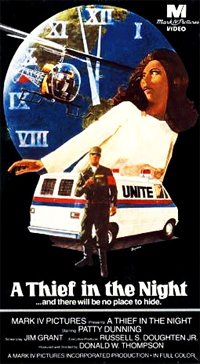
A_Thief_in_the_Night_posterA version of this essay originally appeared in Electric Sheep‘s anthology, The End (2011), and in Czech and German in Umelec (2012).

For the longest time, I could only recall two movies ever giving me nightmares. That shot in Carry on Screaming! (1966) when Oddbod shuffles over the glass-tiled ceiling of the underground conveniences of Dan Dann the lavatory man (hey, I was four). And Apaches, the notorious Public Information film about the dangers of playing on farms. Specifically, the p.o.v. of the kid drowning in a slurry pit. I was nine. And this shot does not actually exist.

But last summer I discovered that for 30 years I have repressed the memory of a film that absolutely terrified me. You see, I managed to get my hands on a copy of Donald W Thompson’s Christian apocalyptic A Thief in the Night (1972).

And it all came flooding back.

The church hall. The haranguing evangelist. The emotional manipulation.

The break from this horrorshow for a film that I thought might offer some respite.

I was wrong…

***

The Bible says that Jesus will return ‘as a thief in the night’. This does not mean that he will be in top hat, tails and domino mask, but that his reappearance will happen when least expected. Nevertheless, for a century and a half, ‘dispensationalist’ Protestants have, with a remarkable blend of dogmatism and imagination, produced interpretations of biblical prophecy that ‘prove’ The End Is Nigh. Fictionalised versions go back at least as far as RH Benson’s 1907 novel The Lord of the World, in which a beleaguered pope organises secret resistance to an American antichrist, but this predominantly Protestant genre is much more likely to identify the antichrist with Europe and the Vatican.

In the 1970s, Hal Lindsey’s The Late Great Planet Earth, a pop-explication of biblical prophecy, sold 28 million copies, prompting similar volumes and fictional treatments to proliferate, such as Stanley A Ellisen’s ‘non-fiction’ Biography of a Great Planet and Carol Balizet’s novel The Seven Last Years. Hollywood knows a bandwagon when it sees one. While The Omen was busy grossing $60 million, a couple of low-budget, Christian filmmakers were quietly toiling away in Iowa to scare the crap out of me.

Thompson’s apocalyptic quartet – A Thief in the Night is followed by A Sound of Thunder (1978), Image of the Beast (1980) and The Prodigal Planet (1983) – starts with the Rapture, when True Believers are whisked up into heaven. Anyone who has not been Born Again is Left Behind. The films chart the ensuing seven years of Tribulation as the antichrist rises to global power, and end as the battle of Armageddon kicks off. They were produced by Russell S Doughten, Jr, who started out making The Blob (1958) for the secular division of a Christian production company. After a fitful, marginal Hollywood career, he returned to his native Iowa, where since 1972 his companies have produced 20 or so issue-orientated, intentionally didactic, evangelical feature films. His website boasts: ‘Over 6 million have come to Christ through our motion pictures.’[1] My anecdotal evidence is every bit as dodgy as his statistics, but something of the under-the-radar reach of these films is surely indicated by the fact that I was subjected to one of them in the late 1970s.

By stick-in-the-mud Methodists.

On Dartmoor.

***

A Thief in the Night begins with a dark screen and a ticking clock. Patty wakes up in an empty bed. The radio announces that 25 minutes earlier millions of people suddenly disappeared from all around the world. She staggers into the bathroom, in search of her husband Jim, but finds only his razor. The Rapture has happened.

The film goes back to before Patty and Jim started dating. As college-age kids, their summer of fun involves Des Moines’ zaniest spots: a lake, a carnival, a youth centre where an earnest young evangelist propounds biblical prophecy to the folk-rock stylings of The Fishmarket Combo. While her friend Diane encourages Patty to hang out with boys, another, Jenny, is born again. Time passes, couples form. Not particularly stylish Iowans sport 70s fashions and hairstyles and British-looking teeth. They sit around talking about Jesus and stuff.

One day, Jim is bitten by a cobra. There is no anti-venom. His only hope is a blood transfusion from a snake farmer who has survived similar attacks. While Jenny prays, cross-cutting suggests that divine intervention gets the snake farmer’s plane there in time. Months later, being reminded of this ‘miracle’ is enough to persuade Jim to be born again.

The very next morning, Patty wakes up in an empty bed…

The evil new world government (the United Nations Imperium of Total Emergency) replaces money with a credit system that requires people to be tattooed on the forehead or the hand with a pattern of zeroes and ones – 666, the Mark of the Beast, but in binary so no one will know that UNITE represents the forces of Satan. Refuseniks are ‘subject to arrest and prolonged inconvenience’.

UNITE are after Patty because of her (belated) faith in Jesus. She flees town, making it to the dam, where Diane and her husband will pick her up and rescue her. But wait! They both bear the Mark of the Beast!

Patty backs away, falls from the dam…

And wakes up in an empty bed…

The clock is ticking.

***

A Distant Thunder follows Patty’s experience of the Tribulation, and ends with her strapped to a UNITE guillotine for refusing the tattoo. Image of the Beast opens with a fabulously extended revision of her death. Before the executioner can do his job, the skies blacken and an earthquake sends everyone running. She is left strapped to the guillotine, face up, struggling to untie her bonds as the tremors gradually loosen the catch holding the blade in place.

The narrative focus shifts to David, who is plotting to disrupt UNITE’s computer system. He is played by William Wellmann, Jr, who has more acting credits than the entire cast of the four movies put together, and even contributes ‘additional story material’ to The Prodigal Planet, the longest and dullest of the series, an even poorer man’s Damnation Alley (1977).

Although the later films more closely approach professional norms, the first two remain the most intriguing. In them, Thompson’s grasp of cinematic possibilities is strongest. This is most evident in the claustrophobic narrative structure that entraps Patty, and in A Thief in the Night’s long-lensed shot in which she runs – seemingly forever – towards the camera to Fishmarket Combo’s refrain, ‘You’ve been left behind’. And they are also the films in which there is the greatest gulf – often hilarious – between Thompson’s cinematic smarts and what the budget will permit. There is the music ripping off the Where Eagles Dare theme (1968), used without attention to aptness or effect; the weird associative editing (on being born again, Jenny says she feels like she can fly; cut to the carnival’s helicopter, flying; cut to a fly on a kitchen window that Patty swats); the horror set-ups without pay-offs (in A Sound of Thunder, Patty finds Grandma’s house unlocked, walks up dark, Dutch-angled stairs, pushes open Grandma’s bedroom door and screams in terror – only for the reverse shot to reveal a phone that is off the hook since Grandma was Raptured mid-call).

And there is the sequence in A Thief in the Night that begins with a preacher’s anecdote about a woman who woke up thinking the Rapture had happened because her husband had gone downstairs to get a drink. The camera zooms in over the congregation onto the face of the young Sandy. She returns home, but no one is there. She calls and calls. No reply. A rapid montage of growing panic … and then her sister and mother suddenly appear. They are fine. But it looks a lot like a prank gone wrong. And it terrorises Sandy into being born again.

While such moments (now) seem funny rather than scary, one sequence in The Prodigal Planet remains truly – if unintentionally – horrific. All attempts to get the imprisoned David to betray fellow hacker Cathy have failed. UNITE personnel threaten to harm her four-year-old son, Billy, if David won’t speak up. He hears someone being taken to be executed, the whirr-thunk of the guillotine blade. Through his window bars, he sees Billy’s red balloon drifting into the sky.

But wait! Billy is OK!

He’s not been executed. He gave his balloon to that nice lady, Leslie, who told him all about Jesus, and it is she who was guillotined. David – apparently forgetting that Leslie is his sweetheart – is relieved. He doesn’t have to betray Cathy. And thanks to Leslie, Billy was born again, so now it’s perfectly alright for UNITE to decapitate him if they want to.

***

Since the 1970s, such fiction has become commonplace. Among others, Pat Robertson, who once campaigned to become the Republican Presidential candidate, reputedly intending to launch a nuclear war so as to prompt the Second Coming, wrote The End of the Age; and Hal Lindsey, who spent 2008 warning voters that Barack Obama might be the antichrist, gave us Blood Moon. Films include Years of the Beast (1981), Vanished (1998), The Moment After (1999), The Omega Code (1999), Gone (2002) and Six: The Mark Unleashed (2004), some of them with sequels. The greatest commercial success has been Tim LaHaye and Jerry B Jenkins’s 16-book Left Behind series (1995-2007), selling over 60 million copies. Franchised spin-offs include nearly 50 other novels, mostly for teenagers, 10 graphic novels, three video games and three movies. Typical of these works’ smug spite is the defence offered when the video game Left Behind: Eternal Forces was criticised for promoting violence against non-Christians: it was claimed that the game taught pacifism because if the player chooses to shoot rather than convert a non-believer, he must pause to pray in order to regain lost ‘spirit points’.

Still, it’s nice to see Christians treating prayer as a penalty.

And there is an option to play on the antichrist’s side.

***

Clearly a lot of money can be made from apocalyptic Christianity, so I want to pitch my own End Times movie. The Rapture does not take everyone who expects to be swept up, just the downtrodden of the Earth who deserve to be somewhere better. No misogynists or homopobes or white supremacists. No advocates of the silver ring thing or the Twilight franchise. None of those who think there is a liberal media, and sometimes suspect even Fox News is part of it. The Christian right, its ranks undepleted, begins to talk about the False Rapture (seriously, google Project Enoch) and precipitates the world into war.

The second act, set some time later, has a kind of Red Dawn (1984) scenario. A handful of decent people fighting the fundamentalist Army of God. Jesus returns and joins the resistance. Oh, and Jesus is a girl. Of mixed race and ambiguous sexuality. A dark-skinned Tank Girl who sounds like Holly Hunter playing white trash. Christian Bale is her intense dad and says intense dad-like things: ‘No daughter of mine is going out to battle the forces of evil dressed like that! And be home by midnight.’

Jesus is foul-mouthed and loves making lines from the Bible her own. There’s this scene in which the Army of God destroy the resistance headquarters, leaving the barely alive Bale mangled in the rubble. And she faces them down: ‘I am the way, the truth and the life, motherfuckers’ – ch-chunk of pump-action shotgun being pumped – ‘and no one gets to my dad except through me’.

The third act is still a bit hazy, but Jesus teams up with the antichrist to overthrow both God and the devil.

Though I can leave it open for a sequel…


[1] http://www.rdfilms.com.

Bernardine Evaristo, Blonde Roots (2008)

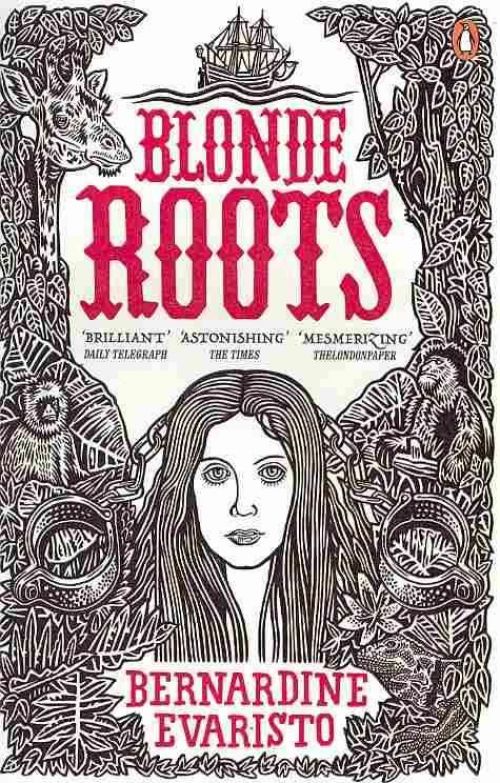
9780141031521It takes a while to get your head around the generic cues and fictional world of this comical and fantastical neo-slave narrative. It flickers between an alternate history and (race) role-reversal satire, each seeming to conflict with the other. A long succession of gags about Africanised London place names – gags which are not particularly funny (such as Mayfah, Paddinto, Golda’s Green, Brixtane and, settled by Chinese seamen, To Ten Ha Ma) but which ultimately pay off with a geological reference to the Essex massif – clashes with a growing certainty that this Londolo is not in the country called England. And so you turn back to the map in the front-matter and everything becomes clear.

Blonde Roots is not a role-reversal narrative in which everything stays the same apart from race relations, as in, say, Desmond Nakano’s 1995 film, White Man’s Burden. Nor is it an alternate history like, say, Steven Barnes’ Insh’Allah novels (2002–3), in which some not-unreasonable extrapolation underpins a relatively rigorously worked-out world dominated by an Islamic Africa for two millennia, and in which Europeans are the victims of an alternative Triangular Trade, abducted and sold into slavery in Bilalistan (as North America is called).

No, what that map reveals is an alternative terrestrial geography.

An island shaped like Britain (unaccompanied by Ireland), but perhaps larger and called the United Kingdom of Great Ambossa spans the equator off the western coast of north Africa, which is also located further south than in our world. It is not quite clear what has happened to the rest of Africa since it is squeezed off the edge of the map by a Europe, here called Europa, displaced to the south of the Gulf of Guinea. England and Wales, but not Scotland, are wedged into the gap between this relocated northwest Europe and Scandinavia.

While it is entertaining to imagine a seasoned sf pro labouring to establish some geophysical perturbation causing this alternative dispersal of the Pangaea supercontinent, and in turn leading to this inverted social order, that is not where Bernadine Evaristo’s interests lie – nor is doing so as much fun as reading the novel itself.

A comedy about slavery is no easy thing to pull off, as the disastrously misogynist and not terribly funny French timeslip comedy Case départ (2011), directed by Lional Steketee and its co-starring co-writers Fabrice Eboué and Thomas N’Gijol, demonstrates. But it is by no means impossible. Ishmael Reed manages it (more or less) in Flight to Canada (1976), as does Charles Johnson (less than more) in Middle Passage (1990).

From the outset, Blonde Roots has some nice comic touches – in its world, the West Indies are called the ‘West Japanese Islands … because when the “great” explorer and adventurer, Chinua Chikwuemeka, was trying to find a new route to Asia, he mistook those islands for the legendary isles of Japan, and the name stuck’ (5) – but sometimes the comedy sits a little uneasily. For example, the protagonist, Doris Snagglethorpe, abducted from the Cabbage Coast (i.e., Yorkshire), transported to Great Ambossa, sold into slavery and renamed Omorenomwara, is branded with the initials of her owner, Kaga Konata Katamba, and his daughter, her first mistress, Panyin Ige Ghika.

Omorenomwara, who hates Panyin, no doubt gets the PIG half the joke, but the KKK half – and the entire joke, if a white slave being branded KKK PIG is a joke – only works for the reader.

Role reversals and inversions come thick and fast to begin with – monogamy is condemned by the polygamous Ambossans as ‘uneconomical, selfish, typically hypocritical and just plain backwards’ (19); house slaves are known as ‘wiggers’ (24); prosperous Ambrossan urban centres are known as ‘Chocolate Cities’ and ‘the tumbledown ghettos on the outskirts’ where ‘free whytes’ live in ‘squalor’ are called ‘Vanilla Suburbs’ (29) – but as the world is established and the narrative begins to come together, the comedy becomes less gag-oriented and  Evaristo expands her comic vision to capture also the pain and tragedy. Misgivings fade.

The novel switches between three strands: Omorenomwara’s present, as she attempts to flee on the Underground Railroad but ends up exiled to a West Japanese sugar plantation and must try to make some kind of life for herself there; Omorenomwara’s memories of her life as Doris and of her years as a house wigger; and an autobiographical pamphlet by Kaga Konata Katamba which includes his justifications for enslaving the self-evidently inferior Caucasians.

Families and lovers long separated by the slave system reunite, sometimes only fleetingly, and a sense of community thrives among brutalised slaves because they are dependent on each other. And in this final section of the novel, Evaristo gets the tone perfect. She reproduces that tired old cliché of slaves singing together in the fields, but makes it clear they do so out of mutual care and to support each other, not because they are happy. She shows them singing on command to welcome their visiting owner, and counterpoints it with them singing for themselves. And she includes the eleven-year-old slave Dingiswayo, ‘strutt[ing] about the quarter in a pair of outsized, hand-me-down cotton pants worn so that the waist hung (somehow) beneath his bum’ (204).

There is always a danger with role-reversal satire that the reader or viewer’s sense of injustice will be aroused for the wrong reason. Not by patriarchy and misogyny, but because men are being treated like women. Not by slavery and racism, but because people of pallor are being treated like people of colour. Blonde Roots’ fractured structure of narrators and temporalities helps it to avoid this pitfall, but for me there was something else, something curious, going on.

I kept forgetting that the slave characters were white.

I suppose this is because the novel mostly uses their Ambossan slave names, rather than their European names; and because so much of the cultural imagery around slavery features enslaved Africans; and because, being a novel rather than a film, there was an absence of concrete visual detail to fix their appearance.

Then every few pages I was brought up short as I remembered, as this potent anamnesis – this remembering of things forgotten – swept over me.

I have no idea whether the novel will work in this way for other people, and I have yet to figure out what it means. But it was powerful and disorientating. The way a good book should affect you.

Paris – mostly science-fictional, mostly morbid

The grave of Georges Méliès...
The grave of Georges Méliès…
...and stumbled upon by chance the next day, the site of Théâtre Robert-Houdin
…and stumbled upon by chance the next day, the site of Théâtre Robert-Houdin
The graves of François Marie Charles Fourier and of
Claude Henri de Rouvroy, comte de Saint-Simon, utopian socialists both
Claude Henri de Rouvroy, comte de Saint-Simon, utopian socialists both,
of Louis-Sébastien Mercier,
author of L'An 2440, rêve s'il en fut jamais (1770),
author of L’An 2440, rêve s’il en fut jamais (1770),
and of Gérard de Nerval
and of Nadar (Gaspard-Félix Tournachon), pioneer of aeronautics, photography and, perhaps unsurprisingly, aerial photography.
Fellow balloon pioneers, Joseph Crocé-Spinelli and Théodore Henri Sivel, fared less well,
reaching 28,000 feet but dying in the attempt.
A plaque for, not the  grave, of Vercors (Jean Bruller), author of Borderline, The Imsurgents and Sylva.
A plaque for, not the grave of, Vercors (Jean Bruller), author of Borderline, The Insurgents and Sylva.
Back to graves. Jean-Marie-Mathias-Philippe-Auguste, comte de Villiers de l'Isle-Adam, author of The Future Eve.
Back to graves. Jean-Marie-Mathias-Philippe-Auguste, comte de Villiers de l’Isle-Adam, author of The Future Eve.
Raymond Roussel, author of Impressions d'Afrique and of Locus Solus.
Raymond Roussel, author of Impressions d’Afrique and of Locus Solus.
Émile Souvestre, author of The World As It Will Be.
Paul Éluard, who did not write sf, but whose poetry collection Capitale de la douleur features heavily in Godard's Alphaville.
Paul Éluard, who did not write sf but whose poetry collection Capitale de la douleur features heavily in Godard’s Alphaville.
And, of course, Oscar Wilde.
Étienne-Gaspard Robertson,
physicist, stage magician,
balloonist (inevitably) and
phantasmagoria pioneer.
The Tomb of the Biologically Divergent Working Class.
A little something...
A little something…
...for fans of...
…for fans of…
Harry Potter.
Harry Potter.
Some good old-fashioned surveillance.
Some good old-fashioned surveillance…
...and a remind of Muybridge.
…and a reminder of Muybridge.
An sf shop,
An sf shop,
an sf bar and...
an sf bar and…
...a bunker anti-zombies.
…a bunker anti-zombies.
And this is where we stayed. The hotel where Breton and Soupault (before his expulsion from the Surrealists for pursuing individualist and stupid literary projects) invented automatic writing and co-wrote The Magnetic Fields.
Not just in the hotel, mind, but in the actual fucking room where they did so.
The room with this creepy-ass shit directly above the bed.