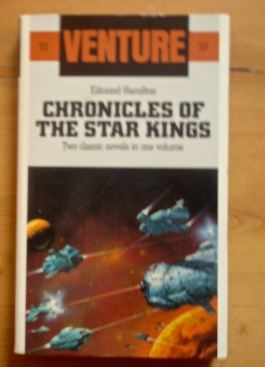
 You probably think getting hold of an old omnibus of Edmond Hamilton’s Star Kings books is not much of an accomplishment. Nothing to boast about.
But you are wrong.
Here, in full, is the epic story of an improbable quest. All it lacks are those certain elements you need to market a film successfully: suspense, laughter, violence, hope, heart, nudity, sex, happy endings, especially happy endings.
Call me Bibliophile. Some months ago – never mind how long precisely – having little or no money in my purse, and nothing particular to interest me on shore, I thought I would order a copy of Edmond Hamilton’s Chronicles of the Star Kings. Reading old space operas is a way I have of driving off the spleen and regulating the circulation. Whenever I find myself growing grim about the mouth; whenever it is a damp, drizzly November in my soul; whenever I find myself involuntarily pausing before coffin warehouses, and bringing up the rear of every funeral I meet; and especially whenever my hypos get such an upper hand of me, that it requires a strong moral principle to prevent me from deliberately stepping into the street, and methodically knocking people’s hats off – then, I account it high time to get me some Hamilton or Williamson or early Simak, some Brackett, perhaps, or some Moore, even some Dickson or early Brunner, as soon as I can.
Why Chronicles of the Star Kings? I was working on something tangentially related so it seemed an ideal opportunity to pick up the cheapest copy I could find of this omnibus volume that I repeatedly looked at on the shelf but never bought back in my teens (I was having too much fun devouring all the Philip E. High published in the same series). So I checked amazon marketplace sellers and abebooks. Amazon was way cheaper so I ordered a copy. Little did I suspect I was merely ordering my first copy.
The parcel arrived on 11 September. My eager little hands tore it open and found inside:
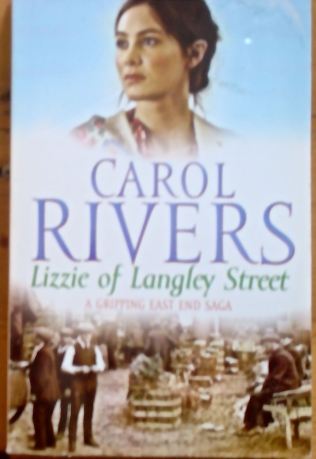 Now, I have nothing against East End Sagas, whether gripping – as it claims – or not. But it was not what I wanted. So I set the returns process in motion and requested they replace it with the book I ordered. They acted with unexpected promptness, dispatching a replacement the same day. Of course, instead of replacing it with a copy of Chronicles of the Star Kings, they replaced it with a copy of Carol Rivers’s gripping East End saga Lizzie of Langley Street.
So I set the returns process in motion again, advised them of the glitch in their inventory system, requested a refund and checked for the next cheapest copy. Which again was from amazon. I ordered it, and waited.
And waited; and waited.
Then a week or so later got an email telling me it had been damaged in the post and returned to the seller. They could not provide me with another copy so gave me a refund.
I checked for the next cheapest copy. Which again was from amazon. And this time was next day delivery. I ordered it, and waited.
But nothing happened.
I left it an extra day but still nothing happened.
I checked the online tracking. Apparently it had been delivered.
Only it hadn’t.
A trip to the local sorting office ensued. The guy there explained that he could not search for the parcel without the notification card I had been left by the postman. Only I hadn’t been left a notification card, which is so unlike Colin, my lovely postman, that I knew something was rotten in the state of Denmark. (Rottenness! thy name is Barry, the lazy substitute postman! But I’m getting ahead of myself.) The best the guy could offer to do was organise a redelivery, and hope that would magic my parcel into being.
The mention of Colin’s name, however, prompted the woman behind the desk to leap into action. Colin would not make that kind of mistake. She asked if I had the tracking number – I did – and after a couple of minutes on the computer was able to confirm that indeed my parcel was lost in some peculiar back-eddy of the postal system. She went to check out back to see if the parcel was there – it wasn’t, but even if it had been, she wouldn’t have been able to hand it over since I did not have a notification card. “I’ll have a word with Colin when he gets in,” she said. “He’ll know what happened.”
A brief aside on Colin. He has been my postman since I moved here fifteen years ago, and somehow he has survived the deliberate sabotaging of the post office by successive governments – running down its services, forcing them to deliver mail below cost for the private carriers competing with them for business, prioritising business deliveries over private mail, etc, etc – as they sought to privatise it, which they eventually achieved a few years ago, since when £500,000 per day has been paid out in dividends to hedge funds and city shareholders. Somehow, through all this, Colin has retained a sense of the role of the postman in the community, as part of the glue that holds a place and its people together. We are not just streets and doors and letterboxes to him. In this, he reminds me of my milkman grandad. Unlike lazy Barry.
Later that morning, Colin knocks on my door.
“Oh,” he says, ‘it was Wednesday. Barry did the route on Wednesday. He’s dead lazy. If it’s not at the sorting office, he’s left it with a neighbour. Won’t be any more than two houses away. I’ve got a couple of packages, so I’ll ask at those houses. If I have no luck, I’ll catch up with him later, and come back after my shift to tell you what he did with it.”
That’s Colin for you.
No way he needs to come back after his shift; he can let me know tomorrow. In the meantime, once I’ve finished my coffee, I’ll knock on some neighbours’ doors.
Colin was right. It was with a neighbour two doors down. I sought out Colin to let him know. Went home. Poured another cup of coffee and opened my parcel. To find within it a copy of:

So the glitch in the inventory was definitely an amazon problem, not an individual seller’s problem. I begin the returns process, ask for a refund, and this time inform amazon rather than merely the seller of the problem. And by good fortune, a couple of cheaper copies of Chronicles of the Star Kings have appeared on abebooks, so I order one.
And nothing happens.
Except the last amazon marketplace seller tells me to not bother returning Carol Rivers’s gripping East End saga Lizzie of Langley Street – and in addition to refunding me, they will try to locate a copy of Chronicles of the Star Kings in their warehouse for me, free of charge, for all the comical inconvenience to which I have been put. So for a moment there it looks like I might end up with three books in total, rather than the single one I first ordered back in the mists of time, around the dawn of man.
But phew! they can’t find a copy.
But I don’t fucking believe this! my parcel containing – at last, I hope – Chronicles of the Star Kings has been damaged in the post and returned to the abebooks seller, who arrange a refund as they do not have a replacement copy in stock.
Back to abebooks. A sixth attempt to buy this fucking book.
And today this arrives:
 The only problem is, I no longer have any fucking clue what I wanted it for in the first place.
So, no, despite appearances, not even a happy ending.
 Last week I was invited to introduce a screening of Contact – a film I had seen twice in twenty years and then saw twice in the same week – as part of this
  and so anyway it turns out that the best thing about Blade Runner 2049 (2017) is not that no one seems to have beaten me to calling it La La Landroid or calling Ryan Gosling’s beautiful and puppy-eyed state-sanctioned murderer Pigolo Joe (the film becomes oddly like Spielberg’s AI: Artificial Intelligence at times), nor is it the unbelievably audacious line of exposition given to Edward James Olmos, nor is that they saved money making the film by just setting some of it in pompous evil hipster Jared Leto’s own house where he does all that weird shit anyway, nor is it that the digits in the title indicate when the film is set rather than enumerating which of Sir Diddly Squat’s re-edits it is, though that is a relief, nor is it that Hampton Fancher trolls Sir Diddly’s endless tinkering by beginning the sequel with a variant on a sequence he wrote for the original film but that could not be restored because it was never actually filmed, no, the best thing about Blade Runner 2049 is that as sequels-to-cult-classics-with-dates-in-their-titles go, and despite everything, including its flaws, longueurs, idiocies, nipples and truly devastatingly funny effort to capture the horror of orphan child labour in its full Dickensian aspect, it is not really really embarrassingly bad, it is not Blues Brothers 2000…
 and so anyway it turns out that the best thing about Suicide Squad (Ayer 2016) is not that it reminds you of just quite how good – and subtle – a film The Dirty Dozen (Aldrich 1967) is but of just quite how good – and subtle – literally any and every other film you have ever seen is…
 Frustrated at repeatedly missing out on the chance to film one of Ballard’s novels, Stanley Baker optioned a number of his short stories through his production company Oakhurst Productions, including ‘Track 12’ (1958). Of the intended anthology picture, only one, the 22-minite ‘Track 12’, was completed, shot by Joseph Losey from a script by Harold Pinter, during a break in production on Accident (Losey 1967).
 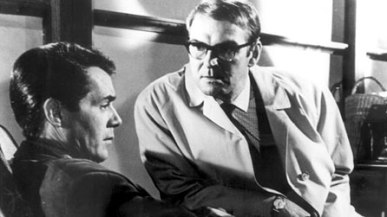 Dirk Bogarde is chilling as the diffident biochemist, Sheringham, avenging his cuckolding by Baker’s robust Maxted. An unbilled Julie Christie was persuaded by Bogarde, who had worked with her on John Schlesinger’s Darling (1965), to provide the glimpsed fragments of Susan Sheringham’s face and body – and the overwhelming, screen-filling kissing lips of the film’s startling conclusion, an image that had a profound influence on David Cronenberg’s Videodrome (1983).
 Broadcaster David Frost and his partner Hazel Adair, perhaps best known as the creator of the long-running soap opera Crossroads (1964–88), bought the rights to adapt The Drought aka The Burning World (1964) in the late 1960s.
 The Wind from Nowhere (1961), Ballard’s debut novel, was hastily optioned prior to publication by Michael Carreras, who had recently parted company with his father’s Hammer Films in order to establish himself as a director and independent producer. Carreras initially intended it as a vehicle for Rod Taylor, but he ultimately turned down the role to star in Hitchcock’s The Birds (1963).
 Intriguingly, Judd, who was a couple of years younger than Ballard was also born in Shanghai, but there is no evidence they met each other there – or, indeed, Burt Kwouk, who was also resident there, and plays an unnamed soldier in the private army of millionaire Hardoon (Eric Portman).
 In the late 1980s, the BBC began to spin off and divest parts of the organisation, laying the groundwork for establishing autonomous but wholly owned cash-cow subsidiaries. Central to this plan was the transformation of BBC Enterprises into BBC Worldwide. In order to monetise the BBC brand, production reoriented to programming that could be sold overseas. One outcome was the three-times-a-week upmarket soap El Dorado, set in a not-too-precisely futuristic gated community and exclusive resort town on the Mediterranean.


 Thwarted in his attempt to produce and star in an adaptation of The Wind from Nowhere (1961), Stanley Baker optioned Ballard’s follow-up novel, The Drowned World (1962), before the ‘Seer of Shepperton’ had even completed a draft.
 APJAC Productions hired Thompson to direct, then replaced him with John Guillermin, who insisted on relocating the story to New York. A week into shooting, Guillermin and Heston got into a now notorious on-set argument. Filming crashed to a halt. Jacobs backed his star over his director. Guillermin was fired, and Heston personally entreated Thompson to return to save the film.
 In January 1977, some nine months into a disastrous shoot, Francis Ford Coppola hired Ballard to script-doctor a key sequence and to help fashion the satisfactory dénouement that had thus far eluded John Milius, George Lucas and Coppola himself. Ensconced in the Philippines, Ballard eventually declared the de Marias rubber plantation sequence beyond salvaging. He was delighted when problems with the sound recording meant it was cut from the film, and in 2001 declined an invitation to see it restored at the Cannes premier of Apocalypse Now Redux.
 Mark Bould