 and so anyway it turns out that the best thing about Mad Max Fury Road (2015), George Miller’s hilariously overblown and rather sandy remake of Waterworld (1995), is not the way it captures with uncanny precision the realities of the post-Brexit British utopia, nor the way Max is captured by a Duran Duran-worshipping cult led by Simon LeBon, who, frankly, has let himself go a bit (see above), nor the way Max’s straggly mullet is promptly shaved off so he looks less like Mel Gibson and more like the love child of Daniel Craig and Kenneth Cranham, nor the way Imperator Furiosa persuades Immortan Joe’s brides to escape with her in a big lorry to Tom Hardy’s myspace or something, but the way in which if you think about the film’s style and themes alongside Babe: Pig in the City (1998) and Happy Feet (2006) you finally have utterly incontrovertible evidence that auteurism is a genuine thing that explains films…
Author: markbould
San Andreas (Brad Peyton 2015)
 and so anyway it turns out that the best thing about San Andreas (2015) is the way Rock has to cope with losing one daughter in a rafting/drowning incident, with losing his wife to cowardly millionaire architect scumbag Reed Richards, with his other daughter getting lost in an earthquake-hit San Francisco and hooking up with Constable Hugh and drowning and coming back from the dead, and with having to navigate in various vehicles through a devastated California and through every cliché in The Boys’ Great Big Bumper Book of Clichés, and yet – like the San Andreas fault responding to the mere presence of California – he just shakes it off, shakes it off…
Sweden, we need to talk.
Sweden, we need to talk about your obsession with big fish.


But I guess sometimes it is best just not to ask.


No, really, just move along, don’t ask.


I know some things just don’t translate well between cultures. Though a little more effort wouldn’t be amiss sometimes.


Especially when you can be so frank about your poor navigation skills and suspicions about English travellers…


… and about your opinion of Rodin and your views on who would probably make the best anonymous residential buildings in the world.


I mean, you get so many things right. Like the first statue of Bernie Sanders, and how you always follow expropriating the expropriators with snacks.
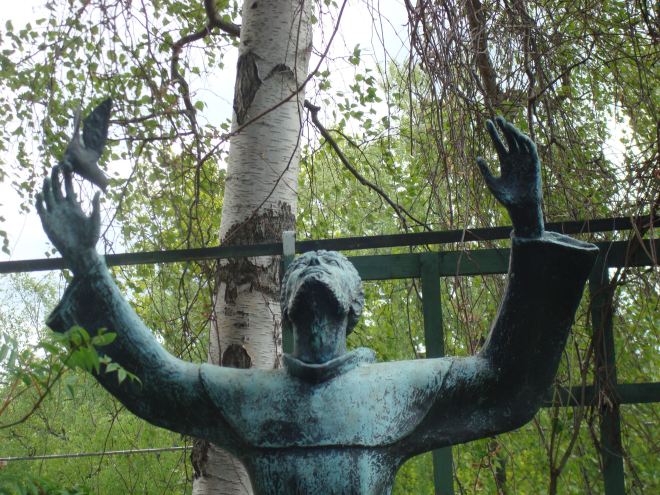

So let’s just forget about the armpit squid baby, and talk.

Seriously, we need to talk, so let’s just forget about the armpit squid baby.
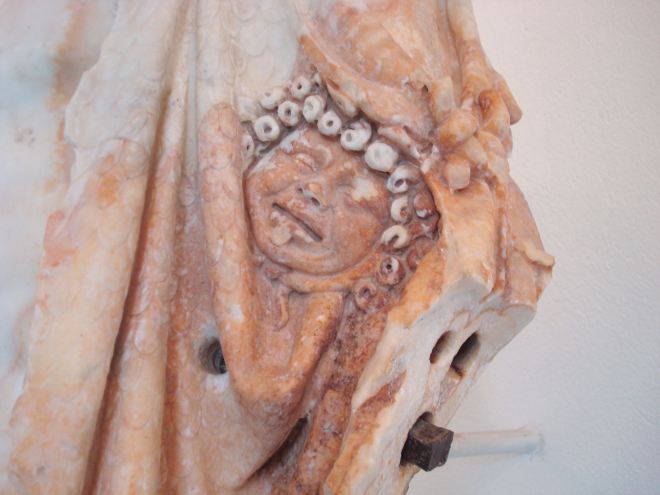
If we can.
Re-reading Tolkien 4: The Hobbit, chapters 7-9

It is difficult to express quite how disappointing chapter seven, ‘Queer Lodgings’, turned out to be.
If you’ve been following this, you might understand when I tell you that the only cave in this chapter is ‘a little cave (a wholesome one with a pebbly floor)’.
Sure, there’s the self-important Lord of the Eagles, who’s a little camp. (He will, we are told, become the King of All Birds. Quite how every avian species and society came to be governed by the dynasty Accipitridae remains unclear. I bet it was by bloody violence. It is always by bloody violence).
Beorn is a bit more interesting. He is a shapeshifter or skin-changer, and there is something queer in his were-bear duality; after all, he is the kind of bear who is ‘a great strong black-haired man with huge arms and a great beard’.
But there is something uncanny about him, too. Something a little unpleasant.
It’s not just that his grey dogs can walk around upright on their back legs, a detail that becomes all the creepier for the way Tolkien just throws it in without elaboration.
It is that Beorn keeps trophies from his kills. A goblin head stuck on something outside his gate. The flayed skin of a Warg nailed to a tree just beyond it.
No doubt, if there were buffalo roaming between the mountains and Mirkwood he would skin his humps.
Then Gandalf – as arbitrarily as an author just making stuff up – buggers off, leaving Bilbo and the dwarves to the perils of Mirkwood.

The perils of the arachnid monstrous-feminine, the archaic mother:
The entrance to the path [into Mirkwood] was like a sort of arch leading into a gloomy tunnel made by two great trees that leant together, too old and strangled with ivy and hung with lichen to bear more than a few blackened leaves.
Like Giger for kids. And with spiders. You know, evil female weavers, and that whole shtick about weaving supposedly originating in women, driven by phallic envy, plaiting their pubic hair.
There they wander, losing their way, slowly running out of supplies. Exhausted. Starving. Trolled by wood-elves. Who are basically dicks.
Bilbo, separated from the company, has ‘one of his most miserable moments’, but steadfastly refuses to let despair overwhelm him, and instead starts thinking ‘of his far-distant hobbit hole with its beautiful pantries’ and ‘of bacon and eggs and toast and butter’.
Is it still a truism of children’s literature studies that food, in its sensual excess, stands in for sex? That would explain what happens next: ‘he felt something touch him. Something like a strong sticky string against his left hand’
Bilbo finds where the dwarves are all hanging, tightly bound in spider threads. He puts the ring on and runs around for a while, with only his little sword visible – ‘I don’t suppose [the spiders] knew what it was’, Tolkien adds, but – like Bilbo – you might want to take a wild stab in the dark. Anyone? Anyone?
You want a clue?
When the spiders are distracted, Bilbo frees his companions, beginning with Fili, identifiable by ‘the tip of a long nose poking out of the winding threads’.
Anyone?
Having escaped the spiders, the dwarves are next captured by the wood-elves who, just a little mysteriously, do not live in the woods but in – you guessed it – caves. Invisibilbo rescues them. And they escape by nicking a trick from Derek Flint.
Okay, chronologically that makes no sense, but I remember feeling cheated when I first read the novel because I had already seen the awesome James Coburn use the same method to save his, er, lady friends. (It is nice though that the chapter in which this happens is called, it turns out, ‘Barrels out of Bond’.)
********
There is actually, in passing, a really bleak moment. Bilbo used his ring of invisibility to avoid capture, but finds himself hiding in the midst of the wood-elves for days and weeks (and possibly months, but I nodded off a little in the middle):
‘I am like a burglar that can’t get away, but must go on miserably burgling the same house day after day,’ he thought.
Nicely played, JRR. As unexpected as dogs on the hind legs waiting table.
Billy Kahora, ed., Imagine Africa 500 (Lilongwe: Pan African Publishers, 2015)
 This fifteen-story collection emerged from an sf writers’ workshop in Malawi, for which the final assignment was to write a story set 500 years in the future.
It opens with the bleakest of them, Muthi Nhlema’s ‘One Wit’ This Place’. After the geo-engineers have failed to save the world from devastating climate change, at the ‘terminus between the Oce and the Sah’, a woman awaits the return of her soldier husband. He is a traumatised as the Earth is scorched, and catastrophe keeps coming.
Other stories are set after the apocalypse has been and gone. Dilman Dila’s ‘Snake Blood’ is an almost-fantasy tale of dynastic and domestic struggles years after The Great Disaster. In Catherine Shepherd’s ‘Xaua-Khoe’, an old man recalls his grandfather explaining to him when he was a child that the ‘giant metal flowers’ dotting the ‘arid landscape’ are ‘defunct wind turbines … Clean energy that came too late’. Disease has swept the world in Lauri Kubuitsile’s ‘When We Had Faith’, leaving only a brutal fundamentalist regime unscathed. Aubrey Chinguwo’s ‘Closer to the Sun’ imagines a crazy plan to wipe out all human life on Earth, apart from a new Adam and Eve, which is news to one of them. In Derek Lubangakene’s ‘Transit’, some genius has only gone and made all the men on the continent impotent, which may or may not be the apocalypse, the jury is still kinda out.
In Tuntufye Simwimba’s ‘Tiny Dots’, the world still hangs in the balance; global warming is intensifying, cancer is like a wildfire, but in all of this, it is still possible for an accident – and an Empire Strikes Back joke – to reunite an estranged father and son. Somehow, in Wole Talabi’s ‘Necessary and Sufficient Conditions’, humanity won the Singularity War, and new technologies have led to an African ascendance, but even in this continent-wide Wakanda there are reasons for a son to want to murder his father. Similarly, in Musinguzi Ray Robert’s ‘Unexpected Dawn’, a united Africa arose in the aftermath of the Eighth World War and survived a Ninth – and there is nothing a recalcitrant Texas can do about it.
Other stories imagine a future of more or less endless capitalism and patriarchy. In Hagai Magai’s ‘Those Without Sin’, a thirty-something son, who got himself imprisoned to escape a world of whose changing values and priorities he despairs, returns home to find everything changed and still changing. Frances Naiga Muwonge’s ‘After Market Life’ depicts Nama’s last day selling actual, non-synthetic food in Kampala’s market as she anticipates her new life with an American husband. In Hannah Onoguwe’s ‘A Is A Four Letter Word’, some little shit blackmails his teacher, who is also his best friend’s mother, for sex, because he knows a secret that could destroy her (and because he is a little shit with no compunction about behaving like that). In Tiseke Chilima’s ‘Women Are From Venus’, women long ago had the good sense to decamp to our sister world, even if it required massive biological transformations, but it has only made women-traffickers all the more devious.
The Venus we do not see nonetheless points to some utopian possibility, as does Stephen Embleton’s ‘Land of Light’, with its vision of a rebuilt Africa united into two fraternal states, and of reconciliations and spiritual connection.
But personally, I found the utopian trace with which Chinelo Onwualu’s ‘The Wish Box’ ends more appealing. A cunning indictment of the philanthropy of its well-meaning protagonist, the story culminates with the sudden flowering of class-consciousness, and rage, in the glinting of a child’s eyes.
Imagine Africa 500 is a smart and engaging addition to the growing number of anthologies of African sf, not quite as literary as Nerine Dorman’s Terra Incognita, nor quite as pulpy as Ivor Hartmann’s AfroSF collections. Billy Kahora, The Story Club and Pan African Publishers are to be congratulated for setting this all in motion, for their commitment to developing new writers, for their efforts to address the domination of African sf by South Africa and Nigeria – Imagine Africa 500 includes five authors from Malawi, four from Uganda and one from Botswana, as well as three Nigerians and two South Africans – and by male writers – two-fifths of the stories are by women, which is not parity but is heading in the right direction.
[My thanks to Trine Andersen for providing a copy.]
He Never Died (Jason Krawczyk 2015)
 It is entirely possible your mother has told you that Henry Rollins is no fun.
Do not trust her.
He Never Died (Krawczyk 2015) is a low-budget not-quite horror, not-quite crime thriller, that is never quite brilliant and never quite camp. Jack (Rollins), a grey-haired, middle-aged man, lives alone in a small apartment, oddly disconnected from the world. He does not have a job. He keeps odd hours. He eats at the same diner every day. Most days he goes to the local church to play bingo not with but near the old folks; they do not distract him, he explains.
He keeps himself to himself.
His interactions with people are oddly stilted. He offers nothing. He states the obvious. He doesn’t get them. He is Keaton-level deadpan. (His one loquacious moment is a flatly delivered, seemingly interminable list of the many jobs he has had. That bit is actually quite brilliant.)
Oh, and he’s an immortal cannibal. Just about holding it together by not eating meat and by drinking the blood he buys from a hospital intern. That way he doesn’t kill people. He has a very long history of killing people. In fact, he started it.
But now, in a Toronto that is shot as often as possible to look like an Edward Hopper painting to convince us it is somewhere in the US, someone with a grudge is coming for him.
They don’t know what he truly is.
But they get, rather bloodily, to find out.
All this, however, is beside the point. The film is about something else entirely.
It is about watching the ageing Rollins.
There is something geological about his body. Present. Weathered by time.
It is about his weary face, crumbling like granite.
It is about the slow dawning of mortality. And about carrying on.
And through all of this, Henry Rollins is no fun. (Except, of course, that he is.)
Swedish lies & saucy exhibits & so on (plus Mr Chicken)
Since the bad weather had pursued us, the plan was to spend the day in museums, learning the truth. But Swedes lie.

There is no coffee cow.
Or tea moose.
And as for the snuff, snus and match museum’s claims about their display of actually-growing tobacco, the less said the better.

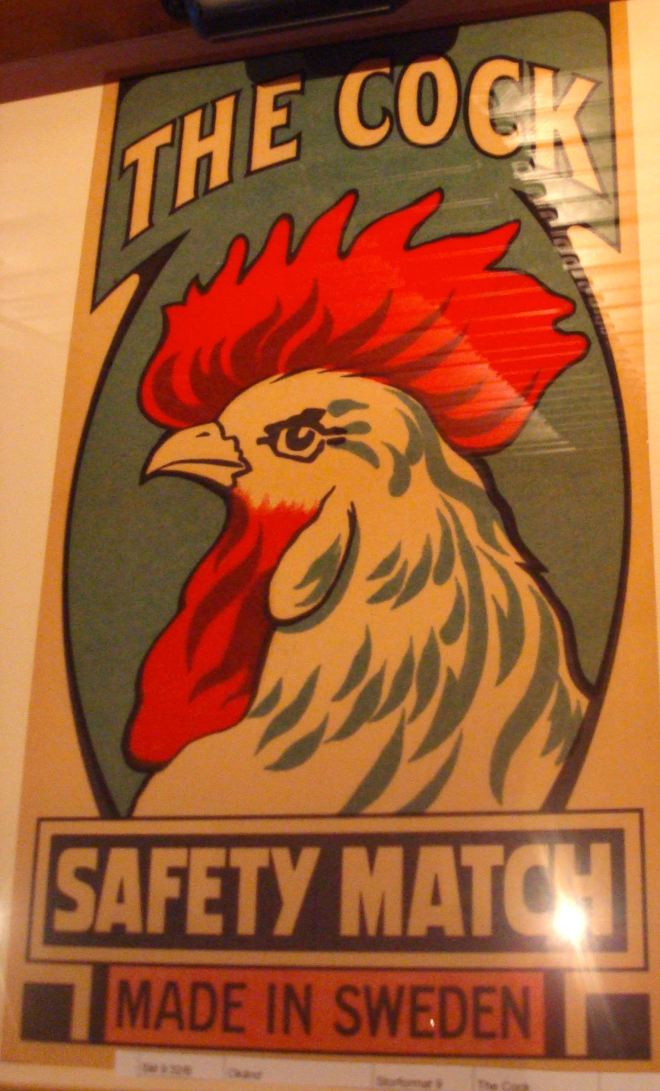
However, Mr Chicken soon put in an appearance and the day began to improve.
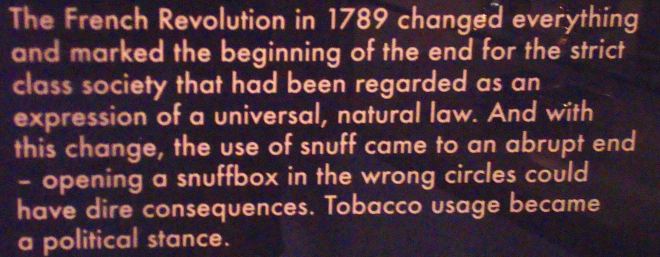
For example, there was vital information about snuff and revolutionary politics.
And then, hidden away around a corner, behind cupboard doors at a height not easy for children to reach, was the display of saucy snus boxes (look away now if easily offended).


After which, these might come in handy:
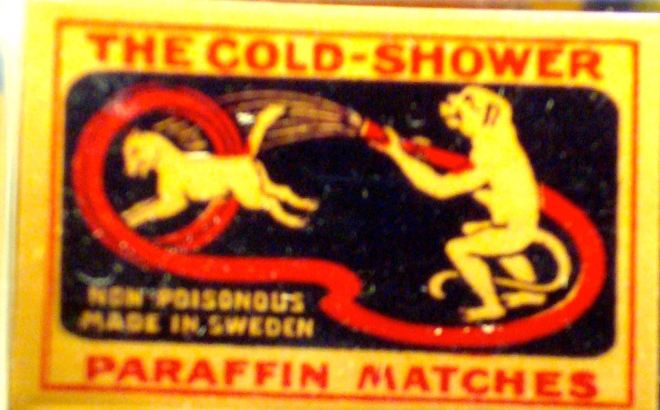
Stirred to a frenzy of curiosity by my discovery of such naughty accoutrements, I was delighted to spot another hidden-away, above-child-height cupboard.

Not quite so impressive.
Still, on the bright side, Nietzsche’s still dead.
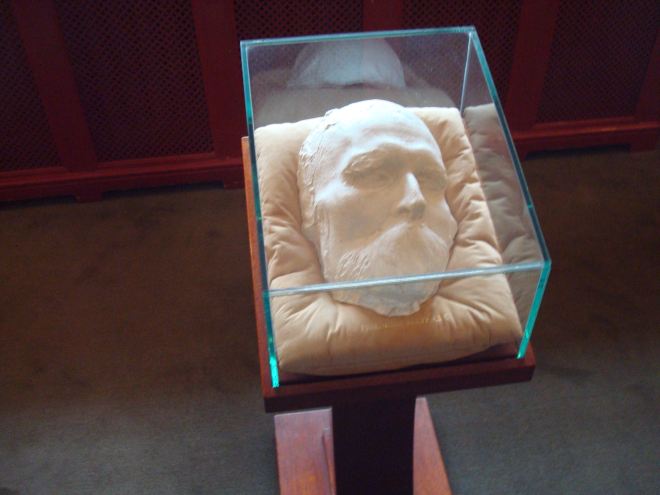
He’s still dead, I tell you.

And then we were pursued by the police.
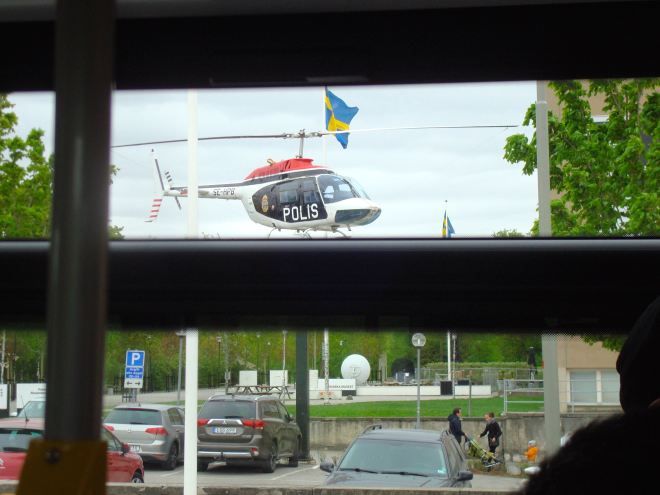
Apparently, you’re not supposed to take photos in the museums and galleries. Or root around in their fuse boxes looking for dirty pictures.
Sweden: the abyss
It was during my sojourn in the icy north that I first began to grasp the utterly cold indifference of nature to man.

As you draw near, you find yourself staring into the abyss.

And then as you begin to reel away in anguish, the abyss stares back…

N.B. ‘Abyss’ is Swedish for ‘goose’.
Stockholm: beating Banksy, calling Zack Snyder (superhero), recalling puppies and the original Doctor
To my surprise, Stockholm pre-empted Banksy.

The original Dismaland, now called Gröna Lund, has been dismal ever since that night on 4 September 1967 when Jimi Hendrix refused to stop playing so they unplugged him. To overcome this shame, the city has recently opened a new venue, which enraged locals have already dubbed Dismaland Redux:

Indeed, so grim and crime-infested has the city become, that officials have been forced to turn to vigilante justice. When the roaming gangs of thugs get too far out of hand the police commissioner has no choice but to call on Zack Snyder for help, projecting a sigil into the sky to summon his aid:

In his language, in any language, it means ‘hopeless’.
Long gone are the days of cheery social democracy, when the nearest thing to a threat faced by the city was the boundless energy of …

Clifford the Big Red Church.
What few people remember is that Doctor Who was originally a Swedish television show, although the streets of Stockholm and other cities are littered with reminders.

Original TARDIS

Original Dalek (standard model)
It was here that the Doctor faced such enemies as the newly hatched troll sheep,


the tiniest goat you have ever seen pooh,

and the dread advance of the robot giraffes of doom.
Re-reading Tolkien 3: The Hobbit, chapters 2-6
 Re-reading Tolkien
 Mostly it had been as good as May can be, even in merry tales, but now it was cold and wet. …
‘To think it will soon be June,’ grumbled Bilbo. (47)
I swear the delay was not because I was waiting until I could quote that. It is merely the serendipitous silver lining to the rain clouds emptying themselves over Bristol.
My last post on The Hobbit ended by questioning whether the whole book could be quite as delightful as the psychosexual smorgasbord of the first chapter. And I’m afraid the answer is no. Although there is still plenty to comment upon, incidents and episodes have rather taken over.
The Battle of Phallic Accoutrements rages on. While both Thorin and Gandalf are given mighty swords, Bilbo takes a blade that ‘would have made only a tiny pocket knife for a troll, but it was as good as a short sword for the hobbit’ (60) – and only becomes really snigger worthy when he is lost in the caves under the Misty Mountains:
But in slapping all his pockets and feeling all round himself for matches his hand came on the hilt of his little sword – the little dagger that he got from the trolls, and that he had quite forgotten; nor fortunately had the goblins noticed it, as he wore it inside his breeches. (91)
Elsewhere, the anal fixation continues. There is an awful lot of wandering around in dank – some might say cloacal – caves, and an obsession about entrances, of gaining access to them, controlling what passes through them, and about squeezing through narrow passages (losing ones buttons in doing so). Probably the less said about rings at this point the better.
One of the curious things re-reading the novel after all this time is that nothing has happened that I do not remember, but I only remember it as it is happening. And certain things have changed because of the passage of time. So when Bilbo decides to embrace the role of burglar and pickpocket one of the trolls – the entire species are Cockerneys, it seems – the whole Žižek thing comes flooding back.
Years ago, I was the journal editor entrusted with the task of asking him to revise and resubmit an article in which he imagines a scene in a porn movie in which a vagina suddenly starts to speak. My favourite part of the process was asking him to not just make such things up, but to actually make the effort to watch a talking-vagina porn movie, such as the excellently-titled Chatterbox. (Sadly, he declined; the book from which the essay was extracted had already been accepted for publication, and he was already busy on the next one or the one after that.)
But now, I see vaginas loquens the way Haley Joel Osment sees dead people. They are everywhere, and sometime you just can’t move for them .
Bilbo plucked up courage and put his hand in William’s enormous pocket. There was a purse in it, as big as a bag to Bilbo. “Ha!” thought he warming up to his new work as he lifted it carefully out, “this is a beginning!”
It was! Trolls’ purses are the mischief, and this was no exception. “’Ere, ’oo are you?” it squeaked… (52-3)
Though I am not sure “Trolls’ purse” will ever catch on as a euphemism, or that it should.
The next chapter is called “Queer Lodgings” – I can hardly wait.
***
And there is this sentence, probably the finest one in the novel so far, and certainly one that struck me when I was young:
When they got to the top of it [the far river bank], leading their ponies, they saw that the great mountains had marched down very near to them. (63)
Well played, JRR, well-played.
(I also have some thoughts about the description of the goblins, race, species and so on, but I will wait until I have seen more of how Tolkien does these things.)
 Mark Bould