The City in Fiction and Film, week 14

Farenheit451This week we continued our exploration of the US postwar suburbs (see week 13), reading Ray Bradbury’s Fahrenheit 451 (1953) and watching Invasion of the Bodysnatchers (Siegel 1956). Both texts were framed in relation to the period’s culture of affluence and anxiety.

But first we began by placing Bradbury’s novel in relation to genre – specifically the interweaving traditions of utopia/anti-utopia, utopia/dystopia and US magazine sf.

Thomas More coined ‘Utopia’ 500 years ago this year. When spoken aloud, the first syllable is a Latin pun on ou which means no and eu which means good (and topos means place) – so utopia means ‘no place’ but also suggests ‘good place’. Utopia has come to be understood as a description of an imaginary world organised according to a better principle than our own, and to frequently involve not-always-gripping systematic descriptions of economic, social and technical arrangements. We discussed the efflorescence of utopian fiction in the wake of Edward Bellamy’s Looking Backward, 2000-1887 (1888), and mentioned such key utopian authors as William Morris, Charlotte Perkins Gilman, Ursula Le Guin and Kim Stanley Robinson. We also noted the relative scarcity of utopian worlds in cinema – Just Imagine (Butler 1930), Things to Come (Menzies 1936) and Star Trek: The Motion Picture (Wise 1979) being potential examples, but all of them also demonstrating potentially negative elements and being susceptible to against-the-grain readings.

This led us to anti-utopias – texts that are in more or less explicit dialogue with someone else’s utopian vision, exposing its darker, oppressive elements. William Gibson’s ‘The Gernsback Continuum’, which we read last semester, is a kind of compendium anti-utopia, while novels such as Yevgeny Zamyatin’s We (1924), Aldous Huxley’s Brave New World (1932) and George Orwell’s Nineteen Eighty-four (1949) are – among other things – direct responses to the utopian vision of HG Wells, drawing out its more totalitarian elements, as does Metropolis (Lang 1927).

During the 20th century, however, the explicit anti-utopia has given way to the proliferation of dystopias (dys + topia = bad place), dark, often satirical exaggerations of the worst aspects of our world. The dystopia emphasises bad aspects of our own world so as to make them more obvious (in this, they parallel the suburban world of All That Heaven Allows). The dystopia is not an explicit critique of the utopia, but a depiction of a world worse than our own – usually totalitarian, bureaucratic, brutal, dehumanising, and sometimes post-apocalyptic. Between us, we concocted a list of novels and films, including:

Kurt Vonnegut, Player Piano (1952)
Frederik Pohl and Cyril Kornbluth, The Space Merchants (1953)
John Wyndham, The Chrysalids (1955)
Anthony Burgess, A Clockwork Orange (1962), filmed as Clockwork Orange (Kubrick 1971)
Philip K. Dick, Do Androids Dream of Electric Sheep? (1968) filmed as Blade Runner (Scott 1982)
Harry Harrison, Make Room! Make Room! (1966), filmed as Soylent Green (Fleischer 1973)
Punishment Park (Watkins 1971)
THX 1138 (Lucas 1971)
Rollerball (Jewison 1975)
Mad Max (Miller 1979)
William Gibson, Neuromancer (1984)
Brazil (Gilliam 1985)
Margaret Atwood, The Handmaid’s Tale (1985), film (Schlöndorff 1990)
Alan Moore and David Lloyd, V for Vendetta (1988–9), film: (McTeigue 2006)
Robocop (Verhoeven 1987)
PD James, The Children of Men (1992), filmed: (Cuarón 2006)
Octavia Butler, The Parable of the Sower (1993)
Kazuo Ishiguro, Never Let Me Go (2005), filmed: (Romanek 2010)
Gamer (Neveldine+Taylor 2009)
Moon (Jones 2009)
Suzanne Collins, The Hunger Games novels (2008-2010), filmed: Ross and Lawrence 2012-15)
Dredd (Travis 2012), based on Judge Dredd strip (1979–)
Elysium (Blomkamp 2013)

The widespread usage of dystopia and the relative decline of the utopia/anti-utopia tradition has led to an increased use of the eutopia (a term which makes linguistic sense as the opposite of dystopia) to describe imagined worlds that in some ways are better than ours, if still far from perfect. The eutopia imagines a better world, using its differences to indicate the shortcomings of our own world.

Both eutopia and dystopia are, in different ways, about the possibility of change.

We then turned to consider Ray Bradbury in the context of American sf in the 1950s. From the late 1930s, American magazine sf had been dominated by Astounding, edited by John W. Campbell. It was not the best-paying venue, but thanks to the galvanising effect Campbell – and his key authors, such as Robert A Heinlein and Isaac Asimov – had had on the field, it was the most respected and prestigious. That situation began to change after the war, particularly with the launch of The Magazine of Fantasy and Science Fiction and Galaxy, both of which could be characterised as being more literary, as being more interested such things as characterisation, atmosphere, slicker prose and satirical humour. Bradbury could not sell to Campbell, but published in wide range of sf magazines as well as in prestigious non-genre venues, such as Argosy and The Saturday Evening Post.

The reason for his failure with Campbell and success elsewhere has been attributed – by Brian Aldiss? – to him writing science fiction for people who don’t like science fiction (which we might more generously describe as writing non-Campbellian science fiction). Bradbury was championed by critics such as Robert Conquest and Kingsley Amis who, although they occasionally wrote and edited sf, were not sf writers per se. Within the genre community, such writers/editors/critics as James Blish and Damon Knight tended to be more ambivalent – caught between what they saw as Bradbury’ ‘poetic’ writing/ higher literary standards and his apparently blissful ignorance of science.

This ambivalence was mirrored by a number of the class, who found aspects of the novel quite compelling while also being frustrated by the ‘vagueness’ of its world-building. (I am not sure ‘vagueness’ is quite the right term, since it implies there is something that Bradbury should be doing rather than thinking about his preference for imagery over concrete images – and it might also indicate a relative lack of familiarity with sf’s specific reading protocols, which often require the reader to collaborate in building the world from the smallest of hints.)

In considering Fahrenheit 451 as an exaggerated dystopian version of the suburbs it is perhaps useful briefly to put aside its most obvious and striking feature – firemen now burn books – and instead think about the other features of its imagined world, all of which resonate strongly with the affluence and anxieties outlined last week:

  • the overwhelming impact of mass media, on everything from the design of houses  (no front porches, replace windows with TV screens, etc) to the fabric of domestic life, which is organised around consumption and pseudo-participation, and dominates social occasions
  • the alienation from other human beings, from nature, from meaningful labour
  • the reliance on tranquillisers, sleeping and other medication
  • the frequency of divorces and the virtual exile of children
  • women’s rejection of pregnancy and natural childbirth (cast as a negative, although Shulamith Firestone and others would see this as a positive)
  • juvenile delinquents racing cars around night-time streets, dying in crashes and aiming for pedestrians
  • how commonplace deliberate suicides and accidental overdoses have become
  • the absence of an urban centre (there is one, but the emphasis throughout is on seemingly endless suburbs)
  • really long billboards because everyone drives so fast
  • the degradation of language
  • the constant sound of military jets and the ultimate outbreak of the fourth nuclear war since the 1960s
  • the near-universal and – it is made clear – willing abandonment of books and reading
  • the only very occasional spectacle of state power when books are burned

We also thought about the ways in which Bradbury’s prose and imagery are ‘simple’ or ‘child-like’ – the way the novel seems to be the product of a pre-pubertal imagination. This led us in two directions.

First, there are the distinctly Oedipal elements of the novel. While its depiction of women is broadly misogynistic, this is especially focused on Mildred Montag. Cast as a simple-minded and anxious nag, she also comes across as a cold and distant mother figure to her husband, who often seems like a boy in quest of a father figure (Granger replacing Faber replacing Beatty). Mildred is early on associated with the kind of marble figure you might find on a mausoleum – remember the suburban fireplace in All that Heaven Allows – and when Montag turns the flamethrower on their twin beds (after all, there is no reason for mummy and daddy to share a bed, is there?), they ‘went up in a great simmering whisper, with more heat and passion and light than he would have supposed them to contain’ (151).

There is also something just a little bit queer about Montag’s relationship with Faber, the older, educated man who first picked Montag up in a public park, slipping him his phone number even though he knew it would put him in the fireman’s power. Faber  maintains this role of mentor, and shares a strange intimacy with the Montag through the earbug the younger man wears so they can always be together.

The second direction in which this sense of Bradbury’s simplicity went was thinking about the imagery he uses. The opening page introduces, among other images, the series of oppositions between black and white: firemen are always associated with blackness, and sometimes Bradbury seems almost to recognise a racial dimension; readers and women are associated with whiteness, although sometimes this whiteness is sepulchral (Mildred) or diseased (Faber). There is also animal and other nature imagery. Sparks become fireflies, books become pigeons. Later, books will rain down around Montag like pigeons, and he will be infected, losing control over his impulses, his hands becoming like ferrets whose antics he can only observe (this sense of alienation from his self culminates in him watching his own pursuit on television, which ends with his capture being faked). As with the bizarre fantasy about the barn in the final section of the novel, there is a nostalgic current underpinning the animal imagery – making manifest the natural world that the suburban sprawl roots up, tears down, eradicates. The imagery haunts the denatured suburb, reminding us of what has been lost and is constantly being thrown away.

Invasion of the Bodysnatchers shares many of these concerns. While its mood of paranoia might lend credence to the commonplace notion that the film is somehow about fears of communist infiltration, there is in fact little in the film to support reading it that way (just a few years earlier the emotionless nature of the pods would have been projected onto Nazis rather than Commies, primarily as a denial of the profound conformism in American life and in a consumer culture). Similarly, it is not especially easy to read the film as being about fears of racial passing or queer passing, although they too might be argued – the film is certainly about ensuring difference does not intrude onto this white suburban small town. This difference takes the form of two childless, sexually active recent divorcees – former sweethearts and possibly lovers – finding themselves thrown together, and everyone around them assuming they will become involved with each other again (while elsewhere, Oedipal anxieties take the form of children thinking there parents are not their parents). It is a film obsessed with sex – Miles makes constant innuendoes and hits on women all the time; he races over to Becky’s house in his pyjamas (don’t ask what her house is doing in his pyjamas) in the middle of the night and sweeps her off to his house, where the next morning she is wearing some of his clothes and cooking him breakfast, and Jack Belicec seems to assume this is post-coital. There is Becky’s summer dress, which miraculously stays up while emphasising her breasts, and Miles’s ultimate declaration that he did not know the real meaning of fear until he kissed her. Against all this sex is cast not only the asexual reproduction of the pod people but also the mechanical reproduction of commodities and the replacement of culture (a live band) by its simulacrum (the juke box).

And, as that penultimate hurried paragraph suggests, we ran out of time. Next week, Alphaville (Godard 1965).

Week 15

Recommended critical reading
AlSayyas, Nezar. Cinematic Urbanism: A History of the Modern from Reel to Real. London: Routledge, 2006. See chapter 9, “Exurban Postmodernity: Utopia, Simulacra and Hyper-reality.”
Biskind, Peter. Seeing is Believing How Hollywood Taught Us to Stop Worrying and Love the Bomb. London: Pluto, 1983. 102–59.
Bould, Mark. “Burning Too: Consuming Fahrenheit 451.” Literature and the Visual Media. Ed. David Seed. Woodbridge: DS Brewer, 2005. 96–122.
Grant, Barry Keith. Invasion of the Bodysnatchers. London: BFI, 2010.
McGiveron, Rafeeq O. “‘To build a mirror factory’: The Mirror and Self-Examination in Ray Bradbury’s Fahrenheit 451.” Critique: Studies in Contemporary Fiction 39.3 (1998): 282–7.
Seed, David. American Science Fiction and the Cold War: Literature and Film. Edinburgh: Edinburgh University Press, 1999.
–. “The Flight from the Good Life: Fahrenheit 451 in the Context of Postwar American Dystopias.” Journal of American Studies 28.2 (1994): 22–40.
Whalen, Tom. “The Consequences of Passivity: Re-evaluating Truffaut’s Fahrenheit 451.” Literature/Film Quarterly 35.3 (2007): 181–90.

Recommended reading
E.M. Forster’s “The Machine Stops” (1909) anticipates surburban consumerist isolation.
Suburbia became a regular setting for postwar sf: Ray Bradbury’s “There Will Come Soft Rains” (1950) and “The Pedestrian” (1951), Judith Merril’s Shadow on the Hearth (1950), Frederik Pohl’s “The Midas Plague” (1954), Philip K. Dick’s Time Out of Joint (1959) and Pamela Zoline’s “Heat Death of the Universe” (1967).
Examples of suburban horror include Anne Rivers Siddons’s The House Next Door (1978) and M. John Harrison’s subtler “The Incalling” (1978) and The Course of the Heart (1991).

Recommended viewing
Bradbury’s novel was filmed by French New Wave director François Truffaut as Fahrenheit 451 (1966). Other sf and fantasy films depicting the dissatisfactions of suburban living include Invaders from Mars (Menzies 1953), Forbidden Planet (Wilcox 1956), The Stepford Wives (Forbes 1975), E.T. – The Extra-terrestrial (Spielberg 1982), Poltergeist (Hooper 1982), Parents (Balaban 1989), Edward Scissorhands (Burton 1990), Pleasantville (Ross 1998), The Truman Show (Weir 1998) and Donnie Darko (Kelly 2001).
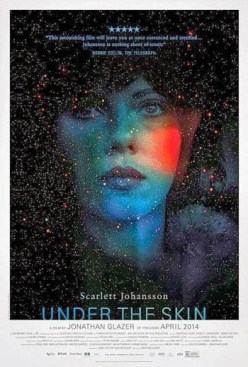
 

Under the Skin (Glazer 2013)

Poster-art-for-Under-the-Skin_event_mainand so anyway it turns out that the best thing about Under the Skin (2013) – the dreary-with-nice-landscapes arthouse remake of Species (Donaldson 1995) that ultimately fails in it valiant attempt at comedy greatness by not crassly letting the dog who caused all the drownings survive after the parents and the Czech guy and the toddler die, though it comes close when the radio news announces that the father, a professor, was reported missing by his university when he failed to turn up to work on Monday morning – is not the perfect casting of blank-faced affectless Scarlett Johansson as the blank-faced affectless alien, nor that you can spend the last part of the movie correcting the typo in its title by chanting Undo the skin! Undo the Johansskin! but the fact that you can spend half the day reading articles that not only praise the film for subverting the male gaze and thus opening up towards otherness but also complain about all the Glaswegian accents

Afrocyberpunk 3: Steven Barnes, Streetlethal (1983), Gorgon Child (1989), Firedance (1994)

Barnes Steven - Aubrey Knight 01 - Street LethalIn 1993, Claire Sponsler argued that cyberpunk reworked earlier post-nuclear-holocaust narratives (Alas, Babylon; A Canticle for Leibowitz; Riddley Walker) which depicted, with ‘angst and ambivalence’, a ‘physical world [that] is unfriendly, unyielding, and unforgiving’, a ‘hostile and forbidding … no-man’s land where humans must struggle to survive’ (257). In contrast, for cyberpunk ‘destruction of the natural environment and decay of the urban zones are givens that are not lamented but rather accepted’ (257). In ‘decayed cityscape[s]’, cyberpunk found ‘a place of possibilities, a carnivalesque realm where anything goes and where there are no rules, only boundaries that can be easily transgressed’ – and where entry into cyberspace, a disembodied realm of deracinated liberation, is ‘encouraged, not hampered, by a milieu of urban decay’ (261).

Thomas Foster’s The Souls of Cyberfolk criticises this view, reminding us that part of the cultural backdrop against which the cyberpunk imaginary emerged was the discourse of urban planning and development that came to the fore in the US in the 1970s and 1980s – and that its ‘language of urban “ruin,” “decay’” or “blight”’ possessed ‘ideological and often specifically racist subtexts’, providing an encoded way of talking about ‘racialized inner-city ghettoes than cities in general’ (206). (It is well worth having this is mind when reading Delany’s Dhalgren, too.)

Steven Barnes’s Aubry Knight trilogy – among the trashiest of afrocyberpunk fiction and in some ways much more afro than cyberpunk – gets closer than any other cyberpunk I have read to acknowledging this urban-planner/property-developer discourse and its racial content.

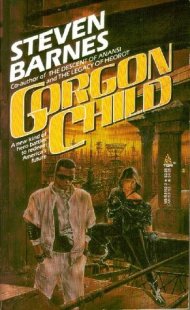
Written before William Gibson’s Neuromancer, Streetlethal (1983) sits alongside cyberpunk, developing similar material rather differently. The trilogy’s ongoing negotiation with 51WfmS5e1uL._SY344_BO1,204,203,200_cyberpunk is most evident if we judge Barnes’s novels by their covers. Barclay Shaw’s 1983 cover – where it is difficult to tell that the protagonist is black – combines 70s martial arts imagery with hints of a post-apocalyptic scenario, perhaps like The Ultimate Warrior (Clouse 1975). It alludes to Mad Max, but the overturned car and shattered road bridge give way to an airy futuristic metropolis. The jacket blurbs point to a conservative tradition of adventure sf (Larry Niven), made a little more decent (Gordon R Dickson) and perhaps a little edgier (Norman Spinrad) (Firedance (1994) adds a blurb from Peter O’Donnell, the creator of Modesty Blaise). The 1991 reissue of Streetlethal retains these three blurbs but has a new cover by Martin Andrews that builds on the imagery of Luis Royo’s cover for Gorgon Child (1989) (rather 593041more effectively than Royo’s cover for Firedance). Aubrey is definitively black. His costume suggests a black urban cool coming out of the dancier end of hip-hop. His dark glasses turn cyberpunk’s mirrorshades black. The urban backdrop is more ambiguous, with hints of futurity and ruination. The female figure is like a rock video version of Molly, Gibson’s street samurai. (The relationship between the women on the covers and the female characters in the novels remains mysterious to me).
From its first sentence, though intermittently, Streetlethal draws on noir imagery and, like Gibson, science-fictionalises it. The novel begins:

Naked and transparent, the woman’s smooth white body undulated slowly, beckoning to the empty streets. The streets were still slick from the afternoon rain; the hologram reflected back from the wet asphalt, an erotic mirage.

[Maxine] steered him further down the street, past the fluxing, beckoning projections that lined Pacific Coast Highway. Soundloops triggered by their passing cajoled, promising the finest in services and goods, the ultimate in intimate experience. A hungry taxi-drone paused on its eternal run down the central guidestrip, and Maxine waved it on. (1, 2-3)

41XSvGIDuwL._AC_UL320_SR212,320_.jpgThe overall plot is also rather noirish. Maxine uses sex to betray Aubry, framing him for murder as part of his punishment for quitting work as muscle for the Ortega gang. He is arrested and imprisoned in the Death Valley Maximum Security Prison; he escapes, makes his way back to Los Angeles, wreaks revenge.

Unlike Gibson, Barnes also works in a blaxploitation mode. Aubry is large and immensely powerful figure, a streetfighter turned Nullboxer – a kind of zero-gravity MMA. Inhumanly strong and determined, there is at times something of Jim Brown, Richard Roundtree and Jim Kelly to him. He is not very smart, though, or well-socialised; the later novels gradually cure him of this emotional/psychological stuntedness, turning him from a kind of Luke Cage into someone more like T’Challa, the Black Panther. Barnes draws on cultural-political strains of black power, Afrotopianism, Afrocentricity and Pan-Africanism (In Firedance, Aubry discovers he is actually African, an child of the Ibandi tribe of warriors who was orphaned in the US. He returns to Africa to topple the insane, Japanese-backed insane military dictator of Pan-Africa, which is composed of six countries: Zaire (Congo), Tanzania, Uganda, possibly Kenya and two never-named others.) Barnes presents a matter-of-fact multiracial and mixed-racial future. More awkwardly, but in a generally positive way, he includes a lesbian separatist community and a group called the NewMen – physically imposing, genetically-engineered warriors, who are all also homosexual. (This sort of diverse future caught between the ghetto, the gang and the New Jim Crow is developed in Erika Alexander and Tony Puryear’s Concrete Park.)

At the centre of Streetlethal is the Los Angeles downtown:

Downtown Los Angeles covered some of the most expensive real estate in the world, and in the 1960’s and ’70’s it had become run-down. Property values were slipping. There was a major effort to clean the area up, to bring in investors. … [Impoverished, homeless] Scavengers have existed for … maybe a century. They move into ruined neighbourhoods, slums, anywhere nobody else wants to live or work, and reclaim. People have been doing it forever, but I guess they just started organizing during the Second Depression, in the eighties. (177, 180)

Although fleetingly evoked, this historical context points to the still ongoing real-world conflicts between a city government enamoured of property developers and the residents of the garment district, skid row and other communities/areas that also occupy the downtown.

Barnes’s LA differs from the real LA not just because of that Second Depression but also because the Big One finally hit.

It was easy to remember when there had been skyscrapers here. The Great Quake, and the even more ruinous firestorm that followed, had razed the city, sending businesses fleeing to the valleys and peripheral areas. Already decaying by the turn of the century, no one cared about central L.A. anymore. The slums remaining in the area were simply referred to as the Maze, and only the hopeless made it their home. (60)

[It] must have been a street, once. It was hard to tell, with the accumulated layers of trash and debris, shattered fragments of buildings, and the gut-punched wreckage of a bus, stripped of rubber and glass and most of its metal, only a framework of rust remaining. … The wreckage was incredible, as if an orgy of wholesale looting and vandalism had destroyed what little was left by the natural disasters of earthquake and fire. (108, 109)

The Maze is home to the Scavengers, a subterranean co-operative community developed from those earlier scavengers. They live in the ruins, including the secretly renovated PanAngeles Multiplex, ‘the largest underground living complex in the western hemisphere’ (177). And they have a semi-official government franchise to recover valuables and salvage materials from the ruins. The state sees them as ‘hoboes scratching at a trash heap’ (176) and have no idea how wealthy they have grown, how far their trade network reaches, how much their influence and range of alliances have grown.

The most depressing aspects of the trilogy is that by the start of Firedance, the Scavengers have themselves turned property developers, using ‘the leverage of property, money, and manpower, combined with generous grants and federal tax breaks’ to create ‘an empire’ (9). They have turned the Maze into Mazetown, a new and more ethnically diverse downtown – and ‘the label “Mazie” seemed less an insult than a celebration of an individual choice’ (17). The new population might have ‘skins tinted every color of the rainbow … cloaked in the raiment of a dozen lands’ (17), a dozen languages and a hundred dialects’ might fill ‘the streets’, and there might be a ‘thousand savory collations from around the world’ being sold by ‘ten thousand street vendors’ (33), but they also look and sound and smell of gentrification. As if capitalism somehow suddenly – and in LA of all places – dropped its racialising and racialised dynamics.

Works cited
Steven Barnes, Streetlethal. New York: Ace, 1983.
–. 
Gorgon Child. New York: Tor, 1989.
–. Firedance. New York: Tor, 1994.
Thomas Foster, The Souls of Cyberfolk: Posthumanism as Vernacular Theory. Minneapolis: University of Minnesota Press, 2005.
Claire Sponsler, ‘Beyond the Ruins: The Geopolitics of Urban Decay and Cybernetic Play’. Science Fiction Studies 60 (1993): 251-265.

The City in Fiction and Film, week 13

936full-all-that-heaven-allows-posterWeek 12

Returning from the holiday break, we picked up and built on some strands from the end of last semester – moving from the rubble of The Third Man and Passport to Pimlico to postwar urban development (foreshadowed in Bicycle Thieves), and extending our thinking about the relationships between built environments and individual/group psychology. For the first couple of weeks we are looking at US suburbs, this week in All That Heaven Allows (Sirk 1955) and next week in Invasion of the Bodysnatchers (Siegel 1956) and Ray Bradbury’s Fahrenheit 451 (1953) – we might get some glimpses of Truffaut’s adaptation in later weeks, as we move onto postwar European and British development Alphaville (Godard 1965), The Model Couple (Klein 1977) and JG Ballard’s High-Rise (1975).

We began with an array of statistics to get some sense of the extent of – and transformations wrought by – the US post-war economic boom as war-time industries retooled, the growth of the suburbs and related expansion of and easier access to credit, and the development of a new consumer and corporate culture.  Some very broad strokes:

  • In 1945, 40% of Americans owned their own homes; relatively few families owned a car; shopping was done in neighbourhood groceries; and aeroplane travel was for the military, the wealthy and the occasional businessman.
  • In 1960, 60% of American owned their own homes; many families owned more than one car; groceries were bought at supermarkets in shopping malls; and TV had replaced films and radio as the major source of entertainment.
  • Between 1947–1960, the rise in average real income was equal to that in the previous half century;  GNP increased by 250%; and expenditure on construction increased ninefold.
  • By 1960, per capita income was 35% higher than the boom year of 1945.
  • By the mid-1950s, 60% of the population enjoyed a secure middle class income ($3000-10,000), twice as many as had done so 25 years earlier, before the Depression.
  • In 1946, there were 6 TV stations in the US; by 1956, there were 442.
  • In the mid-fifties, 66 % of US homes had a TV; by 1960, 87% (and 75% of American families owned their own car their own washing machine).
  • At the height of European emigration to the US in the early years of the 20th century, 1.2 million arrived every year; during the 1950s, the same number of people moved out to the suburbs every year – 18 million in total – as 13 million new homes were built, 11 million of them in the suburbs.
  • By 1960, a quarter of the American population lived in the suburbs.
  • Suburbs were typically whites-only (and when racial segregation in housing was ruled illegal, other methods were developed to keep suburbs whites-only).
  • Suburbs were generally arranged in a class hierarchy – the further away from the city, the bigger the lot/house.
  • There was a boom in sales of consumer goods and domestics appliances – which saw electricity use triple during the 1950s, with advertising revenues increasing 400% between 1945 and 1960, three times the money spent on higher education.
  • There was a massive increase in automobile usage, with the number of cars in the US increasing 133% between 1945 and 1960.
  • There were also government road-building activities: in 1956 Congress appropriated $32 billion to build 41,000 miles of highway, and the Interstate system was developed.

All this affluence surely made people happy? Not really. Eisenhower’s placid decade was also a time typified by an array of deep-rooted anxieties. Again, in broad strokes:

  • the cold war
  • anti-communist hysteria
  • nuclear dread
  • the Civil Rights movement
  • the Kinsey reports into human sexuality
  • dull conformity: endless identical tract homes in the suburbs full of the same consumer durables; the need for men to ‘fit in’ in new corporate workplaces; women pushed out of the workplace in favour of returning veterans and into the home to raise nuclear families
  • isolation: destruction or loss of extended kinship networks and communities in old urban centres, changes in access to urban resources
  • increase in alcoholism, dependency on tranquilisers, psychoanalysis and a major revival in Protestant christianity – all of which can be seen as methods of coping with and adjusting to circumstances rather than trying to change them

These transformations – affluence and anxiety – can be observed in the culture of the time, as well as being evident in the ways the period is remembered (which includes being misremembered, consciously and unconsciously).

From this admittedly sketchy sketch of suburbs – William Chafe’s The Unfinished Journey, the source of many of my stats, is a good place to begin reading more detail about the scale and consequences of these transformations – we turned to the question of genre. More specifically, what is melodrama?

Melodrama emerged as a stage genre in the wake of the 18th century bourgeois revolutions – in France, America, Haiti – and with the rise of capitalism. As feudal structures/hierarchies were destroyed, so tragedy’s emphasis on people of rank – e.g., Hamlet, Othello, Lear – was replaced by the sentimental drama of the bourgeois family. But such sentimental stage dramas inevitably lack ‘heroic dimensions, overt excitement’, ‘cosmic ambition’ and ‘violence’ (Gledhill 17) – and made up for this deficit by taking on some characteristics from popular theatrical traditions of spectacle, performance and music to become melodrama (French: ‘song’ + ‘drama’). Theatrical melodrama also adopted Gothic fiction’s often Manichean outlook – in Europe, this typically pitted good bourgeoisie against evil aristocrats or good proletarians against evil bourgeoisie; in the US, which likes to pretend it doesn’t have a class structure, this opposition was more typically between good rural folk and evil city folk. Theatrical melodrama also increasingly emphasised ‘unpremeditated feeling as an index of moral status and social value’ (Gledhill 24).

In relation to film, Linda Williams argues that melodrama – ‘a modality of narrative with a high quotient of pathos and action’ (51) – should not be regarded as a ‘specific genre’ but as ‘the fundamental mode of popular American moving pictures’ (42):

the basic vernacular of American moving pictures consists of a story that generates sympathy for a hero who is also a victim and that leads to a climax that permits the audience, and usually other characters, to recognize that character’s moral value. This climax revealing the moral good of the victim can tend in one of two directions: either it can consist of a paroxysm of pathos (as in the woman’s film or family melodrama variants) or it can take that paroxysm and channel it into the more virile and action-centered variants of rescue, chase, and fight (as in the western and all the action genres). (58)

The meaning of melodrama has also changed significantly when talking about film. As far as Hollywood was concerned, until the 1970s:

‘melodrama’ meant action thrillers with fast-paced narratives, episodic story-lines featuring violence, suspense and death-defying stunts. Dastardly villains, heroines in peril and daring adventurous heroes populated these films … Cowboy films, gangster films, crime thrillers and horror movies were typically labelled ‘melodramas’ in the trade press. … what Film Studies has come to regard as ‘melodrama’ since 1970 are films with more words than action, inactive male protagonists, active and even domineering female characters, and anything but clear-cut and easily identifiable villains [and it is this version] of ‘melodrama’ that is now in general circulation, having been adopted by Hollywood filmmakers, reviewers and journalists since the 1970s. (Mercer and Shingler 6)

John Mercer and Martin Shingler also offer a useful discussion of the key characteristics of the Hollywood family melodrama (the kind of film made by Sirk, Nicholas Ray and  Vincente Minnelli that is now often conflated with the entirety of melodrama):

  • a focus on the conflicts and tensions of a middle-class family, in which social and economic concerns are registered but are typically secondary to the focus on personal emotional trauma
  • the audience is invited to sympathise with protagonist (who is often also cast as a victim) and to project their own fears/anxieties onto him/her
  • the portrayal of a psychological situation will be pretty direct – there will be no recourse to monsters to express repressed material as in Invasion of the Bodysnatchers or ghosts as in Festen (von Trier 1998)- and the viewer is likely to be able to identify with it from their own experience
  • there will be evidence of Freudian repression, of psychoanalytic symptoms and of the return of the repressed – Freudian psychoanalysis was a familiar part of US popular culture well before the 1950s, and sometimes, as in All That Heaven Allows, its terminology is explicitly evoked
  • the mise-en-scène will have a symbolic or coded dimension
  • expressive music will be used to heighten the emotional impact
  • the film will often culminate in a happy ending – but when it does, the happiness and/or the ending-ness of the happy ending will be unconvincing. In Stella Dallas (Vidor 1937), the working-class Stella (Barbara Stanwyck) is able to give her daughter an upper middle class life, but is shut out from it and will never see her daughter again. In All That Heaven Allows, middle-aged, middle-class widow Cary (Jane Wyman) is finally free of her (awful) children to be with the younger, working class Ron (Rock Hudson), but he is injured, reduced to an infantile state as someone she must care for as if she is his mother (despite the ‘erection’ under his blanket); outside the window, the yonic lake is frozen and the deer who wanders up as a potential symbol of new life is also clearly not a wild creature, independent and free, but one who has been domesticated by Ron (like Cary). Also, the society’s – and Cory’s awful children’s – disapproval of their relationship has not disappeared. Such ambiguous/ambivalent/double-coded endings seem to recognise that the problem/contradiction at the core of the film cannot be so easily resolved. They invite the viewer to read the film against the grain

As we mentioned Freud, we also quickly sketched in some very basic Freudian ideas (we will do more with this material in the level two module on genre and the fantastic):

  • large parts of human thought remains unconscious
  • the human mind expends considerable energy suppressing or repressing certain thoughts and ideas (particularly around sex and aggression)
  • repressed thoughts and ideas often sneak out in dreams, nightmares, slips of the tongue and artistic activity (the return of the repressed)
  • the unconscious, however, is not simply a ready-and-waiting place for repressed desire – it is produced by the very act of repression
  • the tripartite mind: the ego as the fluid product of the conflict and tensions between the id (basic drives around sex and aggression, etc) and the superego (internalised social codes of behaviour); Dr Jekyll (ego) want to chemically realise the angelic part of human nature (superego) but unleashes instead the Mr Hyde (the id)

And then onto Douglas Sirk specifically – his background in interwar Berlin’s leftist creative community, his German and especially his Hollywood films (a contract director who had little choice over what films he made, but found ways to work against their clichéd material; the major melodramas with producer Ross Hunter at Universal), and his belated designation as an auteur in the 1970s (in part aided by his ability in interview to talk a strong leftist game in describing – or claiming – what he sought to achieve in his movies). Since his ‘discovery’, the following characteristics have been discerned in his films:

  • he depicts the material American dream not to celebrate it but to critique it
  • his visual style subverts his clichéd, conservative narratives
  • he uses parody and excess, not for comedy value but to create a distance between the viewer and the film
  • this distance is also the product of his preference for medium-shots and long-shots over close-ups so as to keep the viewer from getting too caught up in the characters’ emotions
  • he also uses long-shots and creates frames within the frame to ‘stage’ events – to make them seem overtly theatrical and staged, thus working a low-key Brechtian alienation effect
  • he uses sets, props and shot construction to create graphic effects
  • he uses mirrors to double, distance and reveal – also uses windows and screens
  • he uses colour and props expressively

The remainder of the class was devoted to discussing a series of questions posed before the screening.

  • How does the film represent different spaces (e.g, suburb vs countryside, the country club vs the Andersons’ party, Carry’s house vs the Old Mill House)?
  • What does the film say about: youth, maturity, respectability, class, duty, desire, convention, passion, romance, community?
  • How does the film depict masculinity and femininity? What does it say about gender?
  • How does the film use colour (especially reds/browns and blues) expressively?
  • How does it use specific objects (spectacles, the TV, the teapot, screens, windows, the deer, Xmas trees, etc) expressively?
  • Does it have a happy ending? What undermines the happiness of the happy ending?

One of the things we focused on was the use of colour. Cary’s decision to abandon her widow’s weeds for a red dress when she goes to the Country Club suddenly changes how other people see her – she is hit on by a married man. Her children – who are every bit as awful as the children in Make Way for Tomorrow (McCarey 1937) and Tokyo Story (Ozu 1953) – struggle to cope with the idea of their mother having  desires, being sexual. Her daughter Kay (Gloria Talbott) starts whom the film rather mocks for her book-learning and appeals to reason); significantly, once she falls in love with a boy and they get engaged she  also wears red – even as she tells her Cary, who at this point has abandoned Ron for the sake of her awful children (who are awful), that at least she had not really loved him. As her awful child, dressed all in red, spouts blithely spouts this, Cary is framed by a bitterly ironic vase of red roses. (It is some small comfort to know that Gloria Talbott will just a few years later marry a monster from outer space.)

The film also uses a range of reds and browns to signal physical and emotional warmth. Domestic interiors are red/brown against the cold blue of the night outside – almost like the conventional tinting of a silent movie – except in scenes when Cary is being berated for her ‘inappropriate’ romance by her awful son Ned (William Reynolds). Then, Cary is always posed against a warm red backdrop while Ned stands in front of a cold blue backdrop – an expressive lighting scheme that makes no realistic sense in terms of the physical space, light sources, lightbulbs, etc.

In the key scene, when the awful Ned walks out on his mother, the expressive use of props is also evident. Ned strides to posture in front of the fireplace, wittering on his patriarchal nonsense in front of a wall that has already been compared to an Egyptian mausoleum in which Cary is entombed (Cary has just suggested he put a screen in front of the fire, as if to block her passions). He leans on the mantlepiece where his father’s trophy used to be displayed (there has already been a row about Cary referring to it as part of the clutter she has taken down to the basement – a good place for repressed material to be stored). Throughout their conversation before and after this moment, the strong vertical lines of a screen has separated the film screen, with one of them either side of it, cut off from each other. Going even further, when Cary asks ‘let’s not this come between us’ (meaning her relationship with Ron) this is what the shot actually looks like:

vlcsnap-2011-12-28-15h26m55s98

Expressive mise-en-scène or what?

Week 14

Core critical reading:
Mercer, John and Martin Shingler, Melodrama: Genre, Style and Sensibility. London: Wallflower, 2004. 38–77.
Recommended critical reading
AlSayyas, Nezar. Cinematic Urbanism: A History of the Modern from Reel to Real. London: Routledge, 2006. See chapter 4, “Cynical Modernity; or the Modernity of Cynicism.”
Biskind, Peter. Seeing is Believing How Hollywood Taught Us to Stop Worrying and Love the Bomb. London: Pluto, 1983. 250–333.
Fishman, Robert, Bourgeois Utopias: The Rise and Fall of Suburbia. New York: Basic, 1989.
Friedan, Betty. The Feminine Mystique. London: Gollancz, 1963.
Gledhill, Christine. ‘The Melodramatic Field: An Investigation’. Home Is Where the Heart Is: Studies in Melodrama and the Woman’s Film. Ed. Christine Gledhill.London: BFI, 1987. 5-39.
Hapgood, Lynn. Margins of Desire: The Suburbs in Fiction and Culture, 1880-1925. Manchester: Manchester University Press, 2005.
Hilliker, Lee. “Hulot vs. the 1950s: Tati, Technology and Mediation.” Journal of Popular Culture 32.2 (1998): 59–78.
Klinger, Barbara. Melodrama and Meaning: History, Culture and the Films of Douglas Sirk. Indianapolis: Indiana University Press, 1994.
Nicolaides, Becky and Andrew Weiss, eds. The Suburb Reader. New York: Routledge, 2006. Especially Chapter 10, ‘Critiques of Postwar Suburbia’.
Spigel, Lynn. Welcome to the Dreamhouse: Popular Media and Postwar Suburbs. Durham: Duke University Press, 2001.
Williams, Linda. ‘Melodrama Revised’. Refiguring American Film Genres: Theory and History. Ed. Nick Browne. Berkeley: University of California Press, 1998. 42-88
Recommended reading
Probably the first satire on suburban life is George and Weedon Grossmith’s *The Diary of a Nobody (1892).
The struggle to live in the suburbs and the meaninglessness of suburban living is central to James M. Cain’s Mildred Pierce (1941), Richard Yates’s Revolutionary Road (1961), John Cheever’s “The Swimmer” (1964), J.G. Ballard’s Vermilion Sands (1971), Don DeLillo’s White Noise (1985) and Rick Moody’s The Ice Storm (1994). Sue Kaufman’s Diary of a Mad Housewife (1967) is set in Manhattan but nonetheless offers a feminist critique of the gender relations more normally associated with the suburbs.
Lorraine Hansberry’s A Raisin in the Sun (1959), based on her own family’s experience, is about the desire to move from the overcrowded, run-down city to the suburbs – and the lengths to which suburban Americans went to keep out people of colour.
Recommended viewing:
There are film versions of Mildred Pierce (Curtiz 1945), A Raisin in the Sun (Petrie 1961), The Ice Storm (Lee 1997) and Revolutionary Road (Mendes 2008). Suburban alienation and dysfunction is also explored in The Reckless Moment (Ophuls 1949), Rebel without a Cause (Ray 1955), Bigger than Life (Ray 1956), The Graduate (Nichols 1967), The Swimmer (Perry 1968), Targets (Bogdanovich 1968), Safe (Haynes 1995) and American Beauty (Mendes 1999).
Far from Heaven (Haynes 2002) reworks Sirk’s film, introducing questions of race and sexuality that films of the 1950s could not deal with directly; Todd Haynes also directed a television adaptation of Mildred Pierce (HBO 2011).
More comical visions can be found in Mon Oncle (Tati 1958) and Ferris Bueller’s Day Off (Hughes 1986).

The Hateful Eight (Quentin Tarantino 2015)

Hateful-Eight-posterand so anyway it turn out that the best thing about The Hateful Eight (Tarantino 2015) roadshow version is not the intermission, because that would be too easy a joke, nor is it every single frame of QT’s yappy remake of John Carpenter’s The Thing (1982) in which no one is speaking because it is all just so gosh-durn pretty to look at (though it is), nor that QT enables you to wile away the hours trying to figure out which precise combination of the characters the title refers to (unless it is self-deprecating joke about his oeuvre) but just the fact that someone at long last has dared to bring to the cinema an adaptation of the very best but least successful series of novels by Enid Blyton….

Creed (Ryan Coogler 2015)

creed_poster_by_sahinduezguen-d99fk7gand so anyway it turns out that the best thing about Creed (2015) is the moment when, after Rocky Balbao falls sick and is forced to drop out of training Adonis Creed, and after Clubber Lang and Ivan Drago step up to help Adonis prepare for his title shot, and after Adonis is forced to drop out because of a hand injury, Rocky himself puts on the gloves and stars-and-stripes shorts for one last shot at glory…
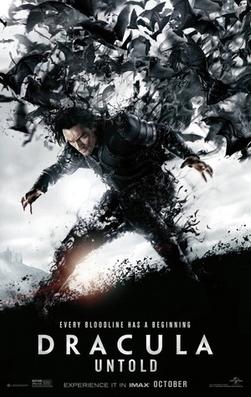
Dracula Untold (Gary Shore 2014)

Dracula_Untold_posterand so anyway it turn out that the best thing about Dracula Untold (2014) is not that, despite its title, it begins with extensive voiceover narration, nor that it promptly sets you up to expect a queer vampire western when the first named location is Broketooth Mountain, nor that Luke Evans dies right at the start so that his big brother Jason Statham can take over (mainly because that doesn’t actually happen), nor the Taransylvaniarantula spiders lurking in the ancient vampire’s cave, but the moment when Vlad, his kingdom about to be overrun by Turks (well, they’re Turk-ish), as a last resort goes to implore the ancient vampire master, ‘Save my people – you’re Charles Dance, you’ll do any old shit for money’…

Divergent (Neil Burger 2014)

DivergentFourTrisMoviePosterand so anyway it turns out the best thing about Divergent (2014) is not its role in the mysterious rise of Jai Courtney, easily the very worst of all the very bad actors in the much-loved Spartacus, nor is it the way that it makes you want to watch the much-loved and incredibly silly Equilibrium (Wimmer 2002) again, but the bold formal experiment it conducts by taking the training montage sequence as the basis for its narrative structure but then including two hours of all the tedious stuff you would normally cut out…

Best, worst and most ambivalent bits of Xmas/New Year trip 2015-16

Best Cocktails at Hotel Congress, John Dillinger’s old hangout
Worst Coffee at IHOP
Best Seeing a coyote, dozens of pronghorn antelope and thousands of sandhill cranes in the wild
Worst Seeing open carry in a pro-gun diner that advertises, with a crossed guns logo, that they never call 911
Best The Border Patrol checkpoints that couldn’t be bothered to stay open in the rain
Worst The Border Patrol checkpoints that just waved us through because we are white
Best Hiking in the Chiricahua mountains, where Geronimo and Cochise hailed from and held out
Worst Visiting Fort Bowie and Apache Pass, site of the Bascom affair and instrumental in the defeat of Cochise, Mangas Coloradas and the Chiricahua Apaches
Best Not having food poisoning
Worst Having some kind of contagious bug with the same kind of symptoms
Worst Having the plane from Chicago to Tucson cancelled because of a mechanical failure, only to have its replacement cancelled because of a mechanical failure and then its replacement cancelled because of a mechanical failure
Best Getting a working plane from Chicago to Tucson
Best Accidentally teaching baby Eli, who at that point had not even worked out it was possible to walk backwards, to moonwalk
Best Walking in the footsteps of Glenn Ford at the ranch where the original 3.10 to Yuma was shot
Best Taking break from the Roger Moore series of Maverick (after the episode written by CL Moore as Catherine Kuttner) to watch the first half of James Garner’s return in Bret Maverick
Best Somehow missing the Marty Robbins museum
Best The extraordinary tortilla in which my otherwise very ordinary burrito was wrapped at Mi Casa
Best Finding occasional traces of an American cuisine that does not feel it necessary to include mediocre American cheese melted onto or into it
Best The name of the Quantum Mechanics Nail and Hair Parlor
Best The crazy second-hand bookstore hidden away in ranch in the middle of the desert
Best The lovely and crazy old lady who runs the crazy second-hand bookstore hidden away in ranch in the middle of the desert
Best Her dog
Most ambivalent Finding oneself thousands of miles from Bristol talking to a woman from Cardiff who was equally dismissive of Arizona’s attempt at a torrential downpour
Most ambivalent Star Wars: The Force Awakens

Writing, publications, events in 2015

CIHAN1-aWriting anything more substantial than blog posts has been hard this year. Things that got in the way included: burn out; depression; general HE mission-drift/precarity/anxiety/malaise; having to design/validate/launch a new degree programme; spending time planning a large research project only to find my institution will not support a bid to the one source likely to fund it. Hopefully, I will find some energy soon since I have an article, a book chapter, a review and a magazine feature due in the next month; and another three essays, two reviews, and six keynotes and invited research talks scheduled before the end of the summer. Oh, and that co-edited collection I keep forgetting about.

But, of course and as always, Sherryl, Gerry and I edited three issues of Science Fiction Film and Television on schedule. And some publications did leak into the world in 2015

Monograph translation
Science Fiction: The Routledge Film Guidebook (2012) appeared in Turkish as Bilimkurgu (Kolektif Kitap 2015)

Contributions to edited collections
‘The Coy Cult Text: The Man Who Wasn’t There as Noir Sf’ in JP Telotte and Gerald Duchovnay, eds, Science Fiction Double Feature: The Science Fiction Film as Cult Text (Liverpool UP 2015), 38–52

‘Slipstream Cinema: Dick without the Dick’ in Stefan Schlensag and Alexander Dunst, eds, The World According to Philip K. Dick (Palgrave Macmillan 2015), 119–136

‘The Futures Market: American Utopias’ in Eric Carl Link and Gerry Canavan, eds, The Cambridge Companion to American Science Fiction (Cambridge UP 2015), 83–96

Non-peer-reviewed article
‘African SF 101’, The SFRA Review (2015), 11–18; also here and here. This was also my most successful blog of the year: 1300+ views in one day, 4,250 as of ten minutes ago (about a fifth of my blog views for the year). It has also been translated in two parts (here and here) for the website of the World Chinese Science Fiction Association, China’s largest association for science fiction practitioners and fans.

Review
‘If Colonialism Was The Apocalypse, What Happens Next? On Nerine Dorman, ed., Terra Incognita: New Short Speculative Stories from Africa and Dilman Dila, A Killing in the Sun’, The Los Angeles Review of Books (5 August 2015)

Blog
‘Piqued Oil’, Salvage online (5 Oct 2015).

Fiction
‘Milton Friedman: An Obituary’, Salvage 1 (2015), 225–229. Also here. This started off a long time ago as a joke and ended up being my first published fiction. In the giddy aftermath, I spilled out an actual story – exactly the kind of space opera/western/romance/mathporn mash-up with gratuitous MaverickFlash Gordon and M. John Harrison riffs no one wants to publish – so for the counterfactual Ballard piece currently under concoction I have reverted to wilfully obscure material in a non-fiction format.

Events
I was interviewed for Alessandro Inglima and Yari Lanci’s Coded Skins, a documentary on the SpaceApe that is currently in production. Simultaneously made me feel really old, and all young and street.

I was part of a panel on ‘Video Nasties’ before the UK premiere of Joe D’Amato’s uncut Anthropophagus, The Cube, Bristol, 16 September 2015.

I introduced the 1930 sonorised version of Sergei Eisenstein’s Battleship Potemkin (along with Everyday, Vintik-Sphintik and Interplanetary Revolution) for Bristol Silents, The Lansdown, Bristol, 23 September 2015.

I helped to organise Global Futures: On Science Fiction, featuring Bill Campbell, Zen Cho, Carmelo Rafala, Geoff Ryman, Stephanie Saulter, Donna Scott and Tade Thompson, at Book & Kitchen, London, 7 November 2015.

And I was the only even remotely mean-spirited curmudgeon who made it into the final cut of Channel 5’s The Definitive History of Star Wars, 11 December 2015,