The City in Fiction and Film, week 11: the city and modernity – ruins and rebuilding

the-bicycle-thief-movie-poster-1949-1020503611

week 10

This week’s class was centred on Ladri di biciclette/Bicycle Thieves (Vittoria De Sica 1948). We have already encountered postwar ruins and a version of the Trümmerfilm (‘rubble film’) in The Third Man (Reed 1949), and will watch Passport to Pimlico (Cornelius 1949) next week – a bit more festive than most Trümmerfilm and one that segues into the period of postwar (re)construction that will begin next semester.

It is difficult to talk about Bicycle Thieves without also talking about Italian neo-realism, and so the lecture this week also overlaps with some issues being discussed on Film Style and Meaning. James Chapman’s Cinemas of the World: Film and Society from 1895 to the Present (2003) usefully describes Italian neorealism as possessing

a distinctive formal and aesthetic character of its own (location shooting, naturalistic lighting, long takes, true-to-life stories, unscripted dialogue and the use of non-professional performers). (232)

It would however be problematic to reduce the movement merely to a matter of aesthetics (Chapman doesn’t – I’ll come back to him in a bit), especially when the terms one finds in such lists are this broad and could be applied to so many realist film movements. So before getting into more detail about neorealism, we focused on the specificities of Italy in the closing years of World War II and the immediate postwar period.

Very broadly, then:

Benito Mussolini, leader of the National Fascist Party, became the Prime Minister of Italy in 1922. In 1925, he abandoned democracy and set up a legal dictatorship. He was ousted in 1943 and replaced by Pietro Badoglio, who set about dissolving the Fascist party and surrendering to the advancing allied forces. In response, Germany invaded Italy and German special forces broke Mussolini out of prison. Italy declared war on Germany; Mussolini became head of the northern Italian Social Republic – a Nazi puppet government. He was captured and executed by partisans in April 1945.

In 1944, the returning exiled leader of the Communist Party, Palmiro Togliatti, promised to pursue parliamentary rather than revolutionary politics, and joined a broadly anti-fascist ‘national unity’ government, which wrote a new constitution, gave women the vote, abolished the monarchy and began to (half-heartedly) purge fascists from office. The Communist Party, had been the mainstay of the anti-fascist partisans and anti-Nazi resistance, and thus it had a certain moral high ground (as well as a million members in 1945). Under the new constitution, the first parliamentary elections since 1922 were held on 18 April 1948 (while Bicycle Thieves was in pre-production).

There were massive housing shortages and unemployment was somewhere between 9% and 20% – and if the Communist Party won, US Marshall Plan aid would have been delayed. The Christian Democrats, backed by the Vatican and covertly by the CIA, won. The Communist Party was established as the second largest party.  On 14 July 1948 there was an attempt to assassinate Togliatti. He was shot three times and put in a coma, but recovered. In response, there were massive protests, a general strike, and violent police repression (including by the Nucleo Celere, who we glimpse out of the police station window in Bicycle Thieves, heading out in jeeps to break up a demonstration).

It was against this complex, tense, conflicted and invigorating background that Italian neorealism emerged, and which to an extent accounts for its distinctiveness among varieties of realist cinema – not least because many of the key personnel were communists, or at least antifascists well to the left of the Christian Democrats.

Chapman also outlines some important other factors in the development of the neorealist style. The massive state studio Cinecittà, opened by Mussolini in 1937, had been bombed during the Allied invasion and was closed down, not reopening until 1948 (it was used as a displaced persons camp from 1945-47). At the same time, distribution networks – which had been starved of overseas films – were badly disrupted. Film production and circulation had become extremely localised, and in the absence of studio facilities, location shooting was at the very least a practical decision as much as it might have been an aesthetic one (presumably, professional actors had also been widely dispersed during the war, so there might also have been expedient casting of non-professional actors).

To the aesthetic characteristics listed by Chapman, we might also add a general preference for medium and long shots, which has the effect of embedding characters in social settings and relationships – the American mistranslators of the title, who called the film The Bicycle Thief, rather missed this point, as well as implying the title referred to Antonio (Lamberto Maggiorani). Additionally, neorealism also tended towards a digressive narrative form (especially in comparison to the Hollywood three-act structure) which arguably had the effect of bringing films closer to the unstructured shape of actual people’s actual lives – a point, as we will see, that André Bazin emphasised in his enthusiastic championing of De Sica’s Umberto D. (1952).

There is of course no consensus on how extensive the canon of Italian neorealist films is – the shortest lists I have seen list usually about eight films, others go up to about sixty.

Either the first neorealist film or the major precursor of neorealism, depending on who you ask, is Ossessione/Obsession (Luchino Visconti 1943), the first adaptation of James M. Cain’s The Postman Always Rings Twice (1934) – which the PCA had forbidden Hollywood to film.

So the other first neorealist film is RomaCittà aperta/Rome, Open City (Roberto Rossellini 1945), the story of a partisan and a priest killed during the liberation of Rome. It is generally interpreted as a call for communists and christians to unite in fighting fascism and building a new Italy. It was shot on the streets of Rome, using scavenged equipment and the ends of film reels, which gave it an urgent, grainy look . According to Dilys Powell, the influential Sunday Times film critic from 1939-79,

its impact was partly accidental, the result, not of the director’s art and imagination alone, but also of the accident of poor physical material which gave the story the air of fact.

For Rossellini, however, aesthetics and politics are inseparable, and neorealism was part of a movement to express a

need that is proper to modern man, to tell things as they are, to understand reality, I would say, in a pitiless concrete way, conforming to that typical contemporary interest, for statistical and scientific results.

In 1946, Rossellini’s Paisà/Paisan, charted – in six episodes – the relationship between Italians and US troops, from the allied invasion of Sicily in 1943 to end of 1944. Again, it is a film that could not have been made by Hollywood – the US troops are often drunk, the third episodes features a woman who works as a prostitute, and the second episode of is centred on an African American soldier.

In the same year, De Sica’s Sciuscià/Shoeshine began to shift the focus of neorealist film’s away from the war and onto the problems of postwar reconstruction. This is also the focus of Bicycle Thieves, as well as Visconti’s La Terra Trema/The Earth Trembles (1948) and Giuseppe De Santis’s Riso Amaro/Bitter Rice (1949), which are both concerned with rural settings, with fishermen and rice farmers.

Bazin praised Bicycle Thieves in these terms:

The story is from the lower classes, almost populist: an incident in the daily life of a worker. But the film shows no extraordinary events such as those that befall the fated workers in Gabin films. There are no crimes of passion, none of those grandiose coincidences common in detective stories … Truly an insignificant, even a banal incident … Plainly there is not enough material here for even a news item: the whole story would not deserve two lines in a stray-dog column. … the event contains no proper dramatic valence. It takes on meaning only because of the social (and not psychological or aesthetic) position of the victim. ( “Bicycle Thief” 49-50)

He also described it as a communist film, but one that avoided being mere propaganda

Its social message is not detached, it remains immanent in the event, but it is so clear that nobody can overlook it, still less take exception to it, since it is never made explicitly a message. The thesis implied is wondrously and outrageously simple: in the world where this workman lives, the poor must steal from each other in order to survive. … events and people are never introduced in support of a social thesis – but the thesis emerges fully armed and irrefutable because it is presented to us as something thrown in into the bargain. (“Bicycle Thief” 51, 53-3)

Arguments about the canon often start with Rossellini’s Stromboli (1950) and De Sica’s Miracolo a Milano/Miracle in Milan (1951) – they are clearly building on neorealism and breaking new ground, but is that new ground somewhere outside of neorealism’s ambit?

No such uncertainty exists about De Sica’s Umberto D., though. It is a deeply digressive story, or non-story, about an old man living a meagre existence. He has a dog, Flike. He contemplates suicide, but first tries to find a new home for Flike. It is a film which Bazin praised for its refusal of ellipsis – for the way it leaves in all the bits classical Hollywood filmmaking would cut out (as in this four-and-a-half-minute scene of the maid making coffee). Nothing at all of significance happens. Apart from the details of her routine, glimpses of her character and a reminder of her dilemma – and so of course it is full of actions and significance.

Bazin saw this as the pinnacle of Italian neorealism – as close as any film got to eliminating the actor (through the casting of non-professionals), miss-en-scène (through abandoning the artifice of the soundstage for the ‘reality’ of location shooting – to be honest, he is not always very good at spotting when things are shot in the studio) and story (eschewing the tightly-plotted classical narrative in favour of the disclosure of the everyday). While conceding that it would never be as widely appreciated or as well liked as Bicycle Thieves, he argued that

It took Umberto D to make us understand what it was in the realism of Ladri di Biciclette that was still a concession to classical dramaturgy. Consequently what is so unsettling about Umberto D is primarily the way it rejects any relationship to traditional film spectacle. (Bazin “Umberto D” 80)

Italian neorealism is normally said to end with Umberto D or perhaps Rome 11.00 (Giuseppe De Santis 1952) – a film I have never managed to see, but which sounds (and from film stills 280px-Romaore11_fotoscenalooks) awesome, although its influence is still at work in films as late as Federico Fellini’s Le notti di Cabiria/Nights of Cabiria (1957) – a film which I ended up misdescribing as being about ‘a prostitute who looks for love in a van’. Of course, I meant ‘in vain’.  And ‘a woman who works as a prostitute’.

Neorealist films were not great hits with Italian audiences, whose cinemas were being flooded with Hollywood product. They were attacked by the Catholic Church as unsavoury (rather than because they were anticlerical, or at least did not hold a high opinion of the church), and they were attacked by politicians because of the negative image of Italy they promoted internationally (not because they were, on the whole, left-wing films critical of the failures of Italian politics). But some of them were also major international successes, winning many festival awards as well as Oscars, and played a key role in the development of arthouse cinemas and circuits, especially in the US.

Before screening the film, I asked the students about Bazin’s claim that the message of the film is that ‘in the world where this workman lives, the poor must steal from each other in order to survive’. Is this what the film says? If so, how? If not, what does it say instead? Can a film be reduced like this to a mere ‘meaning’?

I also asked students to return to the ideas we have been considering (since Poe’s ‘The Man of the Crowd’) around the individual and the crowd – are these the only options? What about families? The neighbourhood? The church? The community party? What role do they play in mediating between – and in creating – the individual and the crowd?

Thinking back to Man with a Movie Camera, how does Bicycle Thieves depict leisure and labour?

And think about the film’s depiction of Rome. This is not the tourist Rome of, say, Roman Holiday (William Wyler), full of images of classical ruins and Renaissance art and architecture (though it is often shot with yards of such locations). Why does it eschew such sights? And why do other films focus so strongly upon them?

In the end, a lot of our discussion focused on the significance of Antonio’s bike – a muscle-powered forms of transport, halfway between the rural world of hand- and animal-drawn vehicles, and the coming modernising decade of Vespas and Lambrettas and Fiats. One of the sharpest contrasts is between Antonio, who needs a bike so he can work and provide for his family, and the racing cyclists who are wealthy enough to own bikes for leisure purposes. (This is part of the film’s argument about the flawed nature of capitalist social organisation.)

There is also the moment early on when Antonio is told he must have a bike and:
a) he lies, saying it is broken rather than that it has been pawned, even though when we see the pawn shop it is obvious everyone else is living on meagre credit, too;
b) none of the other unemployed men, who are not eligible for this particular job, who clearly state that they have bikes, offer to lend theirs to him.

This lack of communal solidarity stands in stark contrast to the way in which the family and neighbours of the guy who stole Antonio’s bike leap to his defence. This incident ties to the film’s argument through architecture. The Val Melaina, where Antonio and his family live is a borgate built for working class people who were forcibly displaced from the centre of Rome when Mussolini destroyed working class neighbourhoods in order to construct the avenues around the Coliseum, St Peter’s, etc. (This also had the advantage of removing antifascist and  potentially antifascist workers to a distant periphery – a move echoing the Haussmanisation of Paris.) These apartment blocks – which we see have no inside water supply – were ‘completed’ in 1933. They were five miles from the centre of Rome, separated from the city by non-urban space, and surrounded by open land. They had few services and poor connections with the city. Under such circumstances, the communal ties of the densely packed urban neighbourhood, with its multigenerational extended and intertwined kinship networks, and compounded by the dislocations and losses of war, came under increasing strain. Community gives way to the individual and the nuclear family; and that is not necessarily a good thing – as we will see in the first half of next semester as we encounter narratives of suburban conformism (from Douglas Sirk, Don Siegel, Ray Bradbury) and urban alienation (from Jean-Luc Godard, JG Ballard, William Klein, Martin Scorsese).

Core critical reading: Gordon, Robert S.C. Bicycle Thieves. London: BFI, 2008. 82–98.

Recommended critical reading
Bazin, André. “Bicycle Thief”, What is Cinema? Volume II, ed. and trans Hugh Gray, Hugh. Berkeley: University of California Press 1972. 47-60.
–. “Umberto D: A Great Work”, What is Cinema? Volume II. Ed. and trans Hugh Gray. Berkeley: University of CaliforniaPress 1972. 79-82.
Cardullo, Bert. “Actor-Become-Auteur: The Neorealist Films of Vittoria De Sica.” The Massachusetts Review 41.2 (2000): 173–92.
Celli, Carlo. “Ladri di biciclette/The Bicycle Thieves.” The Cinema of Italy. Ed. Giorgio Bertellina. London: Wallflower, 2004. 43–52.
Cook, Christopher. Ed. The Dilys Powell Film Reader. Manchester: Manchester University Press, 1991.
Marcus, Millicent. Italian Film in the Light of Neo-Realism. Princeton: Princeton University Press, 1986.
Gold, John R. and Stephen V. Ward. “Of Plans and Planners: Documentary Film and the Challenge of the Urban Future, 1935–52.” The Cinematic City. Ed. David B. Clarke. London: Routledge, 1997. 59–82.
Mennel, Barbara. Cities and Cinema. London: Routledge, 2008. See chapters 5 and 8, “The City in Ruins and the Divided City: Berlin, Belfast, and Beirut” and “The City as Queer Playground.”
Shiel, Mark. Italian Neorealism: Rebuilding the Cinematic City. London: Wallflower, 2006.
Tomasulo, Frank P. “Bicycle Thieves: A Re-Reading.” Cinema Journal 21.2 (1982): 1–13.

Recommended reading
George Orwell’s Nineteen Eighty-four (1949) offers an estranged vision of post-war London combining slums, bombsites and towering new architecture.
Nell Dunn’s Up the Junction (1963) depicts the young working class women living in the post-war slums of Battersea and Clapham Junction; Lynne Reid Banks’s The L-Shaped Room (1960) is also of interest.
Two useful accounts of social housing and postwar reconstruction are Lynsley Hansley’s Estates: An Intimate History (2012) and John Grindrod’s Concretopia: A Journey Around the Rebuilding of Postwar Britain (2014).

Recommended viewing
Short documentaries about slum living, new housing and other urban developments include Housing Problems (Anstey and Elton 1935), The City (Elton 1939), The City (Steiner and Van Dyke 1939) and Land of Promise (Rotha 1946).
Utopia London (Cordell 2010) outlines the vision of a group of modernist architects to rebuild London as a more pleasant and equal city, while Riff-Raff (Loach 1991) and Estate, A Reverie (Zimmerman 2015) chart the destruction of such developments.
Post-war London bombsites play a key role in films such as Hue and Cry (Crichton 1947), Obsession aka The Hidden Room (Dmytryk 1949) and The Yellow Balloon (Thompson 1953). These are Trümmerfilm (‘rubble films’), that is, movies made and set in the ruins of postwar cities. Others include The Murderers Are Among Us (Staudte 1946), the Italian neo-realist Germany Year Zero (Rosselini 1948), Odd Man Out (Reed 1947), The Third Man (Reed 1949) and Ten Seconds to Hell (Aldrich 1959).
Up the Junction was filmed for television by Ken Loach in 1965 (and rather less interestingly for cinema by Peter Collinson in 1968). Also of interest are Loach’s Poor Cow (1967), adapted from Dunn’s 1967 novel of the same name, and his influential television drama Cathy Come Home (1969). Peter Flannery’s Our Friends in the North (BBC 1996) begins – in part – as a drama about the post-war replacement of slum housing with tower blocks and concludes with the problematic privatisation of public housing.

Lucy (Luc Besson 2014)

MV5BODcxMzY3ODY1NF5BMl5BanBnXkFtZTgwNzg1NDY4MTE@._V1_SX214_AL_and so anyway it turns out that the best thing about Lucy (2014) is the way in which Luc ‘the death of cinema’ Besson takes everything French cinema has ever learned from the Cinéma du look to Gaspar Noé, even down to borrowing the latter’s borrowings from Kubrick, and in a profoundly contemporary innovation uses it all to produce the most luridly hyperreal kinetic and yet astonishingly dull – not to mention hilariously literalist and just plain silly – powerpoint presentation imaginable, and yet thanks to the existence of Her (Jonze 2013) still fails to make the worst sf movie starring Scarlett Johansson…

The Connection (Cédric Jimenez 2014)

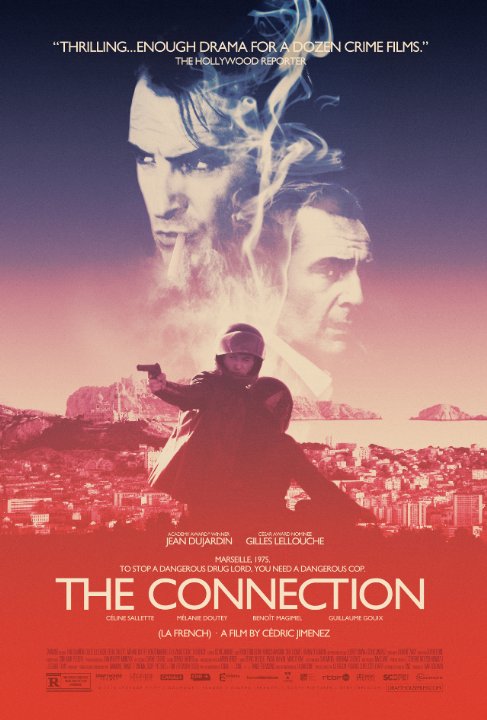
MV5BNzY2MjcxOTA4Nl5BMl5BanBnXkFtZTgwNjAwOTYwNTE@._V1_SX640_SY720_and so anyway it turns out that the best thing about the French crime epic The Connection (2014) is not that after days spent jokingly calling it the French Connection you sit down to watch it and it turns out to be about the Marseille end of the investigation into the French ‘connection’ of The French Connection (Friedkin 1971) – indeed, its French title turns out to be La French – nor is it the stunning ability of a 135-minute film to have about 133 minutes of middle, no, the very best thing about The Connection is that by awarding Jean Dujardin – who you may know from The Artist (Hazanavicius 2011) and the OSS 117 films (Hazanavicius 2006, 2009) – such amazing 70s sideburns it manages to demonstrate my long-standing conviction of just how brilliant Leonard Rossiter would have been as Wolverine…

On W.E.B. Du Bois’s ‘The Princess Steel’ – his newly discovered sf/fantasy story

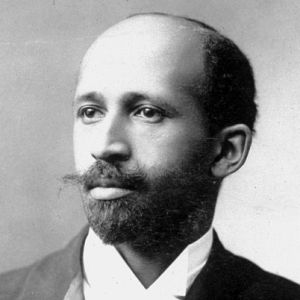
MTE5NTU2MzE2MjA2MDQwNTg3‘The Princess Steel’, a previously unpublished sf/fantasy story by W.E.B. Du Bois, can be found in the most recent issue of the PMLA (130.3: 819-829). It was written some time between 1908 and 1910, and there is an earlier draft called ‘The Megascope: A Tale of Tales’.

The earlier title acknowledges Du Bois’s self-conscious embedding of one tale within another within another. It also shows a clear sense of how the introduction of a science-fictional innovation (not really what Suvin means by the novum) functions as a narratological device to generate fictions. The Megascope shifts the story from one genre/diegesis into another and then into another – or, perhaps more accurately, revises the reader’s expectations of the story as it rewrites the rules of the world in which the story takes place.

‘The Princess Steel’ begins as an apparently realist story in contemporary New York, told with a certain wry humour, as the unnamed protagonist and his wife, in response to a newspaper advertisement, go to witness a scientific demonstration by the sociologist Professor Hannibal Johnson:

Now my wife and I were interested in Sociology; we had studied together at Chicago, so diligently indeed that we had just married and were spending our honeymoon in New York. … it certainly seemed very opportune to hear almost immediately upon our arrival of a great lecturer in Sociology albeit his name, to our chagrin, was new to us. (822)

To their even greater chagrin, Johnson is black (and initially they assume he must be the Professor’s servant). On reflection, however,

One would not for a moment have hesitated to call him a gentleman had it not been for his color. His voice, his manner, everything showed training and refinement. Naturally my wife stiffened and drew back and yet she felt me smiling and hated to acknowledge the failure of our expedition. (822)

This is an intriguing passage in that it is also the one at which we realise that the newly-weds are white. Their studies provide a clue to the likelihood of this, but it is only their assertion of the colour line that definitively places them on one side of it. By making it manifest in this way, Du Bois prepares the ground for a story that will use fantasy so as to imagine some of the determining forces of everyday life that many varieties of realism and naturalism, with their emphasis on surface detail, interpersonal relations and individual psychology, struggle to capture. Like naturalist Frank Norris’s incomplete trilogy of wheat (The Octopus (1901), The Pit (1903)), Du Bois’s first novel, The Quest of the Silver Fleece (1911), is an epic that attempts to map out the complex social relations of a single industry (for Du Bois, cotton); but even Norris, especially in his first novel, bows under the weight of the task and includes weirdly ecstatic visions, as if the real were too complex for mere realism. In this context, one cannot help but also recall the fantastical spirit that imbues Du Bois’s second novel, The Dark Princess (1928), especially when it draws closest to heavy industry in the stunning passage when protagonist Matthew Towns chucks it all in to become a manual labourer digging the subway tunnels:

Lakes and rivers flow … pouring from the hills down to the kitchen sinks with steady pulse beneath the iron street [and] great steel Genii, a hundred feet high, lumber blindly along at out neck and call to dig, lift, talk, push, weep, and swear [and us] houses sag, stagger, and reel … but …do not fall: we hold them, force them and prop them up [even as we] tak[e] away the foundations of the city and leav[e] it delicately swaying on air. (265, 266).

In ‘The Princess Steel’, however, Du Bois approaches the problem from the other side. His broadly realistic opening is just a frame for an exercise in the fantastic, using sf to access the allegorical as a means to draw out the unseen determinants of an exploitative patriarchal-colonial-capitalist modernity and contemporary social life.

Johnson’s library contains volume upon volume of The Great Chronicle – a record he discovered a quarter century earlier of the ‘everyday facts of life but kept with surprising accuracy by a Silent Brotherhood for 200 years’ (823). We learn no more about this surveillant order – perhaps for Du Bois an imaginative precursor to The Dark Princess’s secretive revolutionary Great Central Committee of Yellow, Brown and Black – but their copious records have enabled Johnson to develop the Megascope.

Rather than plunge into directly into allegory or deploy the kind of slippery kind transition into an alternative realm deployed in A Connecticut Yankee in King Arthur’s Court (1889) – I am insufficiently familiar with Du Bois’s biography to know whether he had read Mark Twain’s novel, but it does seem to me to lurk in the background of what is to come – Du Bois turns to scientific innovation, the very stuff of modernity, to investigate modernity. (Foucault scholars will be excited to learn that Du Bois begins with technologies of statistics and surveillance; Hegelians will have to wait a few moments longer for their fix.)

Professor Johnson first shows his visitors a mechanism by which a human deed can be represented in two dimensions on a ‘thin transparent film’ (823). Layering such films one on top of another produces a representation of the ‘history of these deeds in days and months and years’ (823) and, he explains, if

“these planes be curved about one center and reflected to and fro we get a curve of infinite curvings which is—”—he paused impressively—“which is the Law of Life.” (823)

He next reveals the ‘vast solid crystal globe’, ‘fifty feet in diameter’, on which he has spent twenty years plotting the curves of life; and for twenty years he has been thwarted in his quest for the ‘Great Curve … by curious counter-curves and shadow and crossing’ (823). This endless frustration has led him to hypothesise that

Human life is not alone on earth—there is an Over-life—nay—nay I mean nothing metaphysical or theological—I mean a social Over-life—a life of Over-men, Super men, not merely Captains of Industry but field marshalls of the Zeit-geist, who today are guiding the world events and dominating the lives of men. It is a Life so near ourselves that we think it is ourselves, and yet so vast that we vaguely identify it with the universe. (823)

And so he reveals the Megascope, with which he will reveal an Over-Man. First they see

the Curve of Steel—the sum of all the facts and quantities and times and lives that go to make Steel, that skeleton of the Modern World … the Spirit of the wonderful metal which is the center of our modern life, and the inner life of the Over-life that dominates this vast industry— (824)

I love this slightly awkward description of imaginary technology. It beautifully captures the extent to which all language – including and perhaps especially scientific language, for all its pretensions otherwise – is inherently and unavoidably metaphorical. Du Bois transition from more or less mundane descriptions of physical objects

with one more swinging of the lever there swept down before the window a great tube, like a great golden trumpet with the flare toward us and the mouth-piece pointed toward the glit[t]ering sphere; laced round it ran silken cords like coiled electric wire ending in handles, globes and collar like appendages (824)

to the heightened and elusive description of their purpose introduces an ineffable tone that eases the next generic switch.

The great tube’s window displays a vision of New York that transforms before the viewers. The landscape becoming apocalyptically fantastical as the view rushes towards Pittsburg, where steel mills rise like cyclopean castles or ‘the Mills of the Gods’ and between them move obscure and terrifying Things – the ‘Things of this New World, the World of Steel’ (824).

A giant knight emerges. He is the Lord of the Golden Way, a disembodied Voice explains, and then tells in some detail a cod-epic story – part medieval romance, part allegory. (It is only loosely allegorical – there is not the direct one-to-one correspondence between manifest and latent content insisted upon by allegory proper, so it might be more accurate to think of it as a symbolic story, but only so long as you then don’t fall into the trap of expecting each symbol to directly correspond to one specific symbolised thing in a clearly delineated overarching scheme (because that would be allegory proper, horribly reductive and maddeningly dull).)

The Over-Man Sir Guess of Londonton captures the Witch Knowal – the wife of the ogre Evilhood – and she tells him of ‘the dark Queen of the Iron Isles—she that of old came out of Africa’ (825) and who is held captive in the Pits of Pittsburg, along with her enchanted daughter, Princess Steel, fathered by the Sun-God . The Lord of the Golden Way agrees to help Guess rescue the Princess Steel from her enchantment in exchange for her treasure. This leads to inevitable conflict. Guess promptly falls in love with the freed Princess, but the Lord realises her treasure resides in her body:

her hair is silver and her eyes are golden, and … mayhap there be jewels crusted on her heart. (828)

Guess is defeated, and as the Princess watches over her fallen lover, the Lord of the Golden Way begins to spin strands of her hair, which is the steel upon which the modern world is built. The San Franciso and Valparaiso earthquakes of 1906 are signs of her rage at the Lord of the Golden Way and she warns him

I watch and ward above my sleeping Lord till he awake and then woe World! when I shake my curls a-loose. (829)

On this note – presaging the dire consequences of industrial modernity, of capitalist and colonial and gendered exploitation, which include the violent overthrow of such a world – the vision ends.

The wife has seen none of this because, a little troublingly, the megascope ‘was not tuned delicately enough for her’ (829). (Even in The Dark Princess, Du Bois tends to push Princess Kautilya, one of the key members of the revolutionary Committee, into domestic roles.)

The couple make a hasty exit.

In the PMLA, ‘The Princess Steel’ is introduced by Britt Rusert and Adrienne Brown, who are currently co-editing a collection of Du Bois’s sf, fantasy, mystery and crime fiction. The story is locked behind the journal’s pay-wall – but there are bound to be people out there whose universities have institutional access.

Tusk (Kevin Smith 2014)

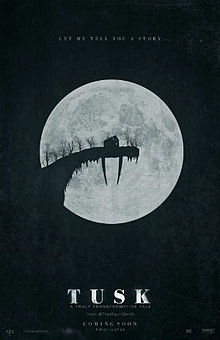
Tusk_(2014_film)_posterand so anyway it turns out that the best thing about Tusk (2014), a film in which an erstwhile mariner turned mad surgeon/serial killer abducts asshole shock-podcaster Justin Long in order to transform him into a walrus fit for gladiatorial combat, is not the spot-on depiction of Canadians in all their native variety, but that moment (and every subsequent moment) that comes several tens of minutes into the film when you go from staring at the screen wondering what you are staring at to staring at the screen wondering whether you are staring at the most expensive movie Frank Henenlotter never made or at a god’s-honest-truth work of genius such as has never actually been made by Wes Anderson…

In Defence of Uncles Dancing Badly at Weddings

He has always been there, out on the dance floor. Middle-aged, a little paunchy, should certainly know better. Grooving to a music no one else can hear. A music that was ancient before even vinyl. A music of weirdly shifting tonic scales, inconsistent rhythms and unmotivated changes of tempo that your non-uncle ears are denied. You get the DJ’s set list; he breaks on through to the other side.

The uncle used to pass through the world, performing his offices, confident that each moment of strut, each tendon-cracking disco move, each bump and every grind would be erased through the strange counter-mnemonic alchemy of nocturnal celebration. He could hand-jive with impunity, and twist with no fear of anachronism. He could even do that hands-on-hips/alternating shoulder-dips thing that he vaguely remembered Suzy Quatro doing.

Cameras changed all that. And the rise of video, coinciding with the decline of the mother-in-law joke, gave him new prominence as a stock character in mediocre observational humour.

In the digital era, he is pinned and mounted like some rare and lurid bug for all to see. A gif that keeps on giving.

But he is the uncle of the bride. And so he dances. Badly. Because it is a duty. Because it serves a higher purpose. And because he loves her.

There are Ancient Ones to be propitiated. His near-shamanic-trance moves, the product of too much champagne and an excess of white-boy funk, lullaby them back into their ages-long slumber.

He invents tipsy-core. (It’s a pun, and not a good one – keep up!)

He pogos. To Dolly Parton.

He timewarps.

He dances on. He passes through the veil. Transmutes. No longer the jowly, ungracefully balding fifth Baldwin brother, he becomes a whip-thin young Jagger, a snake-hipped James Brown.

He waves his hands in the air like he don’t care.

He stays out there dancing when the track changes, when the DJ slips from music of black origin to music that is too obviously black. That way, with him out there, it does not look like a race thing. You think you are dying of embarrassment? The uncle dancing badly dies of shame for your sins.

But even he draws the line at Whigfield.

Another day, another dollar

imagesA route through the maze was not something he could intuit. Of that he was certain.

The skinny shadows told him it was around about noon. He stopped at a corner, nestled into the angle between the walls. They were grey, fifteen, maybe twenty, feet high and uniform apart from their roughly textured surface.

From where he sat, he could see for dozens of feet in each direction. A clear field of fire. If he had a gun. And the ego, or malice, it took to use one.

He could not put his faith in chance. It was appealing, to take a random turn here, another there. To press on. To cover ground. But the odds against it working were so great that he could not calculate them.

His water supply was running low. He had no food, but was not hungry anyway. He could not figure out why that was. All of his appetites had dissolved. He had to force himself to drink. Swallowing was hard. His throat felt bruised.

There was not an ounce of energy left in his limbs, but he rose to his feet, a little unsteadily.

If he could rise further, rise like Icarus, even momentarily, and look down from above to see how far it stretched. Whether he was closer to one of the outer walls than the others. What lay beyond.

He started to walk. That was what he did. It was what he always did.

If he stayed in one place, he could keep better track of the passage of time. Mark it off, day by day, in prison-house scratches. Four vertical, one diagonal. Over and over again. But instead he kept moving. With some kind of systematicity, he told himself, though he might have been lying.

Movement, he thought, the orderly passage through space over time, proved it wasn’t all the same.

Intermittently, he left markings on the walls. Glyphs and sigils. Doodles. Not to mark a route he might one day want to retrace, but to force a sense of difference on the walls that enclosed him. To make change seem real. To construct a lie of progress.

But a realisation had been growing slowly inside him. Metastasising, and with it an awful dread.

There was no way out.

It was not a maze at all.

It was a fucking allegory.

The City in Fiction and Film, week 10: The Secret Agent, part two

41Pi137AB+L._SY344_BO1,204,203,200_

week 9

This week we continued with Conrad’s novel, and also took a look at Hitchcock’s adaptation of it as Sabotage (Hitchcock UK 1936). Our first step was to pick up on a reading exercise left over from last week: in what ways and to what extent do the Professor’s views of society/life (54-6) differ from or coincide with those of Inspector Heat (73-74) and the Assistant Commissioner (82)? [All page references to the current Penguin edition.]

The Professor imagines a world governed by social convention, from which he has separated himself because he is superior to the mass of humankind. To him, society is ‘a complex organised fact’ which orders their lives – even the lives of policemen and anarchists/terrorists, who are similarly bound by it. He describes how Chief Inspector Heat has always to worry about countless things – his bosses, reputation, legal process, being paid, publicity – whereas he himself is capable of focusing on just one thing: building the perfect detonator. He is misanthropic, and has cut himself off from others and, as far as he can, from the needs of his own body.

Heat recognises this social order – he understands thieves. They, like other workers, labour, choosing to risk imprisonment rather than to risk the ‘ankylosis, or lead-poisoning, or fire-damp, or gritty dust’ that come with working ‘in potteries, in coal mines, in fields, in too-grinding shops’ (73). There is a certain honesty to their dishonesty. They are subject to the same morality as him, to the same conventions and demands: ‘Products of the same machine, one classed as useful and the other as noxious, they take the machine for granted in different ways but with a seriousness essentially the same’ (74).

The Assistant Commissioner, who misses the active life of being a copper in the tropics, is discontented with his job (he does not like sitting behind a desk, or having to rely on the underlings he manages) and with his life (his wife, who is from a higher class, insisted on living in Britain). Each night, on the way home, he plays whist at his club with the same three acquaintances, none of whom really know each other – they are ‘co-sufferers’, plagued by the indistinct ‘secret ills of existence’ (82). The club, the game, is a safe haven, a semblance of friendship.

All three accept the existence of a less than satisfactory social order: the Professor would destroy it; Heat is content with it, as long as everyone stays in their assigned place and plays their ascribed role; the Assistant Commissioner does his duty in preserving it, regardless of personal feelings. This is the universe that that iron knitting machine knits without pause or consideration.

Stephen Bernstein’s ‘Politics, Modernity and Domesticity: The Gothicism of Conrad’s The Secret Agent‘ describes the novel in terms of its ‘gothic paranoia and ‘the omnipresence of gothic gloom’’: ‘Everything is ghostly, haunted’ (286) and ‘haunting … is a condition of existence’ rather than merely an isolated location or single individual (287). With this in mind, we looked for gothic imagery of: death, burial, gloom, misery, impoverishment, ill-health, sleepwalking, funerals, existential despair (and clocks).

Verloc’s house is ‘in a shady street behind a shop where the sun never shone’ (205), where the ‘dull brown shelves’ of ‘shady wares’ seem to ‘devour the sheen of the light’ (169). It is in a street where the distant cries of newspaperboys ‘expired between the dirty brick walls without reaching the threshold of the shop’ (162) – indeed, in the ‘darkness and solitude of Brett Street … all sounds of life seemed lost as if in a triangular well of asphalt and bricks, of blind houses and unfeeling stones’ (219). Winnie, when courting another, had imagined marriage as ‘a voyage down the sparkling stream of life’ (191); but when circumstances prompted her to marry Verloc in stead, she found ‘there was no sparkle of any kind of the lazy stream of his life’ , and ‘domestic feeling’ turns out to be ‘stagnant and deep like a placid pool’ (193). Verloc, after Stevie’s death, longs for prison, which ‘was a place as safe from certain unlawful vengeances as the grave’ (186), while Ossipon, on the run with Winnie, curses ‘insular Britain’, which might as well be a prison.


Or we could take Winnie as a key example of the range of deathly imagery applied to characters. When Verloc fails to comprehend the extent of her grief over Stevie, her heart ‘hardened and chilled into a lump of ice’ and ‘her features [set] into a frozen contemplative immobility addressed to a whitewashed wall with no writing on it’ (191). The next page recalls her traumatic childhood, in which she had to protect her younger brother from being beaten by their drunken father, a broken brute of a man. Haunted by these memories, she ‘heard [his] words again in a ghostly fashion’ (192). When she replies to Verloc, ‘it was as if a corpse had spoken’ (196). When she has put on a hat and veil to go out, he complains that it is impossible to ‘tell whether one is talking to a dummy or to a live woman’ (203). She even becomes an inanimate object in a suddenly abstract scientific space:

The veiled sound filled the small room with its moderate volume, well adapted to the modest nature of the wish. The waves of air of the proper length, propagated in accordance with correct mathematical formulas, flowed around all the inanimate things in the room, lapped against Mrs Verloc’s head as if it had been a head of stone. (206)

She looks at the clock ‘mechanically’ (212) – some time earlier, Verloc was described as an automaton:

Mr Verloc obeyed woodenly, stony-eyed, and like an automaton whose face had been painted red. And this resemblance to a mechanical figure went so far that he had an automaton’s absurd air of being aware of the machinery in side of him. (156)

Fleeing the house, terrified of being executed and thus intent on making her way to the Thames to commit suicide, Winnie finds, ironically, that ‘The fear of death paralysed her efforts to escape the gallows’ (214):

She was the most lonely of murderers that ever struck a mortal blow. She was alone in London: and the whole town of marvels and mud, with its maze of streets and its mass of lights, was sunk in a hopeless night, rested at the bottom of a black abyss form which no unaided woman could hope to scramble out. (214)

When Ossipon becomes embroiled in her escape attempt, he takes on the appearance of his own death mask – ‘with a face like a fresh plaster cast of himself after a wasting illness’ (232) – while she becomes like death: ‘all black – black as commonplace death itself, crowned with a few cheap and pale flowers’ (234), and when she lifts her veil, ‘out of [her adamant] face the eyes looked on, big, dry, enlarged, lightless, burnt out like two black holes in the white, shining globes’ (235). Ossipon, who is looking to justify robbing and abandoning her, suddenly see her resemblance to Stevie and, recalling Lombroso’s ‘criminal anthropology’,  begins to catalogue her degenerate features. He thus traps her once more in a system beyond her control – like marriage and family and money and class.

Against the broad backdrop of gothic paranoia found in such examples, we turned to chapter eight. The careful reader will have guess already that Stevie died in the explosion, but as chapter eight starts, he seems to be alive and well.

I remember when I first read The Secret Agent (I would have been maybe fifteen, and had already read Heart of Darkness (1899) to try to figure out  Apocalypse Now (Coppola US 1979), which I had sneaked into the cinema to see, and not understand, when I was 11, on the same day that I saw Star Trek: The Motionless Picture (Wise US 1979). Ah! my precocious and misspent youth!). I was absolutely caught up by the suspense of wondering whether it was indeed Stevie killed in the bomb blast, and then was completely thrown by chapter eight and most of chapter nine, which do not signal that they are set in between Verloc’s meeting with Vladimir and the bombing. For the longest time I hated those chapters – it felt like Conrad was cheating, just like the bit with the doorbell at the end of The Silence of the Lambs (Demme US 1991) – but now I see them rather differently. Yes, on one level, it remains a cheap trick; but it also effectively extends that pervading sense of death-in-life as Stevie is consigned, like Schrodinger’s cat, to a limbo existence, hovering between life and death. And chapter eight in particular is fabulously rich in conveying Conrad’s gloomy entombing London populated with grotesques.

The hackney carriage driver is ‘maimed’, his left hand replaced with an iron hook; his giant ruddy face, ‘bloated and sodden’ (125), almost lights up the ‘muddy stretch of … street’ (124). He is stubbly, dirty, with ‘little red eyes’ and ‘big lips’ that have a ‘violet tint’ (126). His intellect has ‘lost its pristine vivacity in the benumbing years of sedentary exposure to the weather’ (126). His horse is ‘infirm’ (124) and emaciated, its ‘ribs and backbone’ visible (132). The carriage itself is not much better (124). The streets through which he drives Winnie and her mother are so narrow that they can look in the passing windows, which shake and rattle as the carriage goes past, sounding as if they might collapse. Jammed ‘close to the curbstone’, their ‘progress’ is insignificant (126).

When Stevie jumps down from the box to lighten the horse’s burden, Winnie is as ‘white as a ghost’ (125) – later, Verloc will look at her ‘as though she had been a phantom’ (139) – but under the gaslights of the ‘early dirty night’ (126), her cheeks take on an orange hue (127). Her mother’s naturally bilious ‘predisposition’ gives her a yellow complexion – only blushing might turn her cheeks orange (127). The almshouse to which she is moving – barren, unfurnished, just ‘bare planks and cheaply papered bricks’ (123) – has such narrow dimensions that it ‘might well have been devised in kindness as a place of training for the still more straitened circumstances of the grave’ (127).

In ‘the seclusion of the back bedroom’ of Verloc’s house, she had ‘reflected stoically that everything decays, wears out, in this world’ (128); she know she will die soon, and so she must ensure Stevie’ s future by abandoning him prematurely, and this decision – to move south of the river! – seems to be at one with the entropic decline of the cosmos. Later, it will be noted that ‘it may be said that [,] having parted for good from her children [she] had also departed this life’ (135) – and she certainly departs the novel, returning only as a memory, someone who must be told of Stevie’s death yet who seems to Winnie to be so far distant as to be utterly inaccessible.

The cab meanwhile rattles on, jolting so violently as to obliterate ‘every sensation of onward movement’ and create the impression of ‘being shaken in a stationary apparatus like a medieval device for the punishment of crime or’ – and this is a brilliant, deflationary touch, ‘some very new-fangled invention for the cure of a sluggish liver’ (129). A similar ironic tone – evident throughout the novel – can be seen when the cabman examines his payment:

pieces of silver, which, appearing very minute in his big, grimy palm, symbolised the insignificant results which reward the ambitious courage and toil of a mankind whose day is short on this earth of evil. … he talked to Stevie of domestic matters and the affairs of men whose sufferings are great and immortality by no means assured. … A silence reigned, during which the flanks of the old horse, the steed of apocalyptic misery, smoked upwards in the light of the charitable gas-lamp. (131, 132, 132-3)

The continual disjunction between epic phrasing and commonplace life seems simultaneously to say that people should matter this much and clearly do not, and that such illusions might make life bearable, but they are nonetheless illusions.

(This ironic disjuncture exposes the hypocrisy and cant of those who chatter about the ‘dignity of labour’ and ‘heavenly rewards’ by drawing attention to the meagreness of lives here and now and the constraints under which they are lived. Part of me admires that the apolitical Conrad, who believes there is no possible solution to the exigencies of life in a godless universe, never looks for one, and that he refuses to offer any platitudes; but on the other hand, it also frees him from the responsibility of trying to find temporary and partial solutions to real suffering, which kind of annoys me. In this context, Stevie becomes the kind of model liberal subject, incoherently moved to pity and incomprehension – all ‘sensations’ (133), ‘immoderate compassion’ and ‘innocent but pitiless rage’ (134), he cannot comprehend that it is not somehow the job of the police to right such wrongs, but rather in Winnie’s words to ensure ‘that them as have nothing shouldn’t take anything away from them who have’ (138). This is undoubtedly one of those things that, she profoundly feels, ‘do not stand much looking into’ (141). The irony will escalate in the closing chapters of the novel as Conrad gives us insight first into Verloc and Winnie, as their mutual incomprehension grows, and then Winnie and Ossipon, as they talk at cross-purposes, neither perceiving the other, just imputing motives to them.)

The departing cab seems

cast out into the gutter on account of irremediable decay. … Its aspect was so profoundly lamentable, with such a perfection of grotesque misery and weirdness of macabre detail, as it if were the Cab of Death. (135-6)

After Winnie and Stevie return home, the pensive Verloc goes for an aimless walk, leading ‘a cortège of dismal thoughts along dark streets’ (141). On returning home, he stares at Winnie with ‘a somnambulistic, expressionless gaze’ (141) – perhaps like that of Cesar, who we saw in a clip from The Cabinet of Dr Caligari a few weeks ago; later, Inspector Heat will also be described as a ‘somnambulist’ (176). Verloc thinks of his mother-in-law in terms of ‘rats leaving a doomed ship’ (141), and then undresses

with the unnoticing inward concentration of a man undressing in the solitude of a vast and hopeless desert. For thus inhospitably did this fair earth, our common inheritance, present itself to the mental vision of Mr Verloc. All was so still without and within that the lonely ticking of the clock on the landing stole into the room as if for the sake of company. (142)

Conrad moves from sarcastic commentary on Verloc’s melodramatic self-presentation of his situation to the delightful image of the animated ticking of the clock – that would not be out of place in either a Fleischer cartoon or a volume of Marx (who often animates inanimate objects in their relation to human life). The clock will become a recurring image in the later stages of the novel – just a couple of pages later, Winnie will ‘let the lonely clock on the landing count of fifteen ticks into the abyss of eternity’ (144) before responding to her husband, and a couple more pages later we will learn of Stevie’s discomposing habit of sitting in the dark at its foot (147). In Winnie’s dullness after killing Verloc she will be puzzled by the ticking of another clock, one that does not actually tick, and then slowly realise it is the sound of his blood running out (209, 210). She will look at the clock again, assuming it must have stopped since time is passing much more slowly than she thought (212); and she will fear it, half-believing that ‘clocks and watches always stopped at the moment of murder for the undoing of the murderer’ (213). (We have already seen the importance of clock imagery to Fritz Lang’s vision of the modern city in both M and Metropolis.)

In closing, we briefly considered the differences between Hitchcock’s Sabotage and Conrad’s novel, noting among other things how Hitchcock of seems to take small items of inspiration. When the Assistant Commissioner leaves his office, ‘his descent into the street was like a descent into a slimy aquarium’ (117); in the film, Verloc meets his paymaster in the subterranean aquarium at Regent’s Park Zoo. When Hitchcock seems to play up Oscar Homolka’s resemblance to Bela Lugosi, this might also be based on vaguely vampiric imagery in the novel – the comparison of Verloc arriving back from the continent like the influenza (Dracula as a European infection), and the revelation that Ossipon basically conducts his business by night to sleep during the day, and so on. The aquarium, of course, also plays into Hitchcock’s imagery of caged birds and animals – exemplifying gothic entrapment, the snare of circumstances.

Hitchcock also has a rather different, if also black, sense of humour. He shows up the absurdities of common people through attention to the details of mundane life, whereas Conrad’s ironic distancing from his characters often seems like sarcastic mockery of their aspirations and illusions.

week 11

Recommended critical reading – see week 9
Recommended reading – see week 9
Recommended viewing – see week 9

The City in Fiction and Film, week 9: The Secret Agent, part one

41Pi137AB+L._SY344_BO1,204,203,200_week 8

We started this week with the material on the Situationists and the dérive that we did not have time to cover last week, before turning to the first half of Joseph Conrad’s The Secret Agent (1907) – which to be honest I was a little anxious about, given the events in Beirut and Paris last weekend – and a very quick discussion of The Third Man (Carol Reed UK 1949), which we watched in the morning.

The Situationist International (SI) was a group of primarily Paris-based anti-Stalinist Marxists influenced by Dada and Surrealism, which existed from 1957-1972. Their key theoretical activity was to develop Marx’s ideas on alienation and commodity fetishism, broadly arguing that capitalism had become so extensive and intensive that life was no longer experienced directly but through commodities; and that it was necessary to find ways to shatter the commodified spectacle of everyday life. They brilliantly and correctly called for automation to be developed not so as to maximise profit but so as to liberate everyone into lives of freedom and leisure and creativity. And of greater relevance here, they developed a number of theorised practices or ways of critically intervening in the city, including détournement – turning the spectacle against itself through pranks, culture jamming, reality hacks – and such psychogeographical experiments as the dérive.

Differing from the journey (which has a clear destination) and the stroll (which is typically aimless), the dérive is concerned with movement through urban space with a kind of double-consciousness. On the one hand, it is about allowing the ‘attractions of the terrain and the encounters’ found there to organise your movement and experience of the varying ambiances of the city space. On the other hand, it requires a conscious attention to the effects this drifting and these shifting environments have on you. The dérive is both planned – you know your starting point, who your companions (if any) might be, you do not have a specific destination but you do have a broad aim – and unplanned, since you cannot know in advance precisely where your feet will be drawn and who/what you might meet. It can seem random, but the structures of the city also play a determining role, deliberately and accidentally guiding you through its ‘constant currents, fixed points and vortexes’ – physical routes and barriers, but also psychological ones. (It is instructive that Abdelhafid Khattib, the Algerian Arab who was part of the SI and one of the early psychogeographical experimenters was arrested by the police for activities his white French colleagues could undertake unchallenged.)

Returning briefly to Cleo from 5 to 7, we could see ways in which Cleo – who last week we considered as a potential flâneuse – might be thought of as underaking a dérive, more obviously in the second half of the film when an overheard conversation in a café reminds her of her friend, the model Dorothée, which leads her through different aspects of and locations in Paris and various unanticipated encounters. (We will return to some of these issues in a couple of weeks when we focus on Ladri di biciclette/Bicycle Thieves (De Sica Italy 1948).)

But this was obviously the point to clumsily segue into a brief introduction to Joseph Conrad, sketching in some biography, his early association with Impressionism (see the preface to The Nigger of the Narcissus (1897)), his omnivorous  consumption and reworking of raw materials (autobiography, people he met, fiction he read – which lead to charges of plagiarism in Poland –  and real news events – including the French anarchist Martial Bourdin’s presumed attempt to blow up the Greenwich observatory on 15 February 1894, which inspired The Secret Agent).

Conrad is typically considered one of the first British modernist novelists, particularly in regard to his ironic style and the sense of scepticism, melancholy, pessimism, constraint and doom that looms over his fiction (putting him somewhere between Dostoevsky and Kafka).

To help establish this mood or tone, we took a look at this fabulous passage in a letter he wrote to Cunninghame Graham in December 1897 (if I was the kind of person who sent out a family newsletter with Xmas cards, I would be tempted to adopt this). Conrad says that the universe

evolved itself (I am severely scientific) out of a chaos of scraps of iron and behold! – it knits. I am horrified at the horrible work and stand appalled. I feel it ought to embroider – but it goes on knitting. You come and say: “this is all right; it’s only a question of the right kind of oil. Let us use this – for instance – celestial oil and the machine shall embroider a most beautiful design in purple and gold.” Will it? Alas no. You cannot by any special lubrication make embroidery with a knitting machine. And the most withering thought is that the infamous thing has made itself; made itself without thought, without conscience, without foresight, without eyes, without heart. It is a tragic accident –and it has happened. You can’t interfere with it. The last drop of bitterness is in the suspicion that you can’t even smash it. … it is what it is  – and it is indestructible!

It knits us in and it knits us out. It has knitted time space, pain, death, corruption, despair and all the illusions  – and nothing matters.

(Which always makes me think of The Clangers – and of that moment of sheer existential terror when the fabric of the universe rips apart in that episode of Button Moon. (I am so street! I am so down with the kids!))

In Conrad’s own description of the origins of the novel he describes how

the vision of an enormous town presented itself, of a monstrous town more populous than some continents and in its man-made might as indifferent to heaven’s frowns and smiles; a cruel devourer of the world’s light. There was enough room there to place any story, depth enough there for any passion, variety enough there for any setting, darkness enough to bury five millions of lives.

And our treatment of the city in the novel will largely focus on this depiction of London as a monstrous, indifferent and cruel place; as a dark grave in which its inhabitants are buried; as an exemplar of modern anonymity; as claustral and carceral; as somewhere that blurs the distinction between home and work; as an amoral structure inhabited by spectral, untethered characters trapped in death-in-life existences; as a place of darkness, secrecy, mechanisation, hierarchy and control.

[Page references are to the current Penguin Classics edition.]

The first passage we looked at, though, was the one in which Mr Vladimir outlines his rationale for targeting the Greenwich Observatory in the faked anarchist bomb outrage. He begins by dismissing the assassination of a head of state, because such actions are now so commonplace that they are no longer spectacular enough. Attacking churches would just muddy the waters with claims that such attacks are religiously motivated; attacking a theatre or restaurant would be passed off as a ‘non-political passion: the exasperation of a hungry man, an act of social revenge’ (26). Of the latter two options, Vladimir notes – with a timeliness the students also noted – that ‘every newspaper has ready-made phrases to explain such manifestations away’ (26).

Instead, Vladimir favours an attack that defies such easy narrativisation – it must be something so irrational-seeming as to defy our capacity to explain it away. You could attack art – plant a bomb in the National Gallery – but the only people who would cause a fuss would be ‘artists – art critics and such like – people of no account’ (26). But if you could find a way to attack science – ‘any imbecile with an income believes in that. … They believe that in some mysterious way science is at the source of their material prosperity’ (26-7). And if you could find away to attack the purest, most abstract-seeming of science – ‘if one could throw a bomb into pure mathematics’ (27) – it would be so ‘incomprehensible, inexplicable, almost unthinkable’ as to be ‘truly terrifying’ (27).

Attacking the Greenwich Observatory is not just an attack on astronomy, the next best option after maths, but also on the global order. It is an attack on the Greenwich meridian, on the military and commercial imperial web imposed upon the world. It is an attack on the seat of power.

And it is a plan conceived from the lofty view, the god’s-eye perspective, we discussed last week in relation to the de Certeau observing New York from the top of the World Trade Centre. The remainder of Conrad’s novel is set down on street level, in the grubby poetry written by his characters transiting through, and pausing to rest in, the city.

Next we took a look at the way in which Conrad depicts the anarchists: the fat, pasty, wheezing, resigned martyr, Michaelis; the grim, giggling, toothless, balding, goateed, dry-throated, deformed-handed, malevolent-eyed Karl Yundt, whose ‘worn-out passion’ resembles ‘in its impotent fierceness the excitement of a senile sensualist’ (34); and the ethnically ambiguous Comrade Ossipon, who has a ‘flattened nose and prominent mouth cast in the rough mould of the negro type’ and ‘almond-shaped eyes’ that leer ‘languidly’ (35).

Conrad’s descriptions draw upon cultural codes, familiar from popular fiction, yellow journalism and elsewhere, to construct images of unsavouriness and thus to link physical appearance to morality. This is not restricted to the anarchists; later, he describes Sir Ethelred, the government minister, in similarly grotesque terms. Indeed, most – if not all – of the characters in the novel are grotesques. They are the undead adrift in the city, trapped and deformed (physically and morally) by it.

At the end of the section in chapter 3 when the anarchists are described, Ossipon finds the idiot-boy Stevie obsessively drawing, as is his wont, circles. Alluding to Lombroso’s pseudo-science of ‘criminal anthropology’, Ossipon describes young Stevie as a perfect example of degeneracy. Verloc seems sceptical.

It is a curious moment. Conrad seems to be declaring that it is erroneous to make categorical judgments based on appearances even as he relies on his readers doing precisely that. Characters are trapped by their appearances into playing certain roles, just as the city entraps them, constraining and channelling them, serving them up to their fates.

We will return to the novel next week.

In closing, we had a very few minutes to talk about The Third Man. It is set in post-war Vienna, a city which was divided until 1955 into four zones, each governed by a different Allied nation (UK, US, France, USSR), with the international zone in the centre governed by all four powers. As with The Secret Agent, it makes apparent the complex governance structures of a particular which, as in M, is doubled by an underground that seeks to evade those overlapping, panoptical administrative structures. These representations can also help us begin to see the structuration of all cities.

Looking backward, the famous scene on top of the Ferris wheel, in which Harry Lime (Orson Welles) tries to persuade Holly Martins (Joseph Cotten) of the statistical insignificance of individuals so as to justify his own monstrous crimes, recalls the view from atop the World Trade Centre that de Certeau talks about. Looking forward, it is a film set amid the rubble – a Trümmerfilm. It signals the ongoing presence of trauma and the urgent need for reconstruction that we will consider in relation to Bicycle Thieves and Passport to Pimlico (Henry Cornelius UK 1949) before the end of this semester, and which will inform our study of Alphaville (Jean-Luc Godard France/Italy 1965), Le couple témoin/The Model Couple (William Klein 1977) and JG Ballard’s High Rise (1975) next semester.

week 10

Recommended critical reading
Anderegg, Michael A. “Conrad and Hitchcock: The Secret Agent Inspires Sabotage.” Literature/Film Quarterly 3.3 (1975): 215–25.
Bernstein, Stephen. “Politics, Modernity and Domesticity: The Gothicism of Conrad’s The Secret Agent.” CLIO 32.3 (2003): 285–301.
Harrington, Ellen Burton. “The Anarchist’s Wife: Joseph Conrad’s Debt to Sensation Fiction in The Secret Agent.” Conradiana 36.1–2 (2004): 51–63.
Kim, Sung Ryol. “Violence, Irony and Laughter: The Narrator in The Secret Agent.” Conradiana 35.1–2 (2003): 75–97.
Leitch, Thomas. “Murderous Victims in The Secret Agent and Sabotage.” Literature/Film Quarterly 14.1 (1986): 64–8.
Mathews, Cristina. “‘The Manner of Exploding’: Joseph Conrad’s The Secret Agent and Men at Home.” Conradiana 42.3 (2010): 17–44.
Mennel, Barbara. Cities and Cinema. London: Routledge, 2008. See chapter 5, “The City in Ruins and the Divided City: Berlin, Belfast, and Beirut.”
Shaffer, Brian W. “‘The Commerce of Shady Wares’: Politics and Pornography in Conrad’s The Secret Agent.” ELH 62.2 (1995): 443–66.
Sinowitz, Michael. “Graham Greene’s and Carol Reed’s The Third Man.” Modern Fiction Studies 53.3 (2007): 405–33.
Stape, J.H., ed. The Cambridge Companion to Joseph Conrad. Cambridge: Cambridge University Press, 2004.

Recommended reading
Conrad’s Under Western Eyes (1991) is often seen as a companion novel to Secret Agent.
Novels of urban underworlds include Liam O’Flaherty’s The Informer (1925), Graham Greene’s Brighton Rock (1938) and The Third Man (1950), Gerald Kersh’s Night and the City (1938), Nelson Algren’s The Man with the Golden Arm (1949), Margery Allingham’s The Tiger in the Smoke (1952), Alain Robbe-Grillet’s The Erasers (1953) and Hubert Selby, Jr’s Last Exit to Brooklyn (1964).
The criminalisation of sexual dissidence led to an often autobiographical fiction of queer underworlds and marginal urban existence, including James Baldwin’s Giovanni’s Room (1956), John Rechy’s City of Night (1963), Andrew Holleran’s Dancer from the Dance (1978), Larry Kramer’s Faggots (1978), Alan Hollinghhurst’s The Swimming-Pool Library (1988), Leslie Feinberg’s Stone Butch Blues (1993) and Scott Heim’s Mysterious Skin (1995).

Recommended viewing
Conrad’s novel was filmed as Sabotage (Hitchcock 1936), which we will watch next week, and The Secret Agent (Hampton 1996).
Ambiguous underworlds appear in a vast array of films, including The Informer (Ford 1935), Pépé le moko (Duvivier 1937), Brighton Rock (Boulting 1947), The Blue Lamp (Dearden 1950), Night and the City (Dassin 1950), A Generation (Wajda 1955), Canal (Wajda 1957), Ashes and Diamonds (Wajda 1958), À bout de soufflé (Godard 1960), Hell is a City (Guest 1960), The Yards (Gray 2000), We Own the Night (Gray 2007) and Killing Them Softly (Dominik 2012).
Films about marginalised urban sexualities include Midnight Cowboy (Schlesinger 1969), Working Girls (Borden 1986), Paris is Burning (Livingstone 1990), Young Soul Rebels (Julien 1991), The Wedding Banquet (Lee 1993), Exotica (Egoyan 1994), Beautiful Thing (MacDonald 1996), Nowhere (Araki 1997), Fucking Åmål/Show Me Love (Moodysson 1998) and Mysterious Skin (Araki 2004).

High-Rise (Ben Wheatley UK 2015)

highrise2After the varying degrees of self-importance, humourlessness and bloat Spielberg, Cronenberg and Weiss brought to their respective Empires, Crashes and Exhibitions, the very first thing screenwriter Amy Jump and director Ben Wheatley get right with their High-Rise is that Ballard is a comic writer.

A master of the modestly proposed deadpan preposterous, his dry technician’s prose fakes repression, barely concealing the glee with which he drones shock and flattens affect. This is pretty much impossible to reproduce in film. Cronenberg attempted it with Crash, and failed (Shivers got a lot closer, and is still the best version of High Rise that is not actually a version of High Rise).

Jump/Wheatley’s humour is much more their own, and they are sufficiently confident about it to have some fun with Ballard. There is, for example, a nicely played moment when Laing (Tom Hiddlestone) says something to Royal (Jeremy Irons) which is precisely the kind of impossible-thing-for-a-real-person-to-say that a character in a Ballard novel would say, prompting bemusement and discomfort in them both.

The second major thing Jump/Wheatley get right is to not update the setting of the film. Instead, we get a slightly different version of the 1970s, as if the decade went on a little bit longer and somehow became as attractive to look at as it clearly – and mistakenly – thought it was.

But this also reveals a problem with the film as an adaptation (as a Jump/Wheatley film, it is second only to Sightseers).

Ballard’s novel is very specifically about that moment in the early 1970s, when decrying post-war Corbusier-spawned high-rise developments was transforming from merely a fashionable posture to received wisdom (typically and conveniently forgetting that for many people moving from the slums to the new developments was headily utopian – indoor plumbing!). It was written when councils were withdrawing maintenance from post-war housing projects, and their residents were being blamed for the disrepair into which the untended buildings inevitably fell. It was written when working class residents were being demonised as intoxicated, glue-sniffing, violent, criminal – as creatures incapable of not fouling their own nests. It was written when the extent of the corruption behind many housing schemes was being uncovered (as in the John Poulson case, which reached all the way up to Home Secretary Reginald Maudling – you know, like in Our Friends in the North).

And so whether or not Ballard bought into this potent myth, nothing could have seemed more natural than to retell it, but with a cast of middle class professionals, with yuppies avant la lettre. The closing moments of the film do nod to Thatcher, and it is certainly the case that she – conveniently forgetting that many of the worst post-war developments were built by private companies, not by the state or local councils – drew on this myth to drive through her ideological war on council housing, thus creating the ongoing housing crisis in the UK.

But the conditions in which Ballard’s novel was written no longer exists, and the film – despite the way it captures middle-class social sadism – lacks that element of specificity that would provide a vital resonance. Consequently, Ballard, who should be shocking the bourgeosie, is suddenly heritage cinema, and that is just plain wrong.

Probably the most telling moment for me in this regard comes in the sequence when Richard (Luke Evans), slowly making his battered way up the building to exact his revenge, assaults Charlotte (Sienna Miller). A montage, which includes her timidly serving him a tin of dog food for breakfast the next day, plays out to Portishead’s cover version of ABBA’s ‘S.O.S.’. It is a beautiful version, transforming the pop song into a languid, mournful piece of music, as self-consciously ‘serious’ as one would expect from them. And in all kinds of ways it works brilliantly.

But it is completely the wrong choice.

They should have gone with the original version; not because it is better, but because the last thing the film needed was to fall into such clichéd caution. This is not to say that rape, even if only implied rather than depicted, should be treated frivolously; but rather that the film loses something by choosing to treat this particular moment as so very exceptional. At least using ABBA’s version might have been sufficiently inappropriate to shock audiences out of their complacency. But that was never going to happen. Despite all the potentially offensive material the film contains, it also wants to be respectable, and that is budget speaking, not art.

Don’t get me wrong. It’s an enjoyable film, and full of nice little touches, from sets which bring the brutalist concrete inside the apartments to an unexpected nod to Aladdin Sane and some great dancing.

But you know the way The Cabinet of Dr Caligari‘s static camerawork makes it not so much an expressionist film as a film of expressionist sets and performances? So High-Rise is a film of a Ballard novel, not a Ballardian film.

[Thanks to Mark Cosgrove for blagging me into the preview after the ticketing fiasco.]