Xavier de Maistre’s Voyage autour de ma chambre and Expédition nocturne autour de ma chambre

Back in the mists of time, around a decade ago, there was a plan for an ever-expanding online collection of short critical essays on key works of the fantastic. The plan fizzled and died, but not before I wrote nine pieces for it (which I just found). This is another of them.

51FWUCxEkvL._SY344_BO1,204,203,200_Originally published: 1795 and 1825 respectively
Edition used: Xavier de Maistre, A Journey Around My Room and A Nocturnal Expedition Around My Room, translated by Andrew Brown (London: Hesperus 2004)

Confined to his room for 42 days, the narrator undertakes an expedition around it.[i] His closely observed account of its content and disposition wanders off into recollections, fancies, speculations and other digressions. Thirty years later, and without the company of his valet or his dog, he undertakes a similar journey around a different room over the course of a single night.

These two humorous short tales gently mock the conventions of sentimental fiction in a way not dissimilar to Laurence Sterne’s A Sentimental Journey through France and Italy (1768). At the same time, de Maistre’s digressive manner owes something to Sterne’s The Life and Opinions of Tristram Shandy, Gentleman (1759-67) – Voyage not only alludes explicitly to the hobby horse of Tristram’s Uncle Toby, but also has a distinctly Sterne-ian chapter twelve, consisting of a lengthy ellipsis in the middle of which appear the words ‘the mound’ (17).

But what makes de Maistre’s diptych interesting to the scholar of fantasy lies elsewhere.

In Voyage, the narrator offers a pseudo-Cartesian metaphysics in which

man is composed of a soul and a beast. – These two beings are absolutely distinct, but so closely fitted together, or one on top of the other, that the soul must have a certain superiority over the beast to be in a position to draw a distinction between them. (9)

350px-Guillaume_pour_MaistreAs evidence for this dualism, the narrator offers an example that seems to equate the beast with an autonomic, almost machinic, material substratum, and the soul with the imagination (while also offering a provocation to the reader of a book which seems incapable of fastening its attention on anything for very long):

 When you read a book, sir, and a more agreeable idea suddenly strikes on your imagination, your soul straight away pounces on it and forgets the book, while your eyes mechanically follow the words and the lines; you come to the end of the page without understanding it, and without remembering what you have read. – This comes from the fact that your soul, having ordered its companion to read to it, did not warn it of the brief absence on which it was about to embark; as a result, the other continued to read even though your soul was no longer listening. (10)

Why would the explorer and adventurer need to leave his room, if the mere act of being handed a wet sponge with which to wipe clean the portrait of a lover can make his

soul sweep across a hundred million leagues in a single instant. (21)

Or if one can find in fictional worlds a spur to the imagination (51)?

From the expedition of the Argonauts to the Assembly of Notables, from the lowest depths of hell to the last fixed star beyond the Milky Way, to the confines of the universe, to the gates of chaos – this is the vast terrain which I wander across in every direction at leisure; for I do not lack time any more than I lack space. It is here that I transport my existence, on the trail of Homer, Milton, Virgil, Ossian, etc.
All the events that occur between these two eras, all the countries, all the world and all the beings who have lived between these two limits – it is all mine, it all belongs to me just as much and just as legitimately as the vessels that entered the Piraeus belonged to a certain Athenian. (53)

What is refreshing about this advocacy of imaginative indulgence is its absolute lack of moralism. The narrator is clearly something of an amorous adventurer when unconfined, and so when (in chapter 39) his soul berates his beast

‘What!’ said my soul, ‘so that’s how it is: during my absence, instead of restoring your strength by having a peaceful sleep, and thereby making yourself more able to execute my orders, you have insolently decided’ (the term was a bit strong) ‘to succumb to transports of delight that my will had not sanctioned?’ (57)

131215101517673575it is singularly unconvincing, not least because his soul, before waking, had clearly been engaged in an erotic dream about Mme de Hautcastel. The narrator’s disavowal of his wet-dream and its physiological consequences follows precisely the same logic as that which underlies cyberpunk’s spurning of the flesh in favour of disembodied cyberspatial elation two centuries later – as does the narrator’s solipsism.

The narrator’s reveries turn to matters cosmological in two key passages in the sequel story, in which he sits astride his window sill and contemplates the night sky. While the combination of confinement and flights of fantasy is common enough – see, for example, Thomas De Quincey’s Confessions of an English Opium Eater (1821), Jack London’s The Star Rover (1915) and those Gothic fictions in which a socially-entrapped heroine misinterprets mundane events as supernatural – these moments in Journey seem to hint at something specifically science-fictional: not so much the cognitive breakthrough conclusions of stories like Robert Heinlein’s ‘Universe’ (1941) or Isaac Asimov’s ‘Nightfall’ (1941), which convert the profound ontological revelation of humanity’s cosmic insignificance into a plot twist, but something closer to Olaf Stapledon’s Starmaker (1937), in which the night sky observed from a hillside is subsumed into an escalating spiral of immensity. The response of Journey’s narrator to immensity is to proffer a thesis whose paradoxical nature acknowledges its own inadequacy. Chapter 16 reads:

The system of the world

I believe, then, that as space is finite, creation is also finite, and that God has created in his eternity an infinity of worlds in the immensity of space. (95)

And should one be tempted to misread this as something profound, the following chapter commences with the narrator admitting that he does not himself understand it

any better than all the other systems that have hitherto been hatched […]; but mine has the precious advantage of being contained within a couple of lines. (96)

The other eight entries I wrote were:
Voltaire, Candide
Godwin, Caleb Williams
France, Thais
London, The Iron Heel 
Gernsback, Ralph 124C 41+
Smith, The Skylark of Space
Schuyler, Black No More
Sturgeon, Venus Plus X

Notes
[i]
This period of confinement coincides with the punishment meted out to de Maistre for a duelling incident.

William Godwin’s Things As They Are, or The Adventures of Caleb Williams

Back in the mists of time, around a decade ago, there was a plan for an ever-expanding online collection of short critical essays on key works of the fantastic. The plan fizzled and died, but not before I wrote nine pieces for it (which I just found). This is another of them.

Caleb Williams.2-1Originally published: 1794
Edition used: Caleb Williams (Penguin, 1988) edited and introduced by Maurice Hindle

Of humble origin, Caleb Williams, orphaned at the age of 18, is taken into the household of the local squire, Ferdinando Falkland. One day, he stumbles upon his master behaving in a secretive manner; on perceiving Caleb, Falkland becomes violent. Falkland’s steward explains the curious chain of circumstances that saw Falkland recently accused of murder and then vindicated, after which his personality underwent a profound change. Caleb begins to suspect Falkland is actually guilty of the murder and let others be executed for his crime. Falkland eventually confesses to Caleb, secure that no one will believe a servant over his master. When Caleb tries to flee the tyranny with which Falkland circumscribes his daily existence, he is framed for robbery. Awaiting trial, Caleb escapes, and from that moment on his life becomes a miserable series of disguises and upheavals as Falkland’s agents dog his steps, never allowing him to settle.

Things As They Are is an intriguing test case for where the boundaries of the fantastic lie. A ‘political Gothic’, there is nothing of the fantastic in it – not even of the apparently supernatural that is later revealed to have a mundane explanation. M John Harrison argues that the problem with much sf is that it has become addicted to the mediating metaphor – the whole paraphernalia of future societies, other worlds, monsters and spaceships, and the grab-bag of technical and rhetorical tools – rather than deploying such image-furniture and techniques to establish a metaphoric relationship between text and world. Much the same can be seen to happen in the flowering of the Gothic in the second half of the 18th century and its subsequent permutations.

While the Gothic imagined terrible incarcerations in crumbling vaults and subterranean dungeons, Godwin turned to the reality of the contemporary judicial and penal systems as described in The Malefactor’s Register; or the Newgate and Tyburn Calendar (1779) and Howard’s 1777 report on The State of Prisons, and as witnessed on visiting Newgate prison and in the treatment of fellow radicals such as Joseph Gerrald and Maurice Margarot.

While the Gothic generally used such torments to thrill its readers with the depiction of sensibilities under distress, Godwin – who was not above such things – also turned his Gothic imagination to an elaboration of the prison as a model of the social world.

Falkland-discovering-Caleb2-e1300118099300While much Gothic fiction can be read as a kind of sadomasochistic proto-feminist expression of the internalisation of particular historical restrictions on female experience, Caleb stands as a kind of typical subject for whom the whole world is carceral.[i] The ‘paranoid’ depiction of society as a prison-house becomes an important fantastic metaphor in Nathaniel Hawthorne’s The Scarlet Letter (1850), Charlotte Perkins Gilman’s ‘The Yellow Wallpaper’ (1892), Daniel Paul Schreber’s Denkwürdigkeiten eines Nervenkranken/Memoirs of My Nervous Illness (1903), Yevgeny Zamyatin’s My (1924), Franz Kafka’s Der Prozess/The Trial (1925), B Traven’s The Death Ship (1934), George Orwell’s Nineteen Eighty-four (1949), Samuel Beckett’s Le Depeupleur/The Lost Ones (1971), Joanna Russ’s The Female Man (1975), Marge Piercy’s Woman on the Edge of Time (1976), Margaret Atwood’s The Handmaid’s Tale (1985), throughout Philip K Dick’s work and in countless other fantastic and dystopian fictions.

But at what point does one judge the metaphor to have become sufficiently concretised in the diegetic world to make it a fantastic world?[ii]

One particular moment is worth considering in this light. Hiding out in London, Caleb encounters a hawker peddling a fictionalised account of his life:

Here you have the MOST WONDERFUL AND SURPRISING HISTORY AND MIRACULOUS ADVENTURES OF CALEB WILLIAMS: you are informed how he first robbed, and then brought false accusations against his master; as also of his attempting divers times to break out of prison, till at last he effected his escape in the most wonderful and uncredible manner; as also of his travelling the kingdom in various disguises, and the robberies he committed with a most desperate and daring gang of thieves; and of his coming up to London, where it is supposed he now lies concealed; with a true and faithful copy of the hue and cry printed and published by one of his Majesty’s most principal secretaries of state, offering a reward of one hundred guineas for apprehending him. All for the price of one halfpenny. (278)

Robbed of his liberty, Caleb is now stripped of his identity as other characters take this popular account for the truth about him. And it does indeed contain some superficial truths – he has escaped prison, been sheltered by a gang of thieves (although committing no crimes himself), become expert at disguise and made his way to London – but not the truth, especially not what has forced him into this behaviour. But this virtual self becomes a doppelganger, permitting him no rest, even as Falkland’s exercise of arbitrary power takes on a life of its own separate from and outside of his control. Elsewhere, much is made of the difference of justice as it exists on paper and as it is experienced by those subjected to its institutional practices – a long time before Borges or Baudrillard, Godwin observes not only the distinction between map and territory but also the supersession of the territory by the map.

Ultimately, even if Caleb’s misadventures are not judged to be fantastical, they nonetheless pose important questions about how we conceptualise fantasy. If M John Harrison’s Things That Never Happen (2004) collects the fiction of a fantasist working to strip the fantasy out of fantasy, Godwin’s Things As They Are seems to tackle the same problem from the other side.

220px-CalebWilliamsIt should also be noted that Caleb provides a template of sorts for the creature in Mary Shelley’s Frankenstein, or the Modern Prometheus (1818) – Shelley was, of course, Godwin’s daughter – and that like Shelley’s novel Things As They Are cries out for queer reading.

The other eight entries I wrote were:
Voltaire, Candide
de Maistre, Voyage Around My Chamber
France, Thais
London, The Iron Heel 
Gernsback, Ralph 124C 41+
Smith, The Skylark of Space
Schuyler, Black No More
Sturgeon, Venus Plus X

Notes
[i]
This is not to imply that female characters cannot be typical subjects, nor that male experience should be normalised as in anyway typical.
[ii]
Things As They Are bears some obvious similarities to such noirish crime movies as I Am a Fugitive from a Chain Gang (LeRoy 1932) and The Big Clock (Farrow 1948), itself a possible prototype for Dick’s A Scanner Darkly (1977); and a similar question about the boundaries of fantasies is posed by the heady and tortured prose typical of Cornell Woolrich’s crime fiction.

Voltaire’s Candide, or Optimism

Back in the mists of time, around a decade ago, there was a plan for an ever-expanding online collection of short critical essays on key works of the fantastic. The plan fizzled and died, but not before I wrote nine pieces for it (which I just found on an old floppy disc – remember them?). This is one of them.

tumblr_m04x7srMbC1r70saro1_500Voltaire (François-Marie Arouet), Candide, or Optimism
Original publication: 1759 (simultaneously on 22nd February in Paris, Geneva, Amsterdam, London and Brussels in order to pre-empt censorship and pirated editions)
Edition used: Candide and Other Stories, translated by Roger Pearson (Oxford: Oxford University Press, 1998)

The innocent Candide is exiled from the Westphalian castle where he was raised when he and the Baron’s daughter, Cunégonde, fall in love. A series of comic, grotesque, satiric and implausible adventures ensue as Candide and various companions trek throughout Western Europe and South America before finally settling, older, battered by experience and possibly wiser, in Turkey.

Candide contains no fantastic elements beyond its use of outrageous coincidence, which might be more properly judged comical than fantastical. Its most obviously science-fictional component is the briefly sketched satirical utopia of Eldorado

‘What! You mean you don’t have any monks to teach and dispute and govern and intrigue and burn people to death who don’t agree with them?’ (49)

which Candide and Cacambo decide to leave because everyone there is wealthy:

‘If we stay on here, we’ll simply be the same as everyone else, whereas if we return to Europe with even a mere dozen sheep loaded up with Eldorado pebbles, then we’ll be richer than all the kings put together’ (51).

However, in terms of the Natural Philosophy of its period of composition, Candide is a profoundly science-fictional novel.

The ‘optimism’ of its sub-title refers to Leibniz’s Principle of Sufficient Reason, an attempt to apply reason to the problem of theodicy, the branch of theology concerned with defending the Christian god against doubts and attacks derived from the existence of physical suffering, misery and evil. Leibniz’s Principle argued that there is always a logical reason for the way things are. Therefore, as god is perfect, then his actions must also always be perfect. In creating the universe, he created something separate from himself which, by the very definition of being separate from god, must be less than perfect. At the moment of creation, he chose between all possible worlds, and from among them he chose the best of all possible worlds – that which, over the course of its entire history, would produce the greatest ratio of good over evil. Therefore, all the evil and misery and suffering that we experience serves a greater good, although perhaps not on a scale we can perceive. Candide’s journeying and education expose him and his companions to monstrous suffering and degradation, prompting him to question the Leibnizian argument espoused by the supposed philosopher Pangloss.

While darkly hilarious, Voltaire’s relentless assault on the Principle of Sufficient Reason might seem too much of its time to possess contemporary relevance. This is not the case. Chaos theory or non-linear dynamics show that, despite living in a determinist universe, the cause-and-effect chains we construct to explain the world are partial narrativisations which do not take account of the state of the total system as it changes from moment to moment. Nevertheless, we continue to rely on such narrativisations and to frequently misunderstand retrospectively-constructed cause-and-effect chains as inevitable processes and history as purposive. It is good then to be reminded of the spurious reasoning thus produced:

‘It is demonstrably true,’ [Pangloss] would say, ‘that things cannot be other than as they are. For, everything having been made for a purpose, everything is necessarily for the best purpose. Observe how noses were made to bear spectacles, and so we have spectacles. Legs are evidently devised to be clad in breeches, and breeches we have. Stones were formed in such a way that they can be hewn and made into castles, and so His Lordship has a very beautiful castle. The greatest baron in the province must be the best lodged. And since pigs were made to be eaten, we eat pork all the year round. Consequently, those who have argued that all is well have been talking nonsense. They should have said that all is for the best.’ (2)

CANDIDE-BESTOWED-A-THOUSAND-EMBRACES-ON-THE-BARON-AND-PANGLOSS-1-q4532The introduction of and justification for a hierarchical power relationships in Pangloss’s ludicrous argument also demonstrates an early awareness of the instrumentalist misuses to which power bends reason into ideology, normalising existing structures of domination.

The other way into the science-fictionality of Candide is through tracing its possible influence on the genre: the Eldorado episode seems to provide a model for HG Wells’s ‘The Country of the Blind’ (1904); the satire on reason became central to US magazine sf in the 1950s. Neal Stephenson’s monumental Baroque Cycle (Quicksilver (2003), The Confusion (2004), The System of the World (2004)) revisits the origins of science-out-of-alchemy and explores the changes wrought on human understanding by the development of reason and empirical observation. In doing so, in reimagining the Europe of, among others, Leibniz, from a perspective derived from information science, Stephenson revisits the origins of sf in the dialectic of materialist and idealist world-views. By depicting capital as an information technology, Stephenson uncovers the central rôle of fantasy – commodity fetishism – in the modern period. The global trekking of The Confusion resembles Candide (although at considerably greater length – Stephenson has not inherited Voltaire’s concision), while the trilogy as a whole concludes on a distinctly Candide-like note:

At some point the whole System will fail, because the flaws that have been wrought into it … But … he has to admit that having some kind of a System, even a flawed and doomed one, is better than to live forever in the poisonous storm-tide of quicksilver that gave birth to all of this.
He has done his job.
‘I’m going home now,’ he says. (System 886)

Perhaps what is most remarkable about Candide is how very modern it seems. From Pangloss

giving a lesson in applied physiology to [a] maid, a very pretty and very receptive little brunette (3)

to its deadpan descriptions of rape, murder, torture, mutilation and slaughter, its ironic distantiation self-deconstructs reason’s fundamental idealism (its belief in its ability to abstract itself from the material world).

And in this time of religious fundamentalism (Christian and otherwise) and militarism, Candide’s anticlericalism, its clear perception of the sheer brutality of warfare and of the instrumentalisation of reason are to be admired, imitated and pursued.

The other eight entries I wrote were:
Godwin, Caleb Williams
de Maistre, Voyage Around My Chamber
France, Thais
London, The Iron Heel 
Gernsback, Ralph 124C 41+
Smith, The Skylark of Space
Schuyler, Black No More
Sturgeon, Venus Plus X

The first African science fiction short story? Leonard Flemming’s ‘And So It Came To Pass’ (full text)

I’ve had various queries about accessing some of the texts I mention in African SF 101; so here is the complete text of the earliest African sf short story I have been able to locate so far. It appeared in Flemming’s collection, A Crop of Chaff (Pietermaritzburg: Natal Witness 1924) pp. 26-31, which had an introduction by Jan Smuts. There was a second edition the following year, but neither it nor the story seem to have been reprinted since. As far as I know, it is out of copyright.

[26]

AND SO IT CAME TO PASS

A distinguished scientist has made the startling statement that mankind will soon be extinct – that there will not be a single human being left in any part of the world. I was in the middle of my tree-planting when I read this, and it almost made me decide to stop planting trees altogether. What’s the use of it all, I thought, if mankind is to be blotted out of existence soon? But I went on with the job, reckoning that they’d be useful for the monkeys to climb up, anyhow.

No human beings on earth . . . nothing but wild animals . . . . wild life.

*            *            *            *

One day in the future, something like this will be written about the past:-

“The last historians of that period state that the beginning of the end of mankind came when the White races were completely exterminated and the Black and Yellow races ruled.

“Of events in other parts of the world outside South Africa this article is not dealing. The over-running of Europe, Australia, and America by Coloured people, and the total annihilation of the

[27]

Whites is to be read of elsewhere; and though the exact year of the last sign of a White man in South Africa is not certain – some stating it to be 150 years after a fight in Europe in 1914-18; and others believing it to be 250 years after, there is sufficient evidence to show that towards the end of the era of man, the Native races in that country made short work of their one-time White rulers.

“From the meagre information available it would seem that events moved along smoothly enough, even during that epoch, when 50 per cent. of the members of Parliament were Blacks; but when the Native races reached that point where they outnumbered the Whites by 47 to 1, it is said that the White races made a final desperate effort to pull together to save themselves and the country.

“This attempt at unity seems to have failed. The Bill for the Employment of Poor Whites on the Mars air route was apparently the stumbling block. That all the Whites were in a poor way at this time does not seem to have occurred to the majority of the politicians, but it is evident that the pushing of this Bill meant a certain number of votes to one section of the White members of Parliament; and the Native menace, which throughout the years had been put aside in favour of Bills like this, very quietly and quickly sprang into a terrible reality. . . .

“One reads of the marvellous efficiency of the Blacks, their organisation and endurance – the overthrow of the Whites – the Black monarchy – the well-trained armies of countless millions, and so, in the eternal efflux of time, we find history repeating itself,

[28]

and discords and dissension taking place amongst the now ruling Black race, eventually terminating in the Great Black War.

“Before this, conditions, compared to the previous “White” era, appear somewhat extraordinary. Courts were abolished, large distilleries erected, nine-tenths of the arable land of the Union was under Kaffir corn, and every riem had disappeared as if by magic.

“Those whom the Gods wish to destroy they first make mad. Practically the whole of mankind was made by 1924. There is a mass of evidence on the truth of this statement (see Vol. VI., pages 47 to 598). One of the most famous and historical instances, of course, was the objection, by a section of the Whites, to the initiation of a broad, bold, emigration scheme, which might quite easily have been the salvation of South Africa.

“Under the rule of the Blacks, Dingaan’s Day became a day of mourning with trained weepers in every market place, and a great annual festival appears to have taken place in the Government Buildings, Pretoria, on July 27, the date of the massacre of the last White man in South Africa – a one-time prohibitionist member of Parliament who was found hiding in an ant-bear hole.”

It was about this time that I was given a day’s leave from – from the place where I was spending eternity. An excellent arrangement this, giving odd residents 24 hours’ leave on earth at the end of a century or two.

I had chosen a day in midsummer as being one in which I stood less chance of catching cold. A

[29]

private Glidoplane had been put at my disposal – motors had long been obsolete.

I landed in Bloemfontein eventually, feeling very depressed at the sight of thousands of black, and brown, and yellow faces, when, to my joy, I caught sight of a white face inside a funny-looking sort of hut, which on closer examination turned out to be one of the old trackless tramcars.

The man inside proved to be a descendant of my old friend Brones. He wasn’t quite white, but at least he was not so “nativey” as the rest of the inhabitants.

Brones and Mrs. Brones were employed by a Mr. Mopilo Thlatyane as cook and gardener.

“It’s a good job as jobs go for one whose ancestors were white,” said Brones. He talked English with difficulty and with a strong accent of Buzuluto – the universal language now – a sort of native Esperanto.

“Do you mean to say that you and Mrs. Brones are working for a native family?”

“We are,” said Brones, “and very glad of the job too; we have this old tramcar for a house, we spent our spare time during the first six months screwing up the loose nuts, we get enough to eat, Thlatyane gives me his old boots and trousers, and Mrs. Thlatyane gives the wife quite a number of old dresses and things. We’re alright. The people I am sorry for are the descendants of those who were connected with the Police Courts – they have a fiendish time of it – always being run in for something or other and tried by the King – of course you know we have

[30]

a monarchy now with a black King at the head. Only yesterday there was a strong leading article suggesting that the authorities go in more for the death penalty with a lingering kind of death.”

“This particular writer is a chap named P. Pombulo Menletyohae – his grandfather’s name was ‘Sixpence,’ I believe. Of course you know that sending these chaps to English Universities was the beginning of the mischief.”

I listened in horror to the details of life as it was to-day. The native police force was kept solely to deal with the descendants of the Whites. Natives were rarely punished. Sheep stealing was encouraged in order that the old traditional cunning and characteristics of the race should not be entirely lost.

“When a native stole a sheep he at once reported the matter to the police, who, after, satisfying themselves that it was a genuine theft, gave the thief a metal disc. At the end of the year the native who had stolen most sheep was given a Diploma of Merit and a sum of money.”

It was with a feeling of relief that I returned to – to where I was spending eternity. It may be warm, but at least my own race are there and – one does feel safe. . . . .

There came in the course of time the inevitable. Jealousies, spite, hatred, disruption, disunion. Just as these had in another era undermined the power of the White man so did they begin to eat in the power of the Black.

The split occurred when a section of the people headed by one Bolohlomo, a noted psychologist of his

[31]

day, started the “No Education” campaign. It was one of the greatest reforms for the betterment of mankind that had ever been known.

They quoted the downfall of the White man as their chief argument for the abolition of education. “If that is where education brings you,” they said, “we don’t want it.”

So came into being the Pro and the Anti-Education parties. There followed feuds and fights and wars until there came the culminating Great War of the Blacks, in which was used every diabolical means of destruction known to science. Until . . . . man existed no more . . . . there was not one human being on earth . . . . as it was in the beginning. . . .

*            *            *            *

A cold wind swept its way around the world. It was the poor old earth singing, “Thank goodness – relief at last.”

Portnoy compliant: a reading experiment

It is now twelve months to the day that I set myself the task of, for one full year, reading books only by straight, white, middle-class, Anglopone, cis male authors. During that time I read 144 books. The things I learned in my year of selective reading made me pretty glad to have persevered.

First, while you might think finding books by such authors would be as easy as going in a bookstore and throwing a rock, it turns out it actually is.

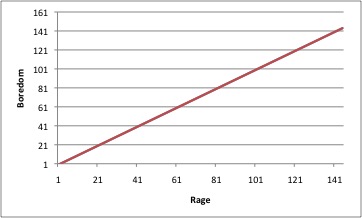
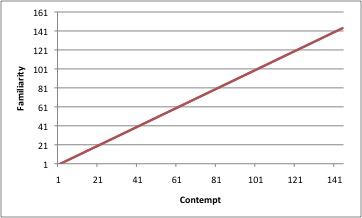
My other findings are graphed below.

boredomrage

FamiliarityContemptGraph

When contacted for comment, both Martin Amis and Ian McEwan banged on self-importantly and interminably.

During the same period, my friend Jason Wyngarde performed a similar experiment with films. His findings were much the same, but he also uncovered a further pattern.

breastsexplosions

Great title, even better opening line

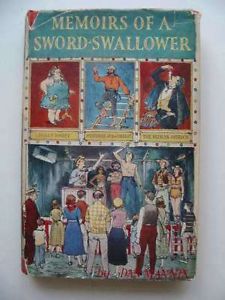
$_35Just when I though nothing could be better than the title of Dan Mannix’s autobiography, Memoirs of a Sword-Swallower, I decided to read the opening line, which was, it turns out, even better:

I probably never would have become America’s leading fire-eater if Flamo the Great hadn’t happened to explode that night in front of Krinko’s Great Combined Carnival Sideshows.  (London: Hamish Hamilton, 1951, p.1)

I did not dare read on.

Dandies in the Underworld

fantomasA giant figure in immaculate evening dress looms over night-time Paris. Stepping over familiar landmarks, he gazes out at us from behind a domino mask. And in his outstretched hand is a bloodied dagger. The image, by Gino Starace, is iconic. It is Fantômas. The Lord of Terror. The Genius of Evil. But despite his costume, he is not a gentleman.

Created in 1911 by Marcel Allain and Pierre Souvestre for a series of 32 monthly novels, the enormously popular Fantômas soon crossed over to the movies. In 1913 and 1914, Louis Feuillade directed five films about the endless quest of Inspector Juve and journalist Jerôme Fandor to capture the criminal mastermind. However, although Starace’s picture was used to promote Feuillade’s Fantômas, he only once appears costumed like this – and then as a figment of the defeated Juve’s imagination.

The head of a vast criminal organisation and a master of disguise, Fantômas has less in common with the gentleman thief than with the villains of Fritz Lang’s Die Spinnen (1919-20), Spione (1928) and Dr Mabuse films (1922, 1933, 1960), in whom the terrors of disempowerment and anonymity that accompany capitalist-industrial, urban modernity coalesce. Brutally instrumentalist and utterly impersonal, there is no true identity to be discovered behind his series of disguises.

Starace’s dapper but knife-wielding gentleman is – in the face of the globalising forces of empire and capital squaring off on the eve of World War I – at once reassuring, anachronistic, transgressive and fantastical. Perhaps this is why Fantômas, the product of arch-conservatives, so appealed to such radical avant-gardists as Guillaume Apollinaire, Antonin Artaud, Blaise Cendrars, René Magritte and Kurt Weill. He embodies the contradictions of his age.

The probable source of Starace’s gentleman-thief image is AJ Raffles, perhaps channelled through Maurice Leblanc’s Arsène Lupin. Created by EW Hornung in the 1890s, Raffles is the finest slow bowler of his generation. Penniless, he is nonetheless proud to be a Gentleman rather than a Player, and likewise insists on his amateur status as a thief. Selecting only the most challenging jobs and most exquisite loot to support his bachelor lifestyle, he robs from the rich and is not averse to others helping the poor.

raffles-1917He appeared in a dozen films between 1905 and 1939. Raffles, the Amateur Cracksman (1917) stars John Barrymore in a breakneck mash-up of Hornung’s stories that only ever pauses to display The Great Profile’s great profile. This Raffles appears to be not so much a gentleman as someone who knows a gentleman’s tailor (Barrymore, his looks and his star both fading, is a more compelling gentleman thief in Arsène Lupin and Grand Hotel, both 1932). In Raffles (1925), House Peters, known as ‘The Star of a Thousand Emotions’, can muster only a handful of them, including ‘stolid refusal to be charismatic’ and ‘discomfort in ill-fitting evening dress’. In contrast, da993b7bbe01f24bdfcf2ae6e48c04bbRonald Colman in the first talkie Raffles (1930) gives one of his most effortless-seeming performances – as if acting were too vulgar even to contemplate – and the warm timbre of his Surrey burr modulates plummy received pronunciation into something quite sensuous. But the narrative material had already been filleted of its fundamental queerness. Hornung’s stories, focused on the close bond between Raffles and his accomplice Bunny, are full of innuendo and double entendre, with occasional allusions to amyl nitrate and Oscar Wilde.

Once the Production Code was enforced, the gentleman thief became not merely straight but almost completely desexualised. In the 1940 Raffles, David Niven is too young, his Raffles too boyish, and the casting of classical Hollywood’s very best good girl, Olivia de Havilland, as his love interest compounds an error that would not be corrected until Yorkshire Television’s 1977 Raffles series, raffles_tll10starring Anthony Valentine. Perfectly cast, Valentine’s precise delivery and slightly faded looks – the contrast between his crow’s feet and seemingly plasticised cheekbones suggests more than merely a youth misspent – unleash the homoerotic appeal of the gentleman thief: the tastefully furnished, comfortable quarters, devoid of women; the endless flirtations, but avoidance of romance or entanglement; the gentlemen’s clubs; the secret nocturnal identity; the dressing-up to break into other men’s houses; the crossing of class barriers; the mixing with rough trade…

But, queer or otherwise, this sexual undercurrent is not the only source of the gentleman thief’s appeal. The flipside of Fantômas, that anonymously devastating force of modernity, the gentleman thief negotiates modernity’s transformations of economic and social structures. This is beautifully captured by the prominence afforded a bust of WG Grace in the apartment of Valentine’s Raffles. As the finest cricketer of his generation, Grace is worthy of Raffles’s respect. But despite being a Gentleman, he was only nominally an amateur, making more money from the sport than any professional Player. A similar whiff of disrepute surrounds Raffles.

As old hierarchies crumbled, signifiers of social class were disrupted by wider access to certain varieties of commodity. Appearances begin to deceive. In Ernst Lubitsch’s racy, pre-Code Trouble in Paradise (1932), a Baron (Herbert Marshall) and a Countess (Miriam Hopkins) only fall in love when each discovers the other is a fake and a thief. Self-made and simulacral, they can play any social role – given the right costume – but the only place they really belong is with each other, conning, stealing or on the lam. However, such semiotic manipulations rarely succeed. In Pépé le moko (1938), Jean Gabin’s proletarian thief is unutterably stylish, but he cannot escape his class or fate.

In the post-war period, values shifted. Consider the contrast in The Pink Panther (1963) between the aristocratic Phantom and his nephew: David Niven is too old, Robert Wagner too American, too glib. A new consumerist masculinity was taking over, and gentleman thieves were no longer gentlemen. And they were as likely to solve crimes as commit them.

The character-type saw a popular resurgence in 1966, the year in which Cary Grant, Hollywood’s master of sartorial transformation (and a gentleman thief in To Catch a Thief, 1955), retired from films. The charm of Gambit’s Harry Dean (Michael Caine) is located in the gulf between his East London vowels and his dubious received pronunciation when posing as Sir Harold Dean. That of Kaleidoscope’s Barney Lincoln (Warren Beatty) depends entirely on his transparent reliance on a broad smile to buy time when he is out of his social depth. This league of ‘gentlemen’, which also includes Oliver Reed in The Jokers (1967) and Stanley Baker in Perfect Friday (1970), consists of working- (or middle-) class boys made good, and valorised for doing so. The very best of them is to be found in How to Steal a Million (1966), less a film than an opportunity to ponder whether Audrey Hepburn – as elegant when disguised as a cleaning lady as when dressed by Givenchy – or a young Peter O’Toole is the more beautiful (although it is probably a draw, O’Toole does showcase some of the most remarkable cigarette-handling you will ever see).

21129_Danger-Diabolik-05Costume, commodities and consumption are also at the heart of Mario Bava’s Diabolik (1968). The eponymous Jaguar-driving criminal mastermind (played by John Phillip Law, who looks like the offspring of Alain Delon and a Vulcan mod) dresses in full-enclosure leather and rubber body suits to commit his crimes, only his eyes visible through a domino-shaped cutaway. Based on a 1960s Italian comic book character, Diabolik is an intriguing inversion of Fantômas. His ‘terrorism’ is restricted to destroying the taxation system because the government have wasted so much public money pursuing him, and his subterranean base is a fantasy of modish, high-tech apartment living – a love-nest shared with Eva (Marisa Mell), his beautiful blonde accomplice with a taste for mini-raf_bun2dresses, hotpants, hipsters, peekaboo tops and kinky boots. Crime, for them, is passionate foreplay and, in contrast to poor Raffles and Bunny, it need never go unconsummated.

This dynamic between class and consumption was repeatedly played out on British television in the late 1960s and early 1970s. Adam Adamant (Gerald Harper), a Victorian secret agent revived in swinging London, was a gentleman (and misogynistic prig) but not a thief. Peter Wyngarde’s deliciously-voiced Jason King was no castgentleman, although he was certainly a player. Tony Curtis’s brash self-made millionaire Danny Wilde partners up with Roger Moore’s Lord Brett Sinclair to fight crime in expensive locations in The Persuaders!, although Moore always seemed less an aristocrat than a bemused estate agent. However, the pattern was most decisively set when, in the fifth season of The Avengers, Patrick Macnee’s John Steed, formerly so well-dressed that you forgot he was a government functionary, let himself be costumed by Pierre Cardin. Bringing modern touches to classic Savile Row designs might have sounded innocuous, but from there it was only a short step to working with Gareth Hunt…

Perhaps it was the backlash against the ‘excesses’ of the 1960s and 1970s, or perhaps it was neo-liberalism’s success in persuading otherwise sensible people that there are no such things as society or social and economic classes, that finally did for the gentleman thief. Where is he now?

In Entrapment (1999), Sean Connery – whose James Bond negotiated so intriguingly between working-class physique and access to style, articulating social mobility as a semiotic possibility – is just some rich guy, no more convincing as a gentleman than he was as a Soviet submarine commander. There is too much of the catalogue model about Pierce Brosnan in The Thomas Crown Affair (1999), and George Clooney’s Danny Ocean merely gentrifies the rat pack. Remorselessly heterosexualised, they reek of new money. And then there is The Gentleman Thief (2001), which only exists because the BBC realised – far too late – that they should lazily cast Nigel Havers as Raffles before it was too late. Or former Eastender Michelle Ryan as Doctor Who’s ‘aristocratic’ thief/Emma-Peel-wannabe, Lady Christina de Souza…

Frankly, I’d rather work with Gareth Hunt.

[A version of this piece first appeared in Electric Sheep back when it was hard copy; but issue 12 (winter 2009), is now out of print.]

On Matters Locomotive and Tentacular; or, Four or Five (More) Things About China Miéville

[After finding yesterday’s old piece on China, I remembered doing this one, too. But on reading it, I have no memory at all of writing it. It’s from the Readercon 17 programme, back in 2006 when China and James Morrow were GoHs.]

This was the plan, the plan was this: I would get the first post-rush hour train from Bristol to London and be there by noon.

tentacles‘There’ is the Starbucks in Borders bookstore on Oxford Street, our default meeting-up place in central London, and we would leave ‘there’ as soon as possible, and grab some pizza at a place around the corner (where, a year earlier, our arrival had been greeted with rapturous applause from the staff – not because they recognised China, but because they’d been open for almost an hour and we were their first customers that day). And after lunch, although the pretext for meeting up was discussing essay proposals for a book we are editing on Marxism and sf, we would head to the Natural History Museum to see the thirty-foot long, newly-on-display, giant squid.

That was the plan, the plan was that.

So of course that was not what happened.

Readers of King Rat and the stories in Looking for Jake (and a forthcoming project, as yet still a secret [Un Lun Dun, I guess]) will know that London is a strange place, where all kinds of unexpected things can happen; that the fabric of the city itself is fantastical. Strange chimera flit through the crowds, pausing to take fliers advertising clubs and bars and language schools from fastidiously scruffy young men and women being paid way less than minimum wage for their cash-in-hand labour, and roar in anguish, in bafflement, at this world which is no longer theirs, and retreat temporarily into the interstices, before emerging once more, hooked on it. Creatures, remnants from another time, can be glimpsed in the reflective surfaces of department stores and sandwich shops, phone booths and passing buses. Others dance across the rooftops. And then there’s the people, who are pretty fucking strange.

But our delays and derailments are far more mundane. Family. Trains. And by the time we get ‘there’ it is gone two o’clock. (There was an amusing incident involving a borrowed phone in case China needed to contact me, which he does, but by text, which my quick briefing on this new-fangled technology did not cover. I manage to find the message but am uncertain how to reply. I amaze myself by finding China’s number in the phone’s address book, so I call and leave him a message. The number later transpires to be that of his old phone. But I will omit this is at makes me sound much too old yet insufficiently curmudgeonly. And has nothing to do with trains or cephalapods.)

Lunch is relocated to an Italian restaurant, which does a pasta dish China likes involving little balls of fried courgette and spinach. Our arrival prompts neither adulation nor irony.

51M+qPPQDFL._SY344_BO1,204,203,200_‘Trains,’ I tut, to boost my curmudgeon-score as we share a mezze and several varieties of bread. But we have been talking about trains a lot, lately. I have a crazy notion that there is a book to be written about trains and early cinema and time-travel (but very distinctly not about early railroad films or time-travel movies), and China’s voracious reading, especially the research for Iron Council (and for his review of Stefan Grabinski’s The Motion Demon), keeps throwing up gems. It’s like having a really good research assistant I don’t have to supervise or pay (although he has still not returned my copies of The Iron Horse, Once Upon a Time in the West and Emperor of the North Pole).

These are the three things he tells me.

‘The seemingly obvious use of the railroad to “mean” Manifest Destiny, as in Zane Grey’s The U.P. Trail, is only permissible because of the peculiarity of that particular railroad. It really did only have one line, at least for a brief moment, but much longer iconically, and that’s been the source of a lot of notions of the unilinearity of the railroad, which are completely spurious. Not even a consideration of the siding or even the parallelism of tracks (necessary unless all trains are going only one way, a patent absurdity). So railroads aren’t even a misused symbol – they only work symbolically because of a lie.’

‘Of a failure, no, a refusal, to observe accurately,’ I suggest, ‘because that would strip the metaphor of its political potency.’

The mezze is really good.

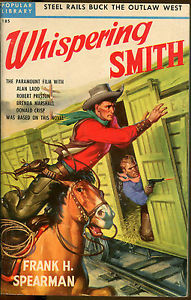
$_35Iron Council riffed heavily on Frank Spearman’s Whispering Smith. Spearman was a sort-of libertarian, reportedly Ayn Rand’s favourite writer, did lots of stuff about rugged railwaymen. Whispering Smith is a troubleshooter for the railroad who is allowed to go anywhere and do more or less anything, including kill anyone necessary, to “fix problems”. It is an extremely perspicacious critique of rugged individualist/libertarian railroadism (as I’ve christened the ideology), because contrary to the “enlightened self-interest” of the Randists and half of Spearman’s own characters, the thrusting of the rails is only possible with a roving assassin – a man in a permanent state of Schmittian law-making exception! – bringing peace for capital-expansion at the end of a gun beyond the bounds of the rails. So the railroad relies for the always-spurious solidity of even its semiotic status to the right on an implicit awareness of beyond-railroad coercion of the most violent kind. Spearman, a cunning writer, recognises this and rather than attempt to conceal it, hides its in plain view.’

‘Agamben,’ I mutter, sipping a rather non-descript red wine, knowing that his Schmitt reference is more astute than my name-drop (but then he did study – and write a book on – legal theory). I refill my glass and reflect on how it is possible for China to talk so enthusiastically about stuff despite his rather non-committal approach to drinking.

220px-Sanatoriumpodklepsydra‘And then there’s Bruno Schulz, using trains (in several different ways – history as both inside and outside the train itself, on the rails as well as in the corridors) to think about the alterity of history and alternate possibilities. I’m increasingly interested by the idea of the multi-track nature of railroads, let alone Grabinski’s sidings, as key to their importance. There’s this astonishing passage in his ‘The Age of Genius’ in The Sanitorium under the Sign of the Hourglass:

Ordinary facts are arranged within time, strung along its length as on a thread. There they have their antecedents and their consequences, which crowd tightly together and press hard one upon the other without any pause. This has its importance for any narrative, of which continuity and successiveness are the soul.

Yet what is to be done with events that have no place of their own in time; events that have occurred too late, after the whole of time has been distributed, divided and allotted; events that have been left in the cold, unregistered, hanging in the air, homeless and errant?

Could it be that time is too narrow for all events? Could it happen that all the seats within time might have been sold? Worried, we run along the train of events, preparing ourselves for the journey.

For heaven’s sake, is there perhaps some kind of bidding for time? Conductor, where are you?

Don’t let’s get excited. Don’t let’s panic; we can settle it all calmly within our own terms of reference. Have you ever heard of parallel streams of time within a two-track time? Yes, there are such branch lines of time, somewhat illegal and suspect, but when, like us, one is burdened with contraband of supernumerary events which cannot be registered, one cannot be too fussy. Let us try to find at some point of history such a branch line, a blind track onto which to shunt these illegal events. There is nothing to fear. It will all happen imperceptibly: the reader won’t feel any shock. Who knows? Perhaps even now, while we mention it, the doubtful manoeuvre is already behind us and we are, in fact, proceeding into a cul-de-sac.

‘Isn’t that fucking amazing?”

I have to agree.

I also have to confess.

This was the plan, the plan was this: over lunch we would talk wisely and wittily about arcane things, scare the children at the next table with our profanity and their parents with out erudition (or vice versa). It is not that China is scarily geeky (although he does know his shit), nor that I cannot write convincing dialogue (although I cannot); but rather that China’s words come from a long and almost painfully helpful email he sent me after a phone conversation about matters locomotive.

Conversation over lunch that day really focused on our childish enthusiasm for all things cephalopodic and tentacular. I’d recently rewatched Jon Lurie’s series of fake fishing documentaries, Fishing With John, in which he takes various celebrities – Jim Jarmusch, Tom Waits, Matt Dillon, Willem Dafoe – on improbable fishing expeditions. The series ends with a two-parter in which John – who died while ice-fishing with Willem in the previous instalment, a fitting punishment considering they used the proper equipment rather than chainsaws to cut through the ice – is discovered to be not only alive and well but taking Dennis Hopper fishing for giant squid in the Andaman Sea. After arduous travels, unsuccessful angling, a sidetrip to see some squid-worshipping monks who warn of the giant squid’s hypnotic powers, they finally meet with success, of a sort. A giant squid rises to the surface. But all is not well. Disorientation strikes Dennis and John. What is going on? Has something happened? They leave Asia disconsolate, because despite seeing their prey up close, it hypnotised them, and they believe their expedition a complete failure.

Jeff VanderMeer’s name of course crops up, as it always does in squidversations. But a new potential source of delight is introduced. An aside about James Woods not sleepwalking through a performance but actually sleeping through a performance in ER triggers a memory deep in China.

‘Have you ever,’ he asked, ‘seen Tentacles? I’ve only heard about it – a 70s Jaws rip-off about a giant octopus – in which John Huston literally phones in his performance. Apparently, he finally gave in and agreed to appear in it on the condition that he didn’t have to leave his own home to do so. So his performance consists of him sitting on a lawn-chair on his own lawn, saying things over his own phone like, “Hmmm, yes, that does sound like it could be the work of a giant octopus”.’

Neither wise nor witty, neither arcane nor profane; more geeky than erudite; but it certainly did scare the children sat at the table next to us. And their parents.

***

Coda 1. We did actually discuss the proposals and finalise the line-up for Red Planets: Marxism and Science Fiction.

Coda 2. The little balls of courgette and spinach are really rather good.

Coda 3. While China’s books are available at all good bookstores, it is worth noting that Tentacles is also available on region 1 DVD, but while I was able to pick up a copy for just five bucks, there is a heavy price to pay: it comes with the Joan Collins movie Empire of the Ants, a low point in a career hardly distinguished by its heights.

Coda 4. We never did get to the Natural History Museum to see the giant squid.

Coda 5. Unless we did but just can’t remember. Hypnotic powers, y’know.

Four or Five Things About China Miéville

[Just stumbled across this old thing I wrote for the Wiscon 17 Programme Booklet in 2003, when China and Carol Emshwiller were GOHs]

Skulltopus011 Saturday September 28th 2002 was a bright and clear day in London. Which was just as well, because China and Emma were late. A group of us had arranged to meet at the National Film Theatre’s Café on the South Bank of the Thames at 12.30. From there, we would cross the river to the Embankment to join the protest march against war on Iraq and for a free Palestine.

In a way, though, the delay didn’t matter. Despite early police claims that there were only 40,000 protestors, it was clear there were ten times that number. It’s not like anyone would have noticed if we were late.

But coffee had been drunk and impatience was setting in and the crowd on the opposite bank was swelling and China wasn’t answering his mobile phone.

Suddenly, in the distance, a sighting.

Arms were waved. Watches were pointed at extravagantly. Tutting noises were made.

China and Emma arrived. China was breathless, not from rushing but from excitement. ‘Sorry we’re late, but you won’t believe what we’ve just seen. We had to stop and watch. We were walking through the park, and there was this pelican. Fucking huge, and it just swooped down and ate a pigeon. It was gross. You could see the pigeon struggling in its gullet.’

China was right. Nobody believed him.

Not that the story was completely implausible. It’s just that impish Mike Harrison had already started the rumour that en route they had popped into John Lewis – an irredeemably bourgeois department store – to buy some things for their new flat.

To this day, nobody believes China’s story about the pelican and the pigeon. But for some reason everybody seems to take a special delight in preferring to believe Mike’s version of events.

***

One of China’s favourite passages of our sf explanation is to be found in Eric Flint’s 1632. It goes like this:

So that’s about it folks … Somehow – nobody knows how – we’ve been planted somewhere in the middle of Germany almost four hundred years ago. With no way back.

It seems like this passage might soon occupy that special place in China’s heart once reserved for a line from the underrated Prince of Darkness:

Nothing anywhere ever should be able to do what it is doing.

***

China’s taste in movies is a bit hit-and-miss.

He’s right about Prince of Darkness – it is underrated. He’s right about Being John Malkovich – the more you think about it the worse it becomes. He’s right about Donnie Darko – it is a little too knowing for its own good. And he’s right about Daredevil – even it if was identical in every other respect, it would have been massively improved by casting Eric Stoltz instead of Ben Affleck.

But he will insist on the genius of the first five minutes of X-Men.

And that Fight Club is a great movie.

***

One of China’s favourite comic book panels is to be found in an old Trigan Empire strip from Look and Learn. It is night-time. On a roof in a city an old man and a young lad are stargazing. Suddenly there is a noise. They both look alarmed.

What was that?

say the old man. The boy replies:

It sounded like a large party of men rushing stealthily down the alley!

***

Last autumn, I was diagnosed with Hodgkins lymphoma. We got home from my first session of chemotherapy about 3.30pm on Friday 15th November. Around 4.00pm the doorbell rang. China and Emma had sent me a huge bouquet of flowers with a hope-it-went-okay kind of message. Later that evening I phoned to thank them, and the first thing China did was apologise in case receiving flowers from a male friend made me feel awkward.

It was a rugged, ironic, manly thing to do; but, in truth, I’d never before received flowers from a male friend and I’d no idea feeling awkward about it was even an option.

***

Perhaps these tidbits, incidents and events will provide a future biographer with things around which to drape some insights into China’s character. But I will leave it to you to decide what it all might mean.

[A sort of sequel piece can be found here.]

Stephen King, Doctor Sleep (2013)

514NhnvVinL._SY344_BO1,204,203,200_This is, I shit you not, the one about evil gypsies abducting children.

Admittedly, the gypsies are actually some kind of energy-vampires, who traverse the US in the guise of middle-aged people in RVs. And they don’t merely abduct the infants, but slowly torture them to death to release more of whatever kind of energy it is they chow down on. And one of the infants in their sights is a girl in her teens who can shine way more powerfully than anyone else. And she knows Danny Torrance, who has grown up to become, like his father, an alcoholic, but is in Alcoholics Anonymous and sober for most of the book.

But mainly it is about gypsies abducting children. I shit you not.

Despite being a sequel to The Shining, it mostly isn’t. It shares Danny and one location and some references to Hallorann and Wendy (in whom King still cannot muster any interest) and inserts them into a mildly and differently fantastical version of the contemporary US. It is smoothly competent – the riff on Jerome Bixby’s ‘It’s a  Good Life’ (1953) is nicely done, but the allusion to The Silence of the Lambs sits there for no reason like a lump in your pablum – but it is hardly gripping, suspenseful or scary. It is like bathing in a cup of tea the way my mum makes it.

King’s semi-autobiographical account of Danny’s experience of AA, of its practices and processes, suggests a strong resonance with neoliberal culture’s emphasis on getting the individual to surveil and manage him/herself, to hope for little more than surviving daily, to self-scrutinise, to locate responsibility within the self – anything rather than fix the society that produces alcoholism. But this is thin stuff, too.

Not everyone agrees. For example, Margaret Atwood says that ‘by the end of this book your fingers will be mere stubs of their former selves’.

Presumably because gypsies stole the tops of them.

PS My other Shining-related posts can be found here, here, here and here. (And boy am I kicking myself for forgetting when writing about Room 237 that Yanis Varoufakis’ book is called The Global Minotaur: America, Europe and the Future of the Global Economy.)