High-Rise (Ben Wheatley UK 2015)

highrise2After the varying degrees of self-importance, humourlessness and bloat Spielberg, Cronenberg and Weiss brought to their respective Empires, Crashes and Exhibitions, the very first thing screenwriter Amy Jump and director Ben Wheatley get right with their High-Rise is that Ballard is a comic writer.

A master of the modestly proposed deadpan preposterous, his dry technician’s prose fakes repression, barely concealing the glee with which he drones shock and flattens affect. This is pretty much impossible to reproduce in film. Cronenberg attempted it with Crash, and failed (Shivers got a lot closer, and is still the best version of High Rise that is not actually a version of High Rise).

Jump/Wheatley’s humour is much more their own, and they are sufficiently confident about it to have some fun with Ballard. There is, for example, a nicely played moment when Laing (Tom Hiddlestone) says something to Royal (Jeremy Irons) which is precisely the kind of impossible-thing-for-a-real-person-to-say that a character in a Ballard novel would say, prompting bemusement and discomfort in them both.

The second major thing Jump/Wheatley get right is to not update the setting of the film. Instead, we get a slightly different version of the 1970s, as if the decade went on a little bit longer and somehow became as attractive to look at as it clearly – and mistakenly – thought it was.

But this also reveals a problem with the film as an adaptation (as a Jump/Wheatley film, it is second only to Sightseers).

Ballard’s novel is very specifically about that moment in the early 1970s, when decrying post-war Corbusier-spawned high-rise developments was transforming from merely a fashionable posture to received wisdom (typically and conveniently forgetting that for many people moving from the slums to the new developments was headily utopian – indoor plumbing!). It was written when councils were withdrawing maintenance from post-war housing projects, and their residents were being blamed for the disrepair into which the untended buildings inevitably fell. It was written when working class residents were being demonised as intoxicated, glue-sniffing, violent, criminal – as creatures incapable of not fouling their own nests. It was written when the extent of the corruption behind many housing schemes was being uncovered (as in the John Poulson case, which reached all the way up to Home Secretary Reginald Maudling – you know, like in Our Friends in the North).

And so whether or not Ballard bought into this potent myth, nothing could have seemed more natural than to retell it, but with a cast of middle class professionals, with yuppies avant la lettre. The closing moments of the film do nod to Thatcher, and it is certainly the case that she – conveniently forgetting that many of the worst post-war developments were built by private companies, not by the state or local councils – drew on this myth to drive through her ideological war on council housing, thus creating the ongoing housing crisis in the UK.

But the conditions in which Ballard’s novel was written no longer exists, and the film – despite the way it captures middle-class social sadism – lacks that element of specificity that would provide a vital resonance. Consequently, Ballard, who should be shocking the bourgeosie, is suddenly heritage cinema, and that is just plain wrong.

Probably the most telling moment for me in this regard comes in the sequence when Richard (Luke Evans), slowly making his battered way up the building to exact his revenge, assaults Charlotte (Sienna Miller). A montage, which includes her timidly serving him a tin of dog food for breakfast the next day, plays out to Portishead’s cover version of ABBA’s ‘S.O.S.’. It is a beautiful version, transforming the pop song into a languid, mournful piece of music, as self-consciously ‘serious’ as one would expect from them. And in all kinds of ways it works brilliantly.

But it is completely the wrong choice.

They should have gone with the original version; not because it is better, but because the last thing the film needed was to fall into such clichéd caution. This is not to say that rape, even if only implied rather than depicted, should be treated frivolously; but rather that the film loses something by choosing to treat this particular moment as so very exceptional. At least using ABBA’s version might have been sufficiently inappropriate to shock audiences out of their complacency. But that was never going to happen. Despite all the potentially offensive material the film contains, it also wants to be respectable, and that is budget speaking, not art.

Don’t get me wrong. It’s an enjoyable film, and full of nice little touches, from sets which bring the brutalist concrete inside the apartments to an unexpected nod to Aladdin Sane and some great dancing.

But you know the way The Cabinet of Dr Caligari‘s static camerawork makes it not so much an expressionist film as a film of expressionist sets and performances? So High-Rise is a film of a Ballard novel, not a Ballardian film.

[Thanks to Mark Cosgrove for blagging me into the preview after the ticketing fiasco.]

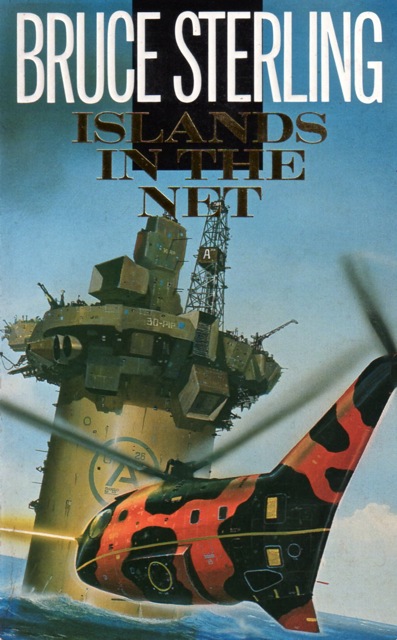
Afrocyberpunk 2: Bruce Sterling, Islands in the Net (1988), part one

BKTG17418If Gibson’s Neuromancer omits Africa and its peoples, including the diaspora, Bruce Sterling’s Islands in the Net (1988) might seem like a step in the right direction, at least inasmuch as it spends one long section in Grenada and (after visiting Singapore) another in Mali (with a brief snatch of coda passing through Algeria to Morocco). Intended as – or at least praised for being – a more realistic take on a global cyberpunk future, the novel offers an improbable variant on that old saw attributed to Fredric Jameson and Slavoj Žižek: it is easier for Sterling to imagine Americans happily giving up their guns than it is to imagine the end of capitalism. The novel is set in the 2020s, after the ‘Abolition’ (of nuclear weapons and conventional small arms). Under a new world order (that is pretty much the old world order but with fewer issues of national sovereignty getting in the way of a liberal-ish neoliberal hegemony) dominated by the ‘developed world’ which at least makes a point of feeding the ‘developing world’, albeit on ‘scop’, a cheaply produced single cell protein – ‘the national food of the Third World’ (38). If no one is exactly racing home to enjoy their dinner, no one need go hungry any more. Except in Africa, where such ‘aid’ enables the unscrupulous to accumulate power.

And that’s the problem. The future in Sterling’s novel is of the demoralising, predatory kind projected by the futures industry. As Kodwo Eshun writes, in such projections, typically produced by NGOs and multinationals,

African social reality is overdetermined by intimidating global scenarios, doomsday economic projections, weather predictions, medical reports on AIDS, and life-expectancy forecasts, all of which predict decades of immiserization. … Within an economy that runs on SF capital and market futurism, Africa is always the zone of the absolute dystopia. There is always a reliable trade in market projections for Africa’s socioeconomic crises. (291-2)

Such projections usually propose corporate intervention – the extension and intensification of the market – as the only possible solution.

Sterling introduces his future Africa through precisely such a modelling tool, David’s Worldrun game,

a global simulation. Worldrun has been invented as a forecasting tool for development agencies, but a glamorized version had found its way onto the street. … Long strips of the Earth’s surface peeled by in a simulated satellite view. Cities glowed green with health or red with social disruption. Cryptic readouts raced across the bottom of the screen. Africa was a mess. ‘It’s always Africa, isn’t it?’ [Laura] said. (10)

Later, David explains to a Pole called Andrei Tarkovsky (!) that in the game,

Protein tech, like [scop], is one of your major tools for world stability. Without it, there are food riots, cities crumble, governments go down . . . And not just in Africa, either. (137)

The sense, implicit in this comment, of Africa’s desperate exceptionalism, that it is the benchmark against which to measure the extent to which you have escaped disaster, barbarism, backwardness is everywhere in the novel. Describing the wired world of 2020 – a passage which is quite endearingly clunky in so badly missing the extrapolative mark – Sterling notes (more or less focalised through Laura) that ‘Most of the world, even Africa, was wired for telex these days’ (22). Rizome, the multinational for which David and Laura work, has decided to ‘negotiate’ with the data havens; Emerson explains

‘That’s a modern solution. It worked for the arms race, after all. It has been working for the Third World.’
‘Except for Africa,’ David said. (45)

After the lodge David and Laura run near Galveston is attacked, the mayor, Magruder, objects that terrorism ‘isn’t supposed to come down any more. … Maybe in Africa. … Not here.’ (70-71). The spook sent by Vienna (a metonym for the international conventions/agencies keeping the new world order in order) to investigate the attack muses about all ‘of those millions and millions of unfired NATO bullets … Too many even for the African market, eh?’ (77) – a point reiterated when Laura, in a Malian jail, overhears an execution:

They would often shoot a single man with five or six machine guns; their ammunition was old, with a lot of duds that tended to choke up the guns. They had a worldful of ammunition, though. All the ammunition of fifty years of the Cold War had ended up here in African war zones. Along with the rest of the junk. (355)

When Laura speaks obliquely about the attack to a mercenary, saying ‘I saw a man killed by a machine gun, once’, he replies ‘Oh, really? You’ve been to Africa?’ (270). Later, on the rogue nuclear sub that takes her to Mali, another mercenary tells her the story of how he ‘ended up in Africa’:

‘Africa,’ Laura repeated. The very sound of it scared her. (331)

There has also been a devastating AIDS-like retrovirus, spread by horny sailors and ‘harbor hookers’:

But the world had the virus pretty much whipped now. Contained anyway. Under control.
Except in Africa. (334)

When Laura demands that her accidental rescuer Gresham helps Katje, a ‘dying woman’, he replies: ‘You’re in Africa now. Dying women aren’t rare here.’ (382)

Lying behind all the globetrotting shenanigans is a group called FACT (not the Federation Against Copyright Theft, but the Free Army of Counter-Terrorism) who have effectively taken over Mali and are at war with Azania (as South Africa is now called). FACT not only have a nuclear sub, but have tested one of their warheads in the desert and are – with the collusion of an embroiled Vienna – contemplating using it in the war. Laura and Katje were being taken to the test-site to appear in a propaganda video about this nuclear capacity when Gresham and his Tuareg warriors attacked the convoy in which they were prisoners. Fleeing with her unintentional rescuers through the Sahara, Laura eventually looks around her:

Time passed, and the heat mounted sullenly as the miles passed. They were leaving the deep Sahara and crossing country with something more akin to soil. This had been grazing land once – they passed the mummies of dead cattle, ancient bone stick-puppets in cracked rags of leather.
She had never realised the scale of the African disaster. It was continental, plantery. They had travelled hundreds of miles without glimpsing another human being, without seeing anything but a few wheeling birds and the tracks of lizards. She’d though Gresham was being cavalier, deliberately brutal, but she understood now how truly little he must care for FACT and their weaponry. They lived here, it was their home. Atomic bombardment could hardly have made it worse. It would only make more of it. (386-387)

There is more to say about Islands in the Net, and I will do so. But for the moment, let that stand as its futures-industry-style representation of Africa: atomic bombardment could hardly have made it worse.

Works cited
Kodwo Eshun, ‘Further Considerations of Afrofuturism’. CR: The New Centennial Review 3.2 (2003), 287-302.
Bruce Sterling, Islands in the Net. London: Legend, 1989.

The City in Fiction and Film, week 8

CLEO DE 5 A 7 - French Poster 2

week 7

This week we watched Cléo de 5 à 7/Cleo from 5 to 7 (Agnes Varda France/Italy 1962) as a way to begin thinking about human movement in, across and around the city. The plan was to consider the ideas of the flâneur/flâneuse and flânerie, the dérive (with a hint of le Parkour and le traceur) – but some ad hoc essay-writing support took up part of the class, which meant more detailed work on Guy Debord and the dérive had to be bumped to next week’s class.

Our starting point was the opening of Michel de Certeau’s essay ‘Walking in the City’, which begins with an elaborated contrast of viewing New York from the top of the World Trade Center and living at street level. He describes the city, seen from on high, as ‘a texturology in which extremes collide’ – a visual field made up of, on the one hand, the new structures that constantly irrupt into the scene, reeking of ambition, blocking out the rest of the city and challenging the future, and on the other hand, ‘yesterday’s buildings’, degraded,  turned into trashcans, their accomplishments discarded. One intriguing phrase – ‘brutal oppositions of races and styles’ – fuses the architectural diversity of the city (buildings so different from each other that they might belong not just to different styles but to different races) with the racial segregation of the city created by generations of concentrated white wealth and privilege even when de jure segregation is illegal.

To bring this all a little closer to home, we looked at some recent photographs of London’s skyline – the new buildings that tower over St Paul’s cathedral (the Gherkin, the Cheesegrater, the Lingam, the Carbuncle Award-winning Walkie Talkie), and in the distance Canary Wharf, and over the Thames the Shard. Precisely the kind of urban perspective that reveals ‘a city composed of paroxysmal places in monumental reliefs’.

de Certeau makes his first move from thinking of the city as a texturology to thinking of it as a text when he describes New York’s monumental buildings as ‘the tallest letters in the world compos[ing] a gigantic rhetoric of excess in both expenditure and production’.

Rising to the top of the WTC is ‘to be lifted out of the city’s grasp’, to be liberated from the encounters with others, with difference, with the peril and stress of the streets. It is to be separated out from the masses, the supposedly threatening mob. It is to become Icarus, soaring above the labyrinths constructed by Daedalus. (Given Icarus’s fate, this seems at first like a rather odd allusion, and one that is oddly proleptic – like Lizzie Borden’s Born in Flames (US 1983) – of the fate of the WTC. Maybe I should have rewatched Der Himmel über Berlin/Wings of Desire (Wenders West Germany/France 1987) in preparation – or at least subjected the class to some Nicolas Cage from City of Angels (Silberling Germany/US 1998)).

The height of the building distances the viewer from the city and other people, and in a vaguely messianic mode transfigures him into a god-like being, liberated from the ‘bewitching world’ and all its fleshy entanglements. From the perspective of such a deity the city is now merely a text to be read. This consummation represents ‘the exaltation of a scopic and gnostic drive’ to see and to know. Attaining such perfect knowledge (or, rather, the ‘fiction of [such] knowledge’)  is the consequence of a ‘lust to be a viewpoint and nothing more’. Here, lust is a wonderfully embodied term with which to describe the drive for a disembodied seeing and knowing – it reveals the contradiction underpinning it all: the material can never become immaterial, reason can never exist outside of the flesh that reasons.

(This prompted a further digression into our unexpected parallel module on the history of art, describing the development of perspectival art, with the aid of Tintoretto – not Dom from the F&F movies – and Cannaleto; and some gesturing towards the notion of Cartesian space.)

King Kong – especially the poster for the 1976 version, in which he bestrides the WTC with Manhattan spread out behind him as in some of the photos we looked at – brought us back to de Certeau, who asks ‘‘Must one finally fall back into the dark space where crowds move back and forth…?’ In brief, yes. It is why the tallest building always gets the giant ape, why the presence of this simian embodiment of white supremacist fears/stereotypes of black masculinity (clutching a white girl snatched from her bed) – and, some argue, though less persuasively, of bourgeois dread of the impoverished mob – is such a scandal. There are too many ways in which Kong and all the things he represents just do not belong there (which is also what makes him so cool). If, to achieve his perfect vision/knowledge/power, the ‘voyeur-god … must disentangle himself from the murky intertwining daily behaviors and make himself alien to them’, then damn right we want the big monkey dragging him back down. Gotta love us some primate insurrection. And ape it.

de Certeau contrasts the voyeur-god (associated with the city planner, and other modes of top-down power that seek to surveil, know and control urban space) with the ‘ordinary practitioners of the city … “down below”’ – that is, those of us do not rise above the streets but walk them. For de Certeau, our perambulations constitute an alternative city, an ‘urban text’ written by walking. And although, lacking a god’s-eye perspective, we cannot read this text, our paths make up ‘intertwining, unrecognized poems’:

The networks of these moving, intersecting writings compose a manifold story that has neither author nor spectator, shaped out of fragments of trajectories and alterations of spaces: in relation to representations, it remains daily and indefinitely other. … a migrational, or metaphorical, city thus slips into the clear text of the planned and readable city.

Which is all a little abstract, if rather beautiful, so we took a look at the first parkour sequence from Banlieue 13/District 13 (Morel 2004), in which we are introduced to David Belle’s dissident traversals of segregated urban space – a tactics of renegade mobility that counters strategies of urban control and nurtures existence in the the cracks of the world-machine.

Jump back 150 years to the Parisian arcades and to the actual and literary phenomenon of the flâneur (and flâneuse) – the stroller, the urban explorer, the connoisseur of the street. Balzac described flânerie as ‘the gastronomy of the eye’. And Baudelaire, in ‘The Painter of Modern Life’,  describes the flâneur thus:

The crowd is his element, as the air is that of birds and water of fishes. His passion and his profession are to become one flesh with the crowd. For the perfect flâneur, for the passionate spectator, it is an immense joy to set up house in the heart of the multitude, amid the ebb and flow of movement, in the midst of the fugitive and the infinite. To be away from home and yet to feel oneself everywhere at home; to see the world, to be at the centre of the world, and yet to remain hidden from the world … a prince who everywhere rejoices in his incognito … the lover of universal life enters into the crowd as though it were an immense reservoir of electrical energy. Or we might liken him to a mirror as vast as the crowd itself; or to a kaleidoscope gifted with consciousness, responding to each one of its movements and reproducing the multiplicity of life and the flickering grace of all the elements of life.

An intriguing figure, the flâneur obviously recalls Poe’s ‘The Man of the Crowd’ and Woolf’s narrator in ‘Street Haunting: A London Adventure’ (which we studied in week three) but also perhaps Hans Becker, the serial killer in Lang’s (which we studied in week two). He also combines the two identities that de Certeau separates out – he is in the crowd but not of the crowd, he keeps himself sovereign and separate, an observer more than a participant. Because of this detached attitude, he is never overwhelmed by the urban spectacle he observes, and he is able to invest imaginative power in the most banal of sights. And his very existence is threatened by the speed of urban circulation, the exhausting intellectual activity it requires to defeat the boredom of the city, the intoxication of commodities, and the imposition of rationality and order on the city.

Which brought us to Cléo de 5 à 7. 

The film famously opens with colour footage of a tarot reading, shot from directly above the table on which the cards are spread out, before cutting to conventional black-and-white close-ups for inserts of Cléo during the reading; the rest of the film, much of which is spent prowling Paris streets, is also in black-and-white. This resonates strongly with de Certeau, especially as the god’s-eye view of the table is of a tarot reading that gives us a broad outline of the film’s story. Authoritative and transcendent – colour! – it knows everything; but is in such broad strokes that we need to get down onto the level of the streets and the people who walk them to know the story. We need to be immersed in the grasp of the city.

Later, this metatextual commentary is developed in the film-within-the film – in which Jean-Luc Godard, playing a Harold Lloyd figure, chooses between black and white versions of his lover. Inevitably he chooses blonde Anna Karina, after the black one has died. (And Cléo will not die of cancer but find love, or at least a lover.) The association of blackness with death has already been established when Cléo, looking out of a cab, twice starts at seeing African masks displayed in shop windows. This obviously problematic connection fits into the broader opposition between circulation and stasis that structures the film, and is also played out in the oppositions between image and reality.

This is a film full of mirrors and reflections (and great technical virtuosity in terms of how infrequently you can glimpse any sign in the reflecting surface of the film crew). A lot of this is organised around Cléo’s vanity or insecurity or sense of mortality, whatever it is that prompts her to look at her own reflection quite so often (as she becomes less self-obsessed and more open to the world around her, so reflections disappear from the film). It is picked up on in the allusions to fairy-tales (Sleeping Beauty, Snow White), the protagonists of which both spend time in a deathlike condition. And it is there when Cléo’s friend Dorothée (Dorothée Blanck), an artist’s model, explains why she has no problem posing nude: the sculptors do not see her, they see an idea.  And it is there in the film-in-the-film, when women are explicitly compared to dolls or puppets.

In contrast to this material about image/stasis/death, we have long sequences of Cléo, alone and in company, walking or being driven around Paris – part of the intertwining, unrecognized poem of the city. Does this make her a flâneuse?

In some ways, yes. For most of the film she is in the crowd but not of it, holding herself at a distance – perhaps best captured in the sequence in the second half of the film which intercuts between her point-of-view shots (including memories) and those of the pedestrians walking towards her. She also clearly wants to be noticed, to have her distinctiveness acknowledged by others, as in the café sequence when she puts one of her own records on the jukebox and wanders around, hoping that someone will at least recognise her.

But in some ways no. Perhaps most especially in the delirious hat shop sequence, in which she utterly succumbs to the commodity spectacle (and demonstrates her amazing superpower – to make any hat, no matter how ridiculous it looks when on display, appear fabulous the moment she puts it on.)

week 9

Recommended critical reading
AlSayyas, Nezar. Cinematic Urbanism: A History of the Modern from Reel to Real. London: Routledge, 2006. See chapter 1 “Industrial Modernity: the Flaneur and the Tramp in the Early Twentieth Century City.”
Mazlish, Bruce. “The Flâneur: From Spectator to Representation.” The Flâneur. Ed. in Keith Tester. London: Routledge, 1994. 43–60.
Mennel, Barbara. Cities and Cinema. London: Routledge, 2008. See chapter 3, “The City of Love: Paris.”
Pratt, Geraldine and Rose Marie San Juan. Film and Urban Space: Critical Possibilities. Edinburgh: Edinburgh University Press, 2104. On Cléo, see 77–89.
Scalway, Helen. “The Contemporary Flâneuse.” The Invisible Flâneuse: Gender, Public Space, and Visual Culture in Nineteenth-Century Paris. Ed. Aruna D’Souza and Tom McDonough. Manchester: Manchester University Press, 2006. 164–71.
Weihsmann, Helmut. “Ciné-City Strolls: Imagery, Form, Language and Meaning of the City Film.” Urban Cinematics: Understanding Urban Phenomena Through the Moving Image. Ed. François Penz and Andong Lu. Bristol: Intellect, 2011. 23–41.
Wilson, Elizabeth. “The Invisible Flâneur.” New Left Review 191 (1992): 90–110.
Wolff, Janet. “The Invisible Flâneuse: Women and the Literature of Modernity.” Feminine Sentences: Essays on Women and Culture. Cambridge: Polity, 1990. 34–50.
–. “Gender and the Haunting of Cities (or, the retirement of the flâneurThe Invisible Flâneuse: Gender, Public Space, and Visual Culture in Nineteenth-Century Paris. Ed. Aruna D’Souza and Tom McDonough. Manchester: Manchester University Press, 2006. 18–31.

Recommended reading
James Joyce’s Ulysses (1922) and Virginia Woolf’s Mrs Dalloway (1925) are the great modernist novels of walking in the city. Other poetry. fiction and non-fiction about flânerie and about traversing the city by tactical means include Charles Baudelaire’s Paris Spleen (1869), Knut Hamsun’s Hunger (1890), Louis Aragon’s Paris Peasant (1926), Robert Musil’s The Man without Qualities (1930–43), Jean-Paul Sartre’s Nausea (1938), Colin MacInnes’s Absolute Beginners (1959), Raymond Queneau’s Zazie in the Metro (1959), Iain Sinclair’s Lights Out for the Territory: 9 Excursions in the Secret History of London (1997), Edmund White’s The Flâneur: A Stroll Through the Paradoxes of Paris (2001) and Matthew Beaumont’s Nightwalking: A Nocturnal History of London (2014).

Recommended viewing
Films about wandering around the city or traversing the city by tactical means include Zazie dans le metro (Malle 1960), Tokyo Drifter (Suzuki 1966), After Hours (Scorsese 1985), London (Keiller 1994), District 13 (Morel 2004), Adrift in Tokyo (Miki 2007), Enter the Void (Noé 2009) and Holy Motors (Carax 2012).

Calixthe Beyala, How to Cook Your Husband the African Way (2002; trans 2013)

51zqAenL6DL._SX360_BO1,204,203,200_Calixthe Beyala, born in Cameroon in 1961 and resident in France since 1978, is generally counted as one of the second generation of African Francophone female writers – a judgment that is not merely to do with when she started publishing fiction (the 1990s) but also a reflection upon her typically feisty, feminist, vulgar subject matter and her eschewal of standard French in favour of a Parisian-African vernacular (not that I can tell, being monolingual). For all that she has won a number of major literary awards, there is a lot of critical commentary (mainly by men, at least from the sample I have been able to access online) that portrays her as, in various ways, not a proper writer. And I guess there are what some might consider improprieties in this novel, but I found them interesting and/or enjoyable rather than shocking or somehow disqualifying.

How to Cook Your Husband the African Way begins with what appears to be a fantastical premiss, with the black protagonist/narrator Aissatou explaining that at some point she became white:

My roots are black. I’m a black woman, but being away from my roots has confused me. Let me be honest. I embraced dissipation. I abandoned myself to it as you abandon yourself to a heavy fog. … I don’t know when I turned from ebony to ivory, but I do know that I smear my hair with a product called White Glow. Guess what it does?

I am, as I said, not sure when I became white. I now smear my skin with Venus de Milo and other cosmetics made for whites. That isn’t the end of it, though. Because to be white you’ve got to be thin. I’ve tortured my body to make it as small as possible. So now, I don’t have any breasts and my thighs are flat geometries – all because the mirror of the world requires that I make my body pleasing to white men. A beautiful woman is flat as a pancake, thin as a rake or a slice of Melba toast. Melba toast snaps easily. Crickle crackle. (7)

However, as soon becomes clear (and is already hinted at in the full version of the quoted paragraphs), this fantastical transformation should not be read literally. This is not like George Schuyler’s Black No More (1931) or Melvin Van Peebles’s Watermelon Man (1970). It is a moment of hyperbole that captures a certain truth of double-consciousness, of a black woman’s conformity to white standards of beauty, of her willed bodily transformation and the abandonment of African aspects of her cultural heritage it entailed:

I am a white negro woman and food poisons my powers of seduction. I make my body sing by peeling my buttocks, by minimizing my breasts, convinced that if I make a martyr of my stomach, I’ll win a great prize. The pores of my trim body will exude divine sensuality. (15)

And apparently, where white Parisian men are concerned, they do. Which is of no help whatsoever when she falls in love/desire/passion with the Malian Suleiman Bolobolo, the new tenant in her building, who lives with his senile mother, who keeps a chicken in their apartment and who thinks she is in contact with the inhabitants of planet Oburne.

Aissatou’s initial approach to winning Bolobolo is to follow her white consciousness:

Rainbows appeared in the sky to answer women’s need to seduce. When a woman wants to seduce a man, she must smell sweet and glitter. Which is why we visit the lingerie shops when we’re in love. The modern knicker is available in all the glorious colours of the universe. These are consolations the gods have granted us to make up for the fact that we are mortal. (28)

But she realises that she is both ‘in Paris and not in Paris’, bilocated between ‘the African jungle’ and ‘a different jungle, the metro’ (33). And although she cannot ‘be bothered’ (40) to return to or embrace some half-remembered/half-invented version of négritude or africanicity, she can follow the advice she imagines her mother would give:  cook for him, cook African meals that awaken his senses and sensuality, and thus capture his heart (and loins).

And in between each short chapter, there is a recipe or two – for meals as varied as paprika ngombo, boa in banana leaves, domba de macabe, mango puree on toast, and crocodile in tchobi sauce.

The novel tacks a course somewhere between essentialism and cultural constructivism, using the later to undermine the former even as it tend to rely on the former to explore notions of identity and hybridity. The tone throughout is a little bit raunchy – or at least blunt about sex – without ever being pornographic (a charge often levelled against Beyala). And while it is never laugh-out-loud funny, it is always comical.

Time heals all wounds though it doesn’t really wound all heels. If only. (9)

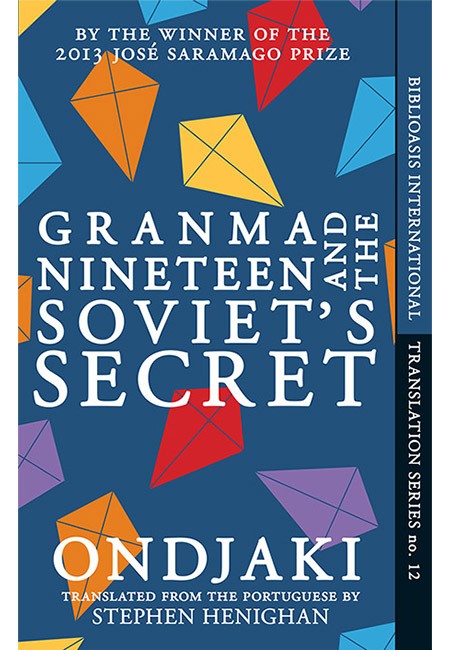
Ondjaki, Granma Nineteen and the Soviet’s Secret (2008; trans 2014)

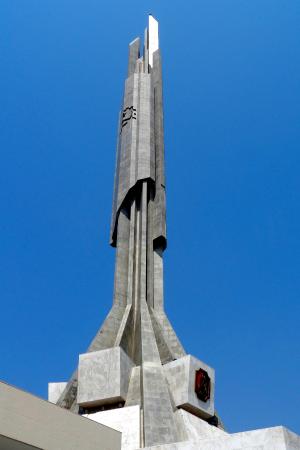
9781927428658.Cover_-450x650Granma Nineteen and the Soviet’s Secret by the Angolan Ondjaki is one of those books I picked up for the Speculative Africas project because it sounded like it might be sf. It isn’t. At least not in any straighforward sense. But it is one of the best books I’ve read this year, and there is something fantastical about it. And it features the astonishing mausoleum of António Agostinho Neto, which I have become mildly obsessed with since seeing photos of it in Kiluanji Kia Henda Icarus 13 installation.

The novel is set sometime in the early 1980s: Reagan is in power in the US; Jackie Chan’s The Big Brawl has reached Angola; and the mausoleum-of-agostinhomausoleum of Angola’s first president is under construction. (In reality, it ground to a halt because Neto’s successor, Jonas Savimbi, was a member of UNITA, backed by South Africa, rather than of Neto’s Soviet- and Cuban-backed MPLA. (There was a third-side in the post-independence civil war, the Mobutu-backed FNLA.) During Savimbi’s thirty year reign, he saw no reason to support its completion, and the possibility of further Soviet financing collapsed with the end of the Cold War. When the MPLA regained power in 2008, they used oil revenue to complete the structure on a much less grand scale than initially planned, and it was inaugurated in 2012, on the ninetieth anniversary of Neto’s birth. (See, I told you, mildly obsessed. Back to the book.))

It starts with an explosion in the sky over polyglot Bishop’s Beach, next to the mausoleum’s constructions site, that

woke up even the birds asleep in the trees and the dozy fish in the sea. Colours came out that had never been seen before: yellow mixed with red pretending to be orange in a bluish green, flares that mimicked the strength of the stars reclining in the sky and a warlike rumble of the kind made by the MiG planes. In the end it was a beautiful explosion that lingered in the noises of the pretty colours that our eyes looked upon and never again forgot. (9)

This is the first of several synaesthetic prefigurations – where colours and sounds get jumbled, as do birds, fish, kites and stars – in the initially episodic account of everyday life in the Bishop Beach. The cast of characters include the young protagonist’s several abuelas (Granma nineteen is not his nineteenth Granma – when Dr Rafael KnockKnock amputates her toe, she is left with nineteen digits and a new nickname); his friends Charlita and 3.14, whose real name, Pinduca, was first shortened to Pi; Comrade Gas Jockey, who faithfully, if lethargically, mans the local petrol station even though there is never any petrol; Sea Foam, who is more mad than wise, but sometimes it seems the other way around; and Soviet Comrade Gudafterov, really called Bilhardov, who is in charge of the blue lobsters, as the children call the Russian troops, and who longs to return to his snowy homeland. All of these characters have stories, and Ondjaki laces his story with glimpses of this much-storied world:

Granma Agnette … sang the music of slow Fado tunes, adapted to put us to sleep, and nobody slept. She told crazy stories about her friend Carmen Fernández who had become pregnant, but had given birth to a huge bag of ants that bit the inside of her stomach. The second time she got pregnant she finally had a baby, but it had the head and wings of a bird and, as the window was open, it flew away and escaped. Granma said that Carmen Fernández was afraid of becoming pregnant a third time, but even then we didn’t fall asleep. Then Granma started with her threats. (26)

When the young protagonist learns that Bishop Beach is going to be demolished, their houses ‘dexploded’, to make way for the elaborate grounds around the base of the mausoleum, he and 3.14 decide their only course of action is to beat the builders to it – they must steal dynamite from the construction site and blow up the mausoleum instead.

This slender narrative is made delightful by comical encounters and episodes; a bittersweet treatment of the civil war, which the children do not quite get; a romance which they do not quite perceive, either; by references to Brazilian soap operas and popular movies; and by a linguistic playfulness in which ‘gangrene’ can be misheard as ‘gangrenades’ and Sea Foam can persuasively argue that the sky is occasionally lit up by ‘fouling stars’:

a phenomena of the skies of the dark universe, the cosmic dust and so on… there are two skies: the blue sky that belongs to our eyes and to the wings of planes and little birds. And then there’s a black sky that’s as big as a desert. … Fouling stars melted in the heat of the sun and that’s why they fall towards planet world. Our planet is the only one that has water where they can cool down again. They’re fouling stars, and one day, after cooling off, I swear, those stars are going to want to return home … We’re still going to see those stars rise up from the earth to way up there, in the skies that sleep far away dressed in bright brightnesses… (12)

Needless to day, it offers an alternative explanation as to why work on the mausoleum stopped in the early eighties. A happier, if not entirely happy, one. And it is appropriate that such poetry surrounds the mausoleum of a president who was once a poet, even if he is not actually buried there.


Memory Palace

Kunzru1

From 18 June to 20 October 2013, the Porter gallery in London’s Victoria and Albert Museum was home to Memory Palace. Sponsored by Sky Arts Ignition, it is the first graphic arts exhibition at the venue in over a decade. It features one eponymous novella by Hari Kunzru (published separately) and twenty installations by as many artists or studios, and attempts to see “how far [you can] push the format and still call it a book,” to provide “an experiential reading format for a story,” to “create an exhibition that can be read’ (Newell and Salazar, “Curating a Book,” Memory Palace 84, 85). It is also a work of sf.

Curators Laurie Britton Newell and Ligaya Salazar commissioned Kunzru to outline a story that would then be developed in collaboration with the artists, who would be co-creators rather than mere illustrators: Abäke, Peter Bil’ak, Alexis Deacon, Sara De Bondt studio, Oded Ezer, Francesco Franchi, Isabel Greenberg, Hansje van Halem, Robert Hunter, Jim Kay, Johnny Kelly, Erik Kessels, Na Kim, Stuart Kolakovic, Frank Laws, Le Gun, CJ Lim, Luke Pearson, Stefanie Posavec, Némo Tral, Henning Wagenbreth, Mario Wagner, and Sam Winston. This process is recounted in Hunter’s dialog-free, short graphic comic, “Making Memory Palace,” appended to Kunzru’s novella.

The British-Indian Kunzru, a former magazine journalist, who wrote about travel, music, culture, and technology, is, like David Mitchell, one of that generation of authors relatively untroubled by genre-policing. His second novel, Transmission (2005), is about a computer virus, and reads like a slimmed-down, nearer-future version of Ian McDonald’s River of Gods (2004) spliced together with one of William Gibson’s Bigend novels; his fourth and most recent novel, the historically-sprawling Gods without Men (2012), includes UFOs and aliens, kinda. A rather trendy literary author, his first novel, The Impressionist (2003), attracted a £1 million+ advance, and he has won several major awards and prizes. The central concerns of his particular brand of popular, not exactly demanding postmodernism, sometimes described as “hysterical realism” or “translit,” are non-linearity and connectivity. Kunzru’s commissioning by Sky Arts is, then, relatively unsurprising (especially as he also used to be a presenter on The Lounge, Sky TV’s own electronic arts program).

His co-creators are rather less well known. Intriguingly, in their brief biographies at the end of the Memory Palace book, not one of them self-describes as an artist. They are all graphic designers, graphic artists, typographers, illustrators, comics artists, book designers, creative directors, art directors, editors, and/or architects. One is left with a strong sense of a smug and slightly shadowy commercial world of professionals, talented but perhaps a bit glib, for whom this is just another commission to be turned in on budget and on time. This perhaps explains why the exhibition’s satirical attack on neo-liberal hegemony and state-imposed regimes of austerity and amnesia is so muted.

Kunzru’s novella, Memory Palace, is set in a post-apocalyptic London. A magnetic storm destroyed the global information infrastructure and brought the Withering, a post-literate Dark Age of totalitarian theocracy, in which Westminster is known as Waste Monster, and other moderately amusing sub-Riddley Walker (1980) wordplay thrives. The Thing (as the council of leaders is known) wants to bring about the Wilding, a future in which the remnants of humanity will live in harmony with nature. The Thing has outlawed writing and recording, thereby criminalizing the Memorialists, those who are devoted to collecting and recollecting the past, whom they now hunt. Appropriately, then, the story, while nicely written and more than competent, stirs with faint echoes: of post-apocalyptic fiction by John Wyndham, John Christopher, and Walter M. Miller; of the television series Survivors (UK 1975-1977) and the coda to the film Threads (Jackson UK/Australia/US 1984); of M. John Harrison’s seedy bedsit entropy, China Miéville’s rejectamentalism, and Evan Calder Wood’s salvagepunk.

The book version of Memory Palace is, as one would expect from such a project, a gorgeous object, lavishly illustrated with selected work from the exhibition and pictures of the physical and electronic installations. If you have read the book, though, the exhibition itself is a little disappointing (I cannot gauge what it would be like to see the exhibition before, or without, reading the book). Le Gun’s life-size model of what someone from the post-apocalypse imagines an ambulance to have looked like – part medicine show, part museum of curiosities, drawn by wolves and driven by a Día de Muertos cross between Baron Samedi and the Child Catcher – is impressively detailed,kunzru2 as is Jim Kay’s reliquary cabinet devoted to Milord Darwing, the author of Origin of the Species (1859), who is misremembered as a rogue GM scientist. In contrast, Oded Ezer’s eight short films, looped on eight separate screens, are all concept with little art, and Erik Kessel’s enormous temple built from bundles of newspapers and advertising fliers, recalling the pre-apocalyptic religious ritual of aakgo9fm2Recycling, has even less art and barely even a concept. The more straightforward illustrations – whether blown up on large light boxes (Tral), arranged in a narrative thread on a white wall so you have to move to follow them (Pearson), or presented on zinc letterpress plates (Winston) – do benefit from exhibition. And it is quite pleasing – after all the corporate profligacy, the privatization and militarization of public spaces, the peonage of cleaners and others, the jingoism and spitefulness, that the London Olympics involved – to see the stadium reduced to slums (Tral) and Anish Kapoor and Arups’ 115-meter tall ArcelorMittal Orbit, a kind of flying spaghetti Eiffel Tower, being ceremonially burned to the ground (Greenberg).

Newell and Salazar write that “Unlike reading a printed book, visiting an exhibition is not usually a linear experience” (85). In this case, however, the layout of the space, and the clearly marked entrance and exit, do produce a linear exhibit, whereas reading the book, with its out-of-order narrative and illustrations that tempt one to flick back and forth between them, is more successfully non-linear. Consequently, I would recommend the book over the exhibition, especially as it is available from online stores for less than £10, and unless you live in South Kensington (or “South Keen Singtown,” as it will be known during the Withering), getting to and seeing the exhibition will cost you more than that.

A version of this review appeared in Science Fiction Studies 121 (2013), 596–8.

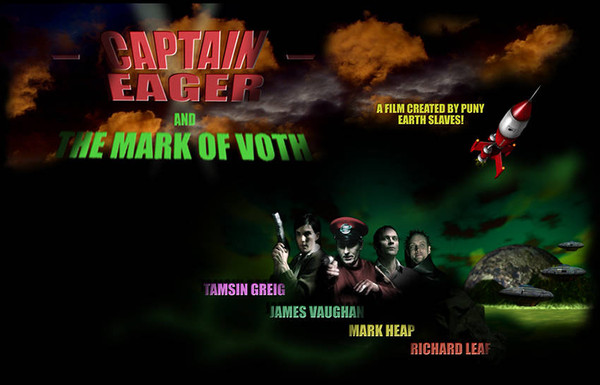
Captain Eager and the Mark of Voth (Simon Davison UK 2008)

1245944274441Curiously, this low-budget movie has all the hallmarks of many a major sf blockbuster. Based on a pre-sold property, it is greenscreen- and CGI-heavy. It assumes that individual shots are more important than narrative or character arcs, and that the incoherence of its plot not only does not matter but is actually something to boast about. It trades in nostalgia for a lost patriarchal and imperialist order misrepresented as an age of certainty and fairness, while gently chiding, with no real conviction, neo-liberal globalisation. It is dull-witted and charmless, and it thinks it is funny. All at a fraction of the cost.

Square-jawed space hero Captain Eager (James Vaughan) is summoned out of retirement by middle management at Macrospace, the interstellar corporation that has taken over everything (they provide ‘infrastructure and marketing’ and thus have turned every conceivable location into a ‘sterile retail opportunity’). Eager’s mission – whatever it actually is; the film is deliberately obscure – almost fails to get off the ground because Shiobhan in Personnel (Laura Clarke) casts doubts on the suitability of the balding, greying, paunchy protagonist and his old-fashioned rocketship-shaped rocketship, the Victory. Further complicating matters is the vengeful Colonel Regamun (Richard Leaf), who has concocted an absurdly elaborate scheme to: 1) drain the lifeforce from the minds of the alien Panvolkians so as to make himself immortal; 2) turn the now-mindless Panvolkians into slave labour; and 3) kill Eager, who he blames for the deaths of his family in a long-ago war. Various poorly-paced shenanigans ensue. Limply. For a seemingly endless ninety-five minutes. Which may, or may not, be deliberate.

Captain Eager is conceived as a parody or pastiche of – or perhaps even a satire on – 1950s and 1960s sf film, television and comics, particularly Frank Hampson’s Dan Dare, created for the Eagle comic in 1950 and set in the late 1990s. However, the film falters because it is either not familiar enough with this source or fears that its potential audience would not be (for example, The Victory looks nothing like the Anastasia or any of Dan Dare’s other spacecraft, more closely resembling a cross between Thunderbird 3 from Gerry Anderson’s Thunderbirds (1965–6) and the rocket that took Hergé’s Tintin to the moon a decade earlier in Objectif Lune (1953) and On a marché sur la Lune (1954)). Consequently, Captain Eager flounders around rather indiscriminately, looking for other things to parody/pastiche/satirise: sliding spaceship doors, clearly made of wood and painted to look like metal, do not open properly; sets made out of painted flats get knocked over; and so on. The film even boasts that it is shot in ‘Card-o-Scope’ and that CGI stands for ‘Cardboard and Gum Imagery’. This not-exactly-nostalgia does lead to the film’s several quite good jokes: Regamun’s Ming-the-Merciless-inspired collar gets in the way every time he turns his head; when Eager and Jenny enter the darkened Victory, Eager turns on the light to the sound of a pull-cord switch echoing in a bathroom. There is also a wry pleasure to be derived from the design of certain vehicles: Eager’s eventual triumph depends upon him flying a battered old Mark 1 spacecraft, which resembles an Avro Vulcan bomber, a triumph of 1950s British aeronautical engineering, and then a glider that recalls the Colditz Cock, a home-made glider constructed by British POWs and featured in Colditz (1972–4). Such amusing moments, however, are also indicative of the film’s conceptual and tonal uncertainty, caught between recalling a 1950s vision of the future and a folk memory of the actual 1950s (and 1960s and 1970s, and 1940s).

Other revisions of Dan Dare have likewise struggled with how to update its upright protagonist. For his intermittent, downbeat and punkish appearance in 2000 AD in the late 1970s, he was thrown, via suspended animation, 200 years further into the future, where he bore no real resemblance to Hampson’s character other than a tendency to answer to the same name. When Eagle was relaunched in the early 1980s, it featured the adventures of one of Dare’s descendants (and quite bizarrely retconned the original Eagle’s stories, recreating that Dan Dare as a World War II veteran timeslipped into the 1990s, so as to explain the survival of his peculiarly mid-century Britishness at the turn of the millennium). About halfway through its run, the strip became more violent, with Dare recast as a space marine. Garth Ennis and Gary Erskine’s Dan Dare (2008) is the most successful attempt to visualise a plausible-seeming future in which, after a Sino-American nuclear war, Britain is once more the leading world power, with its navy dominating the solar system. This seven-issue miniseries introduces an older, traumatised and largely forgotten Dare (he inhabits a virtual-reality reconstruction of an idyllic village, and in reality apparently ‘sees’ the delta-wing Starfires as more Spitfire-like spaceships) to inject elements of the mythical 1950s which shaped Hampson’s fictional 1990s, while also incorporating the violent space marine adventures of the hero’s later iterations. It also contains political satire (nothing so pointed or scurrilous as Grant Morrison’s Dare (1990), though), with a Blair-like Prime Minister betraying humanity to the Mekon – fairly mild stuff until compared to Captain Eager’s toothless whining about megacorporations, the metric system and all this other new-fangled stuff, including digital technology. The latter is, of course, rather ironic, given Captain Eager’s own dependence on such technology, sometimes deploying it, humorously I’m sure, to create images of analogue technology. But Captain Eager is not the kind of film to think things through (for example, Eager’s communicator rings – hilariously – like an old-fashioned dial telephone, but the joke is rather undercut by the existence of real-world cell-phone ringtones that make the same noise).

The performances are rather a mixed bag, too. Lindsay Carr brings some life to Carmina, a caricature vamp with a heart of gold. As Scrutty Baker, Mark Heap, familiar from such offbeat sitcoms and comedy shows as Brass Eye (1997–2001), Big Train (1998–2002), Spaced (1999–2001), Jam (2000) and Green Wing (2004–6), adds a Gollum-like twist to his contorted, constrained, socially awkward persona, but has no room to do anything interesting with it. The suggestion that Scrutty’s repeated betrayals stem from consciously suppressing his sexual desire for Eager is merely an ambiguous throwaway line that fails even to work as commentary on Digby’s homosocial attachment to Dare in Hampson’s comic; consequently, Scrutty becomes just another mildly offensive depiction of homosexual-as-dishonest-misfit. Tamsin Grieg, however, gives a pitch-perfect, subtle and sure performance, and is really the only reason to keep watching the film. Those familiar with Grieg from the sitcoms Black Books (2000–4) and Green Wing will immediately recognise and relish her bright, brittle Jenny, brimming with deep emotions she cannot quite express. Although clearly smarter than everyone around her, she is not exactly Hampson’s Professor Jocelyn Peabody. Jenny displays ‘tremendous pluck’ and, when it comes to a scrap, she is extremely handy with her fists (and unexpectedly good at headbutting). But she also always carries a hanky in her cardigan pocket. She alone is worth the price of admission (especially as the film is now available free via http://www.captaineager.com).

A version of this review appeared in Science Fiction Film and Television 5.2 (2012), 315–7.

The City in Fiction and Film, week five

Ratcatcher_filmWeek four

This week, a lot of people, mostly children, died.

That is, this week we watched Ratcatcher (Lynne Ramsay 1999) and read chapters 5-7 of Elizabeth Gaskell’s Mary Barton: A Tale of Manchester Life (1848). And we did so through a (more or less) structuralist lens, so as to consolidate and build on the semiotic theory and terminology from the last couple of weeks.

So we began with revisiting the relationship between parole and langue, and thinking about how the latter structures the former. Borrowing from Lois Tyson’s not-entirely-accurately-subtitled Critical Theory Today: A User-Friendly Guide (1999), we looked at how utterances such as

tree appears green
Susan is tall
dog runs happily
clouds roll ominously
wisdom comes slowly

share the same parts of speech

noun, verb and descriptor (adjective or adverb)

and the same rule of combination

subject and predicate

So we moved from surface phenomena with very different meanings to the structures that make them comprehensible. We then refreshed our memories about the syntagmatic and paradigmatic axes of language, turning once more to an example from the first episode of Sherlock, in which Holmes is confronted by the word

RACHE

scratched in the floor by the victim. To fathom its meaning he changes paradigm, trying other languages until he finds one in which it is a word (‘revenge’ in German). And then he returns to English and scrolls through another paradigm, letters that could be placed at the end of the sytagm to make a word, until he comes to L and spells

RACHEL

So once more, the relationship between surface phenomena and the (potential) structure(s) underpinning it are made clear. After which we returned to some key sentences from our Sherlock and ‘The Blue Carbuncle’ examples from last week

‘How did you know I had a therapist?’
‘This hat is three years old. These flat brims curled at the edge came in then.’
‘his wife has ceased to love him’

and reconstructed Holmes’s reading of connotations in terms of the codes on which they draw, the myths they reiterate and the ideology they construct/articulate. (For the time being we are leaving ‘ideology’ dangling a little, defined as nothing more complex than ‘knowledge in the service of power’, which is already turning out to be more complex than I thought this simple definition would be…). So again, we move from surface to structure.

Next we turned to some new material, beginning with a brief description of Vladimir Propp’s formalist analysis of Russian folktales in Morphology of the Tale (1928), which finds the same recurring structure of 31 narrative ‘functions’ and seven character types in all the tales in his sample. We also thought about some of the problems with such methodologies – the violence they do to the narratives under consideration by treating the surface level of detail as somehow irrelevant, the violence that is done to narratives to force them to fit a predetermined pattern imposed by the critic. (One student was quite familiar with Propp, having encountered him on A-level Film Studies and being required – to my quiet horror – to undertake  a Proppian analysis of Fight Club (Fincher 1999), which is of course structured exactly like a centuries old oral tale from another culture thousands of miles away. Others had  heard of Joseph Campbell and the monomyth – undoubtedly the fault of George Lucas – but fortunately it didn’t seem appropriate to get into it too much in class, because it would have taken a while to get through the fundamentally racist logic underpinning the method. Maybe next year, in the module on genre theory and fantasy.)

We then took a look at James Damico’s 1978 description of the structure of a film noir:

Either because he is fated to do so by chance, or because he has been hired for a job specifically associated with her, a man whose experience of life has left him sanguine and often bitter meets a not-innocent woman of similar outlook to whom he is sexually and fatally attracted. Through this attraction, either because the woman induces him to it or because it is the natural result of their relationship, the man comes to cheat, attempt to murder, or actually murder a second man to whom the woman is unhappily or unwillingly attached (generally he is her husband or lover), an act which often leads to the woman’s betrayal of the protagonist, but which in any event brings about the sometimes metaphoric, but usually literal destruction of the woman, the man to whom she is attached, and frequently the protagonist himself.

This structure – derived from James M. Cain’s novels The Postman Always Rings Twice (1934) and Double Indemnity (1936), but already broadly familiar from, for example, Hardy’s Tess of the d’Urbervilles (1892) and Zola’s Thérèse Raquin (1867) – can be found in Double Indemnity (Wilder 1944), The Woman in the Window (Lang 1945), Scarlet Street (Lang 1945), The Killers (Siodmak 1946), The Lady from Shanghai (Welles 1948), The Postman Always Rings Twice (Garnett 1946), Out of the Past (Tourneur 1947), Pitfall (De Toth 1948) and Criss Cross (Siodmak 1949), and with variations in Murder, My Sweet (Dmytryk 1944), The Strange Love of Martha Ivers (Milestone 1946) and The Blue Dahlia (Marshall 1946). It mutates and collapses in In a Lonely Place (Ray 1950) and is anticipated by The Maltese Falcon (Huston 1941).

And since we watched the latter just a couple of weeks back, we were able to see how well – or poorly – it matches Damico’s narrative structure, and the violence that needs to be done to the film in order to make it fit.  Which was a useful exercise in reminding us that surface is as important as – if differently important to – structure. (Damico also gave us the opportunity in passing to think about how genre definitions work to privilege certain texts and marginalise others,  reorganising our understanding of groups of relatable texts rather than telling us some fixed truth about genre. But that was me wandering off topic a bit.)

From shared narrative structure we moved onto structuralist thinking about binary oppositions – and to run through this idea we left the city behind for a while and headed out west, as Jim Kitses’s Horizon’s West (1969) contains that fabulously useful (if problematic) discussion of the western in terms of the generative conflict between wilderness and civilisation (and 20 other related oppositions).

And (finally) this brought us to the series of oppositions I asked the class to think about while watching Ratcatcher:

city vs. country
urban tenements vs. suburb/new estate
male vs. female
adults/parents vs. children
rich vs. poor
English vs. Scots
freedom vs. confinement

The class were pretty quick to spot the ways in which most of these categories map onto each other, linking the urban tenement with varieties of confinement and the new estate out in the countryside with freedom: playing on piles of garbage vs. playing on a construction site; flats off shared stairwells vs. individual houses with interior staircases; outside loos and tin baths on the kitchen floor vs. fully plumbed inside bathrooms; the view out of the window onto a dirty dangerous canal vs. the view out of the window onto a rather improbably golden field; looking out of windows vs. climbing out through windows; etc – all  of which is peculiarly echoed in the odd digression about the mouse launched into space finding a new home safe from the cruelty of young boys among a community of mice (which is surely a Clangers homage).

And then there were the wealthy English represented by the received pronunciation of the television news reporters commenting on the dustmen’s strike and the filthy conditions the people of Glasgow endure vs. the actual characters whose lives disrupt this patrician colonial perspective upon them.

Then we turned to Mary Barton.

Chapter 5 begins with a passage that introduces two key oppositions: appearance vs. reality and the individual vs. the mass. Gaskell’s narrator describes the working class Mancunian men who defy middle class expectations (and the tendency to lose particularities when you homogenise people as members of a class) by being skilled mathematicians, botanists and entomologists (and should we doubt it, she invokes a partially-remembered record of botanist Sir JE Smith finding himself dependent on a porter and a hand-loom weaver for advice on a rare specimen he sought).

Margaret Legh brings her friend, Mary Barton, home to meet one such amateur natural historian, her father Jacob. It seems odd at first, but this encounter, focalised through Mary, throws out scientific imagery in favour of something more alchemical, comparing Jacob to a wizard, speaking of the uncanny, the cabalistic, the mysterious. Having just hinged the credibility of her fictional account around a real historical event, Gaskell switches genres, drawing on something closer to the gothic romance. Opposing science and superstition in this way reinforces the common cultural opposition of masculine rationality and feminine fancifulness. In the following pages, a recently widowed woman is described as lacking foresight when she borrows heavily so as to be able to bury her husband, and Margaret, who is losing her eyesight, faces a similar charge because she continues to take in sewing – especially since there are a lot of deaths this winter, which involves sewing black cloth with black thread, straining her eyes even further. Mary’s own romantic fantasies of marrying the wealthy mill-owner’s son (who is courting her but with no such honourable intention) in the hope of finally being able to provide properly for her own unemployed father is contextualised, at the end of chapter 7, in terms of reading too many cheap romances and is described with reference to the Arabian Nights and in terms of building castles in the air.

But we have leapt ahead.

On meeting Jacob, Mary is told the story of how one day he bought from a sailor a scorpion, apparently frozen to death, that when placed without thinking in front of the fire came to life (Jacob managed to kill it by putting it in a pan of boiling water, and then preserved the remains). This peculiar anecdote – for which the chapter up until that point is merely laying the groundwork – leads nowhere in narrative terms, but introduces further oppositions (fire and water, hot and cold, life and death, and once more appearance and reality). It also foreshadows events: the chapter will end with a perilous fire that burns down the mill, and in chapters six and seven Ben Davenport and Joe and Will Wilson die of cholera, burning up with fever.

Soon after the anecdote, there is a paragraph describing a winter so cold that it is impossible for poor people to find liquid water – the icy landscape is deathly, and it seems as if it will go on for ever, a kind of inverse of the scorpion story. And it is the cold that freezes the standing pipes which prevent the fire crews from being able to bring the blaze under control. This paragraph leads into conversations about mourning and death (and economics) and blindness and insight and darkness and light.

The crowd who gather to witness the blaze are described as a mindless, unruly mass – for all her sympathy for the poor, Gaskell seems terrified of the mob and despises working class political organisation and action. But a mass in which, once more, individuals are made to stand out – Magaret and Mary in particular. And there is a curious parallel between the crowd behaving as an unconscious mass, impelled here and there by a kind of mindless subordination to a collective desire for spectacle, and Mary, who in their midst faints – loses consciousness.

Chapter 6 returns to the crowd, when Mary’s father, John Barton, on a mission of mercy is made furious by the apparent unconcern of the people he passes. And yet at the same time, he recognises that he is being unjust, that he cannot tell the first thing about them or the realities of their lives just by looking at them.

The main oppositions in this chapter map class difference onto verticality (and reinforce it with warm/light/dry vs cold/dark/damp).

Barton is summoned by a friend to the aid of Ben Davenport, who has been out of work since the mill burned down. The mill-owners, the Carson family, talk about the need to tighten their belts, but frankly they are glad the fire happened – they are insured, their machinery was out of date and needed replacing, and as the market is not that good, they are relieved to not have any expenses, such as wages. The mill-workers, on the other hand, have nothing, and many are starving. Barton descends into the narrow well between the the filthy street and the housefrony, into which mud and sewage is leaking, and from there down another step into a cellar room that never gets much light (the windows are broken and stuffed with rags, anyway); the mud and sewage is also seeping up through the floor. There is no fire, nor is there any food for the children. Davenport is near death. His desperate wife, who still suckles one of her children even though he is too old and she is barely able to produce any milk, is repeatedly described as death-like, cadaverous. Davenport is spoken of as having sunk down in the world; later, he will sink into death.

Barton’s mission of mercy takes him first to a pharmacist – the night-time shop-windows are full of commodities, perfectly lit to make them seem even more desirable, and again there is a sense of a fantastical world parallel to all this misery – and then the next day to the Carson’s house, which is brightly lit, with blazing fires and plentiful food and drink.

Carson bemoans his loneliness – only the youngest of his daughters stayed home to keep him company the previous night, and this morning the others are all also late to rise after their late night out at the assembly rooms. The youngest daughter puts her hands over her father’s eyes, mocking Margaret’s impending blindness, just as Carson’s loneliness mocks the isolation of so many of the working class characters.

Although the Carsons’ house is above ground, there is no great emphasis on it being higher than the Davenport’s – as in the spatialisation of class evident in sf films such as Metropolis (Lang 1927) and Blade Runner (Scott 1982) – but its vertical distinction is, as already noted, made clear at the end of chapter seven. It is part of the castle in the air that Mary’s romantic fancy builds.

Recommended critical reading
Barry, Peter. Beginning Theory: An Introduction to Literary and Cultural Theory. 3rd ed. Manchester: Manchester University Press, 2009. See chapters on structuralism, Marxist criticism and feminist criticism.
Eagleton, Terry. Literary Theory: An Introduction. 2nd ed. Oxford: Blackwell 1996. 79–109.
Hawkes, Terence. Structuralism and Semiotics. London: Routledge 1977.
Scholes, Robert. Structuralism in Literature. New Haven: Yale University Press, 1975.
Stam, Robert, ed., New Vocabularies in Film Semiotics: Structuralism, Post-Structuralism and Beyond. London: Routledge, 1992. See part III , “Film Narratology,” especially 77–85.
Tyson, Lois. Critical Theory Today: A User-Friendly Guide. London: Routledge, 1998. See chapters on structuralist criticism, Marxist criticism and feminist criticism.
–. Using Critical Theory: How to Read and Write About Literature. London: Routledge, 2011. See chapters on Marxist theory and feminist theory.

Recommended reading
Novels concerned with urban poverty and class structures include Émile Zola’s L’Assommoir (1887), Stephen Crane’s Maggie: A Girl of the Streets (1893), Frank Norris’s McTeague: A Story of San Francisco (1899), Theodore Dreiser’s Sister Carrie (1900), Upton Sinclair’s The Jungle (1906), Robert Tressell’s The Ragged Trousered Philanthropists (1914) and Walter Greenwood’s Love on the Dole (1933).
H.G. Wells’s The Time Machine: An Invention (1895) contains a science-fictionalised vision of class difference.
Jack London’s The People of the Abyss (1903) and George Orwell’s Down and Out in Paris and London (1933) and The Road to Wigan Pier (1937) combine autobiographical writing with sociological reportage about living in poverty.

Recommended viewing
There is a long tradition of British social realist films about working class and lower middle class life, often in provincial towns, including such British New Wave films as Room at the Top (Clayton 1959), Saturday Night and Sunday Morning (Reisz 1960), A Taste of Honey (Richardson 1961), A Kind of Loving (Schlesinger 1962), The L-Shaped Room (Forbes 1962), Billy Liar (Schlesinger 1963) and This Sporting Life (Anderson 1963), all of which were adapted from novels or plays.
Later social realist films include Kes (Loach 1969), Nil by Mouth (Oldman 1997), Red Road (Arnold 2006) and Fish Tank (Arnold 2009).
A lighter tone can be found in Brassed Off (Herman 1996), The Full Monty (Cattaneo 1997), Billy Elliot (Daldry 2000), Son of Rambow (Jennnings 2007), Made in Dagenham (Cole 2010) and Pride (Warchus 2014).
Groundbreaking television series that pushed the limits of social realism are Jim Allen’s Days of Hope (1975), directed by Ken Loach, and Alan Bleasdale’s Boys from the Blackstuff, directed by Philip Saville.

Week six

South Wales is weird. And fantastical.

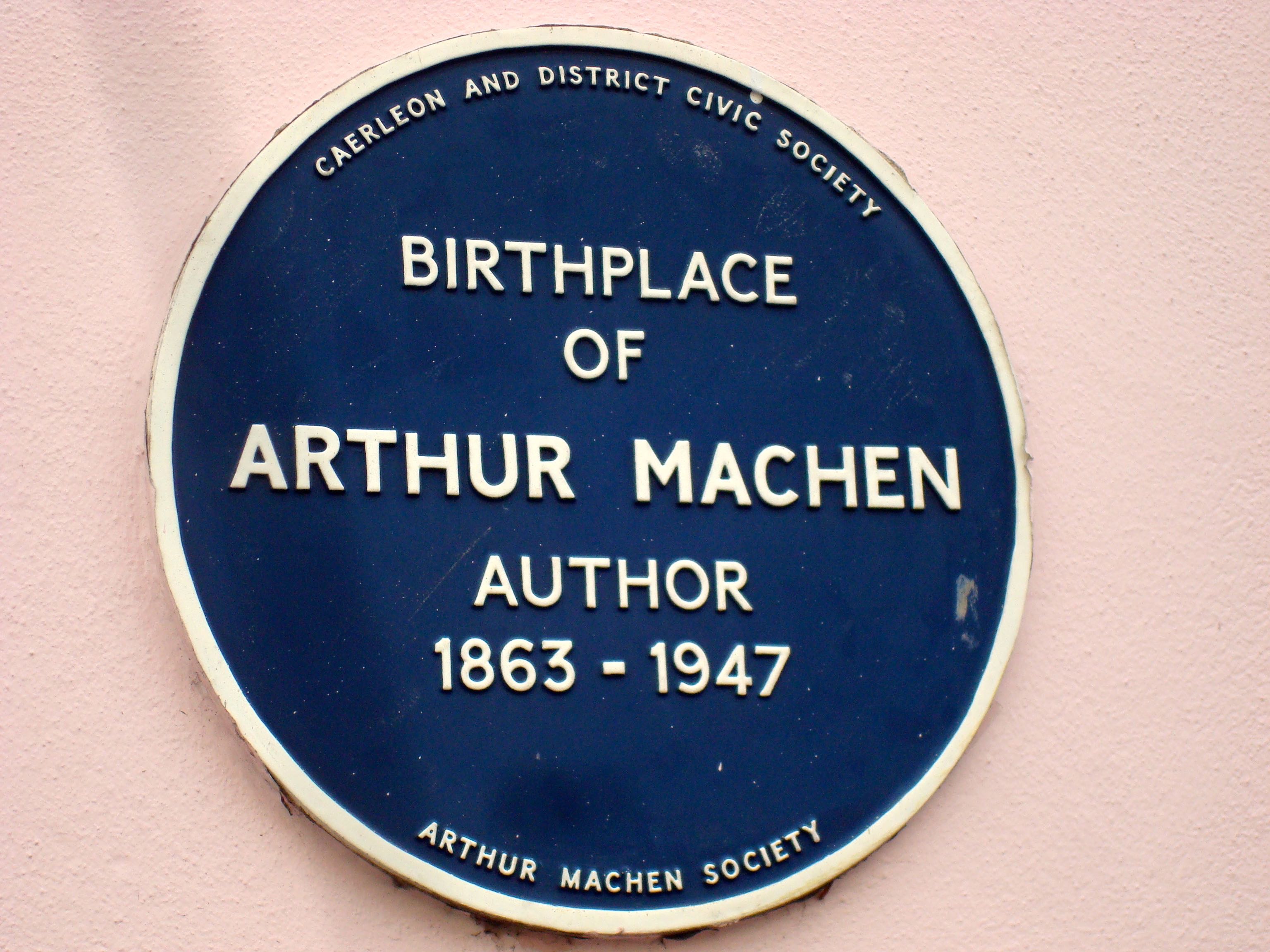
We had some time to kill before the Thee Faction and Helen Love (and others for We Shall Overcome) gig in Newport, so we nipped over to Caerleon to see the amazing Roman ruins. We did not expect to find this:

wales 1

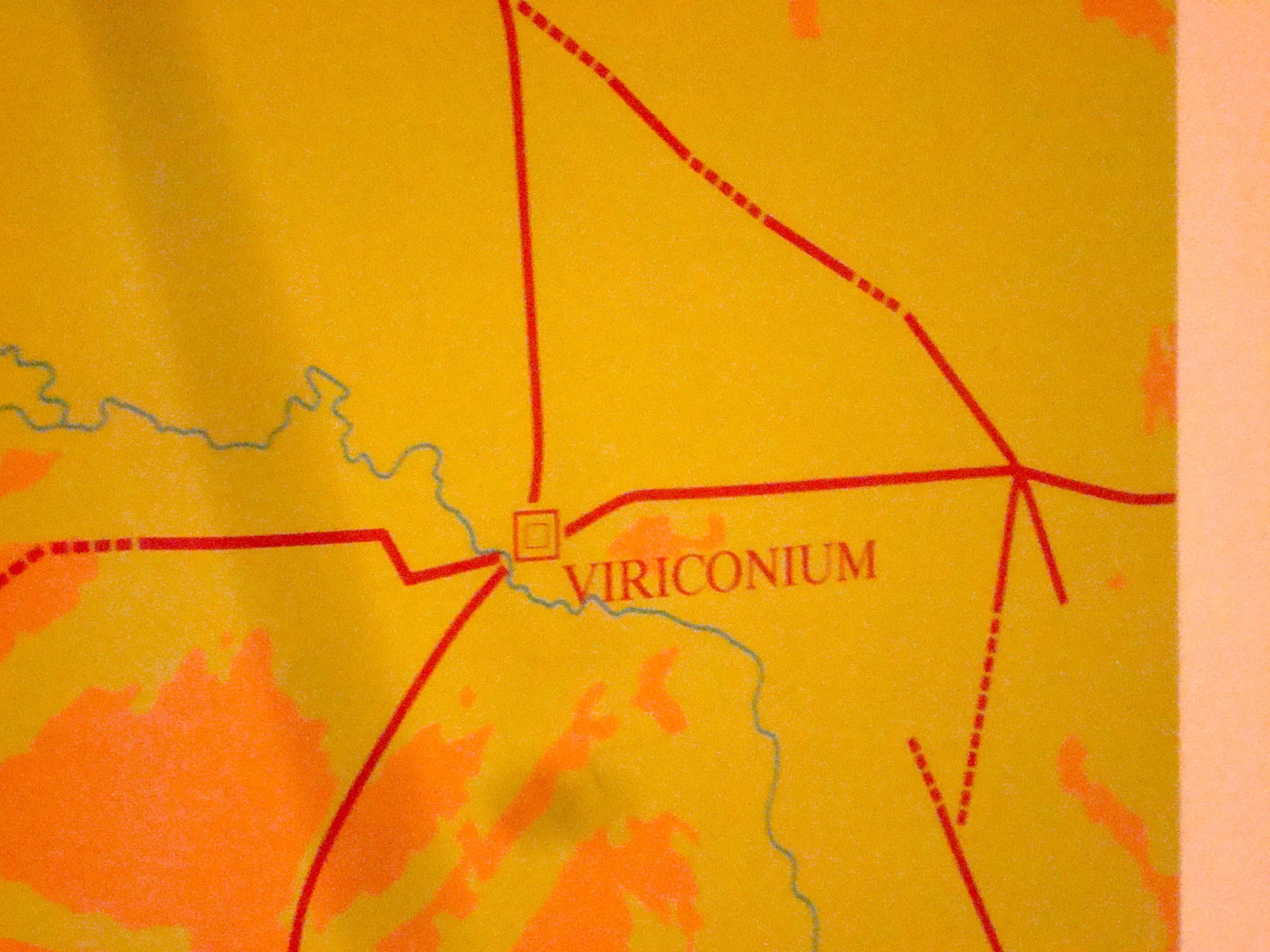
Or, on a map in the museum, to find this:

wales 2

To be honest, this was probably a different guy by the same name:

wales 3

Few things are more weird, though, than putting up a plaque to remember resistance to the Chartists:

wales 4

Before leaving for our walk back to Newport, we thought we’d have a pint. Not expecting the pub we ended up in to be one where this once happened:

wales 5

A lovely afternoon full of surprises. And the gig was even better. Once Thee Faction got on the stage. And then Helen Love.


The City in Fiction and Film, week four

SH_BLUE-01One of the many other things to take into account when designing a coherent degree programme is when and where to fit in all the other things that a HEI is now often expected to provide during scheduled classes – things like study skills, careers, etc, etc. So rather than screen a film this week, this module was responsible for the first library training session, beginning with basics (such as where the library is and what resources and services it provides) and building up to a detailed online workbook (locating different kinds of sources, assessing their reliability, how – and why – to quote and/or paraphrase them, how to reference them, etc). The workbook takes maybe two hours to complete – and in a couple of weeks, students will have their first assignment – an online quiz that tests their knowledge of the library, referencing, etc. Our Faculty Librarian designs and presents this workbook and the quiz, and machines mark it for me!

Back in my day, you were given a library card and told the card catalogue was probably quicker to use and more reliable than the rather basic computer catalogue… Kids today, honestly they don’t know they’re born!

Class began with an informal test about all the semiotic terminology encountered last week – students were free to draw on any resources to help them reformulate the ideas in their own terms to a) probe their understanding of those ideas; b) probe the ideas themselves; and c) tame an alien vocabulary and make it useful.

Next, we took on the James Bond exercise we did not have time for last week. At the start of chapter 25 of Ian Fleming’s From Russia, With Love (1957), called ‘A Tie with a Windsor Knot’, Bond is joined on the Orient Express by psychopathic SMERSH assassin Red Grant posing as an MI6 agent sent by M called Captain Norman Nash. After an exchange of codewords, we are treated to a description of Nash through Bond’s eyes from which Bond extrapolates the character and life story of his new acquaintance. Several codes are evoked to suggest that Nash is untrustworthy or at least unseemly.

He has ‘thick lips’ which writhe briefly rather than forming a smile – whether a friendly greeting or an ironic grin at the ‘childish’ password ‘ritual’. Those lips suggest a racialised sensuality – rather than possessing the British character associated with a stiff upper lip, Nash has stayed behind in the Mediterranean after the war, to ‘avoid the rigours of England’ and to take a foreign girlfriend or marry an Italian.

It gets worse. Not only does he speaks with ‘a hint of … cheap brogue’, so perhaps his off-whiteness can be traced to Irish ancestry, his curious accent is probably also a consequence of speaking a ‘foreign language all the time’. He has simultaneously “gone native” and let the veneer of English civilisation slip sufficiently to reveal beneath it a not-Englishness. Perhaps that is why his calling card mentions his rank, Captain, and that he is a member of the RAC. They are desperate attempts to assert an identity he does not quite possess; and they give themselves  away as such to Bond’s trained – or perhaps merely bigoted –  eye.

Nash’s lips might be given to bestial writhing, but his eyes are at once dead – there is ‘no light in them’ – and a ‘very pale blue’, watery perhaps and lacking resolve. Certainly the career trajectory Bond imagines for him – from ‘minor public school’ (so not from one of the best English families, maybe even from an Irish family) through the Royal Engineers (perhaps not the most frontline of wartime active service, and a bit close to skilled manual labour) to stumbling into a position with MI6 because all the more senior and more qualified men returned to the ‘rigours of England’.

His clothing suggests some mismatching of colours – reddish-brown tweed, pale yellow shirt, blue and red regimental tie, a red bandana handkerchief (that flops out of his breast pocket), a ‘gold signet ring with an indecipherable crest’, a battered silver watch with a leather strap. And then there is that tie tied in a Windsor knot. To Bond, the knot signals Nash’s vanity; it is after all ‘the mark of the cad’ – and was in popular consciousness linked to Edward VII, who after his abdication was seen as a potential pretender to the throne (especially as he was not exactly as unsympathetic to Hitler as one might have hoped).

Throughout, the meanings generated by Nash’s appearance rely on the connotations evoked by specific word choices and combinations, which in turn rely on shared codes through which we understand those connotations. And we can push beyond codes to what Roland Barthes called ‘myth’ – especially around class, masculinity and the colonial imaginary – and thus to ideology.

As Jonathan Bignell explains, for Barthes, ‘myth’ refers

to ways of thinking about people, products, places or ideas which are structured to send particular messages to the reader or viewer of texts … Media texts often connect one signified idea with another, or one signifier with another, in order to attach connotations to people and things and endow them with mythic meaning. (Media Semiotics, 2nd edition, 16, 17)

Fortunately the British press, British Prime Ministers and Fox News never let you down when you want a contemporary examples, so we began by questioning why The Times (14 September 2015) described Jeremy Corbyn’s favoured mode of transport as a ‘Chairman Mao-style bicycle’. Why would a right-wing newspaper want to connect the new moderate centre-left leader of the Labour Party with the head of a brutal communist dictatorship?

We then took a look the first half at this segment from John Oliver, in which he explains why it is problematic for David Cameron to call refugees ‘a swarm’, and why Fox News cannot heavily imply all muslim men and/or refugees are terrorists while claiming that they are not implying precisely that.

In each of these examples, signifiers connote and those connotations draw upon and reinforce Barthesian myths. (We also took a look at Barthes’s own famous example of the Paris-Match cover in which a young black cadet salutes the French flag, thus apparently justifying colonialism.)

After all this (and a break!), it was time for some urban fiction, beginning with Arthur Conan Doyle’s ‘The Blue Carbuncle’ (1892) – the one in which a lost hat and abandoned Xmas goose lead Holmes to solve the theft of the eponymous gem. Our main focus was on the passage in which Holmes performs a semiotic analysis of the hat (though we also considered the simple techniques Doyle uses to persuade us of the accuracy of Holmes’s reading).

There were some indexical signs: several tallow splashes on the hat suggest its owner, Horner, lives in a house where gas-lighting has not yet been installed; and, more ridiculously, the size of the hat leads Holmes to conclude that Horner has a large head and therefore must be ‘highly intellectual’ – later, Horner’s mannered expression and use of the term ‘disjecta membra‘ will serve to confirm this absurdity. (The story was published the year before HG Wells’s essay ‘The Man of the Year Million’, which led to the design of his Martians and thus all those later big-brained aliens with puny bodies – so clearly something was in the air, not least because Horner is also sedentary and out of shape.)

There is also plenty of evidence of myth, as the connotations Holmes draws from his perusal of the hat reach out into the dimension of Victorian morality. Horner, who is no longer as foresightful as once he was, who has fallen on hard times, who  is not as attentive to his appearance as he used to be, and who has taken to drink, is obviously undergoing ‘a moral retrogression’ and has a ‘weakening nature’, though there are vague hopeful indications that ‘he has not entirely lost his self-respect’. In this aspect of Holmes’s analysis, meanings are converted into values – myth, and behind it ideology, in action.

This can be seen even more starkly in Holmes’s conclusion that Horner’s wife no longer loves him.

This hat has not been brushed for a week. When I see you, my dear Watson, with a week’s accumulation of dust upon your hat, and when your wife allows you to go out in such a state, I shall fear that you also have been unfortunate enough to lose your wife’s affection.

Patriarchy, anyone? Normative gender roles much? (It took mere seconds to come up with a half a dozen other reasons for Horner’s hat not having been dusted recently.)

We also took a quick look at the sequence from the first episode of Sherlock, in which Frumious Bandersnatch explains his initial reading of Bilbo’s character, history and current situation – culminating in a moment in which his reliance on heteronormative codes leads him to mistake the gender of his new friend’s sibling. (Other parts of his semiotic analysis were also questionable – were Iraq and Afghanistan really the only sunny places overseas British troops were stationed in 2009/10? why are scratches around the port on the phone evidence of the previous owner having a drink problem when we already know the current owner has a hand that sometimes shakes uncontrollably? Etc.)

We also took a look at the start of Holmes’ crime-scene analysis (damp clothes indexing rain, etc). And the handy bit when we see Holmes work along syntagmatic and paradigmatic axes to make sense of the victim’s message scratched in the floor with her fingernails: RACHE. In what languages is that a word? German, meaning revenge. Doesn’t seem very likely. What letter could be added to it to complete an English word? An L? Rachel! It’s a name. That’ll do nicely.

We finally took a look at William Gibson’s ‘The Gernsback Continuum’ (1981), but we were all flagging a little by this time. Its main significance for this class is twofold:

  • that there came a point – Gibson argues for the 1930s – when design started to dominate function in the construction of commodities and thus we started reorganising the way we purchase things in terms of their readable connotations;
  • and that that we live in built environments which are to varying degrees designed, and can thus be read for their meanings, which may well change over time. (And that all around us lurk semiotic ghosts.)