120 years of sf cinema, part three: 1935-1954

2015 marks the 120th anniversary of sf cinema. This is the third part of a year-by-year list of films I’d recommend (not always for the same reasons), and there are a few years where there is little to recommend for any reason.

Part one (1895-1914), part two (1915-1934) – both of which have lots of links to actual films rather than just occasional pictures…

1935Bride-of-Frankenstein1
Bride of Frankenstein (James Whale)
Kosmitchesky Reis/The Space Ship (Vasili Zhuravlev)
Mad Love (Karl Freund)

1936
The Devil Doll (Tod Browning)
Flash Gordon (Frederick Stephani)
The Invisible Ray (Lambert Hillyer)
The Man Who Changed His Mind (Robert Stevenson)
Things to Come (William Cameron Menzies)

Flash-Gordon-1936-great-old-show-to-watch-on-a-saturday-night1937
Q Planes (Tim Whelan, Arthur Woods)

1938
The Big Broadcast of 1938 (Mitchell Leisen)

1939
The Man They Could Not Hang (Nick Grinde)
Return of Dr X (Vincent Sherman)

1940
Before I Hang (Nick Grinde)
Black Friday (Arthur Lubin)
Dr Cyclops (Ernest B. Schoedsack)
The Man with Nine Lives (Nick Grinde)
Son of Frankenstein (Rowland Lee)

1941
Dr Jekyll and Mr Hyde (Victor Fleming)

1943
The Mad Ghoul (James P. Hogan)

1944
Time Flies (Walter Forde)
The Man in Half Moon Street (Ralph M. Murphy)

1949The_Perfect_Woman_FilmPoster
The Perfect Woman (Bernard Knowles)
Siren of Atlantis (Greg Tallas)

1950
Destination Moon (Irving Pichel)

1951
The Day the Earth Stood Still (Robert Wise)
Five (Arch Oboler)
The Man from Planet X (Edgar G. Ulmer)Gort
The Man in the White Suit (Alexander Mackendrick)
The Thing (from another World) (Christian Nyby)

1952
Monkey Business (Howard Hawks)

1953
The Beast from 20,000 Fathoms (Eugene Lourié)
Four-Sided Triangle (Terence Fisher)
Invaders from Mars (William Cameron Menzies)
It Came from Outer Space (Jack Arnold)

1954creature-from-the-black-lagoon
The Creature from the Black Lagoon (Jack Arnold)
Gojira (Ishirô Honda)
Them! (Gordon Douglas)

Part four (1955-64)

Gojira

120 years of sf cinema, part two: 1915-1934 (links galore!)

2015 marks the 120th anniversary of sf cinema. This is the second part of a year-by-year list of films I’d recommend (not always for the same reasons), and there are a few years where there is little to recommend for any reason.

Part one, 1895-1914

1915
Les vampires (Louis Feuillade)

1916
Verdens Undergang/The End of the World (August Blom)
20,000 Leagues under the Sea (Stuart Paton)

1917
Ever Been Had (Dudley Buxton)

1918
Himmelskibet/A Trip to Mars (Holger-Madsen)

1919
Die puppe/The Doll (Ernst Lubitsch)
Die Spinnen/The Spiders (Fritz Lang)

1920
Dr Jekyll and Mr Hyde (John S. Robertson)
One Week (Edward F. Cline and Buster Keaton)
Der Golem: Wie Er in die Welt Kam/The Golem (Paul Wegener and Carl Boese)

1921
L’Atlantide/Queen of Atlantis (Jacques Feyder)

1922
The Electric House (Edward F. Cline and Buster Keaton)

1923
Paris Qui Dort/The Crazy Ray (René Clair)

1924
Aelita (Jakov Protazanov)

1925
Orlacs Haende/The Hands of Orlac (Robert Wiene)
The Lost World (Harry O. Hoyt)

1926
The Magician (Rex Ingram)

1927
Metropolis (Fritz Lang)
Sur un Air de Charleston/Charleston (Jean Renoir)

1928
Spione/Spies (Fritz Lang)
Alraune (Heinrich Galeen)

1929
Frau im Mond/Woman in the Moon (Fritz Lang)
The Mysterious Island (Lucien Hubbard)
High Treason (Maurice Elvey) – silent and talkie versions on pay per view at BFI player

1930
Just Imagine (David Butler)

1931
Frankenstein (James Whale)
A Connecticut Yankee (David Butler)

1932
Island of Lost Souls (Erle C. Kenton)
Doctor Jekyll and Mr Hyde (Rouben Mamoulian)
F.P.1 Antwortet Nicht/F.P.1 Doesn’t Answer (Karl Hartl)

1933
King Kong (Ernest B. Schoedsack and Merian C. Cooper)
The Invisible Man (James Whale)
Das Testament des Dr Mabuse (Fritz Lang)
Der Tunnel (Curtis Bernhardt) – French version

1934
Gold (Karl Hartl)

Part three, 1935-54

120 years of sf film, part one: 1895-1914 (links galore!)

2015 marks the 120th anniversary of sf cinema. This is the first part of a year-by-year list of films I’d recommend (not always for the same reasons), and there are a few years where there is little to recommend for any reason.

1895
La charcuterie mécanique/The Mechanical Butcher (Louis Lumière)

1897
L’hallucination de l’alchemiste/An Hallucinated Alchemist (Georges Méliès)
Making Sausages (George A. Smith)

1898
La Lune á une mètre/The Astronomer’s Dream (Georges Méliès)

1899
Un bon lit/A Midnight Episode (Georges Méliès) – first giant bug movie, sort of

1900
Chapellerie et charcuterie mécanique/Automated Hat-maker and Sausage-Grinder (Alice Guy-Blaché) – the first sf film made by a woman

1901
L’Homme à la Tête en Caoutchouc/The Man with the Rubber Head (Georges Méliès)
An Over Incubated Baby (Walter R. Booth)

1902
Le voyage dans la lune/A Trip to the Moon (Georges Méliès)
Le Voyage de Gulliver à Lilliput et chez les géants/Gulliver’s Travels Among the Lilliputians and the Giants (Georges Méliès)

1904
Le voyage à travers l’impossible/The Voyage Across the Impossible (Georges Méliès)
Dog Factory (Edwin S. Porter)

1905
Le Raid Paris-Monte Carlo en deux heures/An Adventurous Automobile Trip (Georges Méliès)

1906
The ‘?’ Motorist (Walter R. Booth)
Rescued in Mid-Air (Percy Stow)

1907 Le dirigeable fantastique/The Inventor Crazybrains and his Wonderful Airship (Georges Méliès)
Deux cent milles sous les mers/Under the Seas (Georges Méliès) – has almost nothing to do with the Jules Verne novel

1908
Photographie électrique à distance/Long Distance Wireless Photography (Georges Méliès)
El Hotel eléctrico (Segundo de Chomón)
Excursion dans la lune/Excursion to the Moon (Segundo de Chomón) – Méliès knock-off
L’Aspirateur/The Vacuum Cleaner (Segundo de Chomón)

1909
The Airship Destroyer (Walter R. Booth)
Hydrothérapie fantastique (Georges Méliès)
Le voleur invisible (Segundo de Chomón)

1910
Frankenstein (J. Searle Dawley)
The Aerial Submarine (Walter R. Booth)
Matrimonio interplanetario/A Marriage in the Moon (Yambo (Enrico Novelli))

1911
The Automatic Motorist (Walter R. Booth)

1912
À la conquête du pole/The Conquest of the Pole (Georges Méliès)
Onésime horloger/Onesime, Clockmaker (Jean Durand)

1913
A Message from Mars (J. Wallet Waller)

1914
Der Golem (Heinrich Galeen)

Part two, 1915-1934

The first sf film by a woman

Alice Guy-Blaché
Alice Guy-Blaché

I have always semi-relied on Phil Hardy’s Aurum Film Encyclopedia: Science Fiction for a quick guide to early sf films, beginning with the Louis Lumiere’s La charcuterie mécanique/The Mechanical Butcher from 1895. I have also for year known about Alice Guy-Blaché, the first woman filmmaker and the first woman to own and run a studio, who made over a thousand films between 1896 and 1920 (about a third of which survive) and who until recently has been consistently written out of the history of cinema. Being a little slow-witted, it never occurred to me to crash these things into each other to see what would emerge, and yesterday purely by chance while looking for something else entirely I ran into Chapellerie et charcuterie mécanique/Automated Hat-maker and Sausage-Grinder from 1900. It is one of a number of films that play on the same idea as the La charcuterie mécanique, such as George A. Smith’s Making Sausages (1897) and Edwin S. Porter’s Dog Factory (1904). It is possible that one of Alice Guy-Blaché’s earlier films could be considered science-fictional, but Chez le magnétiseur/At the Hypnotist’s (1897) pushes even my broad definition and I don’t think L’utilité des rayons x (1898) has survived – it sounds promising but I’ve yet to find any information on it.

The Reef (Andrew Traucki 2010)

The-reef-poster-2010jpgand so anyway it turns out the best thing about The Reef (2010), a based-on-a-true-story shark attack movie, is the side betting on the shark’s or sharks’ (it remains unclear) taste in television when it/they eventually show up; will it/they go for the actors who’ve been in Neighbours first, or those who’ve been in Home Away, or the one who has been in both, or the one who has been in neither but was one of McLeod’s Daughters?

Hard to Be a God (German 2013)

its-hard-to-be-a-god-trudno-byt-bogom.28440Hard to Be a God takes the bare armature of Boris and Arkady Strugatsky’s 1964 novel of the same name – human observers embedded among the population of an alien world, which resembles the terrestrial middle ages and in which the first traces of a Renaissance are being brutally expunged – and does something remarkable with it.

At times it reminded me of Andrei Rublev, of Aguirre, Wrath of God, of Seven Samurai, of Come and See,  of The Seventh Seal or The Virgin Spring, of Tetsuo, of Erasherhead, of Jodorowsky, of A Field in England, of Monty Python and the Holy Grail. And yet it is not remotely like them, or like anything else.

As early as the 1960s, Aleksei German was the Strugatskys’ director of choice, and it only took him half a century to make the film. His earliest attempt was halted when Soviet forces invaded Czechoslovakia in 1968, since a film about a fledgling Renaissance being crushed by an invading totalitarian power was deemed untimely. (German was also briefly involved in Peter Fleischmann’s disastrous 1989 adaptation.) In 2000, he finally began what would become a six-year-long shoot (partly in the Czech Republic), but he died in 2013, leaving his filmmaker son, Aleksei German, Jr., to finalise the edit and the soundtrack.

hardtobe6The Strugatskys’ often comic tale poses a series of ethical questions around the (im)possibility of humanitarian intervention akin to those with which Star Trek’s prime directive narratives feebly wrestle. Are there circumstances in which violence can be used to cut short the violence of others? Is it more cruel passively to observe than it is to step in with an overwhelming force that will turn a society on its head? What is the ethical cost to the observer/intervener? The Strugatsky’s novel can also be understood as an expression of anxiety about the re-emergence of Stalinism as the Khruschev-era Thaw drew to a close.

German transforms this material into something marvellously different.

A black-and-white world of rain and mud and shit and piss and snot and blood. Of raw sewage and rotting carcasses. Of grotesquery and deformity. Of violence and death. Of the idiocy, as Marx might say, of feudal life.

istoriya-arkanarskoy-rezni-aleksei-german-ultimo-film-01The frame is frequently crowded. Depth of field is constantly destabilised. Fog and smoke and pouring rain obscure the distinction between earth and sky, clouding out the horizon and disrupting perspective. Objects repeatedly cross the frame inches from the camera, blocking our view of what we might otherwise assume to be the subjects of the film. Characters repeatedly look straight at the camera, not to break the fourth wall but as if it is not there. Or as if the camera cannot be permitted to be in the world without being part of the world; and in this the camera is like the terrestrial observers. They are not permitted to stay, like a Federation away team, separate from the world they visit. They are immersed in it. Mired. And so are we.

It is like reading Rabelais, or reading Bakhtin’s reading of him; and in its relentlessness, Hard to Be a God is really funny.

The few Anglophone reviews of the film I’ve seen complain about the absence of a clear plot. But narrative obliquity is the point. Life doesn’t have a plot or narrative arcs. We are just in the middle of all this stuff going on all the time. And it is comical and absurd and messy and always in our faces.

If I’d been watching it alone, I’d have turned off the not-that-helpful subtitles.

maxresdefaultHard to be a God is obsessed with the odours of the world it can only disclose  indirectly, and with the textures of the world. It continually uses the limitations of the medium – the gulf between the tactile and the visual – to undercut the fiction of the neutral, uninvolved observer. Despite the often troubling content of the image, the pristine cinematography is often too beautiful to bear. Don Remata’s spotless white clothes and handkerchieves function in a similar manner – in their absurdity, they are reminders of the full and unavoidable intersubjectivity of being in the world.

Hard to Be a God might not be your cup of tea. That is your loss.

Mutant Chronicles (Simon Hunter 2008)

The_Mutant_Chroniclesand so anyway it turns out that the best thing about Mutant Chronicles (2008) is not Ron Perlman’s Oirish accent (to be sure), nor is it the film’s unwillingness to leave any cliché unturned in the pursuit of mediocrity; no, the best thing about Mutant Chronicles is Sean Pertwee, for it is one of the fundamental laws of cinema that, regardless of the thing he is in, Sean Pertwee will be the best thing in the thing he is in…and that he will die more horribly and with greater inevitability than Sean Bean…

Portnoy compliant: a reading experiment

It is now twelve months to the day that I set myself the task of, for one full year, reading books only by straight, white, middle-class, Anglopone, cis male authors. During that time I read 144 books. The things I learned in my year of selective reading made me pretty glad to have persevered.

First, while you might think finding books by such authors would be as easy as going in a bookstore and throwing a rock, it turns out it actually is.

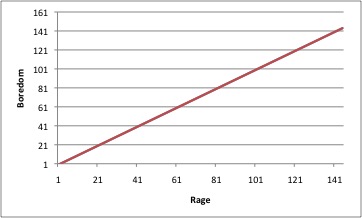
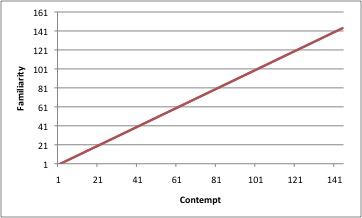
My other findings are graphed below.

boredomrage

FamiliarityContemptGraph

When contacted for comment, both Martin Amis and Ian McEwan banged on self-importantly and interminably.

During the same period, my friend Jason Wyngarde performed a similar experiment with films. His findings were much the same, but he also uncovered a further pattern.

breastsexplosions

Fehér isten a.k.a. White God (Kornél Mundruczó Hungary 2014)

whitegodIf you like dogs, and you like revolution…

If Jupiter Ascending has whetted your appetite for films in which a girl and her dog fight against tyranny and longueurs…

Trailer

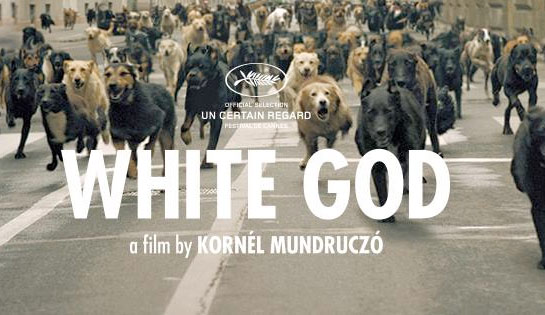
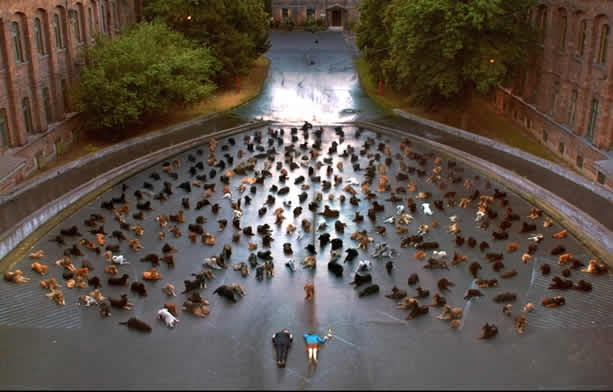
White God begins with a beautifully composed aerial shot of a major Budapest intersection. The streets are deserted. A tiny figure cycles up onto the flyover.

It has a familiar eeriness to it – like the deserted Waterloo Bridge near the start of 28 Days Later…, but without the graininess, the obvious digital compositing. And, shot from so far above, it is as much about the construction of urban spaces and the ways they channel us as it is about the shocking emptiness of this particular space at this moment.

The cyclist – a young girl, Lili, maybe thirteen years old – passes an abandoned car, its doors wide open, and descends into the city streets. Through intersection after intersection. Patient, determined. As if searching, cautiously and with trepidation.

Then the dogs appear.

Dozens of them.

Running.

Not from something, but toward something. With purpose.

They barely even notice her.

The film leaps back a few weeks. Lili’s mother and her partner are off to Australia for three months, so she is left with her father – once a professor, now a meat inspector at an abattoir, dishevelled and disgruntled. (He is inspired by David Lurie, the protagonist of JM Coetzee’s Disgrace (1991)). Lili insists on taking her dog, Hagen, with her.

The tension between estranged father and daughter soon focuses on the dog, culminating in Hagen being abandoned by a busy roadside.

The film then follows two paths.

white god-feher isten-zsofia psotta-hagenAn oh-so-arthouse mildly prurient exploration of the occasionally sexualised Lili’s pubescent struggles – with her father, with older teenagers from the orchestra in which she plays trumpet – as she tries to find Hagen and ultimately reconciles with her father.

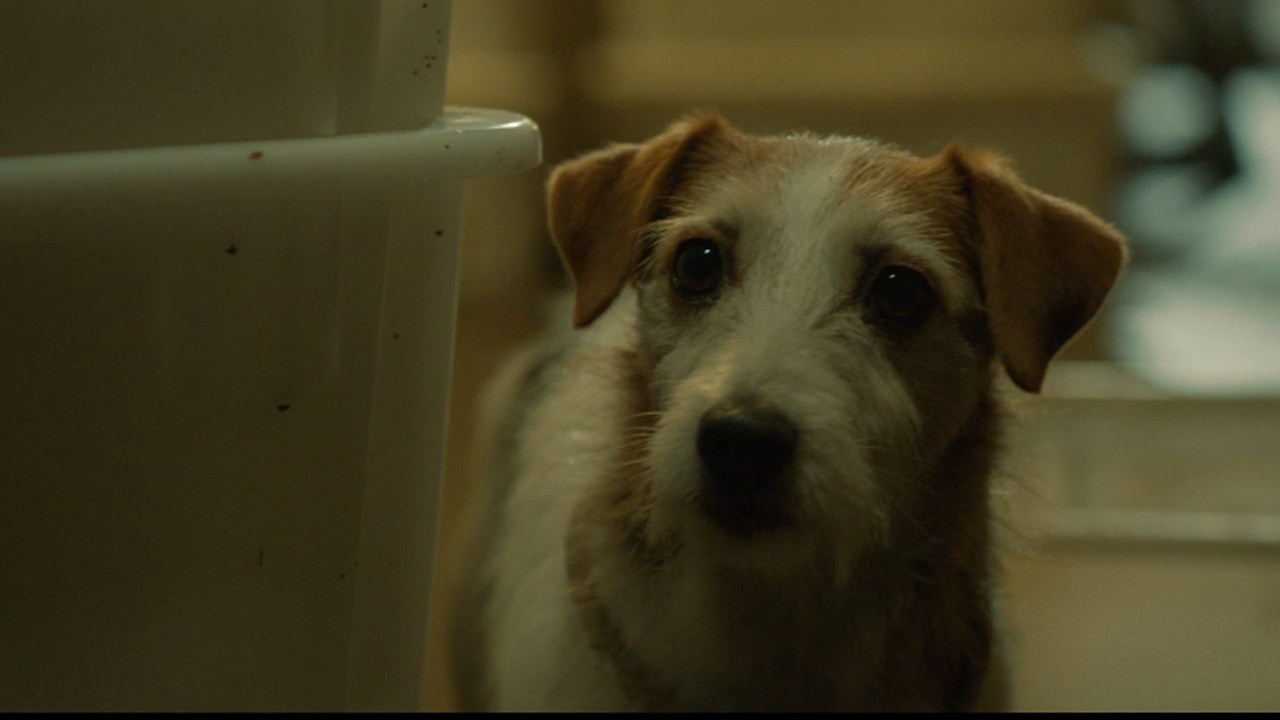
And the story of Hagen’s life as a stray. He is befriended by a dog_THUMB-1418155236944scruffy terrier, who teaches him about life on the streets, how to find food and water and shelter. How to avoid the city dogcatchers. Le barkour. But Hagen is eventually caught and sold into the world of dogfighting.

In the arena he quickly learns the horrible cost of this so-called sport.

Soon, Hagen finds himself in the dog pound, facing a lethal injection. He rebels, rather bloodily, and frees the other dogs.

He is Barktacus; they have nothing to lose but their chains.

The canine uprising has begun.

A lot of the criticism the film faced after winning the Un Certain Regard prize at Cannes last year has to do with the supposed murkiness of its metaphor. This is typical of critics who don’t quite get how fantasy works, and who are incapable of finding value in the fantastic until they have translated it into the mundane. What exactly do the dogs stand for? They don’t have to stand for anything. Let them just be dogs; they will accrue meaning(s) regardless.

In complaining about the purported failure of White God‘s symbolism to symbolise some particular thing clearly, critics unwittingly clamour for an unambiguous one-to-one allegorical correspondence between manifest and latent content. Which is precisely what they would complain about if the film actually did do something so lunkheaded. That would be like  valuing Orwell’s Animal Farm (1945) so highly solely because it is a roman à clef of the Bolshevik revolution and the emergence of Stalinism, rather than because it is also much richer and more ambiguous than that.

Kornél Mundruczó has cited a range of sf influences – Alien, Blade Runner, Terminator – although his film probably comes closer to Conquest of the Planet of the Apes (1972). He inevitably mentions Bresson’s Au hazard Balthazar (1966), and more surprisingly the films of Fassbinder and of Sirk:

For me, White God and All That Heaven Allows is the same story. Both discuss how society confines and forces people to behave.

The genius of Sirk’s film is to move between the constraints faced by a middle-aged widow and the repressiveness of an entire society. Mundruczó’s film is perhaps less successful, but the alternation between the two narrative strands creates a similar critical resonance. It is about race and about immiseration and about state power and about the tyranny of free markets; about family, gender and generation; about species; about surviving and providing and being better than the unhomely world we daily build will allow.

It is also about crossing The Incredible Journey (1963) with The Birds (1963) with Zéro de conduite (1933) or, better yet, Hue and Cry (1947), and throwing in a little Pied Piper of Hamelin, so as to rework, as its anagrammatical title suggests, Sam Fuller’s White Dog (1982).

Does it work? Not quite. But that did not keep me from enjoying loads of it, mostly the doggy parts.

Some might complain about the film’s typical liberal substitution of a vague warm fuzzy feeling for the coherent revolutionary politics it is incapable of imagining. But it is a film that functions primarily on an affective level. There is so much simple joy to beb9114194-0ea0-4e19-8aa1-312cd5d19455-460x276 found in seeing dozens of dogs, all different sizes and shapes and colours, running freely together, in fast motion and slow, that the image of revolution undergoes a quite radical transformation – it is violent and scary, but it is also comical and energetic and charming and delightful, as any worthwhile revolution must surely be.

And almost incidentally it does have some good politics in the mix. According to dog-trainer Teresa Miller, the two dogs playing Hagen don’t quite understand that they are dogs, and so simply did not get that they were supposed to be leading the pack. So although Hagen runs near the front of the pack, he never leads it. He is no Bane, which helps keep the canine rebels from becoming some clumsy reactionary representation of Occupy or Indignado or Tahrir or Syntagma, and which helps keep him unmuzzled. white-godAnd the film ends in media res, not with a Butch Cassidy and the Sundance Kid (1969) memorialisation of an already foreclosed future but, like The Birds, with the future still open … and if Hagen and his dogged comrades can just get to the horses, the cows, the sheep, the birds….

Note While leaving the cinema, I was momentarily thrown by the end credit I thought read ADDITIONAL CATS.

Dandies in the Underworld

fantomasA giant figure in immaculate evening dress looms over night-time Paris. Stepping over familiar landmarks, he gazes out at us from behind a domino mask. And in his outstretched hand is a bloodied dagger. The image, by Gino Starace, is iconic. It is Fantômas. The Lord of Terror. The Genius of Evil. But despite his costume, he is not a gentleman.

Created in 1911 by Marcel Allain and Pierre Souvestre for a series of 32 monthly novels, the enormously popular Fantômas soon crossed over to the movies. In 1913 and 1914, Louis Feuillade directed five films about the endless quest of Inspector Juve and journalist Jerôme Fandor to capture the criminal mastermind. However, although Starace’s picture was used to promote Feuillade’s Fantômas, he only once appears costumed like this – and then as a figment of the defeated Juve’s imagination.

The head of a vast criminal organisation and a master of disguise, Fantômas has less in common with the gentleman thief than with the villains of Fritz Lang’s Die Spinnen (1919-20), Spione (1928) and Dr Mabuse films (1922, 1933, 1960), in whom the terrors of disempowerment and anonymity that accompany capitalist-industrial, urban modernity coalesce. Brutally instrumentalist and utterly impersonal, there is no true identity to be discovered behind his series of disguises.

Starace’s dapper but knife-wielding gentleman is – in the face of the globalising forces of empire and capital squaring off on the eve of World War I – at once reassuring, anachronistic, transgressive and fantastical. Perhaps this is why Fantômas, the product of arch-conservatives, so appealed to such radical avant-gardists as Guillaume Apollinaire, Antonin Artaud, Blaise Cendrars, René Magritte and Kurt Weill. He embodies the contradictions of his age.

The probable source of Starace’s gentleman-thief image is AJ Raffles, perhaps channelled through Maurice Leblanc’s Arsène Lupin. Created by EW Hornung in the 1890s, Raffles is the finest slow bowler of his generation. Penniless, he is nonetheless proud to be a Gentleman rather than a Player, and likewise insists on his amateur status as a thief. Selecting only the most challenging jobs and most exquisite loot to support his bachelor lifestyle, he robs from the rich and is not averse to others helping the poor.

raffles-1917He appeared in a dozen films between 1905 and 1939. Raffles, the Amateur Cracksman (1917) stars John Barrymore in a breakneck mash-up of Hornung’s stories that only ever pauses to display The Great Profile’s great profile. This Raffles appears to be not so much a gentleman as someone who knows a gentleman’s tailor (Barrymore, his looks and his star both fading, is a more compelling gentleman thief in Arsène Lupin and Grand Hotel, both 1932). In Raffles (1925), House Peters, known as ‘The Star of a Thousand Emotions’, can muster only a handful of them, including ‘stolid refusal to be charismatic’ and ‘discomfort in ill-fitting evening dress’. In contrast, da993b7bbe01f24bdfcf2ae6e48c04bbRonald Colman in the first talkie Raffles (1930) gives one of his most effortless-seeming performances – as if acting were too vulgar even to contemplate – and the warm timbre of his Surrey burr modulates plummy received pronunciation into something quite sensuous. But the narrative material had already been filleted of its fundamental queerness. Hornung’s stories, focused on the close bond between Raffles and his accomplice Bunny, are full of innuendo and double entendre, with occasional allusions to amyl nitrate and Oscar Wilde.

Once the Production Code was enforced, the gentleman thief became not merely straight but almost completely desexualised. In the 1940 Raffles, David Niven is too young, his Raffles too boyish, and the casting of classical Hollywood’s very best good girl, Olivia de Havilland, as his love interest compounds an error that would not be corrected until Yorkshire Television’s 1977 Raffles series, raffles_tll10starring Anthony Valentine. Perfectly cast, Valentine’s precise delivery and slightly faded looks – the contrast between his crow’s feet and seemingly plasticised cheekbones suggests more than merely a youth misspent – unleash the homoerotic appeal of the gentleman thief: the tastefully furnished, comfortable quarters, devoid of women; the endless flirtations, but avoidance of romance or entanglement; the gentlemen’s clubs; the secret nocturnal identity; the dressing-up to break into other men’s houses; the crossing of class barriers; the mixing with rough trade…

But, queer or otherwise, this sexual undercurrent is not the only source of the gentleman thief’s appeal. The flipside of Fantômas, that anonymously devastating force of modernity, the gentleman thief negotiates modernity’s transformations of economic and social structures. This is beautifully captured by the prominence afforded a bust of WG Grace in the apartment of Valentine’s Raffles. As the finest cricketer of his generation, Grace is worthy of Raffles’s respect. But despite being a Gentleman, he was only nominally an amateur, making more money from the sport than any professional Player. A similar whiff of disrepute surrounds Raffles.

As old hierarchies crumbled, signifiers of social class were disrupted by wider access to certain varieties of commodity. Appearances begin to deceive. In Ernst Lubitsch’s racy, pre-Code Trouble in Paradise (1932), a Baron (Herbert Marshall) and a Countess (Miriam Hopkins) only fall in love when each discovers the other is a fake and a thief. Self-made and simulacral, they can play any social role – given the right costume – but the only place they really belong is with each other, conning, stealing or on the lam. However, such semiotic manipulations rarely succeed. In Pépé le moko (1938), Jean Gabin’s proletarian thief is unutterably stylish, but he cannot escape his class or fate.

In the post-war period, values shifted. Consider the contrast in The Pink Panther (1963) between the aristocratic Phantom and his nephew: David Niven is too old, Robert Wagner too American, too glib. A new consumerist masculinity was taking over, and gentleman thieves were no longer gentlemen. And they were as likely to solve crimes as commit them.

The character-type saw a popular resurgence in 1966, the year in which Cary Grant, Hollywood’s master of sartorial transformation (and a gentleman thief in To Catch a Thief, 1955), retired from films. The charm of Gambit’s Harry Dean (Michael Caine) is located in the gulf between his East London vowels and his dubious received pronunciation when posing as Sir Harold Dean. That of Kaleidoscope’s Barney Lincoln (Warren Beatty) depends entirely on his transparent reliance on a broad smile to buy time when he is out of his social depth. This league of ‘gentlemen’, which also includes Oliver Reed in The Jokers (1967) and Stanley Baker in Perfect Friday (1970), consists of working- (or middle-) class boys made good, and valorised for doing so. The very best of them is to be found in How to Steal a Million (1966), less a film than an opportunity to ponder whether Audrey Hepburn – as elegant when disguised as a cleaning lady as when dressed by Givenchy – or a young Peter O’Toole is the more beautiful (although it is probably a draw, O’Toole does showcase some of the most remarkable cigarette-handling you will ever see).

21129_Danger-Diabolik-05Costume, commodities and consumption are also at the heart of Mario Bava’s Diabolik (1968). The eponymous Jaguar-driving criminal mastermind (played by John Phillip Law, who looks like the offspring of Alain Delon and a Vulcan mod) dresses in full-enclosure leather and rubber body suits to commit his crimes, only his eyes visible through a domino-shaped cutaway. Based on a 1960s Italian comic book character, Diabolik is an intriguing inversion of Fantômas. His ‘terrorism’ is restricted to destroying the taxation system because the government have wasted so much public money pursuing him, and his subterranean base is a fantasy of modish, high-tech apartment living – a love-nest shared with Eva (Marisa Mell), his beautiful blonde accomplice with a taste for mini-raf_bun2dresses, hotpants, hipsters, peekaboo tops and kinky boots. Crime, for them, is passionate foreplay and, in contrast to poor Raffles and Bunny, it need never go unconsummated.

This dynamic between class and consumption was repeatedly played out on British television in the late 1960s and early 1970s. Adam Adamant (Gerald Harper), a Victorian secret agent revived in swinging London, was a gentleman (and misogynistic prig) but not a thief. Peter Wyngarde’s deliciously-voiced Jason King was no castgentleman, although he was certainly a player. Tony Curtis’s brash self-made millionaire Danny Wilde partners up with Roger Moore’s Lord Brett Sinclair to fight crime in expensive locations in The Persuaders!, although Moore always seemed less an aristocrat than a bemused estate agent. However, the pattern was most decisively set when, in the fifth season of The Avengers, Patrick Macnee’s John Steed, formerly so well-dressed that you forgot he was a government functionary, let himself be costumed by Pierre Cardin. Bringing modern touches to classic Savile Row designs might have sounded innocuous, but from there it was only a short step to working with Gareth Hunt…

Perhaps it was the backlash against the ‘excesses’ of the 1960s and 1970s, or perhaps it was neo-liberalism’s success in persuading otherwise sensible people that there are no such things as society or social and economic classes, that finally did for the gentleman thief. Where is he now?

In Entrapment (1999), Sean Connery – whose James Bond negotiated so intriguingly between working-class physique and access to style, articulating social mobility as a semiotic possibility – is just some rich guy, no more convincing as a gentleman than he was as a Soviet submarine commander. There is too much of the catalogue model about Pierce Brosnan in The Thomas Crown Affair (1999), and George Clooney’s Danny Ocean merely gentrifies the rat pack. Remorselessly heterosexualised, they reek of new money. And then there is The Gentleman Thief (2001), which only exists because the BBC realised – far too late – that they should lazily cast Nigel Havers as Raffles before it was too late. Or former Eastender Michelle Ryan as Doctor Who’s ‘aristocratic’ thief/Emma-Peel-wannabe, Lady Christina de Souza…

Frankly, I’d rather work with Gareth Hunt.

[A version of this piece first appeared in Electric Sheep back when it was hard copy; but issue 12 (winter 2009), is now out of print.]