Film neige: noir + snow

hqdefaultIn 1952, midway between two great noir performances as a psychotic racist (Crossfire, 1947; Odds Against Tomorrow, 1959), Robert Ryan played detective Jim Wilson in Nicholas Ray’s On Dangerous Ground. Alongside Ryan and Ray, the film has pretty much everything you could want from a tough-cop-on-the-edge noir: a script by AI Bezzerides, a score by Bernard Herrmann, and roles for Ida Lupino both in front of and (uncredited) behind the camera.

Wilson is sick of the scum he encounters – and beats on, with weary resignation and twisted joy – every day. Facing possible prosecution over a too-vigorous interrogation, he is sent out of the city to help some small-town cops track the killer of a young girl through the mountains. It is winter. And in the snow, the film begins to change – morphing, like all of Ray’s film noirs, into something more closely resembling the melodramas for which he is best remembered. Wilson stumbles upon the isolated house of a beautiful blind woman. Her kid brother, Danny, is the deranged killer; she is blind because she stayed to look after him rather than going away to have an operation. And her faith in Wilson’s goodness – something he just does not deserve – redeems him.

But this generic transformation is not merely Ray’s doing. It has something to do with the snow.

The first Max Payne video game (2001) is set during the worst blizzard to hit New York in a century, and in Sin City (2005), when Hartigan (Bruce Willis) is released from prison, having finally confessed to crimes he did not commit in order to go out and commit some for real (not without good reason), snow falls, blanketing the ground. There is something very right about these images, appearing in cross-media franchises that function as compendia of American crime fiction tropes.

But snow is rare in film noir.

There is sun, wind and rain – Key Largo (1948) has all three – but very little snow.

Citizen Kane (1941), visually the most significant American precursor of noir, has snow, and the climax of Fritz Lang’s You Only Live Once (1937) does get very cold, since its couple on the run are the odds-against-tomorrow-harry-belafonte-1959only fugitives ever to head for the Canadian rather than the Mexican border. And if you’ve not seen Robert Wise’s Odds Against Tomorrow recently you can be forgiven for thinking it has snow: the sound effects are so good, the icy wind cuts right through you. But in classical Hollywood, film neige, like the snow that somehow brings Britain grinding to a halt every couple of years, is pretty thin on the ground.

Why is this? Well, actually snow is relatively rare in studio-era Hollywood. It does appear in big-budget films (Way Down East, 1920), but it is difficult and expensive to shoot in cold, wet conditions and film noir rarely had a dime to spare. And when you fake it, it looks fake. However, that need not be a problem for films that are comical (How to Marry a Millionaire, 1953), fantastical (The Curse of the Cat People, 1944), musical (Swing Time, 1936) or otherwise given to artifice (All That Heaven Allows, 1955). Film noir, though, is rarely any of these things.

Snow has great noirish potential. It is treacherous, unpredictable. It can betray you, isolate you, trap you, kill you. Pursuers can track you through the snow, and it can force you into dangerous proximity to them. Banks and drifts obscure contours, conceal familiar markers. Flurries become blizzards. Visibility reduces. Cold becomes colder. Circulation slows. You begin to lose feeling. Death is never far away. It creeps inwards.

All of which makes sense in the wilderness, and even, sort of, in the older, northern and eastern cities in which, typically, gangster films – and Max Payne and Sin City – are set.

But film noir is a Californian invention. Whether it is the sultry Argentine night in which Rita Hayworth threatens to strip (Gilda, 1946), the dazzling Mexican afternoon out of which Jane Greer emerges to lead Robert Mitchum astray (Out of the Past, 1947), the hot Mexican night in which Mitchum, shirtless and glistening, is flogged with a belt, the buckle opening welts in his back, and thrown into a steam-filled engine room (His Kind of Woman, 1951), or the unseen suburban deck on which Barbara Stanwyck is sunbathing when Fred MacMurray comes hawking insurance (Double Indemnity, 1944), film noir thrives on heat.

In the heat, passions rise. Tempers fray. Everyone becomes just a little bit flushed. A little bit moist.

Snow simply lacks this erotic resonance.

So Robert Ryan, stuck overnight with Ida Lupino (and, admittedly, Ward Bond), has little choice but to sleep on the floor and wake up in a neighbouring genre; and film noir could do little with snow until it was reworked overseas and in post-classical Hollywood.

François Truffaut’s Tirez sur le pianiste (1960) casts Charles Aznavour as bar-room piano player Charlie Kohler. Once a concert pianist, he goes to pieces when he finds out that his waitress wife slept with an impresario to get him his big break. When she tells him this, he leaves her and she commits suicide. He abandons celebrity for anonymity, and rediscovers love with another supportive waitress, Léna. They flee Paris to his family farm, where his criminal brothers are holed up, having double-crossed their gang. Truffaut sets the final few minutes of the film in a desolate, rural snowscape, wryly inverting film noir’s black:white ratio. TruffautTirezSurLePianisteLenaThe gunfight between the gang and Charlie’s brothers plays on the spatial disorientations – and slippery footing – of deep, featureless snow. Léna, of course, is caught in the crossfire, robbing Charlie of his renewed future.

Charlie returns to the bar. A new waitress is introduced. Will she too become involved with him, offer him redemption? Will it also end badly for her? The snow reminds us that for Truffaut (or perhaps merely Charlie), women are like snowflakes: they are all unique, but this only makes them indistinguishable, interchangeable.

Even bleaker is The Criminal (1960), made in the UK by exiled American director Joseph Losey. Fresh out of prison, Johnny Bannion (Stanley Baker), a cocksure working-class lad made good in London’s gangland, organises a brilliant racetrack heist; but being in love, he makes a tiny error and is promptly betrayed. When he is sent back to prison, his bosses abduct his girlfriend Suzanne to force him to reveal the whereabouts of the loot. Instead, Bannion promises it all to a crook who can break him out. He rescues Suzanne, but is followed to the snow-dusted field where he buried the money. A shoot-out leaves him bleeding to death in this dismal, grey-white, rutted landscape. As the camera cranes up and away from his corpse, his killers randomly scratch at 23-The-Criminal-360x216the frozen dirt in the hope of finding the cash – and we hit the permafrost of existence: life is not just cold, it is as hard and featureless and unrelenting as the ground on which Bannion dies.

In Fargo (1996), snow simplifies things. The ground – even the air – loses its features. The world is reduced to small towns and corporate franchises linked only by roads, phones, TV broadcasts and flows of money in a whited-out desert of the real. It is as if Chuck Jones and Jean Baudrillard had collaborated on a Jim Thompson adaptation. The Coen brothers’ caricatures of Minnesotans and North Dakotans open up the gulf between American capitalism and the kind of small-town values (decency, neighbourliness) that Sarah Palin pretends to embody. In Sam Raimi’s A Simple Plan (1998), snow isolates a gently parodic small town so as to reveal the extent to which those values are a myth desperately at odds with capitalism. College-educated Hank (Bill Paxton), his unemployed brother Jacob (Billy Bob Thornton) and Jacob’s friend, Lou (Brent Briscoe), find a kidnapper’s plane, carrying over four million dollars in ransom, crashed in the snow. Family ties and class differences clash as Jacob is forced to choose between Hank and Lou. Hank’s wife, Sarah (Bridget Fonda), initially nice-as-apple-pie, becomes grimly determined to hang onto the cash. Violence erupts. People die. But that is nothing to her hatred for their just-getting-by lives.

jlgThe Lookout (2007) is likewise about the contradictions of the American dream. Former high school hockey star Chris Pratt (Joseph Gordon-Levitt), brain-damaged in a car crash, has lost everything. Wintry Kansas-Missouri settings emphasise his barren existence. Bank robbers manipulate him into helping them, but the heist goes wrong. Chris must concoct and follow a complex plan to free his kidnapped best friend – the only problem is, Chris has severe difficulties with planning future actions and suffers form short-term memory dysfunction. Against a stark white snowscape, the world – bitterly, ironically – redeems Chris, almost against his will.

However, the bleakest American neo-neige is – unsurprisingly – not actually American. A Danish-Canadian-British-Brazilian co-production co-written by Hubert Selby Jr, Nicolas Winding Refn’s Fear X (2003) starts with Harry Caine (John Turturro) opening the curtains of his Wisconsin suburban tract home. Snow falls gently on the snow-covered street. A woman enters the house opposite. It is Harry’s wife. But Harry is dreaming. His wife is dead, killed in a double homicide outside the mall where he works as a security guard. The black and white surveillance footage from that day – over which Harry pores every night, desperate for any clue as to who killed her and why – fills the screen, grainy and blurred, a blue-grey world of silhouettes, shadows and snow.

Snow fills Harry’s dreams and memories. It creeps into his system, fills him from the core – twin wavefronts of despair and isolation.artikel_fear_x_2

Is it worth risking his life to get a step closer to the killer?

‘I’m not living anyway’, he replies.

[A version of this piece first appeared in Electric Sheep back when it was hard copy; but issue 8 (winter 2008), is now out of print.]

On Matters Locomotive and Tentacular; or, Four or Five (More) Things About China Miéville

[After finding yesterday’s old piece on China, I remembered doing this one, too. But on reading it, I have no memory at all of writing it. It’s from the Readercon 17 programme, back in 2006 when China and James Morrow were GoHs.]

This was the plan, the plan was this: I would get the first post-rush hour train from Bristol to London and be there by noon.

tentacles‘There’ is the Starbucks in Borders bookstore on Oxford Street, our default meeting-up place in central London, and we would leave ‘there’ as soon as possible, and grab some pizza at a place around the corner (where, a year earlier, our arrival had been greeted with rapturous applause from the staff – not because they recognised China, but because they’d been open for almost an hour and we were their first customers that day). And after lunch, although the pretext for meeting up was discussing essay proposals for a book we are editing on Marxism and sf, we would head to the Natural History Museum to see the thirty-foot long, newly-on-display, giant squid.

That was the plan, the plan was that.

So of course that was not what happened.

Readers of King Rat and the stories in Looking for Jake (and a forthcoming project, as yet still a secret [Un Lun Dun, I guess]) will know that London is a strange place, where all kinds of unexpected things can happen; that the fabric of the city itself is fantastical. Strange chimera flit through the crowds, pausing to take fliers advertising clubs and bars and language schools from fastidiously scruffy young men and women being paid way less than minimum wage for their cash-in-hand labour, and roar in anguish, in bafflement, at this world which is no longer theirs, and retreat temporarily into the interstices, before emerging once more, hooked on it. Creatures, remnants from another time, can be glimpsed in the reflective surfaces of department stores and sandwich shops, phone booths and passing buses. Others dance across the rooftops. And then there’s the people, who are pretty fucking strange.

But our delays and derailments are far more mundane. Family. Trains. And by the time we get ‘there’ it is gone two o’clock. (There was an amusing incident involving a borrowed phone in case China needed to contact me, which he does, but by text, which my quick briefing on this new-fangled technology did not cover. I manage to find the message but am uncertain how to reply. I amaze myself by finding China’s number in the phone’s address book, so I call and leave him a message. The number later transpires to be that of his old phone. But I will omit this is at makes me sound much too old yet insufficiently curmudgeonly. And has nothing to do with trains or cephalapods.)

Lunch is relocated to an Italian restaurant, which does a pasta dish China likes involving little balls of fried courgette and spinach. Our arrival prompts neither adulation nor irony.

51M+qPPQDFL._SY344_BO1,204,203,200_‘Trains,’ I tut, to boost my curmudgeon-score as we share a mezze and several varieties of bread. But we have been talking about trains a lot, lately. I have a crazy notion that there is a book to be written about trains and early cinema and time-travel (but very distinctly not about early railroad films or time-travel movies), and China’s voracious reading, especially the research for Iron Council (and for his review of Stefan Grabinski’s The Motion Demon), keeps throwing up gems. It’s like having a really good research assistant I don’t have to supervise or pay (although he has still not returned my copies of The Iron Horse, Once Upon a Time in the West and Emperor of the North Pole).

These are the three things he tells me.

‘The seemingly obvious use of the railroad to “mean” Manifest Destiny, as in Zane Grey’s The U.P. Trail, is only permissible because of the peculiarity of that particular railroad. It really did only have one line, at least for a brief moment, but much longer iconically, and that’s been the source of a lot of notions of the unilinearity of the railroad, which are completely spurious. Not even a consideration of the siding or even the parallelism of tracks (necessary unless all trains are going only one way, a patent absurdity). So railroads aren’t even a misused symbol – they only work symbolically because of a lie.’

‘Of a failure, no, a refusal, to observe accurately,’ I suggest, ‘because that would strip the metaphor of its political potency.’

The mezze is really good.

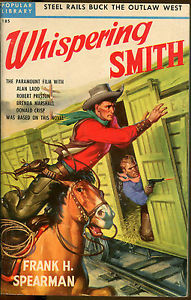
$_35Iron Council riffed heavily on Frank Spearman’s Whispering Smith. Spearman was a sort-of libertarian, reportedly Ayn Rand’s favourite writer, did lots of stuff about rugged railwaymen. Whispering Smith is a troubleshooter for the railroad who is allowed to go anywhere and do more or less anything, including kill anyone necessary, to “fix problems”. It is an extremely perspicacious critique of rugged individualist/libertarian railroadism (as I’ve christened the ideology), because contrary to the “enlightened self-interest” of the Randists and half of Spearman’s own characters, the thrusting of the rails is only possible with a roving assassin – a man in a permanent state of Schmittian law-making exception! – bringing peace for capital-expansion at the end of a gun beyond the bounds of the rails. So the railroad relies for the always-spurious solidity of even its semiotic status to the right on an implicit awareness of beyond-railroad coercion of the most violent kind. Spearman, a cunning writer, recognises this and rather than attempt to conceal it, hides its in plain view.’

‘Agamben,’ I mutter, sipping a rather non-descript red wine, knowing that his Schmitt reference is more astute than my name-drop (but then he did study – and write a book on – legal theory). I refill my glass and reflect on how it is possible for China to talk so enthusiastically about stuff despite his rather non-committal approach to drinking.

220px-Sanatoriumpodklepsydra‘And then there’s Bruno Schulz, using trains (in several different ways – history as both inside and outside the train itself, on the rails as well as in the corridors) to think about the alterity of history and alternate possibilities. I’m increasingly interested by the idea of the multi-track nature of railroads, let alone Grabinski’s sidings, as key to their importance. There’s this astonishing passage in his ‘The Age of Genius’ in The Sanitorium under the Sign of the Hourglass:

Ordinary facts are arranged within time, strung along its length as on a thread. There they have their antecedents and their consequences, which crowd tightly together and press hard one upon the other without any pause. This has its importance for any narrative, of which continuity and successiveness are the soul.

Yet what is to be done with events that have no place of their own in time; events that have occurred too late, after the whole of time has been distributed, divided and allotted; events that have been left in the cold, unregistered, hanging in the air, homeless and errant?

Could it be that time is too narrow for all events? Could it happen that all the seats within time might have been sold? Worried, we run along the train of events, preparing ourselves for the journey.

For heaven’s sake, is there perhaps some kind of bidding for time? Conductor, where are you?

Don’t let’s get excited. Don’t let’s panic; we can settle it all calmly within our own terms of reference. Have you ever heard of parallel streams of time within a two-track time? Yes, there are such branch lines of time, somewhat illegal and suspect, but when, like us, one is burdened with contraband of supernumerary events which cannot be registered, one cannot be too fussy. Let us try to find at some point of history such a branch line, a blind track onto which to shunt these illegal events. There is nothing to fear. It will all happen imperceptibly: the reader won’t feel any shock. Who knows? Perhaps even now, while we mention it, the doubtful manoeuvre is already behind us and we are, in fact, proceeding into a cul-de-sac.

‘Isn’t that fucking amazing?”

I have to agree.

I also have to confess.

This was the plan, the plan was this: over lunch we would talk wisely and wittily about arcane things, scare the children at the next table with our profanity and their parents with out erudition (or vice versa). It is not that China is scarily geeky (although he does know his shit), nor that I cannot write convincing dialogue (although I cannot); but rather that China’s words come from a long and almost painfully helpful email he sent me after a phone conversation about matters locomotive.

Conversation over lunch that day really focused on our childish enthusiasm for all things cephalopodic and tentacular. I’d recently rewatched Jon Lurie’s series of fake fishing documentaries, Fishing With John, in which he takes various celebrities – Jim Jarmusch, Tom Waits, Matt Dillon, Willem Dafoe – on improbable fishing expeditions. The series ends with a two-parter in which John – who died while ice-fishing with Willem in the previous instalment, a fitting punishment considering they used the proper equipment rather than chainsaws to cut through the ice – is discovered to be not only alive and well but taking Dennis Hopper fishing for giant squid in the Andaman Sea. After arduous travels, unsuccessful angling, a sidetrip to see some squid-worshipping monks who warn of the giant squid’s hypnotic powers, they finally meet with success, of a sort. A giant squid rises to the surface. But all is not well. Disorientation strikes Dennis and John. What is going on? Has something happened? They leave Asia disconsolate, because despite seeing their prey up close, it hypnotised them, and they believe their expedition a complete failure.

Jeff VanderMeer’s name of course crops up, as it always does in squidversations. But a new potential source of delight is introduced. An aside about James Woods not sleepwalking through a performance but actually sleeping through a performance in ER triggers a memory deep in China.

‘Have you ever,’ he asked, ‘seen Tentacles? I’ve only heard about it – a 70s Jaws rip-off about a giant octopus – in which John Huston literally phones in his performance. Apparently, he finally gave in and agreed to appear in it on the condition that he didn’t have to leave his own home to do so. So his performance consists of him sitting on a lawn-chair on his own lawn, saying things over his own phone like, “Hmmm, yes, that does sound like it could be the work of a giant octopus”.’

Neither wise nor witty, neither arcane nor profane; more geeky than erudite; but it certainly did scare the children sat at the table next to us. And their parents.

***

Coda 1. We did actually discuss the proposals and finalise the line-up for Red Planets: Marxism and Science Fiction.

Coda 2. The little balls of courgette and spinach are really rather good.

Coda 3. While China’s books are available at all good bookstores, it is worth noting that Tentacles is also available on region 1 DVD, but while I was able to pick up a copy for just five bucks, there is a heavy price to pay: it comes with the Joan Collins movie Empire of the Ants, a low point in a career hardly distinguished by its heights.

Coda 4. We never did get to the Natural History Museum to see the giant squid.

Coda 5. Unless we did but just can’t remember. Hypnotic powers, y’know.

Last Tango in Paris (Luc Besson 2015)

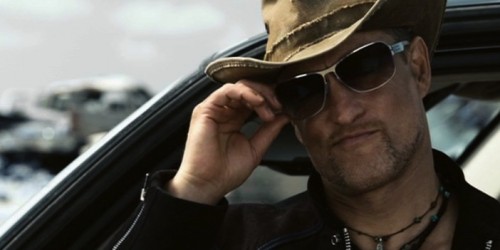
Woody-Harrelson-Zombieland-500x250‘Based on an idea by Luc Besson.’

You know how seeing those words on a screen fills you with dread and giggles?

Let’s remake Escape from New York in a futuristic banlieue, no, wait, in a space prison.

Let’s make a movie about taxis going really fast four separate times, and then let’s make it three more times except instead of taxis we’ll have a delivery guy who kicks ass but has a heart of gold, and then we’ll try it on telly, and then we’ll reboot it and pretend the first ones never happened…

The ideas just pour out of him.

However, just because French courts ruled that Besson is ‘the death of cinema’ (long story, kinda almost true), it does not mean that he cannot have good ideas.

He bunged Tony Jaa euros when it mattered. There was Jean Reno as the clean-up guy, and that whole le parkour thing.

Sometimes his ideas are obviously crazy, but then turn out not to be. Like the morning he sat down and thought, I know, I’ll make Jason Statham a movie star.

Perhaps his most surprising idea to date, though, is his decision to remake Bernardo Bertolucci’s 1972 censor-bothering erotic drama Last Tango in Paris. 

Given the late-career boosts enjoyed by ageing male stars in recent  movies from Besson’s Europacorp, competition for the role of Paul, made famous by Marlon Brando, was understandably stiff. Michael Biehn, Michael Madsen, Craig Fairbrass and Andy Garcia were all considered. But, Besson explains, it was  Woody Harrelson’s performance in Zombieland (2009) that caught his eye. ‘He was perfect. I completely believed he would criss-cross the post-apocalyptic badlands checking out convenience stores and vending machines. Such drive! Such focus! I knew the moment I saw it that he was ideal for Paul.’

In Last Tango, Paul meets a mysterious woman, Jeanne (Scarlett Johansson), at a Parisian apartment they both want to rent. She is half his age. Soon they embark on an intense – and quite graphic –  sexual relationship. They agree to keep it all anonymous, to share no details of their personal lives, and soon Paul finds himself in a race against time to retrieve from evil Albanians a world-shaking secret concealed in France’s only remaining can of a popular fizzy drink…

Luc Besson’s Last Tango in Paris opens June 18.

Hours (Eric Heisserer 2013)

Hours.poster.croppedand so anyway it turns out that the best thing about Hours (2013) – a film in which Paul Walker must hand crank a battery recharger every 3 minutes or less for several days in order to keep his prematurely-born daughter alive in a ventilator while Hurricane Katrina and its aftermath rage outside the deserted hospital – is the bit when Vin Diesel, sporting a prosthetic nose that makes him look like Nicole Kidman, rocks up in an old Detroit muscle car fitted out as a hovercraft to drop off James Franco, who races into the hospital to save father and infant by gnawing off his own arm, though I confess my eyelids did get a little heavy about seventy-five minutes into the movie and so I can’t swear this is exactly how it ended…

The final post, honest, on Jupiter Ascending (with hints of Fifty Shades and Star Wars)

in which the author finds himself attempting self-reflection, which is not, as you know, his strong suit…

0d25976623564ed7fbaa2169ae7c7774After my single-sentence review and longer post, various folk sent me links to blogs saying positive things about the film I had not considered, such as this piece by bootleggirl.

It contains a whole bunch of things I think are problematic.

First, and probably  least relevant here, is the great, and mostly American, tradition of demonising Mormons – I have always found Orson Scott Card hateful and tedious, and am familiar with the many criticisms of the Twilight books and movies (without reading or seeing them), but blaming all that is wrong about them on a religion is just lazy thinking. I am no fan of religion, organised or otherwise, but at least I understand that religions are complex shifting phenomena, and that people have complex shifting relationships with their religions.

Second, the equation of negative criticism of the film with sexism and transphobia. I have no doubt that transphobia does play a role in the treatment of Lana Wachowski – bootleggirl seems to have specific examples in mind, my only evidence is that we live in a much-too-often really shitty world full of loudmouths and assholes. And I will return to the question of sexism in a while. But I am not certain that recognising these factors makes the film any more coherent. (And there is the question of what is meant by incoherence. It is not as if the narrative is hard to follow; it is, after all, a pretty linear, one-damn-thing-after-another action-adventure. It is more that the thinness of the characters and the compression of what was presumably a three-hour cut makes motivations unclear/unconvincing and reduces the story-world to a series of flat and largely indistinguishable backdrops. The lack of chemistry between the leads also does not help make any of it seem to make sense.)

Third, the array of assumptions made about Lana Wachowski. Although, on the other hand, I think bootleggirl does a good job of demonstrating how adopting a trans perspective can change our understanding of the film. Suddenly, the sequence in which a camp robot leads Jupiter and Caine through the labyrinthine bureaucracy necessary for Jupiter to be declared queen becomes something else. It is no longer a misjudged and tiresome homage to Terry Gilliam (himself as frequently tiresome as he is misjudged) into a wry representation of the difficulties faced by trans people in gender-binaried and gender-binarising bureaucracies.

But there are a couple of important things in bootleggirl’s piece, both of which brings us to sexism in the response to Jupiter Ascending.

The first is bootleggirl’s attempted regenrification of the movie away from its marketing image. It is not a space opera for boys, like Guardians of the Galaxy (Gunn 2014). It is about ‘space angel werewolf boyfriends’ with antigravity rollerskates, and thus obviously

a member of the female-targeted romantic fantasy genre – stuff like City of Bones, Beautiful Creatures, and yes, Twilight.

I’ve seen none of the movies bootleggirl gives as examples, and I am way more True Blood than Twilight (at least until the fairies showed up), though admittedly not someone who could ever really understand the appeal of Bill or Alcide, especially not with Eric around.

But this makes me curious about the extent to which the film’s delayed release was also about cutting it, post-Guardians, in an attempt to ‘normalise’ its gender appeal (i.e., make it play more to the boys, albeit not very successfully). The female friend I saw it with, who enjoyed Guardians more than I did, also enjoyed Jupiter Ascending more than I did. But then afterwards was slightly appalled at herself for being swept along by the romance narrative.

Jupiter Ascending reminded me of NK Jemisin’s The Hundred Thousand Kingdoms (2010) not just in terms of similar story elements, but also in my response to it. It is a novel I liked well enough, but not sufficiently to read the rest of the trilogy or to understand why it got all those award nominations. It was all a bit too bodice-rippery for me. (The same friend read my copy in a single sitting and immediately tracked down the sequels; and looked at me like I was mad when I first made the comparison.)

Bootleggirl is very clear on this point: Jupiter Ascending is ‘a female fantasy. It’s not anti-feminist.’ Again with the problems. Female fantasies are not monolithic. The ones in this film are not shared by all – or even most? – women. Just because it is a female fantasy it does not necessarily follow that it is not also anti-feminist. Not all women are feminists. Feminism is not monolithic. Neither is anti-feminism. Both take many forms.

But I am reminded of a point made by Anne Bilson about the Twilight movies

it seems to me that Twilight attracts a lot more vitriol than any other nonsense aimed at the young male demographic. … reviews of such boy-tosh may be predominantly negative, but the tone is not so much derisive as regretful at opportunities wasted. No matter that movies aimed at boys feature superpowers or super-robots or saving the world with super-ninja skills. Those sorts of fantasies are permissible, almost cool, even when the films peddling them are awful. … But Twilight caters to the sexual fantasies of teenage girls. I’m not saying in a good way, but at least it caters to them, and there’s not a lot else at the cinema that does – not in a young adult fantasy genre that invariably reduces females to also-rans or decorative sidekicks while the Harry Potters and Lightning Thieves get on with their questing.

Angie Han makes some similar and related points in her ‘Partial Defense of Fifty Shades of Grey’.

I’m not sure, but these approaches seem to me to be one way to deal with the sexism in such high-profile female-centred, female-created and/or female-targeted movies: try better to understand their appeal to often largely female audiences; try to leverage any analysis, complaints or critiques into the broader problem of the everyday and widely tolerated sexism of most cinema (not just content, but distribution, exhibition, reception). And we need to question and challenge the boy-tosh in similar ways

Which brings us to the second thing in bootleggirl’s post that set me pondering:

do not critique this movie by bringing up whether Jupiter is empowered. I’ve spent substantial time on another forum where largely male folks compared Jupiter unfavorably as a heroine to Princess Leia in Star Wars episodes IV and V. Even leaving out the metal bikini scene, Leia gets upstaged as the “leader of the Rebellion” as soon as Luke shows up, and like Jupiter, her exercise of power is primarily in conventionally feminine ways like giving orders or resisting pressure techniques, rather than shooting guns. Yes, Leia is slightly better at hand to hand combat than Jupiter, who has space werewolf fallen angel boyfriend to protect her. … I find this critique especially galling from people who loved Guardians of the Galaxy, the film that notorious feminist Joss Whedon was involved in producing where the female characters are good at fighting but also completely reduced to sex objects for men.

4766351833_c999af8d08To be frank, I am always mystified by this widespread reading of Leia, who rapidly goes from feisty to uppity to domesticated over the course of the three movies. Her story arc is one of humiliation, of a woman being put in her place. Regardless of what she does, that is how the films treat her. And let’s not forget, her supposed feminist credentials in the first movie are at least as much about the exercise of class privilege and whiteness. But it does seem de rigueur to genuflect before Leia, or at least before this presumably male fan perception of her.  ( In class last autumn, I mentioned Guardians‘ undermining of Gamora (Zoe Saldana) by the way the camera repeatedly leers at her arse. Male students, presumably intentionally catered to by such shots, genuinely seemed not to have even noticed them; but a lone female student did speak up, saying that was the only reason she enjoyed the film. Which made the ensuing discussion a lot livelier than it might otherwise have been.)

2116419.jpg.square-true_maxheight-285_size-285All of which made me think some more about my own liking for and championing of Emily Blunt’s Rita in Edge of Tomorrow (Liman 2014) and, to a lesser extent, her Sara in Looper (Johnson 2012).

Because when male fans are the ones judging the supposedly feminist credentials of female characters we could well be in serious trouble. Especially when the feminism invoked is so one-dimensional and non-specific as ’empowerment’ – a term that always was pretty vague and has become utterly devoid of actual meaning.

211996120It puts feminism(s) in the past, and treats the social realm as an even playing field in which magically empowered individuals swim while others sink and have no one to blame but themselves. Whatever its uses in the past, ’empowerment’ is now mostly a lickspittle, running dog discourse that leaves patriarchy and neoliberalism untroubled, and the action heroine ceases to be a feminist icon (however problematic) and instead become just another masculine fetish item.

Which is not to say that feminists and other women cannot make important use of them. But when they become such toys for boys to fight over, they also become a way of avoiding feminism(s) entirely.

(Trust me: I’m a boy, we pull this kind of shit all the time.)

Made in Dagenham (Nigel Cole 2010)

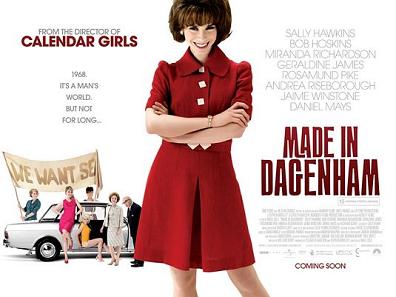
Made_in_dagenham_posterand so anyway it turns out the best thing about Made in Dagenham is not the fact that the film repeatedly has to cgi British industry into the background because there is so little of it actually left (and the destruction of working class lives and communities represented by those weightless images is horrifyingly sad, unlike this tale of plucky proletarian feminists bringing Ford to it knees) but the quiet way in which Bob Hoskins, what a lovely chap, sort of invents second-wave liberal feminism when none of the women are looking…

The Shining (Stanley Kubrick 1980)

shiningIt is difficult to know what to say about The Shining, especially as so much has already been said, some of it of dubious merit.

Like Stephen King, I am baffled as to why people find it so scary; unlike him, I rate it way more highly than his original novel (and the miniseries does not even get a look in).

It is a film I never used to like much, although I always admired its soundtrack and steadicam (Kubrick is so very effective when tracking-in that you can forgive him for his lesser parallel tracking, but, to be fair, Jean-Luc Godard’s not as good at the former as he is at the latter). And I have always been a little taken by the simple tricks Kubrick deploys – an omission here, an ambiguity there, and what Michel Chion describes as his ‘commutative editing’ – to make his films seem enigmatic and profound.

This time round, the film grew on me. I have no idea if this is because I finally watched the 25 minute longer US cut (although some months ago Roger Luckhurst predicted such an outcome, and I learned a long time ago he is usually right about stuff). I was struck very forcefully this time round by the visual and aural resonances with 2001 – and partway through the job interview scene, I stopped hearing the dialogue as being badly-delivered and started hearing it as a development of the earlier film’s depiction of linguistic thinning and debasement. Stuart Ullman (Barry Nelson) channels the performance of sincerity and the platitudinous corporate drone of Heywood Floyd (William Sylvester), and everyone sounds like they are delivering lines because that is what so much of human identity and interaction consists of – performativity.

When I recently read King’s novel, I posted about its proleptic depiction of precarious, disciplined neo-liberal labour. This is developed in Kubrick’s film. The Overlook itself, despite it age, resembles one of the non-places of hypermodernity described by Marc Augé: those spaces that are the opposite of utopia because they exist and do not contain any organic society. For all the historical markers we see on display – from those big cans of kosher dill pickles in a hotel that would once have been restricted, to the Native American designs and images on the walls, to the very 1970s purple penis carpet – it is oddly dehistoricised. It is a space that might even confound Steve Buscemi’s5609791_std CHET! in its obscure blurring of ‘trans’ and ‘res’. The Torrance family, that signifier of a private realm outside the world of work and exchange, that gesture towards organic society, is destroyed by the relentless demands of the Overlook, which is only concerned with Jack as labour-power.

The Shining shows the coming proletarianisation of the American middle class, or perhaps merely charts the delusion of social mobility at the core of the American Dream. This is Jack – the terrorised and terrorising, self-surveilling, self-disciplining and other-discipling sadomasochistic subject of a monstrous power. Just the way capital likes it.

shiningAnd management doesn’t care for one moment that he has produced the treatise on work-life balance. To the Overlook, it’s just a paper trail to prove the staff have been consulted at.

Room 237 (Rodney Ascher 2012)

large_7EDxLdQ8bBG8YC2JAnhvoVhTe3This is easily the most fun and interesting, and least time-consuming, of the various associated texts I’m working through in preparation for teaching The Shining as a cult movie (King’s novel, the miniseries, and Doctor Sleep, which should be done soon). It is a documentary in which five people explain what they think the film is really about: the Native American genocide; the Holocaust; Kubrick’s faking of the Moon landing film; the legend of the minotaur; and the dark violent sexual nature of human beings. (The latter two are the sketchiest, so it is hard to be certain what their central claims are, or if they actually have central claims – and I am sure I must have missed something about the last one since that’s hardly unusual material for a horror movie.)

Students anxious about analysing films often frame their suggestions with a nervous ‘I’m probably reading too much into it, but…’, while also seeming to assume that the process of analysing a film is to dig down and find a secret hidden meaning. Their development as critics usually involves learning to think differently about the nature of texts and the processes by which meanings are made. Meanings aren’t hidden deep within, like pirate treasure, but are the product of engaging with the details of the film in relation to various contexts. There is no ‘reading into’, there is just ‘reading’, because all the information is there on the surface to see and hear.

However, on listening to the (admittedly fragmented) presentation of Room 237’s five featured exegeses, I began to think that maybe I was wrong – that maybe there is such a thing as ‘reading into’ a text.

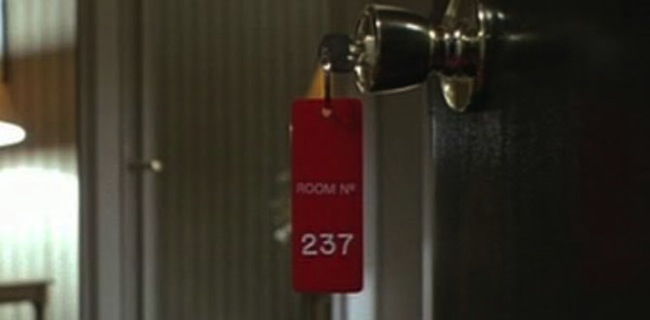
room-237-1And I admit, when the NASA conspiracy guy explained that the letters on the key tag, ROOM No 237, were able to spell just two words, ROOM and MOON, I did blurt out ‘moron’.

But that is a little unfair.

Room 237 gives us a fascinating if largely unwitting exploration of textual heuristics, epistemological limits and the uneven distribution of cultural capital.

sh_monarchTake, for example, Juli Kearns’ claim that the image of a skier on a poster is actually the silhouette of a minotaur. It does not look like one to me, but when she explained what she sees I understood what she meant. It is more convincing than someone else’s claim that the clouds in the opening titles contain an image of Kubrick, but it is still utterly unconvincing. The disproportionate bull-like upper torso is very obviously a hunched figure in a bulky ski jacket.

But perhaps she does not mean it is actually a picture of a minotaur, merely that it was deliberately chosen because it resembled one.

On the opposite side of the doorway, she notes, is a picture of a cowboy on horseback. A centaur, you might think, but no. Her point is that it is a mirror image: a cowboy opposite a bull-man. And it seems that it was only after noticing this ‘picture of a minotaur’ that she began to notice all the labyrinth imagery in the film: the maze, the model of the maze, the corridors and sometimes contradictory layout of the Overlook. What remains not just unclear but downright mystifying is why she needs to build her argument on a questionable interpretation of the skier poster rather than on, say, the film’s obvious and undeniabe labyrinths – and why she never seems to ask why Kubrick organised his version of the story around mazes, corridors and horizontality.

Part of the answer to the constricted nature of these five interpretations lies in the suggestion made by one of the exegetes that Kubrick was a bored genius who he decided to fill The Shining with puzzles and/or clues. A disappearing chair, the disappearing Dopey sticker, a mid-sequence costume change, an apparent reversal of the pattern in the carpet, all of which can be explained as continuity errors, are suddenly transformed into acts of conscious intent. Which enables you to continue believing in Kubrick as a genius who controlled absolutely everything that appears in his films. Which in turn separates from the dull herd those viewers who can pieces together his clues. Which brings the elect into the sacred presence of the author-genius, who slays ambiguity, guarantees meaning and dispenses certainty.

However, the whole proposition that this is what a genius would choose to do suggests a poor understanding of genius, and of creative endeavour. Kubrick ceases to be a person and becomes like that magical autistic guy in Cube (1997), able to do really hard maths without any of the visible effort the female character must put into calculating primes and primes of primes. Kubrick becomes a black box, a monolith, and only some primates get uplifted. Understanding how texts generate meanings is transformed into a paranoid-autistic hermeneutics, like in The Da Vinci Code, with one true meaning to be unearthed. Or, as Dick Hallorann (Scatman Crothers) says to Danny (Danny Lloyd), this is ‘not [about] things that anyone can notice but things that people that can shine can see’.

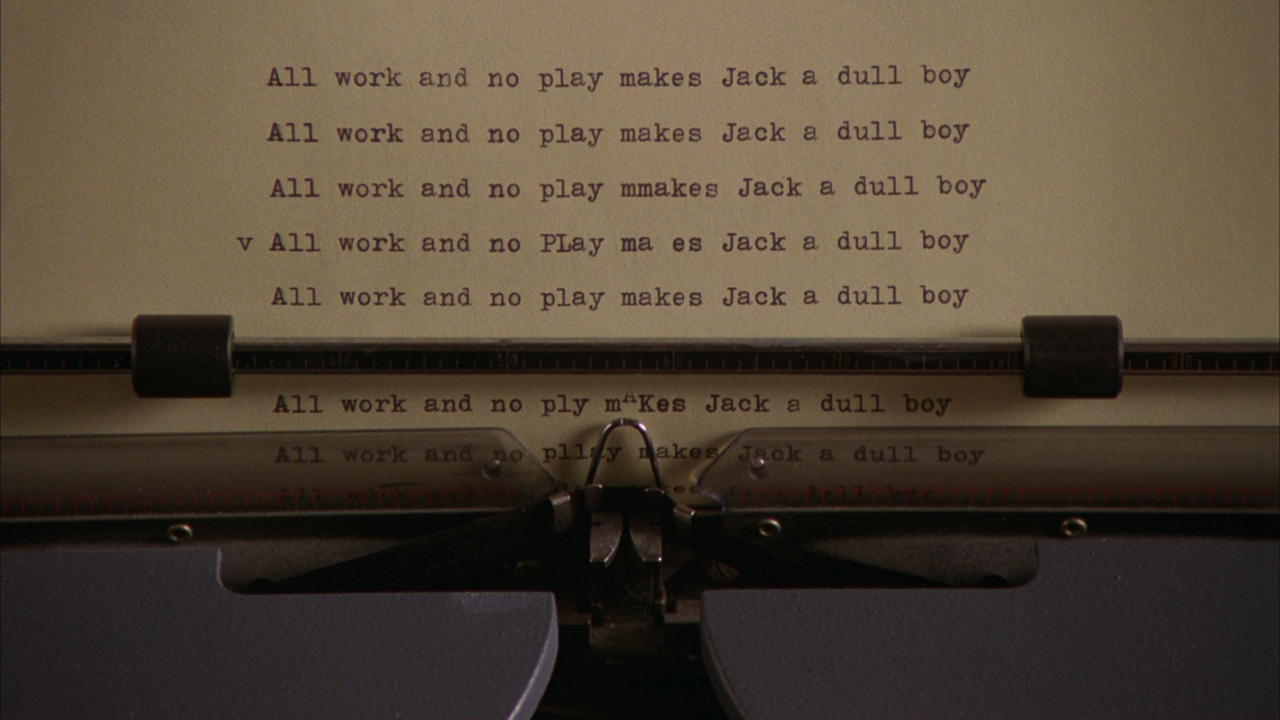
Like when one of the exegetes argues that the recurrence of the number 42, the fact that Jack Torrance (Jack Nicholson) uses a German-made typewriter and the graphic match evident in the dissolve from  a pile of luggage to a group of guests is more than enough to prove the film is about the Holocaust.

The paranoid aspect of this spills out beyond the film when the NASA conspiracy guy claims that he is under state surveillance and that he fully expects an IRS audit next year. (Intriguingly, he insists that the Moon-landing itself was not faked, just the Moon-landing footage, but he never explains why NASA would do this – although he does dismiss someone else’s claim that it was to keep us from seeing the towering alien city in the Sea of Tranquillity.)

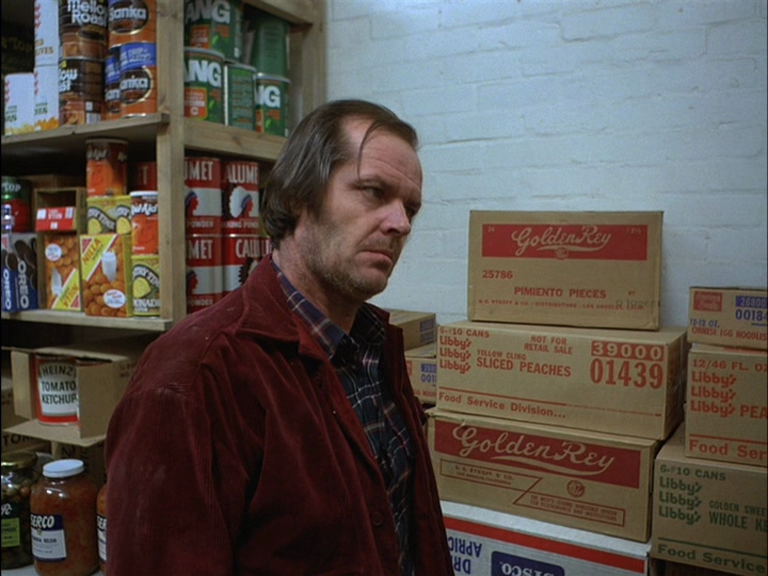
vlcsnap-2012-11-03-17h36m26s183While watching Room 237, I could not resist constructing my own version of its real secret meaning which is also clearly bullshit. The exegete who sees the film as being about the genocide of Native Americans makes much of the prominence afforded to cans of Calumet baking powder. However, he completely misses the genuinely prominent placing of packets of Oreos – next to Jack when he wakes up on the sacks of salt, and then on the extreme left of this shot, clearly mis-shelved behind Jack and the baking powder cans (misdirection!). ‘Oreo’ is slang for a middle class African American, who might look black on the outside but is really white on the inside. Such conservative figures, who align themselves with white culture, function to conceal the supposed threat to white hegemony – especially white masculinity – posed by African Americans.

The same exegete notes that the five o’clock shadow of Bill Watson (Barry Dennen) makes him look mixed race, but quite ludicrously suggests that this aligns him with the native American, when clearly his major domo status – which includes walking behind hotel manager Stuart Ullman (Barry Nelson), being expected to sit quietly to one side, and being ordered to perform menial tasks – positions him as an African American servant, like the butlers played by Bill ‘Bojangles’ Robinson.

6336382_f260But the task of  looking after Danny, The Shining‘s Shirley Temple equivalent, is displaced on to Hallorann. Significantly, it is only after Danny – who, like Hallorann and Hallorann’s grandmother can, ‘shine’ – states his preference for ‘chocolate’ ice cream that Hallorann calls him ‘son’. No wonder Grady, in the red bathroom, warns Jack about this ‘nigger’ interloper, coming to replace him as Danny’s ‘real’ father. (And since ‘the shining’ seems to skip a generation, Hallorann is simultaneously positioned as Danny’s grandfather – that is, Jack’s father.) No wonder Kubrick replaces Jack’s light-coloured typewriter, a symbol of paternal authority and of entry into the Lacanian symbolic order, with a darker model partway through the film…

1350845502845114This explains also Kubrick’s decision about the final images of the film. White masculinity, frozen out of the picture, stuck in a lost past.

This is – of course – not remotely what the film is about. And I really hope no-one takes it seriously, but y’know how the internet is…

Uncertainty (Scott McGehee and David Siegel 2009)

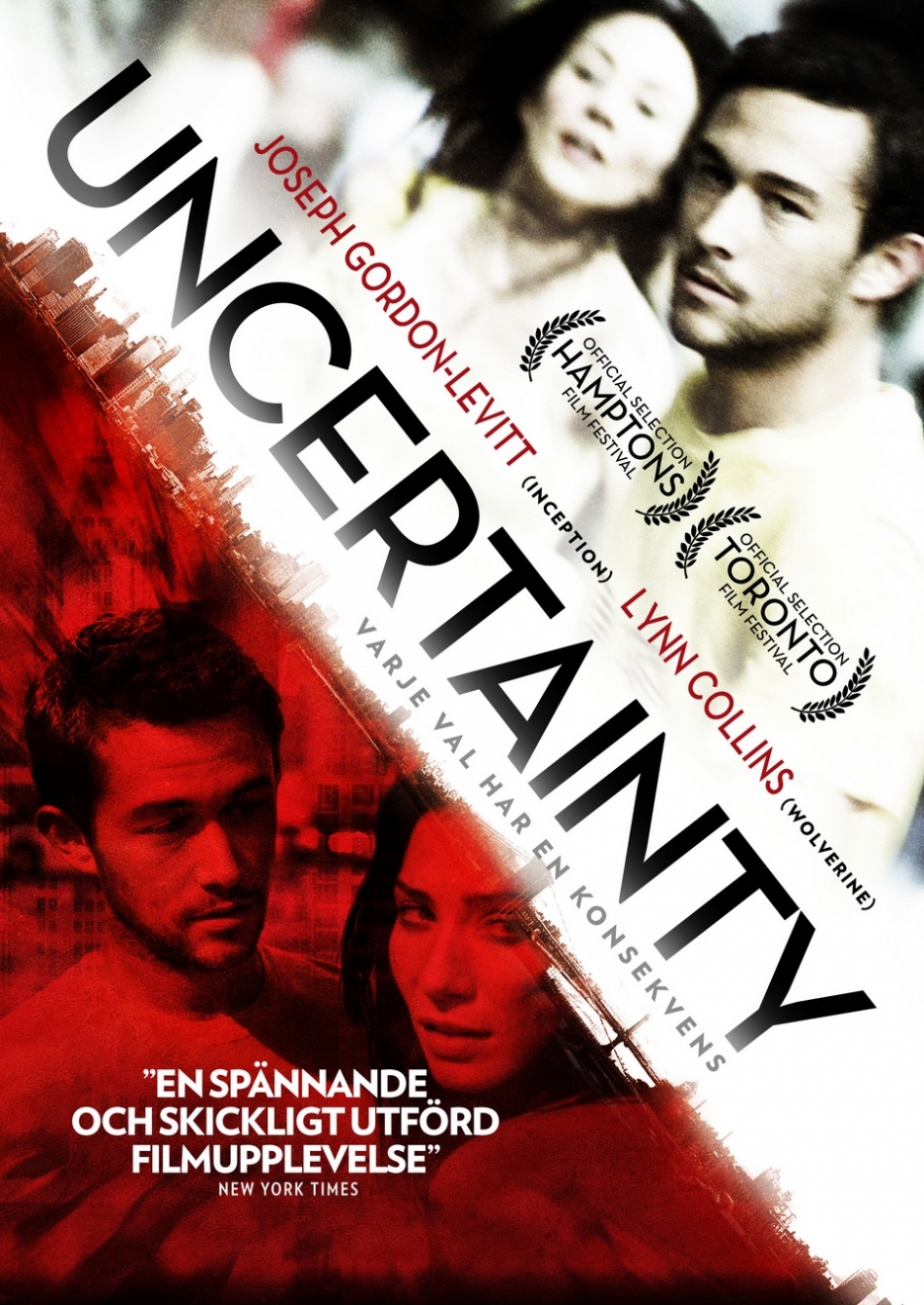
936full-uncertainty-posterand so anyway it turns out that the best thing about Uncertainty (2009) is, as you would expect from the writers/directors of Suture (1993) and The Deep End (2002), its bold experimentalism – not so much with the narrative structure that attempts to construct the perfect date movie by intertwining two different versions of the same day depending on whether the protagonists decide to go to Brooklyn or Manhahattan and, respectively, into a family melodrama or a conspiracy thriller, while also confirming to each gendered-genre viewer that the other gendered-genre viewer’s preference is lame, but with the valiant – and entirely successful attempt – to outdo Stephen Sommers’ similar effort in G.I. Joe: The Rise of Cobra (2009) to make a film so meh that not even the presence of Joseph Gordon-Levitt (doubled!) can save it…

The Wicker Tree (Robin Hardy 2011)

MV5BMTkyNzkyODE5N15BMl5BanBnXkFtZTcwNjUxNzIxNw@@._V1_SX214_AL_and so anyway it turns out that the best thing about The Wicker Tree (2011) is not as I initially thought its ability to transform those memories of the Nicolas Cage Wicker Man remake into fond memories of the Nicolas Cage Wicker Man remake, but its ability to make you realise that they were always fond memories…