Jack London’s The Iron Heel

This wasn’t due to go up until tomorrow, but with the fucking Tories somehow re-elected this morning…

Back in the mists of time, around a decade ago, there was a plan for an ever-expanding online collection of short critical essays on key works of the fantastic. The plan fizzled and died, but not before I wrote nine pieces for it (which I just found). This is another of them.

51FHCMEP0MLFirst editions: New York: Macmillan, 1907; London: Everett, 1907
Edition used: Edinburgh: Canongate Books (Rebel Inc. Classic), 1999

The Iron Heel is the incomplete memoir of Avis, written in 1932, on the eve of the Second Revolt. It recounts how, in 1912, she and her wealthy father met the revolutionary socialist, and her future husband, Ernest Everhard, and were won to his cause. Within a year, their lives are in disarray as the capitalist interests who dominate institutions and an increasingly tyrannical government seize complete control of America. This plutocratic oligarchy – dubbed ‘the Iron Heel’ by Ernest – forces the socialists underground. The novel ends with horrific descriptions of the destruction of Chicago in the failed First Revolt, and breaks off abruptly, leaving no account of the subsequent fifteen years. The memoir is introduced and edited by Anthony Meredith, writing in the year 409 B.O.M. (Brotherhood Of Man), the socialist era that follows three centuries of the Iron Heel.

6e75ede3299bc0149a0073dba92eb6d6In the first issue of Amazing Stories, Hugo Gernsback described the sf story as ‘a charming romance intermingled with scientific fact and prophetic vision’. To his list of exemplars – Jules Verne, H.G. Wells, Edgar Allan Poe – Gernsback could have added Jack London. The Iron Heel reworks the ‘guided tour’ typical of the utopian novel: Avis, her father and Bishop Morehouse enter a new world – that of the immiserated, impoverished working class – and Ernest, their guide, explains in detail its logic and inner workings. The novel also anticipates the hard-sf which emerged from the pulp tradition (and which can still, arguably, be defined in Gernsback’s terms). The science in question is not, however, physics or astronomy but London’s idiosyncratic version of scientific socialism. The near-future events of the novel are predicated on a (vulgar) Marxist analysis of the process of capital accumulation and the cyclical crises it inevitably produces.

London’s extrapolative premises and technique are most obvious in the chapter ‘The Mathematics of a Dream’. Beginning with the ‘ABCs of commerce’ (108) – the production of value by labour and the extraction of surplus-value (profit) by the capitalist – Ernest takes his audience step-by-step through the logic of capital accumulation which leads to periods of overproduction and mass unemployment. His satiric proposal – that destruction of surpluses would be an effective way to deal with cyclical over-production, as in Frederik Pohl’s ‘The Midas Plague’ (1954) – is dismissed as absurd. But in a world in which, for example, agricultural subsidies are paid for deliberate underproduction to stabilise prices and ‘surplus’ crops are routinely destroyed (while people elsewhere starve), The Iron Heel’s prophetic value is difficult to ignore.

A curious aspect of the novel, and of its socialism, is the treatment of the all-but-absent proletariat. Avis’s conversion commences with an investigation into the fate of Jackson, a man who lost his arm in an industrial accident. The machine that maimed him is revealed to be part of a much larger apparatus, an economic and social system which – through coercion, collusion, corruption and conspiracy – denies him justice and subordinates and perverts other ‘slaves of the machine’. Years later, Avis meets a foreman who dishonestly testified against Jackson in order to protect his own job and provide for his family, and is now a member of a group of fanatical assassins. This is not to avenge his dead wife and daughters, he declares, but

‘’tis revenge for my blasted manhood’. (206)

Thus Avis’s career as a revolutionary is circumscribed by images of castrated workers. And when she describes one worker who has been a socialist for over twenty years, it is as

phlegmatic, stolid to such a degree that one could not but wonder how the Revolution had any meaning to him at all … He could obey orders. (198)

a4fa9708a0f91a712cdf60581558931aThis denial of agency to the working class is indicative of the peculiar type of socialism, blended with aspects of Friedrich Nietzsche and with Herbert Spencer’s ‘survival of the fittest’ misunderstanding of evolution, advocated by London (who puts at least one of his own speeches/essays, ‘Revolution’, into Ernest’s mouth).

As his name suggests, Ernest Everhard possesses a phallic intensity of focus and purpose. He physically overwhelms Avis. When she first mentions him by name, he is linked to images of penetration, engorgement and assimilation (6). Her fantasies and desires are ripe with the language of domination (22). Her feelings pulsate with attraction and repulsion, until she is swept off her feet

by the splendid invincible rush of him. (55)

She conceives of him as a messiah – he is an eagle, a lamb, a lion, ‘the spirit of regnant labour’ (63), Christ – and longs to melt before him, to merge her ‘life completely into his’ (138). When they are on the run, Avis learns to take on a completely different appearance through controlling her body whereas Ernest requires cosmetic surgery to transform him: she is fluid, he is hard.

Avis, then, despite her origins, exemplifies what London’s socialism requires of the working class, ‘the People of the Abyss’.[1] In the Chicago uprising, they are not only depicted as dumb beasts but as an inundation, a surging fluid mass. Without form or identity, they are to be shaped or sacrificed by the revolutionary party.

TheIronHeelCapitalV.Labour565This system of images – rigidly armoured male bodies; women and the feminised masses as a threatening flood – is typical of the literature produced by the German Freikorps in the 1920s, many of whom later played significant roles in the SA and SS.[2] And so at the heart of this ‘small folk Bible of scientific socialism’ we find a form of fascism.

Or perhaps not.

London’s novel depicts failed revolutions. This suggests an anxiety about the revolutionaries’ terroristic vanguardism, and the novel does not claim that the final revolution is of that ilk. Rather, the post-revolutionary editorial framework emphasises Ernest’s relative insignificance, Avis’s ‘errors of interpretation’ (1), the ‘equal futility’ of the First and Second Revolts and the

many Revolts, all drowned in seas of blood, ere the world-movement of labor should come into its own. (4)

North America and Asia are beneath the Iron Heel of the Oligarchs for 300 years, but as early as 1912 a wave of socialist revolutions swept the world, inspired and empowered by the general strike which prevented a war between the US and Germany. Perhaps it is such collective action and international solidarity that leads to the Brotherhood of Man.

The other eight entries I wrote were:
Voltaire, Candide
Godwin, Caleb Williams
de Maistre, Voyage Around My Chamber
France, Thais
Gernsback, Ralph 124C 41+
Smith, The Skylark of Space
Schuyler, Black No More
Sturgeon, Venus Plus X

Notes
[1]
This expression, which London also used as the title of his 1903 book of reportage on the London poor, is borrowed from HG Wells’s Anticipations of the Reaction of Mechanical and Human Progress upon Human Life and Thought (1901).

[2]
See Klaus Theweleit, Male Fantasies, volume 1: Women, Floods, Bodies, History (1977; trans. 1987) and Male Fantasies, Volume 2: Male Bodies: Psychoanalyzing the White Terror (1978; trans. 1989).
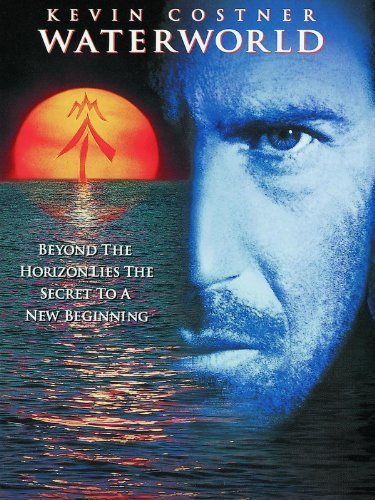
Waterworld (Kevin Reynolds 1995)

MV5BMTA2Nzk3MTgzMTVeQTJeQWpwZ15BbWU3MDgyNTgxNjk@._V1_SX640_SY720_and so anyway it turns out the best thing about Waterworld (1995) is not that it is intermittently far less terrible than I remember it being, though far too intermittently for me to consider rewatching The Postman (1997), the other Kevin Costner post-apocalyptic epic I also saw at the cinema and swore never to watch again, but that Joss Whedon, in his seven weeks of script-doctoring the movie, somehow managed to not ascribe Costner’s character’s gills, webbed toes, Man from Atlantis swimming style, assorted other almost-superpowers and ambiguous motivations to his inability to be a mother…

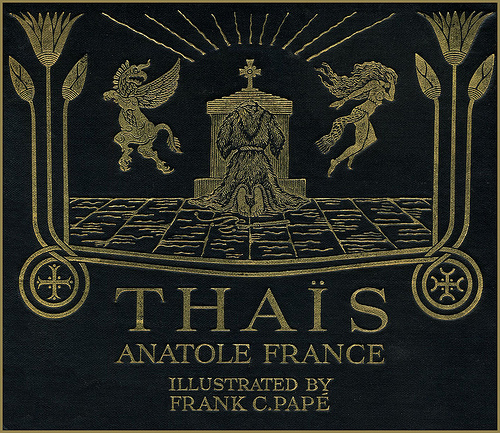
Anatole France’s Thaïs

Back in the mists of time, around a decade ago, there was a plan for an ever-expanding online collection of short critical essays on key works of the fantastic. The plan fizzled and died, but not before I wrote nine pieces for it (which I just found). This is another of them.

5869549609_55f2afb282First published: 1890
Edition used: Thaïs (London: John Lane, 1920) translated by Robert B Douglas

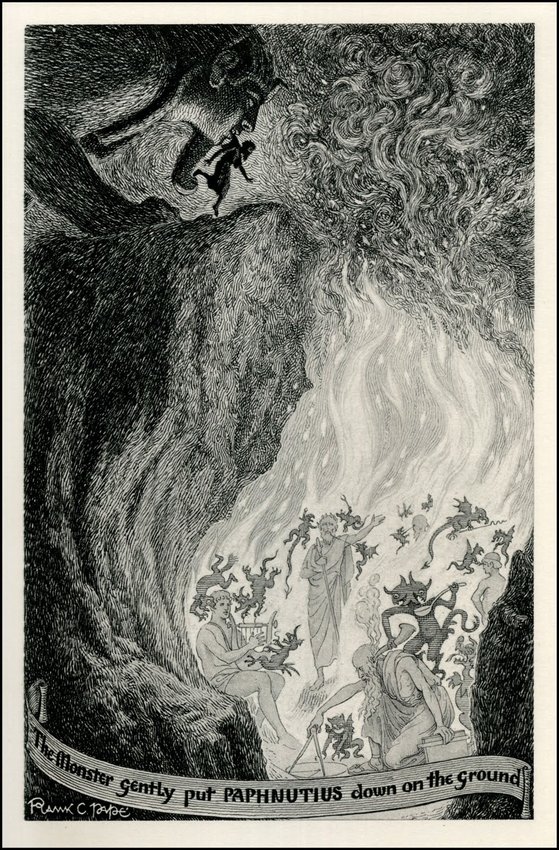
Some time during the late Roman Empire, Paphnutius, the Abbot of Antinoë, an ascetic hermit living on the banks of the Nile, while recalling his sinful life before his conversion, remembers Thaïs, a beautiful and promiscuous actress who had once

almost led [him] into the sins of the flesh. (10)

dfda453a37d468531b3e72219b93bd4bHe takes it upon himself to save her. He traces her to Alexandria, converts her from her life of sin and takes her to live in a religious sisterhood. On returning home, he begins to be haunted by visions of Thaïs and by demonic little jackals. Seeking respite, he sets out on a pilgrimage, finds a pillar in the desert and takes up residence atop it. Pilgrims flock to see him, miracles are performed, and the city of Stylopolis grows up around the pillar. Paphnutius believes he is on a holy mission to take on the sins and sufferings of others – until he realises that Satan has tempted him into pride. He flees, is haunted by demons and falls into the sins of lust and Arian heresy. Hearing that Thaïs is dying, he rushes to her side. She dies a saint, but his sins and torments have altered him so much that when the chorus of chanting virgins see his face, they run away, terrified, crying:

‘A vampire! A vampire!’
He had become so repulsive, that passing his hand over his face, he felt his own hideousness. (234)

Although it does take particular pleasure in its anticlericalism, Thaïs is a remarkable attack not just on Christian asceticism but also upon the self-sustaining systems we develop to explain the world and our place in it. Like Voltaire’s Candide, it holds up to ridicule Leibniz’s Principle of Sufficient Reason, when Nicias argues from observing two baskets of olives that

‘For man, who only sees a part of things, evil is evil; for God who understands all things, evil is good’

to which Eucrites responds

‘The world is a tragedy by an excellent poet. God, who composed it, has intended each of us to play a part in it. If he wills that you shall be a beggar, a prince, or a cripple, make the best of the part assigned you’. (129)

But this is just one of many targets.

Others include those who appeal to textual authority or unduly venerate antiquity: Hermodorus argues that

there is no such thing as a good form of government, and that we shall never discover one, because the Greeks, who had so many excellent ideas, were never able to find one. … all hope of ultimate success is taken from us. Unmistakable signs show that the world is about to fall into ignorance and barbarism. (124)

And when Thaïs claims that Paphnutius

knows the truth

Nicias replies,

‘I know the truths. He knows but one, I know them all. I am superior to him in that respect, but to tell the truth, it doesn’t make me any prouder nor any happier’. (160)

The radical scepticism of the stranger Paphnutius encounters en route to Alexandria, who argues that

‘there is no such thing as a good or evil life. Nothing is itself either virtuous or shameful, just or unjust, pleasant or painful, good or bad. It is our opinion which gives those qualities to things, as salt gives savour to meat’ (23)

is echoed by Nicias, who informs Paphnutius that

‘Good and evil exist only in the opinion. The wise man has only custom and usage to guide him in his acts. I conform with all the prejudices which prevail at Alexandria. That is why I pass for an honest man’. (39-40)

When she was just 11 years old, Thaïs realised that

no one can be good in this world except at cost of the most terrible suffering

and became

afraid to be good, for her delicate flesh could not bear pain. (76)

FrankPape_Thais_05_100As an adult, she greets the world without scepticism, believing in everything (84) – a position every bit as subversive as believing in nothing.

Between these epistemological poles, Paphnutius’s moral certainty is consistently undermined. Travelling through the desert, he spies a plover caught in a hunter’s net; her mate tears an opening in the net for her to escape:

The holy man watched this incident, and as, by virtue of his holiness, he easily comprehended the mystic sense of all occurrences, he knew that the captive bird was no other than Thaïs, caught in the snares of sin, and that – like the plover that cut the hempen threads with its beak – he could, by pronouncing the word of power, break the invisible bonds by which Thaïs was held in sin. Therefore, he praised God, and was confirmed in his first resolution. But then seeing the plover caught by the feet, and hampered by the net it had broken, he fell into uncertainty again. (16-7)

Paphnutius’s judgement is repeatedly called into question, as when he joins in Dorion’s misogyny, blaming women for the arousing sexual feelings in men (50); and his unconscious and self-deceiving motivations become increasingly clear to the reader as, observing Thaïs’s suffering as he leads her through the desert, he does not feel

any of the pity which softens the hearts of the profane [but rejoice[s] at these propitiatory sufferings of the flesh which had so sinned. So infuriated was he with holy zeal that he would have liked to cut with rods the body that had preserved its beauty as a shining witness to its infamy. (164)

This psychosexual dimension is wittily reiterated and simultaneously problematised as an explanatory framework when Lucius Aurelius Cotta enquires of the stylitic Paphnutius,

‘Has this column any phallic signification in your mind?’ (198)

The willingness to believe, and the influence of certain ideological determinants or conceptual systems on what one is prepared to believe, are foregrounded when Palemon tells of a monastery whose inhabitants are divided into groups by letters of the alphabet, where

a certain analogy is observed between the character of the monks and the shape of the letter by which they are designated, and that, for example, those who are placed under Z have a tortuous character, whilst those under I have an upright mind. (181)

Likewise, when the story of Cotta’s attempt to question Paphnutius is recounted:

The story of this meeting was embroidered with wonderful details, which those who invented were the first to believe. … And, the miracle being public and notorious, the deacons of the principal churches of Libya recorded it amongst the authentic facts. (200)

imagesDespite the seeming clarity of these quoted passages, Thaïs remains a rather ambiguous text, a careful balancing out of different voices, none of which can be taken to coincide with its author, teetering on the brink of meaning. But lest any belated postmodernists lurk nearby, waiting to rush in to claim France as a precursor, it is worth remembering a lesson that Nicias offers Thaïs. Throwing down a ‘treatise on morals’ composed by ‘the gravest of stoics’ (88) he had been reading while awaiting her return, he takes her in his arms, explaining:

Yes, when I had before my eyes the line in which it is written, ‘Nothing should deter you from improving your mind,’ I read, ‘The kisses of Thaïs are warmer than fire, and sweeter than honey.’ That is how a philosopher reads the books of other philosophers … It is true that, as long as we are what we are, we shall never find anything but our own thoughts in the thoughts of others, and that all of us are somewhat inclined to read books as I have read this one. (89)

The other eight entries I wrote were:
Voltaire, Candide
Godwin, Caleb Williams
de Maistre, Voyage Around My Chamber
London, The Iron Heel 
Gernsback, Ralph 124C 41+
Smith, The Skylark of Space
Schuyler, Black No More
Sturgeon, Venus Plus X

The Ultimate Warrior (Robert Clouse 1975)

Ultimatewarriorand so anyway it turns out the best thing about The Ultimate Warrior (1975) is not the moment when a young mother, safe within Max Von Sydow’s fortified compound,  decides to sneak out into the violent gang-filled streets of post-apocalyptic Manhattan in search of powdered milk rumoured to be hidden in a nearby derelict bakery, nor is it her decision that the best way to do so is to leave via the front door (er, portcullis) with her given-to-squalling infant on her back, but her decision that the best time to do so is under the cover of broad daylight

Xavier de Maistre’s Voyage autour de ma chambre and Expédition nocturne autour de ma chambre

Back in the mists of time, around a decade ago, there was a plan for an ever-expanding online collection of short critical essays on key works of the fantastic. The plan fizzled and died, but not before I wrote nine pieces for it (which I just found). This is another of them.

51FWUCxEkvL._SY344_BO1,204,203,200_Originally published: 1795 and 1825 respectively
Edition used: Xavier de Maistre, A Journey Around My Room and A Nocturnal Expedition Around My Room, translated by Andrew Brown (London: Hesperus 2004)

Confined to his room for 42 days, the narrator undertakes an expedition around it.[i] His closely observed account of its content and disposition wanders off into recollections, fancies, speculations and other digressions. Thirty years later, and without the company of his valet or his dog, he undertakes a similar journey around a different room over the course of a single night.

These two humorous short tales gently mock the conventions of sentimental fiction in a way not dissimilar to Laurence Sterne’s A Sentimental Journey through France and Italy (1768). At the same time, de Maistre’s digressive manner owes something to Sterne’s The Life and Opinions of Tristram Shandy, Gentleman (1759-67) – Voyage not only alludes explicitly to the hobby horse of Tristram’s Uncle Toby, but also has a distinctly Sterne-ian chapter twelve, consisting of a lengthy ellipsis in the middle of which appear the words ‘the mound’ (17).

But what makes de Maistre’s diptych interesting to the scholar of fantasy lies elsewhere.

In Voyage, the narrator offers a pseudo-Cartesian metaphysics in which

man is composed of a soul and a beast. – These two beings are absolutely distinct, but so closely fitted together, or one on top of the other, that the soul must have a certain superiority over the beast to be in a position to draw a distinction between them. (9)

350px-Guillaume_pour_MaistreAs evidence for this dualism, the narrator offers an example that seems to equate the beast with an autonomic, almost machinic, material substratum, and the soul with the imagination (while also offering a provocation to the reader of a book which seems incapable of fastening its attention on anything for very long):

 When you read a book, sir, and a more agreeable idea suddenly strikes on your imagination, your soul straight away pounces on it and forgets the book, while your eyes mechanically follow the words and the lines; you come to the end of the page without understanding it, and without remembering what you have read. – This comes from the fact that your soul, having ordered its companion to read to it, did not warn it of the brief absence on which it was about to embark; as a result, the other continued to read even though your soul was no longer listening. (10)

Why would the explorer and adventurer need to leave his room, if the mere act of being handed a wet sponge with which to wipe clean the portrait of a lover can make his

soul sweep across a hundred million leagues in a single instant. (21)

Or if one can find in fictional worlds a spur to the imagination (51)?

From the expedition of the Argonauts to the Assembly of Notables, from the lowest depths of hell to the last fixed star beyond the Milky Way, to the confines of the universe, to the gates of chaos – this is the vast terrain which I wander across in every direction at leisure; for I do not lack time any more than I lack space. It is here that I transport my existence, on the trail of Homer, Milton, Virgil, Ossian, etc.
All the events that occur between these two eras, all the countries, all the world and all the beings who have lived between these two limits – it is all mine, it all belongs to me just as much and just as legitimately as the vessels that entered the Piraeus belonged to a certain Athenian. (53)

What is refreshing about this advocacy of imaginative indulgence is its absolute lack of moralism. The narrator is clearly something of an amorous adventurer when unconfined, and so when (in chapter 39) his soul berates his beast

‘What!’ said my soul, ‘so that’s how it is: during my absence, instead of restoring your strength by having a peaceful sleep, and thereby making yourself more able to execute my orders, you have insolently decided’ (the term was a bit strong) ‘to succumb to transports of delight that my will had not sanctioned?’ (57)

131215101517673575it is singularly unconvincing, not least because his soul, before waking, had clearly been engaged in an erotic dream about Mme de Hautcastel. The narrator’s disavowal of his wet-dream and its physiological consequences follows precisely the same logic as that which underlies cyberpunk’s spurning of the flesh in favour of disembodied cyberspatial elation two centuries later – as does the narrator’s solipsism.

The narrator’s reveries turn to matters cosmological in two key passages in the sequel story, in which he sits astride his window sill and contemplates the night sky. While the combination of confinement and flights of fantasy is common enough – see, for example, Thomas De Quincey’s Confessions of an English Opium Eater (1821), Jack London’s The Star Rover (1915) and those Gothic fictions in which a socially-entrapped heroine misinterprets mundane events as supernatural – these moments in Journey seem to hint at something specifically science-fictional: not so much the cognitive breakthrough conclusions of stories like Robert Heinlein’s ‘Universe’ (1941) or Isaac Asimov’s ‘Nightfall’ (1941), which convert the profound ontological revelation of humanity’s cosmic insignificance into a plot twist, but something closer to Olaf Stapledon’s Starmaker (1937), in which the night sky observed from a hillside is subsumed into an escalating spiral of immensity. The response of Journey’s narrator to immensity is to proffer a thesis whose paradoxical nature acknowledges its own inadequacy. Chapter 16 reads:

The system of the world

I believe, then, that as space is finite, creation is also finite, and that God has created in his eternity an infinity of worlds in the immensity of space. (95)

And should one be tempted to misread this as something profound, the following chapter commences with the narrator admitting that he does not himself understand it

any better than all the other systems that have hitherto been hatched […]; but mine has the precious advantage of being contained within a couple of lines. (96)

The other eight entries I wrote were:
Voltaire, Candide
Godwin, Caleb Williams
France, Thais
London, The Iron Heel 
Gernsback, Ralph 124C 41+
Smith, The Skylark of Space
Schuyler, Black No More
Sturgeon, Venus Plus X

Notes
[i]
This period of confinement coincides with the punishment meted out to de Maistre for a duelling incident.

Oblivion (Joseph Kosinski 2013)

tom_cruise_in_oblivion_movie-2880x1800and so anyway it turns out the best thing about Oblivion (2013), a film which patches together bits from every other science fiction film ever, is the way in which flying spherical robot drones manage to combine 2001: A Space Odyssey’s shuttle pods with RoboCop’s ED209 and with The Black Hole’s V.I.N.CENT and Old Bob, though sadly this also brings us to the worst thing about the movie, the way in which a bunch of cowardly philistine corporate suits lacking Joseph Kosinki’s genius and vision refused to have the drones voiced by Windsor Davies, who voiced Sergeant Major Zero in the key sf text of the late twentieth-century, Terrahawks

William Godwin’s Things As They Are, or The Adventures of Caleb Williams

Back in the mists of time, around a decade ago, there was a plan for an ever-expanding online collection of short critical essays on key works of the fantastic. The plan fizzled and died, but not before I wrote nine pieces for it (which I just found). This is another of them.

Caleb Williams.2-1Originally published: 1794
Edition used: Caleb Williams (Penguin, 1988) edited and introduced by Maurice Hindle

Of humble origin, Caleb Williams, orphaned at the age of 18, is taken into the household of the local squire, Ferdinando Falkland. One day, he stumbles upon his master behaving in a secretive manner; on perceiving Caleb, Falkland becomes violent. Falkland’s steward explains the curious chain of circumstances that saw Falkland recently accused of murder and then vindicated, after which his personality underwent a profound change. Caleb begins to suspect Falkland is actually guilty of the murder and let others be executed for his crime. Falkland eventually confesses to Caleb, secure that no one will believe a servant over his master. When Caleb tries to flee the tyranny with which Falkland circumscribes his daily existence, he is framed for robbery. Awaiting trial, Caleb escapes, and from that moment on his life becomes a miserable series of disguises and upheavals as Falkland’s agents dog his steps, never allowing him to settle.

Things As They Are is an intriguing test case for where the boundaries of the fantastic lie. A ‘political Gothic’, there is nothing of the fantastic in it – not even of the apparently supernatural that is later revealed to have a mundane explanation. M John Harrison argues that the problem with much sf is that it has become addicted to the mediating metaphor – the whole paraphernalia of future societies, other worlds, monsters and spaceships, and the grab-bag of technical and rhetorical tools – rather than deploying such image-furniture and techniques to establish a metaphoric relationship between text and world. Much the same can be seen to happen in the flowering of the Gothic in the second half of the 18th century and its subsequent permutations.

While the Gothic imagined terrible incarcerations in crumbling vaults and subterranean dungeons, Godwin turned to the reality of the contemporary judicial and penal systems as described in The Malefactor’s Register; or the Newgate and Tyburn Calendar (1779) and Howard’s 1777 report on The State of Prisons, and as witnessed on visiting Newgate prison and in the treatment of fellow radicals such as Joseph Gerrald and Maurice Margarot.

While the Gothic generally used such torments to thrill its readers with the depiction of sensibilities under distress, Godwin – who was not above such things – also turned his Gothic imagination to an elaboration of the prison as a model of the social world.

Falkland-discovering-Caleb2-e1300118099300While much Gothic fiction can be read as a kind of sadomasochistic proto-feminist expression of the internalisation of particular historical restrictions on female experience, Caleb stands as a kind of typical subject for whom the whole world is carceral.[i] The ‘paranoid’ depiction of society as a prison-house becomes an important fantastic metaphor in Nathaniel Hawthorne’s The Scarlet Letter (1850), Charlotte Perkins Gilman’s ‘The Yellow Wallpaper’ (1892), Daniel Paul Schreber’s Denkwürdigkeiten eines Nervenkranken/Memoirs of My Nervous Illness (1903), Yevgeny Zamyatin’s My (1924), Franz Kafka’s Der Prozess/The Trial (1925), B Traven’s The Death Ship (1934), George Orwell’s Nineteen Eighty-four (1949), Samuel Beckett’s Le Depeupleur/The Lost Ones (1971), Joanna Russ’s The Female Man (1975), Marge Piercy’s Woman on the Edge of Time (1976), Margaret Atwood’s The Handmaid’s Tale (1985), throughout Philip K Dick’s work and in countless other fantastic and dystopian fictions.

But at what point does one judge the metaphor to have become sufficiently concretised in the diegetic world to make it a fantastic world?[ii]

One particular moment is worth considering in this light. Hiding out in London, Caleb encounters a hawker peddling a fictionalised account of his life:

Here you have the MOST WONDERFUL AND SURPRISING HISTORY AND MIRACULOUS ADVENTURES OF CALEB WILLIAMS: you are informed how he first robbed, and then brought false accusations against his master; as also of his attempting divers times to break out of prison, till at last he effected his escape in the most wonderful and uncredible manner; as also of his travelling the kingdom in various disguises, and the robberies he committed with a most desperate and daring gang of thieves; and of his coming up to London, where it is supposed he now lies concealed; with a true and faithful copy of the hue and cry printed and published by one of his Majesty’s most principal secretaries of state, offering a reward of one hundred guineas for apprehending him. All for the price of one halfpenny. (278)

Robbed of his liberty, Caleb is now stripped of his identity as other characters take this popular account for the truth about him. And it does indeed contain some superficial truths – he has escaped prison, been sheltered by a gang of thieves (although committing no crimes himself), become expert at disguise and made his way to London – but not the truth, especially not what has forced him into this behaviour. But this virtual self becomes a doppelganger, permitting him no rest, even as Falkland’s exercise of arbitrary power takes on a life of its own separate from and outside of his control. Elsewhere, much is made of the difference of justice as it exists on paper and as it is experienced by those subjected to its institutional practices – a long time before Borges or Baudrillard, Godwin observes not only the distinction between map and territory but also the supersession of the territory by the map.

Ultimately, even if Caleb’s misadventures are not judged to be fantastical, they nonetheless pose important questions about how we conceptualise fantasy. If M John Harrison’s Things That Never Happen (2004) collects the fiction of a fantasist working to strip the fantasy out of fantasy, Godwin’s Things As They Are seems to tackle the same problem from the other side.

220px-CalebWilliamsIt should also be noted that Caleb provides a template of sorts for the creature in Mary Shelley’s Frankenstein, or the Modern Prometheus (1818) – Shelley was, of course, Godwin’s daughter – and that like Shelley’s novel Things As They Are cries out for queer reading.

The other eight entries I wrote were:
Voltaire, Candide
de Maistre, Voyage Around My Chamber
France, Thais
London, The Iron Heel 
Gernsback, Ralph 124C 41+
Smith, The Skylark of Space
Schuyler, Black No More
Sturgeon, Venus Plus X

Notes
[i]
This is not to imply that female characters cannot be typical subjects, nor that male experience should be normalised as in anyway typical.
[ii]
Things As They Are bears some obvious similarities to such noirish crime movies as I Am a Fugitive from a Chain Gang (LeRoy 1932) and The Big Clock (Farrow 1948), itself a possible prototype for Dick’s A Scanner Darkly (1977); and a similar question about the boundaries of fantasies is posed by the heady and tortured prose typical of Cornell Woolrich’s crime fiction.

Voltaire’s Candide, or Optimism

Back in the mists of time, around a decade ago, there was a plan for an ever-expanding online collection of short critical essays on key works of the fantastic. The plan fizzled and died, but not before I wrote nine pieces for it (which I just found on an old floppy disc – remember them?). This is one of them.

tumblr_m04x7srMbC1r70saro1_500Voltaire (François-Marie Arouet), Candide, or Optimism
Original publication: 1759 (simultaneously on 22nd February in Paris, Geneva, Amsterdam, London and Brussels in order to pre-empt censorship and pirated editions)
Edition used: Candide and Other Stories, translated by Roger Pearson (Oxford: Oxford University Press, 1998)

The innocent Candide is exiled from the Westphalian castle where he was raised when he and the Baron’s daughter, Cunégonde, fall in love. A series of comic, grotesque, satiric and implausible adventures ensue as Candide and various companions trek throughout Western Europe and South America before finally settling, older, battered by experience and possibly wiser, in Turkey.

Candide contains no fantastic elements beyond its use of outrageous coincidence, which might be more properly judged comical than fantastical. Its most obviously science-fictional component is the briefly sketched satirical utopia of Eldorado

‘What! You mean you don’t have any monks to teach and dispute and govern and intrigue and burn people to death who don’t agree with them?’ (49)

which Candide and Cacambo decide to leave because everyone there is wealthy:

‘If we stay on here, we’ll simply be the same as everyone else, whereas if we return to Europe with even a mere dozen sheep loaded up with Eldorado pebbles, then we’ll be richer than all the kings put together’ (51).

However, in terms of the Natural Philosophy of its period of composition, Candide is a profoundly science-fictional novel.

The ‘optimism’ of its sub-title refers to Leibniz’s Principle of Sufficient Reason, an attempt to apply reason to the problem of theodicy, the branch of theology concerned with defending the Christian god against doubts and attacks derived from the existence of physical suffering, misery and evil. Leibniz’s Principle argued that there is always a logical reason for the way things are. Therefore, as god is perfect, then his actions must also always be perfect. In creating the universe, he created something separate from himself which, by the very definition of being separate from god, must be less than perfect. At the moment of creation, he chose between all possible worlds, and from among them he chose the best of all possible worlds – that which, over the course of its entire history, would produce the greatest ratio of good over evil. Therefore, all the evil and misery and suffering that we experience serves a greater good, although perhaps not on a scale we can perceive. Candide’s journeying and education expose him and his companions to monstrous suffering and degradation, prompting him to question the Leibnizian argument espoused by the supposed philosopher Pangloss.

While darkly hilarious, Voltaire’s relentless assault on the Principle of Sufficient Reason might seem too much of its time to possess contemporary relevance. This is not the case. Chaos theory or non-linear dynamics show that, despite living in a determinist universe, the cause-and-effect chains we construct to explain the world are partial narrativisations which do not take account of the state of the total system as it changes from moment to moment. Nevertheless, we continue to rely on such narrativisations and to frequently misunderstand retrospectively-constructed cause-and-effect chains as inevitable processes and history as purposive. It is good then to be reminded of the spurious reasoning thus produced:

‘It is demonstrably true,’ [Pangloss] would say, ‘that things cannot be other than as they are. For, everything having been made for a purpose, everything is necessarily for the best purpose. Observe how noses were made to bear spectacles, and so we have spectacles. Legs are evidently devised to be clad in breeches, and breeches we have. Stones were formed in such a way that they can be hewn and made into castles, and so His Lordship has a very beautiful castle. The greatest baron in the province must be the best lodged. And since pigs were made to be eaten, we eat pork all the year round. Consequently, those who have argued that all is well have been talking nonsense. They should have said that all is for the best.’ (2)

CANDIDE-BESTOWED-A-THOUSAND-EMBRACES-ON-THE-BARON-AND-PANGLOSS-1-q4532The introduction of and justification for a hierarchical power relationships in Pangloss’s ludicrous argument also demonstrates an early awareness of the instrumentalist misuses to which power bends reason into ideology, normalising existing structures of domination.

The other way into the science-fictionality of Candide is through tracing its possible influence on the genre: the Eldorado episode seems to provide a model for HG Wells’s ‘The Country of the Blind’ (1904); the satire on reason became central to US magazine sf in the 1950s. Neal Stephenson’s monumental Baroque Cycle (Quicksilver (2003), The Confusion (2004), The System of the World (2004)) revisits the origins of science-out-of-alchemy and explores the changes wrought on human understanding by the development of reason and empirical observation. In doing so, in reimagining the Europe of, among others, Leibniz, from a perspective derived from information science, Stephenson revisits the origins of sf in the dialectic of materialist and idealist world-views. By depicting capital as an information technology, Stephenson uncovers the central rôle of fantasy – commodity fetishism – in the modern period. The global trekking of The Confusion resembles Candide (although at considerably greater length – Stephenson has not inherited Voltaire’s concision), while the trilogy as a whole concludes on a distinctly Candide-like note:

At some point the whole System will fail, because the flaws that have been wrought into it … But … he has to admit that having some kind of a System, even a flawed and doomed one, is better than to live forever in the poisonous storm-tide of quicksilver that gave birth to all of this.
He has done his job.
‘I’m going home now,’ he says. (System 886)

Perhaps what is most remarkable about Candide is how very modern it seems. From Pangloss

giving a lesson in applied physiology to [a] maid, a very pretty and very receptive little brunette (3)

to its deadpan descriptions of rape, murder, torture, mutilation and slaughter, its ironic distantiation self-deconstructs reason’s fundamental idealism (its belief in its ability to abstract itself from the material world).

And in this time of religious fundamentalism (Christian and otherwise) and militarism, Candide’s anticlericalism, its clear perception of the sheer brutality of warfare and of the instrumentalisation of reason are to be admired, imitated and pursued.

The other eight entries I wrote were:
Godwin, Caleb Williams
de Maistre, Voyage Around My Chamber
France, Thais
London, The Iron Heel 
Gernsback, Ralph 124C 41+
Smith, The Skylark of Space
Schuyler, Black No More
Sturgeon, Venus Plus X

Space is the Place (John Coney 1974)

[A version of this review originally appeared in Foundation: The International Review of Science Fiction 92 (2004), 97–100.]

Sun_Ra_Space_is_Place_21Imagine Philip K. Dick was born 15 years earlier, black and with an astonishing musical talent in Birmingham, Alabama . . . imagine that, and you might just get Herman Poole Blount who became Le Sony’r Ra who was known as Sun Ra. You might just get the other visionary genius of postwar American sf.

Reading John F. Szwed’s Space is the Place: The Life and Times of Sun Ra (Payback 1997), the comparison with Dick seems not entirely spurious. Both were phenomenally productive (Ra recorded over 1000 compositions on at least 120 albums). Both compulsively permutated and reiterated core themes and images whose shades of meaning and internal contradictions always seemed to imply a larger scheme in which they were reconciled. Both were innovators working with battered clichés. Both were treated indifferently at home and lionised in France. Both had run-ins with the FBI, possibly (in 1971 Ra and his Arkestra were invited to Oakland by Bobby Seale and lived for a while in a house owned by the Black Panther Party). Both were students of gnosticism and the Bible. Both had life-changing mystical experiences (in 1936 Ra underwent an ‘alien abduction’), but while the events of 2-3-74 led Dick to write his 8000-page exegesis, Ra lived his exegesis for the next 57 years, in person and on stage. Both were ontologically-troubled, perceiving the world as a veil (either that, or they were both persuasive charlatans). Both were self-mythologisers. Both have been called mad.

Of course, there were also many differences.

tumblr_mku7b2UL0I1s3e71xo1_1280Dick never claimed to be from Saturn, nor did he describe Star Wars as ‘very accurate’. He was not a major figure in post-war jazz, or the frequently unacknowledged godfather of world music, or one of the first musicians to experiment extensively with electronic keyboards. Dick did not mount spectacular lightshows before the likes of Pink Floyd, Hawkwind, the Grateful Dead and others whose attempts to transform gigs into overwhelming integrated audiovisual experiences are sometimes cited as inspiring VR’s total immersion grail.

Nor was Dick born black in Alabama in 1914.

And although Dick was keen, at one point, to make a movie (of Ubik (1969)), he failed. Ra, however, succeeded—even if it was not always clear that the barely-released, rarely-seen Space is the Place was a success.

The plot is straightforward enough. Ra, wandering in an alien garden, explains that he is establishing a Black colony there, to see what they can accomplish without white people around—but should he bring the colonists by ‘isotope transportation transmolecularisation’ or by teleporting them through music? Cut to Chicago, 1943. Sonny Ray is a nightclub pianist. Insulted by a well-dressed black pimp called the Overseer (Ray Johnson), his playing intensifies: glasses explode, smoke pours from the piano, everyone flees. Sonny Ray, now Ra, and the Overseer are transported to an arid plain—Chicago, it appears, was just another phase in an ongoing conflict. The Overseer accepts Ra’s challenge to a game of ‘the end of the world’. Ra flies to Oakland, California in a spaceship powered by the music of his Intergalactic Solar Arkestra. The Overseer recruits Jimmy Fey (Christopher Brooks), a reporter for ‘stone jive Channel Five’, to his cause, along with a brothel madam and two female nurses (who are treated throughout as little more than sex objects). Meanwhile, Ra reaches out to the ‘black youth of planet Earth’ and opens the Outer Space Employment Agency. He convinces the Overseer to up the stakes by letting him put on a show. Government agents abduct Ra and interrogate him about his spaceship’s power source and the African space programme, torturing him with a tape of what sounds like a high school band performing a particularly chipper version of ‘Dixie’. But the show goes on, and Sun Ra returns to space, taking with him a selection of African Americans to establish a colony on an uninhabited garden world. In order to secure this reversal of the Middle Passage from the interference of white people, Sun Ra destroys the Earth behind them.

sun-ra-space-450Shot on 16mm with a tiny budget, the movie has some very rough edges: flat visuals, indifferent dialogue (Ra wrote his own), thin characters, weak performances, poor pacing and the kind of inconsistencies and incoherence one often associates with Ra’s self-consciously elusive and playful pronouncements. Director Coney cites movies like Rocketship X-M (Neumann 1950) and Cat Women of the Moon (Hilton 1954) as inspiring the deliberately cheesy special effects that, aware of budgetary constraints, they set out to create. Fortunately, this unpolished quality quite closely matches Ra’s own pre-punk DIY aesthetic—throughout his career, his and the Arkestra’s costumes were generally homemade and looked it, although those in the movie are of a better quality. (A more remarkable example of this DIY aesthetic is the drum Ra told bassoonist James Jacson to make from a lightning-struck tree opposite the Arkestra’s Philadelphia home—an incident Jacson recounts in Robert Mugge’s 1980 documentary Sun Ra: A Joyful Noise). The movie’s rawness reflects the circumstances of its production. By Hollywood standards, it is only a little less professional than many blaxploitation movies, and more professional than some. But in judging such movies, Hollywood’s standards are not the most appropriate measure.

Argentinian filmmakers Fernando Solanas and Octavio Gettino’s 1969 manifesto ‘Towards a Third Cinema’ identified three kinds of filmmaking. First Cinema is the commercial cinema of Hollywood and its imitators. Second Cinema comprises auteurist cinema and art cinema; but however well-intentioned it might be, it is a bourgeois cinema dependent upon First Cinema distribution. Third Cinema is neither commercial nor bourgeois. In its most militant forms, it is closely aligned with political groups, has clear political goals and is unconcerned with politically-debilitating myths of objectivity and balance. It is an activists’ cinema, embedded in struggle. In his 1969 manifesto ‘For an Imperfect Cinema’, Cuban filmmaker Julio García Espinosa argued that rather than aspiring to the kind of ‘perfect’ cinema exemplified by Hollywood’s hermetic spectacles, Third World countries should aim to create an imperfect cinema, a genuinely popular art created by the masses to aid them in their daily and revolutionary struggle. In addressing Space is the Place and some of the more radically inclined blaxploitation movies – Sweet Sweetback’s Baadasssss Song (Melvin Van Peebles 1971), The Spook Who sat by the Door (Ivan Dixon 1973) – such standards and ideas might prove more appropriate.[i]

maxresdefaultIt is easy to deplore Hollywood’s destruction and depletion of other national cinemas. What is less obvious is the ways in, and extent to, which Hollywood has deprived the US of a national cinema, a tendency evident since the 1920s and currently foregrounded by the multinational ownership of the major Hollywood companies and their increasingly standard policy of treating the US as just one more territory in which they can sell movies. From this perspective, independent film can, depending on the degree and nature of its independence, be regarded as a national cinema manqué; and Space, Sweetback and Spook can be seen as efforts groping towards an indigenous Third Cinema.[ii] Their rawness and rough edges are products of the dialectics of perfect and imperfect cinema.

Space’s imperfections display the disjunctions of the era. Only a movie this marginal could:

  • display pictures of Angela Davis, George Jackson, Bobby Seale, Malcolm X and other black revolutionaries quite so proudly
  • punish a villain by making his underlings, white and black alike, suddenly see him as a ‘nigger’ and treat him like one
  • depict a race war in which whitey loses so comprehensively.[iii]

Only Space could present elements of Ra’s Astro Black Mythology, blending an outer space future with a black Egyptian past – rejecting centuries of Christian metaphorisation of Egypt as a place of bondage and claiming it instead as the Promised Land, as black civilisation.[iv]

vlcsnap-2010-04-13-17h05m45s82And perhaps only such a marginal production could have displayed its misogyny so crudely. But to dismiss Space on this count would be problematic (and not just because many Hollywood productions of the period were just as bad, if more polished). Rather, it is another imperfection that opens up that particular historical conjuncture. This is not to exculpate – nor is it to damn with faint praise by reducing Space to the status of an interesting historical document. More accurate than Star Wars, it tries to offer a new hope, albeit an imperfect one.

Notes
[i]

Although as Mike Wayne argues in Political Film: The Dialectics of Third Cinema (Pluto 2001) we should not regard these types of cinema as pigeonholes into which movies can be placed—instead, particular movies should be considered as embodying the dialectical interplay of these different cinemas.

[ii]

The films of the LA Rebellion group, which mostly rejected blaxploitation, can be understood as another attempt.

[iii]

Compare the wimped-out ending of Conquest of the Planet of the Apes (J Lee Thompson 1972).

[iv]

See Graham Lock’s Blutopia: Visions of the Future and Revisions of the Past in the Work of Sun Ra, Duke Ellington, and Anthony Braxton (Duke 1999).

Eden Log (Franck Vestiel France 2007)

[A version of this review appeared in Science Fiction Film and Television 3.1 (2010), 157–61]

edenlogEden Log begins in darkness.

Water drips into water.

Ragged breaths.

Flashes of light reveal a man (Clovis Cornillac), caked in mud, waking, staggering to his feet. (Later, much later, we – and he – will learn that his name is Tolbiac, but for now he has no idea who or where he is.)

He finds a torch on a nearby corpse and in its intermittent light he creeps and crawls and climbs up out of this cave into the lower levels of a seemingly derelict industrial complex. Cables and roots, difficult to tell apart, hang from the ceiling, industrial detritus devolving into, merging with, the subterranean-organic. On the wall behind him, a half-seen diagram describes a process which seems to involve humans descending below ground and then later ascending. He presses through heavy turnstiles and is greeted by projections of half a dozen women, immaculately clothed and coiffed, who address him in multiple languages. In the ominously bland idiolect of a corporate shill, one of them states,

The contract is fair. It is thanks to your work below that you will build your paradise above. Look after the plant and it will look after you.

This pun on plant, which works in French as well as in English, opens up one of the several fields of ambiguity in which this often elliptical film nestles. The plant is both a miraculous tree of vast proportions, its roots reaching far underground, and the industrial complex which extracts sap with ‘infinite energetic properties’ from the tree so as to power a city.

eden-log-clovis-cornillacAs Tolbiac ascends through underground levels – a trajectory that materialises the vertical integration upon which the Eden Log corporation’s gradually unveiled monopoly depends – he encounters various others from whom he begins to piece together the world and its story. One man, suspended from a wall, claims to have brought down the system, but it is not entirely clear where he ends and the plant (in either sense) begins. Tolbiac triggers a recording of the final confrontation between the technicians and the guards: when faced with an information leak over their corporate malfeasance, the nature and extent of which will only later become clear(er), Eden Log overrode all protocols about the relative autonomy of the subterranean levels and sent in guards to destroy the evidence and eradicate the threat.

1242613626_3The plant has been responding to its escalating exploitation by releasing a toxin that mutates the workers into strange, no-longer human creatures. Tolbiac’s struggle against transformation wavers when he finds an uninfected woman (Vimala Pons) and, suddenly abhuman, rapes her. He is appalled by what he has done, and what he is becoming. She elects to accompany him up to the surface, not knowing that he has infected her.

Eventually, having pieced together most of the puzzle, Tolbiac is recognised – and, at last, named – by the guards he used to command. Pretending to be himself, he cons his way past the guards and plugs himself into the plant, which has always been sterile, infecting it with life. It erupts, shattering the dome that contained it, and expands to take over the deserted city, transforming it into a beautiful – and colour-filled – landscape.

Eden Log actually begins not in darkness but with a quotation:

Therefore the Lord God sent him forth from the garden of Eden to till the ground from whence he was taken. (Genesis 3:23)

Tolbiac’s initial emergence from the mud might be taken as a reworking of the creation of Adam in The Bible: In The Beginning… (US/Italy 1966), replacing John Huston’s achingly – and thus camply – tasteful images of an inspirited wind blowing aside yellow sand to reveal the first man with birthing imagery that is rather more fecal, fluid and feminine. Eden Log certainly invites psychoanalytical readings: its setting recalls the maternal interiors of Alien (Scott UK/US 1979), the rape carries strong overtones of a primal scene fantasy, and Tolbiac’s ascent into realms of language and control, the realm from which he fathered himself, plays out an Oedipal entry into the Symbolic.

The biblical quotation can also be interpreted as Vestiel’s announcement of his transition to directing feature films. Previously, he had directed three episodes of the French cop show, Central Nuit (Night Squad 2001– ), and gathered assistant director credits on numerous films, including Blueberry (Renegade; Kounen France/Mexico/UK 2004), adapted from Jean ‘Moebius’ Giraud’s bande desinée, and Ils (Them; Moreau and Palud France/Romania 2006). Such experience undoubtedly prepared him well for shooting a film in the dark, in confined spaces[1] and with an elusive – some have claimed incomprehensible – narrative with religious overtones.[2] Many of the reviews of Eden Log struggled to make sense of a film with the narrative structure of a Paul W.S. Anderson video game adaptation but stripped of his prolonged action sequences and clearly-defined (if one-dimensional) characters, motives and goals. Struggling to make sense of their disappointed expectations, reviewers typically drew fairly insubstantial comparisons with THX 1138 (Lucas US 1971), Le dernier combat (The Last Battle; Besson France 1983), Cube (Natali Canada 1997), Pi (Aronofsky US 1998) and Primer (Carruth US 2004), among others – often for no better reasons than Eden Log being a first film, French, black-and-white (sort of), low-budget, visually striking and/or elliptically plotted.

A more productive comparison might be drawn with Tsukamoto Shinya. Although Eden Log lacks the viscerality of Haze (Japan 2005), in which a man likewise drags himself through a mysterious subterranean location, Vestiel shares Tsukamoto’s eye for post-industrial landscapes – for once-essential components mutating into something almost-organic – along with his taste for apocalyptic rebirth and a posthuman otherness that defies eutopian-dystopian binaries.

Vestiel’s decision to begin the action in overwhelming darkness, with intermittent flashes of light that reveal less than they show, recalls the opening of The Texas Chain Saw Massacre (Hooper US 1974), with which Eden Log shares an energy crisis narrative about the dehumanising effects of capital. But it also announces that Eden Log is self-consciously a film. Garrett Stewart argues that

cinema exists in the interval between two absences, the one whose loss is marked by any and all photographic images and the one brought on by tossing away each image in instantaneous turn. (xi)

For him, the presence of still photographs within the diegesis functions as a reminder of the photogram, the still image that is held in front of the viewer for a twenty-fourth of a second as the film is projected but which is never seen or experienced as a still image. Vestiel’s prolonged stretches of darkness between each flash of light work in a similar manner, to remind us of the unseen dark absence which replaces each photogram in succession.

This filmic self-consciousness is further developed by the projection of images within the diegesis. For example, in the sequence in which Tolbiac replays the recording of the final attempt at negotiation before the guards invaded the subterranean levels, he must scurry to raise into the air a variety of surfaces so that the recorded dialogue can be accompanied by images projected onto these détourned screens, rematerialising a profilmic moment that is no more and reminding us that the

filmic medium is the once having been there of the represented spaces themselves, absented by necessity to make possible the materiality of their moving image on the track. (Stewart 5)

Later, a wizened figure, attached to the plant but slumped as if dead, is eerily animated as an earlier recording of him is projected onto his unmoving face. This play between the inanimate and the animated – which resonates strongly with the decision to strip the film stock of all colour, apart from the occasional revenant touch of red and green[3] – confronts us once more with the interplay between the substrate and the surface of the filmic experience itself. As Stewart notes,

photography engraves the death it resembles, [whereas] cinema defers the death whose escape it simulates. (xi)

Vestiel’s striking use of light and darkness, his flickering between presence and absence, the visible and the invisible, is matched by a refusal fully to explicate the world of the film or the narrative. By adhering to Tolbiac’s amnesiac perspective as he pieces together information from the thinnest and most elusive of expository clues, Vestiel situates the viewer in the space between obscurity and illumination. Even those adept in the relevant genre conventions will find themselves frustrated by Vestiel’s grimly playful evasion of specificity – a strategy clearly announced in the rape scene.

Having raced together into a room-sized elevator, Tolbiac removes his unknown companion’s helmet, revealing that she is a woman. With increasing passion – and apparently in flashforward – they begin to make love. This is soon intercut with another image stream in which the sex is reconfigured as Tolbiac violently raping the woman, and with a third in which he seems to be looking on in disgust at himself. The scene ends with Tolbiac slumped against a wall in dismay, and with the woman curled up in a corner, crying; and yet when he finds a way out, repeating to himself, ‘It’s not me, it’s not me’, she accompanies him.

While it remains unclear what has actually happened between Tolbiac and the woman, the frequent complaint in online commentary that the scene is gratuitous and that it makes no sense for the woman to follow her rapist indicates the extent to which generic framings can override the indeterminacy of the specific. This troubling conjuncture of community and violence, the flicker between affective intersubjectivity and aggressive domination, between what might be and what is, is at the core of the film’s critique of contemporary power.

Eden_LogThe Eden Log corporation’s circular logo which reappears throughout the film contains a diagram of tree as an intricate network, branching out in all directions. This potentially rhizomatic image is disrupted by the corporation’s name, which bisects the circle horizontally, turning the network into a tree with branches above ground and roots below. It forces verticality and thus hierarchy onto the image. The tree, as Deleuze and Guattari argue,

plots a point, fixes an order (7)

even as the rhizome that this tree places under erasure

expose[s] arborescent pseudomultiplicities for what they are. (8)

Indeed, the film’s working title, Network Zero, suggests the point at which vertical hierarchy severs and deforms lateral multiplicity. The plant – both the tree and the factory housing it – is a synecdoche for the Eden Log corporation which owns it, part of the biopolitical order that, according to Michel Foucault, extends and veils the disciplinary sovereign power of the state to

make live and let die. (241)

In the closing minutes of the film it is revealed that Eden Log has promised immigrants who labour in the plant will be rewarded with citizenship, and concealed from the citizens that the plant is feeding on its workers. Eden Log has a vision of ‘a new social order’ built upon this ‘integration’ of non-citizen outsiders into ‘our civilisation’, and believes that when the truth is revealed that ‘our citizens will accept what our needs impose on these populations’. This exemplifies the manner in which biopolitical governance moulds populations to serve the economy. It can be seen as the logic of the Holocaust, in which the

death of the bad race, of the inferior race (or the degenerate, or the abnormal) is something that will make life in general healthier. (Foucault 255)

But it is also the logic of the supposedly free market.

And to this sovereign power Eden Log counterposes zoē, the

simple act of living common to all living beings (Agamben 1)

which is shared by the abhuman not-death-but-continuation of the mutated workers and the plant-human-machines, and by the climactic, uncanny efflorescence of computer-generated nature.

Notes
[1]
Eden Log was shot in a damp, freezing ten-acre mushroom bed sixty feet below ground, as well as water decontamination stations and sewers.

[2]
Vestiel co-authored the screenplay with Pierre Bordage, co-writer of Marc Caro’s less-than-coherent Dante 01 (France 2008), on which Vestiel also worked as assistant director.

[3]
There are two other bursts of (rather artificial-looking) colour when, courtesy of CGI, the plant effloresces. Stewart suggests that

in the second half of this century, science fiction has continued, more and more vividly, to imagine the technologies that would outdo it, do it in. In the digital era, however, futurist cinema has for the first time mobilized rather than merely evoked its own self-anachronizing upgrades. Engineered by computer enhancements, the super-annuation of a suddenly hybrid medium has become manifestly planned obsolescence, performed from within rather than simply foreseen. (222)

Works cited
Agamben, Giorgio. Homo Sacer: Sovereign Power and Bare Life. Trans. Daniel Heller-Roazen, Stanford: Stanford UP, 1998.
Deleuze, Gilles and Félix Guattari. A Thousand Plateaus: Capitalism and Schizophrenia. Trans. Brian Massumi. London: Athlone, 1988.
Foucault, Michel. Society Must Be Defended: Lectures at the Collège de France 1975–1976. Ed. Mauro Bertani. Trans. David Macey. New York: Picador, 2003.
Stewart, Garrett. Between Film and Screen: Modernism’s Photo Synthesis. Chicago: The University of Chicago Press, 1999.