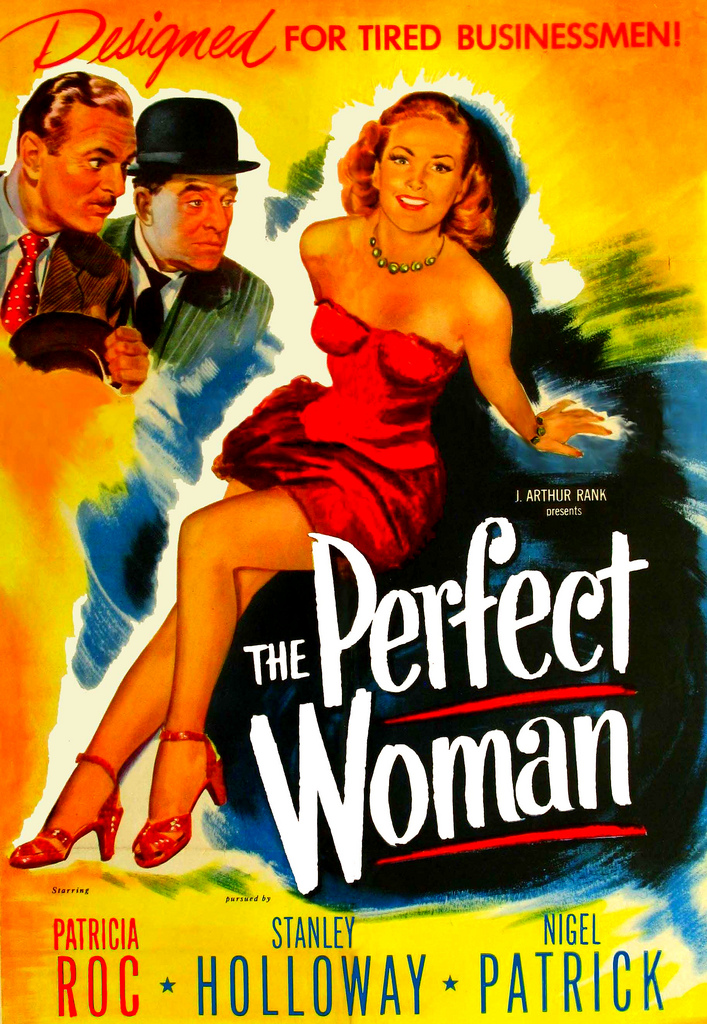
The Perfect Woman (Bernard Knowles 1949)

4668460913_77a9d048aa_bThis post is based on a couple of old conference papers, delivered at Screen (2005) and ICFA 27 (2006), that I never had chance to develop further and forgot about until I stumbled on a draft the other day.

Bernard Knowles’ 1949 film The Perfect Woman is based on Wallace Geoffrey and Basil Mitchell’s play, which premiered September 11th 1948 at the Playhouse Theatre, and follows it quite closely. The dotty Professor Belmon (Miles Malleson) builds a robot called Olga (Pamela Devis), modelled on his niece, Penelope (Patricia Roc). He hires Roger Cavendish (Nigel Patrick), a penniless man about town, and his valet, Ramshead (Stanley Holloway), to field-test Olga by taking her out in society. Penelope, who has led a rather sheltered life, swaps places with Olga. The threesome book into the bridal suite at the Hotel Splendide. Rumours of Roger’s marriage soon reach his aunt, Lady Mary (Philippa Gill), who returns immediately from Paris. The farce escalates until Roger and Penelope realise they love each other. Their mutual declaration sends Olga, who for no clear reason cannot be allowed to hear the word ‘love’, haywire. She blows up, taking part of the hotel with her.

It is a lovely little film, and a rare example of the science fiction romantic comedy.

Many sf movies provoke laughter, and some – sf comedies – even intend to. Many sf movies also contain romance, but few are romances. And ‘sf romantic comedy’ is a vanishingly small category.

Undoubtedly, the film industry’s gendered assumptions about the audiences the two genres attract prevent the greenlighting of such projects, and thus reduce the likelihood of them even being proposed. But perhaps, too, there is an incompatibility in the generic logics of the dominant forms of sf and romantic comedy.

The romantic comedy narrative is typically intimate. Its characters often withdraw from the social realm to a green space or relatively hermetic equivalent. The genre’s spectacle is also intimate: a star couple talk to each other and, in close-up and luminously-lit, finally profess their love; those moments when William Powell and Myrna Loy enjoy each other’s martini-enhancedThin3-300x225 company, talking to each other but saying nothing in particular and certainly nothing of any narrative consequence. In contrast, however much sf tries to humanise its concerns, its narratives – global crises, interplanetary conflicts – do not happen on the scale of the individual, and its spectacle is environmental: human figures are there to provide a sense of the scale of the backdrop, of just how big the alien fleet is.

These are of course generalisations.[i]

Not all sf cinema is spectacular. Often for budgetary reasons, sf films sometimes tell smaller scale stories. For every dozen 50s drive-in movies in which an alien invasion takes the form of some guy in an old gorilla suit and a deep-sea diver’s helmet wandering around Bronson caverns, there is an sf movie in which smallness is about an intimate human scale: Liquid Sky (1982), The Brother from Another Planet (1984), Last Night (1998), Possible Worlds (2000), Chetyre (2005) and the recent ‘low-fi sci-fi’ trend. Moving past the dominant contemporary logic of sf-as-spectacle lessens the sense that sf and romantic comedy are necessarily antagonistic.

So I want to begin by considering The Perfect Woman in the light of Darko Suvin’s and Samuel Delany’s accounts of how sf works. Suvin defined sf as

a literary genre whose necessary and sufficient conditions are the presence and interaction of estrangement and cognition, and whose main formal device is an imaginative framework alternative to the author’s empirical environment

He argued that

SF is distinguished by the narrative dominance or hegemony of a fictional “novum” (novelty, innovation) validated by cognitive logic

and that the

novum or cognitive innovation is a totalizing phenomenon or relationship deviating from the author’s and implied reader’s norm of reality.[ii]

The Suvinian sf text is one in which the author has imagined some materially plausible innovation, thought through all the implications of its introduction, and then written a story in which that altered world is presented in all its variety without ever necessarily explaining the root of the alteration.

In reality, few sf texts do this.

But there are some common variations on this ideal, such as the gadget story, common in the pre-World War 2 pulps, in which an astonishing device with all manner of implications and potential consequences is devised, operated briefly and then destroyed. This story type demonstrates the powerful conservativism of actually-existing sf, despite the radical potential Suvin and others find in it.

Actually-existing cinema is likewise conservative.

Generally incapable of proposing radical social transformation (it is more interested in robots and monsters than alternative social, political or economic structures), sf film often introduces a novum, whether a terminator or a man’s white suit, into a relatively hermetic social setting so as to briefly play out some of its implications before the possibility of radical transformation is shut down by the narrative reassertion of equilibrium. When following this structure, sf comes closer to the structure of romantic comedy – or at least permits a complementary structure to occur, with the restricted space/time of the novum’s presence paralleling romantic comedy’s green space (the nighttime woodland of Bringing Up Baby (1938)) or other delimited transitional space/time (the road – and several nights – of It Happened One Night (1934)).

This structural meshing of genres occurs in The Perfect Woman.

A novum – the android Olga – is introduced into an otherwise unchanged social setting (admittedly it matches neither the author’s nor the implied viewer’s but the conventional upper class milieu of West End farce, looking pre-World War 1 rather than post-World War 2). But rather than allowing the android to be introduced into this social realm, Penelope substitutes herself for the novum and thus transforms the hotel suite into a romantic comedy’s ‘green space’. Some potential implications of this new technology are hinted at, but the movie concentrates instead on the more intimate concerns of the stars falling in love; and as they declare their love, the android self-destructs, permitting the world to continue as if she had never existed.

Delany argues that different kinds of word-series are distinguished by their level of subjunctivity: reportage says this happened; naturalistic fiction could have happened; fantasy could not have happened; science fiction has not happened (which might include might happen, will not happen, have not happened yet, could have happened in the past but did not).[iii] He argues that as we learn the level of subjunctivity of the text, we simultaneously learn how to read the words from which it is constructed. An example he uses to clarify this idea is the expression ‘Her world exploded’. A romance novel’s clichéd description of emotional trauma might mean something different when describing Princess Leia.[iv]

leia-emotes

Delany argues that the

point is not that the meaning of the sentences is ambiguous … but that the route to their possible mundane meanings and the route to their possible SF meanings are both clearly determined.[v]

However, the ambiguity of such a sentence is vitally important: just because it appears in an sf context does not mean that it must be read in its latter sense; there are more proximate determinants of meanings than genre, although those determinants themselves might be determined – enabled or constrained – by genre (although of course genre is simultaneously determined by how the sentence is read). And in this particular instance from Star Wars it can mean both things at once.

Delany is of interest because The Perfect Woman develops much of its humour through linguistic ambiguity, including some fairly racy doubles entendres and other systems of doubling, other proliferations and profligacies. I will outline some of these, before returning to the question of genre by asking, so who exactly is the perfect woman? Penelope or Olga?

The basic humour of double meanings comes from the fact that Olga must be given explicit verbal instructions; but she is programmed to respond to words regardless of the context in which they are uttered (she consistently ignores genre). And it is not only expressions like ‘hopping mad’, ‘get a kick out of it’ and ‘slap up’ that cause problems.

When Belmon’s housekeeper, Mrs Butters (Irene Handl), takes Olga on the tube, she enquires at the gate, ‘Is this right for Green Park?’ Olga, who is ahead of her, turns right and nearly walks straight into the gents’ loos.

This strand also involves Penelope-as-Olga deliberately obeying such accidental instructions, and Roger and Ramshead’s growing proficiency at working necessary instructions into conversation.

When Belmon hires Roger and Ramshead, he talks at length about a woman he has ‘made’ without ever mentioning that he means a robot. Bubbling below the surface is a sense of impropriety, of everything Belmon says in innocence being taken by the others to mean something else – the viewer knows the real meaning, but can enjoy their misinterpretation. The scene culminates in Belmon explaining that the field-test is to avoid embarrassment when he presents Olga to his fellow scientists: it would do no good to give her a big build up only to find that he has produced

a woman who can’t work.

Ramshead uncertainly responds,

a woman must work, if she’s a working woman, scrubbing and all that.

The meaning of ‘working woman’ shifts from ‘functioning robot’ to ‘woman engaged in work’ to ‘prostitute’; ‘scrubbing’ simultaneously evokes domestic labour and, possibly, a scrubber in the sense of slattern (although the OED’s first recorded usage of ‘scrubber’ in this way is not until 1958).

tumblr_lnlexheZyf1qzdvhio1_r4_500There is a similarly difficult to interpret moment later in the film when Olga smokes a cigarette and breathes out through her ears: was this a joke about fellatio in 1949? and, as in the fellatio joke, is this ability what makes her a candidate for the perfect woman?

This euphemistic humour recurs. There are jokes about the delicacy of the mechanism, and about how beautifully built Penelope-as-Olga is. And when Mrs Butters, sozzled on sherry sits in Ramshead’s lap, he comments on her breath smelling of trifle.

Alongside euphemism is the unintended meaning, as when Belmon tells Roger

A child could work Olga. I’m sure you’ll get on with it.

The hotel is run by the Italian Farini (Fred Berger) and the guests are served by a Swiss waiter (David Hurst), leading to jokes about pronunciation and meaning, including confusion over the respective meanings of ‘to say’ and ‘to talk’. This strand begins when Ramshead tells Roger he has booked them into the Splendide.

Roger: Splendid.
Ramshead: Really, I always presumed it was pronounced splendide.

In a later exchange, ‘vase’ is pronounced three different ways – ‘vorze’, ‘varze’ and ‘vayze’ – in as many words.

When Lady Mary dismisses the waiter, saying

You needn’t wait.

He mournfully replies

That’s what I’m for.

When serving Penelope a second bowl of soup, he gets into an argument about whether or not she wants any more:

But sometimes when a lady says ‘no’ it is ‘yes’ she is meaning so ‘no’ means ‘yes’, no?

All of this wordplay depends upon the profligacy of signs, of signifiers producing multiple signifieds. And by constantly foregrounding linguistic ambiguity, The Perfect Woman draws attention to the contextual derivation of meaning and offers a fantasy of plenty during post-war scarcity. The latter is suggested by the anachronistic upper class milieu. Roger’s penniless condition, his fully-extended overdraft, and his aunt’s refusal to pay his monthly allowance are comic conventions that do nothing to exclude him.

Stanley-Holloway-and-Patricia-Roc-and-David-HurstWhen ordering dinner, Ramshead asks for just

something light. Say some soup, fish, chicken, joint, sweet, cheese, dessert, coffee, anything else that occurs to you … Oh yes, something to drink. A bottle of scotch, two dozen bottles of beer, another bottle of scotch, a small fizzy lemonade, and a bottle of scotch.

At the prospect of food, Penelope licks her lips in a peculiarly lascivious close-up; the shot is more or less repeated when Farini describes dessert.[vi]

YooniqImages_102357432And much is made of the fabulous underwear bought for Olga but modelled by Penelope – its luxury and ‘femininity’ contrasting strongly with Olga’s rather more fetishistic underclothing.
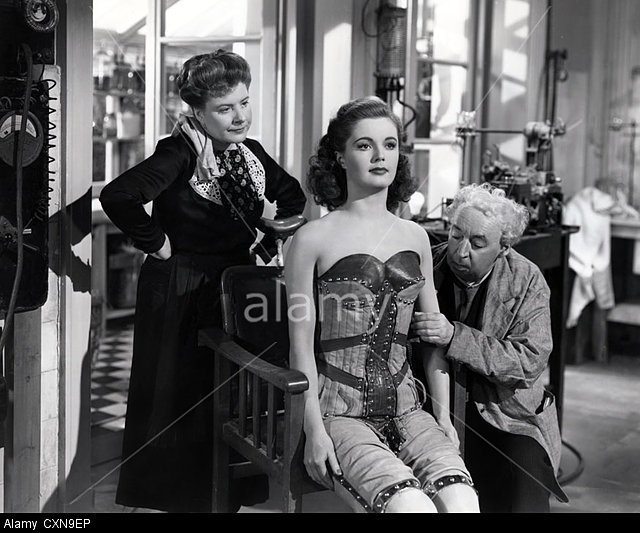
THE PERFECT WOMAN (1949) MILES MALLESON, PATRICIA ROC; IRENE HANDL; BERNARD KNOWLES (DIR); PFTW 002 MOVIESTORE COLLECTION LTDUnlike the Ealing comedies Hue and Cry (1947) and Passport to Pimlico (1949), the war’s devastation of London is hidden, an eradication of history which even includes changing the waiter’s nationality from German-Swiss to Swiss – in another gesture of profligacy, he is called Wolfgang Wilhelm Winkel, the second.

One might regard all this as a consolatory fantasy – a West End big rock candy mountain – in the way it is often asserted that 1930s musicals offered escape from the lived reality of the Depression. Read in this way, and through a lens provided by Andreas Huyssen’s discussion of the two Marias in Metropolis (1927), a central part of this fantasy is the destruction of the machine.[vii] The twinning of Penelope and Olga enables a separation of woman-as-nature from woman-as-technology. And the bridal suite functions as a romantic comedy green space – it is where Penelope clearly belongs and from which Olga, who sparks energy and manically goosesteps around the suite when she hears the word ‘love’, must be ejected.

This decision, the film’s nomination of Penelope rather than Olga as the perfect woman, requires examination.

Penelope asks her uncle

why did you make it like me?

He replies

Well, my dear, I call her the perfect woman … where else should I find such a model? It was either you or Mrs Butters.

When Roger asks him why he calls Olga the perfect woman, Belmon explains

Well, she does exactly what she’s told. She can’t talk. She can’t eat. And you can leave her switched off under a dust sheet for … weeks at a time.

Roger and Ramshead nod approval.

Earlier, Belmon says that Penelope is

 After all … only just another young woman. Flesh and blood and a little calcium … there are millions of them. Mass production. There’s only one Olga.

As with many robotic creations, and with doubles since Hoffman and Poe, this overt reference to mass production in relation to humans evokes the spectre of mechanical reproduction as capital cyborgises and homogenises the subject, as relations between people take on the form of relations between things.

Silvia Federici argues that

the human body and not the steam engine, and not even the clock, was the first machine developed by capitalism.[viii]

And what Marxist accounts of the transition to capitalism have often failed to recognise are the ways in which women were removed from the realm of ‘productive work’. Both the domestic and reproductive labour they then undertook were normalised as female activities and as activities which should not be counted as part of the labour necessary for the extraction of surplus-value, despite being essential to the reproduction of labour power both in terms of enabling the labouring man to recuperate and of having children.

It is not then surprising to find jokes about ‘working women’ and ‘scrubbers’, or layers of misogyny underlying Belmon’s lines about the perfect woman. These lines locate the film within a clear sf tradition, exemplified by Lester Del Rey’s ‘Helen O’Loy’ (1938) and Kate Wilhelm’s ‘Andover and the Android‘ (1963), in which a robot woman is preferred to any human female. A more atypical story in this vein is CL Moore’s ‘No Woman Born’ (1944), a sort-of feminist/anti-humanist story in which the cyborged female protagonist loves the superiority her new form gives her.

YooniqImages_102357428The Perfect Woman, by destroying the foreign/industrial/bound female body hidden by dustsheets, constrictive underwear and heavy macs, offers up the female body as a sensuous object, part of a ‘natural’ plenitude in the scarcity of post-war Britain. This, then, is why Olga cannot hear the word ‘love’ without going haywire. If domestic labour is treated as a person instead of a thing, patriarchal-capital logic is under threat. The only thing to do is to design the robot to malfunction should such a thing happen, saving the system and punishing the offending man with the loss of his robot. By thus restoring a ‘natural’ order of class and gender, it suggests that the green space need never end.

$(KGrHqJ,!hgE6Z3Bp3UUBOwjvTUkN!~~60_35But this preference is compromised by Patricia Roc’s performance as Penelope, another of the film’s areas of doubling and ambiguity. She is most enjoyable to watch when she slips between robot and human, when the viewer is invited into complicity with her masquerade. The concluding ‘falling in love’ is as perfunctory as it is compulsory. There is therefore the prospect of her popping out from behind the facade of the normalised gender role of Roger’s wife.

If, as Federici argues, the role of the wife is to reproduce labour, to be subsumed into and as part of the mechanism by which surplus-value is extracted, Penelope has already demonstrated that she lives in excess of such constraints – even if this excess is articulated through a much more post-feminist-seeming making-invisible of labour through fantasising about consumption.

Notes
[i]
The extent of their validity might be judged by considering the spate of overblown sf family melodramas such as Deep Impact (1998), Mission to Mars (2000), the entire Star Wars series, every sf film Spielberg ever made. This turn to melodrama – which is as often about fathers and sons as it is about romance – can be seen as a way of humanising the spectacular scale made possible by CGI, of turning masculine-gendered genres into less masculinely-coded ones. This logic also applies to such movies as Titanic (1997) and Pearl Harbor (2001), which use the technologies of sf cinema to construct melodramatic spectacles. Perhaps another reason for these movies’ relative success is that in melodrama, like sf, the environment signifies. It is spectacular and has meaning.

[ii]
Darko Suvin, Metamorphoses of Science Fiction: On the Poetics and History of a Literary Genre (New Haven: Yale University Press, 1979), pp.7-8, 63, 64; italics in original.

[iii]
See Samuel R. Delany, ‘About Five Thousand Seven Hundred and Fifty Words’, The Jewel-Hinged Jaw: Notes on the Language of Science Fiction (Elizabethtown: Dragon Press, 1977), pp.33-49.

[iv]
See Samuel R. Delany, ‘The Semiology of Silence: The Science Fiction Studies Interview’, Silent Interviews: On Language, Race, Sex, Science Fiction, and Some Comics (Hanover: Wesleyan University Press/University Press of New England, 1994), pp.21-58.

[v]
Delany, ‘The Semiology of Silence’, p.27.

[vi]
Several other pieces of business are repeated, with variations: because she does not believe Roger, Lady Mary sticks a pin in Penelope and then later in Olga. When Roger and Penelope first swoon at each other and make as if to kiss, Mrs Butters, who has just arrived, shouts stop at Olga. Misunderstanding, they stop and look around, and Penelope kisses Roger on the cheek; this gag is repeated, only the second time it is Roger who kisses Penelope.

[vii]
Andreas Huyssen, ‘The Vamp and the Machine: Fritz Lang’s Metropolis’, After the Great Divide: Modernism, Mass Culture, Postmodernism (Bloomington: Indiana University Press, 1986), pp.65-81.

[viii]
Silvia Federici, Caliban and the Witch: Women, The Body and Primitive Accumulation (Brooklyn: Autonomedia, 2004), p.146; italics in original.

120 years of sf cinema, part nine: 2005-2014

2015 marks the 120th anniversary of sf cinema. This is the ninth part of a year-by-year list of films I’d recommend (not always for the same reasons).

Part one (1895-1914), part two (1915-34), part three (1935-54), part four (1955-1964), part five (1965-74), part six (1975-84), part seven (1985-94), part eight (1994-2004)

200521395_Wild-Blue-Yonder-1
Chetyre/4 (Ilya Khrzhanovskiy)
Pervye na Lune (Aleksey Fedorchenko)
Pyl/Dust (Sergey Loban)
Les saignantes (Jean-Pierre Bekolo)
Tian bian yi duo yun/The Wayward Cloud (Ming-liang Tsai)
The Wild Blue Yonder (Werner Herzog)

2006
Africa Paradis (Sylvestre Amoussou)
Children of Men (Alfonso Cuarón)
Electroma (Thomas Bangalter and Guy-Manuel De Homem-Christo)
Gui si/Silk (Chao-Pin Su)
Gwoemul/The Host (Joon-ho Bong)
Krrish (Rakesh Roshan)
Papurika/Paprika (Satoshi Kon)
Southland Tales (Richard Kelly)
Special (Hal Haberman and Jeremy Passmore)

2007vlcsnap-2010-03-31-22h59m45s74
La Antena (Esteban Sapir)
Bekushiru: 2077 Nihon sakoku/Vexille (Fumihiko Sori)
Los cronocrímenes/Time Crimes (Nacho Vigalondo)
Dai-Nihonjin/Big Man Japan (Hitoshi Matsumoto)
Eden Log (Franck Vestiel)
I Am Legend (Frances Lawrence)
My Winnipeg (Guy Maddin)
Resident Evil: Extinction (Russell Mulcahy)

2008Doomsday(1)
Boku no kanojo wa saibôgu/Cyborg She (Jae-young Kwak)
Doomsday (Neil Marshall)
Mock Up on Mu (Craig Baldwin)
Pontypool (Bruce McDonald)
Sleep Dealer (Alex Rivera)
20-seiki shônen: Honkaku kagaku bôken eiga/20th Century Boys 1: Beginning of the End (Yukihiko Tsutsumi)

2009srs_trailer_sidebar
Fisshu sutôr/Fish Story (Yoshihiro Nakamura)
Gamer (Neveldine + Taylor)
Metropia (Tarik Saleh)
Moon (Duncan Jones)
Mr Nobody (Jaco von Dormael)
Splice (Vincenzo Natali)
Stingray Sam (Cory McAbee)
20-seiki shônen: Dai 2 shô – Saigo no kibô/20th Century Boys 2: The Last Hope (Yukihiko Tsutsumi)
20-seiki shônen: Saishû-shô – Bokura no hata/20th Century Boys 3: Redemption (Yukihiko Tsutsumi)

2010enthiran
Action Replayy (Vipul Amrutlal Shah)
Beyond the Black Rainbow (Panos Cosmatos)
Enthiran (Shankar)
Monsters (Gareth Edwards)
Stake Land (Jim Mickle)

2011
Another Earth (Mike Cahill)
Codependent Lesbian Space Alien Seeks Same (Madeleine Olnek)
Detention (Joseph Kahn)
Fase 7/Phase 7 (Nicolás Goldbart)
In Time (Andrew Niccol)
Juan de los Muertos/Juan of the Dead (Alejandro Brugués)
Love (William Eubank)
Melancholia (Lars von Trier)
Sound of My Voice (Zal Batmanglij)

2012982490_024
Antiviral (Brandon Cronenberg)
Dredd (Pete Travis)
Ghosts with Shit Jobs (Chris McCawley, Jim Morrison, Jim Munroe and Tate Young)
Looper (Rian Johnson)
Robot & Frank (Jake Schreier)
Transfer (Damir Lukacevic)
Universal Soldier: Day of Reckoning (John Hyams)

2013
Snowpiercer (Joon-ho Bong)edge-of-tomorrow_emily-blunt
Trudno byt bogom/Hard To Be a God (Aleksey German)
Under the Skin (Jonathan Glazer)
Upstream Color (Shane Carruth)

2014
Edge of Tomorrow (Doug Liman)
Fehér isten/White God (Kornél Mundruczó)
The Rover (David Michôd)
The Signal (William Eubank)

b9114194-0ea0-4e19-8aa1-312cd5d19455-460x276

120 years of sf cinema, part eight: 1995-2004

2015 marks the 120th anniversary of sf cinema. This is the eighth part of a year-by-year list of films I’d recommend (not always for the same reasons). Part one (1895-1914), part two (1915-34), part three (1935-54), part four (1955-1964), part five (1965-74), part six (1975-84), part seven (1985-94)

1995015-the-city-of-lost-children-theredlist
Atolladero (Óscar Aibar)
La cité des enfants perdus/City of Lost Children (Marc Caro and Jean-Pierre Jeunet)
Kôkaku Kidôtai/Ghost in the Shell (Mamoru Oshii)

1996
Rubber’s Lover (Shozin Fukui)
Space Truckers (Stuart Gordon)

1997event_horizon_gravity_drive
Abre los ojos/Open Your Eyes (Alejandro Amenábar)
Conceiving Ada (Lynn Hershman-Leeson)
Cube (Vincenzo Natali)
Epsilon (Rolf de Heer)
Event Horizon (Paul WS Anderson)
Face/Off (John Woo)
Gattaca (Andrew Niccol)
Nowhere (Gregg Araki)
Smilla’s Sense of Snow (Bille August)
Starship Troopers (Paul Verhoeven)
The Sticky Fingers of Time (Hilary Brougher)

1998movie-of-the-day-blade-L-1tZSBX
Blade (Stephen Norrington)
Dark City (Alex Proyas)
Last Night (Don McKellar)
New Rose Hotel (Abel Ferrara)
Pi (Darren Aronofsky)
La Sonámbula (Fernando Spiner)
Velvet Goldmine (Todd Haynes)

1999Ubergonzo
eXistenZ (David Cronenberg)
Muppets from Space (Tim Hill)
Spectres of the Spectrum (Craig Baldwin)
Wild Zero (Tetsuro Takeuchi)

2000
Batoru rowaiaru/Battle Royale (Kinji Fukasaku)
Donggam/Ditto (Jeong-kwon Kim)
Happy Accidents (Brad Anderson)
Pitch Black (David Twohy)
Possible Worlds (Robert Lepage)

2001billy-zane-and-cq-gallery
The American Astronaut (Cory McAbee)
Avalon (Mamoru Oshii)
CQ (Roman Coppola)
Electric Dragon 80,000 V (Sogo Ishii)
Hey, Happy! (Noam Gonick)
Kairo/Pulse (Kiyoshi Kurosawa)

2002
2009: Lost Memories (Si-myung Lee)
Cypher (Vincenzo Natali)
Rokugatsu no hebi/A Snake of June (Tsukamoto Shinya)
Teknolust (Lynn Hershman-Leeson)

200328sl3
Akarui mirai/Bright Future (Kiyoshi Kurosawa)
Bedwin Hacker (Nadia El Fani)
Dopperugengâ/Doppelganger (Kiyoshi Kurosawa)
Jigureul jikyeora!/Save the Green Planet (Joon-Hwan Jang)
Koi… Mil Gaya (Rakesh Roshan)
Matrubhoomi: A Nation Without Women (Manish Jha)
Patalghar (Abhijit Choudhury)
Le temps du loup/Time of the Wolf (Michael Haneke)

2004
2046 (Wong Kar-wai)
Eternal Sunshine of the Spotless Mind (Michel Gondry)
The Final Cut (Omar Naim)
Ghost in the Shell 2: Innocence (Mamoru Oshii)
G.O.R.A. (Ömer Faruk Sorak)
Primer (Shane Carruth)

part nine, 2005-14

752.original

120 years of sf cinema, part seven: 1985-1994

2015 marks the 120th anniversary of sf cinema. This is the seventh part of a year-by-year list of films I’d recommend (not always for the same reasons).

Part one (1895-1914), part two (1915-34), part three (1935-54), part four (1955-1964), part five (1965-74), part six (1975-84)

thequietearth
1985
Brazil (Terry Gilliam)
The Quiet Earth (Geoff Murphy)
The Stuff (Larry Cohen)
Zaveshchaniye professora Douelya/Professor Dowell’s Testament (Leonid Menaker)

1986
Aliens (James Cameron) – original cinema cut
The Fly (David Cronenberg)
Hombre mirando al sudeste/Man Facing South East (Eliseo Subiela)
Kamikaze (Didier Grousset)
Kin-dza-dza! (Georgiy Daneliya)
Mauvais Sang (Léos Carax)
Offret/The Sacrifice (Andrei Tarkovsky)
RocketKitKongoKit (Craig Baldwin)

1987bfi-00m-iwp
Friendship’s Death (Peter Wollen)
Gandahar (René Laloux)
Ground Zero (Bruce Myles and Michael Pattinson)
Island of the Alive (Larry Cohen)
Mr India (Shekhar Kapur)
RoboCop (Paul Verhoeven)

1988
Akira (Katsuhiro Otomo)
Caller (Arthur Seidelmann)
Incident at Raven’s Gate (Rolf de Heer)
Na srebrnym globie/On the Silver Globe (Andrzej Zulawski)
They Live (John Carpenter)

1989tumblr_muj6gegSuy1r3owlzo1_1280
Tetsuo: The Iron Man (Tsukamoto Shinya)
Tremors (Ron Underwood)

1990
Darkman (Sam Raimi)
Frankenhooker (Frank Henenlotter)
Hardware (Richard Stanley)

1991poison4
Bis ans Ende der Welt/Until the End of the World (Wim Wenders) 280 minute director’s cut
Delicatessen (Marc Caro and Jean-Pierre Jeunet)
Naked Lunch (David Cronenberg)
964 Pinocchio (Shozin Fukui)
Poison (Todd Haynes)
Terminator II: Judgment Day (James Cameron)
Tetsuo II: Bodyhammer (Tsukamoto Shinya)

19922186664,MqveFMRzikFV7Hc_8n63Uc1ipmVb1vLp9msrFhS3XaEtcAt+Fsvlg6ONLfyZMTzjSXWrTFvr7eQHr2OVvq3ulg==
Alien 3 (David Fincher)
Dongfang San Xia/The Heroic Trio (Johnny To)
Gauyat Sandiu Haplui/Saviour of the Soul (Corey Yuen)
Gayniggers from Outer Space (Morten Lindberg)
Orlando (Sally Potter)
Tribulation 99: Alien Anomalies Under America (Craig Baldwin)

1993
Acción mutante (Alex de la Iglesia)
Demolition Man (Marco Brambilla)
Sankofa (Haile Gerima)

1994
Cosmic Slop (Reginald Hudlin, Warrington Hudlin and Kevin Rodney Sullivan)
Welcome II the Terrordome (Ngozi Onwurah)

George-Clinton-Cosmic-Slop

part eight, 1995-2004

120 years of sf cinema, part six: 1975-1984

2015 marks the 120th anniversary of sf cinema. This is the sixth part of a year-by-year list of films I’d recommend (not always for the same reasons).

Part one (1895-1914), part two (1915-34), part three (1935-54), part four (1955-1964), part five (1965-74)

1975
The Rocky Horror Picture Show (Jim Sharman)
Shivers (David Cronenberg)

1976mrblack
Dr Black Mr Hyde (William Crain)
God Told Me To (Larry Cohen)
The Man Who Fell to Earth (Nicolas Roeg)
Queen Kong (Frank Agrama)
Rabid (David Cronenberg)

1977
Le couple témoin/The Model Couple (William Klein)
Eraserhead (David Lynch)
Izbavitelji/The Rat Saviour (Krsto Papic)
The Last Wave (Peter Weir)
Star Wars (George Lucas)

19789tAjaxi1Jpfe62bRNiWSKKPJkvf
Coma (Michael Crichton)
Dawn of the Dead (George Romero)
Invasion of the Body Snatchers (Philip Kaufmann)
It Lives Again (Larry Cohen)
Jubilee (Derek Jarman)
The Long Weekend (Colin Eggleston)
Piranha (Joe Dante)
Test Pilota Pirx/Pilot Prix’s Inquest (Marek Piestrak)

1979
Alien (Ridley Scott)
The Brood (David Cronenberg)
‘Hukkunud Alpinisti’ hotel/Dead Mountaineer’s Hotel (Grigori Kromanov)
Mad Max (George Miller)
Sengoku Jietai/G.I. Samurai (Kôsei Saitô)
Stalker (Andrei Tarkovsky)

1980flash_gordon_ornella_muti_mike_hodges_022_jpg_biqb
Altered States (Ken Russell)
The Empire Strikes Back (Irvin Kershner)
Flash Gordon (Mike Hodges)
Scanners (David Cronenberg)

1981
Alligator (Lewis Teague)
Escape from New York (John Carpenter)
Gosti iz Galaksije/Visitors from the Galaxy (Dušan Vukotić)
Mad Max 2 (George Miller)

1982Liquid-Sky-Large
Blade Runner (Ridley Scott)
Chronopolis (Piotr Kamler)
Liquid Sky (Slava Tsukerman)
Les maîtres du temps/Time Masters (René Laloux)
The Thing (John Carpenter)

1983
Born in Flames (Lizzie Borden)
Videodrome (David Cronenberg)

1984
The Adventures of Buckaroo Banzai Across the Eighth Dimension (W.D. Richter)
The Brother from Another Planet (John Sayles)
Dune (David Lynch)
Forbrydelsens Element/Element of Crime (Lars von Trier)
Repo Man (Alex Cox)
The Terminator (James Cameron)
Threads (Mick Jackson)

tumblr_lwkidkSq2C1qcay1ao1_500

part seven, 1985-94

120 years of sf cinema, part five: 1965-74

2015 marks the 120th anniversary of sf cinema. This is the fifth part of a year-by-year list of films I’d recommend (not always for the same reasons).

Part one (1895-1914), part two (1915-34), part three (1935-54), part four (1955-1964)

1965tumblr_ltx4g62J531qjfr7so1_r1_1280
Alphaville, une étrange aventure de Lemmy Caution (Jean-Luc Godard)
Giperboloid Ingenera Garina/Engineer Garin’s Death Ray (Alexander Gintsburg)
It Happened Here (Kevin Brownlow and Andrew Mollo)
Sins of the Fleshapoids (Mike Kuchar)
Terrore nello Spazio/Planet of the Vampires (Mario Bava)
The War Game (Peter Watkins)

1966
Daikaiju Gamera/Gamera (Noriaka Yurasa)
Fahrenheit 451 (François Truffaut)
Gamera Tai Barugon/Gamera versus Baragon (Shigeo Tanaka)
Konex Sprna v Hotelu Ozon/The End of August at the Hotel Ozone (Jan Schmidt)
Seconds (John Frankenheimer)
Sedmi Kontinent/The Seventh Continent (Dušan Vukotić)
Tanin no kao/The Face of Another (Hiroshi Teshigahara)
Ukradena Vzducholod/The Stolen Dirigible (Karel Zeman)

1967danger_diabolik
The Craven Sluck
(Mike Kuchar)
Diabolik (Mario Bava)
Je t’aime, je t’aime (Alain Resnais)
King Kong No Gyakushu/King Kong Escapes (Ishirô Honda)
Privilege (Peter Watkins)
Quatermass and the Pit (Roy Ward Baker)
Week End (Jean-Luc Godard)

1968
2001: A Space Odyssey (Stanley Kubrick)
Brasil Anno 2000 (Walter Lima, Jr)
Mister Freedom (William Klein)
Night of the Living Dead (George Romero)
Planet of the Apes (Franklin J. Schaffner)
Wild in the Streets (Barry Shear)

1969
Change of Mind (Robert Stevens)
Gladiatorerne/The Peace Game (Peter Watkins)
Scream and Scream Again (Gordon Hessler)
Stereo (David Cronenberg)
Yakeen (Brij)
Zeta One (Michael Cort)

1970
The Andromeda Strain (Robert Wise)
Crimes of the Future (David Cronenberg)
Na Komete/On the Comet (Karel Zeman)
THX 1138 (George Lucas)

1971713792kramerice
A Clockwork Orange (Stanley Kubrick)
Glen and Randa (Jim McBride)
The Hellstrom Chronicle (Walon Green and Ed Spiegel))
Ice (Robert Kramer)
Punishment Park (Peter Watkins)

1972
Conquest of the Planet of the Apes (J. Lee Thompson)
Death Line (Gary Sherman)
Solyaris/Solaris (Andrei Tarkovsky)

1973nuits rouges 3
The Asphyx (Peter Newbrook)
The Crazies (George Romero)
Flesh for Frankenstein (Paul Morrisey)
Una gota de sangre para morir amando/Murder in a Blue World (Eloy de la Iglesia)
It’s Alive (Larry Cohen)
Kala Dhandha/Black Mail (Vijay Anand)
Nippon Chinbotsu/Japan Sinks (Shirô Moritani)
Nuits rouges (Georges Franju)
Phase IV (Saul Bass)
La planète sauvage/Fantastic Planet (René Laloux)
The Spook Who Sat by the Door (Ivan Dixon)
Yilmayan seytan/The Deathless Devil (Yilmaz Atadeniz)

1974
The Cars that Ate Paris (Peter Weir)
Dark Star (John Carpenter)
The Parallax View (Alan J Pakula)
Space is the Place (John Coney)
The Stepford Wives (Bryan Forbes)
Terminal Man (Mike Hodges)

2013-03-22-1aterm

120 years of sf cinema, part four: 1955-64

2015 marks the 120th anniversary of sf cinema. This is the fourth part of a year-by-year list of films I’d recommend (not always for the same reasons).

Part one (1895-1914), part two (1915-1934), part three (1935-54)

1955
journey-to-the-beginning-of-time
Cesta do Praveku/Journey to the Beginning of Time (Karel Zeman)
Kiss Me Deadly (Robert Aldrich)
The Quatermass Xperiment (Val Guest)
Revenge of the Creature (Jack Arnold)
This Island Earth (Joseph Newman)

1956
Forbidden Planet (Fred M. Wilcox)
Invasion of the Body Snatchers (Don Siegel)
Not of this Earth (Roger Corman)
Plan 9 from Outer Space (Edward D. Wood, Jr)
X the Unknown (Leslie Norman)

1957cushing-in-close-up
The Abominable Snowman (Val Guest)
Chikyu Boeignu/The Mysterians (Ishirô Honda)
The Curse of Frankenstein (Terence Fisher)
The Incredible Shrinking Man (Jack Arnold)
Quatermass II (Val Guest)

1958
I Married a Monster from Outer Space (Gene Fowler, Jr)
The Revenge of Frankenstein (Terence Fisher)
Vynalez Zkazy/The Fabulous World of Jules Verne (Karel Zeman)

1959
The World, the Flesh and the Devil (Ranald MacDougall)
Les yeux sans visage/Eyes without a Face (Georges Franju)worldfleshdevil7

1960
Der Schweigende Stern/The Silent Star (Kurt Maetzig)
Die Tausend Augen des Dr Mabuse/The Thousand Eyes of Mr Mabuse (Fritz Lang)
Village of the Damned (Wolf Rilla)

1961220px-Amphibian_Man
L’Anée dernière à Marienbad/Last Year in Marienbad (Alain Resnais)
Chelovek Amfibia/The Amphibian Man (Guennadi Kazansky and Vladimir Chebotarev)
The Damned (Joseph Losey)
The Day the Earth Caught Fire (Val Guest)
Mosura/Mothra (Ishirô Honda)

1962
Gritos en la Noche/The Awful Dr Orloff (Jess Franco)
Planeta Bur/Cosmonauts on Venus (Pavel Klushantsev)
The Manchurian Candidate (John Frankenheimer)

1963
Children of the Damned (Anton M. Leader)
Ikarie XB-1 (Jindrich Polak)
La Jetée (Chris Marker)
King Kong Tai Gojira/King Kong versus Godzilla (Ishirô Honda)
Lord of the Flies (Peter Brook)
Matango/Attack of the Mushroom People (Ishirô Honda)
The Mind Benders (Basil Dearden)
X-The Man with X-Ray Eyes (Roger Corman)

matango_1963_01

1964
Dr Strangelove, or How I Learned to Stop Worrying and Love the Bomb (Stanley Kubrick)
Fail Safe (Sidney Lumet)
Seven Days in May (John Frankenheimer)

part five (1965-74)

Out of the Unknown: ‘Andover and the Android’, BBC2 29 November 1965

Kate Wilhelm
Kate Wilhelm

This is the second episode not to have survived (apart from its final credits and filmed inserts of newspaper headlines). This is particularly annoying since it is the only episode out of 49 based on a story by a woman. Kate Wilhelm’s ‘Andover and the Android’ was one of several original stories among the reprints in her The Mile-Long Spaceship (1963). When the collection was published in the UK in 1966, it was retitled Andover and the Android, presumably because the adaptation had given it recognition value. Curiously, although the story order was shuffled, ‘Andover’ did not become the lead story. (Out of this World also only had one episode based on a story by a woman, Katherine Maclean’s 1951 ‘Picture Don’t Lie’ (11 August 1962).)

Wilhelm’s story begins with Roger Andover facing a choice between the death sentence or narco-analysis, which will wipe his memory and personality. (Or something like that – it is not the clearest of opening exchanges or penal systems.) While deciding on his course of action, he recalls what brought him to this juncture. A confirmed bachelor, he was urged to marry in order to be deemed suitable for promotion to a corporate vice-presidency.

Not normal? Just because he liked an orderly life? Just because he loved his music and his books? Because he had never met a woman who could share his interests and not be cluttering his life with a lot of nonsense about changing the apartment and having a horde of messy children underfoot? Because he couldn’t abide women who had to run things, had to interfere constantly, had to manage me the same way they managed money, children, vacations, everything else he could think of? Damn it! He liked living alone. … The fact that he considered marriage slightly irregular seemed not at all odd to him, but explicable in light of the nature of women; and his own celibate life he privately concluded was a result of the happy circumstances that had seen fit to place him higher on the scale of rationality than his fellow man, to give him a keener insight concerning the machinations of the female mind. (116)

Andover seems to fall halfway between a queer stereotype – he is gourmand; he visits Roman ruins, Parisian galleries, German cathedrals, Venetian concerts – and the kind of sophisticated, consumerist playboy figure Hugh Heffner introduced into fifties culture (played so well by Rock Hudson), without quite being either. So as the pressure mounts, he uses blackmail to have a 130439‘perfect wife’ made for him, even though it is illegal to own personal androids. Lydia is a groundbreaking prototype, utterly convincing. And of course – yet to his complete surprise – he grows accustomed to her ways. He falls in love with her.

When Lydia begins to malfunction, the executive Andover has been blackmailing sees his chance: instead of repairing her, he destroys her, embezzles half a million dollars and flees the country. That is when the police become suspicious about the disappearance of Andover’s wife…

Like the last episode’s source story, ‘Andover and the Android’ is rather slender for an hour-long drama. Adapter Bruce Stewart – who would also adapt Colin Kapp’s 1962 ‘Lambda 1’ (20 October 1966) and write 19 of the 26 episodes of the underrated children’s sf series Timeslip (1970-71) – opted to expand the story by transforming it into a comedy. While a number of earlier episodes, regardless of where they are set, languish somewhere in the middle of the Atlantic, with English actors trying on often infelicitous American accents, ‘Andover’ is firmly relocated from a rather vague future US to the England of West End farces (and of an sf film such as The Perfect Woman (Knowles 1949)). The comic action described by Mark Ward in quite painstaking detail sounds laboriously unfunny, but apparently audiences responded well to it.

OOTU Andover Original listingAndover’s scheme is altered slightly – he needs a wife so as to inherit a fortune, but he intends all along to dispose of her once he is wealthy.

And the conclusion is altered significantly. Rather than Andover declaring that he murdered his wife (presumably so he will be executed without it being revealed that he fell in love with a machine), the adaptation’s protagonist is himself mistaken for a faulty android and destroyed, while the faulty Lydia lives on. This blackly comic conclusion – which seems at odds tonally with the earlier farce – was also apparently well-received, according to audience surveys and newspaper reviews. Indeed, the episode was selected for a repeat (under its own title, rather than the series’) a month later as part of BBC1’s A Taste of Two season intended to promote the junior channel.

OOTU Andover 1The episode was directed by Alan Cooke, who would also direct Frederik Pohl’s ‘Tunnel Under the World’ (1 December 1966). He had directed DH Lawrence’s own stage adaptation of Lady Chatterley’s Lover (the cast included Tom Criddle, who plays Andover and also appears in the series’  adaptation of Mordecai Roshwald’s 1959 Level 7 (27 October 1966), scripted by JB Priestley). Cooke was also a classmate at Cambridge with Tony Richardson and John Schlesinger (apparently Andover at one point orders a ‘simple auberge a la John Schlesinger’; Cooke’s brother Malcolm edited Schlesinger’s Far from the Madding Crowd (1967)).

It would have been nice to see it. And not just because Fulton Mackay was in it.

Last episode, ‘The Fox and the Forest’
Next episode, ‘Some Lapse Time’

References
Mark Ward, Out of the Unknown: A Guide to the Legendary Series (Bristol: Kaleidoscope, 2004)
Kate Wilhelm, ‘Andover and the Android’, The Mile-Long Spaceship (New York: Berkeley Medallion, 1963), 115-127.

120 years of sf cinema, part three: 1935-1954

2015 marks the 120th anniversary of sf cinema. This is the third part of a year-by-year list of films I’d recommend (not always for the same reasons), and there are a few years where there is little to recommend for any reason.

Part one (1895-1914), part two (1915-1934) – both of which have lots of links to actual films rather than just occasional pictures…

1935Bride-of-Frankenstein1
Bride of Frankenstein (James Whale)
Kosmitchesky Reis/The Space Ship (Vasili Zhuravlev)
Mad Love (Karl Freund)

1936
The Devil Doll (Tod Browning)
Flash Gordon (Frederick Stephani)
The Invisible Ray (Lambert Hillyer)
The Man Who Changed His Mind (Robert Stevenson)
Things to Come (William Cameron Menzies)

Flash-Gordon-1936-great-old-show-to-watch-on-a-saturday-night1937
Q Planes (Tim Whelan, Arthur Woods)

1938
The Big Broadcast of 1938 (Mitchell Leisen)

1939
The Man They Could Not Hang (Nick Grinde)
Return of Dr X (Vincent Sherman)

1940
Before I Hang (Nick Grinde)
Black Friday (Arthur Lubin)
Dr Cyclops (Ernest B. Schoedsack)
The Man with Nine Lives (Nick Grinde)
Son of Frankenstein (Rowland Lee)

1941
Dr Jekyll and Mr Hyde (Victor Fleming)

1943
The Mad Ghoul (James P. Hogan)

1944
Time Flies (Walter Forde)
The Man in Half Moon Street (Ralph M. Murphy)

1949The_Perfect_Woman_FilmPoster
The Perfect Woman (Bernard Knowles)
Siren of Atlantis (Greg Tallas)

1950
Destination Moon (Irving Pichel)

1951
The Day the Earth Stood Still (Robert Wise)
Five (Arch Oboler)
The Man from Planet X (Edgar G. Ulmer)Gort
The Man in the White Suit (Alexander Mackendrick)
The Thing (from another World) (Christian Nyby)

1952
Monkey Business (Howard Hawks)

1953
The Beast from 20,000 Fathoms (Eugene Lourié)
Four-Sided Triangle (Terence Fisher)
Invaders from Mars (William Cameron Menzies)
It Came from Outer Space (Jack Arnold)

1954creature-from-the-black-lagoon
The Creature from the Black Lagoon (Jack Arnold)
Gojira (Ishirô Honda)
Them! (Gordon Douglas)

Part four (1955-64)

Gojira

120 years of sf cinema, part two: 1915-1934 (links galore!)

2015 marks the 120th anniversary of sf cinema. This is the second part of a year-by-year list of films I’d recommend (not always for the same reasons), and there are a few years where there is little to recommend for any reason.

Part one, 1895-1914

1915
Les vampires (Louis Feuillade)

1916
Verdens Undergang/The End of the World (August Blom)
20,000 Leagues under the Sea (Stuart Paton)

1917
Ever Been Had (Dudley Buxton)

1918
Himmelskibet/A Trip to Mars (Holger-Madsen)

1919
Die puppe/The Doll (Ernst Lubitsch)
Die Spinnen/The Spiders (Fritz Lang)

1920
Dr Jekyll and Mr Hyde (John S. Robertson)
One Week (Edward F. Cline and Buster Keaton)
Der Golem: Wie Er in die Welt Kam/The Golem (Paul Wegener and Carl Boese)

1921
L’Atlantide/Queen of Atlantis (Jacques Feyder)

1922
The Electric House (Edward F. Cline and Buster Keaton)

1923
Paris Qui Dort/The Crazy Ray (René Clair)

1924
Aelita (Jakov Protazanov)

1925
Orlacs Haende/The Hands of Orlac (Robert Wiene)
The Lost World (Harry O. Hoyt)

1926
The Magician (Rex Ingram)

1927
Metropolis (Fritz Lang)
Sur un Air de Charleston/Charleston (Jean Renoir)

1928
Spione/Spies (Fritz Lang)
Alraune (Heinrich Galeen)

1929
Frau im Mond/Woman in the Moon (Fritz Lang)
The Mysterious Island (Lucien Hubbard)
High Treason (Maurice Elvey) – silent and talkie versions on pay per view at BFI player

1930
Just Imagine (David Butler)

1931
Frankenstein (James Whale)
A Connecticut Yankee (David Butler)

1932
Island of Lost Souls (Erle C. Kenton)
Doctor Jekyll and Mr Hyde (Rouben Mamoulian)
F.P.1 Antwortet Nicht/F.P.1 Doesn’t Answer (Karl Hartl)

1933
King Kong (Ernest B. Schoedsack and Merian C. Cooper)
The Invisible Man (James Whale)
Das Testament des Dr Mabuse (Fritz Lang)
Der Tunnel (Curtis Bernhardt) – French version

1934
Gold (Karl Hartl)

Part three, 1935-54