The City in Fiction and Film, week 18

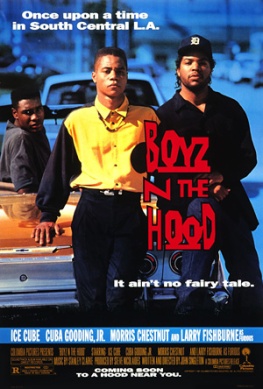
Boyz_n_the_hood_poster.jpgWeek 17

This week we turned to African-American cinematic representations of the city, from blaxploitation and the LA Rebellion group up to the New Jack Cinema and Boyz N the Hood (Singleton 1991). We were guided by Paula J Massood’s argument in Black City Cinema: African American Urban Experiences in Film that:

In the 1960s and 1970s, the American terrifying other was a generalized inner-city ghetto; in the 1990s, it became the young black man. (166)

Last week, we ended with Taxi Driver’s vision of an infernal Manhattan populated by a profoundly fallen humanity (Scorsese is nothing if not a Catholic director). It is an overtly stylised world, often seen through the windscreen of the vehicle which lends Travis mobility while separating him from the world outside. Typically, blaxploitation has a rather different sense of the city and explores it through different aesthetic choices. These points came up in our discussion of the opening sequence of Shaft (Parks 1971):

  • daylight shooting
  • long shots (and some long takes) using zoom lenses on frequently uncontrolled locations
  • concealed – or apparently concealed – cameras so as to not draw the attention of passersby unaware that they are being filmed
  • the city is shabby, run-down, collapsing, but also lively – and there is an everyday rather than demonic quality to the hustling
  • Shaft (Richard Roundtree) moves through the crowded streets with a confidence that Travis Bickle lacked, untraumatised it seems by his experience of being in the world, mixing freely with others both black and white as if by his sheer presence he can command a world without racism
  • different kind of soundtrack, and different relationship between soundtrack and image

Manthia Diawara argues that

space is related to power and powerlessness … those who occupy the center of the screen are usually more powerful than those situated in the background or completely absent from the screen. (qtd in Massood 173)

The opening of Shaft also points to this key factor in blaxploitation – for the first time since the threadbare and now mostly lost race movies of the 1920s and 1930s, large numbers of African-Americans (not just Sidney Poitier or Harry Belafonte, etc) got to occupy centre (and sometimes pretty much the entire) screen of a significant number of movies, as well as working in numbers behind the scenes. Richard Roundtree strutting easily through Manhattan to the sound of Isaac Hayes was and remains so utterly cool that we can perhaps still get some sense, 45 years later and an ocean away, of how important that moment must have been (even if we might be even more inclined now to question the gender politics and Shaft’s tendency to extract himself from the African-American community).

According to Thomas Doherty’s Teenagers and Teenpics: The Juvenilization of American Cinema in the 1950s, the ‘exploitation’ in ‘exploitation films’ refers to
1) the way in which a film was advertised and marketed to entice an audience into the theatre
2) the way in which the film endeared itself to its audience – content
3) and finally as a particular kind of film

This kind of “exploitation” became a cohesive production strategy with three elements:
1) controversial/bizarre/timely subject matter amenable to promotion
2) a substandard budget
3) a teenage audience
i.e., triply exploitative – exploiting sensational events for story value, their public notoriety for publicity value, and a teenage audience for box office value

This is also pretty much the sense in which the ‘xploitation’ in ‘blaxploitation’ is intended.

In the early 1970s, African Americans constitute 25-40% of Hollywood’s US audience. Following the success of Cotton Comes to Harlem (Davis 1970), Sweet Sweetback’s Baadasssss Song (Van Peebles 1971) and Shaft (Parks 1971), a low- and medium-budget production cycle helped to restore Hollywood profitability, but was then abandoned with the emergence of blockbuster cinema – Jaws (Spielberg 1975), Star Wars (Lucas 1977), etc – and of different modes of distribution and exhibition, a process aided by the closure and/or grindhousing and/or pornification of downtown cinemas and an increase in suburban cinemas.

Ed Guerrero argues in Framing Blackness: The African American Image in Film that blaxploitation was part of a larger ‘black film boom’ that saw ‘ninety-one productions’ in 1971-73, ‘of which forty-seven can be considered models of the Blaxploitation formula’ (95) – a fomula that .

usually consisted of a pimp, gangster, or their baleful female counterparts, violently acting out a revenge or retribution motif against corrupt whites in the romanticized confines of the ghetto or inner city. These elements were fortified with liberal doses of gratuitous sex and drugs and the representation of whites as the very inscription of evil. And all this was rendered in the alluring visuals and aggrandized sartorial fashions of the black underworld and to the accompaniment of black musical scores that were usually of better quality than the films they energized. (94)

Blaxploitation had African American critics of this sort from the outset. The term was coined by Junius Griffin, the head of the NAACP’s Beverley Hills-Hollywood branch, when he was quoted in The Hollywood Reporter decrying such ‘black exploitation films’ as Super Fly (Parks Jr 1972). Within days, he resigned from his post and co-founded the Coalition against Blaxploitation (CAB), with the support of various of the more conservative civil rights organisations (e.g., CORE, SCLC). In ‘Black movie boom – good or bad?’ (The New York Times 17 December 1972), he argued that

If black movies do not contribute to building constructive, healthy images of black people and to fairly recording the black experience, we shall have lost our money and our souls [and] have contributed to our own cultural genocide by only offering our children the models of degradation, destruction and dope’ (D19)

Griffin was by no means representative of all African Americans. In the same The New York Times piece, Gordon Parks describes the audience’s response to a crowded 4am screening of his Shaft:

Everything was ‘right on!’ A new hero, black as coal, deadlier than Bogart and handsome as Gable, was doing the thing that everyone in that audience wanted to see done for so long. A black man was winning. (D3)

Parks says of the ‘so-called black intellectuals’ demanding an end to blaxploitation that:

it is curious that some black people, egged on by some whites, will use such destructive measures against black endeavors. … The most important thing to me is that young blacks can now … enter an industry that has been closed to them for so long. (D3).

In Isaac Julien’s documentary Baadasssss Cinema (2002), blaxploitation star and occasional director Fred Williamson criticises NAACP and CORE for coining the implicitly derogatory term, asking

Who was being exploited? All the black actors were getting paid. They had a job. They were going to work. The audience wasn’t being exploited. They were getting to see things on their screens they had longed for.

Blaxploitation star Gloria Hendry adds,

the organizations failed to understand that the community was really in need of their own heroes and black movies.

And The Black Panther newspaper devoted the entire 19 June 1971 issue to Huey P. Newton’s review of Sweet Sweetback’s Baadasssss Song, which concludes ‘We need to see it often and learn from it’ (in To Die for the People (San Francisco: City Lights,
2009) 148).

Many blaxploitation films have an original music soundtrack, including Earth, Wind & Fire on Sweetback Sweetback’s Baadasssss Song, Millie Jackson on Cleopatra Jones (Starrett 1973), James Brown on Black Caesar (Cohen 1973) and Edwin Starr on Hell up in Harlem (Cohen 1973). Sound itself is also often used in interesting ways – partly post-classical stylistic innovation, partly symptomatic of the films’ extremely low budgets which relied on shooting without sound and dubbing later. For example, the opening ten minutes of Super Fly (Parks Jr 1972) contains extended sequences of a couple of would-be muggers walking through New York streets, Super Fly driving through the streets, and then chasing one of the muggers through the streets, much of it to Curtis Mayfield’s soundtrack; there are several similar sequences later in the film, including on using split screen arrangements of still images. On one level, an economy-driven necessity, it becomes an aesthetics concerned with occupying the screen (and soundtrack) space, and key to an actualité-ish depiction of black urban life.

Blaxploitation was often immensely profitable across the budgetary scale, especially in terms of box-office to outlay ratios. MGM budgeted $1.2 million each for Cotton Comes to Harlem and Shaft; the former grossed over $8 million domestically, the latter over $10.8 million in its first year of distribution. Low-budget Cinerama Releasing Corporation spent $200,000 on The Mack (Campus 1973), which grossed over $3 million, and AIP spent $500,000 on Coffy (Hill 1973), which grossed $6 million. The independent Sweet Sweetback’s Baadasssss Song cost an estimated $500,000 and took $4.1 million on its initial domestic release, dislodging Love Story (Hiller 1971) from number one at the US box office, and eventually grossed $10-15 million.

The soundtracks were also often successful. The soundtrack albums for Shaft and Cleopatra Jones (Starrett 1973) sold hundreds of thousands of copies. Super Fly, the first entirely black-financed film to be released by a Hollywood Studio, and the first to employ an almost entirely Black and Puerto Rican crew (mostly drawn from Third World Cinema Corporation, a Harlem-based collective co-founded by Ossie Davis in 1971), had an estimated budget of $100,000 but took $6.4 million during its initial run, eventually grossing over $12 million. Controlled and released by his own publishing company and independent record label, Curtis Mayfield’s singles ‘Super Fly’ and ‘Freddie’s Dead’ sold over 1 million copies each; the soundtrack album sold 12 million copies, earning him over $5 million. (See Eithne Quinn, ‘“Tryin’ to get over”: Super Fly, black politics, and post-civil rights film enterprise’. Cinema Journal 49.2 (2010): 86-105.)

Next, we moved from East Coast to West, to take a look at the sequence in Sweet Sweetback’s Baadasssss Song after Sweetback beats the cops to death and goes on the run. Van Peebles’s stylisations are even more overt than those of Scorsese, layering images, saturating them in psychedlic hues, and cutting with the rhythm of the music, which itself often seems to be improvised in conjunction with the images. Los Angeles is a disjointed, ruptured wasteland, more or less devoid of humanity. It is low and close the ground in contrast to New York, and seems to stretch on forever. Others might escape by plane, but all Sweetback can do is run and run and run.

And then we moved from blaxploitation – a category in which Sweetback does not always seems to fit easily, despite its massive importance to the cycle – to the LA Rebellion group. This network of African-American filmmakers, who studied at UCLA from the late-1960s onwards, made films that set out to resist Hollywood – and blaxploitation – norms, embracing the influence of Italian neo-realism and other European art cinema, and of politicised and postcolonial Latin American and African filmmaking. They made experimental and documentary shorts, documentary features and, later, videos, but the easiest of their work to access is their fiction features, including: Charles Burnett’s Killer of Sheep (1978); Larry Clark’s Passing Through (1977); Julie Dash’s Daughters of the Dust (1991); Jamaa Fanaka’s Penitentiary (1979); Haile Gerima’s Bush Mama (1976) and Sankofa (1993); and Billy Woodberry’s Bless Their Little Hearts (1983).

We took a look at an early sequence from Killer of Sheep, in which African-American kids throw stones at each other and play in the wasteland between railroad tracks. While the landscape itself seems familiar from Sweetback, the grainy – but often beautiful – black-and-white photography (another intersection of budget and aesthetics) contrasts with Van Peebles’s restless (and desperate) innovations. It recalls, in different ways, a number of films we have already watched on the module (Bicycle Thieves, The Third Man, Passport to Pimlico, Cléo from 5 to 7, Ratcatcher).

The soundtrack is likewise naturalistic, just voices and sounds of the city, creating a rather different effect than blaxploitation’s commitment to cutting edge soul and funk (and to Bush Mama’s more experimental layering of fragmentary voices on its soundtrack).

The New Jack Cinema ran from roughly 1989-95. Its key filmmakers and films were
Spike Lee: She’s Gotta Have It (1986), School Daze (1988), Do the Right Thing (1989), Mo’ Better Blues (1990), Jungle Fever (1991), Malcolm X (1992), Crooklyn (1994), Clockers (1995), Girl 6 (1996), Get on the Bus (1996), He Got Game (1998), Bamboozled (2000)
Bill Duke: A Rage in Harlem (1991)
Matty Rich: Straight Out of Brooklyn (1991)
John Singleton: Boyz N the Hood (1991), Poetic Justice (1993), Higher Learning (1995), Rosewood (1997)
Mario Van Peebles: New Jack City (1991), Posse (1993), Panther (1995)
Leslie Harris: Just Another Girl on the IRT (1992)
Allen and Albert Hughes: Menace II Society (1993), Dead Presidents (1995), American Pimp (1999)
Ernest Dickerson: Juice (1992), Blind Faith (1998)

As with the more or less simultaneous New Queer Cinema, it had a strong focus on male experience, and made efforts to diversify representation without reiterating stereotypes or insisting on ‘positive’ images. Its primary focus on African American urban experience was influenced by blaxplotiation’s and the LA Rebellion’s use of actual locations, but was also intertwined with the emergence of hip-hop culture over the preceding decade and more. The New Jack Cinema often depicted gang life, violence, misogyny and drug use in negative terms, but frequently also succumbed to the spectacle such things offered. There were also strong elements of melodrama and liberal handwringing, and a championing of education and middle class lifestyle choices. Unlike Beverly Hills Cop (Brest 1984), New Jack movies tend not to take a single black protagonist out of his own community and relocate him in a white community – a strategy also deployed by many post-New Jack movies, such as Training Day (Fuqua 2001) – but instead builds a picture of an ethnically, culturally, linguistically and generationally diverse neighbourhood, with a history

It is important to bear in mind bell hooks’s comments on the historical, political, economic, cultural and social context of gangsta rap:

The sexist, misogynist, patriarchal ways of thinking and behaving that are glorified in gangsta rap are a reflection of the prevailing values in our society, values created and sustained by white supremacist capitalist patriarchy. (Outlaw Culture (London: Routledge, 1994): 116)

Like blaxploitation, the New Jack Cinema was often extremely profitable. She’s Gotta Have It was shot in 12 days for $175,000 and took over $7 million in the US alone. (It is relatively unusual in being woman-centred, but is problematically centred on a woman whose choice to have multiple sexual partners is repeatedly eroticised and spectacularised.) Do the Right Thing cost $6 million, and took $60 million in the US, with two Oscar nominations (best screenplay, supporting actor). Newspapers worried its ambivalent conclusion would lead to riots. Just Another Girl on the IRT was shot in 17 days for $100,000, took $500,000 at US box office (again relatively unusual, not only in that it focuses on female experience, but on teen female experience and was made by a woman). Like Boyz N the Hood, it ends in blood, but not a drive-by or gang-killing. Instead, it culminates in a long scene of protagonist Chantel’s (Ariyan A Johnson) agonising premature childbirth – she is in denial about and has concealed her unwanted pregnancy, and thus is completely unprepared. Boyz N the Hood cost $6 million, and took $60 million in the US alone; 23-year-old John Singleton was nominated for best director and best original screenplay Oscars.

We focused primarily on the kinds of spaces the film depicted and how they were shot. There is none of the excessive stylisation of Scorsese, no attempt to depict South Central as infernal. There is no attempt to depict the area as a crumbling ruin, as in the views of Manhattan in Shaft and Super Fly, or as an urban wasteland, as in Sweet Sweetback’s Baadasssss Song and Killer of Sheep. In fact, the ‘natural’ daytime light and often pastels palette imbues the hood with the sense of a potentially idyllic suburb of evenly spaced houses in a variety of styles, each set in a neat little garden. Unlike Fahrenheit 451 and despite the ubiquity of television, people still sit on their porches, chatting and whiling away the time. This is countered, to some extent, by the high walls around the backyards and fence around some front yards; by the invisible but nonetheless affectively tangible walls around neighbourhoods and the city; by the role of mass unemployment and limited future prospects in all that porch-sitting; by the eruptions of gang violence and police violence; by the junkie mother who cannot look after her children (even if everyone else in the neighbourhood watches out for them); and by the almost constant nocturnal sound of police helicopters patrolling the skies above.

While Sweetback can at least run past LAX (and run), Boyz begins with a stop sign (while a jet climbs into the sky behind it). Such entrapment – such limited mobility in a city built for cars – is central to the film.

(As, rather more problematically, is its focus on the need for fathers to raise sons as real men so as to end ghetto immiseration and violence, since this involves constantly blaming mothers – reiterating a strong current in the period’s far from progressive political discourse. This goes so far as to undermine its own advocacy of such middle class values as education, responsibility and property ownership by finding fault with aspirational black women.)

Week 19

Core critical reading: Massood, Paula J. Black City Cinema: African American Urban Experiences in Film. Philadelphia: Temple University Press, 2003. 145–74.

Recommended critical reading
AlSayyas, Nezar. Cinematic Urbanism: A History of the Modern from Reel to Real. London: Routledge, 2006. See chapter 8, ‘An Alternative Modernity: Race, Ethnicity and the Urban Experience.”
Bausch, Katharine. “Superflies into Superkillers: Black Masculinity in Film from Blaxploitation to New Black Realism.” Journal of Popular Culture 46.2 (2013): 257–76.
Dyson, Michael Eric. “Between Apocalypse and Redemption: John Singleton’s Boyz N the Hood.” Cultural Critique 21 (1991): 121–41.
Farred, Grant. “No Way Out of the Menaced Society: Loyalty within the Boundedness of Race.” Camera Obscura 12.2 (1995): 6–23.
Gormley, Paul. “The Affective City: Urban Black Bodies and Milieu in Menace II Society and Pulp Fiction.” Screening the City. Ed. Mark Shiel and Tony Fitzmaurice. London: Verso, 2003. 180–199.
Guerrero, Ed. Framing Blackness: The African American Image in Film. Philadelphia: Temple University Press, 1993.
Kennedy, Liam. Race and Urban Space in Contemporary American Culture. Edinburgh: Edinburgh University Press, 2000. Chapter 3, “Between Pathology and Redemption.”
Massood, Paula J. “City Space and City Times: Bakhtin’s Chronotope and Recent African-American Film.” Screening the City. Ed. Mark Shiel and Tony Fitzmaurice. London: Verso, 2003. 200–215.
Mennel, Barbara. Cities and Cinema. London: Routledge, 2008. See chapter 7, “Ghettos and Barrios.”
Mukherjee, Roopali. “The Ghetto Fabulous Aesthetic in Contemporary Black Culture: Class and Consumption in the Barbershop Films.” Cultural Studies 20.6 (2006): 599–629.
Tarr, Carrie. Reframing Difference: Beur and Banlieue Filmmaking in France. Manchester: Manchester University Press, 2012.
Watkins, Craig S. Representing: Hip Hop Culture and the Production of Black Cinema. Chicago: Chicago University Press, 1999.

Recommended reading
African-American, Latino/a and Chicano/a ghetto fiction can be traced back at least as far as Paul Laurence Dunbar’s *The Sport of the Gods (1902), Rudolph Fisher’s The Walls of Jericho (1928) and The Conjure-Man Dies (1932) and Richard Wright’s Native Son (1940), and more autobiographical work, such as Claude Brown’s Manchild in the Promised Land (1965), Iceberg Slim’s Pimp: The Story of My Life (1967) and Piri Thomas’s Down These Mean Streets (1967).
It also draws on the pulp crime fiction of Chester Himes (e.g., A Rage in Harlem (1957)) and Donald Goines (e.g., Dopefiend (1971)), on blaxploitation cinema, New Jack cinema and hip-hop culture.
Contemporary examples include Omar Tyree’s Flyy Girl (1993), Sapphire’s Push (1996), Sister Souljah’s The Coldest Winter Ever (1999), Nina Revoyr’s Southland (2003) and Gary Phillips’s The Jook (2010), and such autobiographical works as Luis J Rodriguez’s Always Running: La Vida Loca, Gang Days in L.A. (1993) and Sanyika Shakur’s Monster: The Autobiography of an L.A. Gang Member (1993).

Recommended viewing
Key blaxploitation films include Sweet Sweetback’s Baadasssss Song (Van Peebles 1971), Shaft (Parks 1971) and Superfly (Parks Jr 1972).
The LA Rebellion group’s more neo-realist depiction of black urban life can be seen in Killer of Sheep (Burnett 1978) and Bush Mama (Gerima 1979).
Key New Jack cinema films include Do the Right Thing (Lee 1989), Just Another Girl on the IRT (Harris 1992) and Menace II Society (Hughes brothers 1993).
Depictions of ghetto life have become a significant part of world cinema, including such films as La Haine (Kassovitz 1995), City of God (Meirelles and Lund 2002), Jerusalema: Gangster’s Paradise (Ziman 2008) and Attack the Block (Cornish 2011).
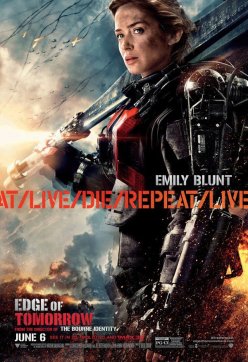
Edge of Tomorrow (Doug Liman 2014)

emily-blunt-edge-of-tomorrow-600x873and so anyway it turns out that the best thing about Edge of Tomorrow (2014) is not the way in which the DVD marketing finally admits that Edge of Tomorrow is a shit title that is nowhere near as good as the tag-line Live. Die. Repeat. and now pretends that the film is actually called Live Die Repeat: Edge of Tomorrow, nor is it Emily Blunt, although she is usually the best thing in anything she is in and would be the best thing about Edge of Tomorrow were it not this other thing, no, the best thing about Edge of Tomorrow or whatever the hell we are supposed to call it now is the simple beauty of watching itsy-bitsy teeny-weeny action star Tom Cruise dying horribly over and over again – for most things in life there is Barclaycard, but some things really are priceless…

Nick Wood, Azanian Bridges (2016)

book_azanianAzanian Bridges is a neat little thriller, set in more or less the present-day South Africa but in a world in which Apartheid continues.  A quick and compelling read, it does a couple of rather cunning things.

The first is its choice of alternate history premise.

There are a number of African alternate histories which invert or rewrite elements of European colonialism (e.g., Abdourahman A. Waberi’s In the United States of Africa (2006), Africa Paradis (Sylvestre Amoussou 2006)  – and Nisi Shawl’s Everfair (2016) to look forward to).

There is a future history imagining the conditions for the emergence of something akin to Apartheid (Arthur Keppel-Jones’s When Smuts Goes: A History of South Africa from 1952 to 2010, first published in 2015 (1947)).

There is an array of near-future thrillers that anticipate the end of Apartheid (Anthony Delius’s The Day Natal Took Off (1960), Gary Allighan’s Verwoerd – the End (1961), Iain Findlay’s The Azanian Assignment (1978), Randall Robinson’s The Emancipation of Wakefield Clay (1978), Andrew McCoy’s The Insurrectionist (1979), Larry Bond’s Vortex (1981), Nadine Gordimer’s July’s People (1981), Frank Graves’s African Chess (1990)).

And there is an alternate history with the brilliant premise of aliens arriving in the skies over Johannesburg during the Apartheid era, although sadly District 9 (Blomkamp 2009) doesn’t have the faintest idea what to do with it. (Read Nnedi Okorafor’s Lagoon (2014) instead.)

But, as far as I know, Azanian Bridges is the first story to project Apartheid beyond 1994.

In doing so, Wood sketches in some sly geopolitical changes. The Soviet Union did not withdraw from Afghanistan in 1989, but has spent thirty years ‘haemmorrhaging men into their Afghan ulcer’ (31). Perestroika and glasnost seem not to have happened, and the USSR is intact, apparently governed by generals. The Berlin wall has not fallen, nor has the Eastern bloc collapsed. Consequently, ‘the old anti-communist arguments for supporting’ South Africa (163) held sway rather longer among Western powers, and it comes as little surprise that Bush and Blair were both supporters of the Apartheid regime. But now President Obama – along with his ally, the US-backed mujahideen leader Osama bin Laden – are involved in peace talks with the Soviets. The Cold War might finally be limping into its terminal phase, and with weakening Soviet influence in Africa, China is investing heavily across the continent. Meanwhile, in a South Africa ruled by President Eugène Terre’Blanche’s Afrikaner Weerstandsbeweging, Mandela did not leave Robben Island and FW de Klerk is still in prison for trying to bring Apartheid to an end in the 1980s.

All of which is sketched in with greater economy than I have just managed, not least because the layers of paranoid security and firewalling significantly restrict all South Africans’ access to the internet and other global media. Phones with cameras are also banned since they are a ‘potentially easy source of troubling video’ (45) – a nice touch that captures the novel’s relevance to our #blacklivesmatter times.

The second (and really really) cunning thing that Wood does is make a connection between the new experimental technology introduced into this alternative near-present and the form his narrative takes: the Empathy Enhancer allows one to experience the experience of others, and vice versa; the novel’s chapters alternate between Sibusiso Mchunu, a young amaZulu on the edges of anti-Apartheid struggle who is deeply traumatised when a friend dies in his arms, shot to death by the police at a protest, and the white (but as-yet not very committed) liberal, Dr Martin Van Deventer, the neuropsychologist treating Sibusiso and co-inventor of the Empathy Enhancer.

The security services want the EE device for use in interrogations. Anti-Apartheid groups want to use it to undermine the regime, person-by-person. It is not clear why the Chinese want it, but they do. So when Sibusiso goes on the lam with the device, and Martin sets out in pursuit, the alternating chapters set you up to expect a tensely intercutting thriller, as pursuers become the pursued.

And there are a number of tense sequences and suspenseful passages.

But Wood is playing a very different game, subverting the form to make the reader focus on the twin protagonists’ very different experiences of living in a racist state which sees them both, in different ways, as its enemies. This ranges from the most perilous things – run-ins with the security services – to the most quotidian: when Martin is told to destroy his cell phone so it can’t be used to trace him, he simply ‘grind[s] the phone under [his] heel’ (153); when Sibusiso’s phone is simply taken from him and tossed into the sea, he is ‘upset and angry’, in large part because ‘we have been taught to throw nothing away’ (129).

Such contrasts are the point of the novel.

Azanian Bridges itself is the Empathy Enhancer. Read it and weep.

Snowpiercer (Bong Joon Ho 2013)

Snowpiercer_posterand so anyway it turns out that the best thing about Snowpiercer (2013) is not the endless arguments about how implausible it is that those two kids could survive in the snowy landscape after the crash as if the ecology of the metaphorical train they have been riding for the last seventeen years made any kind of rational sense, nor is it Tilda Swinton’s decision to play the villainous Mason as some kind of bizarre cross between Janet Street-Porter and Mary Whitehouse (and pull it off), nor is it John Hurt’s half-assed Long John Silver look, but the way in which Bong carries over dystopian elements of our present world into the post-apocalypse, so that – having survived the end of the world – Olivia Spencer’s Tanya, the main black character, is still killed by a white cop, and so that the middle classes still feel free to go to the back of the train and bray their nonsense at the top of their irritating voices as if the rules and etiquette of the quiet carriage somehow do not apply to them…

The City in Fiction and Film, week 17: Ballard’s High-Rise, chapters 10-19

70256Week 16

Last week, we spent some time discussing the layers of observation, performance and display going on in Le couple témoin, as the protagonists are monitored by psychosociological experimenters, watch by television audiences and reported on in current affairs shows. This built on the idea of media – and television in particular – being repeatedly connected to alienation in mid-twentieth-century culture. In All That Heaven Allows, the widow Cary is offered television as a replacement for social life and romance. In Fahrenheit 451, we noted was the role of television in alienating Montag not only from his wife (a microcosm of Bradbury’s broader point about the (anti)social role of television) but also from himself when he watches the coverage of the Mechanical Hound pursuing him:

He watched the scene, fascinated, not wanting to move. It seemed so remote and no part of him; it was a play apart and separate, wondrous to watch, not without its strange pleasure. … If he wished, he could linger here, in comfort, and follow the entire hunt on through its swift phases, down alleys across streets, over empty running avenues, crossing lots and playgrounds, with pauses here and there for the necessary commercials … and so on finally to this house with Faber and himself seated, drinking … Then, if he wished, Montag might rise, walk to the window, keep one eye on the TV screen, open the window, lean out, look back, and see himself dramatized described, made over, standing there, limned in the bright small television screen from outside, a drama to be watched objectively, knowing that in other parlours he was large as life, in full colour, dimensionally perfect! And if he kept his eyes peeled quickly he would see himself, an instant before oblivion, being punctured for the benefit of how many civilian parlour-sitters who had been wakened from sleep a few minutes ago by the frantic sirening of their living room walls to come watch the big game, the hunt, the one-man carnival.
Would he have time for a speech? As the Hound seized him, in view of ten or twenty or thirty million people, mightn’t he sum up his entire life in the last week in one single phrase or a word that would stay with them long after the Hound had turned, clenching him in the metal-plier jaws, and trotted off into darkness, while the camera remained stationary, watching the creature dwindle in the distance – a splendid fade-out!

With an effort, Montag reminded himself again that this was no fictional episode to be watched on his run to the river; it was in actuality his own chess-game he was witnessing, move by move. (172-4, 177)

This dissociation continues even when Montag has escaped: the hunt continues; the Hound tracks down someone else in Montag’s place, cameras carefully shooting it all so as to maintain the deception of the rogue fireman’s capture. It is as if a second Montag has detached from the first. He witnesses his fate as if he has been given access to an alternate world in which he did not make the river crossing.

Television and associated media play a role in High-Rise, too.

Like Montag, Laing experiences moments of dissociation. When the jeweller from the 40th floor takes his fatal plunge (suicide? murder? accident?), Laing is among those who crowd onto the balcony of a neighbouring apartment:

Pushed along the railing, Laing saw his own empty balcony fifteen feet away. In an absurd moment of panic, he wondered if he himself was the victim. (41)

In the first half of the novel we learn about Wilder’s plan to make a documentary about the building and the breakdown of society within it – which his wife, Helen, who seems fully aware of Ballard’s own imagery, shrugs off as just another prison documentary, like the one he has been film in his day job. By the mid-point of the novel, everyone it seems is filming their own acts of violence – ‘Every time someone gets beaten up about ten cameras are shooting away’ (90) – and showing their rushes to each other in the building’s move theatre.

Paul Crosland, the head of Laing’s clan, is also a television news anchor, and he continues to go into the studios to read the news, cataloguing disasters in calm and reassuring tones, never mentioning the similar catastrophe ripping through the building where he lives (96) – a departure from the teleprompter for which Laing continues to hope even as the novel draws to a close (151). When Crosland returns home, it is to stoke confrontations with other clans, emitting a blind and furious anger even though he ‘often … had no idea what he was arguing about’ (97). In those moments, unprotected by his makeup, Crosland’s outrage appears to Laing like that of ‘an announcer tricked for the first time into reading an item of bad news about himself’ (97). Such a dissolution of the distinction between public and private selves, between civilised and brutish behaviour, is linked to and articulated in relation to the electronic media that surround us in the city (just as the inhabitants of Alphaville in some way seem to live inside the Alpha 60 computer, which seems to be so thoroughly extended and distributed through the city as to be coterminous with it).

Even more mediatised is the drunken Eleanor Powell: ‘After a few cocktails she was hyper-animated, and flicked on and off like a confused TV monitor revealing glimpses of extraordinary programmes which Laing could only understand when he was drunk himself’ (96).

Soon, Laing can only watch the television with the sound turned down,

not out of boredom with these documentaries and situation comedies, but because they were meaningless. Even the commercial, with their concern for the realities of everyday life, were transmissions from another planet. Squatting among the plastic garbage-sacks, his furniture piled up behind him, Laing studied these lavish reconstructions of housewives cleaning their immaculate kitchens, deodorants spraying well-groomed armpits. Together they formed the elements of a mysterious domestic universe. (106-7)

When Wilder once more begins his ascent of the building, taking his cine-camera everywhere with him like some kind of protective fetish, he invites those he meets to take part in the television documentary he is making (or deluding himself he is making). On the lower-levels, people are eager to participate, voicing their many complaints, but the higher up he gets the more reluctant his potential interviewees become. Many of them are the kind of middle-class technocrats for whom being on television is nothing new, having previously appeared ‘as professional experts on various current-affairs programmes’ (115). Furthermore, ‘“Television is for watching, Wilder,” one of the women told him firmly, “not for appearing on.”’ (115). It is a curious kind of restraint amid all the chaos of the building, yet some proprieties, it seems, must be maintained. Soon, Wilder’s resolve to make the documentary begins to fade. Perhaps it is because, in some way, he has seen it all before – on television:

The decline of the apartment building reminded him of a slow-motion newsreel of a town in the Andes being carried down the mountain slopes to its death, the inhabitants still hanging out their washing in the disintegrating gardens, cooking in their kitchens as the walls were pulverized around them. (120)

On the top floor, Royal and his entourage dress formally for dinner at a pristine dining table, but even there the ‘theatricality of this contrived setting’ is obvious, ‘like a badly rehearsed and under-financed television commercial for a high-life product’ (132).

It is not just television, though.

The true light of the high-rise was the metallic flash of the polaroid camera, that intermittent radiation which recorded a moment of hoped-for violence for some later voyeuristic pleasure. What depraved species of electric flora would spring to life form the garbage-strewn carpets of the corridors in response to this new source of light? The floors were littered with the blackened negative strips, flakes falling from this internal sun. … Laing’s feet crackled among the polaroid negatives scattered about the corridor floor, each recording a long-forgotten act of violence. (109, 150)

The flash of the Polaroid cameras is picked up on by the flickering lights, recalling the flicker of the movie projector and of analogue televisions:

the lights began to flicker continuously like a fibrillating heart. … a broken mirror lay on the bed, the pieces flickering like the fragments of another world trying unsuccessfully to reconstitute itself. … [Steele] beckoned Laing forward into the stuttering light. … The lights continued to flicker with the harsh over-reality of an atrocity newsreel. … the lights flickered from the doorways of ransacked apartments, form overturned lamps lying on the floor and television screens brought back to a last intermittent life. … In an empty bedroom a cine-projector screened the last feet of a pornographic film on to the wall facing the bed. (110-11)

Wilder projects footage of himself ‘upon the walls and ceiling’ of the elevator lobby, watching the images ‘as if about to leap on to the backs of his own shadows and ride them like a troupe of beasts up the flues of the building’, while in Talbot’s apartment the ‘lurid caricatures’ of homophobic graffiti sprayed ‘on the walls glimmered in the torch-light like the priapic figures drawn by cave-dwellers’ (108). Some floors above, the ‘even light’ in Royal’s penthouse is ‘as dead as a time exposure in a police photography recording a crime’ (138).

The building is media-saturated. In the darkness, nothing remains hidden. Artificial light exposes it all. (Just as the audiotapes made by Pangbourne (83, 140), the gynecologist who never touches his patients, and by Wilder (129-30), unleash things otherwise hidden.)

The novel self-reflexively – but not unambiguously – attributes the breakdown of society in the building to the post-Freudian subjectivities produced by a culture of affluence, commodities and consumerism. Talbot notes that they are not witnessing a return to some ‘happy primitivism’ or ‘the noble savage’; rather, the residents, ‘outraged by all that over-indulgent toilet-training, dedicated breast-feeding and parental affection’, seem to ‘resent never having had a chance to become perverse’ (109).

There is certainly plentiful evidence of regression to infantile psychosexual behaviour in the novel.

Laing takes his older sister – who reminds him of his mother and used to look after him as a child – as a lover; although she has inherited something of their mother’s ‘shrewish manner’, which he dislikes, he nonetheless finds this echo reassuring (98-9). This breaking of the incest taboo has two purposes.

First, it recalls anthropologist Claude Lévi-Strauss’s argument that the cultural ban on incest is intended to promote social stability by favouring exogamy (sex/ marriage outside the group) over endogamy (sex/marriage within the group) and thus expanding the network of mutually dependent interrelationships. Ballard perhaps suggests, then, that with the alienation, isolation and disconnectedness of contemporary urban life, exogamy – engaging with others – might seem to become the greater threat; certainly exogamy is ill-suited to the inward-looking inhabitants of the building.

Second, the incest taboo returns us to the Freudianism that the novel denies but also has in spades. In the Oedipal complex, incestuous desire (the male infant for the mother, the female infant for the father) is the norm, and it must be defeated. The novel repeatedly plays on this. When Royal experiments with touching the passive Helen Wilder ‘she reacted, not by pushing his hand away, but by moving it to her waist and lightly holding it there as she would the straying hands of her children’ (135).

Wilder’s entire trajectory ends up being one of infantile regression. He feels the need to break free from his wife because by doing so ‘he would break away from the whole system of juvenile restraints he had been trying to shake off since his adolescence’ (118). She watches him like a mother ‘as he hunted in her purse for money … amused by her husband’s dependence on the fictions of this elaborate toy [the phallic camera] he takes everywhere with him’ (119). He likes the dark because in it he can ‘deliberately play on all [his] repressed instincts’ (120). He welcomes the building’s ‘forced conscription of the deviant strains of his character’ and the fact that ‘this free and degenerate behaviour became easier the higher he moved up the building’ (120). Mrs Hillman, in whose apartment Wilder stays, spends ‘all her time worrying about him, like an over-anxious mother fretting about a wayward child’ (124), but ‘No more ill-suited couple, Wilder decided, could have been cast to play mock-mother and mock-son’ (125). This mock-relationship leaves room for the possibility of a sexual relationship of the kind the incest taboo is intended to prevent: over the course of the evening spends with the Hillmans, Wilder ‘became more and more oafish …, deliberately coarsening himself like a delinquent youth fooling about with a besotted headmistress’ (126). (He also concocts a lie about Talbot ‘molesting a child in a swimming-pool changing room’, and the fact that everyone knows the accusation to be untrue somehow reinforces it (127) – so some taboos remain to be manipulated by the bullying Wilder.)

Having left the Hillmans behind him, Wilder is soon dominating another woman, who is anxious to avoid the exogamy this encounter involves:

She welcomed him as she would any marauding hunter. First she would try to kill him, but failing this give him food and her body, breast-feed him back to a state of childishness and even, perhaps, feel affection for him. Then, the moment he was asleep, cut his throat. (160)

Although this is described as ‘the synopsis of the ideal marriage’ (160), it is so only inasmuch as it recapitulates the complex feelings of interdependence and aggression as the mother-infant dyad is ruptured and the Oedipal struggle commences.

Ultimately, breaking the building’s taboo on using guns, Wilder kills Royal, the building’s patriarch, and finds himself on the roof surrounded by other – actual – children and the women who care for them. He immediately becomes completely infantile. Hoping to join the children, he wanders out towards the women:

In their bloodied hands they carried knives with narrow blades. Shy but happy now, Wilder tottered across the roof to meet his new mothers. (168)

Laing’s fate is not so clear-cut. The novel ends with him holed up in his apartment with Alice, his sister-lover-mother, and Eleanor Powell, who seems to be merging with her. He addresses them in the childish voice he used as a trainee doctor when talking to ‘the duller of his child patients’ (171), and believing himself to be in control he forages food and waits on them. He indulges them when they treat ‘him like two governesses in a rich man’s ménage, teasing a wayward and introspective child’ (172) – presumably he is both the rich man and the child – and sometimes he acts as if they really are in charge  (this is so convincing that once a raiding party of women left him alone, assuming he was the prisoner of the two women). Laing likes the arrangements – even if he deludes himself as to its actual nature – because it represents ‘an intimate family circle, the first he had know since childhood’ (172).

We also looked at three passages to chart Laing’s progress (regress) – when he attempts to leave the building but turns back (101-4), the start of chapter seven when the building seems to become timeless and motionless (145-7), and when he find Eleanor feeding her cat with her own blood (151-3) – and asked basically the same questions of each: what imagery and ideas does Ballard use to describe the building and its residents? how does the world inside differ from the world outside? why does Laing find it impossible to leave and why in each subsequent passage does he seem happier despite (because of?) the further deterioration of his environment?

This notion of deterioration is important. Ballard’s novel is very specifically about that moment in the early 1970s, when decrying post-war Corbusier-spawned high-rise developments went from being merely a fashionable posture to received wisdom. Typically, what was conveniently forgotten – often for ideological reasons – was that for many people moving from slums to the new developments was headily utopian. Many people finally had enough bedrooms that they did not need to share, indoor plumbing, etc. While Aneurin Bevan’s brick-built housing was intended to last, many of the the prefabricated developments only had intended lives of a few decades, and soon began to deteriorate, not least because councils often failed properly to fund maintenance to post-war housing projects. That this was the fault of government did not get in the way of the residents themselves being being blamed for the disrepair into which the untended buildings inevitably fell. High-Rise was written when working class residents were being demonised as intoxicated, glue-sniffing, violent, criminal – as creatures incapable of not fouling their own nests. It was written when the extent of the corruption behind many housing schemes was being uncovered (as in the John Poulson case, which reached all the way up to Home Secretary Reginald Maudling – Peter Flannery’s Our Friends in the North (1996) dramatises a version of these events). Whether or not Ballard bought into this potent myth, nothing could have seemed more natural than to retell it but with a cast of middle class professionals, with yuppies avant la lettre.

In closing, we had a brief discussion about Taxi Driver (Scorsese 1976), focusing particularly on the ways in which it pretty much reduces New York to a demonised and perilous Times Square, bathed in a red light to make it infernal. This, too, fits in with a broader discourse, one that would lead to the purging of such urban spaces, ridding them of the diverse ethnic and sexual working class cultures that inhabited them in favour of redevelopment. The value of land and property on Manhattan was too high, and full of potential to become even higher, to be left to such people. There was money, and lots of it, to be made by criminalising them, driving them out, displacing them, and by thus reversing white-flight, by gentrification, by tourist-friendly Disneyfication.

We will pick up on this next week when we look at some blaxploitation and some LA Rebellion films as part of the background for thinking about Boyz N the Hood (Singleton 1991).

Week 18

Recommended critical reading
AlSayyas, Nezar. Cinematic Urbanism: A History of the Modern from Reel to Real. London: Routledge, 2006. See chapter 7 “The Modernity of the Sophisticate and the Misfit: The City through Different Eyes.”
Baxter, Jeanette. J.G. Ballard: Contemporary Critical Perspectives. London: Continuum, 2009.
Colombino, Laura. “The House as SKIN: J. G. Ballard, Existentialism and Archigram’s Mini-Environments.” European Journal of English Studies 16.1 (2012): 21–31.
Delville, Michel. J.G. Ballard. Plymouth: Northcote, 1998.
Duff, Kim. Contemporary British Literature and Urban Space: After Thatcher. Basingstoke: Palgrave Macmillan, 2014. 52–86
Gasiorek, Andrzej. J.G. Ballard. Manchester: Manchester University Press, 2005.
Grindrod, John. Concretopia: A Journey Around the Rebuilding of Postwar Britain. London: Old Street, 2013.
Groes, Sebastian. The Making of London: London in Contemporary Literature. Basingstoke: Palgrave, 2011. 67–93
Hansley, Lynsley. Estates: An Intimate History. London: Granta, 2008.
Matthews, Graham. “Consumerism’s Endgame: Violence and Community in J.G. Ballard’s Late Fiction.” Journal of Modern Literature 36.2 (2013): 122–39.
Mennel, Barbara. Cities and Cinema. London: Routledge, 2008. See chapter 8. “The City as Queer Playground.”
Siegel, Allen. “After the Sixties: Changing Paradigms in the Representation of Urban Space.” Screening the City. Ed. Mark Shiel and Tony Fitzmaurice. London: Verso, 2003. 137–159.
Shiel, Mark. “A Nostalgia for Modernity: New York, Los Angeles, and American Cinema in the 1970s.” Screening the City. Ed. Mark Shiel and Tony Fitzmaurice. London: Verso, 2003. 160 – 179.

Recommended reading
High-Rise is part of a thematic trilogy, including Ballard’s most challenging novel, Crash (1973), and Concrete Island (1974). Ballard’s ‘late fiction’ returns to similar material but relocated to gated suburban communities in Running Wild (1988), Cocaine Nights (1996), Super-Cannes (2000), Millennium People (2003) and Kingdom Come (2006).
1970s British novels of urban decay include Doris Lessing’s The Memoirs of a Survivor (1974) and Zoe Fairbairns’s Benefits (1979).

Recommended viewing
Ben Wheatley’s High Rise (2015) adapts Ballard’s novel.
Modern city living deranges or makes miserable in Repulsion (Polanski 1965), Shivers (Cronenberg 1975), Crash (Cronenberg 1996) and Happiness (Solondz 1998).
Films about the decay of urban centres include Midnight Cowboy (Schlesinger 1969), Clockwork Orange (Kubrick 1971) and Dog Day Afternoon (Lumet 1975).


The City in Fiction and Film, week 16: JG Ballard’s High-Rise, chapters 1-9

70256Week 15

This week we began to work on JG Ballard’s High-Rise (1975; all quotations from pictured edition, London: HarperCollins, 2006), reading the first nine chapters and also watching William Klein’s Le couple témoin/The Model Couple (1977).

We began with some context, outlining the scale and nature of house-building and redevelopment in the UK in the postwar years, drawing largely on John Grindrod’s Concretopia: A Journey Around the Rebuilding of Postwar Britain (2013) and Lynsley Hansley’s Estates: An Intimate History (2008).

There was already a housing shortage in the UK between World Wars. The promise to ensure that soldiers returned from  WWI to a land fit for heroes (and thus stave off socialism) was never met – construction rates were too low and often the wrong kind of housing was being built in pursuit of the rather different goal of making private profit (Paul Rotha’s documentary Land of Promise (1946) is the classic film account of this issue and its history). During the war years of 1939-45 the UK population grew by one million per year – and during the same period four million homes were destroyed or damaged beyond repair by bombing (completely undoing the interwar construction efforts and significantly reducing housing stock in relation to total population).

Aneurin Bevan, the minister responsible for housing in the post-WWII Labour government, set a target of 300,000 new council houses per year – but rarely managed more than 200,000 – because the houses were to be spacious (90 square metres), brick-built with gardens. For him, such decent houses were not to be restricted to the privately-owning middle classes – they should be available to the working class, rented at lower than market rates from local councils. (One policy proposal considered but sadly never pursued was buying out all private landlords, thus monopolising the rental market and keeping down the cost of housing.)

When a succession of Conservative governments took office (from late 1951-64), they took up the challenge of 300,000 new houses per year – and succeeded in meeting the target. But they did so by reducing the size of the houses (70 square metres) and shifting from brick construction to speedier (but less durable) prefabricated structures, with no guarantee of gardens. And there was a shift to building blocks of flats rather than houses because they were cheaper and quicker to throw up from prefabricated materials. Ironically, because these blocks were typically set in parkland of some sort, the same number of people could have been housed in the same space with terraced housing.

In High-Rise, Ballard is fully aware of the economics determining such constructions:

All the evidence accumulated over several decades cast a critical light on the high-rise as a viable social structure, but cost-effectiveness in the area of public housing and high profitability in the private sector kept pushing these vertical townships into the sky against the real needs of their occupants. (52)

Why were the blocks typically surrounded by parkland? Partly, it seems to be the influence of Le Corbusier, whose unrealised ville contemporaine (1922) plan to build 24 60-storey cruciform high-rise skyscrapers in which three million people would live and work did so. Ballard does not pursue the scale of this scheme – Robert Silverberg’s The World Inside (1971) comes closer – but he does draw on Le Corbusier in other ways.

Le Corbusier advocated five principles when designing apartment blocks:

1 Lift the structure off the ground on reinforced concrete stilts (pilotis), enabling
2 a free façade (non-supporting exterior walls to allow the architecture freedom in his design) and
3 an open floor plan (interior could be configured without having to worry about supporting walls).
4 The free façade enables ribbon windows so as to provide clear views of surrounding gardens.
5 A roof garden compensates for the ground area covered by the building.

These principles are evident in his Unité d’Habitation in Marseilles, often described as resembling a moored ocean liner, contains 337 apartments, with a floor halfway up the block devoted to public amenities, and a roof garden. It is also raised up on pilotis. It became a location of pilgrimage and an object to copy for a generation or two of architects, including many of those planning housing developments for British councils. It also provides the design for Ballard’s own high-rise (it even stands on pilotis, ‘concrete legs’ (19)), one of five spaced equidistantly on the eastern edge of an under-construction square mile development in London’s docklands (in this, the novel is proleptic of material we studied way back in week one of the module, The Long Good Friday and London’s Overthrow – as well as of what has actually happened to such spaces since Ballard wrote the novel).

The other context I introduced was about Ballard himself: his centrality to New Wave sf of the 1960s and 1970s; his early novels refiguring the conventions of disaster fiction, such The Drowned World (1962), which also introduce surrealistic images into narratives indebted to writer like Joseph Conrad and Graham Greene; the thematic trilogy, including Crash (1973) and Concrete Island (1974), which concludes with High-Rise; the autobiographical fictions and the more mainstream respectability that came with Empire of the Sun (1984); and the return of his late novels, Cocaine Nights (1996), Super-Cannes (2000), Millennium People (2003) and Kingdom Come (2006), to transformations in bourgeois living environments.

Turning to the novel, we began by thinking about the names and characteristics of the three narrators, each of whom is associated with one of the three classes that emerge among the middle class residents of the building.

From the lower levels, Richard Wilder – physical, aspirational – he is the wildest and most overtly violent of the three and a frequent adulterer whose wife calls him Dick.

From the mid-levels, Robert Laing, whose name echoes that of the unorthodox psychiatrist RD Laing (1927-89), who saw mental illness as a product of social environments rather than as some kind of inward-driven deformation of the self, and who considered patients’ descriptions of their responses to their environments as valid in themselves rather than as symptoms of Freudian disorder. Opposed to use of antipsychotics to treat mental illness, he favoured recreational drug use and believed that mental illness could be a kind of transformative, shamanic experience. He also promoted primal scream therapy – most of the inhabitants of Ballard’s building seem to go through some version of it – and rebirthing therapy – foreshadowed for Robert Laing when he is surrounded by the threatening guests at the cocktail party to which he is not invited, with the whole novel constituting a kind of rebirthing for him.

From the very top floor, the architect of the building, Anthony Royal – a royal, the king of the place. Recently injured in a car accident, he suffers from a disability – and wears a distinctive costume – that makes him come across, one of the class suggested, like a Bond villain. Which enabled me to go, ah, funny you should say that…

I have long wondered whether having the architect of the building live in the penthouse was inspired by the fact that Hungarian-born architect Ernő Goldfinger lived for two months in an apartment on the top floor of Poplar’s 26-storey Balfron Tower (built 1965-67), which he had designed. He and his wife are said to have thrown cocktail parties to meet the other residents and learn their thoughts about his design so that he could incorporate criticisms and suggestions in his later building, such as the neighbouring 11-storey Carradale House (built 1967-70). Back in the 1930s, Goldfinger had been responsible for the demolition of some cottages in Hampstead to make way for three new houses, in one of which he would live. Ian Fleming was among those protesting the demolition. Twenty years later, Fleming would name a James Bond novel – and villain – after the architect. Ernő Goldfinger threatened to sue over Auric Goldfinger, to which Fleming reputedly responded, Okay, I’ll just rename him Goldprick. Ernő decided not to pursue the case.

Next we took a look at the opening paragraph, detailing how the design of Ballard’s building displays the influence of Le Corbusier and, in particular, Unité d’Habitation, and then looking at how it introduces patterns of imagery that will recur throughout the novel.

  • a post-apocalyptic sensibility that also suggests a descent into primitivism – Laing is calmly eating a dog (cf. Harlan Ellison’s New Wave story ‘A Boy and His Dog’ (1969) and LQ Jones’s 1975 film adaptation), and the building’s exterior is described as a cliff-face (cf. Henry Blake Fuller’s The Cliff-Dwellers (1893), possibly the first novel about skyscraper living, complete with domestic violence and an Oedipal struggle)
  • conflict – confrontation, violence and war imagery (there are skirmish grounds, raiding parties, provocations, retaliations, a buffer state, an interregnum, etc, but also some specifically WWII images – Royal’s ‘personal Dunkirk’ (69) and also, more ambiguously, the Blitz: a voice ‘calm and matter-of-fact, like that of a civilian in a war-torn city dealing with yet another air-raid’ (60) and, during the first blackout, the darkness providing conditions not just of sexual peril but also of consensual sexual adventuring (20))
  • the embrace of isolation, anonymity and alienation
  • apartments as prison cells (later, there will be news of a prison breakout (30), Wilder will be involved in filming a prison strike (42, 44), and his wife, Helen, will blandly observe that his desire to film in the apartment block will produce just ‘another prison documentary’ (45)) – this introduces the idea of the apartment block as what Erving Goffman called a total institution, like prisons and asylums (two of the psychosociologsist in Le couple témoin previously worked in an asylum) and even ocean liners (to which Unité d’Habitation has often been compared)

We then looked at the next section of the opening chapter (7-11), in which we learned more about the structure of the building and the docklands development of which it is a part, and the feelings it induces as a tripartite class structure begins to emerge among its bourgeois inhabitants. Highlights include:

  • indifference, giddiness, exhilaration, insomnia and, especially among female residents, boredom and nomadism; these troubling sensations will later develop into rifts that some think foreshadow or imply the mutation of the residents into a posthuman species (35–6; a similar idea is mooted in Silverberg’s The World Inside)
  • Steele’s anal obsession with garbage chutes
  • bigotry – people begin to talk dismissively and angrily about other floors as groups to be denigrated, abhorred (14, 24, 38) – Steele will compare ninth floor residents to ‘a traditionally feckless band of migrant workers’ (25), and the intensity of these emerging prejudices will be compared directly to ‘racial prejudice’ (32)
  • the relationship to London – which is somehow distanced in both space and time, a past of ‘crowded streets, traffic hold-ups, rush-hour journeys on the Underground’ (9), while the building belongs to an emerging future; in Ballard’s descriptions, time is transformed into space and vice versa
  • a grand Ballardian simile connecting the psychological to the urban, with a vague gesture to TS Eliot (he does this sort of thing a lot – never quite makes sense yet seems to imply immensities): ‘the ragged skyline of the city resembled the disturbed encephalograph of an unresolved mental crisis’ (9)
  • the contradictions of the building – Laing’s sister says: ‘You could be alone here, in an empty building … Besides, it’s full of the kind of people you ought to meet’ (10); Laing will soon appreciate the way the place enables both proximity and distance, providing a neutral background for his potential affair with Charlotte, although he immediately questions whether this is really the case (16) – this idea is developed further when they do first have sex (38)
  • the ways in which the building design encourages its inhabitants to turn inwards, away from the city but also from each other

The_Model_Couple-652984484-largeWe closed with a brief discussion of Le couple témoin, William Klein’s film about an average couple who win a competition to live as test subjects in a new urban development – the experiment is ostensibly concerned with designing apartments to ensure that they meet the needs of such a couple, but it clearly is more concerned with engineering their consent and subservience. The psychosociologist experimenters – themselves hardly rational – subject Jean-Michel and Claudine to an array of absurd tests, frequently bullying and brow-beating them, passive-aggressively consulting at them, reinforcing the most conservative of gender roles. The tests become increasingly irrational and arbitrary – authority being exercised because it is authority, not for any greater end. As funding for the experiment withers, and viewing figures for the Big Brother-like media coverage slump, so a group of child and teen revolutionaries are hired to stage a hostage-taking…
Recommended critical reading
AlSayyas, Nezar. Cinematic Urbanism: A History of the Modern from Reel to Real. London: Routledge, 2006. See chapter 7 “The Modernity of the Sophisticate and the Misfit: The City through Different Eyes.”
Baxter, Jeanette. J.G. Ballard: Contemporary Critical Perspectives. London: Continuum, 2009.
Colombino, Laura. “The House as SKIN: J. G. Ballard, Existentialism and Archigram’s Mini-Environments.” European Journal of English Studies 16.1 (2012): 21–31.
Delville, Michel. J.G. Ballard. Plymouth: Northcote, 1998.
Duff, Kim. Contemporary British Literature and Urban Space: After Thatcher. Basingstoke: Palgrave Macmillan, 2014. 52–86
Gasiorek, Andrzej. J.G. Ballard. Manchester: Manchester University Press, 2005.
Grindrod, John. Concretopia: A Journey Around the Rebuilding of Postwar Britain. London: Old Street, 2013.
Groes, Sebastian. The Making of London: London in Contemporary Literature. Basingstoke: Palgrave, 2011. 67–93
Hansley, Lynsley. Estates: An Intimate History. London: Granta, 2008.
Matthews, Graham. “Consumerism’s Endgame: Violence and Community in J.G. Ballard’s Late Fiction.” Journal of Modern Literature 36.2 (2013): 122–39.
Mennel, Barbara. Cities and Cinema. London: Routledge, 2008. See chapter 8. “The City as Queer Playground.”
Siegel, Allen. “After the Sixties: Changing Paradigms in the Representation of Urban Space.” Screening the City. Ed. Mark Shiel and Tony Fitzmaurice. London: Verso, 2003. 137–159.
Shiel, Mark. “A Nostalgia for Modernity: New York, Los Angeles, and American Cinema in the 1970s.” Screening the City. Ed. Mark Shiel and Tony Fitzmaurice. London: Verso, 2003. 160 – 179.

Recommended reading
High-Rise is part of a thematic trilogy, including Ballard’s most challenging novel, Crash (1973), and Concrete Island (1974). Ballard’s ‘late fiction’ returns to similar material but relocated to gated suburban communities in Running Wild (1988), Cocaine Nights (1996), Super-Cannes (2000), Millennium People (2003) and Kingdom Come (2006).
1970s British novels of urban decay include Doris Lessing’s The Memoirs of a Survivor (1974) and Zoe Fairbairns’s Benefits (1979).

Recommended viewing
Ben Wheatley’s High Rise (2015) adapts Ballard’s novel.
Modern city living deranges or makes miserable in Repulsion (Polanski 1965), Shivers (Cronenberg 1975), Crash (Cronenberg 1996) and Happiness (Solondz 1998).
Films about the decay of urban centres include Midnight Cowboy (Schlesinger 1969), Clockwork Orange (Kubrick 1971) and Dog Day Afternoon (Lumet 1975).

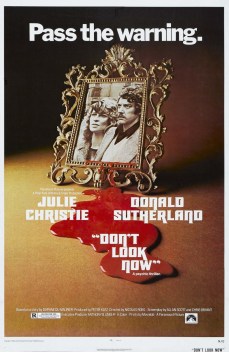
Don’t Look Now (Nicolas Roeg 1973) – restored version

936full-dont-look-now-posterand so anyway it turns out that the best thing about the newly restored version of Don’t Look Now (1973), which incorporates some footage cut at the request of Stephen Murphy, chair of the BBFC, is not the fresh emphasis it places upon Donald Sutherland’s pre-emptive bid to become the new Doctor Who after Jon Pertwee’s departure the following year by dressing up as much like Tom Baker as possible, but the shocking and totally unexpected revelation of who Roeg initially intended to unveil as the diminutive Venetian serial killer…

paddington-bear-and-suitcase


The City in Fiction and Film, week 15. Urban alienation: machines for living in, living in machines.

Alpha_1024x1024.jpgWeek 14

This week we turned from the American suburbs to futuristic (that is, 1960s) Paris, with Alphaville (Godard 1965). But first we took a trip through the history of representations of the city in sf cinema, guided largely by Vivian Sobchack’s ‘Cities on the Edge of Time: The Urban Science-Fiction Film’ (1999).

We returned briefly to Metropolis (Lang 1927), with its vision of a metrocosm – a city with with no apparent exterior – in which verticality dominates: skyscrapers, aerial roads and railways, aeroplanes, and above them all the incredible building from which Joh Fredersen, at the centre of a web of communications technology, governs it all. The bourgeoisie live above the ground; beneath them lie the machines upon which the city depends; and beneath the machines live the workers. Here, verticality figures an oppressive class structure (not unlike the glass slabs reaching into the skies of present-day financial centres). In Just Imagine (Butler 1930), however, Sobchack suggests that verticality implies something different because there is no subterranean world, no marginalised working class, just structures leaping into the sky. Here, she argues, the city as expresses that most American of values (or ideological sleight-of-hand): aspiration. Individual personal planes that can also hover weave among the skyscrapers. (But in longer shots, they all follow rigid grid patterns, like the orderly automobiles on the streets below; this tension between individualism and conformity is played out through the protagonists’ resistance to state control over who marries whom.)

We took a look at the opening of the film, which imagines nineteenth century, 1930s and future version of New York – the wry tone of the sequence indicates the film’s broader ambivalence about the notions of progress it also, at times, seems to espouse.

Detouring from Sobchack, we spent some time looking at the incredible montage sequence, scored by Arthur Bliss, from Things To Come (Menzies 1936) in which, following decades of war and plague and petty dictatorship, the new Everytown is constructed. I mentioned how masculinist the film’s notion of progress is at this point – the Earth is some kind of womb full of riches, waiting to be torn out – but had completely forgotten quite how phallic some of the machines are. The whole sequence can be seen as technoporn, an erotics of mechanism, one in which the future is built on the scorched Earth of the past. In Things to Come, decades of war cleared the ground, but in the real world this was done – and continues to be done – quite deliberately. For example, in the US, the urban renewal programme that ran from 1949 to 1973 bulldozed 2,5000 neighbourhoods in 93 cities, dispossessing at least one million people. Mike Davis’s Planet of Slums (2006) borrows the Filipino term ‘hot demolition’ to describe contemporary landlord arson of slums so as to clear land for redevelopments that are never intended to provide housing for the impoverished populations burned out of their homes.

Equally important for our purposes, though, is quite how abstract Things to Come’s the scientific manufacturing looks – we can see that proficient, technoscientific processes being signified while remaining more or less completely ignorant of what they are actually doing. This is important in thinking about the semiotic thinking of Alphaville.

 Film_660w_ThingsToCome_originalThe sequence ends with the revelation of the subterranean mall future, hints of mid-twentieth-century architecture’s International Style evident in buildings with set-back bases and non-supporting exterior walls. But before we get to the mall, there is a glimpse of a radiating landscape in the distance – of a Garden City.

The idea of the Garden City was espoused in Ebenezer Howard’s To-Morrow: A Peaceful Path to Reform (1898), significantly revised as Garden Cities of To-Morrow (1902), which was influenced by Edward Bellamy’s utopian novel Looking Backward, 2000-1887 (1888). In it, he outlines the attractions and repulsions of two existing magnets – the town and the country – and outlines the attractions of the third, proposed magnet he calls ‘town-Garden_City_Concept_by_Howard.jpgcountry’, or the Garden City. The idea was to build new towns from scratch that avoided urban poverty and squalor – overcrowding, poor drainage and ventilation, pollution, disease, lack of access to the natural world – by combining the pleasures/benefits of the country (nature, fresh air, low rent) with those of the city (opportunity, entertainment, good wages). The Garden Cities would be of limited size, preplanned, and owned by trustees on the behalf of the tenants – and thus also work to undermine private ownership and landlordism.

Letchworth Garden City commenced construction in 1903 and Welwyn Garden City in 1920. Howard’s ideas were taken up by Frederick Law Olmsted II in the US, influencing aspects of suburban development, and after WW2 also influenced British ‘New Town’ developments.

(Incidentally, and à propos of nothing relevant, Howard is the great-grandfather of Una Stubbs.)

American architect Frank Lloyd Wright’s The Disappearing City (1932) took pushed beyond Howard’s ideas even further, proposing the complete dispersal of urban centres into the countryside. Each family to be given an acre of land on which to build an ‘organic architecture’ homestead that used local materials, matched the contours of the land and opened up the interior of the building to the world outside. Unlike Howard, Wright prioritised private automobile ownership over public transport – though in illustrations, he also seems to imagine the car being replaced by varieties of helicopter. Wright ‘Broadacre City’ design was also an influence on US suburban developments.

Returning to American sf films, our next port of call was the short film showing of Norman Bel Geddes massive Futurama diorama, built for the General Motors exhibition at the 1939 New York World’s Fair. It envisions an entire country organised around roads and automobiles – quel supris! – and urban centres that owe something to Le Corbusier’s ville contemporaine (1922), which emphasised orderliness, symmetry, space and vistas in a plan to build 24 60-storey cruciform high-rise skyscrapers in which three million people would live and work (which, if divided out evenly, would 125,000 people per building and approximately 2,080 per floor).

Sobchack draws on Susan Sontag’s 1965 essay, ‘The Imagination of Disaster’, to describe ‘the fantasy’, evident in 1950s US sf films, ‘of living through one’s own death and more, the death of cities, the destruction of humanity itself’ (Sontag 44). In such films height and aspiration are brought low as tidal waves sweep through Manhattan (When Worlds Collide (Maté 1951)), when a reanimated dinosaur romps through New York (The Beast from 20,000 Fathoms (Lourié 1953)), when flying saucers crash into the Capital’s neo-classical government buildings (Earth vs the Flying Saucers (Sears 1956)) – and, in Japan, when Godzilla smacks down Tokyo. This concession to non-US cinema is telling. Gojira (Honda 1954) is a bleak film, critical of nuclear war and Cold War atomic escalation; when recut for US release as Godzilla, King of the Monsters (1956), all such material is carefully excised so as not to have to face up to it.

Sobchack also adds the category of films in which we are shown deserted cities. Five (Oboler 1951) shows us not destruction but the emptiness of all that aspiration (and is mostly filmed around a desert home designed by Frank Lloyd Wright). The remarkable The World, the Flesh and the Devil (MacDougall 1959) not only casts Manhattan’s skyscrapers as the tombstones of civilisation, but also, like Five, tries to discuss racial politics. Both films show that one of the few legacies of American civilisation that will endure into the post-apocalypse is the colour line – suggesting that it is not just an issue of individuals who are racist, but of the deepest structures of American society. Ultimately, both flinch away from their full implications, but they are among the relatively few films of the period trying to say something important about it.

In the 1960s and 1970s, the underground returns in THX 1138 (Lucas 1971), replacing aspiration with oppression; fullness becomes overcrowding in Soylent Green (Fleischer 1973); and in A Clockwork Orange (Kubrick 1971), the ‘brutalist’ architecture of postwar British developments – evoked here by the Thamesmead estate – becomes brutalising, or is at least blamed for brutalisation.

In the 1980s, white flight from the centre to the suburbs has given way to white flight to the off-world colonies. In films such as Blade Runner (Scott 1982), the urban core has been junked rather than redeveloped, and then exoticised and made cool by punks and ethnic others. The exhausted, colourful downtown seems to go on for ever – remember how improbable the flight to the countryside seemed at the end of the original cinema cut – and the city seems to have become all run-down centre. In contrast, the blast LA landscape of Repo Man (Cox 1984) is all exhausted, quirky margins, as if any kind of centre is impossible. Also, in films such as RoboCop (Verhoeven 1987), Darkman (Raimi 1990) and They Live (Carpenter 1988), it becomes clear that property developers – and the financial interests they serve – are grasping, criminal, inhuman.

In the 1990s, Sobchack argues, the decentredness of the city gives way to the ungrounded or groundless city. On the one hand, there is the emphasis on pastiche in films such as Independence Day (Emmerich 1996) and Pleasantville (Ross 1998), in which very familiar sf images are repeated – flying saucers destroying the Whitehouse, a conformist smalltown invaded by alien others – but have no real connection to the cultures in which they are produced and consumed. And on the other hand, thanks largely to the development of CGI and other digital production technologies, there are films in which the city becomes a vertiginous, boundless space across which impossible trajectories are traced (The Fifth Element (Besson 1997), Star Wars: Attack of the Clones (Lucas 2002)) and, perhaps more interestingly, a space to be endlessly reshaped – and human identities along with it – by far from benevolent powers, as in Dark City (Proyas 1999).

Since Sobchack wrote her essay, the city in sf film since the 1990s has become primarily a post-9/11 space. It is subject to:

  • inexplicable alien attacks in Cloverfield (Reeves 2008), War of the Worlds (Speilberg 2005), Attack the Block (Cornish 2011)
  • terrorist attack in Star Trek Into Darkness (Abrams 2013)
  • emptying out in 28 Days Later… (Boyle 2002) and I am Legend (Lawrence 2007)
  • military occupation in 28 Weeks Later… (Fresnadillo 2007)

In Children of Men (Cuarón 2006), the city is reduced to an endless camp for remantn populations and dislocated people.

In Mad Max Fury Road (Miller 2015), the city as such has completely disappeared, leaving nothing but a brute vertical structure of violent oppression.

Turning to Alphaville, we began by outlining the dystopian elements of the future it depicts, some of which clearly develop ideas and themes we had already encountered last week in Bradbury’s Fahrenheit 451 and Siegel’s Invasion of the Body Snatchers. These included:

  • centralised and totalitarian control (the extent to which the Alpha 60 computer and Alphaville are co-extensive is ambiguous, but arguably the inhabitants of Alphaville effectively also live inside the computer)
  • loss of emotion and flattening of affect
  • state-organised spectacle (swimming pool executions replacing books burnings) which is not so much about punishing perpetrators as reminding the rest of the population of the state’s potential to use disciplinary force
  • the ubiquity of modern commodities, which replace art, live music, poetry, etc
  • the degradation of language – if you remove words from the dictionary, people cannot feel or express the emotions/ideas they signify
  • the reduction of humans to the status of commodities (which, in Alphaville’s treatment of all(?) women as sex-workers does at least demystify the economics of normative heterosexual exchange)
  • the imminence of nuclear war
  • an architecture – here all cold reflective glass and marble – that establishes barriers between people
  • an emphasis on abstraction – signs and graphics, diegetic and otherwise – rather than on embodied human interconnection

This last point extends into the film’s emphasis on semiotics – how meanings are created and circulated. This is most obvious in the way in which, in Alphaville, nodding your head means ‘no’, and shaking it means ‘yes’ – semiotic signs, remember, are arbitrary and conventional.

The film foregrounds an array of intertextual connections – references to characters from pulps, comics and films (Flash Gordon, Dick Tracy, Nosferatu, Heckel and Jeckel), to scientists and related institutions (von Braun, Fermi, Einstein, Heisenberg, Los Alamos, IBM), but does little if anything to explain them, leaving the viewer to fathom their presence, their signification – perhaps as a kind of pop culture primer to help us read the poetry of surrealist Paul Eluard that might save us.

The film plays with genre, casting Eddie Constantine, already familiar to French audiences from the actual Lemmy Caution films in which he has starred, and going out of its way to make the sex and violence and melodramatic music of crime thrillers awkward and absurd (as if desperate to find a way to both have the pleasures of mass culture and to distance itself from them). Such elements signify a genre to which the film using them arguably does not belong – at least not in any straightforward way.

Finally, the film levers open the gap between sound and image that conventional continuity editing tries to close down. Not only do we not know where Alpha 60’s voice actually comes from in the world of the film, we also often do not know its status in relation to the footage: can it be heard by the characters? is it a voiceover address to the viewer?

Next week, we turn in more detail to the International Style, the influence of Le Corbusier on British postwar developments, to brutalist architecture and its decline – and to the first half of JG Ballard’s High-Rise (1975), accompanied by The Model Couple (Klein 1977).

Week 16

Core critical reading: Utterson, Andrew. “Tarzan vs. IBM: Humans and Computers in Jean-Luc Godard’s Alphaville.” Film Criticism 33.1 (2008): 45–63.

Recommended critical reading
AlSayyas, Nezar. Cinematic Urbanism: A History of the Modern from Reel to Real. London:    Routledge, 2006. See Chapter 5, “From Postmodern Condition to Cinematic City.”
Desser, David. “Race, Space and Class: The Politics of Cityscapes in Science-Fiction Films.” Alien Zone II: The Spaces of Science Fiction Cinema. Ed. Annette Kuhn. London: Verso, 1999. 80–96.
Duarte, Fábio, Rodrigo Firmino and Andrei Crestani. “Urban Phantasmagorias: Cinema and the Immanent Future of Cities.” Space and Culture 18.2 (2015): 132–42.
Easthope, Anthony. “Cinécities of the Sixties.” The Cinematic City. Ed. David B. Clarke. London: Routledge, 1997. 129–139.
Hilliker, Lee. “The History of the Future in Paris: Chris Marker and Jean-Luc Godard in the 1960s.” Film Criticism 24.3 (2000): 1 – 22.
–. “In the Modernist Mirror: Jacques Tati and the Parisian Landscape.” The French Review 76.2 (2002): 318–29.
Mennel, Barbara. Cities and Cinema. London: Routledge, 2008. See chapter 6, “Utopia and Dystopia: Fantastic and Virtual Cities.”
Shaw, Debra Benita. “Systems, Architecture and the Digital Body: From Alphaville to The Matrix.” Parallax 14.3 (2008): 74–87.
Sobchack, Vivian. “Cities on the Edge of Time: The Urban Science-Fiction Film.” Alien Zone II: The Spaces of Science Fiction Cinema. Ed. Annette Kuhn. London: Verso, 1999. 123–143.
Staiger, Janet. “Future Noir: Contemporary Representations of Visionary Cities.” Alien Zone II: The Spaces of Science Fiction Cinema. Ed. Annette Kuhn. London: Verso, 1999. 97–122.
Utterson, Andrew. From IBM to MGM: Cinema at the Dawn of the Digital Age. London: BFI, 2011.

Recommended reading
E.M. Forster’s “The Machine Stops” (1909), Yegeny Zamyatin’s We (1924) and Aldous Huxley’s Brave New World (1932) are key dystopias concerned with modern built environments. Robert Silverberg’s The World Inside (1971) is an ambivalent take on life in an arcology.

Recommended viewing
The design of the future city in Things to Come (Menzies 1936) draws on contemporary architectural debates.
THX 1138 (Lucas 1971) and Logan’s Run (Anderson 1976) are set in dystopian arcologies. World of Tomorrow (Bird and Johson 1984) looks at the future city designed by corporations for the 1939 New York World’s Fair.
Jacques Tati’s mechanised suburbia of Mon Oncle (1958) is matched by a hyper-modern Paris in Playtime (1967).

Chappie (Neill Blomkamp 2015)

onesheetand so anyway it turns out that the best thing about Chappie (2015), Blomkamp’s bizarre mash-up of RoboCop (1987) and Short Circuit (1986) and every other sf cliché he could ineptly execute, is not that the Asian scientist actually gets to be played by an Asian actor (Dev Patel), although that is a vast improvement on having Fisher Stevens in brown face, nor is it the decision to subtitle only Brandon Auret’s heavily accented but comprehensible English rather than whatever heavily accented (Aussie? South African?) language it was Huge Jackass was alternately mumbling and shouting, nor is it that even after this disastrous mess of a movie the internet still kept on whingeing about Blomkamp not getting to make an Alien movie, but the fact that, at absolutely no point in the production, did anyone involved turn around to Blomkamp and ask him how much did José Padilha pay to make the RoboCop remake look less bad than it is? or even, less cynically, you do realise what a fucking bloated, idiotic, self-important, tone-deaf mess this is?

Space Station 76 (Jack Plotnick 2014)

Space_Station_76_posterand so anyway it turns out that the best thing about Space Station 76 (2014) is not Patrick Wilson’s utterly wasted career-best performance – he really is far far better in this intermittently amusing spoof on 70s era space TV than anyone needs to be – nor is it the spot-on scripting and performance of the robot psychiatrist, nor is it the cunning way in which Matt Bomer still gets away with not acting because he has really pretty eyes, but the way the movie takes the bold and devastatingly pointed step of criticising old TV shows for having just one character of colour who basically gets to appear in the background, saying and doing nothing of consequence, by including one  black guy (Victor Togunde) who appears in the background, saying and doing nothing…