 and so anyway it turns out that the best thing about Hummingbird (2013) is not the hilarious heavy-handedness of the whole endeavour but the moment when Jason Statham – playing a traumatised Afghanistan veteran on the run from a court martial for the revenge-atrocities he committed and now living among London’s homeless who, through a series of utterly probable twists, emerges from the stupor in which he keeps himself, becomes a strong-arm man for Chinese gangsters and falls in love with a nun – asks his criminal boss to identify the killer of a homeless female friend who was forced into prostitution, and they agree to help provided he ‘does the thing no-one else is willing to do’, and the next shot is of him driving across the Severn Bridge into Wales…
Author: markbould
Ondjaki, Granma Nineteen and the Soviet’s Secret (2008; trans 2014)
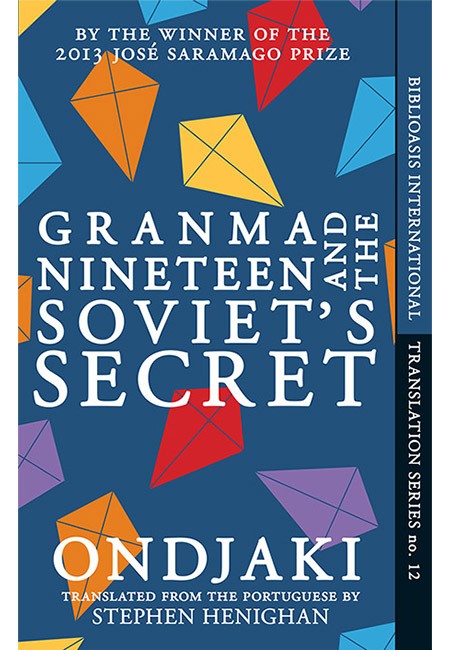 Granma Nineteen and the Soviet’s Secret by the Angolan Ondjaki is one of those books I picked up for the Speculative Africas project because it sounded like it might be sf. It isn’t. At least not in any straighforward sense. But it is one of the best books I’ve read this year, and there is something fantastical about it. And it features the astonishing mausoleum of António Agostinho Neto, which I have become mildly obsessed with since seeing photos of it in Kiluanji Kia Henda Icarus 13 installation.
The novel is set sometime in the early 1980s: Reagan is in power in the US; Jackie Chan’s The Big Brawl has reached Angola; and the 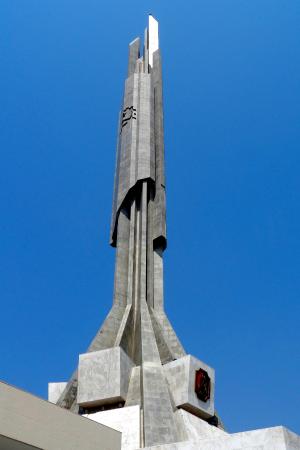 mausoleum of Angola’s first president is under construction. (In reality, it ground to a halt because Neto’s successor, Jonas Savimbi, was a member of UNITA, backed by South Africa, rather than of Neto’s Soviet- and Cuban-backed MPLA. (There was a third-side in the post-independence civil war, the Mobutu-backed FNLA.) During Savimbi’s thirty year reign, he saw no reason to support its completion, and the possibility of further Soviet financing collapsed with the end of the Cold War. When the MPLA regained power in 2008, they used oil revenue to complete the structure on a much less grand scale than initially planned, and it was inaugurated in 2012, on the ninetieth anniversary of Neto’s birth. (See, I told you, mildly obsessed. Back to the book.))
It starts with an explosion in the sky over polyglot Bishop’s Beach, next to the mausoleum’s constructions site, that
woke up even the birds asleep in the trees and the dozy fish in the sea. Colours came out that had never been seen before: yellow mixed with red pretending to be orange in a bluish green, flares that mimicked the strength of the stars reclining in the sky and a warlike rumble of the kind made by the MiG planes. In the end it was a beautiful explosion that lingered in the noises of the pretty colours that our eyes looked upon and never again forgot. (9)
This is the first of several synaesthetic prefigurations – where colours and sounds get jumbled, as do birds, fish, kites and stars – in the initially episodic account of everyday life in the Bishop Beach. The cast of characters include the young protagonist’s several abuelas (Granma nineteen is not his nineteenth Granma – when Dr Rafael KnockKnock amputates her toe, she is left with nineteen digits and a new nickname); his friends Charlita and 3.14, whose real name, Pinduca, was first shortened to Pi; Comrade Gas Jockey, who faithfully, if lethargically, mans the local petrol station even though there is never any petrol; Sea Foam, who is more mad than wise, but sometimes it seems the other way around; and Soviet Comrade Gudafterov, really called Bilhardov, who is in charge of the blue lobsters, as the children call the Russian troops, and who longs to return to his snowy homeland. All of these characters have stories, and Ondjaki laces his story with glimpses of this much-storied world:
Granma Agnette … sang the music of slow Fado tunes, adapted to put us to sleep, and nobody slept. She told crazy stories about her friend Carmen Fernández who had become pregnant, but had given birth to a huge bag of ants that bit the inside of her stomach. The second time she got pregnant she finally had a baby, but it had the head and wings of a bird and, as the window was open, it flew away and escaped. Granma said that Carmen Fernández was afraid of becoming pregnant a third time, but even then we didn’t fall asleep. Then Granma started with her threats. (26)
When the young protagonist learns that Bishop Beach is going to be demolished, their houses ‘dexploded’, to make way for the elaborate grounds around the base of the mausoleum, he and 3.14 decide their only course of action is to beat the builders to it – they must steal dynamite from the construction site and blow up the mausoleum instead.
This slender narrative is made delightful by comical encounters and episodes; a bittersweet treatment of the civil war, which the children do not quite get; a romance which they do not quite perceive, either; by references to Brazilian soap operas and popular movies; and by a linguistic playfulness in which ‘gangrene’ can be misheard as ‘gangrenades’ and Sea Foam can persuasively argue that the sky is occasionally lit up by ‘fouling stars’:
a phenomena of the skies of the dark universe, the cosmic dust and so on… there are two skies: the blue sky that belongs to our eyes and to the wings of planes and little birds. And then there’s a black sky that’s as big as a desert. … Fouling stars melted in the heat of the sun and that’s why they fall towards planet world. Our planet is the only one that has water where they can cool down again. They’re fouling stars, and one day, after cooling off, I swear, those stars are going to want to return home … We’re still going to see those stars rise up from the earth to way up there, in the skies that sleep far away dressed in bright brightnesses… (12)
Needless to day, it offers an alternative explanation as to why work on the mausoleum stopped in the early eighties. A happier, if not entirely happy, one. And it is appropriate that such poetry surrounds the mausoleum of a president who was once a poet, even if he is not actually buried there.
Memory Palace

From 18 June to 20 October 2013, the Porter gallery in London’s Victoria and Albert Museum was home to Memory Palace. Sponsored by Sky Arts Ignition, it is the first graphic arts exhibition at the venue in over a decade. It features one eponymous novella by Hari Kunzru (published separately) and twenty installations by as many artists or studios, and attempts to see “how far [you can] push the format and still call it a book,” to provide “an experiential reading format for a story,” to “create an exhibition that can be read’ (Newell and Salazar, “Curating a Book,” Memory Palace 84, 85). It is also a work of sf.
Curators Laurie Britton Newell and Ligaya Salazar commissioned Kunzru to outline a story that would then be developed in collaboration with the artists, who would be co-creators rather than mere illustrators: Abäke, Peter Bil’ak, Alexis Deacon, Sara De Bondt studio, Oded Ezer, Francesco Franchi, Isabel Greenberg, Hansje van Halem, Robert Hunter, Jim Kay, Johnny Kelly, Erik Kessels, Na Kim, Stuart Kolakovic, Frank Laws, Le Gun, CJ Lim, Luke Pearson, Stefanie Posavec, Némo Tral, Henning Wagenbreth, Mario Wagner, and Sam Winston. This process is recounted in Hunter’s dialog-free, short graphic comic, “Making Memory Palace,” appended to Kunzru’s novella.
The British-Indian Kunzru, a former magazine journalist, who wrote about travel, music, culture, and technology, is, like David Mitchell, one of that generation of authors relatively untroubled by genre-policing. His second novel, Transmission (2005), is about a computer virus, and reads like a slimmed-down, nearer-future version of Ian McDonald’s River of Gods (2004) spliced together with one of William Gibson’s Bigend novels; his fourth and most recent novel, the historically-sprawling Gods without Men (2012), includes UFOs and aliens, kinda. A rather trendy literary author, his first novel, The Impressionist (2003), attracted a £1 million+ advance, and he has won several major awards and prizes. The central concerns of his particular brand of popular, not exactly demanding postmodernism, sometimes described as “hysterical realism” or “translit,” are non-linearity and connectivity. Kunzru’s commissioning by Sky Arts is, then, relatively unsurprising (especially as he also used to be a presenter on The Lounge, Sky TV’s own electronic arts program).
His co-creators are rather less well known. Intriguingly, in their brief biographies at the end of the Memory Palace book, not one of them self-describes as an artist. They are all graphic designers, graphic artists, typographers, illustrators, comics artists, book designers, creative directors, art directors, editors, and/or architects. One is left with a strong sense of a smug and slightly shadowy commercial world of professionals, talented but perhaps a bit glib, for whom this is just another commission to be turned in on budget and on time. This perhaps explains why the exhibition’s satirical attack on neo-liberal hegemony and state-imposed regimes of austerity and amnesia is so muted.
Kunzru’s novella, Memory Palace, is set in a post-apocalyptic London. A magnetic storm destroyed the global information infrastructure and brought the Withering, a post-literate Dark Age of totalitarian theocracy, in which Westminster is known as Waste Monster, and other moderately amusing sub-Riddley Walker (1980) wordplay thrives. The Thing (as the council of leaders is known) wants to bring about the Wilding, a future in which the remnants of humanity will live in harmony with nature. The Thing has outlawed writing and recording, thereby criminalizing the Memorialists, those who are devoted to collecting and recollecting the past, whom they now hunt. Appropriately, then, the story, while nicely written and more than competent, stirs with faint echoes: of post-apocalyptic fiction by John Wyndham, John Christopher, and Walter M. Miller; of the television series Survivors (UK 1975-1977) and the coda to the film Threads (Jackson UK/Australia/US 1984); of M. John Harrison’s seedy bedsit entropy, China Miéville’s rejectamentalism, and Evan Calder Wood’s salvagepunk.
The book version of Memory Palace is, as one would expect from such a project, a gorgeous object, lavishly illustrated with selected work from the exhibition and pictures of the physical and electronic installations. If you have read the book, though, the exhibition itself is a little disappointing (I cannot gauge what it would be like to see the exhibition before, or without, reading the book). Le Gun’s life-size model of what someone from the post-apocalypse imagines an ambulance to have looked like – part medicine show, part museum of curiosities, drawn by wolves and driven by a Día de Muertos cross between Baron Samedi and the Child Catcher – is impressively detailed, as is Jim Kay’s reliquary cabinet devoted to Milord Darwing, the author of Origin of the Species (1859), who is misremembered as a rogue GM scientist. In contrast, Oded Ezer’s eight short films, looped on eight separate screens, are all concept with little art, and Erik Kessel’s enormous temple built from bundles of newspapers and advertising fliers, recalling the pre-apocalyptic religious ritual of
  Recycling, has even less art and barely even a concept. The more straightforward illustrations – whether blown up on large light boxes (Tral), arranged in a narrative thread on a white wall so you have to move to follow them (Pearson), or presented on zinc letterpress plates (Winston) – do benefit from exhibition. And it is quite pleasing – after all the corporate profligacy, the privatization and militarization of public spaces, the peonage of cleaners and others, the jingoism and spitefulness, that the London Olympics involved – to see the stadium reduced to slums (Tral) and Anish Kapoor and Arups’ 115-meter tall ArcelorMittal Orbit, a kind of flying spaghetti Eiffel Tower, being ceremonially burned to the ground (Greenberg).
Newell and Salazar write that “Unlike reading a printed book, visiting an exhibition is not usually a linear experience” (85). In this case, however, the layout of the space, and the clearly marked entrance and exit, do produce a linear exhibit, whereas reading the book, with its out-of-order narrative and illustrations that tempt one to flick back and forth between them, is more successfully non-linear. Consequently, I would recommend the book over the exhibition, especially as it is available from online stores for less than £10, and unless you live in South Kensington (or “South Keen Singtown,” as it will be known during the Withering), getting to and seeing the exhibition will cost you more than that.
A version of this review appeared in Science Fiction Studies 121 (2013), 596–8.
Superpower: Africa in Science Fiction

From May 5 to July 1 2012, the Arnolfini gallery in Bristol, UK, was home to “Superpower: Africa in Science Fiction,” an exhibition curated by Nav Haq and Al Cameron. Exemplifying a recent trend for artists to view the continent through science-fictional lenses, it includes work by João Maria Gusmão and Pedro Paiva (Portugal), Kiluanji Kia Henda (Angola), Luis Dourado (Portugal), Mark Aerial Waller (UK), Neïl Beloufa (France), Neill Blomkamp (South Africa/Canada), Omer Fast (Israel/Germany), Paweł Althamer (Poland), Wanuri Kahiu (Kenya), and Bassam El Baroni, Jeremy Beaudry and Nav Haq (Egypy/US/UK).
Some of the short films on display – Kahui’s Pumzi (2009), set in a water-scarce future Africa, and Blompkamp’s Tetra Val (2004) and Alive in Joburg (2005), the latter of which was hothoused into District 9 (2009) – might already be familiar to SFS readers. Of them all, though, the most intriguing is Omer Fast’s Nostalgia (2009), consisting of three parts, each of them continuously looped in an individually dedicated room.
Nostalgia I is a four-and-half minute HD video: in a forest, a white man in camouflage fatigues builds a trap from branches and twine; on the soundtrack, a former Nigerian child soldier talks about his childhood and how a surrogate father figure taught him how to make a partridge trap from branches and twine.
Nostalgia II runs for ten minutes on two synchronized HD screens: on the left, the former child soldier, now a man; on the right, Omer Fast. The interview subject does not seem to understand the artist’s questions, and although he describes the partridge trap his father taught him to build from sticks and twine, the artist grows skeptical of the subject’s inability to provide specific detail about growing up in Nigeria. And, depending on when you join the film, it sooner or later becomes clear that both men are actors, the interview a reconstruction.
The thirty-two minute Nostalgia III, shot on 16mm and transferred to HD, contains eight scenes, with several momentary flashforwards (or, depending on when you join the film, flashbacks). The setting, loosely sketched in passing hints, is an Africa faced with the problem of illegal immigration from Europe (it is unclear whether this is an alternative present or a future after European civilization has collapsed, but everyone dresses like they are from seventies Britain or from a seventies British adventure television series). Nostalgia III alternates scenes from two stories. One follows three British illegal immigrants, who meet their fate in secret tunnels under the African security perimeter. It is a linear narrative, albeit with two scenes actually occurring simultaneously, but the second story is a closed loop. In each scene, one character describes how to make a trap out of sticks and twine, and in the next scene, a character who has heard this information recounts it as first-hand knowledge – A tells B, B tells C, C tells D, D tells A, A tells B, and so on.
While fascinating, Nostalgia is also a little troubling. Its spiraling narrativization, and concomitant destabilization of experience, marginalizes a specific Nigerian voice, transforming his life into an art-commodity. But it is not as troubling as Blomkamp’s shorts, which contain all the problems of District 9 in embryonic form; or as Althamer’s Common Task: Mali, a photographic record of an “encounter” with Dogon villagers that reeks of colonial appropriation and the touristic gaze.
 The other highlight is Kia Henda’s Icarus 13 (2008), an installation recounting the first African space mission – an endeavour every bit as foolish as the one in Ngũgĩ wa Thiong’o’s Wizard of the Crow (2006). Launched from Angola, Icarus 13 landed on the surface of the sun – at night, so as to avoid deadly heat – and successfully returned to Earth with ‘some particles from the photosphere’ for laboratory study. The six-hundred-word account of the mission covering one wall culminates in the observation that ‘from the description given by the astronauts, the Sun has the most beautiful night’, before announcing upcoming tourist flights to finance further scientific investigations. There are also a tabletop architect’s model of Icarus 13 on the launch-pad, and eight photographs. The first photograph shows Icarus 13, rising in the centre of the frame, viewed from Luanda, with a vast open sky above and beyond it. The rocket, though, is actually the mausoleum of António Agostinho Neto, Angola’s first president – its base resembles the flared rockets of a Soyuz launch vehicle, while its jagged pinnacle looks like a prototype for London’s The Shard. Other striking buildings are similarly repurposed: a domed structure is labeled “Astronomy Observatory, Namibe Desert,” despite its obvious lack of astronomical equipment, and a low, flat building whose obliquely angled walls might suggest, from above, a star shape, is described as a “Centre of astronomy and astronaut training, Namibe Desert,” although in reality it is a cinema. A medium shot of five construction workers is captioned “Building the spaceship Icarus 13,” while a yellow torus against a dark background is “First picture of the Sun’s photosphere from Icarus 13 in orbit.” The final photograph, labeled “The return of the astronauts,” prises open the gap between image and caption even further by containing nothing to which the caption could actually apply. It is a gap that frustrates, and which calls for the viewer to inflate it with story – just as Kia Henda fills the frustrating gap between the dream of independence and the nightmares of civil war and post-colonial dependence, between socialist aspiration and neo-liberal hegemony, with myth, tall tale, humour and hope.
Among related events at the Arnolfini, Roger Luckhurst (Birkbeck), Rehan Hyder (UWE) and I ran a workshop, “Martians of Africa,” on the relationship between sf and colonialism, asking what would happen if one considered such anti-colonial and post-colonial films as Les statues meurent aussi (Marker and Resnais France 1953) and La Noire de… (Sembene Senegal/France 1966) as works of sf. The exhibition’s run came to a close with a double bill of Africa Paradis (Amoussou Benin/France 2006) and Les Saignantes (Bekolo Cameroon/France 2005).
(Blompkamp’s short films, Gusmão and Paiva’s The Shadow Man (2006-7), and almost all of Beloufa’s Kempinski (2007) are available on youtube. The text of El Baroni, Beaudry and Haq’s second ARPANET dialogue – a fake conversation between Samir Amin, Steve Biko, Francis Fukuyama and Minoru Yamasaki, which would not have seemed out of place in Moorcock’s New Worlds – can be found here.
A version of this review appeared in Science Fiction Studies 118 (2012), 559–61.
Spectacle, Apocalypse and the Telepathic Fruitarian Pacifists from Mars
 A version of this review appeared in Science Fiction Film and Television 4.1 (2010), 107–15.
Atlantis (August Blom Denmark 1913). Danish Film Institute. PAL region 0. Original ratio. 20fps. Verdens undergang (The End of the World; August Blom 1916) and Himmelskibet (A Trip to Mars; Holger-Madsen Denmark 1918). Danish Film Institute. PAL region 0. Original ratio. 17fps and 20fps, respectively.
For half a decade, beginning in 1910, Denmark was the most influential film-making nation in Europe after France. Of more than two dozen production companies, many of which lasted only long enough to make a handful of films, Nordisk Films Kompagni was the most successful.[1] Established in 1906 by cinema-owner Ole Olsen, it quickly became the second largest European production company, after France’s Pathé,[2] making, for example, over 140 films in 1915 alone. Indeed, Nordisk’s fame and influence was such that the Hungarian theatrical actor and film director Miháley Kertész – better known as Michael Curtiz – visited Denmark to study their filmmaking systems and techniques.[3] Nordisk ceased to make films in 1917, and when production recommenced after World War One, its global position was lost. Its German market was undermined by the establishment of Ufa, Germany’s state-owned studio, and Nordisk’s increasing focus on literary adaptations proved a less-successful export strategy than Germany’s development of expressionism into a cinematic mode.
Spectacle
 In 1910, actor August Blom joined Nordisk’s 1700 staff as a director.[4] He soon became the studio’s leading director, shooting more than a hundred films by 1924. While Olsen preferred single reel films (up to sixteen minutes long), which had to sell about twenty prints before turning a profit, Blom wished to make longer films. After his racy three-reel melodrama Val Fœngslets Port (The Temptations of a Great City; Denmark 1911) became an international hit, selling nearly 250 copies, he increasingly got his way. Although largely forgotten nowadays, Blom was a major figure in the development of what we now think of as feature-length films, both in Denmark and internationally. He was best known for literary adaptations, including versions of Robinson Crusoe, Strange Case of Dr Jekyll and Mr Hyde and a Hamlet shot at Elsinore, and for social melodramas, which depicted temporary mobility between social classes before conservatively reasserting the natural order of social hierarchies (Mottram 135–6). In 1913, he adapted German Nobel prize-winner Gerhart Hauptmann’s novel Atlantis, following its narrative very closely. It was a prestige production over which Hauptman retained considerable control; but despite the novel’s rather modern perspective, its story of the self-exiled, proto-existentialist Dr Friedrich von Kammacher (Olaf Fønss) resonated strongly with the melodramatic form Blom favoured. At eight reels (nearly two hours), it was the longest Danish film – and one of the longest films anywhere – to that date. It was another international hit, with prints prepared specifically for Danish, German, English, French, Italian, Portuguese and Russian language markets (there were two Russian versions, one with a much more tragic conclusion which is included as an extra on this DVD). For its US release, it was cut down to six-reels. According to Mottram, the excised scenes almost certainly included von Kammacher’s side trip to Paris and his brief shipboard affair with a Russian Jewess from steerage, and probably the two-shot sequence which gives the film its title and its few moments of more-or-less direct interest to readers of this journal: von Kammacher’s dream/vision of Atlantis.
Nearly halfway through the film, the overwrought von Kammacher retreats to his cabin on a liner crossing the Atlantic to the US. In his sleep, he meets a dead friend, with whom he walks through the streets of Atlantis. While Blom succeeds in giving this sequence an oneiric quality, the lost continent is rather obviously just a Danish town. This tension makes it appear oddly prescient of Ingmar Bergman’s symbolic use of Scandinavian settings in a film such as Smultronstället (Wild Strawberries; Sweden 1957), but it is profoundly at odds with the rest of the film’s realist aesthetics. In Blom’s defence, the equivalent brief passage in Hauptmann’s novel seems just as odd.
Perhaps, then, of greater interest than this fantastic element is the film’s investment in spectacle, which is increasingly treated as a defining characteristic of sf cinema. In addition to specially-filmed establishing shots of Manhattan, location shooting in Berlin (including striking material filmed from moving cars) and shots of magnificent landscapes and seascapes, there are three sequences that even more specifically evoke the cinema of attractions associated with early cinema.
First, when von Kammacher, distressed by the rejection of his revolutionary bacteriological research and by the need to commit his insane wife to an asylum, takes a holiday in Berlin, his friend Hans Füllenberg (Miháley Kertész) invites him to the debut of Ingergerd Hahlstrom (Ida Orlov). Her dance – a vaguely allegorical performance called ‘The Spider’s Victim’ – not only fills him with a desire for her against which he will struggle for the rest of the film, but also abruptly terminates narrative momentum in order to insert what is, in effect, a two-minute-and-forty-second butterfly dance film. Such short films, which featured the hypnotically swirling skirts and sleeves (often hand-painted frame by frame) of such performers as Annabelle Moore, were immensely popular in the 1890s and the first few years of the twentieth century (various sources claim that they constituted between 30–80% of all films made before 1910).
In the second half of the film, von Kammacher’s fellow voyager, the armless performer Arthur Stoss (Charles Unthan), performs amazingly dexterous acts with his feet. Again, the action halts – for three minutes – to present a sequence that resembles a short film recording of a popular variety act: Stoss plays a trumpet; shuffles, cuts and deals a pack of cards; lights and smokes a cigarette; opens a wine bottle with a corkscrew, pours and drinks the wine; types a letter and signs it with a pen.[5]
 In between these two ‘attractions’ lies the film’s most spectacular sequence, in which the liner hits a derelict ship and sinks. Some sources state that Hauptmann’s novel was published four weeks before the Titanic disaster, others that the novel was inspired by it; but regardless of this, the film adaptation a year later again evokes a genre of the cinema of attractions: the record of a catastrophe (typically opportunistic, often reconstructed or otherwise fraudulent) and the specific cycle of films purporting to contain actual footage of the Titanic sinking. Blom’s resolutely unspectacular visual style lends a sense of greater realism to shots of barely-choreographed extras milling about on the ship, of others leaping twenty feet or more into the sea and of the actual sinking of a large-scale model/set of the ship.
Apocalypse
 Of more direct interest to the readers of this journal is Blom’s Verdens undergang (The End of the World; 1916), in which a comet – or its debris – strikes northwest Europe. It was shot in Sweden and Denmark while memories of the 1908 Tunguska event (probably the airburst of a meteoroid or cometary fragments) and 1910’s two major cometary visitations – Halley’s Comet and the Great January Comet, also known as the Daylight Comet – were still relatively fresh, and while World War One was consuming men and matériel in unprecedented quantities. That a residual sense of such celestial phenomena being ill omens persisted is indicated by a New York Times article on the Great January Comet, which displaces such concerns onto other peoples: ‘its appearance is reported to have caused extreme terror among the Russian peasants, who regard it as the precursor either of a great war in the Far East or of the end of the world’ and ‘warnings have been issued as to the effect it is likely to have upon the populations of North Africa and India’ (Anon). However, despite Nordisk making a number of pacifist and explicitly anti-war films, Blom ignores the potential in his material to develop such a connection with the Great War. Instead, he chooses to construct another social melodrama, which escalates as the comet draws nearer (in this, it has much in common both with the overwrought familial and homosocial melodrama of Deep Impact (Leder US 1998) and Armageddon (Bay US 1998), and with the low-key mapping of social difference in Last Night (McKellar Canada/France 1998)).
When Frank Stoll (Olaf Fønss), a wealthy industrialist, comes to a remote town to inspect his mine, he promptly falls for Dina (Ebba Thomsen), one of the daughters of its manager, West (Carl Lauritzen). She feels stifled by the strictures of her conservative, religious father, and when Stoll declares his love for her, she abandons her home and her fiancé, a miner called Flint (Thorleif Lund), for a life of luxury in Copenhagen. Several years later, Stoll’s financial machinations have made him an even larger fortune on the stock exchange. When a comet is spotted approaching the Earth, he manipulates his cousin, Professor Wisemann (K. Zimmermann), into revealing to him the Astronomical Society’s findings about the likelihood of a collision, which are supposed to be kept secret so as to avoid panic. Having already purchased stock at rock-bottom prices when news of the comet prompted a crash, Stoll forces a newspaper editor to print a false report that it will pass by harmlessly. Public confidence – and stocks – rise, enabling Stoll to sell at a massive profit before the truth comes out. He then returns with Dina to his mansion near her home town so as to shelter in the mines from the coming conflagration. On the eve of destruction, he – presumably not being familiar with Poe’s ‘The Masque of the Red Death’ (1842) – throws a party for his wealthy friends, instructing them ‘Let us celebrate this evening! If we are saved, it will be we who will found the new world, and be its masters. We will salute the rush of the meteors towards the Earth with a feast. Tonight, when the sky is in flames, we will let our stars dance for us.’ Meanwhile, Flint, intent on revenge  against Stoll, incites the miners and townsfolk to riot. As flaming debris fall from the sky – the combination of model work and location shooting remains quite effective – and as Dina performs an erotic dance for Stoll’s guests, the common people, armed with tools and guns, converge on the mansion. Class warfare erupts (in one remarkable shot, the camera looks past the workers, through a hole they have torn in a door to where Stoll’s guests return fire). Stoll hustles the injured Dina through a secret passage into the mines, pursued by Flint. She dies from her wound; Flint and Stoll, overwhelmed by toxic gases released by the comet’s impact, die; in fact, everyone dies.
Everyone, that is, but Dina’s virtuous sister, Edith (Johanne Fritz-Petersen), rescued from the sea’s  inundation of the land by a priest (Frederik Jacobsen), who then disappears, and her fiancé, Reymers (Alf Blütecher), the only survivor of his wrecked ship. She makes her way through the post-catastrophe desolation to a church tower.[6] Reymers hears the sound of church bells ringing, and the lovers are reunited, a new Adam and Eve.
Blom’s visual style in Atlantis and Verdens undergang exemplifies – some might say typifies – the Nordisk look, which strongly favoured a single camera set-up and deep focus composition, with multiple planes of action. This not only enabled an entire scene to be filmed in a single long take, but also helped to produce a film grammar less concerned with montage (as in the US) than with composition and spatial relationships within the mise-en-scene. Blom reduces the theatricality often associated with such a style by offsetting the camera so as to reduce the sense of frontality – unless frontality could be used to emphasise a character’s sense of social or psychological confinement – and by adopting (limited) panning and tracking so as to follow the action. There is little cross-cutting to build tension or parallelism between locations, and the actors, usually in medium shot, eschew melodramatic gestures, actions and emotions in favour of a more restrained, naturalistic style. Sets are well-dressed, often with very solid-looking furniture, and Blom is careful to imply the existence of real spaces on the other sides of doors and walls. He is not afraid of cramming twenty or more actors into a shot, and he is fond of mirrors as a means of extending visible space. For example, in Verdens undergang, a tableau of the lascivious but bored Dina features a mirror angled so as to depict part of the room that is out of shot, and the haste of the scheming Stoll’s return from the stock exchange is captured by thus showing him burst into the room (in the mirror) before he bursts into shot. Slightly more mystifying – at first – is the mirror that dominates one wall of West’s dining room, seemingly angled outward at the top merely to display the rug on the floor. Its true purpose is only revealed when flood waters pour in through the window, treating the viewer to a sight of the rapidly rising tide that swirls around Edith’s legs, adding to the sense of her peril without having to alter the camera set up or edit the film.[7]
Perhaps the most striking shots in Verdens undergang come when Stoll scouts out a hiding place in the mine, and later when, pursued by  Flint, he tries to bear the injured Dina to safety there. Each time, the characters descend into utter darkness, with only a single candle to light the way. Blom’s ingenious use of what appears to be a chest-mounted lighting rig gives halos of light to otherwise invisible figures shot from behind, and of mobile lights out of shot at the feet of the advancing characters produces moving pools of light and shadow, emphasising the deeper darkness into which they descend. There is nothing like it in silent sf – perhaps in silent cinema – until Rotwang (Rudolf Klein-Rogge) pursues/rapes Maria (Brigitte Helm) with a torchbeam in Metropolis (Lang Germany 1926).
Telepathic Fruitarian Pacifists from Mars
 Alongside Blom, Nordisk’s other major director in the 1910s was Forest Holger-Madsen, another occasional actor, who shot forty-six films between 1912 and 1936. His Nordisk films include three overtly anti-war films: Ned med vaabne (Lay Down Your Arms; 1914), scripted by Carl Theodor Dreyer from a novel by Nobel Peace Prize-winning activist Baroness Bertha von Suttner; Pax Aeterna (1917), co-written by Nordisk-owner Ole Olsen, the poet, novelist and playwright Sophus Michaëlis and Otto Rung; and Himmelskibet (A Trip to Mars 1918), adapted by Olsen and Michaëlis from the latter’s novel of the same name.
In Himmelskibet, sea captain turned aeroplane enthusiast Avanti Planetaros (Gunnar Tolnæs) yearns for a new and worthy venture, something that will further the human spirit and the cause of peace. He finds inspiration in the work of his father, the astronomer Professor Planetaros (Nicolai Neiiendam), and commits himself to building a ‘bridge between the planets’ – to constructing a spaceship and flying to Mars. He is joined in this endeavour by his friend Dr Krafft (Alf Blütecher), who is in love with his sister, Corona Planetaros (Zanny Petersen). After two years, Avanti announces the completion of the Excelsior at a meeting of the Scientific Society. A cigar-shaped craft with a propeller at the rear and biplane wings above the front of the fuselage, it has a revolutionary power source[8] that will enable it to travel through interplanetary space at 12,000kph. Despite Avanti’s impressive presentation (he is dramatically lit at a lectern at the front of the darkened room, with footage of the spaceship matted in beside him as if it is a film being projected), he is ridiculed by the demoniacally-lit – and appropriately named – Professor Dubius (Frederik Jacobsen), who denounces the venture as madness rather than science and calls for common sense to prevail.
The contrast between Dubius and his friend, Professor Planetaros, is articulated, as one might expect, through mise-en-scene. Planetaros is a stable, bourgeois patriarch, his observatory uncluttered, his home spacious and dull, with immaculate furniture that could be decades old. Physically, he resembles one of Boris Karloff’s white-haired scientists of the late 1930s and early 1940s, but while he shares something of their melancholy, he possesses none of their madness. Dubius, with his pointed beard, shock of hair, pince-nez and cheroots, more closely resembles the owlish Dr Mabuse (Rudolf Klein-Rogge) of Dr. Mabuse: Der Spieler (Lang Germany 1922). Indeed, in his rather cluttered office, strewn with books and papers, he even sits beneath a giant stuffed owl, symbolising a knowledge more arcane than modern science. He lives alone with his housekeeper; his clothes suggest vanity and he is furiously envious of Avanti. When the press turn against the expedition, Professor Planetaros, fearing for his son’s safety, is driven into physical and psychological decline by Dubius’ constant taunting. (Dubius is eventually driven mad by the expedition’s success and is struck dead by lightning.)
Among the volunteer crew Avanti recruits from the Science Society, two figures are particularly noteworthy. One is an unnamed Japanese, played by an uncredited European in yellowface with spectacles and smoothed down hair, who retains an air of formal deference despite his western dress. The other is David Dane (Svend Kornbech), a stout American adventurer with the build of a young Fatty Abuckle. He is uncouth – he enters the meeting smoking a pipe and wearing a stetson, with his jacket draped over his arm, only for one of the stewards to remove his pipe and hat and make him put his jacket back on – and, it soon transpires, a secretive alcoholic. This depiction of a modern Japanese obviously owes much to Japan’s surprise victory in the 1904–5 war with Russia and to its significant role in World War One;[9] a similar blend of modernity and orientalism is found in the Japanese of Spione (Lang Germany 1928). In contrast, Dane combines frontier accoutrements with crass materialism, unhealthy appetites and a bully’s swagger that turns out to be a coward’s front. Six months into the voyage, it is not the oriental who turns treacherous, but the American. Driven to despair by the ‘brooding darkness’ of space, Dane no longer attempts to conceal his heavy drinking and begins to plot mutiny. Only Krafft and the Japanese remain loyal to their commander.
Avanti self-consciously models himself on Christopher Columbus, talking to a portrait of the explorer that decorates his father home and copying its visionary subject’s heroic pose (Tolnæs’ overemphatic performance of heroic energy and messianic commitment is at odds with that of most of the rest of the cast; his excessive gesturality recalls Gustav Fröhlich’s often-criticised performance as Metropolis’ Freder Fredersen). And in an echo of the myth of Columbus’ voyage, it is just as the Excelsior is nearing Mars that the mutineers attempt to seize the spaceship. However, the Martian observers monitoring its approach accelerate the Excelsior to ten times its normal speed and land it safely on their planet.
 It is on Mars that Himmelskibet’s pacifism comes to the fore. Martian civilisation combines elements typical of nineteenth-century utopian or lost-race fictions: pseudo-classical architecture, costume and customs; divine ancient wisdom; telepathy; social, psychological and physiological engineering, in this instance organised around a fruitarian diet; and a scattering of superscience technologies. Here, however, the emphasis is not on detailing eutopia’s radically different socio-economic structures but on the stately grace of the Martians, their social/religious rituals and the beauty of their landscape (which looks exactly like the Danish countryside, apart from the occasional ziggurat or giant flower). Premiering in February 1918, the film’s boldest move is overtly to transvaluate the God of War into the Planet of Peace.
The Martians greet the expedition with fruit, but disdain the wine they are offered in return and are repelled by cans of ‘dead meat’. Avanti shoots a bird from the sky to show the Martians that they, too, could easily add meat to their diet. The Martians, appalled by the sound of the first gunshot on the planet in thousands of years and by the murder of a living being, advance on the humans, and Dane throws a grenade, killing a Martian: ‘War and sin! Killing and blood!’ have come to ‘the planet of peace’, and ‘must be atoned for’.
Marya (Lilly Jacobson), the daughter of the Martian Wise Man (Philip Bech), appoints herself the expedition’s defender as the humans subject themselves to Martian law, which punishes them by giving them self-knowledge. They are shown scenes from Martian history – of the ‘killing with fire and iron’ that prevailed until the Wise Man brought peace to their world – and thus learn that ‘Blood screams in even the smallest murder and sin opens its gates of hell/The source of life is but pure and good, woven from every strain of blood’. The humans vow never again to kill any living creature and even Dane surrenders his weapons. Then, to their amazement, the dead Martian is revived.
Many elements of Himmelskibet remain quite impressive: the dressing of its bourgeois sets and the chiaroscuro lighting effects; the Excelsior’s interior design, its rivets, gears and wheels prefiguring the spaceship interiors of Just Imagine (Butler US 1930) and Flash Gordon (Stephani US 1936); and the blend of effects shots and actuality footage, including aerial views of Copenhagen, worked into the Excelsior’s launch sequence.
However, its attempts to depict a truly spiritual Martian people have fared less well. This is perhaps most evident in the rather curious courtship of Avanti and Marya. When he declares his love at ‘the tree of longing’ and then enters the ‘forest of love’ with her, it is impossible to tell whether these terms are supposed to have symbolic meaning within the diegesis, are part of an exegetic double-coding to make it clear that they are about to consummate their love, or just really unfortunate phrasing. Likewise, it is difficult to know what to make of Avanti fondling Marya’s breasts, especially as the rest of their interactions seem so chaste and this scene comes just after a comparison has been drawn between the Martian ‘dance of chastity’ and scenes of terrestrial debauchery and violence. Indeed, the only time the images manage to convey any sense of poetic harmony are a handful of shots depicting terrestrial workers in the early morning light of which Humphrey Jennings would have been proud.
 Marya joins the Excelsior on its return to Earth so as to propagate her father’s ‘message of enlightenment’. Professor Planetaros, whose suicide is narrowly averted by his son’s homecoming, welcomes her with these words: ‘In you I greet the new generation – the flower of a superior civilization, the seed of which shall be replanted in our earth, so that the ideals of love may grow strong and rich’.[10] This hopeful address to the future must have seemed bitterly ironic in the closing months of a war in which nine million combatants, most of them young people, were killed. It is, however, perhaps too much to suggest that, in such hierarchical and patriarchal sentiments, in Planetaros’ reduction of a ‘superior’ woman to a literal and symbolic womb, and in the film’s Aryan vision of superiority, its fascination with uniforms, technology and messianic heroism, that the outlines of the Next Great War can already be glimpsed.
Works cited
Abel, Richard. The Red Rooster Scare: Making Cinema American, 1900–1910. Berkeley: University of California Press, 1999.
Anon. ‘Not Much is Known of Daylight Comet’, The New York Times (30 January 1910): C3. http://query.nytimes.com/gst/abstract.html?res=9400E7D61730E233A25753C3A9679C946196D6CF.
Mottram, Ron. The Danish Cinema before Dreyer. Metuchen: Scarecrow, 1988.
Notes
[1] The longest continuously operating studio in the world, Nordisk still makes 10-15 productions and co-productions per year.
[2] The first decade of the twentieth century was the only time imported films have dominated the American screen. By the autumn of 1907, Pathé alone ‘was selling on the American market between thirty and forty million feet of positive film stock per year, nearly twice as much as all the American companies combined’ (Abel 87).
[3] He has a role in Atlantis, but there is ‘no documentation … to support [the] claim’ (Mottram 9) that he was also its assistant director.
[4] For an overview of his films from 1910-14, see Mottram.
[5] One cannot help but wonder whether this sequence inspired Tod Browning’s The Unknown (US 1927), in which Lon Chaney performs equally remarkable armless feats.
[6] A Danish audience would presumably have recognised this as the Buried Church in Skagen, the most northerly point of Jutland, which was lost – with much metaphorical commentary – to the encroaching sands during a period of desertification in the eighteenth and nineteenth centuries.
[7] Such attention to the contents and spatial organisation of the frame may have influenced Curtiz’s own distinctive mise-en-scene, perhaps best exemplified by the interiors of Casablanca (US 1942) and Mildred Pierce (US 1945).
[8] Although its engine room seems to contain only a small five-stroke motor.
[9] After the war, Japan was awarded a seat on the Council of the League of Nations, and Saionji Kinmochi was seated with David Lloyd George, Woodrow Wilson, Georges Clemenceau and Vittorio Emanuele Orlando at the Versailles Peace Conference, although his attempts to include a racial equality clause into the Versailles Treaty failed.
[10] Rather unfortunately for the Anglophone viewer, this sentiment is followed by an ‘End’ caption in Swedish, which is ‘Slut’.
The City in Fiction and Film, week six

This week we watched Modern Times (Chaplin 1936), read a recent article on it by Lawrence Howe (which contains some useful contextualisation for the film, even though I am not wholly convinced by its argument), had a brief introduction to Marxist ideas about capitalism and the class society it produces, and then spent quite a while discussing some basic essay writing skills.
As described by Frederick Engels, in his ‘Preface to the English Edition of 1888 of The Communist Manifesto’, Marx’s ‘fundamental proposition’ concerning history and class is that
the whole history of mankind … has been a history of class struggles, contests between exploiting and exploited, ruling and oppressed classes; that the history of these class struggles forms a series of evolutions in which, nowadays, a stage has been reached where the exploited and oppressed class – the proletariat – cannot attain its emancipation from the sway of the exploiting and ruling class – the bourgeoisie – without, at the same time, and once and for all, emancipating society at large from all exploitation, oppression, class distinctions and class struggles. (in Karl Marx and Friedrich Engels, The Communist Manifesto, ed. by David McLellan (Oxford: OUP, 1998), 48.)
Starting with this broad sweep ties back to the work we did on historical periodisation in week 2 as we started to think about ‘modernity’, but more importantly gave me an opportunity to include a picture of the lovely late Andy Whitfield on the  powerpoint slide explaining classical slave societies (Feudalism had to make do with a picture of Errol Flynn as Robin Hood.)
Capitalism, Marx argued, is defined by the exploitative relationship between the bourgeoisie (or capitalist class), who own and control the means of production (from factories to financial instruments), and the proletariat (or working class), who sell their labour for a wage which is worth less than the value created by their labour. All that extra value they create is used to pay for raw materials, plant, etc; and all that is left over from that – surplus value, in Marx’s term – is taken by the capitalist. Although there might be small individual and partial exceptions, the capitalist will always look to increase production of surplus value – by introducing ‘rationalised’ production processes and increasing automation, by lowering or freezing wages, by extending the working day (including reducing breaks), by offering productivity bonuses, by resisting unionisation of the workforce and health/safety legislation, by casualising the workforce, by not paying the costs of pollution, by relocating to countries with weaker unions/workplace protections/ environmental laws, and by avoiding/evading taxes and manipulating political systems.
Before discussing Modern Times, we took a look at several short sequences from Metropolis (Lang 1927), a film I really wanted to include on the module but which is too long for the screening session (and perhaps in that respect a bit cruel as an introduction to silent cinema – although next week we will be watching Man with a Movie Camera, so I am not sure where the greater cruelty lies).
Lang’s film spatialise class relations in a manner that will become common in dystopian visions, and also in the real world. Here the spatial division is vertical, recalling the literal and figurative descents into poverty in Gaskell’s Mary Barton. The garden in which the city’s wealthy youths play is somewhere high up and pristine. Freder’s father’s office – as controller of the city – is also elevated above all, symbolising his pan optical powers (making him an important figure when we dip our toes into a little de Certeau in a few weeks). Then there is the magnificent metropolis itself, beneath which are the machines which sustain it. And beneath the level even of the machines, as Lang’s opening sequence shows, is the city of the workers.
We also took a look at some of the machinery in the film: the 10-hour shift clock and 24-hour clock over which the shift change is announced (we have already seen Lang’s obsession with clocks in M), the rather abstract machine which overheats and transforms, in Freder’s eyes, into a barbaric ancient idol into whose maw the workers are fed; and the even more abstract clock machine that Freder undertakes to operate so as to free an exhausted worker, only to become a kind of knackered Christ figure himself as he struggles to keep up with its incomprehensible demands for repetitive motion.
Some of this imagery is picked up on directly in Chaplin’s film, which also begins with the image of a clock and workers trudging to the factory like lambs to the slaughter.
Before the screening, I suggested some possible binary oppositions that could be used to try to think through the logic of the film:
capitalist and worker
surveiller and surveilled
employed and unemployed
production and consumption
lack and plenty
work and leisure
human and automaton
conformity and difference
law and lawlessness
order and chaos
authority and resistance
propriety impropriety
male and female
adult and child
As ever, a lot of these terms sort of overlap or seem to be describing the same things from different angles.
The boss using the giant screen in the bathroom to berate Chaplin on his break establishes that the relationship between capitalist and worker is a power relationship (we have already seen the boss goofing off, doing a jigsaw and reading the funny pages – Flash Gordon, if I am not mistaken, since the visible page is Tarzan?) – and that this power relationship includes bullying and surveillance (which includes workers having to clock-in and clock-out, even for bathroom trips). Furthermore, the fact that the boss even contemplates subjecting his works to the Billows Automatic Feeding Machine so that can they be fed lunch without needing to leave the production line indicates the extent to which he does not think of them as human beings but as mere parts of a technical apparatus, as cogs in a machine. (It is also an example of trying to increase productivity through automation so as to increase surplus value, or profit, at the expense of the worker.)
Such control systems or disciplinary structures as the factory represents also provide most of the other key locations of the film: asylum, prison, orphanage, department store, restaurant.
Talking about the department store – designed to move customers through the space in such a way as to organise and prolong their experience within the retail environment (think about how IKEA has no windows or clocks and only one route through the warehouse – and, at least according to one of the class, blocks cell phone reception) – also facilitated a way to think about the interconnections of production and consumption.
Chaplin and the gamin (Paulette Goddard), of course, are disruptive forces of chaos in all this. Chaplin’s derangement by the repetitive labour of the production line shows how poorly we all, as humans, fit the environments created to maximise the extraction of our labour power for other people’s profit. The gamin’s initial gender-blurring – posing like Peter Pan, providing food for the family when her father is unemployed – and her refusal to be subordinated to state systems (the law around property, the orphanage to which her younger siblings are sent) betoken a similar energy. Both she and Chaplin are often positioned as childlike, and their attempts to find a space in the adult world are endearing parodies of that world: the dream vision of a suburban home Chaplin imagines, the run-down shack the gamin crafts into the image of a suburban idyll, the way they play and dress up in the department store. (And they are not alone in not fitting in this world: the prim and severe vicar’s wife whose stomach nonetheless gurgles when she drinks tea; the scarcely glimpsed ‘gay’ prisoner, who minces out of the dining hall and into his cell; the unemployed men forced to break into the department store because they are starving; and so on.)
Then it was time for a break, for the grand unveiling of the essay questions, for reminders to do the library quiz online within 24 hours, and for essay-writing advice.
The latter is especially tough, I find, to do for a whole group, none of whom have yet submitted any work. Makes it hard to know where to begin, what particular strengths and weaknesses each student has. So we did some very basic stuff.
On stucture, taking Strunk and White’s advice: ‘Make the paragraph the unit of composition: one paragraph to each topic.’ So a brief introduction to what is going to be discussed, probably somewhere between 5 and 8 paragraphs, each devoted to making, developing and supporting a single idea in a chain of ideas/paragraphs, and a short conclusion tying it all together. For a 1200 word essay, the introduction and conclusion should probably need no more than a sentence or two each. Revise the introduction once the essay is completed so as to ensure it describes what the essay actually does, rather than what you intended to do (the initial introduction can also be used to help think through revisions to early drafts). No new ideas to be introduced in the conclusion – and never end with a quotation (it is supposed to be your conclusion).
Using spell-check (make sure it is set to English UK; remember it won’t catch certain kinds of errors, such as typing ‘form’ when you mean ‘from’). Use grammar-check sparingly, as typically you need to understand grammar in order to make sense of its recommendations. Instead, concentrate on becoming a better writer (obligatory plug for the genuinely excellent kids’ book, The English Repair Kit by Angela Burt and William Vandyck).
We covered rules about laying how to quote and paraphrase and reference (MLA-style).
Finally, we thought about writing in a more formal academic style, but how that did not necessarily mean writing in long sentences. Focus on short, clear sentences, and work in length-variety where necessary – focus on the connection between what you want to say and the best way to say it clearly.
And then wrapped it all up with another quotation from Strunk and White:
Omit needless words. Vigorous writing is concise. A sentence should contain no unnecessary words, a paragraph no unnecessary sentences, for the same reason that a drawing should have no unnecessary lines and a machine no unnecessary parts. This requires not that the writer make all his sentences short, or that he avoid all detail and treat his subjects only in outline, but that every word tell.
Recommended critical reading
AlSayyas, Nezar. Cinematic Urbanism: A History of the Modern from Reel to Real. London: Routledge, 2006. See chapter 2, “Urbanizing Modernity: Utopia/Dystopia and the City of the Future Past.”
Desser, David. “Race, Space and Class: The Politics of Cityscapes in Science-Fiction Films.” Alien Zone II: The Spaces of Science Fiction Cinema. Ed. Annette Kuhn. London: Verso, 1999. 80–96.
Jenkins, Henry. “Looking at the City in The Matrix Franchise.” Cities in Transition: The Moving Image and the Modern Metropolis. Ed. Andrew Webber and Emma Wilson. London: Wallflower, 2008. 176–192.
Mellen, Joan. Modern Times. London: BFI, 2006.
Sobchack, Vivian. “Cities on the Edge of Time: The Urban Science-Fiction Film.” Alien Zone II: The Spaces of Science Fiction Cinema. Ed. Annette Kuhn. London: Verso, 1999. 123–143.
Staiger, Janet. “Future Noir: Contemporary Representations of Visionary Cities.” Alien Zone II: The Spaces of Science Fiction Cinema. Ed. Annette Kuhn. London: Verso, 1999. 97–122.
Recommended reading
By imagining future cities, sf often highlights contemporary concerns about the city. See, for example, Yevgeny Zamyatin’s We (1924), Aldous Huxley’s Brave New World (1932), George Orwell’s Nineteen Eighty-four (1949), Frederik Pohl and Cyril Kornbluth’s The Space Merchants (1953), Harry Harrison’s Make Room! Make Room! (1966), John Brunner’s Stand on Zanzibar (1968), Thomas Disch’s 334 (1972), Marge Piercy’s Woman on the Edge of Time (1976), William Gibson’s Neuromancer (1984), Neal Stephenson’s Snow Crash (1992), Colson Whitehead’s The Intuitionist (1999), Tricia Sullivan’s Maul (2003) and Nnedi Okorafor’s Lagoon (2014).
Recommended viewing
The same is true of many sf films, such as Metropolis (Lang 1927), Things to Come (Menzies 1936), Alphaville (Godard 1965), Clockwork Orange (Kubrick 1971), THX 1138 (Lucas 1971), Soylent Green (Fleischer 1973), Blade Runner (1982), Akira (Ôtomo 1988), Dark City (Proyas 1998), Minority Report (Spielberg 2002), Code 46 (Winterbottom 2003), District 13 (Morel 2004), Children of Men (Cuarón 2006), La Antena (Sapir 2007) and In Time (Niccol 2011).
Modern Times was partly inspired by À Nous la Liberté (Clair 1931).
Captain Eager and the Mark of Voth (Simon Davison UK 2008)
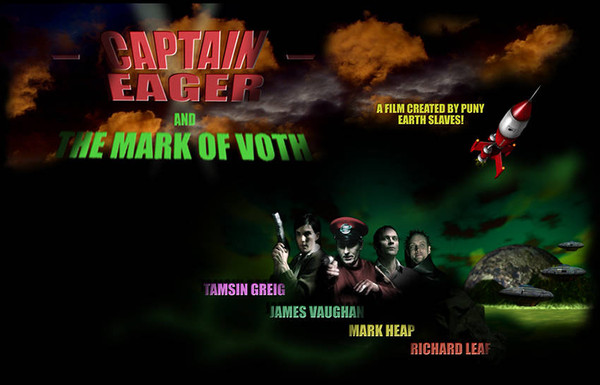 Curiously, this low-budget movie has all the hallmarks of many a major sf blockbuster. Based on a pre-sold property, it is greenscreen- and CGI-heavy. It assumes that individual shots are more important than narrative or character arcs, and that the incoherence of its plot not only does not matter but is actually something to boast about. It trades in nostalgia for a lost patriarchal and imperialist order misrepresented as an age of certainty and fairness, while gently chiding, with no real conviction, neo-liberal globalisation. It is dull-witted and charmless, and it thinks it is funny. All at a fraction of the cost.
Square-jawed space hero Captain Eager (James Vaughan) is summoned out of retirement by middle management at Macrospace, the interstellar corporation that has taken over everything (they provide ‘infrastructure and marketing’ and thus have turned every conceivable location into a ‘sterile retail opportunity’). Eager’s mission – whatever it actually is; the film is deliberately obscure – almost fails to get off the ground because Shiobhan in Personnel (Laura Clarke) casts doubts on the suitability of the balding, greying, paunchy protagonist and his old-fashioned rocketship-shaped rocketship, the Victory. Further complicating matters is the vengeful Colonel Regamun (Richard Leaf), who has concocted an absurdly elaborate scheme to: 1) drain the lifeforce from the minds of the alien Panvolkians so as to make himself immortal; 2) turn the now-mindless Panvolkians into slave labour; and 3) kill Eager, who he blames for the deaths of his family in a long-ago war. Various poorly-paced shenanigans ensue. Limply. For a seemingly endless ninety-five minutes. Which may, or may not, be deliberate.
Captain Eager is conceived as a parody or pastiche of – or perhaps even a satire on – 1950s and 1960s sf film, television and comics, particularly Frank Hampson’s Dan Dare, created for the Eagle comic in 1950 and set in the late 1990s. However, the film falters because it is either not familiar enough with this source or fears that its potential audience would not be (for example, The Victory looks nothing like the Anastasia or any of Dan Dare’s other spacecraft, more closely resembling a cross between Thunderbird 3 from Gerry Anderson’s Thunderbirds (1965–6) and the rocket that took Hergé’s Tintin to the moon a decade earlier in Objectif Lune (1953) and On a marché sur la Lune (1954)). Consequently, Captain Eager flounders around rather indiscriminately, looking for other things to parody/pastiche/satirise: sliding spaceship doors, clearly made of wood and painted to look like metal, do not open properly; sets made out of painted flats get knocked over; and so on. The film even boasts that it is shot in ‘Card-o-Scope’ and that CGI stands for ‘Cardboard and Gum Imagery’. This not-exactly-nostalgia does lead to the film’s several quite good jokes: Regamun’s Ming-the-Merciless-inspired collar gets in the way every time he turns his head; when Eager and Jenny enter the darkened Victory, Eager turns on the light to the sound of a pull-cord switch echoing in a bathroom. There is also a wry pleasure to be derived from the design of certain vehicles: Eager’s eventual triumph depends upon him flying a battered old Mark 1 spacecraft, which resembles an Avro Vulcan bomber, a triumph of 1950s British aeronautical engineering, and then a glider that recalls the Colditz Cock, a home-made glider constructed by British POWs and featured in Colditz (1972–4). Such amusing moments, however, are also indicative of the film’s conceptual and tonal uncertainty, caught between recalling a 1950s vision of the future and a folk memory of the actual 1950s (and 1960s and 1970s, and 1940s).
Other revisions of Dan Dare have likewise struggled with how to update its upright protagonist. For his intermittent, downbeat and punkish appearance in 2000 AD in the late 1970s, he was thrown, via suspended animation, 200 years further into the future, where he bore no real resemblance to Hampson’s character other than a tendency to answer to the same name. When Eagle was relaunched in the early 1980s, it featured the adventures of one of Dare’s descendants (and quite bizarrely retconned the original Eagle’s stories, recreating that Dan Dare as a World War II veteran timeslipped into the 1990s, so as to explain the survival of his peculiarly mid-century Britishness at the turn of the millennium). About halfway through its run, the strip became more violent, with Dare recast as a space marine. Garth Ennis and Gary Erskine’s Dan Dare (2008) is the most successful attempt to visualise a plausible-seeming future in which, after a Sino-American nuclear war, Britain is once more the leading world power, with its navy dominating the solar system. This seven-issue miniseries introduces an older, traumatised and largely forgotten Dare (he inhabits a virtual-reality reconstruction of an idyllic village, and in reality apparently ‘sees’ the delta-wing Starfires as more Spitfire-like spaceships) to inject elements of the mythical 1950s which shaped Hampson’s fictional 1990s, while also incorporating the violent space marine adventures of the hero’s later iterations. It also contains political satire (nothing so pointed or scurrilous as Grant Morrison’s Dare (1990), though), with a Blair-like Prime Minister betraying humanity to the Mekon – fairly mild stuff until compared to Captain Eager’s toothless whining about megacorporations, the metric system and all this other new-fangled stuff, including digital technology. The latter is, of course, rather ironic, given Captain Eager’s own dependence on such technology, sometimes deploying it, humorously I’m sure, to create images of analogue technology. But Captain Eager is not the kind of film to think things through (for example, Eager’s communicator rings – hilariously – like an old-fashioned dial telephone, but the joke is rather undercut by the existence of real-world cell-phone ringtones that make the same noise).
The performances are rather a mixed bag, too. Lindsay Carr brings some life to Carmina, a caricature vamp with a heart of gold. As Scrutty Baker, Mark Heap, familiar from such offbeat sitcoms and comedy shows as Brass Eye (1997–2001), Big Train (1998–2002), Spaced (1999–2001), Jam (2000) and Green Wing (2004–6), adds a Gollum-like twist to his contorted, constrained, socially awkward persona, but has no room to do anything interesting with it. The suggestion that Scrutty’s repeated betrayals stem from consciously suppressing his sexual desire for Eager is merely an ambiguous throwaway line that fails even to work as commentary on Digby’s homosocial attachment to Dare in Hampson’s comic; consequently, Scrutty becomes just another mildly offensive depiction of homosexual-as-dishonest-misfit. Tamsin Grieg, however, gives a pitch-perfect, subtle and sure performance, and is really the only reason to keep watching the film. Those familiar with Grieg from the sitcoms Black Books (2000–4) and Green Wing will immediately recognise and relish her bright, brittle Jenny, brimming with deep emotions she cannot quite express. Although clearly smarter than everyone around her, she is not exactly Hampson’s Professor Jocelyn Peabody. Jenny displays ‘tremendous pluck’ and, when it comes to a scrap, she is extremely handy with her fists (and unexpectedly good at headbutting). But she also always carries a hanky in her cardigan pocket. She alone is worth the price of admission (especially as the film is now available free via http://www.captaineager.com).
A version of this review appeared in Science Fiction Film and Television 5.2 (2012), 315–7.
The City in Fiction and Film, week five

This week, a lot of people, mostly children, died.
That is, this week we watched Ratcatcher (Lynne Ramsay 1999) and read chapters 5-7 of Elizabeth Gaskell’s Mary Barton: A Tale of Manchester Life (1848). And we did so through a (more or less) structuralist lens, so as to consolidate and build on the semiotic theory and terminology from the last couple of weeks.
So we began with revisiting the relationship between parole and langue, and thinking about how the latter structures the former. Borrowing from Lois Tyson’s not-entirely-accurately-subtitled Critical Theory Today: A User-Friendly Guide (1999), we looked at how utterances such as
tree appears green
Susan is tall
dog runs happily
clouds roll ominously
wisdom comes slowly
share the same parts of speech
noun, verb and descriptor (adjective or adverb)
and the same rule of combination
subject and predicate
So we moved from surface phenomena with very different meanings to the structures that make them comprehensible. We then refreshed our memories about the syntagmatic and paradigmatic axes of language, turning once more to an example from the first episode of Sherlock, in which Holmes is confronted by the word
RACHE
scratched in the floor by the victim. To fathom its meaning he changes paradigm, trying other languages until he finds one in which it is a word (‘revenge’ in German). And then he returns to English and scrolls through another paradigm, letters that could be placed at the end of the sytagm to make a word, until he comes to L and spells
RACHEL
So once more, the relationship between surface phenomena and the (potential) structure(s) underpinning it are made clear. After which we returned to some key sentences from our Sherlock and ‘The Blue Carbuncle’ examples from last week
‘How did you know I had a therapist?’
‘This hat is three years old. These flat brims curled at the edge came in then.’
‘his wife has ceased to love him’
and reconstructed Holmes’s reading of connotations in terms of the codes on which they draw, the myths they reiterate and the ideology they construct/articulate. (For the time being we are leaving ‘ideology’ dangling a little, defined as nothing more complex than ‘knowledge in the service of power’, which is already turning out to be more complex than I thought this simple definition would be…). So again, we move from surface to structure.
Next we turned to some new material, beginning with a brief description of Vladimir Propp’s formalist analysis of Russian folktales in Morphology of the Tale (1928), which finds the same recurring structure of 31 narrative ‘functions’ and seven character types in all the tales in his sample. We also thought about some of the problems with such methodologies – the violence they do to the narratives under consideration by treating the surface level of detail as somehow irrelevant, the violence that is done to narratives to force them to fit a predetermined pattern imposed by the critic. (One student was quite familiar with Propp, having encountered him on A-level Film Studies and being required – to my quiet horror – to undertake a Proppian analysis of Fight Club (Fincher 1999), which is of course structured exactly like a centuries old oral tale from another culture thousands of miles away. Others had heard of Joseph Campbell and the monomyth – undoubtedly the fault of George Lucas – but fortunately it didn’t seem appropriate to get into it too much in class, because it would have taken a while to get through the fundamentally racist logic underpinning the method. Maybe next year, in the module on genre theory and fantasy.)
We then took a look at James Damico’s 1978 description of the structure of a film noir:
Either because he is fated to do so by chance, or because he has been hired for a job specifically associated with her, a man whose experience of life has left him sanguine and often bitter meets a not-innocent woman of similar outlook to whom he is sexually and fatally attracted. Through this attraction, either because the woman induces him to it or because it is the natural result of their relationship, the man comes to cheat, attempt to murder, or actually murder a second man to whom the woman is unhappily or unwillingly attached (generally he is her husband or lover), an act which often leads to the woman’s betrayal of the protagonist, but which in any event brings about the sometimes metaphoric, but usually literal destruction of the woman, the man to whom she is attached, and frequently the protagonist himself.
This structure – derived from James M. Cain’s novels The Postman Always Rings Twice (1934) and Double Indemnity (1936), but already broadly familiar from, for example, Hardy’s Tess of the d’Urbervilles (1892) and Zola’s Thérèse Raquin (1867) – can be found in Double Indemnity (Wilder 1944), The Woman in the Window (Lang 1945), Scarlet Street (Lang 1945), The Killers (Siodmak 1946), The Lady from Shanghai (Welles 1948), The Postman Always Rings Twice (Garnett 1946), Out of the Past (Tourneur 1947), Pitfall (De Toth 1948) and Criss Cross (Siodmak 1949), and with variations in Murder, My Sweet (Dmytryk 1944), The Strange Love of Martha Ivers (Milestone 1946) and The Blue Dahlia (Marshall 1946). It mutates and collapses in In a Lonely Place (Ray 1950) and is anticipated by The Maltese Falcon (Huston 1941).
And since we watched the latter just a couple of weeks back, we were able to see how well – or poorly – it matches Damico’s narrative structure, and the violence that needs to be done to the film in order to make it fit. Which was a useful exercise in reminding us that surface is as important as – if differently important to – structure. (Damico also gave us the opportunity in passing to think about how genre definitions work to privilege certain texts and marginalise others, reorganising our understanding of groups of relatable texts rather than telling us some fixed truth about genre. But that was me wandering off topic a bit.)
From shared narrative structure we moved onto structuralist thinking about binary oppositions – and to run through this idea we left the city behind for a while and headed out west, as Jim Kitses’s Horizon’s West (1969) contains that fabulously useful (if problematic) discussion of the western in terms of the generative conflict between wilderness and civilisation (and 20 other related oppositions).
And (finally) this brought us to the series of oppositions I asked the class to think about while watching Ratcatcher:
city vs. country
urban tenements vs. suburb/new estate
male vs. female
adults/parents vs. children
rich vs. poor
English vs. Scots
freedom vs. confinement
The class were pretty quick to spot the ways in which most of these categories map onto each other, linking the urban tenement with varieties of confinement and the new estate out in the countryside with freedom: playing on piles of garbage vs. playing on a construction site; flats off shared stairwells vs. individual houses with interior staircases; outside loos and tin baths on the kitchen floor vs. fully plumbed inside bathrooms; the view out of the window onto a dirty dangerous canal vs. the view out of the window onto a rather improbably golden field; looking out of windows vs. climbing out through windows; etc – all of which is peculiarly echoed in the odd digression about the mouse launched into space finding a new home safe from the cruelty of young boys among a community of mice (which is surely a Clangers homage).
And then there were the wealthy English represented by the received pronunciation of the television news reporters commenting on the dustmen’s strike and the filthy conditions the people of Glasgow endure vs. the actual characters whose lives disrupt this patrician colonial perspective upon them.
Then we turned to Mary Barton.
Chapter 5 begins with a passage that introduces two key oppositions: appearance vs. reality and the individual vs. the mass. Gaskell’s narrator describes the working class Mancunian men who defy middle class expectations (and the tendency to lose particularities when you homogenise people as members of a class) by being skilled mathematicians, botanists and entomologists (and should we doubt it, she invokes a partially-remembered record of botanist Sir JE Smith finding himself dependent on a porter and a hand-loom weaver for advice on a rare specimen he sought).
Margaret Legh brings her friend, Mary Barton, home to meet one such amateur natural historian, her father Jacob. It seems odd at first, but this encounter, focalised through Mary, throws out scientific imagery in favour of something more alchemical, comparing Jacob to a wizard, speaking of the uncanny, the cabalistic, the mysterious. Having just hinged the credibility of her fictional account around a real historical event, Gaskell switches genres, drawing on something closer to the gothic romance. Opposing science and superstition in this way reinforces the common cultural opposition of masculine rationality and feminine fancifulness. In the following pages, a recently widowed woman is described as lacking foresight when she borrows heavily so as to be able to bury her husband, and Margaret, who is losing her eyesight, faces a similar charge because she continues to take in sewing – especially since there are a lot of deaths this winter, which involves sewing black cloth with black thread, straining her eyes even further. Mary’s own romantic fantasies of marrying the wealthy mill-owner’s son (who is courting her but with no such honourable intention) in the hope of finally being able to provide properly for her own unemployed father is contextualised, at the end of chapter 7, in terms of reading too many cheap romances and is described with reference to the Arabian Nights and in terms of building castles in the air.
But we have leapt ahead.
On meeting Jacob, Mary is told the story of how one day he bought from a sailor a scorpion, apparently frozen to death, that when placed without thinking in front of the fire came to life (Jacob managed to kill it by putting it in a pan of boiling water, and then preserved the remains). This peculiar anecdote – for which the chapter up until that point is merely laying the groundwork – leads nowhere in narrative terms, but introduces further oppositions (fire and water, hot and cold, life and death, and once more appearance and reality). It also foreshadows events: the chapter will end with a perilous fire that burns down the mill, and in chapters six and seven Ben Davenport and Joe and Will Wilson die of cholera, burning up with fever.
Soon after the anecdote, there is a paragraph describing a winter so cold that it is impossible for poor people to find liquid water – the icy landscape is deathly, and it seems as if it will go on for ever, a kind of inverse of the scorpion story. And it is the cold that freezes the standing pipes which prevent the fire crews from being able to bring the blaze under control. This paragraph leads into conversations about mourning and death (and economics) and blindness and insight and darkness and light.
The crowd who gather to witness the blaze are described as a mindless, unruly mass – for all her sympathy for the poor, Gaskell seems terrified of the mob and despises working class political organisation and action. But a mass in which, once more, individuals are made to stand out – Magaret and Mary in particular. And there is a curious parallel between the crowd behaving as an unconscious mass, impelled here and there by a kind of mindless subordination to a collective desire for spectacle, and Mary, who in their midst faints – loses consciousness.
Chapter 6 returns to the crowd, when Mary’s father, John Barton, on a mission of mercy is made furious by the apparent unconcern of the people he passes. And yet at the same time, he recognises that he is being unjust, that he cannot tell the first thing about them or the realities of their lives just by looking at them.
The main oppositions in this chapter map class difference onto verticality (and reinforce it with warm/light/dry vs cold/dark/damp).
Barton is summoned by a friend to the aid of Ben Davenport, who has been out of work since the mill burned down. The mill-owners, the Carson family, talk about the need to tighten their belts, but frankly they are glad the fire happened – they are insured, their machinery was out of date and needed replacing, and as the market is not that good, they are relieved to not have any expenses, such as wages. The mill-workers, on the other hand, have nothing, and many are starving. Barton descends into the narrow well between the the filthy street and the housefrony, into which mud and sewage is leaking, and from there down another step into a cellar room that never gets much light (the windows are broken and stuffed with rags, anyway); the mud and sewage is also seeping up through the floor. There is no fire, nor is there any food for the children. Davenport is near death. His desperate wife, who still suckles one of her children even though he is too old and she is barely able to produce any milk, is repeatedly described as death-like, cadaverous. Davenport is spoken of as having sunk down in the world; later, he will sink into death.
Barton’s mission of mercy takes him first to a pharmacist – the night-time shop-windows are full of commodities, perfectly lit to make them seem even more desirable, and again there is a sense of a fantastical world parallel to all this misery – and then the next day to the Carson’s house, which is brightly lit, with blazing fires and plentiful food and drink.
Carson bemoans his loneliness – only the youngest of his daughters stayed home to keep him company the previous night, and this morning the others are all also late to rise after their late night out at the assembly rooms. The youngest daughter puts her hands over her father’s eyes, mocking Margaret’s impending blindness, just as Carson’s loneliness mocks the isolation of so many of the working class characters.
Although the Carsons’ house is above ground, there is no great emphasis on it being higher than the Davenport’s – as in the spatialisation of class evident in sf films such as Metropolis (Lang 1927) and Blade Runner (Scott 1982) – but its vertical distinction is, as already noted, made clear at the end of chapter seven. It is part of the castle in the air that Mary’s romantic fancy builds.
Recommended critical reading
Barry, Peter. Beginning Theory: An Introduction to Literary and Cultural Theory. 3rd ed. Manchester: Manchester University Press, 2009. See chapters on structuralism, Marxist criticism and feminist criticism.
Eagleton, Terry. Literary Theory: An Introduction. 2nd ed. Oxford: Blackwell 1996. 79–109.
Hawkes, Terence. Structuralism and Semiotics. London: Routledge 1977.
Scholes, Robert. Structuralism in Literature. New Haven: Yale University Press, 1975.
Stam, Robert, ed., New Vocabularies in Film Semiotics: Structuralism, Post-Structuralism and Beyond. London: Routledge, 1992. See part III , “Film Narratology,” especially 77–85.
Tyson, Lois. Critical Theory Today: A User-Friendly Guide. London: Routledge, 1998. See chapters on structuralist criticism, Marxist criticism and feminist criticism.
–. Using Critical Theory: How to Read and Write About Literature. London: Routledge, 2011. See chapters on Marxist theory and feminist theory.
Recommended reading
Novels concerned with urban poverty and class structures include Émile Zola’s L’Assommoir (1887), Stephen Crane’s Maggie: A Girl of the Streets (1893), Frank Norris’s McTeague: A Story of San Francisco (1899), Theodore Dreiser’s Sister Carrie (1900), Upton Sinclair’s The Jungle (1906), Robert Tressell’s The Ragged Trousered Philanthropists (1914) and Walter Greenwood’s Love on the Dole (1933).
H.G. Wells’s The Time Machine: An Invention (1895) contains a science-fictionalised vision of class difference.
Jack London’s The People of the Abyss (1903) and George Orwell’s Down and Out in Paris and London (1933) and The Road to Wigan Pier (1937) combine autobiographical writing with sociological reportage about living in poverty.
Recommended viewing
There is a long tradition of British social realist films about working class and lower middle class life, often in provincial towns, including such British New Wave films as Room at the Top (Clayton 1959), Saturday Night and Sunday Morning (Reisz 1960), A Taste of Honey (Richardson 1961), A Kind of Loving (Schlesinger 1962), The L-Shaped Room (Forbes 1962), Billy Liar (Schlesinger 1963) and This Sporting Life (Anderson 1963), all of which were adapted from novels or plays.
Later social realist films include Kes (Loach 1969), Nil by Mouth (Oldman 1997), Red Road (Arnold 2006) and Fish Tank (Arnold 2009).
A lighter tone can be found in Brassed Off (Herman 1996), The Full Monty (Cattaneo 1997), Billy Elliot (Daldry 2000), Son of Rambow (Jennnings 2007), Made in Dagenham (Cole 2010) and Pride (Warchus 2014).
Groundbreaking television series that pushed the limits of social realism are Jim Allen’s Days of Hope (1975), directed by Ken Loach, and Alan Bleasdale’s Boys from the Blackstuff, directed by Philip Saville.
The Atrocity Exhibition (Jonathan Weiss US 2001)
 Assuming it is even possible, to what extent and in what ways should adaptations remain faithful to their sources? All manner of possibilities emerge when the adaptation is free of the constraints of respectability, accessibility and banal fidelity that a studio budget tends to entail, and when the source is supposedly ‘unfilmable’, as is the case with Weiss’s independently financed adaptation of JG Ballard’s novel.
Ballard’s and Ballardian prose is recited in voiceover and by carefully positioned actors – affectless mannequins in static tableaux. The camera is locked or tracks slowly. Interspersed is footage of Hiroshima survivors, crash test dummies, nuclear tests, Kennedy’s assassination, plastic surgery, the Challenger disaster, the war in Vietnam, penetration, Marilyn Monroe. A voiceover posits that the film was shot by Dr Travis (Victor Slezak), misappropriating the institution’s equipment and funds, as therapy, but is uncertain for whom.
Often, however, this mixture of stock footage and re-enacted scenes feels more like a high-end BBC documentary profile of Ballard, with the talking heads and explicatory arc excised. Some shots are strikingly composed, particularly when situating humans among architecture, but they lack the clinical precision of Cronenberg’s adaptation of Ballard’s Crash (Canada/UK 1996) and never achieve the gorgeous insanities of Matthew Barney’s Cremaster cycle (1995–2002). The static set-ups and slow tracks suggest Tarkovksy, but lack his attention to rhythm, to sculpting in time. While the film is never as torpid as, say, a classical Hollywood adaptation of Hemingway, its languor is strangely at odds both with Ballard’s surrealist prose montage and the media landscape he dissected. Imagine what Godard or Tsukamoto could have done with such material.
Several times Weiss tilts his camera upwards from the ground at his feet to an object further away, opening up a wider perspective. This tension between the detail and the whole pins Weiss and his film in the angle between two depths of field. Take for example the long shot of Karen Novotny (Anna Juvander), being fucked from behind while leaning out of a car window, naked apart from a picture of Ronald Reagan strapped over her face. The camera tracks in slowly, the music on the soundtrack adding a sense of respectfulness rather than juxtaposition. Before we can make out the image over her appropriately bored face, we know it will be of Reagan. All the elements are there, but somehow together they become less than their sum. The sequence only comes alive when old movie footage of Reagan, apparently looking askance at these shenanigans, is briefly inserted. This captures something of Ballard’s impish absurdism but nothing that might shock, however fleetingly, the bourgeoisie.
The Atrocity Exhibition is not so much an adaptation as an ambiguous memorialisation, turning Ballard into a suburb of European art cinema.
A version of this review originally appeared in Science Fiction Film and Television, 1.2 (2008), 359–60.
Crimson Peak (del Toro 2015)
 Pretty much all the commentary so far has been about one of two things.
Critics have been unanimous in their praise of how gorgeous the film looks, from its gothicky design to its fabulous frocks and sumptuous colour palette (it also has some nice irises and cunning wipes).
Or they have echoed del Toro’s own point that it is not really a horror movie so much as a gothic romance, full of echoes and allusions, including: Poe’s ‘The Fall of the House of Usher’; the several versions of Jane Eyre and Silence of the Lambs; Du Maurier’s Rebecca; Hitchcock’s Rebecca and Notorious; Medak’s The Changeling; The Haunting, and Wises’s; King’s The Shining, and Kubrick’s; the Coen’s Barton Fink; del Toro’s own Devil’s Backbone; and so on.
All of these critics are right, and yet without exception they overlook del Toro’s major accomplishment.
Somehow, he manages constantly to keep this astonishing overblown confection of evil aristocrats, ghosts, forbidden rooms, gramophone cylinders, automata, letters, keys, ghosts, murder, incest, idiosyncratic grim-up-north grimness, peculiarly hardy Cumberland moths, violent assaults and revolutionary mining technology just this side of hilariously funny. And somehow he makes it a constant delight, grand guignol at its most operatic, all logic subordinated to production design.
But it would take just one person in the auditorium to start laughing, and it could all go disastrously wrong.
It is not the first time del Toro has walked this particular line. Much as I enjoyed them, Hellboy II and Pacific Rim edge along a similar tightrope, and are rather less successful in keeping it together.
Early in the film, protagonist Edith Cushing (Mia Wasikowska) explains of a story she has written that it is not so much a ghost story as a story with ghosts in it, and that her ghosts are actually metaphors for the past. With the kind of New Weird chutzpah that China Miéville once championed, del Toro’s film takes completely the opposite tack. His ghosts are ghosts, not metaphors.
However, the logic of Miéville’s argument meant that while one should be absolutely committed to treating monsters as monsters rather than as metaphors, this should nonetheless leave their metaphorical potential open and even make for more effective metaphoricity. But with del Toro’s pastiche late-Victorian setting lacking the historical resonances of Devil’s and Pan’s Labyrinth‘s (not unproblematic) Spanish Civil War settings, there is nothing really for his ghosts to gain metaphorical purchase, even if they were so inclined. There is some stuff about aristocrats as parasites, and a whole Blut und Boden thing lying around should anyone want to make something of it, but no one does. And del Toro seems utterly uninterested in the gendered restrictions and sexual repression that seem so fundamental to gothic romance.
It is a film of many layers, all of them on the surface.
On the other hand, I loved every deliriously silly minute of it, and you get the impression del Toro did, too.
 Mark Bould