My Holiday in the Peak District, day four (afternoon)

Dark-clouds-over-Chrome-landscapeDay 1, 2, 3, 4 (morning).

Once my repulsion at that vile mycelium was more fully under control and I felt better composed, we walked back down towards the lower village through a thin drizzle.

The ground was uneven. It had once been a continuation of the single road that ran into Lower Wirklesworth, connecting it to the higher village, but it had been torn up some time in the middle of the last century – a desperate effort, it seemed, to disconnect Upper Wirklesworth from the world.

Charteris told me what little he had been able to find out about that secret military unit. During the Second World War some of the original team had returned to the still-deserted village, embedded within an advanced radar group, or the semblance of one, but something went wrong just a few weeks after their arrival. According to various sources, mysterious lights in the sky were seen by witnesses as much as thirty miles away, but stories of these sightings were suppressed before they could make the national press and local papers recanted, dismissing the phenomena as nothing more than Luftwaffe bombers wandering off course and the staunch response of quickly scrambled Hurricanes.

That same night, an infernal white fire burned through Upper Wirklesworth, killing everyone stationed there. The army turned up within hours and sealed the place off, apparently never venturing inside, content merely to maintain a cordon – or too scared to do more than that. They held that perimeter until long after most chaps had been demobbed, and then as they left tore the road up behind them

‘There is more,’ Charteris said. ‘The ground beneath us is riddled with tunnels. Old lead mines, secret passages carved – I kid you not – between public houses by the miners themselves. A lot of drinking, it seems, happened underground, outside of regular hours, and especially on the Sabbath. And there are said to be tunnels far older than that. The usual legends of knockers, of lone miners found dead in side passages, the bruises on their neck evidence not of asphyxiation but of strangulation by trolls. All that sort of thing. And there is one tunnel that runs directly from beneath the altar in the church above us to the crypt in the church down there. There is a story of two brothers who lost their lives deliberately collapsing it so as to prevent some ancient evil. Back in the 1850s, the antiquary Thomas Bateman – the tumuli archaelogist, the Barrow Knight – entered it as one end and found it blocked by a rockfall, and then did the same at the other end. He intended to clear it, but died in 1861 before he could make a start, which is probably just as well, what with his tendency to destroy sites as he uncovered them. There is no record of such an excavation taking place, or indeed of them being sealed off. But when Sprake and I opened up the tunnel and ventured into it, the route was clear from one end to the other. The walls are scorched like those in the village above, almost smooth, apart from streaks of Galena, and thick matted ropes of the protoplasmic filaments – the hyphae – of that mycological abomination.’

I confess, I knew not what to make of this seemingly random concatenation of information, superstition, supposition and legend. Charteris was fastidious about not drawing connections or making fanciful claims. It was as if he wanted to present me with evidence as impartially as he could, and yet the very fact that he seemed to give the same weight to all these incommensurable modalities of data could not help but imply he that he believed them all equally – and that they we all linked together in some bigger picture. I decided to keep my own counsel. I feared he was losing his mind.

Next, he took me to the church, or, rather, beneath it, into the crypt, where MacReady and Dyson were taking a break from their scientific, perhaps pseudoscientific, labours.

Charteris showed me where he and Sprake had exposed the bricked up entrance to the tunnel that, so he claimed, led to the church at the top of the hill. I did not feel it warranted further exploration by me at that point. In truth, I was still feeling somewhat uneasy.

It was not the only entrance they had found hidden in the crypt. A second one led to steps that curved down to another, far more ancient crypt. Even in the poor light of the torches we carried, it was obviously a pre-Christian excavation. Deep inside me I felt, with a certainty my scientific mind struggled to reject, that it was crafted many millennia before that saviour in whose ways my parents tried to instruct me had walked among his human creations.

Charteris told me to keep my beam aimed at the floor. I felt sure it was a ploy to help him stage some theatrical monstration, but I complied. After maybe a dozen yards, he stopped and signalled me to do the same

‘Where we are standing now,’ he said, pointing at a chalk mark etched on the rock by our feet, ‘is the very centre of the cavern, of this ancient temple.’

Before I could object to his claim as to the nature of the site, which was as yet I felt unwarranted, he took me by the wrist and pulled my hand down to the floor. ‘Feel that.’

From some incalculable distance, deep within the Earth, came a distinct vibration and then, at regular intervals, a pulse, a throb, both natural and profoundly wrong, like the heartbeat of some vast and alien machine or slumbering god.

My mind reeled.

‘One last thing,’ Charteris said. ‘I first came here because of a dream. It haunted me. I saw… I thought at first I was being summoned, but I found myself with no will to resist. I was compelled here…by that!’

He swung up his torch to the wall ahead of us. In the stone was carved – though something told me that it was not carved – a gargantuan abhuman face.

It was not the bobbing torchlight that made it seem alive.

Day 7

My Holiday in the Peak District, day four (morning)

Dark-clouds-over-Chrome-landscapeDay one, two, three.

It seems I am destined to sleep poorly and rise early in this narrow house. The apprehension that it was something other than I that had been summoned here filled me with dread, leaving me enervated but too anxious to sleep; and towards dawn that infernal scratching started in the walls again, and to my horror seemed now also rise from beneath the floorboards.

Making the best of a bad situation I elected to work on the translation while drinking honeyed tea. Outside the kitchen there was no sign of the squirrel, yet as I stared out into the orchard waiting for the kettle to boil I swear I saw something moving – a large black dog? – among the stunted trees. Although they are as evenly spaced as one would expect, their low twisted branches suggest a profound disorder, an impenetrable tangle. I was unsure if it was a barrier protecting us from that glimpsed dark shape, or an enclosure from which one day we might find ourselves in urgent need of escape.

I set such thoughts aside and forced myself to make steady progress with the codex, aided by a growing certainty that the original translation was a cunning sleight-of-hand. Why my predecessor felt the need to produce such an elaborate layering of misdirections – a series of Chinese boxes that neatly switched into a finger-trap for the mind – was beyond me. I would need to spend some time working through his cyphered journals in order to proffer a plausible explanation in the scholarly apparatus that would accompany my new translation. The prospect of this additional labour was frustrating, but the solid steady work it represented also appealed to my equable temperament and the tendency towards careful and deliberate effort that lingered on in me, one of the final vestiges of my Protestant upbringing, along with my thrift and general abstemiousness – values rarely valued any more.

I came to with a start to find Charteris gently shaking my shoulder. I must have nodded briefly over my papers, but for some reason Charteris took it as an opportunity to essay a quite feeble prank. Putting on a worried face, he implied that he had found me in a trance-like state, tracing a line of characters in the codex and pronouncing aloud those ancient, inhuman words from a language which has not been heard on this world in millennia. I scoffed at his lamentable joke and made clear that I found it to be in poor taste and that I considered such mockery to be unacceptable. He relented with an apology whose sincerity I could not judge.

MacReady and Dyson left soon after breakfast, and Charteris assured me that today he would finally begin to explain why he had invited me to join them in this awful place. First, however, he had to attend to Sprake, who was leaving us to lodge under the care of a physician who ran a kind of sanitorium some miles away. ‘A good chap, very well qualified to take on a case like this,’ Charteris explained. ‘In addition to his regular practice, he has devoted himself to transcendental medicine.’

Still annoyed with him, I was unwilling to reveal my ignorance as to what that curious phrase might mean.

I was completing my ablutions when Dr Raymond arrived, a middle-aged man, gaunt and thin, of a pale yellow complexion. I chose to wait until Sprake had been bundled into his car and whisked away before returning to the kitchen.

Charteris was all business. Since yesterday’s weather prevented me from visiting the site of Upper Wirklesworth, that is where we would begin. We walked briskly, skirting the lower village and climbing quickly to the older village overlooking the valley. It had once been the more prosperous of the two, with none of the meanness or inhibiting closeness of its younger sibling below, but now it was in ruins. There was not a roof or window or door to be found among the tumble-down walls, and what few traces of wood remained were blackened tokens of some forgotten conflagration. Apparently, the place had been requisitioned during the First World War by a secretive military unit involved in scientific work of some sort. Covert weapons development, I assumed, and wondered whether experimentation with chemical or biological weapons had contributed to the weird wrongness of the valley people, but Charteris was going on at some length about occultists, numeromancers and other such nonsense.

Breaking away from his absurdities, I took a look inside one of the ruins – a large house with thick walls – and reeled back nauseated by what lay within. The walls were covered with a pale squamous growth, fleshy, fungal and clogged with the corpses of mice and rats and birds which it seemed to be in the process of digesting. The floor was a carpeted with feathers and small, bleached bones. A cloying smell, sweet with corruption, choked the air. A thin bile rose and clogged my throat. Black flies rose up in clouds at my interruption. I spat repeatedly to rid my mouth of the taste.

Out of the corner of my eye, as I turned to face Charteris, who was making apologetic noises for not warning me, a long white furred creature darted through the grassy bank and into the nettles on the far side of the road. It moved so quickly I could not make out what it was.

Charteris rested a gentle hand on my shoulder and offered me his water bottle.

More than a little ashamed by my reaction, I forced my voice to adopt the measured tone of a professional academic. ‘What is that stuff?’ I asked. ‘I’ve never seen anything like it.’

‘Neither, if Dyson is to be trusted, has anyone else.’

Day 4 (afternoon)

My Holiday in the Peak District, day three

Dark-clouds-over-Chrome-landscapeDay one, two.

I have much to report, yet of substance little.

When Charteris finally stirred he was much preoccupied with Sprake. All that could be gathered from the latter’s ramblings and peculiar reticence was that he had left the pub in the company of the barmaid, but that something had intervened in their dalliance. Something that caused him to reel away in such horror that he was left with no conscious capability, merely an instinct that returned him to us.

It was MacReady’s turn to collect supplies from the farm. It was a daily chore, Dyson explained, because the food did not last. He showed me the apples left over from last night, shrivelled now and wormy, then threw them away.

On MacReady’s return we breakfasted, in silence except for when the muttering audible from Sprake’s room rose in volume or pitch, prompting us to drown it out as best we could with meaningless but loud conversation. The others were still intent on keeping something from me, and once our brief meal was over they hastened to leave about their day’s work. I could draw from them no hints as to its nature, and when I made as if to join them they insisted I wait and talk to Charteris. I acceded begrudgingly (I had no wish to join them in their labours but urgently wanted to escape that accursed cottage for a while).

Left with nothing to do, I pretended to myself that I was making further progress on my translation of the codex and its implications. I allowed Charteris, when he descended with the news that Sprake was sleeping once more, to believe he was interrupting me, but in truth I had no idea where the previous hour or so had gone. The sheet on which I was working was a mass of barely legible scrawls, so different form my common hand, that I could not recall making – nor, indeed, make much sense of – them.

Charteris pecked at his breakfast. He refused to answer any of my questions directly, but he did indicate that my supposition was correct – he did have need of my expertise. He claimed it had never been his intention to reveal anything to me until tomorrow, and now Sprake’s obscure malady prevented him even from showing me the lay of land, which is how he had wanted us to spend this first full day together. But there was no reason it would not be safe for me to walk the circle of the hills around Lower Wirklesworth alone. He would lend me boots, if I needed them, and a stout jacket, ‘You need to get a sense of the place,’ he said, ‘of its shape and antiquity, the ages that are gathered here.’

He thrust a battered old map at me. It dated from the 1870s. ‘By far the most reliable one,’ he explained. ‘Places might not always seem to be where they should. But as long as you stay on the marked paths you should always find your way back into the village. Remember, though, the map is never the territory, and sometimes the territory does not want to be known.’

It was nonsense of the highest order, but the rain had ceased , the skies seemed clear, and some fresh air would be welcome. I did not like to admit to myself that I was anxious to be out of that house.

‘Take some apples,’ he advised. ‘Throw them away if you don’t eat them – they will be bitter by nightfall and rotten by dawn.’

And so I walked up the main road out of the village until it peaked and then left it to commence a widdershins circuit high above Lower Wirklesworth. By noon I was skirting the edge of a gritstone moor. Even to the untrained eye, it was clearly a ceremonial landscape, Neolithic stone circles and burial chambers and other cyclopean remnants bulging here and there out of the riotous heather and ferns. It was there that I noticed the contrast I had not perceived on my arrival as Charteris had driven me over the ridge and into the bowl-shaped valley below. Beyond, the land was full of colour, rich and full, but the peaks of the hills seemed to provide a barrier of sorts, and within them colours faded into a greyness, from fruitful verdure to a grim vegetal enervation.

The moorland gave way to a black tarn, ominous in its placidity. I threw an apple as far out as I could, and it slipped into the opaque waters with barely a ripple.

Emaciated cattle, their sickly eyes a milky white, parted before me, skittish but bone weary.

Within an hour, a thick mist descended and it was all I could do to keep to the path. The grass grew wet and treacherous underfoot. Long before reaching the ruins of Upper Wirklesworth, I made my way down to the village, the circuit incomplete.

At the cottage, Charteris was nowhere to be seen. I found Sprake huddled in an armchair.

Now was not the time, I realised, to fumble my condolences over his wife’s death. I sat with him, though at first he barely acknowledged me. He picked at a patch of mould on the blanket in which he was wrapped. I could not help but stare. When he became aware of my gaze, he smiled and explained: ‘It is everywhere in this valley. Leave your clothes hanging for more than a day and it will appear. If you find it on your skin , scrub it out like the very devil.’ He picked up a twig and showed me the curious growth mottling every inch of it. ‘It’s not a mould or a fungus, not a lichen, not a moss, according to Dyson,’ he said. ‘And every time he sends off a sample to a lab it deliquesces before it reaches them. He is trying to get the equipment here to do his own analysis. Look closely and you will see it on the grass and the trees, even on those rickety cows. It is indiscriminate.’ Somehow in his mouth that word seemed filthy.

He lapsed into silence and soon fell asleep. I, too, was in need of rest. I went inside and lay on my bed. I drifted in and out of consciousness, disturbed once more by that animal scratching. I grew convinced that it was not outside in the eaves as I had thought during the night, but inside the walls. I might have been dreaming.

I awoke at dusk, disturbed no doubt by the sound of the others returning. I threw open my attic window to let some of the mustiness out of the air. It must have startled the squirrel, still gathering food for her young, on the guttering below me. Whatever was in her mouth was still alive.

She turned on me, dropping her prey and rearing up in fury. Through the dull lactescence of her eyes a rage burned. It seemed sentient, prompted by an affront aeons old.

Stifling a scream, I slammed the window shut.

I longed for company yet could not bring myself to join the others.

Later, Charteris brought me up a tray of supper. He looked at me with a knowingness I could not bear. ‘Get some sleep,’ he said, ‘we will speak in the morning.’

I could sense something buried deep inside me emerging.

Not merely the hatred I felt for him in that moment, but something that was not quite part of me. Something that had been summoned.

Day 4 (morning)

My Holiday in the Peak District, day two

Dark-clouds-over-Chrome-landscapeDay one.

Thanks to my rather ascetic scholarly ways I am accustomed to starting the day while half the world is still a-bed, but this morning I am awake far earlier than I intended. After the events of last night I am unsurprised that my sleep was so fitful, but it was the sound of tiny animals scrabbling among the eaves that finally woke me. I have dim memories of such noises repeatedly disturbing me during the night. As the sun laboured into the sky I finally abandoned my bed and made my way stealthily down through the tight, creaking stairway to the kitchen. I put on the kettle for a fresh pot of tea.

Overnight, to my disgust, the milk had gone off. Its stench turned my stomach.

I drank my tea black. It was bitter stuff. A spoonful of honey made it more palatable.

My first thoughts were, as always, of the translation on which I am working, but as I had left my notes in my luggage and did not fancy stirring from the armchair that looked out over the puddled driveway and into a sodden orchard, I fell to pondering what must have befallen Sprake after we left him at the pub last night.

As with Charteris, I knew Sprake from my undergraduate days at the University of M––––––. An archeologist by training, he had always seemed to take his ancient Anglo-Saxon name – with its connotations of agility and liveliness – quite seriously, devoting considerable energy to carousing in low houses and pursuing women of questionable virtue. As a postgraduate he had developed a more sober persona, and his subsequent academic career saw him metamorphose into something of a ladies’ man, bedding a succession of female students with a discretion that I did not expect. There had been a sudden marriage to a Classics scholar from another university, and within a year he had with equal abruptness found himself a widower. I was not clear how she had died. There was talk of a wasting illness, a lengthy confinement. That was some years ago. I had not attended the funeral and when he returned to the cottage with the others there was no private moment in which to express my belated condolences. The opportunity passed, but I knew at some point I would mutter something awkward that would make us both uncomfortable. There had been a definite decline in the quality of his work since her death, and there was plentiful gossip about his rather unconvincing sexual renaissance as a tweedy, balding lothario.

After a peremptory dinner of bread and cheese, some small tart apples and a rather dry fruitcake purchased at the neighbouring farm, I accompanied Charteris, Sprake and the others through the rain, which was heavier now, into the leaden heart of the village.

Lower Wirklesworth is hidden away low in an odd fold of land. It clings to the banks of a small river prone to flooding when the encircling moorland is sodden, and climbs unsteadily up the steep hills on either side. Like all such villages, it is presided over by a church built on a site whose links to Christian worship can be traced back more than a millennium. Deposited heavily among the higgledy-piggledy houses are several stolid lumps of Victorian civic architecture – a town hall, a school, meeting rooms – provided by the philanthropy of an eminent industrialist who made his fortune from the exploitation of local workers, lured off their failing farms to be indentured, more or less, into his pits and quarries, mills and factories. There used to be a pub on each of the three sides of the triangular marketplace, but only one remains in business. Long and low, it rather resembles a barrow. On entering the dim public bar, I half expected to find the funereal accoutrements and cursed treasure of an ancient king from some race that walked these lands before the coming of Rome.

While the others supped brimming foamy tankards of a local ale, I contented myself with a half-pint of port stout, relishing its slightly bitter tang. They chattered on about this and that, but as if by common consent there was something about which my companions clearly avoided talking. Something they had decided to keep from me, at least for now. I had anticipated this so it did not trouble me greatly. Charteris had obviously invited me here with a purpose in mind. He had unearthed something requiring my expertise, of that I was certain.

Soon Sprake’s attention was drawn to the barmaid, and he began to spend as much time propping up the bar as sitting with us. She had a pallid complexion, and I felt sure that in the barroom’s peculiar light he, up so close, would not be able to discern its rather jaundiced tinge.

Over my second drink, I fell to observing the locals. There was something unappetising about them. Blocky features seemed to blur together, and recur from face to face. Something in their heavy brows hinted at abnormality. They rarely blinked. Their milky eyes indicated a shared, generations-deep imbecility. The village’s isolation and limited gene pool, reaching back through meaningless and obscure centuries divorced from the currents of history, had undoubtedly played its part, and I recalled Charteris mentioning centuries of lead mining in the district. Perhaps the water – and thus the local crops and livestock – had been contaminated, concentrating toxins in the blood and bones – and wombs! – year after year.

They were an unattractive people on the whole, dark and surly. Their thick-fingered clumsy gestures were quite brutish – expressions of their dumb animal nature – yet in the crowded bar they moved around each other with a disturbing grace. Elbows never collided. There was no jostling, and no drinks were spilled. They moved around like bees communicating with each other, as if some ancient shared consciousness animated and choreographed them all. Their mumbled conversation, slurring words together into an incomprehensible hum, only served to confirm this impression. It was only with the greatest of efforts that any would stir themselves to respond to my companions’ attempts to engage with them, but from the little I overheard it was hardly worth the effort involved.

Except, that is, for the barmaid, with whom Sprake seemed to be making his inevitable unsavoury progress.

I attempted to excuse myself early, claiming fatigue from the day’s journey, but Charteris and the others insisted on returning to the cottage with me. Sprake stayed behind.

In truth, I was relieved to have their company. Something about the night had made me anxious about running into the locals when I was on my own. One half expected to find them in the jumbled streets, staring dully at their own reflections in dirty puddles, or yelping at the thin moonlight breaking through the clouds here and there. I dreaded some such encounter.

As we walked, my companions fell silent, as if exhausted.

I was already in bed when he returned a mere hour or so after closing times. He was ashen-faced and gibbering. I have never seen anyone so unmanned. We could get no sense from him.

Charteris eventually got him to his bed and sat with him until he slept.

Little wonder that my night was so disturbed, or that I am up so early.

I have half a mind to return home. Yet I am, I confess, curious about why Charteris summoned me. I realise now that that is what his invitation really was – a summoning. And there is something here that intrigues every bit as much as it repels me.

I will see what the day holds and then make a decision.

Day 3

My Holiday in the Peak District, day one

Dark-clouds-over-Chrome-landscapeMy decision to join Charteris and his friends was rather a last minute affair. His cryptic invitation arrived several weeks ago, but sat unanswered on the mantlepiece. I was determined to take advantage of the summer’s respite to pursue the more laborious aspects of translating an ancient codex, the identity of which I prefer not to reveal until my work is complete. This is no mere academic prissiness or pretension. The codex has been translated before – indeed, by one of my more illustrious predecessors at the university. My researches among the incunabula he bequeathed the library that are held in its sealed room  led me to conclude – at first – that his work, based on a series of peculiar errors, was fatally flawed. However, as during the long hot evenings I pondered these mistakes and the paths down which they had taken him, I began to perceive that it was not a case of mistranslation at all but one of misdirection.

I confess, I was frightened by this realisation. I dispatched a hasty message to Charteris, advising him of the time of my arrival at the nearest train station, on the edge of the Peak district. I packed a bag, shut up the house and, not to put too fine a point on it, fled.

I remember little of the journey. My mind was in such turmoil that even the several changes of train, with all the loitering on draughty, dank and increasingly rural platforms they involved, barely registered. At some point, a fellow traveller commented on a stretch of one of the branch lines supposedly being the most beautiful in the country. I grunted concurrence though in truth I had not noticed.

Charteris met me at the station and whisked me away past fields and through country lanes, the verdancy of which seemed somehow obscene.

We had not spoken in a number of years, and conversation did not seem inclined to flow.

The cottage Charteris has rented is rather narrow. It strikes me as too small for all of us. We shall see when his companions return from their day’s excursion. I can always book into a local inn if their presence and proximity becomes too onerous.

In truth, I am beginning to feel rather foolish. I am not one to act in haste, nor am I commonly prey to the weird fancies that now preoccupy me.

Outside, dark clouds are massed in the sky and the rain has started. It is the kind of thin drizzle, little more than a mist, which will soak through everything and leave the place smelling of damp wool. In the tree by my window, a squirrel is busy bringing in food to its nest. Perhaps it has young to feed? I shake my head – the habits of Rodentia are hardly within the purview of my concerns. Besides, Charteris tells me as we struggle to converse over the pot of thick black tea he made while I unpacked, it is the wrong season.

Day 2


Signs above urinals that make no coherent sense, cowniballism, 50s timeslip, the wicker cat, keeping small boys amused since 1977, and whatever happened to Mike Oldfield?

Highlights of a trip to Wells and a ten-mile walk across the Mendips plateau (there is even, it turns out, an escarpment).

With our bearers on the Mendip escarpment.
With our bearers on the Mendips escarpment.
Andrea's escarpment midadventure.
Andrea’s escarpment misadventure.


In the pub where the production of Hot Fuzz was based, they advertise food above the urinals, with pictures that make no sense:

wells 1

DSC03030

DSC03031

It wasn’t easy making sense of the thought process behind this, either:

DSC03025

But then, we were lost somewhere in the 1950s:

DSC03024

In one of those villages with peculiar local customs, such as erecting giant wicker figures in which to sacrifice rather surprised visiting Catholic coppers:

DSC03021

Here’s a place name that has made small boys, such as this one, titter since 1977:

DSC03023
Hear me roar!

And whatever did happen to Mike Oldfield?

DSC03034

Nothing anywhere near as bad as he deserves, but it’s a start…

Out of the Unknown: ‘Thirteen to Centaurus’, BBC2 13 December 1965

JG Ballard
JG Ballard

Scriptwriter Stanley Miller and director Peter Potter, responsible for series opener ‘No Place Like Earth’, return with Ballard rather than Bradbury for an episode that is just as talky but overall rather more effective. This is in large part down to casting of British film and television stalwart – and one-time Moonbase commander (see Barry Letts and Terrance Dicks Moonbase 3 (1973)) – Donald Houston in the lead role of Francis. Always more likely to be a sidekick  than a leading man, he is reliably reliable, a curious mix of stolidity, occasional passion and uncertain humour.

13 OOTU ArticleBallard’s story, originally published in Amazing Science Fiction (April 1962), is set up as one of those generation starship stories in which people do not realise they are on a generation starship until they and you discover that they are – like Robert Heinlein’s 1941 ‘Universe’ and Brian Aldiss’s 1958 Non-Stop (unless you had the misfortune to buy it under the US title, Starship, which kind of gave the game away) and Syfy’s plodding Ascension (2014). There is also more than a hint of Isaac Asimov’s 1941 robot story ‘Reason’ – adapted in the second season as ‘The Prophet’ – to it.

tve91644-19651213-1718Abel, who is young and problematically smart, begins to work out what is going on, so Francis, the ship’s doctor tells him all about their mission to Alpha Centauri, commenced before Abel was born and not to be completed within his lifetime. Ballard’s extra twist, of course, is that Francis is lying – the mission is a simulation. The fake starship is housed in a dome on Earth, and its crew are under constant surveillance in order to see how an actual crew would fare during a real mission. It has been running for half a century, and following the failure of moon and Mars colonies, interest has waned and budgets are being cut. Under this increased pressure, Francis – who is secretly able to enter and exit the ship – elects to join the crew permanently so as to help them survive whatever method is found to curtail the ‘mission’. Like Kerans in The Drowned World, Ballard’s novel from the same year, Francis heads further in, embracing the catastrophe rather than fleeing from it. (Ballard’s solar imagery also plays a role in the story.)

Two further Ballardian twists occur.

05-thirteen-to-centaurusFirst, Abel decides he wants to build an isolation experiment inside the starship, itself an isolation experiment – the kind of nesting of simulations within simulations found in some of Frederik Pohl’s short stories and in Daniel Galouye’s Simulacron-3 (1964) before becoming a mainstay of unsurprisingly unsurprising surprise VR stories. (One of the nice, if unintentional, things in the episode is that when Francis exits the starship and descends into the dome housing it, the landscape depicted on the studio wall in the background is obviously fake, giving an uncanny frisson to it all by suggesting that the primary narrative diegesis is also a simulation. Who knows? This might even explain why the monitors’ uniforms are way more space opera-ish than those of the starship crew. (Except it doesn’t.))

Second, it becomes clear that, at some unspecified point in the story, Abel has discovered and embraced the true truth of his situation but also that he is not the first on the starship to have done so. These are precisely the kind of thing one now expects from a Ballard story that must have been stunning at the time – they certainly wobbled my world a little when as a teenager I first read the story.

thirteen_leadThe story also always reminds me of The Prisoner (1967–68), the quintessential British sf tale of simulacral societies, isolation experiments, conditioning, paranoia and indeterminate realities. Ballard’s story is likewise an ambivalent tale of countercultural youth rebellion that doesn’t really like youth or the counterculture or rebellion, that is rather priggish and authoritarian, and that features a protagonist (or two) with whom it is impossible to empathise, difficult even to sympathise, but whose travails you nonetheless follow with interest.

The episode makes two significant alterations.

04-thirteen-to-centaurusFirst, with its opening scene of Captain Peters’ funeral it introduces a religious undercurrent into proceedings, from the crew’s dubbed singing of ‘Onward Christian Soldiers’ to a religious monomania that possesses Abel – or at least becomes part of the rhetoric he introduces into the experiments in conditioning he performs on Francis.

Second, while Ballard’s story concludes on an ambiguous note, with Francis discovering that Abel and probably Captain Peters knew that the starship was a fake, the adaptation ends with the suggestion that Abel, who, like Satan, would rather reign in hell, has completely broken Francis, who now believes he really is part of a mission to Alpha Centauri.

The adaptation, however, is no more capable than Ballard of clarifying exactly who are the thirteen of the title.

In Ballard’s story, at one point a slip of Francis’s tongue reveals that he considers himself one of the 14 en route to Alpha Centauri – although there only 13 people in the crew, plus himself as an observer who knows the truth. After Peters’ death, there are 12 plus one, or possibly 11 plus two, which is how things stand at the end of the story (although the revelation that Peters’ had also known what was going on demands a further recount). In the adaptation, the early disposal of Peters forces Miller’s script to change these numbers. Francis implies he counts himself among the 13, although there are only 12 left plus himself as an observer. At the end of the episode, Abel knows they are going nowhere but Francis seems to have been conditioned into believing they are en route to Alpha Centaurus. So there remain 12 believers and one observer. But in Francis’s closing exchange with Abel, there is talk of Abel controlling the 13 people on the ship – but for that to add up, Abel must be one of the 13 Abel is controlling.

Though to be honest, having just worked all that out, I am not entirely sure I care.


Loathe others, loathe yourself: the Gerald Kersh school of characterisation

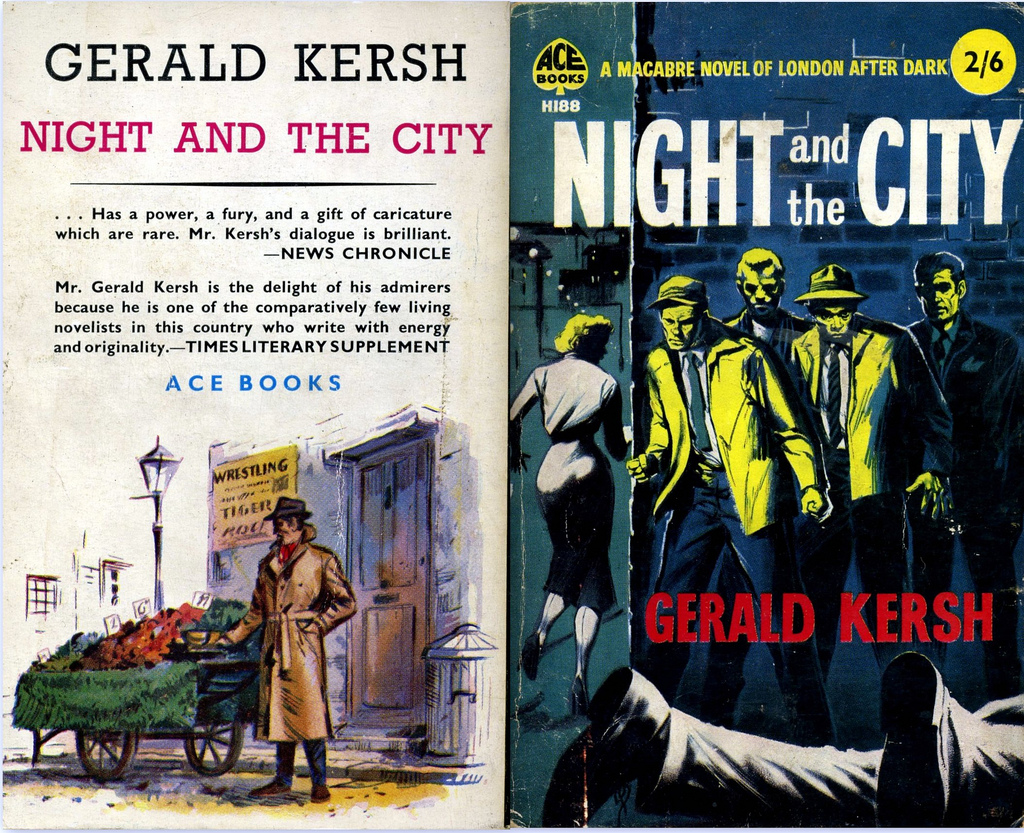
Gerald Kersh does not like other people. Or himself. (Or cats.) Let us consider his classic novel of low-life London, Night and the City (1938).

Night-in-the-City-bookFirst, the grotesquerie of people glimpsed in passing. Harry Fabian, a ponce (i.e., pimp) living off the immoral earnings of a woman, Zoë, trails one of her blackmail-able gentleman callers to the Turkish baths. Looking around, he sees

An old gentleman, abominably naked, looking like a Surrealist vision of pumpkins, marrows and varicose veins, turned the steam on higher, and began to smack himself in the belly. Another man, young and exceedingly drunk, stood trembling under the cold shower and mumbled something about forgetting his umbrella. (57)

Kersh has a thing about booze – and about all of mankind:

Man spends the first half of his life trying to find himself, and the other half trying to lose himself. He runs in little circles, like a pup trying to nuzzle its own behind; he catches up with himself, sniffs, is disgusted, and runs away from his own smell. He fears life; he flies from it. … He can always kill himself, of course, but he never does. He lacks the courage to put his head in the gas-oven, so he says: ‘That’s the coward’s way out’ – and even thinks himself a hero for living on. … above all give him a drink. Stuff his howling mouth with the nipples of oblivion! … Anesthetise him: that is his greatest comfort – poor simulacrum; soft white maggot still unformed! (104-5)

Later, heartbroken night club owner Phil Nosseros will pour

out the brandy with the grim concentration of one who believed that truth, happiness and the consummation of human endeavour lie at the bottom of a bottle. (256)

Does Harry Fabian ever have any regrets about the life he has chosen for himself? Well, at one point he finds himself swearing to a woman ‘On my honour!’

As he said this, Fabian experienced a curious sensation of misery. What was it? Was it that for the first time in his life he had become aware of the appalling burden of accumulating lies with which he loaded his soul from hour to hour – the closing coils of deceit which he spun about himself day by day? There passed through his mind a vision of life free from vanity, fiction and subterfuge … But all this passed in the blink of an eye. (204)

As Greta, one of the novel’s several women working as prostitutes, says ‘philosophically’:

All men are marvelous till you find them out. (242)

Wait, there is more than one prostitute in the novel? Yes. This is how Kersh introduces Vi, a B-girl who sometimes goes a little farther. It initially seems like she will just be a bit of background colour but later she becomes one of the viewpoint characters

She was a tall, slender, red-haired girl in a black lace evening gown. Under her rouge, one could distinguish the papery greyish pallor of the night-bird – the dead opacity born of dark dance-halls, where, in thick blue smoke and the exhalations of steamy bodies, the crude, raw rhythms of red-hot gut-bucket jazz seem to shake the blood out of women. … Vi yawned, and from between her pale, painted lips there proceeded a breath such as might come from a pathological specimen in a jar when the alcohol is evaporating. (77, 87-8)

Kersh even has a low opinion of her wallpaper

It was lined with brownish paper – mottled, sickening brown paper with stripes like the tracks of balloon-tyres in rose-pink, and wide bands dotted with circles, crosses and things like broken fans in pale green. You can get such wallpaper for sixpence a roll in the region of Somers Town; but who can sit down at a drawing-board and actually design it? (89)

The virginal and financially struggling shorthand-typist Helen lives in the same boarding house as Vi, who eventually persuades her to make a quick buck as a B-girl, just until her situation improves a little… Helen falls for Adam, the nearest to a consistently decent person in the book, but by the time they finally get it on they are both caught up in and deeply conflicted by the life, so when they make love

They appeared like enraged enemies, locked in a last desperate struggle. (154)

While Adam tries to get out, Helen finds ways to justify abandoning her sense of decency and embracing a life she previously saw as degrading. She quickly learns to use sex to manipulate all men, including the one she loves:

She kissed him, pressing her whole body against him; and in spite of the fact this kiss, and Adam’s immediate response to it, stirred up in her a veritable maelstrom of desire, she retained, deep in her consciousness, a little cold corner from which her critical faculties watched him. (177)

Later she will say,

It’s all very well talking about prostitution, but is sleeping with a man for money any worse than marrying him for money? (262-263)

Which might have passed as Kersh being insightful if he had not already made such pronouncements as

The prostitute is sentimental and unhappy. Why does she walk interminably, in utter degradation, and then give all her money to a man? Because he … is, in her consciousness, the last human being in the world to whom, by virtue of her self-sacrifice, she can feel superior, and therefore she loves him with a curious desperate love.
And now,’ thought Zoë, ‘he’s got hold of somebody else with my money.’
Rage, the hysterical rage of the prostitute rose within her. (244)

Kersh loves to elaborate upon the grotesquerie of his characters, and has a field day describing the wrestlers Fabian recruits for his newest venture as a fight promoter. There is the Cypriot, Kration, a deeply conflicted character at war with himself, as his physiognomy and follicles attest:

as soon as his mouth closed his face changed. Savagery came into it. He looked strong and ferocious enough to tear himself apart. His hair crouched low on his forehead, trying to obliterate his eyebrows; his eyebrows, colliding over his nose in a spray of black hair, endeavoured to smother his eyes; and only the flat, heavy prow of his nose kept his eyes apart – otherwise, they would have snapped at each other. Meanwhile they waited, smouldering, while his upper lip snarled in triumph over the lower, which, from time to time, jumped up and clamped down on it. Turkey, Greece and Africa waged war in his veins. Even his hair carried on ancient warfare. There was antagonism in his very follicles, and the hair writhed out, enormously thick, twisted, rebellious, kinked, frizzled and dried up. (211)

Actually, Kration has no inner conflict whatsoever. Though, thanks to Fabian’s manipulations, he does have a conflict with aged ex-champion Charlie Bamboo, the Black Strangler. Kersh’s description of this ‘colossus’ is even more racialised – but the hammer is a great touch, even if I cannot quite picture the sausages:

The man whom Fabian called Strangler was a colossus. You must imagine the Farnese Hercules in ebony, dressed in a nigger-brown suit with a yellow-chalk stripe, a sky-blue shirt and a crimson tie with a greenish domino motif. He had an extraordinary head. You could reproduce it by shaving the head of a Neanderthal man, polishing it with stove-polish and then smashing up the features with a hammer. The ears no longer resembled ears – they had been beaten and rubbed into indescribable shapelessness – while the nose, a dozen times broken and never repaired, spread in a two-inch width almost flush with the rest of the face. Beneath it a pair of vast pink lips, remarkably pale and prominent and as thick as beef sausages, sucked at the sodden remains of a dead cigar. (41-2)

So is there anybody or anything Kersh does not loathe? No. Not even the earth, the moon or the night sky:

Outside, the dull moon – little, fickle satellite – trails after the advancing earth like a prostitute at the heels of a batter soldier, marching on in blind obedience to incomprehensible orders, across the desert of the skies. (276)

Coda – some amusing stuff for the film buffs out there
At one point, Fabian goes into a gentleman’s outfitters and finds himself discarding the ‘little pale green hat which he had bought only a week before: the Fred MacMurray, for which he had yearned with all his soul’ in favour of the Cicero, ‘exactly as worn by Al Capone’. The sales assistant also tempts him with ‘the Humphrey Bogart shirt, exactly as worn in The Petrified Forest’, but has rather less success when he asks ‘would you care to see the Stepin Fetchit bowtie? … the Barrymore sock?’ (240-241)

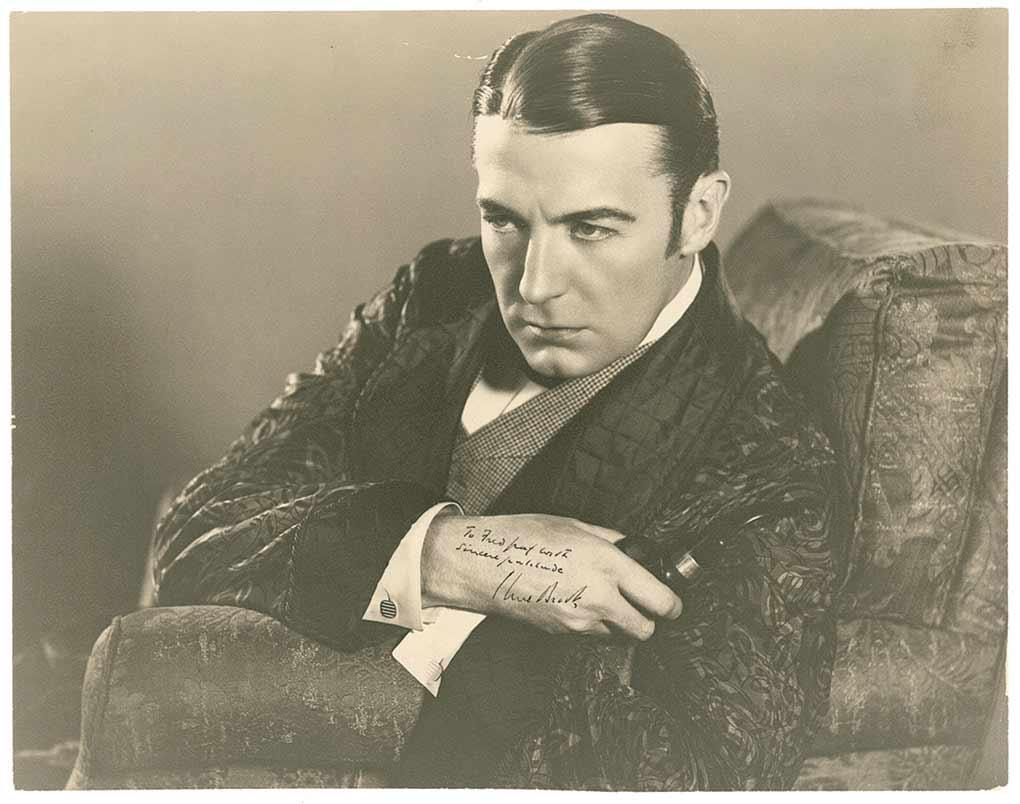
Clive Brook. Swoon.
Clive Brook. Swoon.

In an early conversation, Helen protests that unlike Vi, she’s got ‘high standards’ when it comes to men:

‘Ah,’ said Vi, with an air of infinite experience, ‘I used to talk like that, too. I used to be crazy about Clive Brook–’ (96)

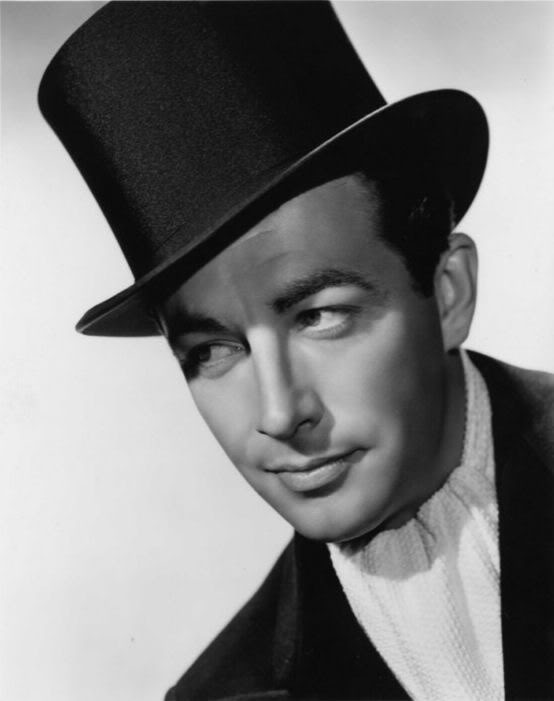
And later, when Zoë admires Harry, we learn that

Robert Taylor. What women want.

There is nothing a woman loves more in a man than self-confidence. A man who appears to know precisely what he wants, and how to get it, can win more hearts than Robert Taylor. (237)


Gerald Kersh on the subject of cats – no, really, it is only cats he is writing about, nothing else at all

imagesI have always been fascinated by the way Gerald Kersh describes characters. Descriptions full of loathing that very quickly slide into self-loathing. I’m currently part-way through Night and the City (1938) – the source of Jules Dassin’s rather good 1950 film with Richard Widmark and of Irwin Winkler’s rather terrible 1992 film with Robert De Niro – and cataloguing a selection I will share when I am done. But in the meantime, in one of Kersh’s rather characteristic digressions, he has decided to tackle the subject of cats in nighttime London.

I swear it is only cats he is talking about. Nothing else.

First, he obviously prefers dogs to cats. And to women from villages.

Cats may be terrible to mice, but they have no equipment for heavier game. If they had long claws, cats would be extinct: they dilate with hatred, they shriek with hatred – they want to rend, devour, torture, and obliterate each other; but they can’t. So they pour out all their venom in their voices, their howling and malevolent voices; exactly like the gossiping women of the villages. (80)

He then moves on to the subject of tom cats howling and shrieking in the night. Their motivations, their anguish. At no point is this about anything other than tom cats.

Why do tom-cats do this thing? For them, love is by no means all moonlight and roses. The genital organ of a tom-cat bristles with spikes, like a pip-scraper; it is a severe surgical instrument of reproduction, not pleasure. He loses blood and fur in frenzies of impotent rage, and almost bursts with bitterness, simply to achieve a torture-chamber.
What good does it do? It generates more cats.
Who wants more cats? (80)

But what, you ask, about the female of the species? Ah, there’s a grey female there. Let’s follow her for three pages, remembering at all times that this is only about cats, nothing else – not even the image of religious transcendence culminating in a pun you might not believe he could have got away with in 1938.

What did she not know about sex and motherhood? She had had fifty kittens and forgotten about them. Tom-cats … were all right; but for her part, she found more sensual pleasure in an empty sardine-tin…

The grey cat was unable to suppress a yawn. How monotonous, how miserably familiar, were the oscillations and outcries of these passion-intoxicated males! They were all alike…

It was impossible to embarrass this cat.
She was shameless and heartless, a cat of the city; elusive as an eel, resilient as rubber, indestructible and persistent as chewing-gum; a tile-begotten hybrid, born among salmon tins and broken bottles, whose pedigree had slunk in offal from dustbin to dustbin since Egypt. … Every muscle in her body seemed to have been designed for prowling, sneaking, ducking and running away. She lived for herself, parasitically … In hundreds of homes her presence had been suspected by a smell, proved by the disappearance of food and disposed of by hisses and blows. Ratepayers often took her in and christened her with fancy names; but in the end, they always gave her away, with false and hypocritical eulogies and regrets. She had no idea of the significance of a box of ashes, and regarded the practice of Rubbing Her Nose In It as a charming human eccentricity rather than a lesson, or punishment.

Why hunt mice? Only fools work. There is always food. The city is full of people, most of whom are mad. Poor crazed creatures – they give away food! The only proper thing to do with food is eat it all. Give nothing away. Preserve yourself! Preserve yourself! The world is your cat’s-meat. The Great Tom-Cat, who plays with the world like a ball of wool, created man to give you warmth, milk and chicken-bones, and put the sun in the sky to make you purr . . . You are the Great Tom-Cat’s Chosen Pussies. (81-82)

[Quotations from London Books edition, 2007]


Sweet Sweetback’s Baadasssss Song (Van Peebles 1971) and Baadasssss! aka How To Get the Man’s Foot Outta Your Ass (t’other Van Peebles 2003)

bigtmp_20824[A version of this review appeared in Film International 27 (2007), 70–3]

In the late 1960s, Melvin Van Peebles, an expatriate novelist and the director of four short films, including The Story of a Three-Day Pass (1968), which depicted the brief romance between an African-American soldier and a white French woman, was hired by Columbia Pictures to direct the comedy Watermelon Man (1970). His debut feature starred Godfrey Cambridge as Jeff Gerber, a white racist who, one morning, wakes up to find he has become black. Driven out of his community, he eventually finds pride in his new identity. In a remarkable final scene, he is shown working out in a basement somewhere with two dozen other black men, practicing martial arts with mop and broom handles. The camera zooms in over these men and into a medium close-up of Gerber as, yelling, he thrusts his mop handle toward the camera, freezeframing for a full ten seconds.[i]

This image of militant radicalism resonates with the final shot of the anti-imperialist film Yawar mallku/Blood of the Condor (1969), about the resistance triggered by the revelation that the Peace Corps were sterilising indigenous Quechua women without their consent (which in reality led to the Peace Corps’ expulsion from Bolivia). Jorge Sanjinés’ film ends with a still of raised hands, holding automatic rifles. Although there is no reason to suggest direct inspiration or imitation, the connection is not a spurious one, as Van Peebles’s subsequent film, Sweet Sweetback’s Baadasssss Song, makes clear. It defied Hollywood conventions of racial representation, narrative structure, the construction of time and space, and the relationship between soundtrack and image. And in its adaptation of nouvelle vague techniques, which it re-radicalised through merging them with Black Power politics and African-American aesthetics, it represents not only a landmark in black American cinema and American independent cinema but also a rare instance of Californian Third Cinema.

In their 1969 manifesto ‘Towards a Third Cinema’, Argentinian filmmakers Fernando Solanas and Octavio Gettino identified three kinds of filmmaking: First Cinema (the commercial cinema of Hollywood and its imitators), Second Cinema (auteurist and art cinema, always limited politically by being a bourgeois cinema dependent on First Cinema distribution) and Third Cinema (neither commercial nor bourgeois, an activist cinema directly involved in political struggle). Mike Wayne’s Political Film: The Dialectics of Third Cinema argues that rather than treat these categories as pigeonholes into which we can place films, they should be understood as conceptual categories whose dialectical interaction can be observed in individual films. Regardless of its political impact – Huey Newton devoted all of the 16 June 1971 issue of The Black Panther to a laudatory review of Sweetback, declaring it ‘the first truly revolutionary black film’, and made it mandatory viewing for members of the Black Panther Party nationwide – it retains significant First Cinema elements: Van Peebles’s desire to make it as entertaining as ‘a motherfucker’, its commitment to a narrative about an individual, and its commercial distribution and exhibition (however much Van Peebles had to fight to get it screened, it made $15 million on its initial release and dislodged Love Story (Hiller 1970) from number one at the US box-office; and it has been commercially available on video and DVD for some years).

tumblr_m5vimzquPt1qf5ylso1_500Its Second Cinema elements can be articulated around the figure of Van Peebles himself, who has credits as writer, composer, producer, director and editor, as well as star, while its Third Cinema elements can be detected in the goals towards which he flexed his auteurism. Sweetback is precisely, as the opening titles claim, ‘a film of Melvin Van Peebles’. The narrative is a slender armature upon which a unique – and arguably a uniquely African-American aesthetic – is developed. Growing up in a South Central whorehouse, a ten year-old boy is introduced to sex by a prostitute, who cries out in ecstasy that he has a ‘sweet, sweet back’. Strangely passive and nearly as mute as John Sayles’s Brother from Another Planet, the adult Sweetback seems disconnected from the black community in which he makes a living performing in sex shows. Lent by his boss to some white cops who need to bring someone in for questioning to make it look like they are making progress on a case, Sweetback eventually intervenes when they brutally assault the young black radical Mu-Mu, beating them to death with his handcuffs.

‘Where we going?’, Mu-Mu asks him.
‘Where you get this “we” shit?’ he replies.

But as Sweetback goes on the run, he encounters his community for the first time, and as a result later sacrifices his own chance at escape to ensure that Mu-Mu survives because ‘He’s our future’. Fleeing the police and an army helicopter, Sweetback finally escapes the city and heads for the Mexican border. When the hunting dogs unleashed to bring him down fall silent, his pursuers are convinced they have killed him. But the next morning, the dogs are found dead, floating in a river. And out of the Californian hills flash the words:

sweetback_12

Generically, Sweetback can be understood as an example of the neo-slave narrative which, beginning with Margaret Walker’s novel Jubilee (1966), reworked the 19th century tradition of autobiographical writings by escaped slaves so as to explore the ongoing legacy of the West African genocide, the Middle Passage and slavery in the Americas.[ii] It also has (like the final minutes of Watermelon Man) strong affiliations with a group of African-American novels from the 1960s and 1970s by such authors as Chester Himes, Sam Greenlee, Blyden Jackson and John A. Williams which imagine a radical black uprising against white supremacist America.[iii]

Formally, though, it is difficult to think of an American narrative film – even in the midst of the ‘Hollywood Renaissance’ – to compare. Van Peebles shot the film, with a non-union cast and crew, in about 19 days, and then embarked on five and a half months of editing. The film is a compendium of technique: location shooting, actuality footage, handheld cameras, imbalanced framings, zooms, slow motion, expressive shifts in and out of focus, superimpositions, multiple superimpositions, colour synthesisation, split screens, mirrored split screens, multiple split screens, and so on. An uncharitable view might be that such overt stylisations were nothing more than a bravura attempt to expand the slight narrative to feature length and get around problems with shooting sufficient coverage and recording sound on location. But whatever shortcomings the footage might have had, in its editing this low-budget crime drama was transformed into one of the most important films made in America. While the radicalism of, say, The Spook Who Sat By the Door (Dixon 1973) lies almost entirely in its narrative of black revolution, Sweetback simultaneously developed an aesthetic radicalism far in excess of, say, The Battle of Algiers (Pontecorvo 1966), even of Tout va bien (Godard 1972).

According to Edouard Glissant’s Caribbean Discourse, the brutal dislocation of the slave trade was such that Afrodiasporic

historical consciousness could not be deposited gradually and continually like a sediment. (62)

Others have built on this insight to argue that this different experience of historical space-time has led to the development of a diasporic black aesthetic, manifested in contemporary music, for example, in terms of scratching, dubbing, breaking, mixing and remixing. Throughout Sweetback, Van Peebles improvises a similar aesthetic, returning materiality to the film, rendering it sensible through a complex play of prolepsis and repetition, folding and layering, which shatters the white reality constructed through Hollywood’s technical and narrative conventions. (One particularly moving instance has the camera and the soundtrack return again and again to a poor African American woman, surrounded by the children she looks after for the county, repeating with slight variations the lines ‘I might have had a Leroy once, but I don’t rightly remember’ and ‘When they get older and bad, they take them away from me.’)

But rather than an aleatory jumble of fragments, the film coheres through its soundtrack, which includes music by Earth, Wind and Fire. The blaxploitation films which flourished, briefly, in the wake of Sweetback’s success, resulted in impressive soundtracks by James Brown, Isaac Hayes, Millie Jackson, Curtis Mayfield and Edwin Starr, and footage shot on location without synchronised sound was often edited into a montage sequence to accompany a particular track, as with Mayfield’s ‘Super Fly’. Van Peebles went much further – the only comparably imaginative soundtrack of the period is that of the rather different The Texas Chain Saw Massacre (Hooper 1974) – and produced a layered, ruptured, sometimes deeply discordant blend of diegetic sounds, diegetic and extra-diegetic voices, and music. Throughout the film one can sense the dialectical tensions and unities of sound and vision.

In his 1969 manifesto ‘For an Imperfect Cinema’, Cuban filmmaker Julio García Espinosa argued that rather than aspiring to the kind of ‘perfect’ cinema exemplified by Hollywood’s hermetic Teflon spectacles, Third World countries should aim to develop an imperfect cinema, a genuinely popular art created by the masses to aid them in their daily and revolutionary struggles. Sweetback tends towards this kind of imperfection. If financial restrictions mean that Van Peebles’s techniques are raw, that rawness itself is a direct manifestation of and testimony to the marginalisation of African Americans in mainstream America and to the radicalism of the project. As, perhaps, is the extent to which the making of the film became such a one-man show – the opening titles might declare that it is a film ‘starring the black community’, but ‘and Brer Soul’ gets its own, separate title afterwards. Faced with such effective exclusion from filmmaking as a way to express African-American experience(s), and with the US state’s violent and often illegal suppression of such radical black groups as the Panthers in full swing, perhaps there simply was not available the possibility for the kind of collectivism often seen as crucial to Third Cinema. Perhaps, also, there were political and personal factors.

baadasssss-movie-poster-2003-1020233016Mario Van Peebles’s Baadasssss! – a sometimes humorous, sometimes sentimental, sometimes inspiring (in a TV movie kind of way) adaptation of his father’s book about the making of Sweetback – indicates the latter while also, incidentally, revealing something of the former. There can be no denying the sexism and homophobia evident in Sweetback (or, indeed, Baadasssss!) and these problems were not uncommon in Civil Rights and Black Power movements.[iv] Baadassssss! is sufficiently certain of the importance of Sweetback to not need to paint its creator as a saint.

In easily the best performance of his career, Mario plays Melvin as an egotist tormented by insecurity, a bully whose manipulations and threats could also inspire, a radical who might also just be a hustler talking radical, a genius who might also just be simulating genius through a deep-rooted fear of being seen to fail. But he is always meant to be admired, or at the very least excused. The Oedipal conventions of the narrative – Melvin justifies putting thirteen year-old Mario in a sex scene by telling how his father sent him out every day from the age of nine to do demeaning work which might see him beaten up and robbed – further accentuate this, even as they make the phallus as central to the making of Sweetback as Sweetback’s own phallic mastery is to the original film.up-badass2_lg

As the casting of Lawrence Cook, Pam Grier, Isaac Hayes, Robert Hooks and Melvin in Posse (1993) suggests, Mario Van Peebles has always seemed keen to place himself in a lineage of black American actors which reaches back through his father’s generation at least as far as Woody Strode, while also aligning himself with the New Jack Cinema of the 1990s (as attested by his casting of John Singleton as a DJ in Baadasssss!). In Baadasssss!, he captures very well the look of the early 1970s, but sadly very little of the politics or spirit (one is constantly reminded of how its executive producer Michael Mann stripped everything of real political significance from Ali (2001), his own biopic of Muhammad Ali). Mario Van Peebles has made a very competent film in admittedly difficult circumstances, and even made some interesting stylistic choices, but is not really any kind of meaningful successor to ‘the first truly revolutionary black film’. It is First Cinema, longing to be Second Cinema.

At the end of Isaac Julien’s Baadasssss Cinema (2002), Fred Williamson is asked about the ‘black Hollywood’ whose success is signalled in the Oscar wins of Cuba Gooding, Jr., Denzel Washington and Halle Berry. Chewing on his cigar, he laughs as he says,

Black Hollywood? Yeah, right. … it don’t exist, man, no, no.

The point of Sweetback was that it was not about integrating into the white Hollywood machine; the sadness which haunts Baadasssss! is that the trail that it blazed in the early 1970s has led many right into that trap.

Notes

[i]
Columbia supposedly had a ‘happy’ ending in mind, in which Gerber regains his whiteness, but Van Peebles reputedly shot this different ending without telling the studio.

[ii]
Other examples include Gayl Jones’s Corregidora (1975), Alex Haley’s Roots: The Saga of An American Family (1976), Ishmael Reed’s Flight to Canada (1976), Samuel Delany’s Star in My Pocket Like Grains of Sand (1984), Toni Morrison’s Beloved (1987) and arguably every novel by the late Octavia Butler.

[iii]
On this cycle of novels, see Kalil Tal’s ‘“That Just Kills Me”: Black Militant Near-Future Fiction” (Social Text 71) and my ‘Come Alive By Saying No: An Introduction to Black Power Sf’ (Science Fiction Studies 102). In 1973, Greenlee’s novel, The Spook Who Sat By The Door (1969) was adapted as an independent film of the same name. Long rumoured to have been suppressed by the FBI, it has recently become available on DVD. Lacking Sweetback’s formal experimentation, it is nonetheless still a potent Black Power document.

[iv]
See Steve Estes I Am a Man! Race, Manhood, and the Civil Rights Movement for an acute analysis of why the fight for African American equality was so often articulated around remasculinising the emasculated black man. These problems were also common in the New Left and other radical movements of the period, as well, of course, as in mainstream and conservative politics.