African Science Fiction 101: update

This is really just a note listing some of the African sf that has been published since I wrote ‘African Science Fiction 101’ – and some of the books I just plain missed when I researched it. Hopefully, this summer I will have time to read them… 51BDxwqGg+L

Dr Satan’s Echo Chamber – double issue (12/13) of Chimurenga (2008). An all-faxion issue on black technologies no longer secret, plus 13 associated documents. Copies still available.

Khairy Shalaby, Travels of the Pickle and Sweet Vendor (1991; trans 2010). Egyptian timeslip narrative, which seems to have a different title on the cover than in the listings where I found it, and my copy is still in the post, so this mystery will remain temporarily unresolved…

Iain S. Thomas, Intentional Dissonance (2012). Post-apocalyptic dystopia by South African author.

Sofia Samatar, A Stranger in Olondria (2013). Debut fantasy novel written in South Sudan by a remarkable American short-story writer of Somali and Swiss/German heritage.

Rachel Zadok, Sister-Sister (2013). A road-trip through an apocalyptic alternative (or near-future) South Africa.

Chibundu Onuzo, The Spider King’s Daughter (2013). This keeps being recommended to me – but I cannot find any reference to it containing fantastical elements (despite the title), so I guess I should read it and then either replace this explanation or cut it from this list… 0987019872.02.LZZZZZZZ

Dilman Dila, A Killing in the Sun (2014). Solid collection of ten short stories playing across distinctions between sf and fantasy, modernity and tradition, superstition and indigenous knowledges, by the Ugandan author and filmmaker. I think this is the first single-author collection of African sf.

Nerine Dorman, ed., Terra Incognita: New Short Speculative Stories from Africa (2015). Anthology of nineteen stories – the third to come out of Short Story Day Africa’s annual competition – at the more literary end of genre. Only a couple of duds in it. (I should have a review of it – and the previous entry – forthcoming soon.)

Nnedi Okorafor, The Book of Phoenix (2015). Prequel to Who Fears Death.

In terms of short fiction, issue three of Omenana has just come out, and the second volume of Ivor Hartmann’s AfroSF: Science Fiction by African Writers is imminent. There is also forthcoming this year an anthology called Imagine Africa 500, which apparently will contain ten sf stories by writers from Malawi and ten from writers from other African countries.

Crumbs (Miguel Llansó Ethiopia/Spain/Finland 2015) is currently doing the rounds of film festivals before, hopefully, a wider arthouse and DVD release. According to imdb, ‘Our figurine sized supermen hero embarks on an epic surreal journey that will take him across the Ethiopian post apocalyptic landscape in search of a way to get on the hovering spacecraft that for years has become a landmark in the skies’.

In ‘Africa SF 101’, I mentioned A Beast in View (1969), by exiled anti-Apartheid activist Peter Dreyer, and Nadine Gordimer’s July’s People (1981), set in a near-future in which resistance to Apartheid is becoming open revolution. 752297331.0.mWhat I missed completely were a number of novels by South Africans anticipating the end of Apartheid, ranging from the earnest to the satirical to the trashy: Anthony Delius, The Day Natal Took Off (1960) Gary Allighan, Verwoerd – the End (1961) Andrew McCoy, The Insurrectionist (1979) Frank Graves, African Chess (1990; recently revised and reissued).

There are several similar novels from outside of Africa: Iain Findlay, The Azanian Assignment (1978) – the only novel by this Australian author 51TPVFXnAWL._SY344_BO1,204,203,200_

Randall Robinson, The Emancipation of Wakefield Clay (1978) – looks like a further example of the American cycle of ‘Black Power Sf’, but with the revolution displaced from the US

Larry Bond, Vortex (1981) – about the size of a housebrick, and just as smart; as well as a dramatis personae, it has a glossary giving details of all the different weapons and weapons systems it mentions

In other news, ‘African Science Fiction 101’ has been translated in two parts for the website of the World Chinese Science Fiction Association, China’s largest association for science fiction practitioners and fans. If you want to see it, go here and here.

Update 2

China Miéville, The Scar (London: Macmillan, 2002)

200px-TheScar(1stEd)[A version of this review appeared in Foundation 86 (2002), 132–4]

The Scar returns to Perdido Street Station’s Bas Lag, but it is not a novel about return: it is about departure and loss. Part of that loss is the sense that the author, with his bold opening move of denying New Crobuzon, has learned all he can from Mervyn Peake; and consequently it wobbles, or seems to wobble, in the first 60 pages.

Peake has often been criticised for leaving Gormeghast in the final volume of his trilogy – a criticism with which Miéville does not necessarily agree but to which he has clearly paid attention. New Crobuzon, that brilliant invention and potential albatross, does not appear in The Scar. For the reader wanting a consolatory return, New Crobuzon has become like M. John Harrison’s Egnaro; indeed, an alternative title for the novel might have been ‘A Young Man’s Journey to New Crobuzon’. Miéville is too ambitious to serve up just more of the same, and that is why the novel wobbles at the start (or seems to: I am not exempt from wanting consolation), why the world seems a little thin to begin with, why the visit to Salkrikaltor City seems skimped, curtailed. The opening pages reek of impatience. Like the protagonist Bellis Coldwine, the author needs to depart, to move on, and through her he transforms his refusal to return to New Crobuzon into part of his thematic complex about a mature regard for the universe and the compassionate identification with others that it demands of ethico-political beings.

Which is not to say that those pages are not full of the restless invention, exemplary prose and visualisation we have so quickly come to expect from Miéville. And even when Bas Lag does not seem as dense and filled as it might, there is still the sense of a dense, full world lurking out of sight, of whole other volumes that can only be hinted at. On the very first page we read that ‘Presences something between molluscs and deities squat patiently below eight miles of water’; and on the next page that ‘There is heroism and brute warfare on the ocean floor, unnoticed by land-dwellers. There are gods and catastrophes’. But that is all we are told.

Forced to flee New Crobuzon, Bellis (a former lover of Perdido’s Isaac Dan der Grimnebulin) plans to settle for a while in the colony of Nova Esperium, but her journey is interrupted, diverted, hi-jacked. She finds herself caught up in the plans of the Lovers, the sado-masochistic and megalomaniac rulers of Armada, and in the conspiracies and counter-conspiracies of Silas Fennec (aka Simon Fench), a secret agent, and Uther Doul, the Lovers’ right-hand man. She witness scab-mettlers fight in the mortu crutt style and displays of stamp-fighting; she walks upon Machinery Beach; she eavesdrops upon the Lovers sexualised scarifications; she is courted by Doul and hears him play the Perhapsadian; she learns about oceanic megafauna, the Ghosthead Empire and possibility mining. And she is used, and punished, and used some more.

But that is a mere fraction. There is the magnitude of the Lovers’ hubristic designs for Armada; the resistance of the Brucolac, the ab-dead vampir ruler of Dry Fall; the grindylows’ pursuit of Fennec; the story of Crawfoot and the Conch Assassins; the Remaking of Tanner Sack; Bastard John, the dolphin; the education of Shekel and his romance with the Remade Angevine; the peculiar adventure of the cactacae Hedrigall; awkward friendships and alliances; there is a none-too-secret message hidden in the open, an extraordinarily bad pun (471) involving the Maguffin which drives one strand of the action, and an obscure joke about the author’s doctoral thesis (417–21), which he was completing alongside the novel. There are moments of great tenderness (Bellis teaching Shekel to read; Sack repairing Angevine’s boiler) and tremendous set-pieces (the attack of the she-anophelii; the Brucolac’s revolt and punishment; breaking into the Compass Factory; Hedrigall’s vision). And there is the anxiety of influence, manifested in numerous allusions to The Matrix (a character called Carrianne, Uther Doul’s sword-fighting in bullet-time) and to other nautical fantasies (the Aronnax Lab, the Pinchermarn, Tintinnabulum, Captain Princip Cecasan of the Morning Walker, a godwhale). There are various echoes of Bruce Sterling’s Involution Ocean and a game of pitch and toss borrowed from Tim Powers’s The Stress of Her Regard.

And, most importantly, there is a sustained critique of colonialism. The anophelii, isolated and under military guard, are remorselessly exploited by the Samheri cactacae, their access to information tightly circumscribed and their intellectual labours expropriated without reward. There are questions about who are the real slaves and who are the real pirates. There is a clear-headed explication of the mercantile motivation of exploration, and a revelation that changes our perspective on the grindylow. There is Machinery Beach, a complex image of ruination and potential, of the colonised world as both dumping ground and source of commodities:

Some way off were shapes she had taken to be boulders, huge things the size of rooms, breking up the shoreline. They were engines. Squat and enormous and coated with rust and verdigris, long-forgotten appliances for unknown purposes, their pistons seized by age and salt.
There were smaller rocks too, and Bellis saw that these were shards of the larger machines, bolts and pipework junctions; or finer, more intricate and complete pieces, gauges and glass work and compact steampower engines. The pebbles were gears, cogs, flywheels, bolts and screws … thousands of minuscule ratchets and gearwheels and ossified springs, like the innards of inconceivably tiny clocks. … The beach was an imitation, a found-sculpture mimicking nature in the materials of the junkyard. Every atom from some shattered machine. … She imagined the seafloor around the bay – reclaimed reef of decaying industry, the contents of a city’s factories allowed to collapse, pounded by waves and sun, oxidizing, bleeding with rust, breaking into their constituent parts and then into smaller shards, thrown back by the water onto the island’s edge, evolving into this freakish shore. … This is the flotsam Hedrigall meant, she realized. This is a graveyard of dead devices. There must be millions of secrets mouldering here into rust-dust. They must sift through it, and scrub it clean, and offer the most promising bits for trade, two or three pieces picked randomly from a thousand piece-puzzle. Opaque and impenetrable, but if you could put it together, if you could make sense of it, what might you have? (274-5)

And most of all there is the Lovers’ plan for Armada, in which they convince and cajole many to believe, regardless of its tremendous environmental and human consequences, because it might just bring wealth and power.

The Scar represents a further maturation of Miéville as a writer. If the novel lacks some of the profligacy which made Perdido Street Station such a joy it is made up for by a more disciplined approach to narrative and tighter control over intertextual riffs. His emotional and affective range has expanded, without abandoning the eyeball-kicks.

The Scar is the best nautical fantasy since John Calvin Batchelor’s The Birth of the People’s Republic of Antarctica and the most important one since B Traven’s The Death Ship.

It is arguably the first major novel of the anti-capitalist movement, and as I’ve said elsewhere, it makes Moby Dick look like a big fat book about whales.


China Miéville, Perdido Street Station (Macmillan 2000)

PerdidoStreetStation(1stEd)[A version of this review appeared in Foundation 79 (2000), 88–90. Which I think makes it the first thing on China to appear in an academic journal. Yay me!]

Vivid as a comic book, Miéville’s King Rat (1998), with its funky London and splendid conceit, and its passages of grace, charm and glee, was one of the most assured fantasy debuts of the 1990s. Like the bass beneath the treble, its narrative momentum and crafter prose danced the enchanted reader past the slipperiness of plot logic and duration. His second novel, Perdido Street Station, dwarfs King Rat – in words, weight, ambition, invention, accomplishment. It is a garuda to the former’s wyrman, and eagle to its flying monkey. Let me explain.

North of Myrshock, Shankell, Perrick Nigh and the Mandrake Islands; north-east of the Cacatopic Stain and the Shards; east of Bered Kai Nev, the Swollen Ocean, Gnur Kett and the Jheshull Islands; at the confluence of the rivers Tar and Canker, where they become the Gross tar: there lies the city of New Crobuzon, magnificent and squalid, powerful and corrupt, home to humans and others. A mysterious figure approaches. Isaac Dan der Grimnebulin, outcast scientist and corpulent dilettante, receives an unusual commission, as does his khepri partner, a renegade spit-artist. And so connections begin. Evil, irresponsibly cultivated, is accidentally unleashed. A company – neither quite a Seven Samurai nor a Dirty Dozen – gathers, although they do not all meet. Things emerge: winged rippers, artificial intelligence, the dancing mad god, class consciousness. Chaos theory is transmuted into crisis science. Dirigibles and aerostats criss-cross the troubled sky. The identity of a serial killer is slyly revealed. A vigilante steps in when it counts. Decisions, ethical and otherwise, are taken. People change and changed. Some die. All suffer.

The story told is a familiar one, yet different. It grips and exhausts. The birds, spiders, sewers, rooftops and hybrids of King Rat reappear exfoliated, as do the city’s alternative architectures, the shared worlds existing within but different from the built environment. The appetite for language that occasionally strained the earlier novel has grown to remarkable proportions but is disciplined by the clarity and efficiency of Miéville’s tempered prose; he delineates characters and settings with precision and compassion, building layers of texture rather than ornamentation. Some have suggested that New Crobuzon itself is the novel’s main achievement, but it is difficult to separate city from novel. Their fabric is intertwined and full of echoes: Gormenghast and Viriconium are here, and Cinnabar, Cirque, Dhalgren, Lankhmar, Malacia. London, too, both steampunk and contemporary; and where the lived music of King Rat captured coming-of-age in the late 1980s and 1990s, Perdido Street Station evokes the dark days of Thatcher, Major and Blair. Amid the ghettos and squalor, poverty and the appearance of difference are used as tools of state oppression. Secretive paramilitary forces who police ‘by decentralised fear’ (269) brutally suppress a strike and redefine it as a riot. Government, big business and organised crime are in cahoots. Military funding perverts scientific research and education. A suffrage lottery preserves privilege, and evil resides in a dome built on rubble-strewn wasteground.

Comparisons to Mervyn Peake and M. John Harrison are inevitable – Miéville acknowledges them both and even sneaks in ‘a storm of wings’ (159) – so here are some others. Miéville’s obsessive invention rivals William Gibson and Bruce Sterling, and, like Neal Stephenson, he wants to tell use everything (but for more important reasons). He writes with the compassion of Philip K. Dick at his best but without his misogyny and crude moral certainty. His gorgeous, tainted images match those of Elizabeth Hand, Storm Constantine and Poppy Z. Brite, but without the cloying atmosphere or swamping effect on narrative that sometimes mars their work. He depicts and art-world as well-realised as Misha’s, but more concrete and lacking in preciosity. He places the maimings and torments one expects to find only in Tim Powers within a political and ethical rather than mythopoeic framework. And he writes better prose than any of them.

He also mock the anxieties of sf’s ‘scientific’ patter and hand-waving, essays political doggerel and children’s songs, pastiches political journalism, satirises Judaeo-Christian despite for women, lampoons academic doublespeak, nods to Jonathan Swift and Ursula Le Guin, canonises the Jabberwocky – and still that is not all.

In King Rat, when the protagonist, Saul, briefly takes up with Deborah, a young homeless woman, he instructs himself not to patronise her but to treat her as a real person; and because the London Saul has come to inhabit is a fantastical one, this passage, with its conscious effort to bridge between textual and extratextual worlds, seems clumsy, a touch too didactic. Noentheless, it provides an important key to understanding the ethical fiction is attempting to construct. Similar moments, lacking in overt trans-diegetical moves and more smoothly executed, occur in Perdido Street Station: a brothel full of Remade whores and an act of betrayal offer mutual understanding; a trip to a freakshow, undertaken after some ninety pages of astonishments, refuses to conjure still more fabulous grotesques but instead portrays degradation, misanthropy and complacency. The nature of Perdido Street Station is such that it cannot gain King Rat’s purchase, however, awkward, on the extratextual world. Instead, these ethical and empathic moments occur within networks of interconnection. The key metaphor is provided by Isaac’s crisis science, which sees through consensual reality to the perpetual moment of crisis, to a precarious potential energy with which to drive revolutionary engines. It is, therefore, no coincidence that it is the striking vodyanoi dockers whose watercræft draws, albeit unconsciously, on this power. There are connections, Miéville insists, and in those connections, in shated being, there is hopeful energy; and, as Isaac, disgusted by the attitudes of other people at the freakshow, is reminded by a radical friend, ‘It turns … It turns quickly’ (88).

Of course the novel has flaws – some might find the Alien movies cast too large a shadow, or that Isaac’s mourning seems skimped (but not without reason), or that Miéville cares too much about his characters (whatever the hell that means), or that the reader is left as battered and drained as the company – but make no mistake: Perdido Street Station is the rich hallucinogenic dreamshit of genre, mutating into socialist fiction.

Wake up and smell the ordure.

Kim Stanley Robinson, The Years of Rice and Salt (London: HarperCollins, 2002)

[A version of this review originally appeared in Foundation 86 (2002), 134-36]

the-years-of-rice-and-saltBold Bardash, a Mongol horseman in the army of Temur the Lame, crosses through the Moravian Gate and onto the Magyar Plain, and there finds Europe dead, victim of a plague that has killed nearly everyone on the continent. Forced to flee Temur, he heads south to the Mediterranean, where he is captured and sold into slavery. As he sails east to China, he befriends the teenage Kyu, a fellow slave. Various adventures see them become members of the Yongle Emperor’s household, travelling between Nanjing and Beijing. But things end badly, and a tenth of the way through the novel they are dead.

Reunited in bardo, the afterlife, they await rebirth. Bold, Kyu, I-li and several other characters are members of a karmic jati, and when they reincarnate, their lives will again intertwine.

The opening book, ‘Awake to Emptiness’, establishes the basic pattern for the following nine, each of which is written in a slightly different style. For example, ‘Awake to Emptiness’ imitates aspects of Wu Ch’êng-ên’s The Journey to the West, with passages of incidental verse, and narrative hooks at the end of each chapter:

One of the sailors happily names it: ‘Alexandria!’ Bold had heard the name, though he knew nothing about it. Neither do we; but to find out more, you can read the next chapter (23)

whereas Book Six, ‘Widow Kang’, contains marginal commentary, a sometimes sarcastic scholarly exegesis of unfamiliar terminology which also hints at the meaning of the novel’s title (372).

Each book is set in a different period of the seven hundred years following the death of Europe, producing an alternative history centred on Asia, but also including North Africa, colonised Europe, and a North America in which the native American Hodenosaunee League occupies the central region between Chinese invaders on the West Coast and Muslim invaders on the East Coast (one of the novel’s tributes to Dick’s The Man in the High Castle; there are also a couple of references to Tagomi-san). Later books trace the spread of Islam, the temporary establishment of an Islamic utopia, an attempted Chinese invasion of Japan, the discovery of the New World, a revolution in bardo, the birth of empirical science, the establishment of the Hodenosaunee League, attempts at religious co-existence, the industrialisation of warfare and a 70-year long world war, and the gradual development of a world-wide League based on mutual interdependence and responsibility.

Previously, Robinson has deployed various conceits to ensure continuity of viewpoint over a long historical span – such as the Mars trilogy’s anti-agathic drugs, which extend the lives of key members of the First Hundred – or in alternative versions of the same world. In The Years of Rice and Salt, he achieves the latter by doing precisely what Clute suggests he did in the Orange County trilogy, using the same characters under new names (Clute and Nicholls, The Encyclopedia of Science Fiction 1015); and to assist the reader in following them through their multiple incarnations, he uses a naming device ascribed to ‘the Samarqandi anthologist Old Red Ink’ (649). However, as the novel progresses, reincarnation starts to be treated by the characters as a useful metaphor which needs to be reconceptualised in secular terms: humans live again through our children; when we are remembered or when, unremembered, we nonetheless affect the way people behave; when broken down into atoms, ‘we are diffusely reincarnate throughout the universe’ (664). Most importantly, reincarnation can be achieved by thinking of the species as the organism. It lives on, with history or language or DNA as its consciousness and, as Bao Xinhua says,

if we think of it that way, then it might increase feelings of solidarity and obligation to others. It makes it clearer that if there is a part of the body that is suffering, and if at the same time another part commandeers the mouth and laughs and proclaims that everything is really fine … then we understand more clearly that this creature-species or species-creature is insane, and cannot face its own sickness-unto-death. Seen in that sense, more people might understand that the organism must try to keep itself healthy throughout its whole body. (665)

Ultimately, The Years of Rice and Salt tells us not just that other worlds are possible, but that another world is possible.

One of the basic attractions of the alternative history for both reader and writer is the puzzle element: what was the initial moment of divergence from the historical record? For example, the pervasive anachronism in Gibson and Sterling’s The Difference Engine is commonly said to stem from Babbage’s success at transforming his designs for mechanical computers into working machines; but as this could not happen without advances in metals technology and engineering, the authors alter economic, social and political circumstances by positing a revolution in which a coalition of workers, scientists and capitalists overthrew the Duke of Wellington around 1830. Byron’s leadership of this pro-industrial faction is in turn attributed to his wife’s decision in 1815 to stay with him despite his peccadilloes. This event has typically been described as the point of divergence for The Difference Engine, yet there are hints of at least one earlier change to the historical record: the successful establishment by Wordsworth and Coleridge of the Pantisocracy, a utopian community, in North America (that was really proposed by Coleridge and Southey in the 1790s). Did their absence from the British literary scene mean that Romanticism failed to take hold, leading to political rather than poetical careers for both Byron and the Luddite leader, Shelley? Are there even earlier divergences?

This puzzle aspect of the alternative history points to the form’s dependence on a shared epistemic base: we know that the Spanish Armada, the South and the Nazis did not win that vampires do not exist (Roberts’s Pavane, Moore’s Bring the Jubilee, Deighton’s SS-GB, Stableford’s The Empire of Fear, respectively), and, to take an example from Robinson, that America did drop an atom bomb on Hiroshima (‘The Lucky Strike’). Alternative histories then work by establishing how the world created by the alteration differs from our own. This is the other aspect of the shared epistemic base: the reader must be familiar with the historical record that is being changed.

In The Years of Rice and Salt, Robinson offers a magnificent misprision of the form. He has created an intricate alternative history of cultures whose real-world history is largely excluded from Western mass education. This is a profoundly political act, and one which could not be more timely as ignorance of Islamic cultures forms the basis of the stereotyping which is used to justify slaughter of Afghan civilians, oppression of Palestinians and genocidal sanctions on Iraq. Throughout the novel Robinson draws multiple perspectives on the many strands of Islam and the variety of Chinese and Japanese cultures. Sometimes these cultures seem to match stereotypes all too common in the real world – Islam as viciously repressive, the Chinese as yellow peril – but Robinson’s world is too vast and complex to allow these views to go unchallenged. For example, Islam is mourned as a religion with a more or less feminist and egalitarian core in the Quran that has been lost behind the hadith (later teachings which have rather more to do with the subjugation of the people and the maintenance of power); later, other muslims propose looking for what is most buddhist in their religion.

The structure of the novel enables Robinson to demonstrate once more his tremendous skill at novella-length writing, his marvellous economy in creating credible characters, his eye for many different landscapes, and his thematic complexity and coherence over both shorter and longer lengths. He remains a didactic writer, but the various discussions about politics and theories of history that appear throughout The Years and Rice of Salt are vital, integral and invigorating.

It is a work to be pondered, certainly, but more than that, to be savoured.

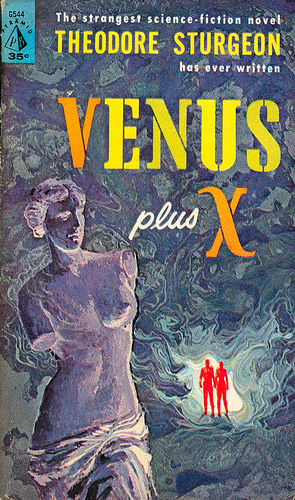
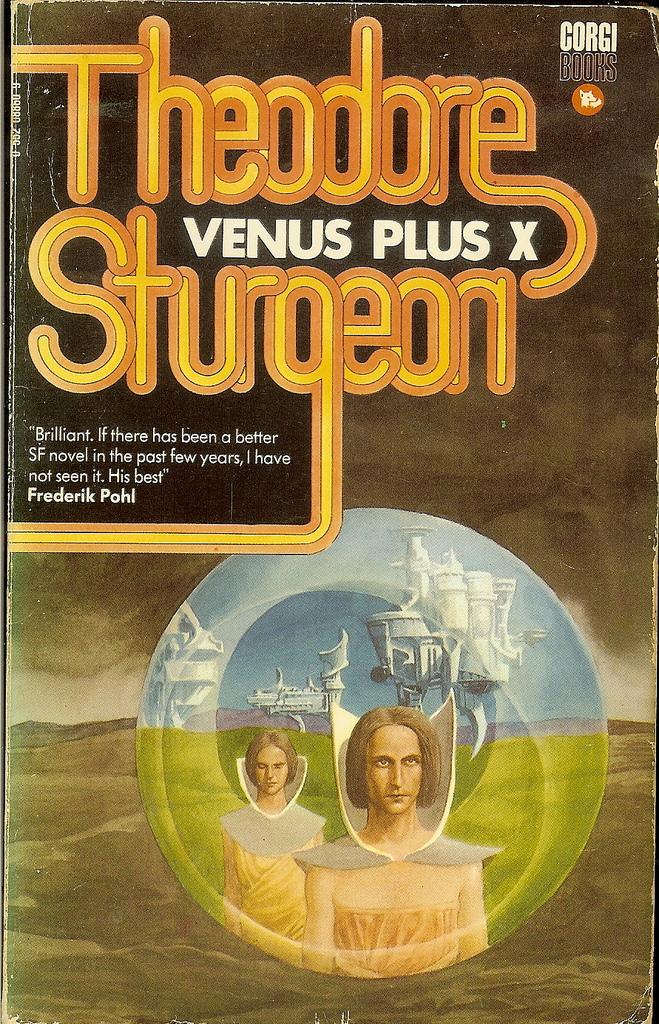
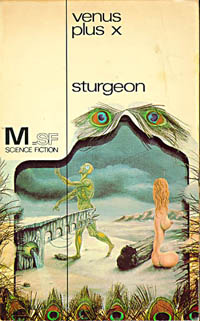
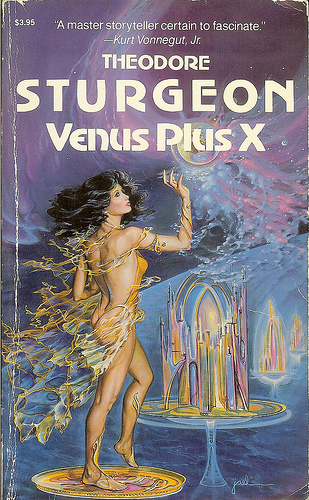
Theodore Sturgeon’s Venus Plus X

Back in the mists of time, around a decade ago, there was a plan for an ever-expanding online collection of short critical essays on key works of the fantastic. The plan fizzled and died, but not before I wrote nine pieces for it (which I just found). This is the last of them.

4624298147_dc53dc7d03First edition: New York: Pyramid, 1960
Edition used: New York: Pyramid, 1960

Charlie Johns, a contemporary American, mysteriously wakes up in a posthuman future, the apparently utopian society of Ledom (‘model’ backwards). It is home to homo sapiens’ replacements, an androgynous species possessing both male and female genitals. As devoted to the principles of process and change as they are to their children (who symbolise the future and thus change), they live lives of fulfilment and repose. They transported Charlie through time so he can learn about them and offer an ‘objective’ view on their culture and society. Or so he is led to believe…

Interpolated between the chapters charting Charlie’s adventure are shorter ones depicting the life of contemporary suburbanites Herb and Jeanette Raile, and their children, Davy and Karen. These contrapuntal chapters offer sharp satiric insights into gender roles, sexual politics and mores, consumerism, competition, materialistic Protestantism, social hierarchies and child-rearing. Although their tone is very different from that of the Ledom chapters, they offer an essential counterbalance to the more traditionally utopian method of Charlie’s story.

John Clute described Venus Plus X as the novel which

bravely came as close to a traditional utopia as any US genre-sf writer had approached before the efforts of Mack Reynolds.[1]

5896940782_43c4b2478e_bThis tension – between the utopian guided tour and genre sf’s predominantly action-adventure format – is perhaps most evident in the closing pages of the novel in which a cognitive breakthrough (of sorts) piles fresh revelation on fresh revelation, casting much of what has gone before in a fresh light. A similar tension is effectively balanced in the tonal differences between the Ledom and suburban chapters. Because the utopian form requires expository dialogue to interpose between the utopia and the visitor (including the reader), there is always overt commentary in place of the effect of direct perception. Consequently, in depicting suburban America, Sturgeon is faced with the option of an apparently realistic vision or an expository technique which would parallel (without replicating) the technique used to depict Ledom. Sturgeon’s turn to the satiric, which had become increasingly commonplace in 1950s US magazine sf, is in many ways the more satisfactory method of reconciling the traditional utopian with genre sf, not least of all because it keeps them in constant tension and balance. Venus Plus X, like Ledom, is about ‘passage’ (107) and ‘dynamic imbalance’ (108).

What, then, are the qualities of Ledom that make it utopian? Without biological differentiation in terms of sexual characteristics, and without the fetishisation of particular body parts, there is no basis upon which to construct an ideology of gender differentiation. Biological determinism is invalidated as a concept, replaced by a variety of cultural (including technological) determinism. The Ledom thus express themselves, rather than sexual or gender categories, through their modes of dress, labour and creative activity. Competition has been replaced by harmonious coexistence. Community has replaced suburb.

sturgeon_t_venusplusx_1970_1These utopian elements take on greater effect because of their contrast with the harried, frustrated, confused lives of the Raile family. Herb and his neighbour Smitty worry about what they perceive as women taking over in the guise of attaining equality. Where Smitty struggles to maintain masculinist bigotry, Herb struggles to compromise between traditional masculinity and an equal relationship with Jeanette. But Jeanette is not without her own neuroses about sexuality and power relationships. And in a number of comic asides – when Karen touches herself in the bath, when Davy hits her with a pillow for receiving different treatment from their father – it is clear that their children will be caught in similar dilemmas.

The major set of images Sturgeon uses to valorise this distinction between community and suburb is concerned with music. The inspirational, unrehearsed but nonetheless perfect group singing of the Ledom stands in stark contrast to the pop idol Herb and Smitty watch singing ‘Goozle Goozle’ on TV, a polysemic performer targeted at a whole array of market segments:

The words are something about Yee Ooo: I hold Yee Ooo, I kiss Yee Ooo, I love Yee Ooo, Ooo-Ooo. The camera dollies back and the singer is observed in a motion which one might explain by asserting that the singer, with infinite ambition, is attempting to grasp between his buttocks a small doorknob strapped to a metronome. (37)

venpxAt the core of the novel lie its least novelistic chapters, when Charlie receives a history lesson via the cerebrostyle. The Ledom – and arguably Sturgeon – locate the failure of Western civilisation in the suppression of pre-Christian ecstatic religion and sex and their distortion into instruments of social control:

So sex and religion, the real meaning of human existence, ceased to be meaning and became means. (130)

In the opening chapter, the dislocated Charlie devotes his energy to trying to remember:

He could not stop remembering; dared not, and did not want to stop. Because as long as he kept remembering, he knew he was Charlie Johns; and although he might be in a new place without knowing what time it was, he wasn’t lost, no one is ever lost, as long as he knows who he is. (8)

Continuity of identity here depends not upon name but upon recollection; and what applies to the individual applies to society as a whole. As long as ecstatic religion and sex are repressed, forgotten, Western so-called civilisation is alienated from its true identity.

Central to this repression is an overemphasis

on differences which [are] in themselves not drastic. (61)

venusAnticipating Judith Butler’s Gender Trouble: Feminism and the Subversion of Identity (1990), the Ledom argue that differentiation is a product of looking for difference – which is then employed to construct ideologically naturalised hierarchies. Without the deconstruction of sexual differentiation – an act literalised in Ledom – sexual equality will continue to be one of Western literature’s ‘hallucinatory images’, along with

pigs with wings, human freedom, fire-breathing dragons, the wisdom of the majority, the basilisk, the golem. (84)

Notes
[1] John Clute and Peter Nicholls, eds, The Encyclopedia of Science Fiction (London: Orbit, 1993), p.1176.

The other eight entries I wrote were:
Voltaire, Candide
Godwin, Caleb Williams
de Maistre, Voyage Around My Chamber
France, Thais
London, The Iron Heel 
Gernsback, Ralph 124C 41+
Smith, The Skylark of Space
Schuyler, Black No More

George S Schuyler’s Black No More. Being an Account of the Strange and Wonderful Workings of Science in the Land of the Free, A.D. 1933-1940

Back in the mists of time, around a decade ago, there was a plan for an ever-expanding online collection of short critical essays on key works of the fantastic. The plan fizzled and died, but not before I wrote nine pieces for it (which I just found). This is another of them.

9781555537753_p0_v1_s260x420First edition: New York: Macaulay, 1931
Edition used: New York: Negro Universities Press, 1969

Frequently praised by HL Mencken as

the most competent Negro journalist […] the most competent editorial writer now in practice in this great free Republic[1]

Schuyler has been largely neglected in histories of sf, partly because of the difficulty of penetrating his pseudonyms (including Samuel I Brooks, Rachel Call, Edgecombe Wright), partly because sf constitutes only a tiny fraction of his massive output, partly because he was published outside of the regular pulp venues, and partly because his politics were somewhat at odds with genre norms. So, for example, his novellas ‘The Black Internationale’ and ‘Black Empire’ (1936–38; later collected as Black Empire), which depict a conspiracy of black professionals manipulating national and international politics to reclaim Africa as a black homeland, did not appear in Amazing or Astounding but in the Pittsburgh Courier – not a publication to which sf historians would necessarily think to turn.

The neglect of Black No More, first published in book form at the tail end of the Harlem Renaissance in 1931 (when sf books were few and far between), is perhaps harder to explain, although it would not have been promoted as sf and many might have found its dedication off-putting:

THIS BOOK IS DEDICATED TO ALL CAUCASIANS IN THE GREAT REPUBLIC WHO CAN TRACE THEIR ANCESTRY BACK TEN GENERATIONS AND CONFIDENTLY ASSERT THAT THERE ARE NO BLACK LEAVES, TWIGS, LIMBS OR BRANCHES ON THEIR FAMILY TREES.

When, on New Year’s Eve 1933, Max Disher is spurned by a white woman at the Honky Tonk Club, he decides to take Dr Junius Crookman’s revolutionary BLACK-NO-MORE treatment to turn him white. Adopting the name Matthew Fisher, he returns to his hometown of Atlanta in pursuit of her. There, pretending to be an anthropologist, he takes up with the Reverend Henry Givens, an ex-officer of the Ku Klux Klan, who is starting up the Knights of Nordica, an organisation of

White Men and Women […] Fight[ing] for White Race Integrity. (60)

41DHqZxFNMLTo Max’s delight, the white woman turns out to be Givens’ daughter, Helen. Fearing Max’s growing popularity in his rapidly expanding organisation, Givens is happy to see them married. Meanwhile, Max has been joined by his newly-whitened friend Bunny Brown, and together they make the Knights of Nordica into a major political power, effectively taking over the Anglo-Saxon Association and the Democratic Party. As the black population of America disappears, the central plank of the Knights election strategy is to demand compulsory genealogical testing and race-based social stratification. Crookman and his associates join forces with the Republicans to keep open the BLACK-NO-MORE centres and lying-in hospitals (where any baby born black is turned white so as to avoid social embarrassment). On the eve of the election, Dr Buggerie’s genealogical research – which suggests that if there were as few as one thousand African-Americans who could

pass for white […] fifteen generations ago […] their descendants now number close to fifty million souls (197)

– is stolen, and published in the newspapers:

 DEMOCRATIC LEADERS PROVED OF NEGRO DESCENT
Givens, Snobbcraft, Buggerie, Kretin and Others
of Negro Ancestry, According to Old
Records Unearthed by Them. (210)

Max, Bunny and their loved ones manage to escape. Buggerie and Snobbcraft are not so fortunate. Fleeing though Mississippi in blackface disguise, they are nearly lynched; only after they have proven who they are and that they are white, do the newspapers arrive…

Schuyler_BlackNoMore_CollierBlack No More is a remarkable work of satire, as sprightly and as timely now as when it was written. Its great strength lies in its dyspeptic vision of the absurdity of racism and the hypocrisy with which race is used as a means of obtaining and maintaining power, wealth and influence by some people regardless of colour. This latter is at its most pointed in the sequence in which Max blackmails Blickdoff and Hortzenboff, the owners of Paradise Mill in South Carolina, into paying him to break the imminent strike – a feat he then achieves by seeming to side with the workers, most of them Knights of Nordica who wish to unionise, while hinting that among them are probably some whitened blacks who are constitutionally incapable of not betraying the strike:

Rumor was wafted abroad that the whole idea of a strike was a trick of smart niggers in the North who were in the pay of the Pope. The erstwhile class conscious workers became terror striken by the specter of black blood. You couldn’t, they said, be sure of anybody any more, and it was better to leave things as they were than to take a chance of being led by some nigger. If the colored gentry coudn’t sit in the movies and ride in trains with white folks, it wasn’t right for them to be organizing and leading white folks. (134)

Once the strike is over, the mill owners

took immediate steps to make their workers more satisfied with their pay, their jobs and their little home town. They built a swimming pool, a tennis court, shower baths and a playground for their employees but neglected to shorten their work time so these improvements could be enjoyed. They announced that they would give each worker a bonus of a whole day’s pay at Christmas time, hereafter, and a week’s vacation each year to every employee who had been with them more than ten years. There were no such employees, of course, but the mill hands were overjoyed with their victory. (136)

Because Schuyler’s satire is so wide-ranging, because he treats leaders as cynical manipulators and followers as dupes, because none of his characters seem capable of good or pure motives, it would be easy to label Black No More misanthropic. However, to do so would be to misintepret a comic vision that finds so much humour in venality because those who think they are acting in their own self-interest so frequently are not. Such a perspective produces the kind of absurdism which defines Black No More and which reaches its pinnacle in the last few pages – a few years after the events the novel recounts, it is discovered that those who underwent the BLACK-NO-MORE treatment are in fact lighter in colour than ‘white’ people; consequently, in the desire not to be taken for blacks, people begin to darken their skin colour to look like whites…

The other eight entries I wrote were:
Voltaire, Candide
Godwin, Caleb Williams
de Maistre, Voyage Around My Chamber
France, Thais
London, The Iron Heel 
Gernsback, Ralph 124C 41+
Smith, The Skylark of Space
Sturgeon, Venus Plus X

Notes
[1] Both quotations can be found in Schuyler, Black Empire (Boston: Northeaatern University Press, 1991), p.312, n.15.

EE ‘Doc’ Smith’s, The Skylark of Space (co-written with Mrs Lee Hawkins Garby)

Back in the mists of time, around a decade ago, there was a plan for an ever-expanding online collection of short critical essays on key works of the fantastic. The plan fizzled and died, but not before I wrote nine pieces for it (which I just found). This is another of them.

eeds_theskylaWritten: 1915–1920
First published: Amazing Stories, August-October 1928
First edition: Providence, Rhode Island: Buffalo Book Co., 1946
Edition used: London: Panther, 1974 (revised text of 1958)

Richard Seaton accidentally discovers the ability of ‘X’, a hitherto unknown metal,

to liberate and control the entire constituent energy of metallic copper. (17)

This

pure and total conversion of matter to controllable energy [with] no radiation, no residue, no by-products (17)

062provides the key to space travel. Seaton and his millionaire chum, M Reynolds Crane, set out to exploit this source of virtually free energy. An attempt by rival scientist, Marc ‘Blackie’ DuQuesne, to hold Seaton’s wealthy fiancée, Dorothy Vaneman, ransom in exchange for X goes awry. DuQuesne’s starship is flung across space at an incredible speed. Seaton and Crane pursue them in the eponymous starship. They rescue Dorothy, DuQuesne and another hostage, Margaret Spencer, from the grip of a dead star. On the low-gravity planet Osnome, they take sides in (and win) a genocidal war, before returning to Earth.

Smith was neither the first to write space opera (Robert W Cole’s 1900 The Struggle for Empire is a more likely contender), nor the first American author of space opera (that distinction probably belongs to Ray Cummings), nor indeed the best of the subgenre’s first flourishing in the American pulps (Edmond Hamilton, John W Campbell, Jr and Jack Williamson consistently wrote less infelicitous prose and demonstrated a better grasp of the potential of sf). But Smith’s work remains the best-remembered. Undoubtedly, this is partly a result of being the-skylark-of-space-fffamong the first pulp sf to be reissued in hardback editions in the late 1940s and 1950s, and of the 1960s and 1970s paperback editions finding a substantial following among the fantasy readership created/uncovered by the US paperback editions of JRR Tolkien’s The Lord of the Rings. Although Smith’s space operas often seem excruciatingly naïve by the standards of more contemporary authors (Iain M Banks, Samuel R Delany, Colin Greenland, Ursula Le Guin, M John Harrison, Ken MacLeod, Alastair Reynolds), the continued popularity of the Star Wars movies indicates that juvenile sf of this sort is still attractive; and while it is tempting to read Smith’s sf as camp, this can only partly (if, presumably, increasingly) account for its appeal.

One of Smith’s central achievements is to capture something of the scale of the universe while also rendering it safe, conquerable, human-sized. Despite postulating new technologies and travelling thousands of light years from Earth, the characters and plotting of The Skylark of Space are firmly rooted in familiar romance conventions. Seaton is a working class boy made good, a scientist and athlete

over six feet in height, broad-shouldered, narrow-waisted. (12)

He can withstand higher acceleration than any of his crew, and exercises his super-strength to great effect in Osnome’s low gravity.

Crane,

the multi-millionaire explorer-archaeologist-sportsman’ (12)

is also a businessman, an engineer and

a rocket-instrument man second to none in the world. (13)

Seaton’s love for Dorothy and Crane’s for Margaret is pure, assured, eternal. DuQuesne is

utterly heartless and ruthless, so cold and scientific (90)

003yet strangely honourable in his villainy. And in a world dominated by global corporations, it falls to such individuals to discover, create, explore. Despite such unrealistic characterisations, the very familiarity of these types works to domesticate the universe in which they adventure.

Moreover, the vastness and strangeness of space is also contained by Smith’s repeated failure to depict it. As the crew whiz around the galaxy, they observe it almost entirely through instrument readings, and the few descriptions of what can be seen through the Skylark’s viewports possess a curious contradictory quality:

For the blackness of the black of the interstellar void is not the darkness of an earthly night but the absolute absence of light–a black besides which that of platinum dust is merely gray. Upon this indescribably black backdrop there glowed faint patches which were nebulae; there blazed hard, brilliant, multi-colored, dimensionless points of light which were stars. (88)

In addition to the clumsy simultaneous presence and absence of light in this view, there is blackness to be recognised through its dissimilarity to the blackness with which the reader is familiar.[1] A more telling failure to depict an external view of space comes in the passage in which Crane realises his love for Margaret. Staring out

into infinity, each felt as never before the pitiful smallness of the whole world they had known, and the insignificance of human beings and their works. (91)

As their ‘minds reached out to each other in understanding’, Crane considers Margaret:

He looked up quickly and again studied the stars; but now, in addition to the wonders of space, he saw a mass of wavy black hair, high-piled upon a queenly head; deep brown eyes veiled by long, black lashes; sweet, sensitive lips; a firmly rounded, dimpled chin; and a beautifully formed young body. (91 and 92)

This description[2] displaces that of the view that so enraptures Margaret and prompts her to say

‘How stupendous . . . how unbelievably great this is . . . […]. How vastly greater than any perception one could possibly get on Earth . . . and yet . . . […] doesn’t it seem to you, Mr. Crane, that there is something in man as great as even all this? That there must be, or Dorothy and I could not be sailing out here in such a wonderful things as this Skylark, which you and Dick Seaton have made?’ (92)

This bathetic descent contains and constrains the capacity of the sublime to disorientate and estrange.

Throughout the novel, Smith demonstrates little interest in the implications of his conceits. For example, when a mechanical educator accidentally gives Seaton and Dunark, Kofedix of Kondal, perfect knowledge

down to the finest detail […] of everything that the other had ever learned (117)

it is merely a convenient plot device, enabling Seaton to justify his collaboration with the fascistic social-Darwinist Kondalians against the treacherous Mardonalians (who ‘are the scum of the universe’ (120)).

ill-613Again and again, The Skylark of Space promises novelty but delivers mere novelties.

And herein must lie whatever appeal it has: there is no terrible abyss, just space waiting to be filled should anyone ever look out of the window.

The other eight entries I wrote were:
Voltaire, Candide
Godwin, Caleb Williams
de Maistre, Voyage Around My Chamber
France, Thais
London, The Iron Heel 
Gernsback, Ralph 124C 41+
Schuyler, Black No More
Sturgeon, Venus Plus X

Notes
[1]
This practice of describing the indescribability of a phenomenon rather than the phenomenon itself reaches its glorious nadir in the explosion of a charge of X:

There was a blare of sound that paralyzed their senses, even inside the vessel and in the thin air of that enormous elevation. There was a furiously-boiling, furiously expanding ball of . . . of what? The detonation of a Mark Ten load cannot be described. It must be seen; and even then, it cannot be understood. It can scarcely be believed. (105)

[2]
It is, of course, equally telling of Smith’s lack of interest in his female characters that not only should Margaret be so beautiful as to distract Crane but also so eminently reducible to a list of clichéd fragments. Elsewhere, she champs at the bit to be a secretary (92).

Hugo Gernsback’s Ralph 124C 41+: A Romance of the Year 2660

Back in the mists of time, around a decade ago, there was a plan for an ever-expanding online collection of short critical essays on key works of the fantastic. The plan fizzled and died, but not before I wrote nine pieces for it (which I just found). This is another of them.

200px-ModernElectrics1912-02First published: Modern Electrics, April 1911-March 1912
First edition: Boston: The Stratford Company, 1925
Edition used: Lincoln: University of Nebraska Press, 2000

In the year 2660, when the world’s population has reached 90 billion people, Ralph 124C 41+ is

one of the greatest living scientists and one of the ten men on the whole planet earth permitted to use the Plus sign after his name. (9)

writing5In the opening chapter, a serendipitous malfunction with his Telephot system and some quick thinking enable him to save Alice 212B 423 from an avalanche thousands of miles away. When Alice and her father travel to New York to thank him, Ralph and Alice fall in love. During an extended guided tour of the magnificent future city Alice is kidnapped, rescued and then kidnapped again by Fernand 60O 10. Before Ralph can rescue her, she is again abducted, this time by the Martian Llysanorh’ CK 1618. When Llysanorh’ realises Ralph is about to capture him, he kills Alice. In a desperate gamble, Ralph performs an experimental procedure on her to preserve her body until he can return to Earth and revive her. A week after the emergency operation, Ralph visits his recovering sweetheart:

‘Dearest,’ she said, ‘I have just found out what your name really means.’
Ralph twined a little tendril of her hair around one of his fingers.
‘Yes?’ he asked with a quizzical smile.
‘Well, you see,’ and the lovely color deepened to rose, ‘your name is going to be my name now, so I keep saying it over to myself–’
‘My darling!’
ONE TO FORESEE FOR ONE.
( 1     2     4       C     4       1 )            (293)

As the above plot description suggests, Gernsback’s fix-up novel is deficient as fiction and frequently unspeakably banal. It is nonetheless a major text in the development of the modern American pulp-and-paperback tradition of sf – although arguably more for what it signifies than for what it achieves. As an editor, Gernsback famously advocated a variety of

‘scientifiction’ … the Jules Verne, HG Wells and Edgar Allan Poe type of story – a charming romance intermingled with scientific fact and prophetic vision. (Amazing Stories, 1 (April 1926): 3)

Ralph 124C 41+, written over a decade before the launch of Amazing Stories, is perhaps best understood as an earlier effort by Gernsback to describe that formula. The naïvely-depicted romance between Ralph and Alice, and the various rescues and abductions, alarums and excursions, are the very stuff of Romance, if conceptualised and presented in a cack-handed, juvenile manner. Ralph_Alice_roller+skatesInterspersed among the narrative elements are plenty of scientific facts, pseudo-scientific information, and scientific-sounding patter – including diagrams and footnotes about experiments. And the future New York offered by Gernsback constitutes prophetic vision.

One of the most obvious failings of Gernsback’s prophetic vision is his inability to extend imagined social developments beyond the realm of the technological, to allow for changes in human institutions and ideologies. Thus we get a condemnation of industrial action understood merely in terms of workers’ alleged greed and irresponsibility:

 our governor had some trouble with the four weather-engineers of our district, some months ago, and they struck for better living. They claimed the authorities did not furnish them with sufficient luxuries, and when their demands were refused, they simultaneously turned on the high-depression at the four Meteoro-Towers and then fled, leaving their towers with the high-tension currents escaping at a tremendous rate. (18)

The adulation Ralph receives, and that which is lavished upon the ‘light-picture of the Planet Governor’ (118), indicates that for all the supposed improvements that technological advancement has brought to humanity, society remains deeply hierarchical. Also, the central action of the novel is concerned with Alice being exchanged between men and avoiding miscegenation, culminating in her swapping her father’s name (212B – ‘to want to be’?) for Ralph’s.

This inability to imagine human relationships lies behind not only Gernsback’s utilisation of a debased Romance narrative, but also behind the characters’ suppressed sexuality. This is most obvious in the opening chapter, in which Ralph finds Alice alone, about to be engulfed by an avalanche. Throughout this chapter and its aftermath, we find the kind of fascist body imagery analysed by Klaus Theweleit.[1] Ralph has

a physique much larger than that of the average man of his times and approaching that of the huge Martians. His physical superiority, however, was as nothing to his gigantic mind. (9)

His phallic body is matched by his phallic house,

a round tower, six hundred and fifty feet high, and thirty in diameter, built entirely of crystal glass-bricks and steelonium, … one of the sights of New York. (33)

His body is subordinated to the will of the state, and he demonstrates no interest in the crowd of well-wishers, either individually or collectively. Fluid and tempestuous nature often operates as a metaphor for female sexuality. It is frpaul_02_amazquar_1929win_ralph124csignificant then that Ralph uses all his rational-technological powers to spurt energy from his aerial to melt the tide of snow and ice threatening to overwhelm Alice. This sexual displacement is made obvious (and ridiculous) by Alice’s father simultaneously racing home to ensure nothing untoward befalls her, and by Ralph’s tactful withdrawal when he burst in.

In this context, it is important to take account of the primary characteristic shared by the many inventions, techniques and marvels Ralph shows Alice: flawless steelonium streets, liquidised food, perfect climate control, floodlit sportsfields, the bacillatorium, giant double-glazed geothermically-heated greenhouses, artificial milk produced direct from the grass without having to pass through a cow, a city floating in the sky, an antigravity circus. In all of these, it is possible to see Gernsback’s vision of science as a means of abstracting people from nature, and interposing technology between them so as to keep them Frank-R.-Paul-Ralph-124C41+-Resurrectionseparated. This finds an obvious resonance with the lengths to which Gernsback goes to distance his hero from physical intimacy with Alice, even killing her off so as not to leave her alone with Ralph in a spaceship together for fifty days – she is only permitted to recover when it is possible to banish intimacy beyond the end of the novel.

The other eight entries I wrote were:
Voltaire, Candide
Godwin, Caleb Williams
de Maistre, Voyage Around My Chamber
France, Thais
London, The Iron Heel 
Smith, The Skylark of Space
Schuyler, Black No More
Sturgeon, Venus Plus X

Notes
[1]
See Klaus Theweleit, Male Fantasies, volume 1: Women, Floods, Bodies, History (1977; trans. 1987) and Male Fantasies, Volume 2: Male Bodies: Psychoanalyzing the White Terror (1978; trans. 1989).

Jack London’s The Iron Heel

This wasn’t due to go up until tomorrow, but with the fucking Tories somehow re-elected this morning…

Back in the mists of time, around a decade ago, there was a plan for an ever-expanding online collection of short critical essays on key works of the fantastic. The plan fizzled and died, but not before I wrote nine pieces for it (which I just found). This is another of them.

51FHCMEP0MLFirst editions: New York: Macmillan, 1907; London: Everett, 1907
Edition used: Edinburgh: Canongate Books (Rebel Inc. Classic), 1999

The Iron Heel is the incomplete memoir of Avis, written in 1932, on the eve of the Second Revolt. It recounts how, in 1912, she and her wealthy father met the revolutionary socialist, and her future husband, Ernest Everhard, and were won to his cause. Within a year, their lives are in disarray as the capitalist interests who dominate institutions and an increasingly tyrannical government seize complete control of America. This plutocratic oligarchy – dubbed ‘the Iron Heel’ by Ernest – forces the socialists underground. The novel ends with horrific descriptions of the destruction of Chicago in the failed First Revolt, and breaks off abruptly, leaving no account of the subsequent fifteen years. The memoir is introduced and edited by Anthony Meredith, writing in the year 409 B.O.M. (Brotherhood Of Man), the socialist era that follows three centuries of the Iron Heel.

6e75ede3299bc0149a0073dba92eb6d6In the first issue of Amazing Stories, Hugo Gernsback described the sf story as ‘a charming romance intermingled with scientific fact and prophetic vision’. To his list of exemplars – Jules Verne, H.G. Wells, Edgar Allan Poe – Gernsback could have added Jack London. The Iron Heel reworks the ‘guided tour’ typical of the utopian novel: Avis, her father and Bishop Morehouse enter a new world – that of the immiserated, impoverished working class – and Ernest, their guide, explains in detail its logic and inner workings. The novel also anticipates the hard-sf which emerged from the pulp tradition (and which can still, arguably, be defined in Gernsback’s terms). The science in question is not, however, physics or astronomy but London’s idiosyncratic version of scientific socialism. The near-future events of the novel are predicated on a (vulgar) Marxist analysis of the process of capital accumulation and the cyclical crises it inevitably produces.

London’s extrapolative premises and technique are most obvious in the chapter ‘The Mathematics of a Dream’. Beginning with the ‘ABCs of commerce’ (108) – the production of value by labour and the extraction of surplus-value (profit) by the capitalist – Ernest takes his audience step-by-step through the logic of capital accumulation which leads to periods of overproduction and mass unemployment. His satiric proposal – that destruction of surpluses would be an effective way to deal with cyclical over-production, as in Frederik Pohl’s ‘The Midas Plague’ (1954) – is dismissed as absurd. But in a world in which, for example, agricultural subsidies are paid for deliberate underproduction to stabilise prices and ‘surplus’ crops are routinely destroyed (while people elsewhere starve), The Iron Heel’s prophetic value is difficult to ignore.

A curious aspect of the novel, and of its socialism, is the treatment of the all-but-absent proletariat. Avis’s conversion commences with an investigation into the fate of Jackson, a man who lost his arm in an industrial accident. The machine that maimed him is revealed to be part of a much larger apparatus, an economic and social system which – through coercion, collusion, corruption and conspiracy – denies him justice and subordinates and perverts other ‘slaves of the machine’. Years later, Avis meets a foreman who dishonestly testified against Jackson in order to protect his own job and provide for his family, and is now a member of a group of fanatical assassins. This is not to avenge his dead wife and daughters, he declares, but

‘’tis revenge for my blasted manhood’. (206)

Thus Avis’s career as a revolutionary is circumscribed by images of castrated workers. And when she describes one worker who has been a socialist for over twenty years, it is as

phlegmatic, stolid to such a degree that one could not but wonder how the Revolution had any meaning to him at all … He could obey orders. (198)

a4fa9708a0f91a712cdf60581558931aThis denial of agency to the working class is indicative of the peculiar type of socialism, blended with aspects of Friedrich Nietzsche and with Herbert Spencer’s ‘survival of the fittest’ misunderstanding of evolution, advocated by London (who puts at least one of his own speeches/essays, ‘Revolution’, into Ernest’s mouth).

As his name suggests, Ernest Everhard possesses a phallic intensity of focus and purpose. He physically overwhelms Avis. When she first mentions him by name, he is linked to images of penetration, engorgement and assimilation (6). Her fantasies and desires are ripe with the language of domination (22). Her feelings pulsate with attraction and repulsion, until she is swept off her feet

by the splendid invincible rush of him. (55)

She conceives of him as a messiah – he is an eagle, a lamb, a lion, ‘the spirit of regnant labour’ (63), Christ – and longs to melt before him, to merge her ‘life completely into his’ (138). When they are on the run, Avis learns to take on a completely different appearance through controlling her body whereas Ernest requires cosmetic surgery to transform him: she is fluid, he is hard.

Avis, then, despite her origins, exemplifies what London’s socialism requires of the working class, ‘the People of the Abyss’.[1] In the Chicago uprising, they are not only depicted as dumb beasts but as an inundation, a surging fluid mass. Without form or identity, they are to be shaped or sacrificed by the revolutionary party.

TheIronHeelCapitalV.Labour565This system of images – rigidly armoured male bodies; women and the feminised masses as a threatening flood – is typical of the literature produced by the German Freikorps in the 1920s, many of whom later played significant roles in the SA and SS.[2] And so at the heart of this ‘small folk Bible of scientific socialism’ we find a form of fascism.

Or perhaps not.

London’s novel depicts failed revolutions. This suggests an anxiety about the revolutionaries’ terroristic vanguardism, and the novel does not claim that the final revolution is of that ilk. Rather, the post-revolutionary editorial framework emphasises Ernest’s relative insignificance, Avis’s ‘errors of interpretation’ (1), the ‘equal futility’ of the First and Second Revolts and the

many Revolts, all drowned in seas of blood, ere the world-movement of labor should come into its own. (4)

North America and Asia are beneath the Iron Heel of the Oligarchs for 300 years, but as early as 1912 a wave of socialist revolutions swept the world, inspired and empowered by the general strike which prevented a war between the US and Germany. Perhaps it is such collective action and international solidarity that leads to the Brotherhood of Man.

The other eight entries I wrote were:
Voltaire, Candide
Godwin, Caleb Williams
de Maistre, Voyage Around My Chamber
France, Thais
Gernsback, Ralph 124C 41+
Smith, The Skylark of Space
Schuyler, Black No More
Sturgeon, Venus Plus X

Notes
[1]
This expression, which London also used as the title of his 1903 book of reportage on the London poor, is borrowed from HG Wells’s Anticipations of the Reaction of Mechanical and Human Progress upon Human Life and Thought (1901).

[2]
See Klaus Theweleit, Male Fantasies, volume 1: Women, Floods, Bodies, History (1977; trans. 1987) and Male Fantasies, Volume 2: Male Bodies: Psychoanalyzing the White Terror (1978; trans. 1989).

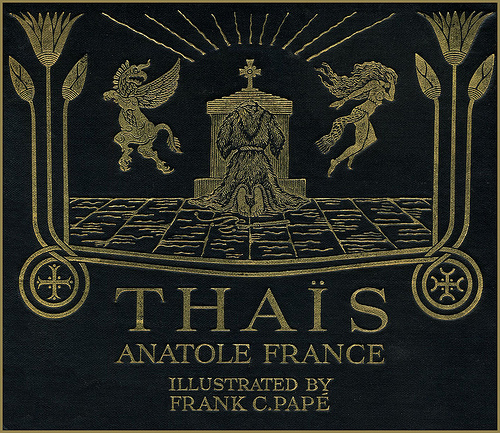
Anatole France’s Thaïs

Back in the mists of time, around a decade ago, there was a plan for an ever-expanding online collection of short critical essays on key works of the fantastic. The plan fizzled and died, but not before I wrote nine pieces for it (which I just found). This is another of them.

5869549609_55f2afb282First published: 1890
Edition used: Thaïs (London: John Lane, 1920) translated by Robert B Douglas

Some time during the late Roman Empire, Paphnutius, the Abbot of Antinoë, an ascetic hermit living on the banks of the Nile, while recalling his sinful life before his conversion, remembers Thaïs, a beautiful and promiscuous actress who had once

almost led [him] into the sins of the flesh. (10)

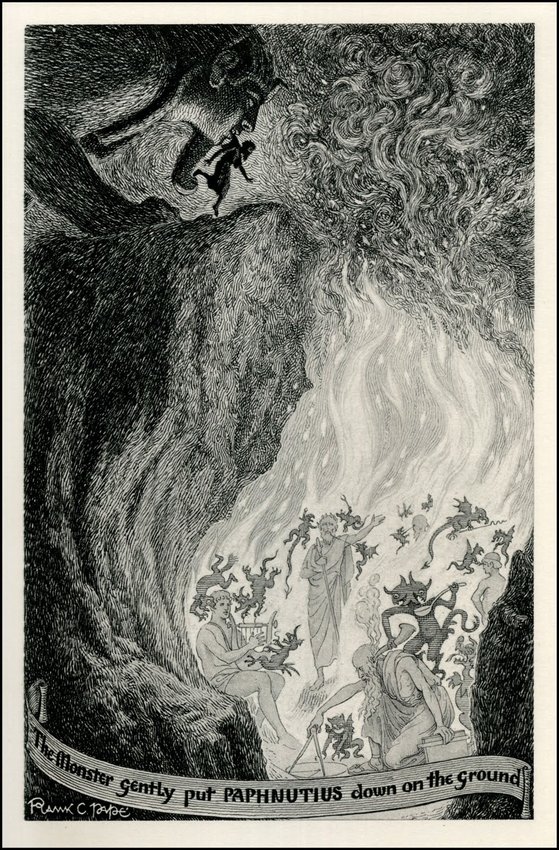
dfda453a37d468531b3e72219b93bd4bHe takes it upon himself to save her. He traces her to Alexandria, converts her from her life of sin and takes her to live in a religious sisterhood. On returning home, he begins to be haunted by visions of Thaïs and by demonic little jackals. Seeking respite, he sets out on a pilgrimage, finds a pillar in the desert and takes up residence atop it. Pilgrims flock to see him, miracles are performed, and the city of Stylopolis grows up around the pillar. Paphnutius believes he is on a holy mission to take on the sins and sufferings of others – until he realises that Satan has tempted him into pride. He flees, is haunted by demons and falls into the sins of lust and Arian heresy. Hearing that Thaïs is dying, he rushes to her side. She dies a saint, but his sins and torments have altered him so much that when the chorus of chanting virgins see his face, they run away, terrified, crying:

‘A vampire! A vampire!’
He had become so repulsive, that passing his hand over his face, he felt his own hideousness. (234)

Although it does take particular pleasure in its anticlericalism, Thaïs is a remarkable attack not just on Christian asceticism but also upon the self-sustaining systems we develop to explain the world and our place in it. Like Voltaire’s Candide, it holds up to ridicule Leibniz’s Principle of Sufficient Reason, when Nicias argues from observing two baskets of olives that

‘For man, who only sees a part of things, evil is evil; for God who understands all things, evil is good’

to which Eucrites responds

‘The world is a tragedy by an excellent poet. God, who composed it, has intended each of us to play a part in it. If he wills that you shall be a beggar, a prince, or a cripple, make the best of the part assigned you’. (129)

But this is just one of many targets.

Others include those who appeal to textual authority or unduly venerate antiquity: Hermodorus argues that

there is no such thing as a good form of government, and that we shall never discover one, because the Greeks, who had so many excellent ideas, were never able to find one. … all hope of ultimate success is taken from us. Unmistakable signs show that the world is about to fall into ignorance and barbarism. (124)

And when Thaïs claims that Paphnutius

knows the truth

Nicias replies,

‘I know the truths. He knows but one, I know them all. I am superior to him in that respect, but to tell the truth, it doesn’t make me any prouder nor any happier’. (160)

The radical scepticism of the stranger Paphnutius encounters en route to Alexandria, who argues that

‘there is no such thing as a good or evil life. Nothing is itself either virtuous or shameful, just or unjust, pleasant or painful, good or bad. It is our opinion which gives those qualities to things, as salt gives savour to meat’ (23)

is echoed by Nicias, who informs Paphnutius that

‘Good and evil exist only in the opinion. The wise man has only custom and usage to guide him in his acts. I conform with all the prejudices which prevail at Alexandria. That is why I pass for an honest man’. (39-40)

When she was just 11 years old, Thaïs realised that

no one can be good in this world except at cost of the most terrible suffering

and became

afraid to be good, for her delicate flesh could not bear pain. (76)

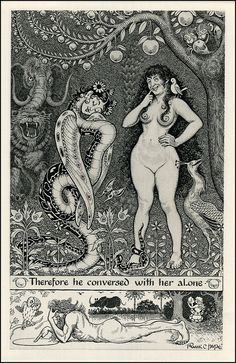
FrankPape_Thais_05_100As an adult, she greets the world without scepticism, believing in everything (84) – a position every bit as subversive as believing in nothing.

Between these epistemological poles, Paphnutius’s moral certainty is consistently undermined. Travelling through the desert, he spies a plover caught in a hunter’s net; her mate tears an opening in the net for her to escape:

The holy man watched this incident, and as, by virtue of his holiness, he easily comprehended the mystic sense of all occurrences, he knew that the captive bird was no other than Thaïs, caught in the snares of sin, and that – like the plover that cut the hempen threads with its beak – he could, by pronouncing the word of power, break the invisible bonds by which Thaïs was held in sin. Therefore, he praised God, and was confirmed in his first resolution. But then seeing the plover caught by the feet, and hampered by the net it had broken, he fell into uncertainty again. (16-7)

Paphnutius’s judgement is repeatedly called into question, as when he joins in Dorion’s misogyny, blaming women for the arousing sexual feelings in men (50); and his unconscious and self-deceiving motivations become increasingly clear to the reader as, observing Thaïs’s suffering as he leads her through the desert, he does not feel

any of the pity which softens the hearts of the profane [but rejoice[s] at these propitiatory sufferings of the flesh which had so sinned. So infuriated was he with holy zeal that he would have liked to cut with rods the body that had preserved its beauty as a shining witness to its infamy. (164)

This psychosexual dimension is wittily reiterated and simultaneously problematised as an explanatory framework when Lucius Aurelius Cotta enquires of the stylitic Paphnutius,

‘Has this column any phallic signification in your mind?’ (198)

The willingness to believe, and the influence of certain ideological determinants or conceptual systems on what one is prepared to believe, are foregrounded when Palemon tells of a monastery whose inhabitants are divided into groups by letters of the alphabet, where

a certain analogy is observed between the character of the monks and the shape of the letter by which they are designated, and that, for example, those who are placed under Z have a tortuous character, whilst those under I have an upright mind. (181)

Likewise, when the story of Cotta’s attempt to question Paphnutius is recounted:

The story of this meeting was embroidered with wonderful details, which those who invented were the first to believe. … And, the miracle being public and notorious, the deacons of the principal churches of Libya recorded it amongst the authentic facts. (200)

imagesDespite the seeming clarity of these quoted passages, Thaïs remains a rather ambiguous text, a careful balancing out of different voices, none of which can be taken to coincide with its author, teetering on the brink of meaning. But lest any belated postmodernists lurk nearby, waiting to rush in to claim France as a precursor, it is worth remembering a lesson that Nicias offers Thaïs. Throwing down a ‘treatise on morals’ composed by ‘the gravest of stoics’ (88) he had been reading while awaiting her return, he takes her in his arms, explaining:

Yes, when I had before my eyes the line in which it is written, ‘Nothing should deter you from improving your mind,’ I read, ‘The kisses of Thaïs are warmer than fire, and sweeter than honey.’ That is how a philosopher reads the books of other philosophers … It is true that, as long as we are what we are, we shall never find anything but our own thoughts in the thoughts of others, and that all of us are somewhat inclined to read books as I have read this one. (89)

The other eight entries I wrote were:
Voltaire, Candide
Godwin, Caleb Williams
de Maistre, Voyage Around My Chamber
London, The Iron Heel 
Gernsback, Ralph 124C 41+
Smith, The Skylark of Space
Schuyler, Black No More
Sturgeon, Venus Plus X