The City in Fiction and Film, week 16: JG Ballard’s High-Rise, chapters 1-9

70256Week 15

This week we began to work on JG Ballard’s High-Rise (1975; all quotations from pictured edition, London: HarperCollins, 2006), reading the first nine chapters and also watching William Klein’s Le couple témoin/The Model Couple (1977).

We began with some context, outlining the scale and nature of house-building and redevelopment in the UK in the postwar years, drawing largely on John Grindrod’s Concretopia: A Journey Around the Rebuilding of Postwar Britain (2013) and Lynsley Hansley’s Estates: An Intimate History (2008).

There was already a housing shortage in the UK between World Wars. The promise to ensure that soldiers returned from  WWI to a land fit for heroes (and thus stave off socialism) was never met – construction rates were too low and often the wrong kind of housing was being built in pursuit of the rather different goal of making private profit (Paul Rotha’s documentary Land of Promise (1946) is the classic film account of this issue and its history). During the war years of 1939-45 the UK population grew by one million per year – and during the same period four million homes were destroyed or damaged beyond repair by bombing (completely undoing the interwar construction efforts and significantly reducing housing stock in relation to total population).

Aneurin Bevan, the minister responsible for housing in the post-WWII Labour government, set a target of 300,000 new council houses per year – but rarely managed more than 200,000 – because the houses were to be spacious (90 square metres), brick-built with gardens. For him, such decent houses were not to be restricted to the privately-owning middle classes – they should be available to the working class, rented at lower than market rates from local councils. (One policy proposal considered but sadly never pursued was buying out all private landlords, thus monopolising the rental market and keeping down the cost of housing.)

When a succession of Conservative governments took office (from late 1951-64), they took up the challenge of 300,000 new houses per year – and succeeded in meeting the target. But they did so by reducing the size of the houses (70 square metres) and shifting from brick construction to speedier (but less durable) prefabricated structures, with no guarantee of gardens. And there was a shift to building blocks of flats rather than houses because they were cheaper and quicker to throw up from prefabricated materials. Ironically, because these blocks were typically set in parkland of some sort, the same number of people could have been housed in the same space with terraced housing.

In High-Rise, Ballard is fully aware of the economics determining such constructions:

All the evidence accumulated over several decades cast a critical light on the high-rise as a viable social structure, but cost-effectiveness in the area of public housing and high profitability in the private sector kept pushing these vertical townships into the sky against the real needs of their occupants. (52)

Why were the blocks typically surrounded by parkland? Partly, it seems to be the influence of Le Corbusier, whose unrealised ville contemporaine (1922) plan to build 24 60-storey cruciform high-rise skyscrapers in which three million people would live and work did so. Ballard does not pursue the scale of this scheme – Robert Silverberg’s The World Inside (1971) comes closer – but he does draw on Le Corbusier in other ways.

Le Corbusier advocated five principles when designing apartment blocks:

1 Lift the structure off the ground on reinforced concrete stilts (pilotis), enabling
2 a free façade (non-supporting exterior walls to allow the architecture freedom in his design) and
3 an open floor plan (interior could be configured without having to worry about supporting walls).
4 The free façade enables ribbon windows so as to provide clear views of surrounding gardens.
5 A roof garden compensates for the ground area covered by the building.

These principles are evident in his Unité d’Habitation in Marseilles, often described as resembling a moored ocean liner, contains 337 apartments, with a floor halfway up the block devoted to public amenities, and a roof garden. It is also raised up on pilotis. It became a location of pilgrimage and an object to copy for a generation or two of architects, including many of those planning housing developments for British councils. It also provides the design for Ballard’s own high-rise (it even stands on pilotis, ‘concrete legs’ (19)), one of five spaced equidistantly on the eastern edge of an under-construction square mile development in London’s docklands (in this, the novel is proleptic of material we studied way back in week one of the module, The Long Good Friday and London’s Overthrow – as well as of what has actually happened to such spaces since Ballard wrote the novel).

The other context I introduced was about Ballard himself: his centrality to New Wave sf of the 1960s and 1970s; his early novels refiguring the conventions of disaster fiction, such The Drowned World (1962), which also introduce surrealistic images into narratives indebted to writer like Joseph Conrad and Graham Greene; the thematic trilogy, including Crash (1973) and Concrete Island (1974), which concludes with High-Rise; the autobiographical fictions and the more mainstream respectability that came with Empire of the Sun (1984); and the return of his late novels, Cocaine Nights (1996), Super-Cannes (2000), Millennium People (2003) and Kingdom Come (2006), to transformations in bourgeois living environments.

Turning to the novel, we began by thinking about the names and characteristics of the three narrators, each of whom is associated with one of the three classes that emerge among the middle class residents of the building.

From the lower levels, Richard Wilder – physical, aspirational – he is the wildest and most overtly violent of the three and a frequent adulterer whose wife calls him Dick.

From the mid-levels, Robert Laing, whose name echoes that of the unorthodox psychiatrist RD Laing (1927-89), who saw mental illness as a product of social environments rather than as some kind of inward-driven deformation of the self, and who considered patients’ descriptions of their responses to their environments as valid in themselves rather than as symptoms of Freudian disorder. Opposed to use of antipsychotics to treat mental illness, he favoured recreational drug use and believed that mental illness could be a kind of transformative, shamanic experience. He also promoted primal scream therapy – most of the inhabitants of Ballard’s building seem to go through some version of it – and rebirthing therapy – foreshadowed for Robert Laing when he is surrounded by the threatening guests at the cocktail party to which he is not invited, with the whole novel constituting a kind of rebirthing for him.

From the very top floor, the architect of the building, Anthony Royal – a royal, the king of the place. Recently injured in a car accident, he suffers from a disability – and wears a distinctive costume – that makes him come across, one of the class suggested, like a Bond villain. Which enabled me to go, ah, funny you should say that…

I have long wondered whether having the architect of the building live in the penthouse was inspired by the fact that Hungarian-born architect Ernő Goldfinger lived for two months in an apartment on the top floor of Poplar’s 26-storey Balfron Tower (built 1965-67), which he had designed. He and his wife are said to have thrown cocktail parties to meet the other residents and learn their thoughts about his design so that he could incorporate criticisms and suggestions in his later building, such as the neighbouring 11-storey Carradale House (built 1967-70). Back in the 1930s, Goldfinger had been responsible for the demolition of some cottages in Hampstead to make way for three new houses, in one of which he would live. Ian Fleming was among those protesting the demolition. Twenty years later, Fleming would name a James Bond novel – and villain – after the architect. Ernő Goldfinger threatened to sue over Auric Goldfinger, to which Fleming reputedly responded, Okay, I’ll just rename him Goldprick. Ernő decided not to pursue the case.

Next we took a look at the opening paragraph, detailing how the design of Ballard’s building displays the influence of Le Corbusier and, in particular, Unité d’Habitation, and then looking at how it introduces patterns of imagery that will recur throughout the novel.

  • a post-apocalyptic sensibility that also suggests a descent into primitivism – Laing is calmly eating a dog (cf. Harlan Ellison’s New Wave story ‘A Boy and His Dog’ (1969) and LQ Jones’s 1975 film adaptation), and the building’s exterior is described as a cliff-face (cf. Henry Blake Fuller’s The Cliff-Dwellers (1893), possibly the first novel about skyscraper living, complete with domestic violence and an Oedipal struggle)
  • conflict – confrontation, violence and war imagery (there are skirmish grounds, raiding parties, provocations, retaliations, a buffer state, an interregnum, etc, but also some specifically WWII images – Royal’s ‘personal Dunkirk’ (69) and also, more ambiguously, the Blitz: a voice ‘calm and matter-of-fact, like that of a civilian in a war-torn city dealing with yet another air-raid’ (60) and, during the first blackout, the darkness providing conditions not just of sexual peril but also of consensual sexual adventuring (20))
  • the embrace of isolation, anonymity and alienation
  • apartments as prison cells (later, there will be news of a prison breakout (30), Wilder will be involved in filming a prison strike (42, 44), and his wife, Helen, will blandly observe that his desire to film in the apartment block will produce just ‘another prison documentary’ (45)) – this introduces the idea of the apartment block as what Erving Goffman called a total institution, like prisons and asylums (two of the psychosociologsist in Le couple témoin previously worked in an asylum) and even ocean liners (to which Unité d’Habitation has often been compared)

We then looked at the next section of the opening chapter (7-11), in which we learned more about the structure of the building and the docklands development of which it is a part, and the feelings it induces as a tripartite class structure begins to emerge among its bourgeois inhabitants. Highlights include:

  • indifference, giddiness, exhilaration, insomnia and, especially among female residents, boredom and nomadism; these troubling sensations will later develop into rifts that some think foreshadow or imply the mutation of the residents into a posthuman species (35–6; a similar idea is mooted in Silverberg’s The World Inside)
  • Steele’s anal obsession with garbage chutes
  • bigotry – people begin to talk dismissively and angrily about other floors as groups to be denigrated, abhorred (14, 24, 38) – Steele will compare ninth floor residents to ‘a traditionally feckless band of migrant workers’ (25), and the intensity of these emerging prejudices will be compared directly to ‘racial prejudice’ (32)
  • the relationship to London – which is somehow distanced in both space and time, a past of ‘crowded streets, traffic hold-ups, rush-hour journeys on the Underground’ (9), while the building belongs to an emerging future; in Ballard’s descriptions, time is transformed into space and vice versa
  • a grand Ballardian simile connecting the psychological to the urban, with a vague gesture to TS Eliot (he does this sort of thing a lot – never quite makes sense yet seems to imply immensities): ‘the ragged skyline of the city resembled the disturbed encephalograph of an unresolved mental crisis’ (9)
  • the contradictions of the building – Laing’s sister says: ‘You could be alone here, in an empty building … Besides, it’s full of the kind of people you ought to meet’ (10); Laing will soon appreciate the way the place enables both proximity and distance, providing a neutral background for his potential affair with Charlotte, although he immediately questions whether this is really the case (16) – this idea is developed further when they do first have sex (38)
  • the ways in which the building design encourages its inhabitants to turn inwards, away from the city but also from each other

The_Model_Couple-652984484-largeWe closed with a brief discussion of Le couple témoin, William Klein’s film about an average couple who win a competition to live as test subjects in a new urban development – the experiment is ostensibly concerned with designing apartments to ensure that they meet the needs of such a couple, but it clearly is more concerned with engineering their consent and subservience. The psychosociologist experimenters – themselves hardly rational – subject Jean-Michel and Claudine to an array of absurd tests, frequently bullying and brow-beating them, passive-aggressively consulting at them, reinforcing the most conservative of gender roles. The tests become increasingly irrational and arbitrary – authority being exercised because it is authority, not for any greater end. As funding for the experiment withers, and viewing figures for the Big Brother-like media coverage slump, so a group of child and teen revolutionaries are hired to stage a hostage-taking…

Recommended critical reading
AlSayyas, Nezar. Cinematic Urbanism: A History of the Modern from Reel to Real. London: Routledge, 2006. See chapter 7 “The Modernity of the Sophisticate and the Misfit: The City through Different Eyes.”
Baxter, Jeanette. J.G. Ballard: Contemporary Critical Perspectives. London: Continuum, 2009.
Colombino, Laura. “The House as SKIN: J. G. Ballard, Existentialism and Archigram’s Mini-Environments.” European Journal of English Studies 16.1 (2012): 21–31.
Delville, Michel. J.G. Ballard. Plymouth: Northcote, 1998.
Duff, Kim. Contemporary British Literature and Urban Space: After Thatcher. Basingstoke: Palgrave Macmillan, 2014. 52–86
Gasiorek, Andrzej. J.G. Ballard. Manchester: Manchester University Press, 2005.
Grindrod, John. Concretopia: A Journey Around the Rebuilding of Postwar Britain. London: Old Street, 2013.
Groes, Sebastian. The Making of London: London in Contemporary Literature. Basingstoke: Palgrave, 2011. 67–93
Hansley, Lynsley. Estates: An Intimate History. London: Granta, 2008.
Matthews, Graham. “Consumerism’s Endgame: Violence and Community in J.G. Ballard’s Late Fiction.” Journal of Modern Literature 36.2 (2013): 122–39.
Mennel, Barbara. Cities and Cinema. London: Routledge, 2008. See chapter 8. “The City as Queer Playground.”
Siegel, Allen. “After the Sixties: Changing Paradigms in the Representation of Urban Space.” Screening the City. Ed. Mark Shiel and Tony Fitzmaurice. London: Verso, 2003. 137–159.
Shiel, Mark. “A Nostalgia for Modernity: New York, Los Angeles, and American Cinema in the 1970s.” Screening the City. Ed. Mark Shiel and Tony Fitzmaurice. London: Verso, 2003. 160 – 179.

Recommended reading
High-Rise is part of a thematic trilogy, including Ballard’s most challenging novel, Crash (1973), and Concrete Island (1974). Ballard’s ‘late fiction’ returns to similar material but relocated to gated suburban communities in Running Wild (1988), Cocaine Nights (1996), Super-Cannes (2000), Millennium People (2003) and Kingdom Come (2006).
1970s British novels of urban decay include Doris Lessing’s The Memoirs of a Survivor (1974) and Zoe Fairbairns’s Benefits (1979).

Recommended viewing
Ben Wheatley’s High Rise (2015) adapts Ballard’s novel.
Modern city living deranges or makes miserable in Repulsion (Polanski 1965), Shivers (Cronenberg 1975), Crash (Cronenberg 1996) and Happiness (Solondz 1998).
Films about the decay of urban centres include Midnight Cowboy (Schlesinger 1969), Clockwork Orange (Kubrick 1971) and Dog Day Afternoon (Lumet 1975).

The City in Fiction and Film, week 14

Farenheit451This week we continued our exploration of the US postwar suburbs (see week 13), reading Ray Bradbury’s Fahrenheit 451 (1953) and watching Invasion of the Bodysnatchers (Siegel 1956). Both texts were framed in relation to the period’s culture of affluence and anxiety.

But first we began by placing Bradbury’s novel in relation to genre – specifically the interweaving traditions of utopia/anti-utopia, utopia/dystopia and US magazine sf.

Thomas More coined ‘Utopia’ 500 years ago this year. When spoken aloud, the first syllable is a Latin pun on ou which means no and eu which means good (and topos means place) – so utopia means ‘no place’ but also suggests ‘good place’. Utopia has come to be understood as a description of an imaginary world organised according to a better principle than our own, and to frequently involve not-always-gripping systematic descriptions of economic, social and technical arrangements. We discussed the efflorescence of utopian fiction in the wake of Edward Bellamy’s Looking Backward, 2000-1887 (1888), and mentioned such key utopian authors as William Morris, Charlotte Perkins Gilman, Ursula Le Guin and Kim Stanley Robinson. We also noted the relative scarcity of utopian worlds in cinema – Just Imagine (Butler 1930), Things to Come (Menzies 1936) and Star Trek: The Motion Picture (Wise 1979) being potential examples, but all of them also demonstrating potentially negative elements and being susceptible to against-the-grain readings.

This led us to anti-utopias – texts that are in more or less explicit dialogue with someone else’s utopian vision, exposing its darker, oppressive elements. William Gibson’s ‘The Gernsback Continuum’, which we read last semester, is a kind of compendium anti-utopia, while novels such as Yevgeny Zamyatin’s We (1924), Aldous Huxley’s Brave New World (1932) and George Orwell’s Nineteen Eighty-four (1949) are – among other things – direct responses to the utopian vision of HG Wells, drawing out its more totalitarian elements, as does Metropolis (Lang 1927).

During the 20th century, however, the explicit anti-utopia has given way to the proliferation of dystopias (dys + topia = bad place), dark, often satirical exaggerations of the worst aspects of our world. The dystopia emphasises bad aspects of our own world so as to make them more obvious (in this, they parallel the suburban world of All That Heaven Allows). The dystopia is not an explicit critique of the utopia, but a depiction of a world worse than our own – usually totalitarian, bureaucratic, brutal, dehumanising, and sometimes post-apocalyptic. Between us, we concocted a list of novels and films, including:

Kurt Vonnegut, Player Piano (1952)
Frederik Pohl and Cyril Kornbluth, The Space Merchants (1953)
John Wyndham, The Chrysalids (1955)
Anthony Burgess, A Clockwork Orange (1962), filmed as Clockwork Orange (Kubrick 1971)
Philip K. Dick, Do Androids Dream of Electric Sheep? (1968) filmed as Blade Runner (Scott 1982)
Harry Harrison, Make Room! Make Room! (1966), filmed as Soylent Green (Fleischer 1973)
Punishment Park (Watkins 1971)
THX 1138 (Lucas 1971)
Rollerball (Jewison 1975)
Mad Max (Miller 1979)
William Gibson, Neuromancer (1984)
Brazil (Gilliam 1985)
Margaret Atwood, The Handmaid’s Tale (1985), film (Schlöndorff 1990)
Alan Moore and David Lloyd, V for Vendetta (1988–9), film: (McTeigue 2006)
Robocop (Verhoeven 1987)
PD James, The Children of Men (1992), filmed: (Cuarón 2006)
Octavia Butler, The Parable of the Sower (1993)
Kazuo Ishiguro, Never Let Me Go (2005), filmed: (Romanek 2010)
Gamer (Neveldine+Taylor 2009)
Moon (Jones 2009)
Suzanne Collins, The Hunger Games novels (2008-2010), filmed: Ross and Lawrence 2012-15)
Dredd (Travis 2012), based on Judge Dredd strip (1979–)
Elysium (Blomkamp 2013)

The widespread usage of dystopia and the relative decline of the utopia/anti-utopia tradition has led to an increased use of the eutopia (a term which makes linguistic sense as the opposite of dystopia) to describe imagined worlds that in some ways are better than ours, if still far from perfect. The eutopia imagines a better world, using its differences to indicate the shortcomings of our own world.

Both eutopia and dystopia are, in different ways, about the possibility of change.

We then turned to consider Ray Bradbury in the context of American sf in the 1950s. From the late 1930s, American magazine sf had been dominated by Astounding, edited by John W. Campbell. It was not the best-paying venue, but thanks to the galvanising effect Campbell – and his key authors, such as Robert A Heinlein and Isaac Asimov – had had on the field, it was the most respected and prestigious. That situation began to change after the war, particularly with the launch of The Magazine of Fantasy and Science Fiction and Galaxy, both of which could be characterised as being more literary, as being more interested such things as characterisation, atmosphere, slicker prose and satirical humour. Bradbury could not sell to Campbell, but published in wide range of sf magazines as well as in prestigious non-genre venues, such as Argosy and The Saturday Evening Post.

The reason for his failure with Campbell and success elsewhere has been attributed – by Brian Aldiss? – to him writing science fiction for people who don’t like science fiction (which we might more generously describe as writing non-Campbellian science fiction). Bradbury was championed by critics such as Robert Conquest and Kingsley Amis who, although they occasionally wrote and edited sf, were not sf writers per se. Within the genre community, such writers/editors/critics as James Blish and Damon Knight tended to be more ambivalent – caught between what they saw as Bradbury’ ‘poetic’ writing/ higher literary standards and his apparently blissful ignorance of science.

This ambivalence was mirrored by a number of the class, who found aspects of the novel quite compelling while also being frustrated by the ‘vagueness’ of its world-building. (I am not sure ‘vagueness’ is quite the right term, since it implies there is something that Bradbury should be doing rather than thinking about his preference for imagery over concrete images – and it might also indicate a relative lack of familiarity with sf’s specific reading protocols, which often require the reader to collaborate in building the world from the smallest of hints.)

In considering Fahrenheit 451 as an exaggerated dystopian version of the suburbs it is perhaps useful briefly to put aside its most obvious and striking feature – firemen now burn books – and instead think about the other features of its imagined world, all of which resonate strongly with the affluence and anxieties outlined last week:

  • the overwhelming impact of mass media, on everything from the design of houses  (no front porches, replace windows with TV screens, etc) to the fabric of domestic life, which is organised around consumption and pseudo-participation, and dominates social occasions
  • the alienation from other human beings, from nature, from meaningful labour
  • the reliance on tranquillisers, sleeping and other medication
  • the frequency of divorces and the virtual exile of children
  • women’s rejection of pregnancy and natural childbirth (cast as a negative, although Shulamith Firestone and others would see this as a positive)
  • juvenile delinquents racing cars around night-time streets, dying in crashes and aiming for pedestrians
  • how commonplace deliberate suicides and accidental overdoses have become
  • the absence of an urban centre (there is one, but the emphasis throughout is on seemingly endless suburbs)
  • really long billboards because everyone drives so fast
  • the degradation of language
  • the constant sound of military jets and the ultimate outbreak of the fourth nuclear war since the 1960s
  • the near-universal and – it is made clear – willing abandonment of books and reading
  • the only very occasional spectacle of state power when books are burned

We also thought about the ways in which Bradbury’s prose and imagery are ‘simple’ or ‘child-like’ – the way the novel seems to be the product of a pre-pubertal imagination. This led us in two directions.

First, there are the distinctly Oedipal elements of the novel. While its depiction of women is broadly misogynistic, this is especially focused on Mildred Montag. Cast as a simple-minded and anxious nag, she also comes across as a cold and distant mother figure to her husband, who often seems like a boy in quest of a father figure (Granger replacing Faber replacing Beatty). Mildred is early on associated with the kind of marble figure you might find on a mausoleum – remember the suburban fireplace in All that Heaven Allows – and when Montag turns the flamethrower on their twin beds (after all, there is no reason for mummy and daddy to share a bed, is there?), they ‘went up in a great simmering whisper, with more heat and passion and light than he would have supposed them to contain’ (151).

There is also something just a little bit queer about Montag’s relationship with Faber, the older, educated man who first picked Montag up in a public park, slipping him his phone number even though he knew it would put him in the fireman’s power. Faber  maintains this role of mentor, and shares a strange intimacy with the Montag through the earbug the younger man wears so they can always be together.

The second direction in which this sense of Bradbury’s simplicity went was thinking about the imagery he uses. The opening page introduces, among other images, the series of oppositions between black and white: firemen are always associated with blackness, and sometimes Bradbury seems almost to recognise a racial dimension; readers and women are associated with whiteness, although sometimes this whiteness is sepulchral (Mildred) or diseased (Faber). There is also animal and other nature imagery. Sparks become fireflies, books become pigeons. Later, books will rain down around Montag like pigeons, and he will be infected, losing control over his impulses, his hands becoming like ferrets whose antics he can only observe (this sense of alienation from his self culminates in him watching his own pursuit on television, which ends with his capture being faked). As with the bizarre fantasy about the barn in the final section of the novel, there is a nostalgic current underpinning the animal imagery – making manifest the natural world that the suburban sprawl roots up, tears down, eradicates. The imagery haunts the denatured suburb, reminding us of what has been lost and is constantly being thrown away.

Invasion of the Bodysnatchers shares many of these concerns. While its mood of paranoia might lend credence to the commonplace notion that the film is somehow about fears of communist infiltration, there is in fact little in the film to support reading it that way (just a few years earlier the emotionless nature of the pods would have been projected onto Nazis rather than Commies, primarily as a denial of the profound conformism in American life and in a consumer culture). Similarly, it is not especially easy to read the film as being about fears of racial passing or queer passing, although they too might be argued – the film is certainly about ensuring difference does not intrude onto this white suburban small town. This difference takes the form of two childless, sexually active recent divorcees – former sweethearts and possibly lovers – finding themselves thrown together, and everyone around them assuming they will become involved with each other again (while elsewhere, Oedipal anxieties take the form of children thinking there parents are not their parents). It is a film obsessed with sex – Miles makes constant innuendoes and hits on women all the time; he races over to Becky’s house in his pyjamas (don’t ask what her house is doing in his pyjamas) in the middle of the night and sweeps her off to his house, where the next morning she is wearing some of his clothes and cooking him breakfast, and Jack Belicec seems to assume this is post-coital. There is Becky’s summer dress, which miraculously stays up while emphasising her breasts, and Miles’s ultimate declaration that he did not know the real meaning of fear until he kissed her. Against all this sex is cast not only the asexual reproduction of the pod people but also the mechanical reproduction of commodities and the replacement of culture (a live band) by its simulacrum (the juke box).

And, as that penultimate hurried paragraph suggests, we ran out of time. Next week, Alphaville (Godard 1965).

Week 15

Recommended critical reading
AlSayyas, Nezar. Cinematic Urbanism: A History of the Modern from Reel to Real. London: Routledge, 2006. See chapter 9, “Exurban Postmodernity: Utopia, Simulacra and Hyper-reality.”
Biskind, Peter. Seeing is Believing How Hollywood Taught Us to Stop Worrying and Love the Bomb. London: Pluto, 1983. 102–59.
Bould, Mark. “Burning Too: Consuming Fahrenheit 451.” Literature and the Visual Media. Ed. David Seed. Woodbridge: DS Brewer, 2005. 96–122.
Grant, Barry Keith. Invasion of the Bodysnatchers. London: BFI, 2010.
McGiveron, Rafeeq O. “‘To build a mirror factory’: The Mirror and Self-Examination in Ray Bradbury’s Fahrenheit 451.” Critique: Studies in Contemporary Fiction 39.3 (1998): 282–7.
Seed, David. American Science Fiction and the Cold War: Literature and Film. Edinburgh: Edinburgh University Press, 1999.
–. “The Flight from the Good Life: Fahrenheit 451 in the Context of Postwar American Dystopias.” Journal of American Studies 28.2 (1994): 22–40.
Whalen, Tom. “The Consequences of Passivity: Re-evaluating Truffaut’s Fahrenheit 451.” Literature/Film Quarterly 35.3 (2007): 181–90.

Recommended reading
E.M. Forster’s “The Machine Stops” (1909) anticipates surburban consumerist isolation.
Suburbia became a regular setting for postwar sf: Ray Bradbury’s “There Will Come Soft Rains” (1950) and “The Pedestrian” (1951), Judith Merril’s Shadow on the Hearth (1950), Frederik Pohl’s “The Midas Plague” (1954), Philip K. Dick’s Time Out of Joint (1959) and Pamela Zoline’s “Heat Death of the Universe” (1967).
Examples of suburban horror include Anne Rivers Siddons’s The House Next Door (1978) and M. John Harrison’s subtler “The Incalling” (1978) and The Course of the Heart (1991).

Recommended viewing
Bradbury’s novel was filmed by French New Wave director François Truffaut as Fahrenheit 451 (1966). Other sf and fantasy films depicting the dissatisfactions of suburban living include Invaders from Mars (Menzies 1953), Forbidden Planet (Wilcox 1956), The Stepford Wives (Forbes 1975), E.T. – The Extra-terrestrial (Spielberg 1982), Poltergeist (Hooper 1982), Parents (Balaban 1989), Edward Scissorhands (Burton 1990), Pleasantville (Ross 1998), The Truman Show (Weir 1998) and Donnie Darko (Kelly 2001).


Afrocyberpunk 3: Steven Barnes, Streetlethal (1983), Gorgon Child (1989), Firedance (1994)

Barnes Steven - Aubrey Knight 01 - Street LethalIn 1993, Claire Sponsler argued that cyberpunk reworked earlier post-nuclear-holocaust narratives (Alas, Babylon; A Canticle for Leibowitz; Riddley Walker) which depicted, with ‘angst and ambivalence’, a ‘physical world [that] is unfriendly, unyielding, and unforgiving’, a ‘hostile and forbidding … no-man’s land where humans must struggle to survive’ (257). In contrast, for cyberpunk ‘destruction of the natural environment and decay of the urban zones are givens that are not lamented but rather accepted’ (257). In ‘decayed cityscape[s]’, cyberpunk found ‘a place of possibilities, a carnivalesque realm where anything goes and where there are no rules, only boundaries that can be easily transgressed’ – and where entry into cyberspace, a disembodied realm of deracinated liberation, is ‘encouraged, not hampered, by a milieu of urban decay’ (261).

Thomas Foster’s The Souls of Cyberfolk criticises this view, reminding us that part of the cultural backdrop against which the cyberpunk imaginary emerged was the discourse of urban planning and development that came to the fore in the US in the 1970s and 1980s – and that its ‘language of urban “ruin,” “decay’” or “blight”’ possessed ‘ideological and often specifically racist subtexts’, providing an encoded way of talking about ‘racialized inner-city ghettoes than cities in general’ (206). (It is well worth having this is mind when reading Delany’s Dhalgren, too.)

Steven Barnes’s Aubry Knight trilogy – among the trashiest of afrocyberpunk fiction and in some ways much more afro than cyberpunk – gets closer than any other cyberpunk I have read to acknowledging this urban-planner/property-developer discourse and its racial content.

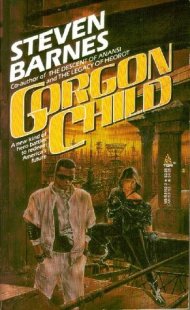
Written before William Gibson’s Neuromancer, Streetlethal (1983) sits alongside cyberpunk, developing similar material rather differently. The trilogy’s ongoing negotiation with 51WfmS5e1uL._SY344_BO1,204,203,200_cyberpunk is most evident if we judge Barnes’s novels by their covers. Barclay Shaw’s 1983 cover – where it is difficult to tell that the protagonist is black – combines 70s martial arts imagery with hints of a post-apocalyptic scenario, perhaps like The Ultimate Warrior (Clouse 1975). It alludes to Mad Max, but the overturned car and shattered road bridge give way to an airy futuristic metropolis. The jacket blurbs point to a conservative tradition of adventure sf (Larry Niven), made a little more decent (Gordon R Dickson) and perhaps a little edgier (Norman Spinrad) (Firedance (1994) adds a blurb from Peter O’Donnell, the creator of Modesty Blaise). The 1991 reissue of Streetlethal retains these three blurbs but has a new cover by Martin Andrews that builds on the imagery of Luis Royo’s cover for Gorgon Child (1989) (rather 593041more effectively than Royo’s cover for Firedance). Aubrey is definitively black. His costume suggests a black urban cool coming out of the dancier end of hip-hop. His dark glasses turn cyberpunk’s mirrorshades black. The urban backdrop is more ambiguous, with hints of futurity and ruination. The female figure is like a rock video version of Molly, Gibson’s street samurai. (The relationship between the women on the covers and the female characters in the novels remains mysterious to me).
From its first sentence, though intermittently, Streetlethal draws on noir imagery and, like Gibson, science-fictionalises it. The novel begins:

Naked and transparent, the woman’s smooth white body undulated slowly, beckoning to the empty streets. The streets were still slick from the afternoon rain; the hologram reflected back from the wet asphalt, an erotic mirage.

[Maxine] steered him further down the street, past the fluxing, beckoning projections that lined Pacific Coast Highway. Soundloops triggered by their passing cajoled, promising the finest in services and goods, the ultimate in intimate experience. A hungry taxi-drone paused on its eternal run down the central guidestrip, and Maxine waved it on. (1, 2-3)

41XSvGIDuwL._AC_UL320_SR212,320_.jpgThe overall plot is also rather noirish. Maxine uses sex to betray Aubry, framing him for murder as part of his punishment for quitting work as muscle for the Ortega gang. He is arrested and imprisoned in the Death Valley Maximum Security Prison; he escapes, makes his way back to Los Angeles, wreaks revenge.

Unlike Gibson, Barnes also works in a blaxploitation mode. Aubry is large and immensely powerful figure, a streetfighter turned Nullboxer – a kind of zero-gravity MMA. Inhumanly strong and determined, there is at times something of Jim Brown, Richard Roundtree and Jim Kelly to him. He is not very smart, though, or well-socialised; the later novels gradually cure him of this emotional/psychological stuntedness, turning him from a kind of Luke Cage into someone more like T’Challa, the Black Panther. Barnes draws on cultural-political strains of black power, Afrotopianism, Afrocentricity and Pan-Africanism (In Firedance, Aubry discovers he is actually African, an child of the Ibandi tribe of warriors who was orphaned in the US. He returns to Africa to topple the insane, Japanese-backed insane military dictator of Pan-Africa, which is composed of six countries: Zaire (Congo), Tanzania, Uganda, possibly Kenya and two never-named others.) Barnes presents a matter-of-fact multiracial and mixed-racial future. More awkwardly, but in a generally positive way, he includes a lesbian separatist community and a group called the NewMen – physically imposing, genetically-engineered warriors, who are all also homosexual. (This sort of diverse future caught between the ghetto, the gang and the New Jim Crow is developed in Erika Alexander and Tony Puryear’s Concrete Park.)

At the centre of Streetlethal is the Los Angeles downtown:

Downtown Los Angeles covered some of the most expensive real estate in the world, and in the 1960’s and ’70’s it had become run-down. Property values were slipping. There was a major effort to clean the area up, to bring in investors. … [Impoverished, homeless] Scavengers have existed for … maybe a century. They move into ruined neighbourhoods, slums, anywhere nobody else wants to live or work, and reclaim. People have been doing it forever, but I guess they just started organizing during the Second Depression, in the eighties. (177, 180)

Although fleetingly evoked, this historical context points to the still ongoing real-world conflicts between a city government enamoured of property developers and the residents of the garment district, skid row and other communities/areas that also occupy the downtown.

Barnes’s LA differs from the real LA not just because of that Second Depression but also because the Big One finally hit.

It was easy to remember when there had been skyscrapers here. The Great Quake, and the even more ruinous firestorm that followed, had razed the city, sending businesses fleeing to the valleys and peripheral areas. Already decaying by the turn of the century, no one cared about central L.A. anymore. The slums remaining in the area were simply referred to as the Maze, and only the hopeless made it their home. (60)

[It] must have been a street, once. It was hard to tell, with the accumulated layers of trash and debris, shattered fragments of buildings, and the gut-punched wreckage of a bus, stripped of rubber and glass and most of its metal, only a framework of rust remaining. … The wreckage was incredible, as if an orgy of wholesale looting and vandalism had destroyed what little was left by the natural disasters of earthquake and fire. (108, 109)

The Maze is home to the Scavengers, a subterranean co-operative community developed from those earlier scavengers. They live in the ruins, including the secretly renovated PanAngeles Multiplex, ‘the largest underground living complex in the western hemisphere’ (177). And they have a semi-official government franchise to recover valuables and salvage materials from the ruins. The state sees them as ‘hoboes scratching at a trash heap’ (176) and have no idea how wealthy they have grown, how far their trade network reaches, how much their influence and range of alliances have grown.

The most depressing aspects of the trilogy is that by the start of Firedance, the Scavengers have themselves turned property developers, using ‘the leverage of property, money, and manpower, combined with generous grants and federal tax breaks’ to create ‘an empire’ (9). They have turned the Maze into Mazetown, a new and more ethnically diverse downtown – and ‘the label “Mazie” seemed less an insult than a celebration of an individual choice’ (17). The new population might have ‘skins tinted every color of the rainbow … cloaked in the raiment of a dozen lands’ (17), a dozen languages and a hundred dialects’ might fill ‘the streets’, and there might be a ‘thousand savory collations from around the world’ being sold by ‘ten thousand street vendors’ (33), but they also look and sound and smell of gentrification. As if capitalism somehow suddenly – and in LA of all places – dropped its racialising and racialised dynamics.

Works cited
Steven Barnes, Streetlethal. New York: Ace, 1983.
–. 
Gorgon Child. New York: Tor, 1989.
–. Firedance. New York: Tor, 1994.
Thomas Foster, The Souls of Cyberfolk: Posthumanism as Vernacular Theory. Minneapolis: University of Minnesota Press, 2005.
Claire Sponsler, ‘Beyond the Ruins: The Geopolitics of Urban Decay and Cybernetic Play’. Science Fiction Studies 60 (1993): 251-265.

Writing, publications, events in 2015

CIHAN1-aWriting anything more substantial than blog posts has been hard this year. Things that got in the way included: burn out; depression; general HE mission-drift/precarity/anxiety/malaise; having to design/validate/launch a new degree programme; spending time planning a large research project only to find my institution will not support a bid to the one source likely to fund it. Hopefully, I will find some energy soon since I have an article, a book chapter, a review and a magazine feature due in the next month; and another three essays, two reviews, and six keynotes and invited research talks scheduled before the end of the summer. Oh, and that co-edited collection I keep forgetting about.

But, of course and as always, Sherryl, Gerry and I edited three issues of Science Fiction Film and Television on schedule. And some publications did leak into the world in 2015

Monograph translation
Science Fiction: The Routledge Film Guidebook (2012) appeared in Turkish as Bilimkurgu (Kolektif Kitap 2015)

Contributions to edited collections
‘The Coy Cult Text: The Man Who Wasn’t There as Noir Sf’ in JP Telotte and Gerald Duchovnay, eds, Science Fiction Double Feature: The Science Fiction Film as Cult Text (Liverpool UP 2015), 38–52

‘Slipstream Cinema: Dick without the Dick’ in Stefan Schlensag and Alexander Dunst, eds, The World According to Philip K. Dick (Palgrave Macmillan 2015), 119–136

‘The Futures Market: American Utopias’ in Eric Carl Link and Gerry Canavan, eds, The Cambridge Companion to American Science Fiction (Cambridge UP 2015), 83–96

Non-peer-reviewed article
‘African SF 101’, The SFRA Review (2015), 11–18; also here and here. This was also my most successful blog of the year: 1300+ views in one day, 4,250 as of ten minutes ago (about a fifth of my blog views for the year). It has also been translated in two parts (here and here) for the website of the World Chinese Science Fiction Association, China’s largest association for science fiction practitioners and fans.

Review
‘If Colonialism Was The Apocalypse, What Happens Next? On Nerine Dorman, ed., Terra Incognita: New Short Speculative Stories from Africa and Dilman Dila, A Killing in the Sun’, The Los Angeles Review of Books (5 August 2015)

Blog
‘Piqued Oil’, Salvage online (5 Oct 2015).

Fiction
‘Milton Friedman: An Obituary’, Salvage 1 (2015), 225–229. Also here. This started off a long time ago as a joke and ended up being my first published fiction. In the giddy aftermath, I spilled out an actual story – exactly the kind of space opera/western/romance/mathporn mash-up with gratuitous MaverickFlash Gordon and M. John Harrison riffs no one wants to publish – so for the counterfactual Ballard piece currently under concoction I have reverted to wilfully obscure material in a non-fiction format.

Events
I was interviewed for Alessandro Inglima and Yari Lanci’s Coded Skins, a documentary on the SpaceApe that is currently in production. Simultaneously made me feel really old, and all young and street.

I was part of a panel on ‘Video Nasties’ before the UK premiere of Joe D’Amato’s uncut Anthropophagus, The Cube, Bristol, 16 September 2015.

I introduced the 1930 sonorised version of Sergei Eisenstein’s Battleship Potemkin (along with Everyday, Vintik-Sphintik and Interplanetary Revolution) for Bristol Silents, The Lansdown, Bristol, 23 September 2015.

I helped to organise Global Futures: On Science Fiction, featuring Bill Campbell, Zen Cho, Carmelo Rafala, Geoff Ryman, Stephanie Saulter, Donna Scott and Tade Thompson, at Book & Kitchen, London, 7 November 2015.

And I was the only even remotely mean-spirited curmudgeon who made it into the final cut of Channel 5’s The Definitive History of Star Wars, 11 December 2015,

My top twenty books of 2015

1144This year, I read 166 books for pleasure. (My definition of ‘pleasure’ here includes background reading for new modules, research projects, reader’s reports, reviews, blurbs, etc, as well as ploughing through books that have been cluttering up the house for years – or decades – before donating them to the local charity shop; hence I am surprised to find four of my top twenty were actually published in 2015).

Portnoy compliance data:
All of the world except… = 87
…straight white men writing in English = 74
plus multi-authored in ways too complex to divide = 5
(but only about 40 by women)

Top twenty titles (excluding books I’ve read before)
Novels

Bernardine Evaristo, Blonde Roots (2008)
Leslie Feinberg, Stone Butch Blues (1993)
Elizabeth Hardwick, Sleepless Nights (1979)
Ondjaki, Granma Nineteen and the Soviet’s Secret (2008)
Richard Powers, Generosity: An Enhancement (2009)
Alain Robbe-Grillet, The Erasers (1953)
Sapphire, Push (1996)
Sam Selvon, The Lonely Londoners (1956)

Short stories
Dilman Dila, A Killing in the Sun (2015)
Nerine Dorman, ed, Terra Incognita: New Speculative Fiction from Africa (2015)
Abdelfattah Kilito, The Clash of Images (1995)
China Miéville, Three Moments of An Explosion (2015)
Sam Selvon, Ways of Sunlight (1957)

Poetry
Sam Greenlee, Ammunition! (1975)

Comics
Tony Puryear and Erika Alexander, Concrete Park: You Send Me (2014)
–. Concrete Park: R.E.S.P.E.C.T. (2015)
Gene Luen Yang, Boxers (2013)

Biography
Isaac Deutscher, The Prophet Armed: Trotsky 1879-1921 (1954)
— The Prophet Unarmed: Trotsky 1921-29 (1959)
The Prophet Outcast: Trotsky 1929-40 (1963)

The full list of books I read this year
Brian Aldiss, Bury My Heart at WH Smith’s
Helliconia Summer
The Twinkling of an Eye
Michelle Alexander and Jeanne Long, How to Lose a Guy in 10 Days: The Universal Don’ts of Dating
Monica Ali, Brick Lane
Nelson Algren, A Walk on the Wild Side
Grant Allen, The Woman Who Did
Margery Allingham, The Tiger in the Smoke
Guillermo Arriaga, The Guillotine Squad
Isaac Asimov and Martin Greenberg, eds, Cosmic Critiques: How and Why Ten Science Fiction Stories Work
Marc Augé, The Future

JG Ballard, High Rise (film reviewed)
The Drowned World
Lynne Reid Banks, The L-Shaped Room
René Barjavel, Ashes, Ashes
Steven Barnes, Streetlethal
Walter Besant, The Revolt of Man
Calixthe Beyala, How to Cook Your Husband the African Way
David Bischoff, Young Sun Ra and the Strange Celestial Roads
Andy Boot, Fragments of Fear: An Illustrated History of British Horror Films
Elizabeth Bowen, The Heat of the Day
Dennis Broe, Maverick
Michael Bronski, Pulp Friction: Uncovering the Golden Age of Gay Male Pulps
Keith Brooke, ed., Strange Divisions and Alien Territories: The Sub-Genres of Science Fiction
Octavia Butler, Dawn
Adulthood Rites
Imago

Brian Chikwava, Harare North
Agatha Christie, The Moving Finger
Teju Cole, Open City
Warwick Collins, Gents
Joseph Conrad, The Secret Agent
Richard Cowper, The Custodians, and Other Stories
The Twilight of Briareus

Chris Darke, La jetée
Isaac Deutscher, The Prophet Armed: Trotsky 1879-1921
— The Prophet Unarmed: Trotsksy 1921-29
The Prophet Outcast: Trotsky 1929-40
Bernard F Dick, The Merchant Prince of Poverty Row: Harry Cohn of Columbia Pictures
Joan Didion, Where I Was From
Dilman Dila, A Killing in the Sun
Brian Dooley, Black and Green: The Fight for Civil Rights in Northern Ireland and Black America
Nerine Dorman, ed, Terra Incognita: New Speculative Fiction from Africa
Fyodor Dostoevksy, Notes from Underground
Arthur Conan Doyle, The Adventures of Sherlock Holmes
–. Uncle Bernac: A Memory of the Empire
David Duffy, Losing the Head of Philip K Dick
Alexandre Dumas, The Count of Monte Cristo
Nell Dunn, Up the Junction

Caroline Edwards and Tony Venezia, eds, China Miéville: Critical Essays
George Alec Effinger, When Gravity Fails
David Eggers, A Hologram for the King
Bernardine Evaristo, Blonde Roots
Allen Eyles, House of Horror: The Complete Hammer Films Story

Michael Fabre, Under the Skin
Hans Fallada, Tales from the Underworld
Leslie Feinberg, Stone Butch Blues
Eric Flint, Gorg Huff and Paula Goodlett, 1636: The Kremlin Games
Karen Joy Fowler and Debbie Norton, 80! Memories and Reflections on Ursula K Le Guin
Carl Freedman, Art and Idea in the Novels of China Miéville

Elizabeth Gaskell, Mary Barton
Stella Gibbons, Cold Comfort Farm
William Gibson, The Peripheral
Jeremy Gilbert, Common Ground: Democracy and Collectivity in an Age of Individualism
Robert SC Gordon, Bicycle Thieves
Joe Gores, Hammett
Graham Greene, Brighton Rock
Karl Taro Greenfield, Speed Tribes: Children of the Japanese Bubble
Sam Greenlee, Ammunition!
Walter Greenwood, Love on the Dole
John Grindrod, Concretopia: A Journey Around the Rebuilding of Postwar Britain

Joe Haldeman, The Long Habit of Living
Sarah Hall, The Carhullan Army
Knut Hamsun, Hunger
Elizabeth Hardwick, Sleepless Nights
Mark Harris, Scenes from a Revolution: The Birth of the New Hollywood
Ivor W Hartmann, ed., AfroSF, volume 2 
Brett Harvey, The Fifties: A Woman’s Oral History
Mary Higgs, Glimpses into the Abyss
Patricia Highsmith, The Price of Salt
Andrew Holleran, Dancer from the Dance
Tendai Huchu, The Maestro, the Magician and the Mathematician
Fergus Hume, The Mystery of a Hansom Cab

CLR James, Letters from London
James Joyce, Dubliners

Anton Kaes, M
Sue Kaufman, The Diary of a Mad Housewife
Gerald Kersh, Night and the City (here and here)
Abdelfattah Kilito, The Clash of Images
Stephen King, Doctor Sleep
The Shining
Cyril M Kornbluth, Not this August
Sigizmund Krzhizhanovsky, Memories of the Future
Hanif Kureishi, The Buddha of Suburbia
Andrei Kurkov, Death and the Penguin
Henry Kuttner, Elak of Atlantis

George Lamming, The Emigrants
Andrea Levy, Small Island
Marina Lewycka, Two Caravans
Megan Lindholm, Wizard of the Pigeons
Kelly Link, Magic for Beginners
Jack London, The People of the Abyss

Neil McAleer, Odyssey: The Authorised Biography of Arthur C Clarke
Arthur Machen, The Great God Pan
The Three Impostors
The Terror
Colin Macinnes, Absolute Beginners
City of Spades
Katherine Mansfield, In a German Pension
Richard Marsh, The Chase of the Ruby
The Datchet Diamonds
Guy de Maupassant, Bel Ami, or the Secret History of a Scoundrel
Quentin Meillassoux, Science Fiction and Extro-Science Fiction
China Miéville, This Census Taker
Three Moments of An Explosion
Rick Moody, The Ice Storm
Alan Moore and Kevin O’Neill, The League of Extraordinary Gentlemen, volume one
Susanna Moore, In the Cut

VS Naipaul, The Mimic Men
Frank Norris, Blix
Moran of the Lady Letty
Sarah Nuttall and Achille Mbembe, eds, Johannesburg: The Elusive Metropolis

Liam O’Flaherty, The Informer
Ondjaki, Granma Nineteen and the Soviet’s Secret

Félix J Palma, The Map of Time
Richard Powers, Generosity
Tony Puryear and Erika Alexander, Concrete Park: You Send Me
–. Concrete Park: R.E.S.P.E.C.T.

Raymond Queneau, Zazie in the Metro

Alain Robbe-Grillet, The Erasers
Jackie Robinson, I Never Had It Made
David S. Roh, Betsey Huang and Greta A. Niu, eds, Techno-Orientalism: Imaging Asia in Speculative Fiction, History, and Media
Satyajit Ray, The Diary of a Space Traveller and Other Stories
Sharifa Rhodes-Pitts, Harlem is Nowhere: A Journey to the Mecca of Black America
Jean Rhys, Voyage in the Dark

Sunjeev Sahota, Ours are the Streets
Sapphire, Push
Sam Selvon, The Lonely Londoners
–. Ways of Sunlight
Khairy Shalaby, The Time-Travels of the Man Who Sold Pickles and Sweets
Patrick Sheeran, The Informer
Anne River Siddons, The House Next Door
Sister Souljah, The Coldest Winter Ever
Muriel Spark, The Ballad of Peckham Rye
The Girls of Slender Means
Colin Spencer, Homosexuality: A History
Bruce Sterling, Islands in the Net
Herbert Strang, Round the World in Seven Days
The Old Man of the Mountain
Mrs Herbert Strang, The Girl Crusoes
Neil Strauss, ed., Radiotext(e)
Boris and Arkaday Strugatsky, Hard to Be a God (film reviewed)
Preston and Sandy Sturges, Preston Sturges on Preston Sturges

Rose Tremain, The Road Home

Jeff Vandermeer, Annihilation
Authority
Acceptance
Dai Vaughan, Odd Man Out
Jules Verne, The Sphinx of the Ice Realm

HG Wells, The Autocracy of Mr Parham
The Time Machine
Brian Willems, Shooting the Moon
Jeanette Winterson, The Stone Gods
Virginia Woolf, Mrs Dalloway

Gene Luen Yang, Boxers
Richard Yates, Revolutionary Road

Yevgeny Zamyatin, We
Benjamin Zephaniah, Refugee Boy

AfroSF volume 2 (2015), edited by Ivor W. Hartmann

afrosf2So much has happened since the appearance of Ivor Hartmann’s AfroSF: Science Fiction by African Writers (2012). It is not just that AfroSF is more visible than it was four years ago, but that the market and venues for it are growing, especially at short story length. This year alone has given us Jalada’s online Afrofuture(s) anthology, Nerine Dorman’s Terra Incognita: New Short Speculative Stories from Africa, Jo Thomas and Margrét Helgadóttir’s African Monsters (2015) and five issues of omenana. This proliferation must have seemed impossible when Hartmann started work on AfroSF 2, but it makes his decision to follow up his anthology of 22 short stories with a collection of just 5 novellas all the more significant.

There is a long tradition of sf writers cutting their teeth on short stories before proceeding, via novella and novelette lengths, to full-length novels. Primarily a peculiar by-product of the demands of mid-twentieth-century US magazine publishing, it nonetheless provided a pragmatic apprenticeship and trajectory. We no longer live in that world (as Eric Flint’s Hugo commentaries spent a bunch of 2015 explaining), and with the majority of sf magazines now electronic rather than hard-copy there is relatively little demand for fiction at those intermediate lengths. But the step-up from short-shorts and shorts and even long-shorts to novels remains a big one. And so AfroSF 2’s change of format represents a conscious commitment to the further development of the field – and of the writers within it. Only two of the six writers in this volume have published a novel before: Nick Wood, whose YA sf The Stone Chameleon appeared all the way back in 2004 (although his sf novel, Azanian Bridges, is due out early next year), and Tade Thompson, whose crime thriller Making Wolf appeared just a couple of months back.

AfroSF 2 opens with Thompson and Wood’s ‘The Last Pantheon’, a sprightly tale of rival African superheroes, called Black-Power and Pan-Africa, that riffs off Luke Cage and Black Panther (and Superman), as well as name-checking Nigeria’s Powerman aka Powerbolt (drawn by a young Dave Gibbons and Brian Bolland) and South Africa’s Mighty Man (but why not Jet Jungle?). Although the backstory covers millions of years, the story itself focuses on their decades-long disagreement over the role they should play in the period of post-WW2 anti-colonial and post-colonial struggle – the assassination of Patrice Lumumba is a watershed moment – and on an attempt to bring them both out of retirement for one last smackdown, to be televised globally. It is all rather canny and quick-moving.

Next up is Mame Bougouma Diene’s ‘Hell Freezes Over’, set in a post-human post-civilisation hanging on in the watery ruins of our world as a new Ice Age advances. The two halves of the story, placed (I think) in reverse chronological order, feature treachery, betrayal, revolution and retribution. Sadly, it is not the kind of story I ever enjoy, regardless of who wrote it (reminded me of Claude Nunes, kinda, but that’s probably too obscure to be helpful), and I read it under considerably less than ideal conditions (involving tube trains, loud drunks, illness and fatigue). But it does contain some quite beautiful passages, such as when the Fish People swim into waters that freeze around them.

I am a big fan of Dilman Dila, and his ‘The Flying Man of Stone’ is for me probably the best piece in the anthology. Like his ‘A Killing in the Sun’, it is about surviving (or not) in the contradictions, uncertainty and sheer randomness of conflicts; like ‘The Healer’ it is about the complex cultural and social identities left in the wake of colonialism; and like ‘Itanda Bridge’ and ‘The Yellow People’ it is about crash-landed aliens living underground and forging ambiguous symbiotic relationships with humans. It is also a superhero story, full of questions about power, responsibility and consequences.

Andrew Dakalira’s ‘VIII’ is set in a near-future Malawi where a series of apparently random killings breaks out just as the world’s population hits eight billion. These attacks turn out to be a global phenomenon, presaging a wider slaughter (there’s a kind of AVP backstory lurking in the backstory). It rattles along at great pace, jumping between multiple viewpoint characters. You wonder how this apocalypse can possibly be averted and, when the story is over, you continue to do so.

Efe Tokunbo Okogu, whose BSFA-nominated ‘Proposition 23’ was one of the highlights of AfroSF, ends the volume with ‘An Indigo Song for Paradise’. It is the longest piece in the anthology, a great big sprawling mess of story that works really well when it does work, but never quite hangs together, especially when it switches from cyberpunkish crime caper action sequences to meandering, sententious speechifying. As with Diene’s ‘Hell Freezes Over’, I found the setting a little too unfocused to get a clear grip on. There is an idyllic Gaia and a post-apocalyptic Terra which also seems to be a post-historical Dying Earth. There is the ironically named Paradise City, presided over by an evil corporation and the remaining few white people (known as vampires), and populated by people of colour who sound a lot like they’ve popped in from the 1990s. And there is a xombie apocalypse. And it might all just be a simulation running on a computer anyway. Everything the author could think of seems to be crammed in somewhere somehow, and some of it might be jokes I just don’t get. But there is no denying the pell-mell energy that dominates stretches of it.

There is, of course, a downside to publishing just novellas. Obviously, Hartmann’s desire to do something new and different with this volume, to help writers step up to the challenges of writing at greater length, means that AfroSF 2 inevitably lacks AfroSF’s wide variety of story types and voices from across the continent and diaspora. This is most obvious in the absence of women writers (discussed with Hartmann and omenana’s editor Chinelo Onwualu on the always fabulous bookshy).

Maybe the next challenge, whether for Hartmann or others, should be an anthology of AfroSF entirely by women writers. It should only be a matter of logistics – as the original AfroSF and other anthologies/magazines clearly demonstrate, there are already more than enough potential contributors out there.

(Many thanks to Ivor for providing me with an ARC.)

African Science Fiction 101: update 2

The months since my last update have been crazily busy with other things, so there has been little time for research and even less time for actually reading any of the goodies I’ve uncovered. Most of which are annoyingly inconvenient sizes and shapes to lug around with me over my Xmas perambulations. But I thought I would post another list before Xmas (and before that teetering pile of books in the corner falls over on top of me).

First up, I should mention the hugely embarrassing omission of Amos Tutuola from the article that started all this (and my indebtedness to Paul March-Russell for drawing it to my attention   in such a generous way). Truth is, I have never read anything by him, though The Palm-Wine Drinkard (1952), My Life in the Bush of Ghosts (1954) and Feather Woman of the Jungle (1962) may well 51ZoowIE8gL._SY344_BO1,204,203,200_be squeezed into the suitcase. As might D.O. Fagunwa’s Forest of a Thousand Daemons: A Hunter’s Saga (1939), translated by Wole Soyinka(!) – the first Yoruba-language novel, said to be an influence on Tutuola, not least in its fantastical landscape in which the supernatural is as real and present as the natural world.

While we’re in the margins of what might be considered sf, I have had a load of things recommended to me that might be more appropriately labelled ‘weird’ or ‘slipstream’:

  • Tawfiq Al-Hakim, The People of the Cave (1933) – a play based on the seven sleepers of Ephesus, who sleep their way into the future; their story is told in the eighteenth surah of the Qu’ran
  • Bertène Juminer, Bozambo’s Revenge (1968)41yjzEc0m9L._SY344_BO1,204,203,200_ – satirical alternate history in which Africans have colonised a swampy Europe full of idle, childish, pallid natives
  • Gamal al-Ghitani, The Zafarini Files (1976) – in a crowded corner of Sadat-era Cairo, a sheikh uses magic to take away men’s sexual potency
  • Olympe Bhêly-Quénum, Snares without End (1978) – there is an essay about him at Weird Fiction Review
  • Ivan Vladislavić, The Folly (1993), which seems to have a nice salvage vibe to it, if not exactly salvagepunk
  • Calixthe Beyala, How to Cook Your Husband the African Way (2002) – begins with a black woman explaining how she turned white, but not in quite the way I initially thought it was going to go
  • José Eduardo Agualusa, The Book of Chameleons (2004) – a murder mystery involving a trader in memories and identity creation
  • Ondjaki, Granma Nineteen and the Soviet’s Secret (2008) – a wonderful poetic novel, one of the best things I’ve read this year; there is something fantastical about it, but there is not any fantasy in it…
  • Franklin Rosemont and Robin DG Kelley, eds, Black, Brown and Beige: Surrealist Writings from Africa and the Diaspora (2009) – does what it says on the tin
  • Fiston Mwanza Mujilla, Tram 83 (2014)Tram-83-310px-square – according to reviewers it is ‘Blade Runner in Africa with a John Coltrane soundtrack’ that ‘transfigures harsh reality with a bounding, inventive, bebop-style prose’ and depicts ‘a world so anarchic it would leave even Ted Cruz begging for more government’
  • A. Igoni Barrett, Blackass (2015) – Furi Wakiboko wakes up one morning to discover he has turned white; well, all but one part of him has…

The more obviously genre works that have come my way include:

  • Charlie Human, Apocalypse Now Now (2013) – an urban fantasy thriller in Cape Town’s supernatural underworld
  • Masha du Toit, Crooks & Straights (2014)51Jp-br-R1L._SX310_BO1,204,203,200_ – YA urban fantasy in which Cape Town provides a home for magical refugees
  • Sarah Lotz, The Three (2014) – global thriller with horror/fantasy edge
  • SL Grey, Under Ground (2015) – while a lethal virus sweeps the world, the folks hiding out in a plush subterranean survival bunker find they have brought horror with them
  • Rob Boffard, Tracer (2015) – set on the falling-apart space station housing the last of humanity above a devastated Earth
  • Ivor W. Hartmann, ed., AfroSF volume 2 (2015)afrosf2 – contains five novellas by Tade Thompson and Nick Wood, Mame Bougouma Diene, Dilman Dila, Andrew Dakalira, and Efe Tokunbo Okogu
  • Jo Thomas and Margrét Helgadóttir, eds, African Monsters (2015) – contains fifteen stories and a comic strip by, among others, Dilman Dila, Nerine Dorman, Tendai Huchu, Sarah Lotz, Nnedi Okorafor, Tade Thompson, Nick Wood

(Should also mention Tade Thompson’s debut novel, Making Wolf (2015), although it is a crime thriller, not sf/f.)

One of the things I am interested in starting to trace is the role of speculation and futurity in African political discourse, which has recently led me to:

  • JE Casely Hayford (aka Ekra-Agiman), Ethiopia Unbound: Studies in Race Emancipation (1911) – a novel which apparently includes a vision of a future pan-Africa
  • Camara Laye, A Dream of Africa (1966) – a novel which apparently does the same

Taking of awkwardly shaped and sized books, as I was some time back, one final goody I stumbled across, which provides some useful context for thinking about African sf/f is Readings in African Popular Literature (2002), edited by Stephanie Newell. It reprints some critical articles, but also some fiction and comics and various pages from Drum magazine.


On W.E.B. Du Bois’s ‘The Princess Steel’ – his newly discovered sf/fantasy story

MTE5NTU2MzE2MjA2MDQwNTg3‘The Princess Steel’, a previously unpublished sf/fantasy story by W.E.B. Du Bois, can be found in the most recent issue of the PMLA (130.3: 819-829). It was written some time between 1908 and 1910, and there is an earlier draft called ‘The Megascope: A Tale of Tales’.

The earlier title acknowledges Du Bois’s self-conscious embedding of one tale within another within another. It also shows a clear sense of how the introduction of a science-fictional innovation (not really what Suvin means by the novum) functions as a narratological device to generate fictions. The Megascope shifts the story from one genre/diegesis into another and then into another – or, perhaps more accurately, revises the reader’s expectations of the story as it rewrites the rules of the world in which the story takes place.

‘The Princess Steel’ begins as an apparently realist story in contemporary New York, told with a certain wry humour, as the unnamed protagonist and his wife, in response to a newspaper advertisement, go to witness a scientific demonstration by the sociologist Professor Hannibal Johnson:

Now my wife and I were interested in Sociology; we had studied together at Chicago, so diligently indeed that we had just married and were spending our honeymoon in New York. … it certainly seemed very opportune to hear almost immediately upon our arrival of a great lecturer in Sociology albeit his name, to our chagrin, was new to us. (822)

To their even greater chagrin, Johnson is black (and initially they assume he must be the Professor’s servant). On reflection, however,

One would not for a moment have hesitated to call him a gentleman had it not been for his color. His voice, his manner, everything showed training and refinement. Naturally my wife stiffened and drew back and yet she felt me smiling and hated to acknowledge the failure of our expedition. (822)

This is an intriguing passage in that it is also the one at which we realise that the newly-weds are white. Their studies provide a clue to the likelihood of this, but it is only their assertion of the colour line that definitively places them on one side of it. By making it manifest in this way, Du Bois prepares the ground for a story that will use fantasy so as to imagine some of the determining forces of everyday life that many varieties of realism and naturalism, with their emphasis on surface detail, interpersonal relations and individual psychology, struggle to capture. Like naturalist Frank Norris’s incomplete trilogy of wheat (The Octopus (1901), The Pit (1903)), Du Bois’s first novel, The Quest of the Silver Fleece (1911), is an epic that attempts to map out the complex social relations of a single industry (for Du Bois, cotton); but even Norris, especially in his first novel, bows under the weight of the task and includes weirdly ecstatic visions, as if the real were too complex for mere realism. In this context, one cannot help but also recall the fantastical spirit that imbues Du Bois’s second novel, The Dark Princess (1928), especially when it draws closest to heavy industry in the stunning passage when protagonist Matthew Towns chucks it all in to become a manual labourer digging the subway tunnels:

Lakes and rivers flow … pouring from the hills down to the kitchen sinks with steady pulse beneath the iron street [and] great steel Genii, a hundred feet high, lumber blindly along at out neck and call to dig, lift, talk, push, weep, and swear [and us] houses sag, stagger, and reel … but …do not fall: we hold them, force them and prop them up [even as we] tak[e] away the foundations of the city and leav[e] it delicately swaying on air. (265, 266).

In ‘The Princess Steel’, however, Du Bois approaches the problem from the other side. His broadly realistic opening is just a frame for an exercise in the fantastic, using sf to access the allegorical as a means to draw out the unseen determinants of an exploitative patriarchal-colonial-capitalist modernity and contemporary social life.

Johnson’s library contains volume upon volume of The Great Chronicle – a record he discovered a quarter century earlier of the ‘everyday facts of life but kept with surprising accuracy by a Silent Brotherhood for 200 years’ (823). We learn no more about this surveillant order – perhaps for Du Bois an imaginative precursor to The Dark Princess’s secretive revolutionary Great Central Committee of Yellow, Brown and Black – but their copious records have enabled Johnson to develop the Megascope.

Rather than plunge into directly into allegory or deploy the kind of slippery kind transition into an alternative realm deployed in A Connecticut Yankee in King Arthur’s Court (1889) – I am insufficiently familiar with Du Bois’s biography to know whether he had read Mark Twain’s novel, but it does seem to me to lurk in the background of what is to come – Du Bois turns to scientific innovation, the very stuff of modernity, to investigate modernity. (Foucault scholars will be excited to learn that Du Bois begins with technologies of statistics and surveillance; Hegelians will have to wait a few moments longer for their fix.)

Professor Johnson first shows his visitors a mechanism by which a human deed can be represented in two dimensions on a ‘thin transparent film’ (823). Layering such films one on top of another produces a representation of the ‘history of these deeds in days and months and years’ (823) and, he explains, if

“these planes be curved about one center and reflected to and fro we get a curve of infinite curvings which is—”—he paused impressively—“which is the Law of Life.” (823)

He next reveals the ‘vast solid crystal globe’, ‘fifty feet in diameter’, on which he has spent twenty years plotting the curves of life; and for twenty years he has been thwarted in his quest for the ‘Great Curve … by curious counter-curves and shadow and crossing’ (823). This endless frustration has led him to hypothesise that

Human life is not alone on earth—there is an Over-life—nay—nay I mean nothing metaphysical or theological—I mean a social Over-life—a life of Over-men, Super men, not merely Captains of Industry but field marshalls of the Zeit-geist, who today are guiding the world events and dominating the lives of men. It is a Life so near ourselves that we think it is ourselves, and yet so vast that we vaguely identify it with the universe. (823)

And so he reveals the Megascope, with which he will reveal an Over-Man. First they see

the Curve of Steel—the sum of all the facts and quantities and times and lives that go to make Steel, that skeleton of the Modern World … the Spirit of the wonderful metal which is the center of our modern life, and the inner life of the Over-life that dominates this vast industry— (824)

I love this slightly awkward description of imaginary technology. It beautifully captures the extent to which all language – including and perhaps especially scientific language, for all its pretensions otherwise – is inherently and unavoidably metaphorical. Du Bois transition from more or less mundane descriptions of physical objects

with one more swinging of the lever there swept down before the window a great tube, like a great golden trumpet with the flare toward us and the mouth-piece pointed toward the glit[t]ering sphere; laced round it ran silken cords like coiled electric wire ending in handles, globes and collar like appendages (824)

to the heightened and elusive description of their purpose introduces an ineffable tone that eases the next generic switch.

The great tube’s window displays a vision of New York that transforms before the viewers. The landscape becoming apocalyptically fantastical as the view rushes towards Pittsburg, where steel mills rise like cyclopean castles or ‘the Mills of the Gods’ and between them move obscure and terrifying Things – the ‘Things of this New World, the World of Steel’ (824).

A giant knight emerges. He is the Lord of the Golden Way, a disembodied Voice explains, and then tells in some detail a cod-epic story – part medieval romance, part allegory. (It is only loosely allegorical – there is not the direct one-to-one correspondence between manifest and latent content insisted upon by allegory proper, so it might be more accurate to think of it as a symbolic story, but only so long as you then don’t fall into the trap of expecting each symbol to directly correspond to one specific symbolised thing in a clearly delineated overarching scheme (because that would be allegory proper, horribly reductive and maddeningly dull).)

The Over-Man Sir Guess of Londonton captures the Witch Knowal – the wife of the ogre Evilhood – and she tells him of ‘the dark Queen of the Iron Isles—she that of old came out of Africa’ (825) and who is held captive in the Pits of Pittsburg, along with her enchanted daughter, Princess Steel, fathered by the Sun-God . The Lord of the Golden Way agrees to help Guess rescue the Princess Steel from her enchantment in exchange for her treasure. This leads to inevitable conflict. Guess promptly falls in love with the freed Princess, but the Lord realises her treasure resides in her body:

her hair is silver and her eyes are golden, and … mayhap there be jewels crusted on her heart. (828)

Guess is defeated, and as the Princess watches over her fallen lover, the Lord of the Golden Way begins to spin strands of her hair, which is the steel upon which the modern world is built. The San Franciso and Valparaiso earthquakes of 1906 are signs of her rage at the Lord of the Golden Way and she warns him

I watch and ward above my sleeping Lord till he awake and then woe World! when I shake my curls a-loose. (829)

On this note – presaging the dire consequences of industrial modernity, of capitalist and colonial and gendered exploitation, which include the violent overthrow of such a world – the vision ends.

The wife has seen none of this because, a little troublingly, the megascope ‘was not tuned delicately enough for her’ (829). (Even in The Dark Princess, Du Bois tends to push Princess Kautilya, one of the key members of the revolutionary Committee, into domestic roles.)

The couple make a hasty exit.

In the PMLA, ‘The Princess Steel’ is introduced by Britt Rusert and Adrienne Brown, who are currently co-editing a collection of Du Bois’s sf, fantasy, mystery and crime fiction. The story is locked behind the journal’s pay-wall – but there are bound to be people out there whose universities have institutional access.

The City in Fiction and Film, week 10: The Secret Agent, part two

41Pi137AB+L._SY344_BO1,204,203,200_

week 9

This week we continued with Conrad’s novel, and also took a look at Hitchcock’s adaptation of it as Sabotage (Hitchcock UK 1936). Our first step was to pick up on a reading exercise left over from last week: in what ways and to what extent do the Professor’s views of society/life (54-6) differ from or coincide with those of Inspector Heat (73-74) and the Assistant Commissioner (82)? [All page references to the current Penguin edition.]

The Professor imagines a world governed by social convention, from which he has separated himself because he is superior to the mass of humankind. To him, society is ‘a complex organised fact’ which orders their lives – even the lives of policemen and anarchists/terrorists, who are similarly bound by it. He describes how Chief Inspector Heat has always to worry about countless things – his bosses, reputation, legal process, being paid, publicity – whereas he himself is capable of focusing on just one thing: building the perfect detonator. He is misanthropic, and has cut himself off from others and, as far as he can, from the needs of his own body.

Heat recognises this social order – he understands thieves. They, like other workers, labour, choosing to risk imprisonment rather than to risk the ‘ankylosis, or lead-poisoning, or fire-damp, or gritty dust’ that come with working ‘in potteries, in coal mines, in fields, in too-grinding shops’ (73). There is a certain honesty to their dishonesty. They are subject to the same morality as him, to the same conventions and demands: ‘Products of the same machine, one classed as useful and the other as noxious, they take the machine for granted in different ways but with a seriousness essentially the same’ (74).

The Assistant Commissioner, who misses the active life of being a copper in the tropics, is discontented with his job (he does not like sitting behind a desk, or having to rely on the underlings he manages) and with his life (his wife, who is from a higher class, insisted on living in Britain). Each night, on the way home, he plays whist at his club with the same three acquaintances, none of whom really know each other – they are ‘co-sufferers’, plagued by the indistinct ‘secret ills of existence’ (82). The club, the game, is a safe haven, a semblance of friendship.

All three accept the existence of a less than satisfactory social order: the Professor would destroy it; Heat is content with it, as long as everyone stays in their assigned place and plays their ascribed role; the Assistant Commissioner does his duty in preserving it, regardless of personal feelings. This is the universe that that iron knitting machine knits without pause or consideration.

Stephen Bernstein’s ‘Politics, Modernity and Domesticity: The Gothicism of Conrad’s The Secret Agent‘ describes the novel in terms of its ‘gothic paranoia and ‘the omnipresence of gothic gloom’’: ‘Everything is ghostly, haunted’ (286) and ‘haunting … is a condition of existence’ rather than merely an isolated location or single individual (287). With this in mind, we looked for gothic imagery of: death, burial, gloom, misery, impoverishment, ill-health, sleepwalking, funerals, existential despair (and clocks).

Verloc’s house is ‘in a shady street behind a shop where the sun never shone’ (205), where the ‘dull brown shelves’ of ‘shady wares’ seem to ‘devour the sheen of the light’ (169). It is in a street where the distant cries of newspaperboys ‘expired between the dirty brick walls without reaching the threshold of the shop’ (162) – indeed, in the ‘darkness and solitude of Brett Street … all sounds of life seemed lost as if in a triangular well of asphalt and bricks, of blind houses and unfeeling stones’ (219). Winnie, when courting another, had imagined marriage as ‘a voyage down the sparkling stream of life’ (191); but when circumstances prompted her to marry Verloc in stead, she found ‘there was no sparkle of any kind of the lazy stream of his life’ , and ‘domestic feeling’ turns out to be ‘stagnant and deep like a placid pool’ (193). Verloc, after Stevie’s death, longs for prison, which ‘was a place as safe from certain unlawful vengeances as the grave’ (186), while Ossipon, on the run with Winnie, curses ‘insular Britain’, which might as well be a prison.


Or we could take Winnie as a key example of the range of deathly imagery applied to characters. When Verloc fails to comprehend the extent of her grief over Stevie, her heart ‘hardened and chilled into a lump of ice’ and ‘her features [set] into a frozen contemplative immobility addressed to a whitewashed wall with no writing on it’ (191). The next page recalls her traumatic childhood, in which she had to protect her younger brother from being beaten by their drunken father, a broken brute of a man. Haunted by these memories, she ‘heard [his] words again in a ghostly fashion’ (192). When she replies to Verloc, ‘it was as if a corpse had spoken’ (196). When she has put on a hat and veil to go out, he complains that it is impossible to ‘tell whether one is talking to a dummy or to a live woman’ (203). She even becomes an inanimate object in a suddenly abstract scientific space:

The veiled sound filled the small room with its moderate volume, well adapted to the modest nature of the wish. The waves of air of the proper length, propagated in accordance with correct mathematical formulas, flowed around all the inanimate things in the room, lapped against Mrs Verloc’s head as if it had been a head of stone. (206)

She looks at the clock ‘mechanically’ (212) – some time earlier, Verloc was described as an automaton:

Mr Verloc obeyed woodenly, stony-eyed, and like an automaton whose face had been painted red. And this resemblance to a mechanical figure went so far that he had an automaton’s absurd air of being aware of the machinery in side of him. (156)

Fleeing the house, terrified of being executed and thus intent on making her way to the Thames to commit suicide, Winnie finds, ironically, that ‘The fear of death paralysed her efforts to escape the gallows’ (214):

She was the most lonely of murderers that ever struck a mortal blow. She was alone in London: and the whole town of marvels and mud, with its maze of streets and its mass of lights, was sunk in a hopeless night, rested at the bottom of a black abyss form which no unaided woman could hope to scramble out. (214)

When Ossipon becomes embroiled in her escape attempt, he takes on the appearance of his own death mask – ‘with a face like a fresh plaster cast of himself after a wasting illness’ (232) – while she becomes like death: ‘all black – black as commonplace death itself, crowned with a few cheap and pale flowers’ (234), and when she lifts her veil, ‘out of [her adamant] face the eyes looked on, big, dry, enlarged, lightless, burnt out like two black holes in the white, shining globes’ (235). Ossipon, who is looking to justify robbing and abandoning her, suddenly see her resemblance to Stevie and, recalling Lombroso’s ‘criminal anthropology’,  begins to catalogue her degenerate features. He thus traps her once more in a system beyond her control – like marriage and family and money and class.

Against the broad backdrop of gothic paranoia found in such examples, we turned to chapter eight. The careful reader will have guess already that Stevie died in the explosion, but as chapter eight starts, he seems to be alive and well.

I remember when I first read The Secret Agent (I would have been maybe fifteen, and had already read Heart of Darkness (1899) to try to figure out  Apocalypse Now (Coppola US 1979), which I had sneaked into the cinema to see, and not understand, when I was 11, on the same day that I saw Star Trek: The Motionless Picture (Wise US 1979). Ah! my precocious and misspent youth!). I was absolutely caught up by the suspense of wondering whether it was indeed Stevie killed in the bomb blast, and then was completely thrown by chapter eight and most of chapter nine, which do not signal that they are set in between Verloc’s meeting with Vladimir and the bombing. For the longest time I hated those chapters – it felt like Conrad was cheating, just like the bit with the doorbell at the end of The Silence of the Lambs (Demme US 1991) – but now I see them rather differently. Yes, on one level, it remains a cheap trick; but it also effectively extends that pervading sense of death-in-life as Stevie is consigned, like Schrodinger’s cat, to a limbo existence, hovering between life and death. And chapter eight in particular is fabulously rich in conveying Conrad’s gloomy entombing London populated with grotesques.

The hackney carriage driver is ‘maimed’, his left hand replaced with an iron hook; his giant ruddy face, ‘bloated and sodden’ (125), almost lights up the ‘muddy stretch of … street’ (124). He is stubbly, dirty, with ‘little red eyes’ and ‘big lips’ that have a ‘violet tint’ (126). His intellect has ‘lost its pristine vivacity in the benumbing years of sedentary exposure to the weather’ (126). His horse is ‘infirm’ (124) and emaciated, its ‘ribs and backbone’ visible (132). The carriage itself is not much better (124). The streets through which he drives Winnie and her mother are so narrow that they can look in the passing windows, which shake and rattle as the carriage goes past, sounding as if they might collapse. Jammed ‘close to the curbstone’, their ‘progress’ is insignificant (126).

When Stevie jumps down from the box to lighten the horse’s burden, Winnie is as ‘white as a ghost’ (125) – later, Verloc will look at her ‘as though she had been a phantom’ (139) – but under the gaslights of the ‘early dirty night’ (126), her cheeks take on an orange hue (127). Her mother’s naturally bilious ‘predisposition’ gives her a yellow complexion – only blushing might turn her cheeks orange (127). The almshouse to which she is moving – barren, unfurnished, just ‘bare planks and cheaply papered bricks’ (123) – has such narrow dimensions that it ‘might well have been devised in kindness as a place of training for the still more straitened circumstances of the grave’ (127).

In ‘the seclusion of the back bedroom’ of Verloc’s house, she had ‘reflected stoically that everything decays, wears out, in this world’ (128); she know she will die soon, and so she must ensure Stevie’ s future by abandoning him prematurely, and this decision – to move south of the river! – seems to be at one with the entropic decline of the cosmos. Later, it will be noted that ‘it may be said that [,] having parted for good from her children [she] had also departed this life’ (135) – and she certainly departs the novel, returning only as a memory, someone who must be told of Stevie’s death yet who seems to Winnie to be so far distant as to be utterly inaccessible.

The cab meanwhile rattles on, jolting so violently as to obliterate ‘every sensation of onward movement’ and create the impression of ‘being shaken in a stationary apparatus like a medieval device for the punishment of crime or’ – and this is a brilliant, deflationary touch, ‘some very new-fangled invention for the cure of a sluggish liver’ (129). A similar ironic tone – evident throughout the novel – can be seen when the cabman examines his payment:

pieces of silver, which, appearing very minute in his big, grimy palm, symbolised the insignificant results which reward the ambitious courage and toil of a mankind whose day is short on this earth of evil. … he talked to Stevie of domestic matters and the affairs of men whose sufferings are great and immortality by no means assured. … A silence reigned, during which the flanks of the old horse, the steed of apocalyptic misery, smoked upwards in the light of the charitable gas-lamp. (131, 132, 132-3)

The continual disjunction between epic phrasing and commonplace life seems simultaneously to say that people should matter this much and clearly do not, and that such illusions might make life bearable, but they are nonetheless illusions.

(This ironic disjuncture exposes the hypocrisy and cant of those who chatter about the ‘dignity of labour’ and ‘heavenly rewards’ by drawing attention to the meagreness of lives here and now and the constraints under which they are lived. Part of me admires that the apolitical Conrad, who believes there is no possible solution to the exigencies of life in a godless universe, never looks for one, and that he refuses to offer any platitudes; but on the other hand, it also frees him from the responsibility of trying to find temporary and partial solutions to real suffering, which kind of annoys me. In this context, Stevie becomes the kind of model liberal subject, incoherently moved to pity and incomprehension – all ‘sensations’ (133), ‘immoderate compassion’ and ‘innocent but pitiless rage’ (134), he cannot comprehend that it is not somehow the job of the police to right such wrongs, but rather in Winnie’s words to ensure ‘that them as have nothing shouldn’t take anything away from them who have’ (138). This is undoubtedly one of those things that, she profoundly feels, ‘do not stand much looking into’ (141). The irony will escalate in the closing chapters of the novel as Conrad gives us insight first into Verloc and Winnie, as their mutual incomprehension grows, and then Winnie and Ossipon, as they talk at cross-purposes, neither perceiving the other, just imputing motives to them.)

The departing cab seems

cast out into the gutter on account of irremediable decay. … Its aspect was so profoundly lamentable, with such a perfection of grotesque misery and weirdness of macabre detail, as it if were the Cab of Death. (135-6)

After Winnie and Stevie return home, the pensive Verloc goes for an aimless walk, leading ‘a cortège of dismal thoughts along dark streets’ (141). On returning home, he stares at Winnie with ‘a somnambulistic, expressionless gaze’ (141) – perhaps like that of Cesar, who we saw in a clip from The Cabinet of Dr Caligari a few weeks ago; later, Inspector Heat will also be described as a ‘somnambulist’ (176). Verloc thinks of his mother-in-law in terms of ‘rats leaving a doomed ship’ (141), and then undresses

with the unnoticing inward concentration of a man undressing in the solitude of a vast and hopeless desert. For thus inhospitably did this fair earth, our common inheritance, present itself to the mental vision of Mr Verloc. All was so still without and within that the lonely ticking of the clock on the landing stole into the room as if for the sake of company. (142)

Conrad moves from sarcastic commentary on Verloc’s melodramatic self-presentation of his situation to the delightful image of the animated ticking of the clock – that would not be out of place in either a Fleischer cartoon or a volume of Marx (who often animates inanimate objects in their relation to human life). The clock will become a recurring image in the later stages of the novel – just a couple of pages later, Winnie will ‘let the lonely clock on the landing count of fifteen ticks into the abyss of eternity’ (144) before responding to her husband, and a couple more pages later we will learn of Stevie’s discomposing habit of sitting in the dark at its foot (147). In Winnie’s dullness after killing Verloc she will be puzzled by the ticking of another clock, one that does not actually tick, and then slowly realise it is the sound of his blood running out (209, 210). She will look at the clock again, assuming it must have stopped since time is passing much more slowly than she thought (212); and she will fear it, half-believing that ‘clocks and watches always stopped at the moment of murder for the undoing of the murderer’ (213). (We have already seen the importance of clock imagery to Fritz Lang’s vision of the modern city in both M and Metropolis.)

In closing, we briefly considered the differences between Hitchcock’s Sabotage and Conrad’s novel, noting among other things how Hitchcock of seems to take small items of inspiration. When the Assistant Commissioner leaves his office, ‘his descent into the street was like a descent into a slimy aquarium’ (117); in the film, Verloc meets his paymaster in the subterranean aquarium at Regent’s Park Zoo. When Hitchcock seems to play up Oscar Homolka’s resemblance to Bela Lugosi, this might also be based on vaguely vampiric imagery in the novel – the comparison of Verloc arriving back from the continent like the influenza (Dracula as a European infection), and the revelation that Ossipon basically conducts his business by night to sleep during the day, and so on. The aquarium, of course, also plays into Hitchcock’s imagery of caged birds and animals – exemplifying gothic entrapment, the snare of circumstances.

Hitchcock also has a rather different, if also black, sense of humour. He shows up the absurdities of common people through attention to the details of mundane life, whereas Conrad’s ironic distancing from his characters often seems like sarcastic mockery of their aspirations and illusions.

week 11

Recommended critical reading – see week 9
Recommended reading – see week 9
Recommended viewing – see week 9

The City in Fiction and Film, week 9: The Secret Agent, part one

41Pi137AB+L._SY344_BO1,204,203,200_week 8

We started this week with the material on the Situationists and the dérive that we did not have time to cover last week, before turning to the first half of Joseph Conrad’s The Secret Agent (1907) – which to be honest I was a little anxious about, given the events in Beirut and Paris last weekend – and a very quick discussion of The Third Man (Carol Reed UK 1949), which we watched in the morning.

The Situationist International (SI) was a group of primarily Paris-based anti-Stalinist Marxists influenced by Dada and Surrealism, which existed from 1957-1972. Their key theoretical activity was to develop Marx’s ideas on alienation and commodity fetishism, broadly arguing that capitalism had become so extensive and intensive that life was no longer experienced directly but through commodities; and that it was necessary to find ways to shatter the commodified spectacle of everyday life. They brilliantly and correctly called for automation to be developed not so as to maximise profit but so as to liberate everyone into lives of freedom and leisure and creativity. And of greater relevance here, they developed a number of theorised practices or ways of critically intervening in the city, including détournement – turning the spectacle against itself through pranks, culture jamming, reality hacks – and such psychogeographical experiments as the dérive.

Differing from the journey (which has a clear destination) and the stroll (which is typically aimless), the dérive is concerned with movement through urban space with a kind of double-consciousness. On the one hand, it is about allowing the ‘attractions of the terrain and the encounters’ found there to organise your movement and experience of the varying ambiances of the city space. On the other hand, it requires a conscious attention to the effects this drifting and these shifting environments have on you. The dérive is both planned – you know your starting point, who your companions (if any) might be, you do not have a specific destination but you do have a broad aim – and unplanned, since you cannot know in advance precisely where your feet will be drawn and who/what you might meet. It can seem random, but the structures of the city also play a determining role, deliberately and accidentally guiding you through its ‘constant currents, fixed points and vortexes’ – physical routes and barriers, but also psychological ones. (It is instructive that Abdelhafid Khattib, the Algerian Arab who was part of the SI and one of the early psychogeographical experimenters was arrested by the police for activities his white French colleagues could undertake unchallenged.)

Returning briefly to Cleo from 5 to 7, we could see ways in which Cleo – who last week we considered as a potential flâneuse – might be thought of as underaking a dérive, more obviously in the second half of the film when an overheard conversation in a café reminds her of her friend, the model Dorothée, which leads her through different aspects of and locations in Paris and various unanticipated encounters. (We will return to some of these issues in a couple of weeks when we focus on Ladri di biciclette/Bicycle Thieves (De Sica Italy 1948).)

But this was obviously the point to clumsily segue into a brief introduction to Joseph Conrad, sketching in some biography, his early association with Impressionism (see the preface to The Nigger of the Narcissus (1897)), his omnivorous  consumption and reworking of raw materials (autobiography, people he met, fiction he read – which lead to charges of plagiarism in Poland –  and real news events – including the French anarchist Martial Bourdin’s presumed attempt to blow up the Greenwich observatory on 15 February 1894, which inspired The Secret Agent).

Conrad is typically considered one of the first British modernist novelists, particularly in regard to his ironic style and the sense of scepticism, melancholy, pessimism, constraint and doom that looms over his fiction (putting him somewhere between Dostoevsky and Kafka).

To help establish this mood or tone, we took a look at this fabulous passage in a letter he wrote to Cunninghame Graham in December 1897 (if I was the kind of person who sent out a family newsletter with Xmas cards, I would be tempted to adopt this). Conrad says that the universe

evolved itself (I am severely scientific) out of a chaos of scraps of iron and behold! – it knits. I am horrified at the horrible work and stand appalled. I feel it ought to embroider – but it goes on knitting. You come and say: “this is all right; it’s only a question of the right kind of oil. Let us use this – for instance – celestial oil and the machine shall embroider a most beautiful design in purple and gold.” Will it? Alas no. You cannot by any special lubrication make embroidery with a knitting machine. And the most withering thought is that the infamous thing has made itself; made itself without thought, without conscience, without foresight, without eyes, without heart. It is a tragic accident –and it has happened. You can’t interfere with it. The last drop of bitterness is in the suspicion that you can’t even smash it. … it is what it is  – and it is indestructible!

It knits us in and it knits us out. It has knitted time space, pain, death, corruption, despair and all the illusions  – and nothing matters.

(Which always makes me think of The Clangers – and of that moment of sheer existential terror when the fabric of the universe rips apart in that episode of Button Moon. (I am so street! I am so down with the kids!))

In Conrad’s own description of the origins of the novel he describes how

the vision of an enormous town presented itself, of a monstrous town more populous than some continents and in its man-made might as indifferent to heaven’s frowns and smiles; a cruel devourer of the world’s light. There was enough room there to place any story, depth enough there for any passion, variety enough there for any setting, darkness enough to bury five millions of lives.

And our treatment of the city in the novel will largely focus on this depiction of London as a monstrous, indifferent and cruel place; as a dark grave in which its inhabitants are buried; as an exemplar of modern anonymity; as claustral and carceral; as somewhere that blurs the distinction between home and work; as an amoral structure inhabited by spectral, untethered characters trapped in death-in-life existences; as a place of darkness, secrecy, mechanisation, hierarchy and control.

[Page references are to the current Penguin Classics edition.]

The first passage we looked at, though, was the one in which Mr Vladimir outlines his rationale for targeting the Greenwich Observatory in the faked anarchist bomb outrage. He begins by dismissing the assassination of a head of state, because such actions are now so commonplace that they are no longer spectacular enough. Attacking churches would just muddy the waters with claims that such attacks are religiously motivated; attacking a theatre or restaurant would be passed off as a ‘non-political passion: the exasperation of a hungry man, an act of social revenge’ (26). Of the latter two options, Vladimir notes – with a timeliness the students also noted – that ‘every newspaper has ready-made phrases to explain such manifestations away’ (26).

Instead, Vladimir favours an attack that defies such easy narrativisation – it must be something so irrational-seeming as to defy our capacity to explain it away. You could attack art – plant a bomb in the National Gallery – but the only people who would cause a fuss would be ‘artists – art critics and such like – people of no account’ (26). But if you could find a way to attack science – ‘any imbecile with an income believes in that. … They believe that in some mysterious way science is at the source of their material prosperity’ (26-7). And if you could find away to attack the purest, most abstract-seeming of science – ‘if one could throw a bomb into pure mathematics’ (27) – it would be so ‘incomprehensible, inexplicable, almost unthinkable’ as to be ‘truly terrifying’ (27).

Attacking the Greenwich Observatory is not just an attack on astronomy, the next best option after maths, but also on the global order. It is an attack on the Greenwich meridian, on the military and commercial imperial web imposed upon the world. It is an attack on the seat of power.

And it is a plan conceived from the lofty view, the god’s-eye perspective, we discussed last week in relation to the de Certeau observing New York from the top of the World Trade Centre. The remainder of Conrad’s novel is set down on street level, in the grubby poetry written by his characters transiting through, and pausing to rest in, the city.

Next we took a look at the way in which Conrad depicts the anarchists: the fat, pasty, wheezing, resigned martyr, Michaelis; the grim, giggling, toothless, balding, goateed, dry-throated, deformed-handed, malevolent-eyed Karl Yundt, whose ‘worn-out passion’ resembles ‘in its impotent fierceness the excitement of a senile sensualist’ (34); and the ethnically ambiguous Comrade Ossipon, who has a ‘flattened nose and prominent mouth cast in the rough mould of the negro type’ and ‘almond-shaped eyes’ that leer ‘languidly’ (35).

Conrad’s descriptions draw upon cultural codes, familiar from popular fiction, yellow journalism and elsewhere, to construct images of unsavouriness and thus to link physical appearance to morality. This is not restricted to the anarchists; later, he describes Sir Ethelred, the government minister, in similarly grotesque terms. Indeed, most – if not all – of the characters in the novel are grotesques. They are the undead adrift in the city, trapped and deformed (physically and morally) by it.

At the end of the section in chapter 3 when the anarchists are described, Ossipon finds the idiot-boy Stevie obsessively drawing, as is his wont, circles. Alluding to Lombroso’s pseudo-science of ‘criminal anthropology’, Ossipon describes young Stevie as a perfect example of degeneracy. Verloc seems sceptical.

It is a curious moment. Conrad seems to be declaring that it is erroneous to make categorical judgments based on appearances even as he relies on his readers doing precisely that. Characters are trapped by their appearances into playing certain roles, just as the city entraps them, constraining and channelling them, serving them up to their fates.

We will return to the novel next week.

In closing, we had a very few minutes to talk about The Third Man. It is set in post-war Vienna, a city which was divided until 1955 into four zones, each governed by a different Allied nation (UK, US, France, USSR), with the international zone in the centre governed by all four powers. As with The Secret Agent, it makes apparent the complex governance structures of a particular which, as in M, is doubled by an underground that seeks to evade those overlapping, panoptical administrative structures. These representations can also help us begin to see the structuration of all cities.

Looking backward, the famous scene on top of the Ferris wheel, in which Harry Lime (Orson Welles) tries to persuade Holly Martins (Joseph Cotten) of the statistical insignificance of individuals so as to justify his own monstrous crimes, recalls the view from atop the World Trade Centre that de Certeau talks about. Looking forward, it is a film set amid the rubble – a Trümmerfilm. It signals the ongoing presence of trauma and the urgent need for reconstruction that we will consider in relation to Bicycle Thieves and Passport to Pimlico (Henry Cornelius UK 1949) before the end of this semester, and which will inform our study of Alphaville (Jean-Luc Godard France/Italy 1965), Le couple témoin/The Model Couple (William Klein 1977) and JG Ballard’s High Rise (1975) next semester.

week 10

Recommended critical reading
Anderegg, Michael A. “Conrad and Hitchcock: The Secret Agent Inspires Sabotage.” Literature/Film Quarterly 3.3 (1975): 215–25.
Bernstein, Stephen. “Politics, Modernity and Domesticity: The Gothicism of Conrad’s The Secret Agent.” CLIO 32.3 (2003): 285–301.
Harrington, Ellen Burton. “The Anarchist’s Wife: Joseph Conrad’s Debt to Sensation Fiction in The Secret Agent.” Conradiana 36.1–2 (2004): 51–63.
Kim, Sung Ryol. “Violence, Irony and Laughter: The Narrator in The Secret Agent.” Conradiana 35.1–2 (2003): 75–97.
Leitch, Thomas. “Murderous Victims in The Secret Agent and Sabotage.” Literature/Film Quarterly 14.1 (1986): 64–8.
Mathews, Cristina. “‘The Manner of Exploding’: Joseph Conrad’s The Secret Agent and Men at Home.” Conradiana 42.3 (2010): 17–44.
Mennel, Barbara. Cities and Cinema. London: Routledge, 2008. See chapter 5, “The City in Ruins and the Divided City: Berlin, Belfast, and Beirut.”
Shaffer, Brian W. “‘The Commerce of Shady Wares’: Politics and Pornography in Conrad’s The Secret Agent.” ELH 62.2 (1995): 443–66.
Sinowitz, Michael. “Graham Greene’s and Carol Reed’s The Third Man.” Modern Fiction Studies 53.3 (2007): 405–33.
Stape, J.H., ed. The Cambridge Companion to Joseph Conrad. Cambridge: Cambridge University Press, 2004.

Recommended reading
Conrad’s Under Western Eyes (1991) is often seen as a companion novel to Secret Agent.
Novels of urban underworlds include Liam O’Flaherty’s The Informer (1925), Graham Greene’s Brighton Rock (1938) and The Third Man (1950), Gerald Kersh’s Night and the City (1938), Nelson Algren’s The Man with the Golden Arm (1949), Margery Allingham’s The Tiger in the Smoke (1952), Alain Robbe-Grillet’s The Erasers (1953) and Hubert Selby, Jr’s Last Exit to Brooklyn (1964).
The criminalisation of sexual dissidence led to an often autobiographical fiction of queer underworlds and marginal urban existence, including James Baldwin’s Giovanni’s Room (1956), John Rechy’s City of Night (1963), Andrew Holleran’s Dancer from the Dance (1978), Larry Kramer’s Faggots (1978), Alan Hollinghhurst’s The Swimming-Pool Library (1988), Leslie Feinberg’s Stone Butch Blues (1993) and Scott Heim’s Mysterious Skin (1995).

Recommended viewing
Conrad’s novel was filmed as Sabotage (Hitchcock 1936), which we will watch next week, and The Secret Agent (Hampton 1996).
Ambiguous underworlds appear in a vast array of films, including The Informer (Ford 1935), Pépé le moko (Duvivier 1937), Brighton Rock (Boulting 1947), The Blue Lamp (Dearden 1950), Night and the City (Dassin 1950), A Generation (Wajda 1955), Canal (Wajda 1957), Ashes and Diamonds (Wajda 1958), À bout de soufflé (Godard 1960), Hell is a City (Guest 1960), The Yards (Gray 2000), We Own the Night (Gray 2007) and Killing Them Softly (Dominik 2012).
Films about marginalised urban sexualities include Midnight Cowboy (Schlesinger 1969), Working Girls (Borden 1986), Paris is Burning (Livingstone 1990), Young Soul Rebels (Julien 1991), The Wedding Banquet (Lee 1993), Exotica (Egoyan 1994), Beautiful Thing (MacDonald 1996), Nowhere (Araki 1997), Fucking Åmål/Show Me Love (Moodysson 1998) and Mysterious Skin (Araki 2004).