 and so anyway it turns out that the best thing about The Killing of a Sacred Deer (2017), Yorgos Lanthimos’s tepidly comic but ultimately toothless mash-up of Ballard, Kubrick and Lynch, is not the relentlessly crawling pace that actually gives you time to watch not paint dry but Colin Farrell’s beard grow (and turn increasingly grey), nor is it Alicia Silverstone’s wise decision to quit the movie after a single scene because it required her to suck Colin Farrell’s fingers, nor is it the fact that I have finally managed to stay awake all the way through a film by Yorgos “no idea how to wrap up this story” Lanthimos, though this time ironically it could well have been the praying for sleep to come that kept me from napping, nor is it the fact that no deer, sacred or otherwise, were killed during the making of this film, no, the best thing about The Killing of a Sacred Deer is the immensely tall cameraman employed to do the long tracking-in and tracking-out shots, whose head you constantly fear is going to come a cropper on light fittings and door ways, thus adding a much-needed sense of danger and suspense as this never-seen lanky technician is the nearest thing to a character you could give a flying fuck about…
Category: Film
Legend (Brian Helgeland 2015)
 and so anyway it turns out that the best thing about Legend (2015), the most recent attempt to glamourise and whitewash at least one of the Kray twins, is not Brian Helgeland’s decision to hire Emily Browning, an actress every bit as inept at voice work as Daniel Craig (see Renaissance (Volckman 2006)), to do the voiceover narration, nor Brian Helgeland’s decision to let someone as inept at writing voiceover as Brian Helgeland write the voiceover script, nor is it Brian Helgeland’s decision to cast David Thewliss, Christopher Eccleston and Tara Fitzgerald but not bother to write roles for them to play, nor is it Brian Helgeland’s stunt casting of the lovely Tom Hardy as both of the Krays, thus forcing him to stop doing all the accents at the same time and to instead create two distinct characters – the loyal, beautiful, misunderstood but handy in a fight and not at all auditioning for the role of James Bond Reggie Kray, and the psychotic gurning-like-a-Gumby jealous queer in NHS glasses Ronnie Kray – nor is it the inclusion of a unicorn just in case Sir Diddley Squat needs some outtake footage for yet another reissue of Blade Runner, no, the best thing about Legend always was and remains the poster’s chutzpah in pretending The Guardian‘s overly generous two-star review was – look between their ears – yet another of the utterly mystifying four-star reviews…
Žižek and the dawning light not quite dawning; or, a little self-knowledge is a dangerous – but unlikely – thing
Admit it. For the longest time you’ve suspected there’s a reason these two men have never been photographed together.


Ben Stiller, of all people, was the first to draw attention to the rhetorical strategy that the professional contrarian and incessant Lacanian shares with the Sphinx. But since it pissed Stiller off so much, we were so busy relishing his impotent fury that we failed to think through the implications – that beneath the Sphinx’s masks must lurk not the excellent Wes Studi but a certain Slovenian philosopher.
Over the last decade, fractures have appeared in Žižek’s work that suggest even he is beginning to suspect himself of being one of the Mystery Men. For example, 116 pages into Violence: Six Sideways Reflections (New York: Picador 2008) Žižek writes:
It is, however, all too easy to score points in this debate using witty reversals which can go on indefinitely.
However, the remainder of the book and many of his subsequent pronouncements merely indicate the depths of his denial.
Contact (Robert Zemeckis 1997)
 Last week I was invited to introduce a screening of Contact – a film I had seen twice in twenty years and then saw twice in the same week – as part of this series at Bristol Cathedral. (The last film I saw there was The Medusa Touch (1978), which was partly filmed in the cathedral. They sat us in rows where, in the film, the ceiling collapses on people sat in rows.) This did not seem quite the right place to detail the film’s profound intellectual dishonesty, so this, more or less, is what I said:
When we think of science fiction, if we strip away all the space battles, alien monsters and big explosions, it might seem that we would be left with a genre that is profoundly secular and materialist, free from any concern with the supernatural or the spiritual. But sf is also part of our wider culture; it plays off it and builds on it in all kinds of ways.
Indeed, Adam Roberts, in his The History of Science Fiction (2006) argues that one of the sources – or perhaps an early manifesation – of sf is a sixteenth- and seventeenth-century theological debate, primarily Catholic but also taken up by Protestants, on the plurality of worlds. Could there be other worlds inhabited by other beings like us? Were they fallen races? Did Christ have to die again for each of them?
As Roberts writes, ‘unsupported by scriptural authority, the very notion of other inhabited worlds flirts with heresy, which lends the topic a dangerous flavour for more than 100 years’ (50). Both Johannes Kepler and Cyrano de Bergerac wrote fiction in which the Moon is inhabited – but chose not to have these tales publish while they were still alive. Palingenius – real name Pietro Angelo Manzoli – was less careful. As Roberts states, in his ‘speculative cosmology … Zodiacus Vitae (‘Living Zodiac’), originally published in Italy in 1537’, Palingenius pointed out that some people considered every bright star to be a world, and supposes that their inhabitants count our dark planet as the least among all the heavenly bodies. Despite his circumspection in attributing such ideas to others, he was ‘classified as a heretic of the highest class in the Papal Index’ (50).
Leap forward into 20th century sf, and the same sort of questions are explored in CS Lewis’s Out of the Silent Planet (1938), Perelendra (1943) and That Hideous Strength (1945), books I find hateful – the more mean-spirited they become, the worse the quality of the writing (and thinking). American writers also explore such questions, as in James Blish’s A Case of Conscience (1958), Harry Harrison’s ‘The Streets of Ashkelon’ (1962) and Mary Doria Russell’s The Sparrow (1996) and Children of God (1998).
In a rather different vein – weirder and more horrific – HP Lovecraft’s Cthulhu stories of the 1920s and 1930s create a thoroughly non-supernatural universe the age and immensity of which renders alien species as kinds of mad, diseased gods.
Perhaps more interesting as a backdrop for Carl Sagan’s work is a tradition of atheist but nonetheless religious sf. Olaf Stapledon’s Starmaker (1937) is overwhelmed with awe at the unbelievably vast magnitudes – both space and time – of the universe, itself just one cosmos among many, that in the end novel it copes with the sublime by imagining a kind of prime creative energy or force. Stapledon’s his successor in this tradition is of course Arthur C Clarke, especially in Childhood’s End (1953) and 2001: A Space Odyssey (1968), both of which are set in quite rigorously material universes, but in which the possibility of transcendence remains – albeit as an evolutionary experience cast in in quasi-spiritual terms. (Clarke’s 2001 provides Sagan with the notion of hyperspace or wormhole travel as a kind of massive interstellar railway system; in the later stages of the film, John Hurt’s character increasingly resembles Clarke.) Stanley Kubrick’s film version of 2001 (1968) is much more oblique and ambiguous, skipping exposition in favour of a kind of overwhelming sensory experience – which Robert Zemickis’s Contact (1997) also attempts – as did films such as The Black Hole (1979) and Star Trek: The Motion Picture (1979) before it. But all of them lack Kubrick’s cool, misanthropic tone – unsurprising with Zemeckis, who is kind of a Spielberg discovery.
Sagan’s own position seems to lie somewhere between Kubrick’s film and Robert Zemeckis’s adaptation of his novel. In 1995, in The Demon-Haunted World: Science as a Candle in the Dark, Sagan said that
Science is not only compatible with spirituality; it is a profound source of spirituality. When we recognize our place in an immensity of light-years and in the passage of ages, when we grasp the intricacy, beauty, and subtlety of life, then that soaring feeling, that sense of elation and humility combined, is surely spiritual.
He would describe himself not as an atheist but as an agnostic. In a 1981 interview collected in Conversations with Carl Sagan (2006), he said that
An atheist is someone who is certain that God does not exist, someone who has compelling evidence against the existence of God. I know of no such compelling evidence. Because God can be relegated to remote times and places and to ultimate causes, we would have to know a great deal more about the universe than we do now to be sure that no such God exists. To be certain of the existence of God and to be certain of the nonexistence of God seem to me to be the confident extremes in a subject so riddled with doubt and uncertainty as to inspire very little confidence indeed.
In his novel Contact (1985), protagonist Ellie Arroway makes the same point when questioned about her religious beliefs, or lack thereof.
In one of my favourite passages, as she is driving through the early morning desert, her headlights sweeping ahead of her, she notices rabbits gathering on either side of the road. As each one in turn is hit by the beam of light, it stands up on its hind legs and watches until the light has past. This has obvious resonances with her team of radio astronomers – and by extension, the whole human race – picking up the alien transmission. But but she also explicitly wonders if, in that moment, each rabbit is having a religious experience.
It is one of many moments in the novel where religion, spirituality and awe are probed from various directions.
And it is worth recalling that the novel itself expresses grave concern – omitted from the film – with the growing power of varieties of dispensationalist, prosperity-gospel Protestant fundamentalism, whose influence of American public life – and the practice of science – has only increased since then.
A few words about the film Contact.
In 1979, the production company Casablanca Pictures commissioned Sagan, who had recently won a non-fiction Pulitzer for The Dragons of Eden (1977) to develop a story for them to film. He was the most famous astronomer, possibly the most famous scientist, in America at that time, even though he had yet to make the PBS series Cosmos (1980). By the end of 1980, he and his co-author Anne Druyan had completed a 100 page story treatment. (Druyan was an author, who had also headed part of the NASA project about the golden discs of sound recordings that were attached to Voyager 1 and 2, in which Sagan was also involved, having previously designed the plaque for Pioneer. They married in 1981, his third and final wife, and she co-authored his later non-fiction books. She appears very briefly in the film on an episode of Crossfire debating Rob Lowe, who seems to be in the film for no reason other than to be pretty. Which is kind of his career.)
Casablanca took the project to Warner Bros, where it go stuck in development hell. So Sagan and Druyan wrote the novel (the extent of her involvement remains unclear; he alone is credited as the author). It attracted a $2 million dollar advance from Simon & Schuster, and became a best seller, selling 1.7 million copies in its first two years. This led to renewed interest in the film. Roland Joffe, fresh from Best Director Oscar nominations for The Killing Fields (1984) and The Mission (1986), was initially attached to direct. When he dropped out and it was offered to Robert Zemeckis, who turned it down, then to George Miller, who had just made Mad Max Beyond Thunderdome (1985) and The Witches of Eastwick (1987). Miller was fired because he was taking so long, and it was offered to Zemeckis again, who this time accepted, having recently wrapped up the Back to the Future trilogy (1989, 1990) and Forrest Gump (1994), for which he’d won best director Oscar. Gump seems to have inspired the use of digitally altered footage of Bill Clinton (after Sidney Poitier turned down the role President) – footage which includes his serendipitous August 7 1996 press conference about the announcement that an Antarctic meteorite – almost certainly from Mars – seemed to contain microfossils of bacteria
Sagan died in December 1996, while Contact was still in production. Released the following June, it is dedicated to him.
Before we start, just a few words of warning. If there are any Matthew McConaughey fans here tonight, be aware you have to wait a full and seventeen and a half minutes for him to get his shirt off.
If it is any consolation, the first several of those endless, utterly unconscionable minutes contain what was in 1997 the longest continuous CGI sequence in film – a record it held for seven years.
It is, I know, no consolation (sotto voce: But such is the nature of the universe.)
Blade Runner 2049 (Villeneuve 2017)
 and so anyway it turns out that the best thing about Blade Runner 2049 (2017) is not that no one seems to have beaten me to calling it La La Landroid or calling Ryan Gosling’s beautiful and puppy-eyed state-sanctioned murderer Pigolo Joe (the film becomes oddly like Spielberg’s AI: Artificial Intelligence at times), nor is it the unbelievably audacious line of exposition given to Edward James Olmos, nor is that they saved money making the film by just setting some of it in pompous evil hipster Jared Leto’s own house where he does all that weird shit anyway, nor is it that the digits in the title indicate when the film is set rather than enumerating which of Sir Diddly Squat’s re-edits it is, though that is a relief, nor is it that Hampton Fancher trolls Sir Diddly’s endless tinkering by beginning the sequel with a variant on a sequence he wrote for the original film but that could not be restored because it was never actually filmed, no, the best thing about Blade Runner 2049 is that as sequels-to-cult-classics-with-dates-in-their-titles go, and despite everything, including its flaws, longueurs, idiocies, nipples and truly devastatingly funny effort to capture the horror of orphan child labour in its full Dickensian aspect, it is not really really embarrassingly bad, it is not Blues Brothers 2000…
Mother! (Darren Aronofsky 2017)
 Just back from finally seeing Mother! at a late screening. For me, it reiterates with startling clarity Aronofksy’s three key themes, all of which are evident throughout, but each of which in turn comes to the fore in the film’s three sections.
Part one: men are dicks, perhaps especially Darren Aronofsky.
Part two: other people are just unbearably awful, perhaps especially Darren Aronofsky.
Epilogue: people who consider themselves ‘Artists’ are complete assholes, perhaps especially Darren Aronofsky.
I must confess to be being baffled at all the fuss and controversy. I can only assume that audiences were upset that, despite its fair share of laugh-out loud moments, Mother! just wasn’t as continuously hilarious as Aronofsky’s earlier comedies, The Fountain (2006) and Noah (2014).
Jason Bourne (Paul Greengrass 2016)
 and so anyway it turns out that the best thing about Jason Bourne (2016) is not its relentlessly undistinguished blandness or its sheer breathtaking lack of any fucking reason to exist or to take up so much of my life, or that it gave me one last chance to pretend that Julia Stiles is really the daughter of Furious Styles, which is how she got the in to teach those ghetto kids ballet before becoming head of street dance at the CIA, no, the best thing about Jason Bourne is its completely unexpected, subtly crafted and cunningly layered self-reflexivity, which saw me drawn back into a franchise of which I have only the most fragmented and disconnected memories, starring Matt Damon, who has been drawn back into a franchise of which he has only the most fragmented and disconnected memories, playing a character who is drawn back into a life of which he has only the most fragmented and disconnected memories, and now you too are trying to remember what exactly happened in this franchise of which you have only most fragmented and disconnected memories…
The Legend of Tarzan (David Yates 2016)
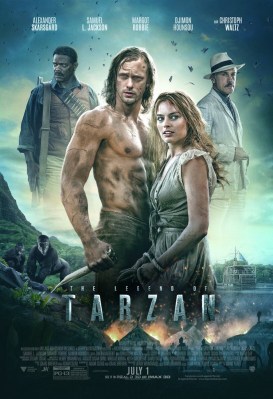 and so anyway it turns out that the best thing about The Legend of Tarzan (2016) – apart, obviously, from the scantily-clad Alexander Skarsgård – is not that it represents big-budget Hollywood finally drawing attention to, and giving a nuanced, accurate and genuinely harrowing account of, King Leopold’s genocidal regime in the Congo Free State, which killed roughly ten percent of the population of all of Africa, because it doesn’t do that, nor is it Christopher Waltz’s feature-length audition tape for the role of Hercule Poirot’s evil twin brother in some awful modernising ‘reboot’ that no-one wants of a well-loved character that will undoubtedly be directed by Guy fucking Ritchie, no, the best thing about The Legend of Tarzan is that, terrible as it is, even with its genuinely well-intended but miserably inadequate revisionism, it still somehow manages not to be the worst Margot Robie film directed by someone called David I have seen this week…
Suicide Squad (David Ayer 2016)
 and so anyway it turns out that the best thing about Suicide Squad (Ayer 2016) is not that it reminds you of just quite how good – and subtle – a film The Dirty Dozen (Aldrich 1967) is but of just quite how good – and subtle – literally any and every other film you have ever seen is…
Ballard’s Cinema: Notes for a Retrospective – Track 12 (Joseph Losey 1967)
 Frustrated at repeatedly missing out on the chance to film one of Ballard’s novels, Stanley Baker optioned a number of his short stories through his production company Oakhurst Productions, including ‘Track 12’ (1958). Of the intended anthology picture, only one, the 22-minite ‘Track 12’, was completed, shot by Joseph Losey from a script by Harold Pinter, during a break in production on Accident (Losey 1967).
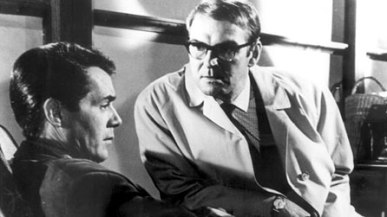 Dirk Bogarde is chilling as the diffident biochemist, Sheringham, avenging his cuckolding by Baker’s robust Maxted. An unbilled Julie Christie was persuaded by Bogarde, who had worked with her on John Schlesinger’s Darling (1965), to provide the glimpsed fragments of Susan Sheringham’s face and body – and the overwhelming, screen-filling kissing lips of the film’s startling conclusion, an image that had a profound influence on David Cronenberg’s Videodrome (1983).
Christie would, of course, go on to co-star in Losey’s Palme d’Or-winning The Go-Between (1971), his fourth and final collaboration with Pinter; and Ballard later scripted the contemporary sequences that saved Pinter’s adaptation of John Fowles’s 1969 The French Lieutenant’s Woman, directed by Karel Reisz in 1981, from mere historical pictorialism.
Other films in the retrospective
Apocalypse Now (Francis Ford Coppola 1979)
Carry On Getting It Up (Gerald Thomas 1977)
The Drowned World (J. Lee Thompson 1974)
The Drowned World: The Director’s Cut (J. Lee Thompson 2015)
El Dorado (BBC 1992-93; 156 episodes)
Gale Force (Val Guest 1967)
Jodorowsky’s Burning World (Frank Pavich 2013)
 Mark Bould