Robot birds…


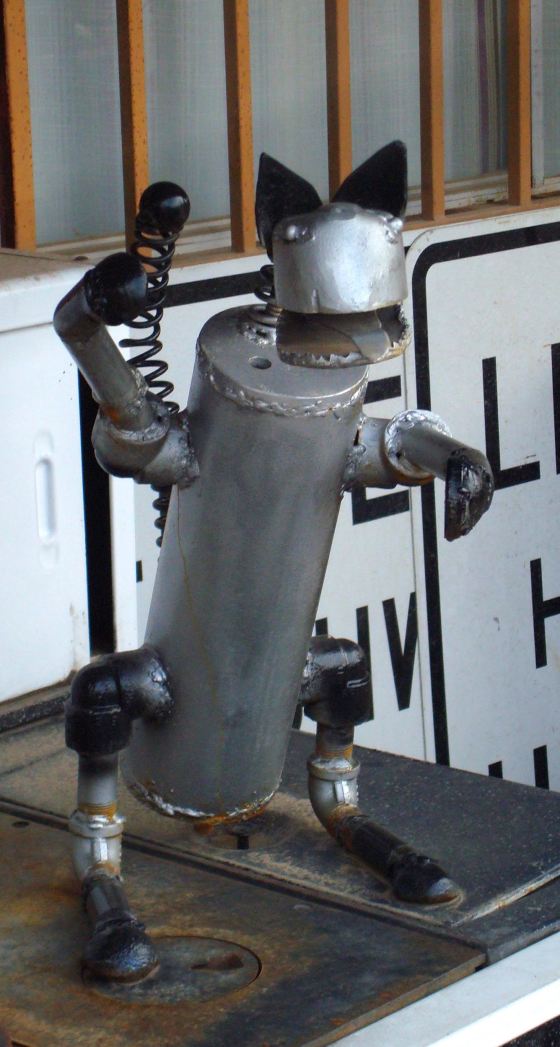
…and the robot cat that stalks them.
The iron dragon.


Sometimes in the desert it is better to just not ask.

Robot birds…
…and the robot cat that stalks them.
The iron dragon.
Sometimes in the desert it is better to just not ask.
The Sarlac pit


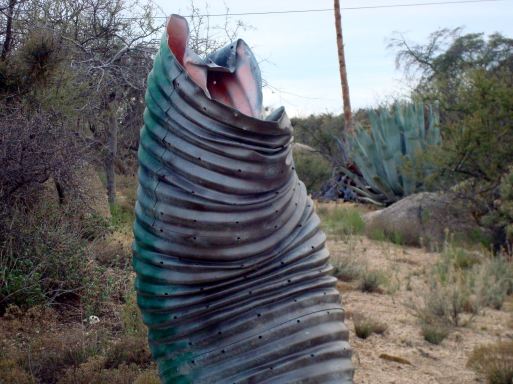
Holy shit!


 [The last of the pieces written for that book on sf adaptations that never appeared]
Written in 1920, ‘From Beyond’ is an early, minor Lovecraft story. Crawford Tillinghast’s new invention stimulates the ‘unrecognized sense-organs that exist in us as atrophied or rudimentary vestiges’, enabling him to perceive the ‘strange, inaccessible worlds … at our very elbows’ (90). The narrator, summoned by Tillinghast, finds his previously stout, clean-shaven friend a dishevelled, muttering, yellow-skinned shadow of his former self. After switching on the machine, Tillinghast warns the narrator not to move, because the rays that enable them to see beyond also make them visible to whatever exists there. As the narrator’s ‘augmented sight’ (95) develops, he perceives roiling clouds, a temple, the cosmos, ‘huge animate things brushing past … and occasionally walking or drifting through my supposedly solid body’ (94–95), another realm ‘superimposed upon the terrestrial scene much as a cinema view may be thrown upon the painted curtain of a theatre’ (95). The laboratory fills with ‘indescribable shapes both alive and otherwise’, with ‘inky, jellyfish monstrosities which flabbily quivered in harmony’ with the machine’s vibrations (95). The ecstatic Tillinghast has ‘seen beyond the bounds of infinity’, ‘drawn down daemons from the stars’, and ‘harnessed the shadows that stride from world to world to sow death and madness’ (96). The things pursuing Tillinghast come for the narrator, who shoots the machine. He passes out and Tillinghast suffers a fatal apoplexy. The narrator can never forget the teeming, invisible world around him, or shake the feeling that something hunts him still.
Following the success of Stuart Gordon’s Re-Animator (1985), adapted from Lovecraft’s ‘Herbert West – Reanimator’ (1922), Charles Band’s Empire Pictures, its US distributor, offered Gordon a three-film deal. Gordon pitched an adaptation of Lovecraft’s ‘Dagon’ (1919) but Band preferred one of his alternative suggestions, ‘From Beyond’ (Gordon would eventually make Dagon in 2001). Since Lovecraft’s story is little more than a single scene – and one that would be prohibitively expensive to film – Gordon, screenwriter Dennis Paoli and producer Brian Yuzna adapted it as the opening sequence: Tillinghast (Jeffrey Combs) switches on the Resonator for the first time, and a piscine creature, swimming through the air, attaches to his face like some monstrous leech, tearing open his cheek; when his boss, Dr Pretorius (Ted Sorel) – named after Ernest Thesiger’s wonderfully queer mad scientist in Bride of Frankenstein (Whale 1935) – activates the Resonator, something tears his head off. We are not shown Pretorius’s demise. It is the last time the film will show such restraint.


Lovecraft’s unseen realm, populated by fragmentary teratalogical wonders, can be interpreted as figuring all that is excluded from what Jacques Lacan calls the symbolic order; and weird intrusions from there can be understood in terms of what Julia Kristeva describes as the abject – things that are neither subject nor object, neither living nor dead, and which are often associated with female bodies and queer sexualities. Although From Beyond now seems quite innocent, twenty-five years ago its escalating and increasingly elaborate special effects sequences looked like a handbook of post-structuralist psychoanalytic theory.
Tillinghast is committed to an asylum run by the draconian Dr Bloch (Carolyn Purdy-Gordon), named after Lovecraft’s friend and protégé, Robert Bloch. The police hire ‘girl  wonder’ psychiatrist, Dr Katherine McMichaels (Barbara Crampton), to determine whether Tillinghast can stand trial. Along with the cop Buford ‘Bubba’ Brownlee (Ken Foree), she takes him back to the house, where she discovers evidence of Pretorius’s BDSM predilections and reconstructs the experiment that, according to Tillinghast, released whatever killed his mentor. A toothed, tentacled creature attacks Bubba, and Pretorius returns, monstrously transformed, before Tillinghast can switch off the machine. McMichaels, sexually aroused by the Resonator’s stimulation of her pineal gland, is compelled to turn it back on. Pretorius returns in even more hideous form. The enormous slug-like creature that sucked his head from his shoulders fastens on to Tillinghast, tearing of his hair before the Resonator is again switched off. McMichaels, fascinated by the BDSM clothes and equipment in Pretorius’s room, dresses up in dominatrix gear and attempts to have sex with the unconscious Tillinghast and with Bubba. Her sexual energy reactivates the Resonator, unleashing locusts that strip Bubba’s flesh to the bone. Returned to the asylum, the mutating Tillinghast becomes hungry for human brains. He sucks out one of Bloch’s eyes and eats her brain through the socket. McMichaels and Tillinghast return to Pretorius’s house for another extravagant display of sexual apparatuses and gloopy special effects before the Resonator is destroyed.


From Beyond never quite achieves the gleeful excesses of Re-animator, although that did not prevent the MPAA refusing it an R certificate three times before finally approving a cut. Nor did it enjoy the same critical and financial success or cult afterlife. Its prosthetic and make-up effects were soon surpassed – not least by Screaming Mad George’s work on Yuzna’s Society (1989) three years later – and its use of lurid purples and greens whenever the Resonator is switched on now seems like some archaic VHS aesthetic.


Although the original story lacks the adjectival proliferation associated with Lovecraft’s relentlessly failing specificity of otherness, the film’s comic tone detracts from the special effects’ ability to convey the gross materiality that Lovecraft strove to catalogue. Gordon is not concerned to replicate the critical seriousness of Videodrome (Cronenberg 1983), but his slapstick humour is not as well developed or focused as that of the young Sam Raimi and Peter Jackson. From Beyond’s more salacious content lacks the shock-value of Re-animator’s notorious cunnilingus scene, while its elaboration of Lovecraft’s sexual undercurrents pales in comparison to Clive Barker’s Hellraiser (1987). But it is still worth watching, if only for Combs’ remarkable performance. He is adept at conveying with just his eyes the eagerness, hope, anxiety and inarticulate regret of a young man a long way out of his depth. The intensity he brings to the role contrasts with the blandness of everyone else in the cast. It is as if he really has seen beyond and knows more than he should.
References
H.P. Lovecraft, ‘From Beyond’, in H.P. Lovecraft Omnibus 2: Dagon and Other Macabre Tales. London: HarperCollins, 1994. 89-97.
 *************************************************************
*************************************************************
*************************************************************
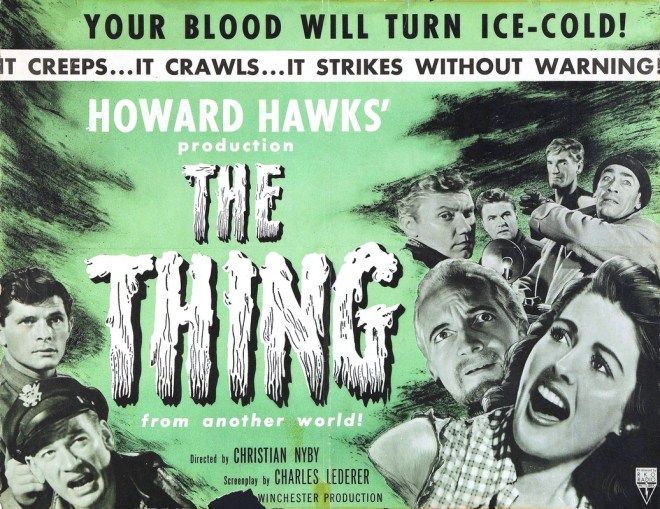
These airforce men are
Such manly men’s men. That’s why
It’s called a cockpit.
When flyboys hit on
You, here is a tip: disarm
them through alcohol.
Drink him under the
Table, girl. Octopus hands
Flailing. Evaded.
Haematophagous
Reproduction. Better than
Fucking a flyboy.
By computation.
That’s how we computed it.
By computation.
SOP. Beat ’em
Or thermite bomb ’em. They go
Up pretty easy.
Electric blanket
Blamed. Quartermaster facing
Investigation.
Chiefs of Staff issue
New regulations about:
Blankets, electric.
Seventeen people.
Academy ratio.
Medium shot. Awe.
No. It is not so
Much a super-carrot as
An above par-snip.
There’s only one way
To let a girl know you’re keen.
Flaming kerosene.
Show her how hot you
Are in bed. Torch the mattress
She’s hiding behind.
Carrington. New York
Jewish Commie Queer. And worse.
An intellectual.
Homophobia
Trumped by homophonic
Play on Ark and arc.
From outer space it
Came. To steal arctic footwear.
Keep watching the skis!


It is difficult to express quite how disappointing chapter seven, ‘Queer Lodgings’, turned out to be.
If you’ve been following this, you might understand when I tell you that the only cave in this chapter is ‘a little cave (a wholesome one with a pebbly floor)’.
Sure, there’s the self-important Lord of the Eagles, who’s a little camp. (He will, we are told, become the King of All Birds. Quite how every avian species and society came to be governed by the dynasty Accipitridae remains unclear. I bet it was by bloody violence. It is always by bloody violence).
Beorn is a bit more interesting. He is a shapeshifter or skin-changer, and there is something queer in his were-bear duality; after all, he is the kind of bear who is ‘a great strong black-haired man with huge arms and a great beard’.
But there is something uncanny about him, too. Something a little unpleasant.
It’s not just that his grey dogs can walk around upright on their back legs, a detail that becomes all the creepier for the way Tolkien just throws it in without elaboration.
It is that Beorn keeps trophies from his kills. A goblin head stuck on something outside his gate. The flayed skin of a Warg nailed to a tree just beyond it.
No doubt, if there were buffalo roaming between the mountains and Mirkwood he would skin his humps.
Then Gandalf – as arbitrarily as an author just making stuff up – buggers off, leaving Bilbo and the dwarves to the perils of Mirkwood.

The perils of the arachnid monstrous-feminine, the archaic mother:
The entrance to the path [into Mirkwood] was like a sort of arch leading into a gloomy tunnel made by two great trees that leant together, too old and strangled with ivy and hung with lichen to bear more than a few blackened leaves.
Like Giger for kids. And with spiders. You know, evil female weavers, and that whole shtick about weaving supposedly originating in women, driven by phallic envy, plaiting their pubic hair.
There they wander, losing their way, slowly running out of supplies. Exhausted. Starving. Trolled by wood-elves. Who are basically dicks.
Bilbo, separated from the company, has ‘one of his most miserable moments’, but steadfastly refuses to let despair overwhelm him, and instead starts thinking ‘of his far-distant hobbit hole with its beautiful pantries’ and ‘of bacon and eggs and toast and butter’.
Is it still a truism of children’s literature studies that food, in its sensual excess, stands in for sex? That would explain what happens next: ‘he felt something touch him. Something like a strong sticky string against his left hand’
Bilbo finds where the dwarves are all hanging, tightly bound in spider threads. He puts the ring on and runs around for a while, with only his little sword visible – ‘I don’t suppose [the spiders] knew what it was’, Tolkien adds, but – like Bilbo – you might want to take a wild stab in the dark. Anyone? Anyone?
You want a clue?
When the spiders are distracted, Bilbo frees his companions, beginning with Fili, identifiable by ‘the tip of a long nose poking out of the winding threads’.
Anyone?
Having escaped the spiders, the dwarves are next captured by the wood-elves who, just a little mysteriously, do not live in the woods but in – you guessed it – caves. Invisibilbo rescues them. And they escape by nicking a trick from Derek Flint.
Okay, chronologically that makes no sense, but I remember feeling cheated when I first read the novel because I had already seen the awesome James Coburn use the same method to save his, er, lady friends. (It is nice though that the chapter in which this happens is called, it turns out, ‘Barrels out of Bond’.)
********
There is actually, in passing, a really bleak moment. Bilbo used his ring of invisibility to avoid capture, but finds himself hiding in the midst of the wood-elves for days and weeks (and possibly months, but I nodded off a little in the middle):
‘I am like a burglar that can’t get away, but must go on miserably burgling the same house day after day,’ he thought.
Nicely played, JRR. As unexpected as dogs on the hind legs waiting table.
 It is entirely possible your mother has told you that Henry Rollins is no fun.
Do not trust her.
He Never Died (Krawczyk 2015) is a low-budget not-quite horror, not-quite crime thriller, that is never quite brilliant and never quite camp. Jack (Rollins), a grey-haired, middle-aged man, lives alone in a small apartment, oddly disconnected from the world. He does not have a job. He keeps odd hours. He eats at the same diner every day. Most days he goes to the local church to play bingo not with but near the old folks; they do not distract him, he explains.
He keeps himself to himself.
His interactions with people are oddly stilted. He offers nothing. He states the obvious. He doesn’t get them. He is Keaton-level deadpan. (His one loquacious moment is a flatly delivered, seemingly interminable list of the many jobs he has had. That bit is actually quite brilliant.)
Oh, and he’s an immortal cannibal. Just about holding it together by not eating meat and by drinking the blood he buys from a hospital intern. That way he doesn’t kill people. He has a very long history of killing people. In fact, he started it.
But now, in a Toronto that is shot as often as possible to look like an Edward Hopper painting to convince us it is somewhere in the US, someone with a grudge is coming for him.
They don’t know what he truly is.
But they get, rather bloodily, to find out.
All this, however, is beside the point. The film is about something else entirely.
It is about watching the ageing Rollins.
There is something geological about his body. Present. Weathered by time.
It is about his weary face, crumbling like granite.
It is about the slow dawning of mortality. And about carrying on.
And through all of this, Henry Rollins is no fun. (Except, of course, that he is.)
 Do not be fooled if your local arthouse tries to advertise it like this: ‘Featuring some of the most mesmerising underwater cinematography this side of Jacques Cousteau and containing undertones of the weird horror fiction of HP Lovecraft…’
They have to do it that way round cos they’re an arthouse cinema, and they figure their main audience is going to be the people who want to see Cousteau-like cinematography. And it is indeed mesmerising, rendering the world beneath the waves beautiful and alien all at once.
But the film is really for those who like their fiction weird. And who want to know where babies come from.
An oddly piscine-looking woman raises a ten-year-old boy, Nicolas, in a white-walled coastal village full of oddly piscine-looking women, each of whom is raising a ten-year-old boy. The landscape is vaguely volcanic, the beach and streets covered in cinders. They live on a diet of khaki mush filled with worms, and every day, Nicolas must take four drops of medicine that looks suspiciously like cephalopod ink. He claims to have seen a dead boy on the sea floor with a red starfish on his belly. His mother dives to retrieve the starfish, thus ‘proving’ there was no dead boy.
 The camera is generally static. No one says very much.
But Nicolas senses something is not right. Where do the women go by lantern-light once their boys are asleep? What is going on at the medical facility along the cliffs? Why do all the boys eventually go there? What happens to them?
It is difficult to write more without giving too much away. Plus, the film tends to live and resonate in its obscurities, its half-glimpses and elliptical cutaways, its silences and incompletions, so writing much more would also pin down meanings in a way which counter the film’s affect. Suffice to say, there is not just Lovecraft here, but also a Lynchian suspension of meaning, the surgical/gynaecological horror of Cronenberg, a hint of del Toro’s El espinazo del diablo but without the boys adventure literalness of his ghost story, and of The Wicker Man‘s odd local customs, and even of Brian Yuzna’s Society but without the comical excesses. (There is nothing comical about this film.) Hadzihalilovic has also mentioned in interview the influence of Theodore Sturgeon’s The Dreaming Jewels.
For a while near the end you start to think it does not know how to end, but then its final shot reframes all that has gone before as a document of the Anthropocene.
It is probably the creepiest, weirdest-on-first-viewing film I have seen since Tsukamoto Shinya’s A Snake of June, and easily the best thing I have seen in a cinema this year.

[A version of this piece appeared on the Salvage website]
We live in a world being made monstrous.
By us. Inhuman and obscene (and anthropocene). Not merely unhomely but uninhabitable.
And it is a time of monsters.
Aliens and kaiju, zombies and mutants, giant robots and costumed freaks lay waste to our cities. Rumbling urban smackdowns between unknowable forces scorch the Earth for those with an eye to the main chance. Property developers. Gentrifiers. Buy-to-let landlords. Their snouts in the tattered remains of a public purse no longer really intended to serve the public. At the same time, politicians and journalists casually – and with the most deadly of intentions – label people on our borders and estates and social security as not really human at all.
Monsters mean.
They are good for thinking with – from Marx’s vampire capitalists and cyborg factories to the brain-eating undead ghouls that shamble relentlessly across all our post-millennial screens, large and small, dragging the mechanisms by which biopolitical states of exception operate out into plain sight.
Even though monsters might not exist they are the most material of metaphors, and more than mere metaphor.
They matter and make meaning.
Monsters refuse monstrosity.
In Tade Thompson’s ‘One Hundred and Twenty Days of Sunlight’, a deliberately self-interred then accidentally disinterred West African vampire tells his tale. He turned his back on the human world, but had to return to it to learn how to be in a world to which he could never belong. With chilling composure he observes armies clash and people kill for reasons he cannot fathom. He remembers a tale he was told in childhood in which – reworking Dracula’s voyage to Britain – one of the vampire kind, taken unknowingly, broke free in a slaveship and killed everyone onboard. Despite this, the monster, it is clear, was not the real monster. Like the protagonist, the monster refuses – rather than denies – monstrosity. The monster resists and refutes it. He buries himself. He walks away.
‘He had the combined face of a pig and a monkey, which comforted her.’ And so it should. All of us.
Even if we must rip this line from Dilman Dila’s ‘Monwor’ completely out of context.
You must look closely to spot the monster. Although it’s not hard.
The eponymous and implied monster of Tendai Huchu’s ‘The Chikwambo’ is a motley being, an exquisite corpse: it has ‘the face of a new born baby’, albeit with ‘the head dangl[ing] to the side as if stitched up to the neckless body’, and the ‘hands’ of a ‘monkey, the legs of a baboon and [a] torso made of a patchwork of cloth and dried animal skins, fur from rabbits and cows’. A Chikwambo is created by huroyi, or witchcraft, usually for a businessman looking to get rich. All he needs to do is feed it with a relative’s blood and ‘that blood metamorphose[s] into money’.
It’s a labour-power equation. The Chikwambo can eat or die; the businessman should fuck off and die.
Likewise, in Chikodili Emelumadu’s ‘Bush Baby’, there’s a wastrel gambler turned thief, the gwei-gwei pursuing and torturing him for stealing its mat, and the men who lied to the wastrel gambler thief, tricking him into stealing from the forest-spirit even though they know it will cost him – agonisingly – his life. Spot the monster.
Is there some calculus by which we can determine the moment at which the becoming-monstrous occurs? At which capital is embodied and the capitalist becomes capital?
When the monster is monstrated and the line is drawn, the monstrator is always on the wrong side of it.
See Apartheid (cf. James Bennett and Dave Johnston’s comic ‘A Divided Sun’).
Monsters are the world.
In Zambia’s Ndola sunken lakes the Ichitapa lurks. If your shadow falls on the water, the monster will cut it from your body, and you will fall into the water and be devoured. There were thing here before us, Jayne Bauling’s ‘Severed’ tells us, things we cannot account for. Things that will remain long after we – individually and as a species – are gone. They predate us, and they pre-date us, and they will be our post-.
There might be a time when the only ethical thing left for us is, as a character in Vianne Venter’s ‘Acid Test’ seems to think, a radical green accelerationism. Bring it all down, and let the world return.
(Delightfully, and perhaps instructively, Ndola is a twin town of Aldershot.)
Your description of the monster misdescribes the monster and destroys it.
In Joe Vaz’s ‘After the Rain’, strange and deadly things emerge from the abandoned mines swiss-cheesing the ground beneath Johannesburg. Even the bugs in the mountainous mine dumps fear these creatures. They prey on township folk, like some contorted repressed returning, a reminder of the suffering and immiseration and state violence under Apartheid and since.
Mistaken for ‘long skinny men with dog-heads’, the creatures turn out to be dogs, ‘standing on long hind legs, balancing [their] weight on the tips of [their] paws’, a correction that is also mistake. Whatever they are, they are that, not something or some other thing that they resemble. Not the isomorphic protagonist, who got out as a nine-year-old back in 1986 and only now, thirty years later, returns.
But this is what happens when the monster ventures from its lair into normalcy.
Its angularity, its awkward and improbable being, its ferocity and anguish, get domesticated. Like a dog.
‘History is what hurts’, Jameson tells us, failing to add: ‘That, and monsters’.
They hurt and they hurt. They are in pain, and they bring pain.
Like the witch in Sarah Lotz’s ‘That Woman’ and the women who support and protect her because justice is not going to come from patriarchy or the state. Like the daughter of the old witch in Joan De La Haye’s ‘Impundulu’, who unleashes her just rage and anguish – and the eponymous lightning bird – not only on the man who raped her and made her miscarry but on all those who would take his side. On what we, often glibly, call rape culture and patriarchy.
As if naming them contains them.
The other has just as much right (and wrong) as the self.
Which doesn’t mean it’s easy or comfortable, as Su Opperman’s grotesque comic ‘The Death of One’ shows us.
Although maybe I’m reading it wrong. Maybe what I should be paying attention to is the page split into four panels, across the top two of which the man says ‘the death of one is…’ and across the bottom pair of which the sawtooth-beaked, bird-headed man-thing with too many eyes concludes ‘…is life to the other’. This is not some Lion King circle-of-life pablum, but a call for the dissolution of the monadic subject (and his comedy sidekick, the rational economic actor). An invocation of full communism.
‘If you see a monster at your doorstep’, Grandma says in Nnedi Okorafor’s ‘On the Road’, ‘the wise thing to do is shut the door’. Grandma is wrong.
The other is not really other, Lacan says, it just reflects and projects the ego. The Other is radical alterity. It cannot be identified with. It cannot be assimilated. It is unique and beyond representation and it is also the system of representation – the symbolic – that mediates the relationship between the radical, unassimilable alterity of subjects. The Other we first encounter is – quelle surprise! – the mother, defined of course by her phallic lack, which in turn figures the signifier that is always missing.
‘There is an abyss between this world and the next,’ the narrator of Toby Bennett’s ‘Sacrament of Tears’ writes, ‘I fear my nephew looked deep and could not make sense of what he saw’.
But perhaps the abyss is not a vagina, and the vagina is not an abyss.
Perhaps difference is not a lack at all.
Perhaps difference is an opening-out, a flowering into the realm of monsters. Which is where the monadic phallic white subject already, unbeknown to himself, lives. Along with us all.
Perhaps, like the queer, monster-embracing protagonist of Nerine Dorman’s ‘A Whisper in the Reeds’, we should not focus so much on the monster entering our world but instead on going away from here with the monster. On becoming monster.
Because difference is an opening-out onto that place beyond, which is called hope or utopia.
Not just full communism.
Full-on communism.

 Mark Bould