Best Cocktails at Hotel Congress, John Dillinger’s old hangout
Worst Coffee at IHOP
Best Seeing a coyote, dozens of pronghorn antelope and thousands of sandhill cranes in the wild
Worst Seeing open carry in a pro-gun diner that advertises, with a crossed guns logo, that they never call 911
Best The Border Patrol checkpoints that couldn’t be bothered to stay open in the rain
Worst The Border Patrol checkpoints that just waved us through because we are white
Best Hiking in the Chiricahua mountains, where Geronimo and Cochise hailed from and held out
Worst Visiting Fort Bowie and Apache Pass, site of the Bascom affair and instrumental in the defeat of Cochise, Mangas Coloradas and the Chiricahua Apaches
Best Not having food poisoning
Worst Having some kind of contagious bug with the same kind of symptoms
Worst Having the plane from Chicago to Tucson cancelled because of a mechanical failure, only to have its replacement cancelled because of a mechanical failure and then its replacement cancelled because of a mechanical failure
Best Getting a working plane from Chicago to Tucson
Best Accidentally teaching baby Eli, who at that point had not even worked out it was possible to walk backwards, to moonwalk
Best Walking in the footsteps of Glenn Ford at the ranch where the original 3.10 to Yuma was shot
Best Taking break from the Roger Moore series of Maverick (after the episode written by CL Moore as Catherine Kuttner) to watch the first half of James Garner’s return in Bret Maverick
Best Somehow missing the Marty Robbins museum
Best The extraordinary tortilla in which my otherwise very ordinary burrito was wrapped at Mi Casa
Best Finding occasional traces of an American cuisine that does not feel it necessary to include mediocre American cheese melted onto or into it
Best The name of the Quantum Mechanics Nail and Hair Parlor
Best The crazy second-hand bookstore hidden away in ranch in the middle of the desert
Best The lovely and crazy old lady who runs the crazy second-hand bookstore hidden away in ranch in the middle of the desert
Best Her dog
Most ambivalent Finding oneself thousands of miles from Bristol talking to a woman from Cardiff who was equally dismissive of Arizona’s attempt at a torrential downpour
Most ambivalent Star Wars: The Force Awakens
Category: Places
Piqued Oil
 [A version of this piece first appeared in Salvage]
On 28 September 2015, Royal Dutch Shell – suddenly and without warning – announced their withdrawal from exploratory drilling in the Chuckchi Sea. This decision will cost them, depending on who you ask, somewhere between $4-8 billion in terms of money already spent or contractually committed. Many have found reason to celebrate this announcement – especially when it was followed a couple of days later by Alberta’s governor, Rachel Notley, declaring that there was no long-term future for the province or Canada as a whole to be found in the continued exploitation of the Alberta Tar Sands.
But for others, Shell’s press release – a bland technocratic utterance, an oleaginous misdirection, terse, wilfully oblique – was a cause for concern, a weird provocation.
What exactly has Shell done up there off the coast of Alaska? What have they found? Why are they not talking about it?
What haematophagic vegetal Thing from Another World did they accidentally defrost? What therianthropic congeries of cellular neo-liberalism? What ripe metaphor? What ravening alien maw?
How long until our skies are darkened by fleets of Nazi UFOs pouring out from the Hohlweltlehre’s Fourth Reich? How long until our lands are ravaged by their subhuman legions of Dero Sturmtruppen?
Did Shell really mistake that oozing nightmare plastic column of foetid black iridescence for oil? What rough shoggoth, its hour come around at last, is now slouching southwards to consume us? What Hyperborean sleeping abnormalities, what blasphemously surviving entities, have they disturbed? To the attention of what Elder Gods have their clumsy probings brought us?
Did they drill so deep into the crust that the Earth itself screamed?
Or have Shell, rather more mundanely, had a Mitchell-and-Webb epiphany? Did they stare into the abyss and find themselves staring back? Have they realised that they are the bad guys? Are they going to apologise? Are they going to shut down their chunk of the oil industry and devote future revenues from green energy to repairing the environmental destruction for which they are responsible? Does this retreat from the arctic mark the start of a new era that recognises the unsustainability of development? An era in which existing development will be radically redistributed?
If only.
This is not Armageddon. No plucky oilmen and hot-doggin’ roughnecks are going to divert the extinction event coming our way.
This is not The Abyss. Deep-sea drilling operations are not going to uncover some watery alien messiah.
This is not even On Deadly Ground. No possible blend of motivational-poster mysticism, misappropriated indigenous culture, pony tails and lardy kung fu can stop the oil companies.
Shell is clear on this. Like recent similar withdrawals by Exxon and Chevron, this is a temporary, strategic move based on the several variables. Their main concerns at this point are ‘the high costs associated with the project, and the challenging and unpredictable federal regulatory environment in offshore Alaska’. Their announcement must therefore be seen as a statement of intent: they will lobby and exert influence to get those regulations revised in their favour; they will develop and/or await the technologies that will sufficiently lower the cost of drilling, extraction and transportation; they will wait for global warming to make the Arctic more conducive; they will rely upon – and manipulate – oil demand and oil scarcity; and then they will return.
They say they will ‘cease further exploration activity in offshore Alaska for the foreseeable future’. As if they do not foresee this one. As if this is not their plan.
Notley talks about weaning Alberta – and Canada – off fossil fuels over the next century. A timescale which, however well-intentioned, however inadequate, might just coincide with the oil in the tar sands running out anyway, as peak oil gives way to oil depletion.
So while this weird flight from the icy seas might seem like a turning point in the story of peak oil, it is, in truth, more about piqued oil.
The monotonous self-serving corporate drone of Shell’s statement is designed to conceal only one thing: they are just a little bit miffed.
But rest assured. They were already regrouping, strategising, shifting resources and priorities before they even said a word. And remember: they can’t be bargained with; they can’t be reasoned with; they do not feel pity or remorse or fear. And they will absolutely not stop, ever, until the last drop of oil is made profitable and then wrung from the planet.
Forgotten Spaces 2013
 From 4 October to 10 November 2013, London’s Somerset House, which stretches from the Strand to the Embankment, was home to Forgotten Spaces 2013, an exhibition showcasing the 26 shortlisted (of 147) entries in the Royal Institute of British Architects’ competition of the same name. Located in the Lightwells (the two meter wide subterranean passageway that runs between three of the House’s inner walls and the sides of the fountain court) and in the Deadhouse (the tunnels beneath the fountain court where gravestones were relocated during the Georgian rebuilding of the House), it is fairly minimalist: a pair of information boards per entry, including artists’ impressions and, perhaps, photographs of the location as it currently appears or as it used to be fifty or a hundred or more years ago; occasional architects’ models or dioramas; several small installations. It is as if William Gibson’s cool hunters raided the Bridge for ideas to commodify but ended up doing school projects instead.
Forgotten Spaces is a rather spectral affair. Ghosts of London’s multiple pasts appear in glimpses; histories that played out differently than expected flicker and flit among the Deadhouse stands; and each display conjures a possible future that, like the dirigible cheekily lofting in the blue evening sky above A Lost World, is never seriously intended to become reality. (Meanwhile, dancing just out of reach are reputation and the possibility of actual commissions.) The exhibition inserts possibility into deeply sedimented urban spacetime. Each entry refuses to accept that a city’s retrofitting must succumb to the dystopianism of Syd Mead’s Blade Runner Los Angeles. But utopian desire is everywhere haunted by the phantasm of corporate co-optation. Neoliberal capital frames every project. Few of them would have any chance without corporate sponsorship, and those that might get by without it—such as Urban Agri-Aqua Culture’s plan to convert an abandoned Kingston Upon Thames sewage works into a fish, fruit and vegetable farm—cannot hope to escape the inertia of property and the menace of land values.
The scale of the projects varies considerably. Bikebox wants to create a network of emergency cycle repair stations from the iconic K6 red telephone boxes falling into relative disuse across the city, while In the Canopy raises ladders up to treetop perches, opening up new vistas for adults reliving childhood tree-climbing antics. The Lepidopterium is an exotic butterfly house, situated on a patch of ground next to a railway line, itself already a haven to native species. Recalling some of London’s earliest streetlights, fuelled by methane from the sewers, Hidden Light imagines pipes that slowly telescope up into the air as they fill with sewer gas and, on reaching their full extension, burn it off in a spectacular flare before telescoping down to ground level once more.
Another piece of outmoded gas technology, the gasometer, fascinates entrants. The Gasworks retains the cylindrical lattice that used to frame the gasholder when it was above ground, and decorates it with panels off which light can be bounced, creating the effect of a giant lantern, while the cavernous space below, which held the retracted gasholder, becomes a gallery, with a long ramp sweeping down around the outer wall. A Lost World envisions several adjacent gasometers housing a zoo and aquarium, with their anaerobically digested waste sustaining a lake and wetlands. Reclaiming the Canalside has its eye on gasometers as the centerpiece of an urban park, while Sculpture & Sons seems happy merely to have a gasometer visible in the background of its five-storey reconfigurable sculpture park.
 Every bit as iconic as a phone box or gasometer is the BT Tower, which (when it was the Post Office Tower and tallest building in London) housed the megalomaniacal WOTAN supercomputer (at least according to Doctor Who’s “The War Machines” (1966)). It once had a revolving restaurant and viewing galleries open to the public, but for more than thirty years public access to this monument to the 1960s’ optimism of Harold Wilson’s “white heat of technology” has been restricted. An Aerial View wishes to convert the Tower’s aerial platforms into a public space once more, with multi-storey curtains to be pulled back to reveal the city. (Sadly, there is no plan to turn its pinnacle into a mooring mast for A Lost World’s rogue airship.)
Plunging beneath the ground, Museum of Memories is an archive of artifacts situated in the terminus of the old London Necropolis Railway (which, I swear, is, or was, a real thing). With more than a hint of Passport to Pimlico (Cornelius UK 1949) about it, Aldwych Baths is a decommissioned tube station turned swimming baths; Aquadocks is a similar, if rather more up-market, scheme for the airy, columned space  beneath the Royal Docks. In contrast, Fleeting Memories wants to bring water above ground, returning the River Fleet to the surface near St. Pancras where, according to the crafty artists’ impression, Seurat’s Bathers at Asnières (1884) will idle away London days; and The Centre for Forgotten Beer wants to recover London’s brewing history and bring long abandoned beers—their flavors and smells—back into circulation.
While some projects prioritize recycled and reusable materials, others seem mostly to harvest buzzwords (“responsive,” “innovative,” “permeable public realm”). Some are difficult to distinguish from the ongoing gentrification of Docklands and other rising boroughs. Many of those that want to recover river and canal banks seem little different—give or take a tree or two, some wetlands, or a strip of garden—to the soulless piazza behind the new Paddington Station development. A number of entries seem to belie their nature as hypermodern spaces by imagining themselves as, in Marc Augé’s terms, places. Guerrilla gardening and other urban insubordinations are pre-empted by the occasional bed devoted to urban agriculture, and innovation from below becomes draped in the discourse of increasing “food security” against a backdrop of rising global populations (as if produce from an urban fish farm might actually end up on regular folks’ dinner tables rather than the menu of a boutique restaurant).
Other, related dystopianisms lurk in equally plain view. Many entries talk about providing spaces for “the community,” but no one seems even to have consulted with actually existing communities in which these forgotten spaces exist. Has the ideological commitment to neoliberal regeneration reached the point where “the community” is always-already in the subjunctive tense? Are incoming hipsters always-already gathering, like Hitchcock’s birds? About halfway around the displays, I realized that in all the artists’ impressions there had not been a single person of color, and the only one I subsequently spotted in any of the exhibition’s images was in a “before,” rather than an “after,” picture. Is this the real future of London to be found in Forgotten Spaces 2013?
Artists’ impressions of the 26 shortlisted entries can be seen at the RIBA London website.
A version of this review appeared in Science Fiction Studies 123 (2014): 467–9.
South Wales is weird. And fantastical.
We had some time to kill before the Thee Faction and Helen Love (and others for We Shall Overcome) gig in Newport, so we nipped over to Caerleon to see the amazing Roman ruins. We did not expect to find this:
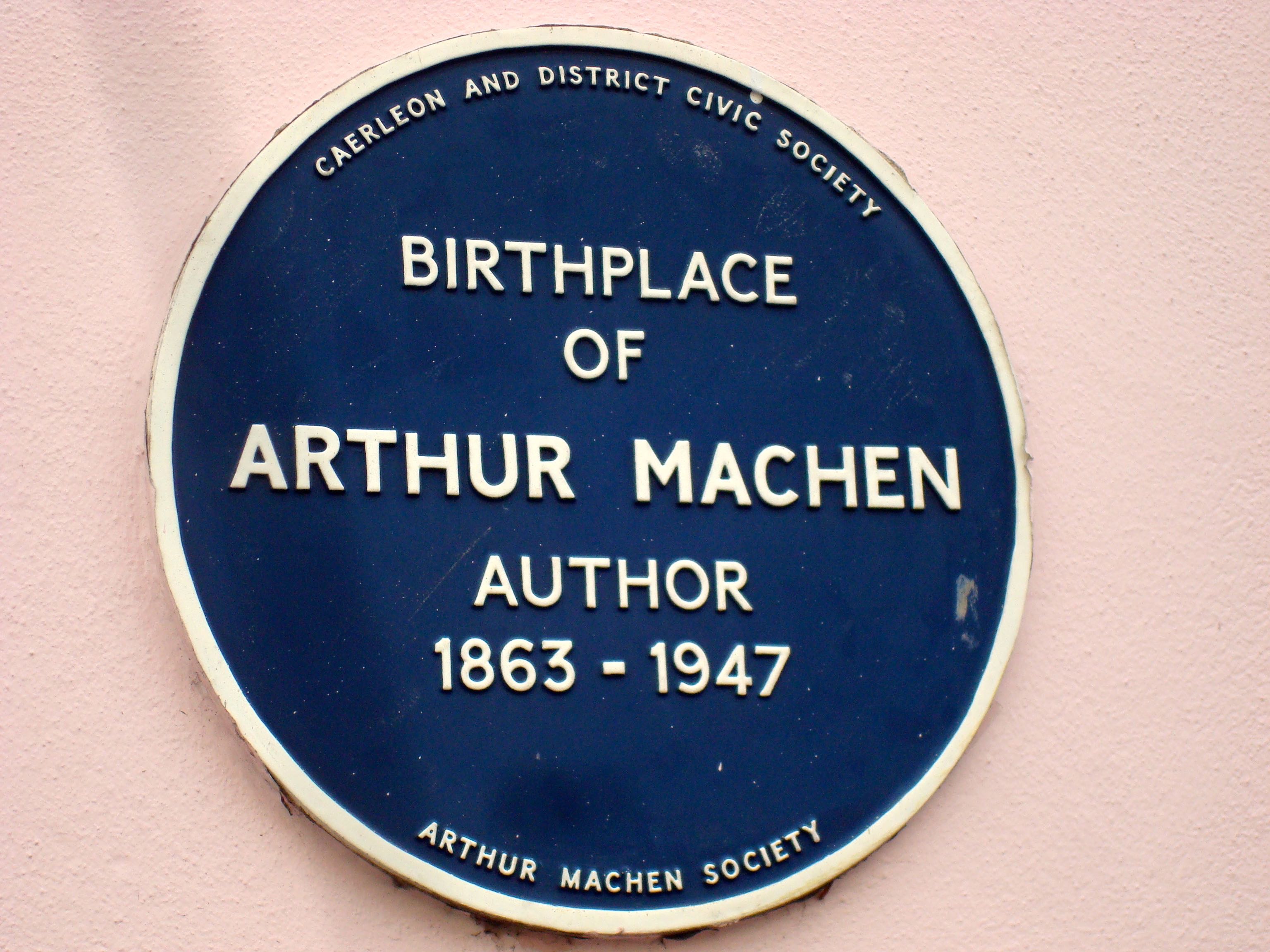
Or, on a map in the museum, to find this:
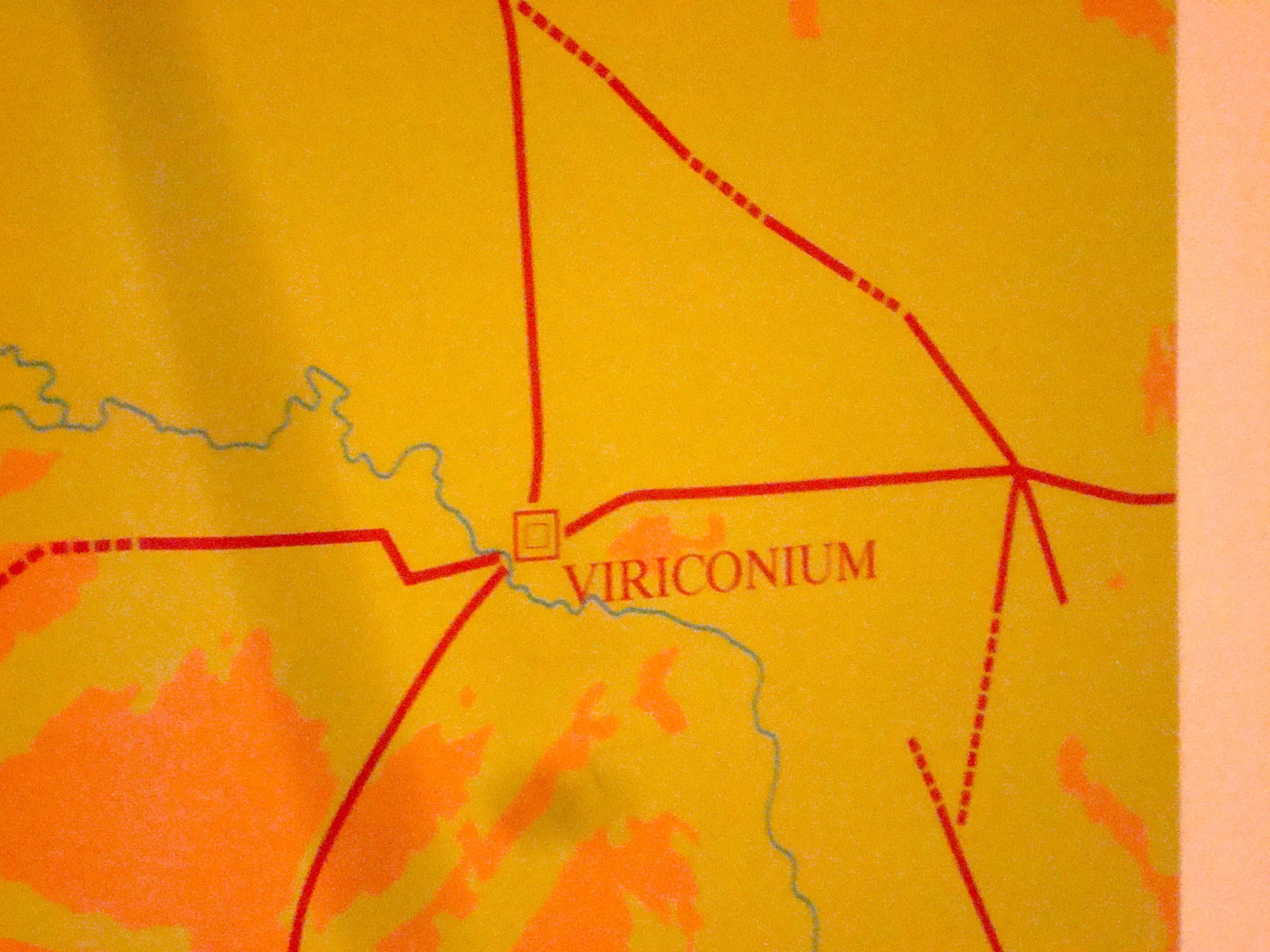
To be honest, this was probably a different guy by the same name:

Few things are more weird, though, than putting up a plaque to remember resistance to the Chartists:

Before leaving for our walk back to Newport, we thought we’d have a pint. Not expecting the pub we ended up in to be one where this once happened:

A lovely afternoon full of surprises. And the gig was even better. Once Thee Faction got on the stage. And then Helen Love.
The City in Fiction and Film, week three

One of the issues in designing a coherent new programme is working out at which level, in which module and when in that module (in relation to the other modules) to deliver certain kinds of material. When we designed the BA Film Studies twelve years ago, we decided to concentrate a lot of the film theory and critical theory in a compulsory level two (i.e., second year) module, whimsically entitled Currents in Film Theory. On the new BA Literature and Film Studies, in which students will encounter literary theory as well as film theory and critical theory, such a module seemed inappropriate, so part of our design process involved deciding what of this kind of material students needed to encounter and how best to divide it up between modules and levels.
All of which is a long way round to saying that today’s class involved an introduction to semiotics, ably supported by the first chapter of Jonathan Bignell’s Media Semiotics: An Introduction, still by far the best book of its kind – and I’m not just saying that because he used to teach me. (There will some structuralism, Marxism and feminism soon.)
By the end of the lecture, we had covered these terms/ideas from Saussure and Peirce:
Semiotics
diachronic vs. synchronic
langue and parole
the sign is arbitrary and conventional
sign = signifier + signified
the referent
syntagmatic vs. paradigmatic
symbol, icon and index
denotation and connotation
There was, as always, much exemplification through the medium of cats. (Back in the day, it was always trees, but over the last couple of decades this arboreal hegemony has fallen to a relentless feline insurgency – probably something to do with the internet and the ‘mind-control’ parasite Toxoplasma gondii.)
We’ll nail down these terms with a test at the start of class next week. A revision aid can be found here.
We looked at three texts this week – John Huston’s film of The Maltese Falcon (1941), Edgar Allan Poe’s story ‘The Man of the Crowd’ (1940) and Virginia Woolf’s essay ‘Street Haunting: A London Adventure’ (1927).
The vagaries of timetabling mean that each week the screening comes before the lecture, which is normally not a problem, but the challenge today was to come up with screening questions that are basically asking questions about semiotics without using semiotic terminology. Such as:
What kind of man is Sam Spade (Humphrey Bogart)? How do we know these things about him? How does he differ from Miles Archer (Jerome Cowan)?
How do we know Joel Cairo (Peter Lorre) is gay?
How do we know Kasper Gutman (Sidney Greenstreet) cannot be trusted? Is he also gay? Is Wilmer (Elisha Cook Jr) his lover?
How many roles does Brigid O’Shaughnessy (Mary Astor) play? How does she imply these differences?
How does Brigid differ from Iva Archer (Gladys George)? How do they both differ from Effie Perrine (Lee Patrick)?
How do we tell Lt. Detective Dundy (Barton McLane) and Detective Polhaus (Ward Bond) apart? In what ways does Polhaus resemble Sam Spade? In what ways does he resemble Dundy?
Although we did not get to work through all these questions in detail, it became very clear very quickly how much information is conveyed by costume and manner. We were obviously in the realm of signs – of signifiers and signifieds, of denotations and connotations.
When Miles walks into the office and finds Spade interviewing Brigid, the contrasts between the two men are clear and shape our understanding of each of them in relation to the other. Spade is in a tailored suit with subtle stripes, buttoned up with a precisely knotted tie; his manner thus far has been similarly professional, slightly patronising. Miles, a taller and slightly gangly figure, wears a baggier suit, unbuttoned, his shirt and tie not as neat; he makes no effort to conceal his sexual interest in Brigid, seating himself on the edge of Spade’s desk. Archer’s desk faces the window, Spade’s the door. He lacks Spade’s composure, his air of competence; Archer’s death, then, comes as little surprise.
Joel Cairo’s card smells of gardenias. He is small and feminised, his costume dapper, his hair neatly oiled curls. He wears gloves to keep his hands soft; he fiddles nervously with his cane, constantly positioning it near his mouth, suggesting some kind of oral fixation. His accent is exotic, as are the overseas places he has visited – and his surname. It is difficult to tell how much of his ‘deviant’ persona from M, which had been a hit in the US, is carried over, but it is clear that The Maltese Falcon – like many American crime films – uses queerness to connote wrongness and villainy. Some of this is evident in the corpulent Gutman, too, with Wilmer just the latest in what appears to be a succession of young men he picks up to work as his henchmen (and catamites?). However, there is an intriguing countercurrent at work. Perhaps it is the appeal of the exotic, perhaps just the brilliant performances of Lorre and Greenstreet, but neither character is particularly loathsome – and both in various ways are quite likeable.
We also noted the importance of transience and anonymity again in the representation of the city: Brigid goes by three names and at least that many personas; no-one knows their neighbours or lives in a discernible community; the closest thing to a friendship we see is between Spade and Effie (boss and employee).
Walter Benjamin says that Poe’s ‘A Man of the Crowd’
is something like an X-ray of a detective story. It does away with all the drapery that a crime represents. Only the armature remains: the pursuer, the crowd, and an unknown man who manages to walk through London in such a way that he always remains in the middle of the crowd.
We began with the moment in which the narrator first spots this mysterious man – whose appearance is a parole (speech-act) which the narrator struggles to filter through the available langue (sign system):
As I endeavoured, during the brief minute of my original survey, to form some analysis of the meaning conveyed, there arose confusedly and paradoxically within my mind, the ideas of vast mental powers, of caution, of penuriousness, of avarice, of coolness, of malice, of blood-thirstiness, of triumph, of merriment, of excessive terror, of intense–of supreme despair.
And then we took a step back to the start of the story, in which the narrator describes looking out at the crowd on a London street, abstracting himself from it, presenting himself as some kind of disembodied neutral observer, who fantasises about his ability to see without being seen. For two pages, he divides the crowd into distinct groups, and distinguishes between them by their costume, demeanour and behaviour, producing a catalogue of types, descending from the respectable professional classes down through clerks and swells, gamblers and pickpockets, prostitutes and drunks. The narrator reads the character of these people from their appearance; and the author persuades us of its accuracy and truthfulness through his careful selection of signs (words) for their denotative and, perhaps more importantly, connotative powers. No wonder, then, that ‘the man of the crowd’ comes as a shock, an epistemological limit that might undermine the certainty with which the narrator has described everyone else.
We also had a think about the following:
How does the story express the anonymity of life in the city?
How does it contrast day/night, different districts, different social or economic classes?
Who is the man the narrator follows?
What does the ending mean?
Virginia Woolf’s essay does some similar things. We thought about the connotations of the place names she includes:
the area between Holborn and the Strand
Oxford Street
Mayfair
Brixton
Waterloo Bridge
Barnes
Surbiton
Some of them retain similar connotations; others, such as ‘Brixton’, which then evoked a middle class suburb with green spaces, connotes something very different now. (Next semester we will look at some Windrush era and post-Windrush representations of London.)
Woolf begins by talking about the very personal connotations of items in one’s own room, where
we sit surrounded by objects which perpetually express the oddity of our own temperaments and enforce the memories of our own experience.
But there is an important slippage between this investment of personal meanings in a bowl or a stain on the carpet, and the connotations for readers. For the narrator, the bowl recalls the holiday in Mantua where is was purchased. For the reader, the buyer’s fond memory of the woman who sold it reeks of English class condescension, and the bowl connotes wealth, because who but the well-off could afford to spend a summer in Italy?
There is a curious passage also when the narrator visits a shoe store. A female dwarf, accompanied by two regular-sized women, reveals her perfect, full-sized, ‘arched and aristocratic’ foot. Its revelation alters her demeanour, and thus that of the people in the store. At the same time, the narrator is infected by the fantastical imagery of dwarves and giants (the regular-sized companions), and this spills over into her phantasmagorical description of the often-foreign working class denizens of the area around Seven Dials and Covent Garden. It is as if she cannot bring herself to directly describe this area and the people there. And, like Poe’s narrator, Woolf’s narrator is suddenly shocked by the appearance of a stereotypical Jew, with all the long and terrible anti-semitic baggage that evokes.
Woolf also fantasises about seeing without being seen – she describes herself as stripping away the shell of her home and becoming like the pearl in the oyster, which promptly transmutes into a giant eye, capable of observing the surfaces of things, the plane of signification. As a consequence of which, I now imagine Virginia Woolf looks like this:

I also had the opening of chapter 25, ‘A Tie With a Windsor Knot’, from Ian Fleming’s From Russia with Love (1957) to hand, but time as always was our enemy – will probably kick off next week’s class with it. (My colleague teaching the Cultural Value, Literature, Film and Consumption module will be doing some work on James Bond in the coming weeks, so it will make a nice crossover; she has been working on Sherlock Holmes this week, so I will be building on that next week.)
Recommended critical reading
Bignell, Jonathan. Media Semiotics: An Introduction. 2nd ed. Manchester: Manchester University Press, 2002.
Chandler, Daniel. Semiotics: The Basics. London: Routledge, 2002.
Monaco, James. How to Read a Film. 4th ed. Oxford: Oxford University Press, 2009. See chapter 3, “The Language of Film: Signs and Syntax.”
Stam, Robert, ed. New Vocabularies in Film Semiotics: Structuralism, Post-Structuralism and Beyond. London: Routledge, 1992. See part II, “Cine-Semiology,” on how semiotics was developed in relation to film.
Turner, Graeme. Film as Social Practice. 4th ed. London: Routledge, 2006. See chapter 3, “Film Languages.”
Recommended reading
The opening and closing pages of Nikolai Gogol’s “Nevsky Prospect” (1835) capture the bustle and variety of a modern city street.
Virginia Woolf’s Mrs Dalloway (1925) repeatedly leaps from the mind of one character to another as they walk across London.
John Huston’s film is based on Dashiell Hammett’s hard-boiled crime novel, The Maltese Falcon (1929).
Recommended viewing
Women take on the role of detectives and attempt to make sense of the city, solve crimes or discover their own identities in Phantom Lady (Siodmak 1944), Desperately Seeking Susan (Seidelman 1985) and In the Cut (Campion 2003).
Flagstones of the week
Cue jingle: ♫ favourite flagstones of the week!!!! ♫
And this week’s winners are…

These flagstones are part of the workroom floor at the rear of William Herschel’s house in Bath, where he made his own lenses and other optical equipment. In August 1871, during one such procedure, the stones were shattered by a stream of molten metal that leaked through the bottom of the furnace.
The event is recorded in the journals of his sister, the renowned comet-hunter Caroline. She later accompanied the Doctor on a series of interstellar and transtemporal adventures in a stone TARDIS.

The Hogs of Haddon Hall
In Haddon Hall, the seat of the Duke of Rutland, which dates back to Tudor times and beyond, there is a recurring porcine motif. I took these pictures intending to write about the ancient Peak District custom of once a year dressing up your prize pig as Shakespeare – a practice outlawed by an unamused Queen Victoria following an outbreak of Hamlet jokes during her visit to nearby Bakewell.


Then the light caught this chap just right and instead I planned to write about the Duke of Rutland’s unholy cross-breeding of William Hope Hodgson’s swine-things with China Miéville’s skulltopus.

But after #piggate #Hameron #swine/11 , there is nothing left to do but post the pictures and wonder quite how long that sort of thing has been happening, how widespread it is and how high it goes.

PS There was also this rather cool monkey and a strange flying ukulele-playing bagpipe monster painted on one of the walls.


The Real Magic of Glastonbury
I admit I have always been sceptical of the place, all the crystals and shit. Back when I worked the festival circuit as a steward all those years ago, Glastonbury was the one I’d always skip, and although I’ve lived just a short bus drive away for more than a decade I’ve never felt the inclination to go.
But then – through some complex alchemy of rail repairs and the inability to think of an alternative – that is where we went.
The key is to leave the centre, with its shops full of crystals and wind-chimes, questionable displays of ‘ethnic’ clothes and accoutrements, King Arthur merchandise. The key is to get away from the strangely accented American who ‘can see the energy vortexes, although they are much smaller than [he] expected’.
Be gracious – permit him the uglier plural form of ‘vortex’ – and move on!
It is out beyond the town, away from the commercialisation and tourism, that you really begin to sense what it is that draws so many people.
There is some inexplicable energy or power about the place.
You can feel it in the air.
Down there, among the huddled boxes that cower, their backs turned to the grim periphery of builders’ yards and struggling industrial parks, in pathetic denial,
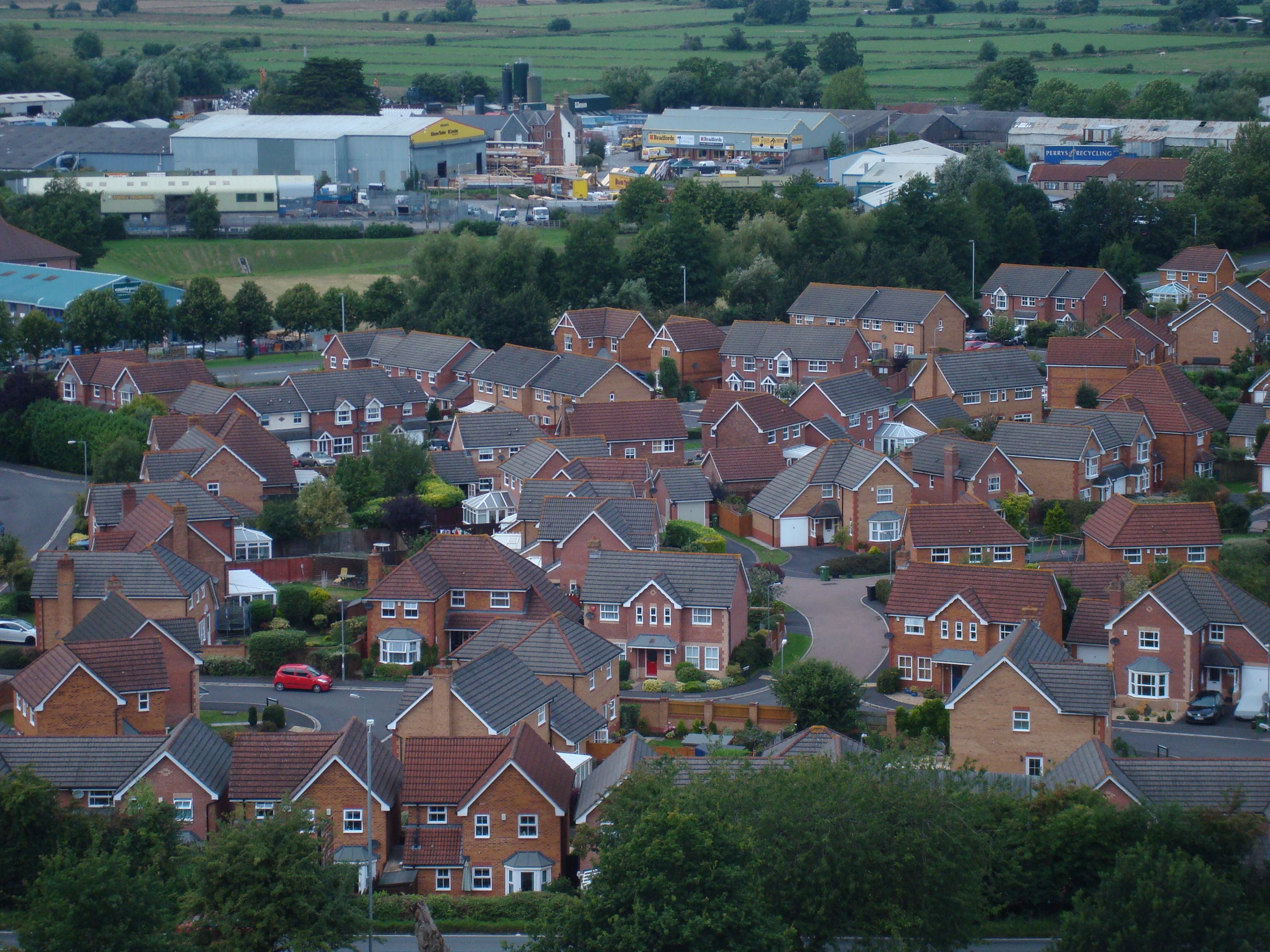
their UPVC conservatories lolling like pallid dry tongues, too enervated even to lap sustenance from the perpetual drizzle that fills the air.
Down there, cowering in the scant shelter their Tesco and their Wickes can offer from the louring sky, empty now of gods.
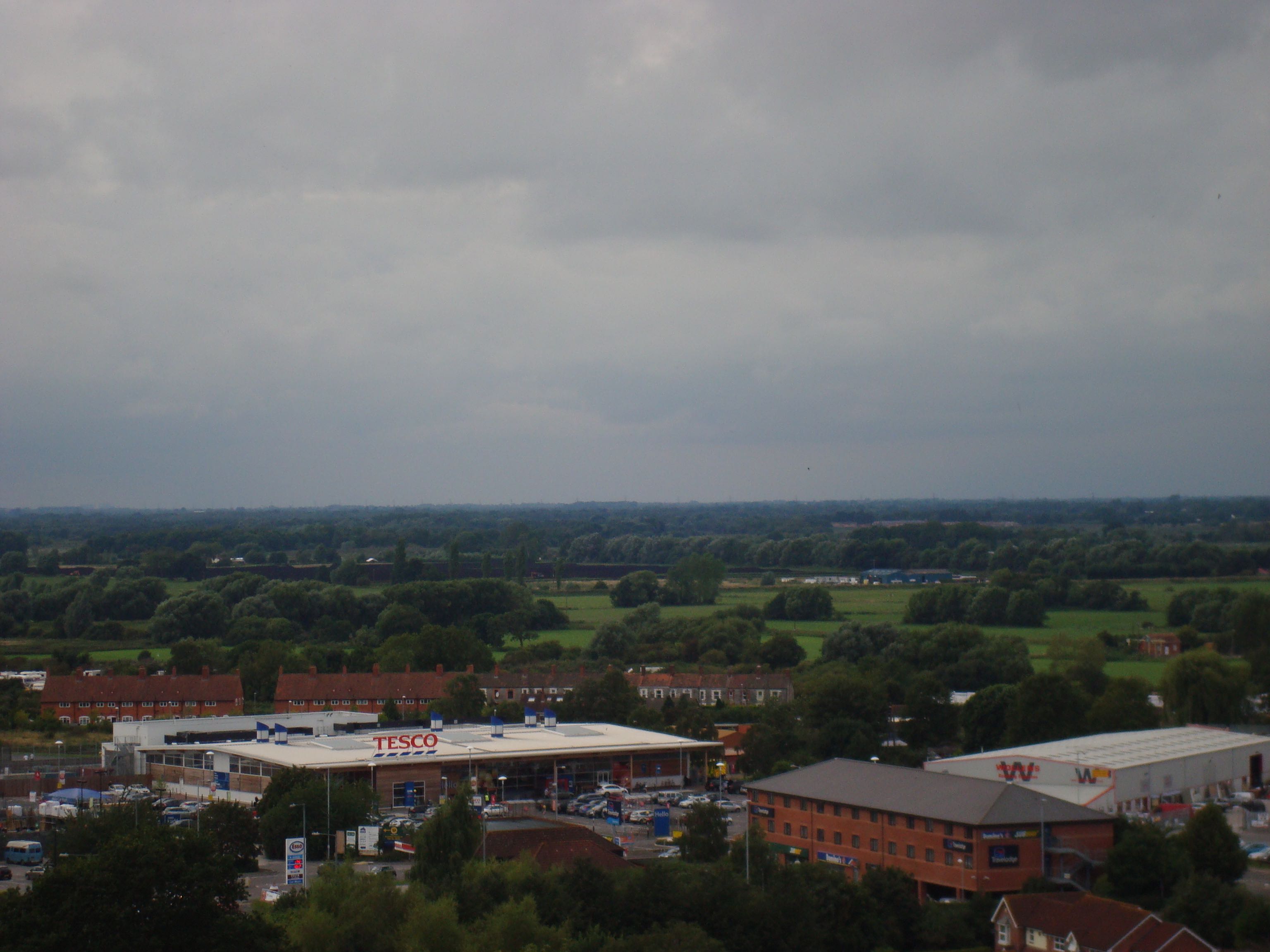
Down there, gnawing on chicken bones behind their KFC and then casting them in a desperate cleromancy.

Down there, in their antiseptic hostelries, practicing their antic anomie, their idiot sex magick.
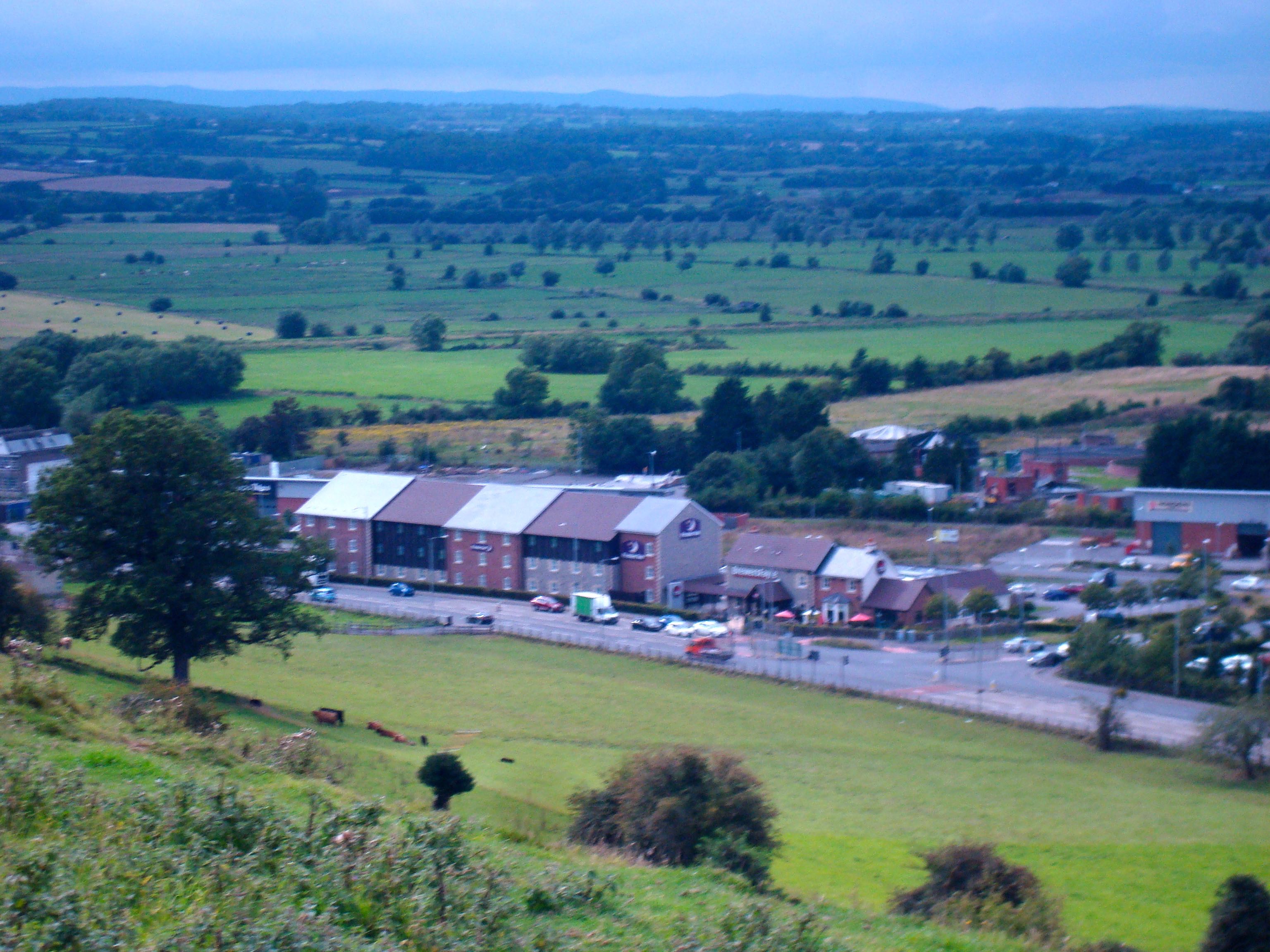
Down there, where they dream of a different world.

Down there, among the detritus of their strange rituals…

…their fevered incantations…
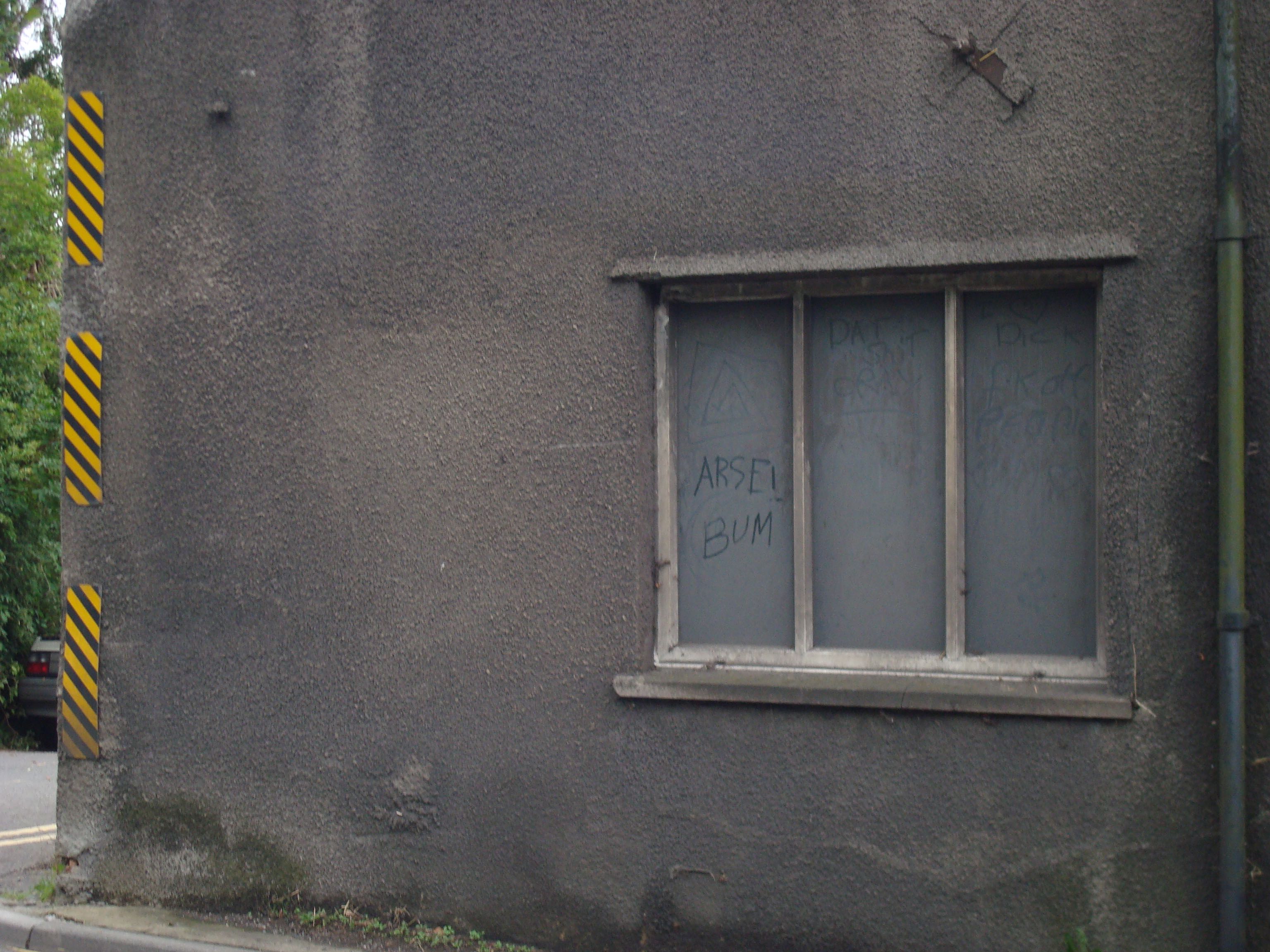
…their sacrifices…

Down there, among their baubles, their pitiable comforts…

…there is something terrifying and unerring.
Some scurfish divinity.
Some tawdry pleroma.
Some filthy backwash of the sublime.
Angry Tourist at Gentrification Ground Zero
I should have been prepared for it. The bus journey to the start of our walk had given us plenty of warning. Weaving through the steep-sided Matlock Bath, we could make out big new houses being constructed on the surrounding hilltops so that rich folks could look out onto the Peak District and down on the strange old resort village.
To be honest, it is easy to look down on Matlock Bath – thanks to a comment by Byron, it was once known as ‘little Switzerland’ and was later dubbed ‘the Venice of the North’, when in reality it is more like the Paignton of the North on a rainy out-of-season weekday when most everything is shut – but at least I feel no urge to transmute my metaphorical disdain into architectural form. (Technically, this is the moral high ground, but it is not very high at all. Or particularly moral.)
It was only when we got onto the open moorland that it became clear how far this gentrification had advanced. Everywhere you look, noble dignified proletarian grasses and ferns and gorse are being swept away by a tide of purple sprouting broccoli, advancing inexorably like the Martian red weed.
 Our long looping walk brought us onto the Chatsworth estate, home to the Dukes of Devonshire. In the 18th century, the 4th Duke reoriented the house and decided he wanted a clear prospect – to provide a startling first view of the house for approaching visitors, and to give himself a nice view of the grounds. In order to achieve this, he demolished the village of Edensor, where estate workers and others lived, and relocated them to a newly built village hidden from his view.
 There are several striking things about his new Edensor. First, it is dominated by the Estate’s massive church – just to remind the residents who exactly is in charge. Just because they are out of his sight now, they have not escaped his power.
 Second, no two buildings are alike. The Duke is said to have gone through a book of architectural pictures and picked out the ones he liked. The buildings are all rather sturdy and may well have been a significant improvement in some
  respects for the workers who moved into them.
I really wanted to hate the place, but it is so fucking picturesque that at first it is quite difficult.
But the picturesqueness is part of the reason to be really angry at this obscene display of wealth. Fucking furious at the arrogance of the man.
It is not just the social cleansing – people seeing their homes demolished and being forcibly relocated just so someone could have a pretty view – but also that, having removed these workers from his prospect, the Duke then turned them into some kind of entertainment spectacle for his family and household and guests on their way to the Estate church. And no way did he not at other times just take his chums along to marvel at the absurd village he built and the amusing people who lived there. To him, they were no more people than the plants and trees in his garden.
I guess I should calm down. After all, my sole remaining career goal is to retire and be hired by one of these hereditary parasites as an ornamental hermit. And at least the struggle goes on, as the good people of nearby Bakewell demonstrate with their proletarian commitment to not ‘fusion’ but ‘portmanteau’ cuisine.

My Holiday in the Peak District, final day
 Day 1, 2, 3, 4am, 4pm, 7, 11, 17, 21.
I should never have…
I have his dreams, I see the ancient temple beneath the rocks, I see where the face is
was
it is no longer there
later
Peering out of the windows at what my watch assures me must be noon – even in this thick caul of fog there is some light out there, though it is diffused, lacks direction, is too ambient even to cast a shadow – there is nothing but a luminous watery haze. Something moves out there. Not the black dog nor the white hare, their duty of prolepsis is long over and they have fled. What moves out there is vast and inhuman.
Sometimes I think I am the bottom of an alien ocean and above me a leviathan courses through the deeps, pursuing elephantine prey with a stately grace born of its immensity. Sometimes I feel its shadow fall on this narrow house. Terror turns to hope. How can something as miniscule as a human life even be noticed by a being so colossal?
I know this is just idle fancy.
The thing outside is terrene, mineral. Asperous. It moved so slowly for millennia that it appeared to be without life. Perhaps its liveliness was twisted out of sight in another dimension. But now it walks the Earth again.
later
It is coming for me. I know that, though not how I know that. I can only surmise that hidden in the words of the codex by some ancient steganography were words, curled up like a virus, waiting to be woken, words that infiltrated my mind, replicating and replacing neurons, wiring themselves into me. And that by some strange conjunction of influences, I was drawn here. And they leapt again, from me to the even older text Charteris unearthed, and activated something within it.
later
I see I have become quite mad.
later
What we think of as madness is really knowledge, perhaps even a kind of truth. I see the world differently now, and it is twisting me, making me other. Who knows what I will have become by the time my rescuers arrive?
But I am not so delusional as to expect rescue any more, or respite.
The thing out there is quartering the ground. It is drawing close.
It will not be long until it finds me.
later
It’s in the trees! It’s coming!
***
Fin
 Mark Bould