Out of the Unknown: ‘Some Lapse of Time’, BBC2 8 December 1965

John Brunner
John Brunner

One of the things ‘Some Lapse of Time’ gets right (and would have probably got right even if it had been a 75-minute episode as originally intended) is selecting to adapt a source of appropriate length – John Brunner’s novella of the same name, originally published in Science Fantasy (February 1963) and reprinted in Brunner’s collection Now Then just a couple of months before the episode aired. A novella has more than sufficient complication for an hour-long drama without any need for additional elaboration (or padding), while also not requiring the compression that adapting a novel might entail, such as season two’s Level Seven, season three’s Immortality, Inc and The Naked Sun or season four’s Deathday.

lapse-02Dr Max Harrow – whose young son recently died of a rare disease, heterochylia, the product of a genetic mutation caused by radiation – is plagued by a nightmare of the distant past, of immiserated primitives dominated by a shaman figure. In the small hours of the morning, after the nightmare has woken him once more, a policeman arrives at the door, having found an unconscious tramp outside Harrow’s house. To the doctor’s astonishment, the tramp seems to have survived into his thirties or forties despite suffering from heterochylia, which is every bit as impossible as him even having the disease since he was born long before there were any nuclear weapons. And he somehow found his way to the doorstep of one of the handful of doctors in the country capable of recognising the symptoms…

These are not the only odd thing about the vagrant.lapse

He carries a finger bone with a distinctive curve, he speaks no known language and is, it turns out, radioactive. He is not from the past at all, but from the future. From after the nuclear war. His language is an evolved or, rather devolved, version of English (like in Threads (1985) or Russell Hoban’s Riddley Walker (1980)).

And when Harrow loses the top of one finger – accidentally slammed in a car door during an argument with his wife – and it goes missing, he realises it is the shaman/tramp’s fetish bone, used to focus his journey back in time. (Nigel Kneale’s The Road (1964) relied on a similar reversal of temporal perspective.)

Also being treated at hospital is Wilfred Fitz-Prior, the Minister of War – precisely the kind of person Harrow holds responsible for causing his son’s death. (What choice does Harrow have but to steal the Fitz-Prior’s’s amputated leg and hide it so that it’s bones, too, can become a fetish object for some post-apocalyptic shaman to use to come back and haunt the Minister?) On a rather less macabre note, when Harrow wants to carbon-date the finger bone, he consults with Gerry Anderson (presumably taking a break from filming Supercar or Fireball XL5).

Brunner’s novella is structurally a little clunky, and bows some under the weight of a compositional principle that seems to consist of cramming in everything he could think of, but this does help to generate a sense of inescapable nightmare. (A nightmare that ties in closely with Brunner’s work with the National Council for the Abolition of Nuclear Tests and with the Campaign for Nuclear Disarmament.)

The script by Leon Griffiths – who also wrote John Gillings’ Burke and Hare movie The Flesh and the Fiends (1960), and adapted Raymond F. Jones’s  ‘Divided We Fall’ (1950) and Rog Phillips’ ‘The Yellow Pill’ (1958) for Out of this World (25 August and 30 June 1962, respectively, the latter also reworked for Out of the Unknown (25 March 1969)) – cuts away a lot of the clutter. This reduces the nightmarish quality somewhat, even as the pace of the episode teeters on the brink of hysteria.

The production design is by some chap called Ridley Scott, and includes some impressively moderne hospital spaces, especially an angular corridor. The brief exteriors – filmed at the Technical College and the School of Art in (appropriately enough) Harrow – further convey this sense of the very near future; and one shot, in which the camera hurriedly tracks alongside one side of a fence while Dr Harrow races down the other, is especially effective.

Other things to look out for:
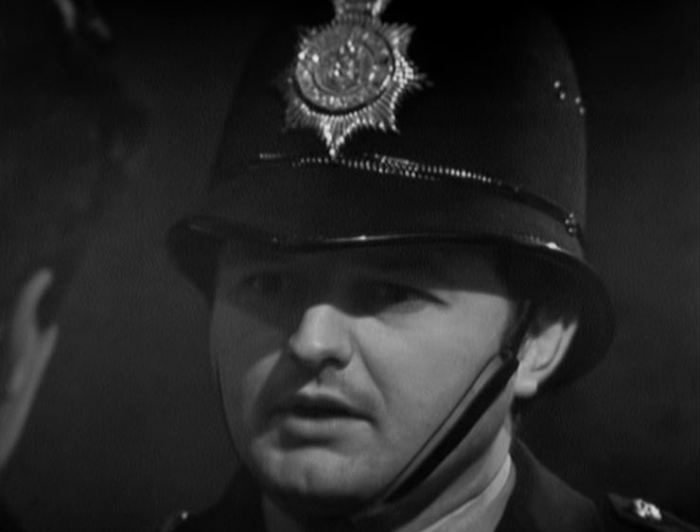
– the copper who finds the tramp is played by a young Peter Bowles, delightfully struggling to do the accent of a rural plod
– one of the medical students lurking in the background is played by Victor Pemberton, who wrote the Doctor Who serial ‘Fury from the Deep’ (1968), as well as episodes of Timeslip (1971) and Ace of Wands (1972)
lapse-03Previous episode, ‘Andover and the Android’

Sources
John Brunner, ‘Some Lapse of Time’, Now and Then (London: Mayflower-Dell, 1965)
Mark Ward, Out of the Unknown: A Guide to the Legendary Series (Bristol: Kaleidoscope, 2004)
Out of the Unknown DVD boxset. BFI, 2014.
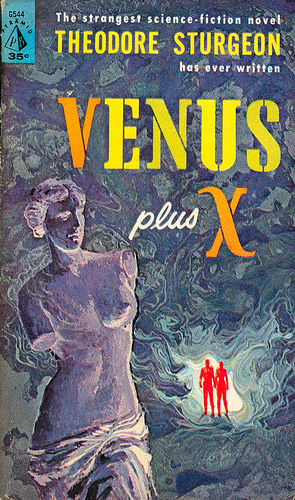
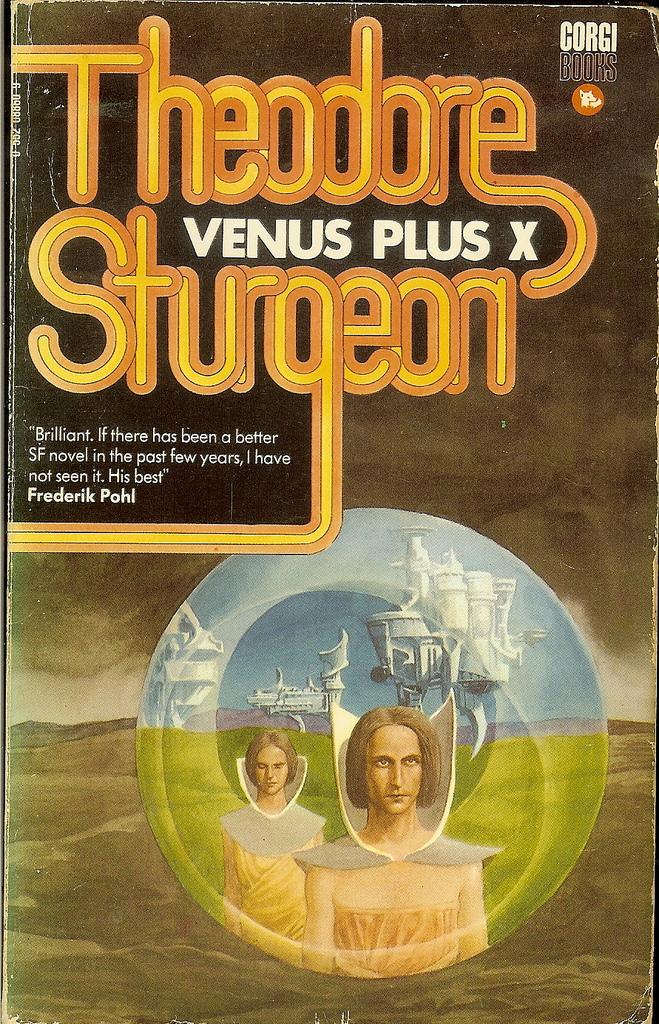
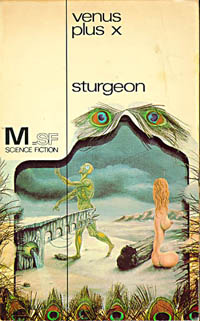
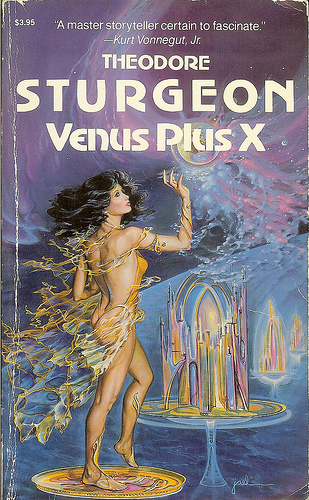
Theodore Sturgeon’s Venus Plus X

Back in the mists of time, around a decade ago, there was a plan for an ever-expanding online collection of short critical essays on key works of the fantastic. The plan fizzled and died, but not before I wrote nine pieces for it (which I just found). This is the last of them.

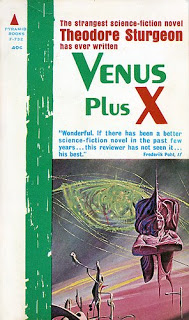
4624298147_dc53dc7d03First edition: New York: Pyramid, 1960
Edition used: New York: Pyramid, 1960

Charlie Johns, a contemporary American, mysteriously wakes up in a posthuman future, the apparently utopian society of Ledom (‘model’ backwards). It is home to homo sapiens’ replacements, an androgynous species possessing both male and female genitals. As devoted to the principles of process and change as they are to their children (who symbolise the future and thus change), they live lives of fulfilment and repose. They transported Charlie through time so he can learn about them and offer an ‘objective’ view on their culture and society. Or so he is led to believe…

Interpolated between the chapters charting Charlie’s adventure are shorter ones depicting the life of contemporary suburbanites Herb and Jeanette Raile, and their children, Davy and Karen. These contrapuntal chapters offer sharp satiric insights into gender roles, sexual politics and mores, consumerism, competition, materialistic Protestantism, social hierarchies and child-rearing. Although their tone is very different from that of the Ledom chapters, they offer an essential counterbalance to the more traditionally utopian method of Charlie’s story.

John Clute described Venus Plus X as the novel which

bravely came as close to a traditional utopia as any US genre-sf writer had approached before the efforts of Mack Reynolds.[1]

5896940782_43c4b2478e_bThis tension – between the utopian guided tour and genre sf’s predominantly action-adventure format – is perhaps most evident in the closing pages of the novel in which a cognitive breakthrough (of sorts) piles fresh revelation on fresh revelation, casting much of what has gone before in a fresh light. A similar tension is effectively balanced in the tonal differences between the Ledom and suburban chapters. Because the utopian form requires expository dialogue to interpose between the utopia and the visitor (including the reader), there is always overt commentary in place of the effect of direct perception. Consequently, in depicting suburban America, Sturgeon is faced with the option of an apparently realistic vision or an expository technique which would parallel (without replicating) the technique used to depict Ledom. Sturgeon’s turn to the satiric, which had become increasingly commonplace in 1950s US magazine sf, is in many ways the more satisfactory method of reconciling the traditional utopian with genre sf, not least of all because it keeps them in constant tension and balance. Venus Plus X, like Ledom, is about ‘passage’ (107) and ‘dynamic imbalance’ (108).

What, then, are the qualities of Ledom that make it utopian? Without biological differentiation in terms of sexual characteristics, and without the fetishisation of particular body parts, there is no basis upon which to construct an ideology of gender differentiation. Biological determinism is invalidated as a concept, replaced by a variety of cultural (including technological) determinism. The Ledom thus express themselves, rather than sexual or gender categories, through their modes of dress, labour and creative activity. Competition has been replaced by harmonious coexistence. Community has replaced suburb.

sturgeon_t_venusplusx_1970_1These utopian elements take on greater effect because of their contrast with the harried, frustrated, confused lives of the Raile family. Herb and his neighbour Smitty worry about what they perceive as women taking over in the guise of attaining equality. Where Smitty struggles to maintain masculinist bigotry, Herb struggles to compromise between traditional masculinity and an equal relationship with Jeanette. But Jeanette is not without her own neuroses about sexuality and power relationships. And in a number of comic asides – when Karen touches herself in the bath, when Davy hits her with a pillow for receiving different treatment from their father – it is clear that their children will be caught in similar dilemmas.

The major set of images Sturgeon uses to valorise this distinction between community and suburb is concerned with music. The inspirational, unrehearsed but nonetheless perfect group singing of the Ledom stands in stark contrast to the pop idol Herb and Smitty watch singing ‘Goozle Goozle’ on TV, a polysemic performer targeted at a whole array of market segments:

The words are something about Yee Ooo: I hold Yee Ooo, I kiss Yee Ooo, I love Yee Ooo, Ooo-Ooo. The camera dollies back and the singer is observed in a motion which one might explain by asserting that the singer, with infinite ambition, is attempting to grasp between his buttocks a small doorknob strapped to a metronome. (37)

venpxAt the core of the novel lie its least novelistic chapters, when Charlie receives a history lesson via the cerebrostyle. The Ledom – and arguably Sturgeon – locate the failure of Western civilisation in the suppression of pre-Christian ecstatic religion and sex and their distortion into instruments of social control:

So sex and religion, the real meaning of human existence, ceased to be meaning and became means. (130)

In the opening chapter, the dislocated Charlie devotes his energy to trying to remember:

He could not stop remembering; dared not, and did not want to stop. Because as long as he kept remembering, he knew he was Charlie Johns; and although he might be in a new place without knowing what time it was, he wasn’t lost, no one is ever lost, as long as he knows who he is. (8)

Continuity of identity here depends not upon name but upon recollection; and what applies to the individual applies to society as a whole. As long as ecstatic religion and sex are repressed, forgotten, Western so-called civilisation is alienated from its true identity.

Central to this repression is an overemphasis

on differences which [are] in themselves not drastic. (61)

venusAnticipating Judith Butler’s Gender Trouble: Feminism and the Subversion of Identity (1990), the Ledom argue that differentiation is a product of looking for difference – which is then employed to construct ideologically naturalised hierarchies. Without the deconstruction of sexual differentiation – an act literalised in Ledom – sexual equality will continue to be one of Western literature’s ‘hallucinatory images’, along with

pigs with wings, human freedom, fire-breathing dragons, the wisdom of the majority, the basilisk, the golem. (84)

Notes
[1] John Clute and Peter Nicholls, eds, The Encyclopedia of Science Fiction (London: Orbit, 1993), p.1176.

The other eight entries I wrote were:
Voltaire, Candide
Godwin, Caleb Williams
de Maistre, Voyage Around My Chamber
France, Thais
London, The Iron Heel 
Gernsback, Ralph 124C 41+
Smith, The Skylark of Space
Schuyler, Black No More

George S Schuyler’s Black No More. Being an Account of the Strange and Wonderful Workings of Science in the Land of the Free, A.D. 1933-1940

Back in the mists of time, around a decade ago, there was a plan for an ever-expanding online collection of short critical essays on key works of the fantastic. The plan fizzled and died, but not before I wrote nine pieces for it (which I just found). This is another of them.

9781555537753_p0_v1_s260x420First edition: New York: Macaulay, 1931
Edition used: New York: Negro Universities Press, 1969

Frequently praised by HL Mencken as

the most competent Negro journalist […] the most competent editorial writer now in practice in this great free Republic[1]

Schuyler has been largely neglected in histories of sf, partly because of the difficulty of penetrating his pseudonyms (including Samuel I Brooks, Rachel Call, Edgecombe Wright), partly because sf constitutes only a tiny fraction of his massive output, partly because he was published outside of the regular pulp venues, and partly because his politics were somewhat at odds with genre norms. So, for example, his novellas ‘The Black Internationale’ and ‘Black Empire’ (1936–38; later collected as Black Empire), which depict a conspiracy of black professionals manipulating national and international politics to reclaim Africa as a black homeland, did not appear in Amazing or Astounding but in the Pittsburgh Courier – not a publication to which sf historians would necessarily think to turn.

The neglect of Black No More, first published in book form at the tail end of the Harlem Renaissance in 1931 (when sf books were few and far between), is perhaps harder to explain, although it would not have been promoted as sf and many might have found its dedication off-putting:

THIS BOOK IS DEDICATED TO ALL CAUCASIANS IN THE GREAT REPUBLIC WHO CAN TRACE THEIR ANCESTRY BACK TEN GENERATIONS AND CONFIDENTLY ASSERT THAT THERE ARE NO BLACK LEAVES, TWIGS, LIMBS OR BRANCHES ON THEIR FAMILY TREES.

When, on New Year’s Eve 1933, Max Disher is spurned by a white woman at the Honky Tonk Club, he decides to take Dr Junius Crookman’s revolutionary BLACK-NO-MORE treatment to turn him white. Adopting the name Matthew Fisher, he returns to his hometown of Atlanta in pursuit of her. There, pretending to be an anthropologist, he takes up with the Reverend Henry Givens, an ex-officer of the Ku Klux Klan, who is starting up the Knights of Nordica, an organisation of

White Men and Women […] Fight[ing] for White Race Integrity. (60)

41DHqZxFNMLTo Max’s delight, the white woman turns out to be Givens’ daughter, Helen. Fearing Max’s growing popularity in his rapidly expanding organisation, Givens is happy to see them married. Meanwhile, Max has been joined by his newly-whitened friend Bunny Brown, and together they make the Knights of Nordica into a major political power, effectively taking over the Anglo-Saxon Association and the Democratic Party. As the black population of America disappears, the central plank of the Knights election strategy is to demand compulsory genealogical testing and race-based social stratification. Crookman and his associates join forces with the Republicans to keep open the BLACK-NO-MORE centres and lying-in hospitals (where any baby born black is turned white so as to avoid social embarrassment). On the eve of the election, Dr Buggerie’s genealogical research – which suggests that if there were as few as one thousand African-Americans who could

pass for white […] fifteen generations ago […] their descendants now number close to fifty million souls (197)

– is stolen, and published in the newspapers:

 DEMOCRATIC LEADERS PROVED OF NEGRO DESCENT
Givens, Snobbcraft, Buggerie, Kretin and Others
of Negro Ancestry, According to Old
Records Unearthed by Them. (210)

Max, Bunny and their loved ones manage to escape. Buggerie and Snobbcraft are not so fortunate. Fleeing though Mississippi in blackface disguise, they are nearly lynched; only after they have proven who they are and that they are white, do the newspapers arrive…

Schuyler_BlackNoMore_CollierBlack No More is a remarkable work of satire, as sprightly and as timely now as when it was written. Its great strength lies in its dyspeptic vision of the absurdity of racism and the hypocrisy with which race is used as a means of obtaining and maintaining power, wealth and influence by some people regardless of colour. This latter is at its most pointed in the sequence in which Max blackmails Blickdoff and Hortzenboff, the owners of Paradise Mill in South Carolina, into paying him to break the imminent strike – a feat he then achieves by seeming to side with the workers, most of them Knights of Nordica who wish to unionise, while hinting that among them are probably some whitened blacks who are constitutionally incapable of not betraying the strike:

Rumor was wafted abroad that the whole idea of a strike was a trick of smart niggers in the North who were in the pay of the Pope. The erstwhile class conscious workers became terror striken by the specter of black blood. You couldn’t, they said, be sure of anybody any more, and it was better to leave things as they were than to take a chance of being led by some nigger. If the colored gentry coudn’t sit in the movies and ride in trains with white folks, it wasn’t right for them to be organizing and leading white folks. (134)

Once the strike is over, the mill owners

took immediate steps to make their workers more satisfied with their pay, their jobs and their little home town. They built a swimming pool, a tennis court, shower baths and a playground for their employees but neglected to shorten their work time so these improvements could be enjoyed. They announced that they would give each worker a bonus of a whole day’s pay at Christmas time, hereafter, and a week’s vacation each year to every employee who had been with them more than ten years. There were no such employees, of course, but the mill hands were overjoyed with their victory. (136)

Because Schuyler’s satire is so wide-ranging, because he treats leaders as cynical manipulators and followers as dupes, because none of his characters seem capable of good or pure motives, it would be easy to label Black No More misanthropic. However, to do so would be to misintepret a comic vision that finds so much humour in venality because those who think they are acting in their own self-interest so frequently are not. Such a perspective produces the kind of absurdism which defines Black No More and which reaches its pinnacle in the last few pages – a few years after the events the novel recounts, it is discovered that those who underwent the BLACK-NO-MORE treatment are in fact lighter in colour than ‘white’ people; consequently, in the desire not to be taken for blacks, people begin to darken their skin colour to look like whites…

The other eight entries I wrote were:
Voltaire, Candide
Godwin, Caleb Williams
de Maistre, Voyage Around My Chamber
France, Thais
London, The Iron Heel 
Gernsback, Ralph 124C 41+
Smith, The Skylark of Space
Sturgeon, Venus Plus X

Notes
[1] Both quotations can be found in Schuyler, Black Empire (Boston: Northeaatern University Press, 1991), p.312, n.15.

The Mad Maxathon, part four: Mad Max: Fury Road (2015)

Mad-Max-Fury-Road-lovely-day

Part one, part two, part three

Let there be no doubt. Mad Max: Fury Road is without question the very best film I saw yesterday (the other one was La momia azteca contra el robot humano (1958)).

It is also the very best Mad Max movie since Road Warrior. And like Road Warrior, it needs to be seen on the big screen (albeit for slightly different reasons, which I will get into below).

I can see George Miller’s pitch even now: Ice Cold in Alex (1958) meets Pumzi (2009), but faster. And we’re gonna steal all that crazy shit about pregnant women and bags of seed from The Ultimate Warrior (1975). And just one more thing from Island of Lost Souls (1932). And Dune (1984) was set on a desert planet, too, so we’ll throw in some of the unsavouriness of the Harkonnens, but without the obvious homophobia.

And, the executives asked, will there be an unexpected homage to Duran Duran and fellow ozploitation alumnus Russell Mulcahy?

You betcha, said George.

But even more unexpected than that there will be, when Max comes to desert after the big sandstorm scene, a tribute to Derek Zoolander’s friends who died in a freak gasoline-fight accident.

Except with supermodels.

Pregnant supermodels.

And water, not guzzle-een. We’ll save the tanks of wet-nurse milk for later. When Max has to wash blood off his face.

But don’t worry, it’s not his blood.

There has been a lot of commentary about how Fury Road gets it right by mostly eschewing CGI in favour of actually staging the action with real vehicles and actual stuntmen. Which is both true and a little misleading. There is quite a bit of CGI, albeit more judiciously deployed than one would expect in a $150 million movie, and there is an awful lot of compositing and post-production digital enhancement. (This is why you need the big screen – not so much for the profilmic car-crunching of Mad Max and Road Warrior, but for the setting of similar action in massively spectacular landscapes.)

There is also – and this is what most people seem to be missing – a lot of attention paid to classical conventions of spatial construction. Unlike in a Christopher Nolan movie, spaces actually make coherent sense, and thanks to John Seale’s camera being held that little bit further from the action and Margaret Sixel’s less-rapid editing you can, unlike in a Michael Bay movies, always tell who is doing what to whom and where they are in relation to each other and their setting.

75Don’t get me wrong, this coherence does not necessarily lead to suspense – Fury Road is no Wages of Fear (1953) or Hell Drivers (1957) or even, though it pains me to say it, Duel (1971) – but it is able to produce an awful lot of tense moments. And this tension stems from the careful thinking-through of the action sequences, from the small scale stuff (Max fighting Furiosa, while he is chained to both a broken-off car door and the unconscious Nux and suffering from the interference of the pregnant supermodels) upwards.

maxresdefaultIs it one long chase sequence? Not exactly. There are moments of pause, moments when the audience can catch their breath, but Miller does something inspired with them. They are character scenes, but so perfunctory – so hilariously badly written, so utterly lacking in the cheesy charm of the Fast and Furious movies – that you are happy for these layovers to be shortened and the chase to start back up again.

The only thing missing is Jerry Reed singing ‘East Bound and Down‘.

Is it the feminist movie those “Men’s Rights” folks seemed so terrified of? (Assuming all that bullshit wasn’t an ingenious piece of viral marketing.)

The answer really depends on how you define feminism. I think it passes the Bechdel test, but there is so little conversation in the movie it is hard to tell. 75.0Charlize Theron, an actress who normally makes me go meh, is implacable as Furiosa and handles a big share of the action every bit as well as the always adorable Tom Hardy. The pregnancy/supermodel/ lactation/seeds conjunction recalls something of that old school hippy female-essentialist feminism. The ageing desert warrior women are just plain brilliant – not exactly 70s lesbian separatists but, in a future where all the men are such dicks, who wouldn’t be in favour of a little wimminz separatism? There is also at times a curious overlaying of female voices, often too quiet to make out many of the words, which made me think of the Kristevan chora –‘Although the chora can be designated and regulated, it can never be definively posited: as a result, one can situate the chora and, if necessary, lend it a topology, but one can never give it axiomatic form’ – which seemed to be pointing towards something interesting to do with desert spaces and, in this company of women, the pre-symbolic (and to pick up on Max’s traumatic flashback instants to events similar, but not identical, to things that happened in the trilogy).

Do these things make it feminist?

Frankly, you’re having a laugh. It is just less intolerant of women than many other movies made on this scale.

But they do give the movie some powerful and intriguing cross-currents and textures. I will have to see it a few more times to even begin to figure it out.

Does Max have a mullet? That would be spoilers.

Is it worth seeing? Absolutely.

Especially if you can dodge the inflation of ticket prices by distributors/exhibitors manipulating 2D and 3D screenings. My local cinema only had the 3D version at £15+ a ticket. The big-ass fancypants cinema in town was charging less for 3D, but had put the 2D version in the “director’s hall”, which made tickets even more expensive than the local 3D. Fortunately, the third-rate cinema in town was showing the 2D at a price which meant two of us could see it for a fraction more than one of us could have seen the local 3D or the fancypants 2D. It is like a temporally-compacted version of classical Hollywood’s system of ‘runs’ is being reintroduced.

And sadly the cinema we saw it in was just a sanitised pathetic relic of its former self, rather than the grunge pit in which ozploitation, however gussied up, should be seen.

The Mad Maxathon, part three: Mad Max Beyond Thunderdome (1985)

MV5BMTk0MDQ5NTYxNV5BMl5BanBnXkFtZTcwNTA0ODYyMQ@@._V1_SX640_SY720_Part one, part two, part four

This is the one that broke the franchise.

It is the one with the audacity to have a character claim, early on, that ‘We’re dealing with subtlety here’. And the bravery, moments later, to let Aunty (Tina Turner) ask, ‘You can shovel shit, can’t you?’

It is the one featuring the Goonies outback adventure. It is Max Rockatansky’s Kindergarten Cop. His Mr Nanny, his Pacifier, his Game Plan. It is Dad Max.

It is the one that makes Waterworld look not so very terrible after all.

It is a poxalypse, full of pain.

It begins with a drum-machine, for chrissakes.

It is full of other terrible 80s things, such as a shockingly ill-judged Maurice Jarre soundtrack and a dreadful saxophone that, for a moment, fills you with dread MPW-65247that Aunty will be played not by Tina Turner – whose chainmail shoulderpads are even more awesome now than they were thirty years ago – but by Al Jarreau.

Beyond Thunderdome lays bare the insidious effects of LucasSpielbergianism.

Costing five times as much as the first two films added together, it made rather less than them added together. But a bigger budget meant a drop in the certificate. Which meant replacing innovation with competence. Which meant abandoning crude, robust, imaginative and often very skilful filmmaking in order to imitate the less-than-stellar Indiana Jones and the Temple of Doom. Badly.

It nicks sequences and gags and ideas from HG Wells’s The Island of Doctor Moreau and Island of Lost Souls (1932), from Russell Hoban’s Riddley Walker (1980) but sadly not from William Golding’s Lord of the Flies (1954), from episodes six and seven of Flash Gordon (1936) and episode one of Bret Maverick (1981), from Star Wars (1977) and Apocalypse Now (1979) and Raiders of the Lost Ark (1981) and Mad Max and a whole bunch of westerns. Badly.

mad-max-beyond-thunderdome-train-chaseIt reworks the climactic chase from Road Warrior.

Badly.

As if Health and Safety finally caught onto some of the crazy shit George Miller was doing.

It is like some Spacehunter: Adventures in the Forbidden Zone (1983) knock off.

While Tina Turner is fabulous as the same-sex-yet-somehow-cross-dressing Aunty, it is disappointing to see the queerness of this future has been muted in the fifteen years since the events of Road Warrior. (I have no idea how the scantily-clad musclemen cranking Bartertown’s elevator managed to sneak unnoticed through the straightening of the post-apocalypse, but I’m glad they made it and are thriving.)

Although there are plenty of stereotypical signifiers of non-white ethnicities – Max’s burnoose and camels, the didgeridoos on the soundtrack early on, Maurice Jarre’s delusion that he is scoring Taras Bulba (1962), the plane-crash-surviving kids’ version of Aboriginal art and make-up – it remains a fairly pallid future in which whitey has learned almost nothing from these cultures about practical fashions for desert environments. One can only assume that Bartertown is built in a quarry (some of the time) because they are mining for sunblock. And talc. And, of course, vaseline.

MCDMAMA EC038When the movie came out, Roger Ebert, who loved it, raved about the Thunderdome fight sequence, calling it ‘the first really original movie idea about how to stage a fight since we got the first karate movies’ and ‘one of the great creative action scenes in the movies’. It was never that good and doesn’t really hold up that well. But it can be made fabulous by taking the time to set up a second screen so you can synch it to the Peter Pan scene from 21 Jump Street (2012).

Much was also made of the alternative Riddley Walker-lite English spoken by the kids who grew up in isolation without any adults around. This linguistic drift, which has none of the post-apocalyptic horror of the final minutes of Threads (1984) either, would have perhaps seem more innovative if a few minutes earlier it hadn’t been revealed that in Bartertown the meaning of the word ‘gulag’ had shifted to mean ‘to be driven into the desert to die while sitting backwards on a horse with a giant papier-mache head on your head’.

So, besides Tina Turner, is there anything good about Beyond Thunderdome?

Well, it provides an opportunity to admire some of the early work by Terese Willis from Neighbours, formerly Sophie Simpson from Home and Away.

It was nice to see Bruce Payne return, playing a character indistinguishable from the one he played in Road Warrior but definitely intended by Miller to be a different character, which doesn’t quite explain how Max recognises him, unless it is a version of that joke in the A-Team title sequence when Face recognises a Cylon.

And it was nice to see the sarlacc pit get work again, even if it never did manage to break free of the way it was typecast by Return of the Jedi

Oh, and the first thing the kids do after rescuing Max is cut off his mullet. Which at least puts it ahead of Steel Dawn (1987), at the conclusion of which Patrick Swayze is permitted to stride off into the sunset, mane uncropped.

Part four

Big Ass Spider! (Mike Mendez 2013)

MV5BMTk4OTU3NzY0MV5BMl5BanBnXkFtZTcwMDU5MTgwOQ@@._V1_SX640_SY720_and so anyway it turns out the best thing about Big Ass Spider! is not, as you might assume, its title, which, like Eight Legged Freaks (2002), no film could possibly live up to, nor is it the pleasure of seeing Lombardo Boyar, playing the offensively-written comedy ethnic sidekick, steal every scene he is in, because sadly that is not really much of an accomplishment, nor is it the unexpected Lloyd Kaufman cameo, no, the very best thing about Big Ass Spider! is that they seem to have brought it in on time and budget, more or less, I guess…

The Mad Maxathon, part two: The Road Warrior (1981) mostly

M-0005_Mad_Max_2_The_Road_Warrior_one_sheet_movie_poster_lPart one, part three, part four

Road Warrior might be punk’s Sistine chapel, but it is not without problems.

To be punk at all it has to have problems.

Many of them come from its dependence on colonial adventure narratives, particularly Westerns. There is an enclave of ‘white’ civilisation in the wilderness – a fortress, circled wagons – surrounded by aggressive and highly mobile ‘savages’, who are darker and more ‘tribal’ (some even sport Mohicans), and who rape and murder one of the ‘white’ women.

And as if this racial othering is not enough, many of them also dress as sexual dissidents.

To be honest, I am not sure whether it is because I have cherished this movie since adolescence that I tend to overlook these problems, or whether it is genuinely more complex than this reductive account suggests. Certainly such colonial imagery can be used in different ways. For example, when Starship Troopers (1997) uses the fort under siege scenario, it does so to parody imperialist military aggression. Unlike, say, Zulu (1964), in which post-imperial melancholy works hard to mythologise yet another shabby episode in the history of British imperialism. And unlike the final section of X-Men: The Last Stand (2006), in which Brett Ratner, once more putting the idiot into idiot savant, slanders San Francisco’s queer counterculture.

And Road Warrior does do some interesting things with its colonial set-up.

RoadWarrior_066PyxurzThree of the key ‘white’ people are so white as to become parodic, including their bleached blond leader Pappagallo (Mike Preston, who back in the late 50s recorded ‘Dirty Old Town’ and ‘Whispering Grass’, long before The Pogues and Windsor Davis/Don Estelle). This excess at least suggests a self-consciousness at work, and although it might not be very articulate, it is far more convincing than the post-hoc claims that the Rutger Hauer’s Roy Batty (in that film from the following year about the police flying around over Los Angeles deciding who counts as human) is some kind of ‘ironic Aryan’. (The absence of any actual Aboriginal people helps deracinate the situation, I guess.)

MadMax_VernonWellsRelated to this is the transition from Mad Max’s Tom of Finland coppers to the accoutrements of sexual dissidence worn by the ‘natives’: the studded leather pants, wristbands and harness of The Humugus (Kjell Nilsson), and his Jason Voorhees take on an enclosure mask; the buttocks-flashing chaps of Wez (Vernon Wells) and the cutaway bondage gear of his bleached boytoy, etc, etc. However, I think this works a little differently to Toecutter’s stereotypically jealous (but, come to think of it, not really demonised) blond second-in-command in Mad Max.

it does not mean they are really fond of camping

Yes, the ‘natives’ are queer (except perhaps for the misleadingly credited ‘Tent Lovers’), but they are also charismatic and alive in a way the ‘white’ folks are not.

In Doomsday, the natives’ Glaswegian equivalents – and who would have thought that thirty years after the zombie apocalypse there would be quite so much pristine bondage gear stockpiled in Glasgow? – bear a very specific resonance, as evidenced by the music Sol (Craig Conway) plays to the crowd before they cook and eat Sean Pertwee. Adam and the Ants’ ‘Dog Eat Dog’, the Fine Young Cannibals ‘Good Thing’, Siouxsie and the Banshees’ ‘Spellbound’ and Areil Rechtshaid’s knock-off of Bad Manners’ ‘The Can-Can’ are all part of the anti-Thatcher eighties, and so it comes as no surprise that during the Road Warrior-like climactic chase, we get Frankie Goes to Hollywood’s ‘Two Tribes’. Displaced into the future, this is a culture of political and sexual dissidence being celebrated.

In Road Warrior, the celebration is perhaps less clear, but the film does not despise its ‘natives’. Miller, like Milton, is secretly of Satan’s camp.

And the opposition between the ‘civilisation’ and ‘natives’ is not as secure as one might think. Max lives in the wilderness and only crosses into ‘civilisation’ so he can leave again. The same is true of the Gyro Captain (Bruce Spence). He eventually chooses to stay, but only as ‘civilisation’ begins its long trek through the wilderness. The Feral Kid (Emil Minty) is raised in ‘civilisation’ but looks like one of the ‘natives’, grunts and growls a lot and behaves like some kind of monkey-dog; his finger-slicing boomerang is as close as we get to Aboriginal culture. And of course the opening narration turns out to have been spoken by him in his old age, long after the events of the movie, when he has become the chief of the Great Northern Tribe – a rank and social structure that suggests some retreat from ‘civilisation’.

MCDROWA EC002The bondage gear also provides Humungus’s motivation for besieging the fortified refinery. Clearly, from the way his crew race around everywhere, they are not short of fuel. But in that dry hot sandy environment, leather and rubber are gonna get uncomfortable. They’re gonna chafe. So it is not gasoline Humungus is after. It is some other petroleum-based product. Like, I dunno, vaseline.

Mad Max’s key cinematic innovation was setting the racing cameras so close to the ground. Road Warrior added a couple more things to the language of contemporary cinema.

First, is the long final action sequence. Films did not used to do that, and now they do. Without Road Warrior, the runway during the climax of Fast and Furious 6­ (2013) – a runway so long you begin to suspect they are just gonna drive all the way to the destination airport – would have been a whole lot shorter and much less would have happened on it.

Second, is the radical electro-surgery George Miller performed on the muscles under Mel Gibson’s face, so that in this film it actually moves. Sadly, this experimental procedure was not entirely successful, dooming Gibson to decades of shit-eating glibness and peculiar gurning.

One time it even turned his face blue.

The Mad Maxathon, part one: Mad Max (1979) mostly

4ea91f68f6cde2b35e8e578f085e566b

Part two, part three, part four

Waking up in post-apocalyptic Britain last Friday, and with only a week to go until Mad Max: Fury Road, it was time to get back up to speed. Thus did the Mad Maxathon commence!

Back in my Plymouth teens, one of the local free papers had a competition to win cinema tickets and related goodies. Most weeks I entered and – not having enough pocket money or, later, paper-round wages to waste on a postage stamp – would deliver it in person (in a reused envelope) to their offices. The only things I ever won were a pair of tickets for a double bill of Ghoulies and Trancers (I suspect no one else entered that competition) and, a year later, a pair of tickets for Mad Max Beyond Thunderdome, a film my girlfriend did not want to see, especially after the preceding year’s fiasco. Oh, and along with the tickets came a Thunderdome t-shirt, which I had to collect in person and, being poor, could not just throw away despite the embarrassment of advertising a film I hated. It became a winter garment, always worn under something else, until eventually it faded and fell apart. This may well be the origin of my dislike for clothing with writing on it. And of white t-shirts.

I forget when or where I first saw the previous movies – presumably on video at a friend’s house. So something good did come of those free tickets. They enabled me to reassess my opinion that Mad Max, despite holding the world record cost-to-profit ratio for twenty years, was the weakest film in the series. (The Road Warrior was always, in the words of JG Ballard, ‘punk’s Sistine Chapel’.) While I have watched the first two multiple times over the years, I have only seen Thunderdome twice – and not since it was first broadcast on television. So how do they hold up?

MAD MAX -1979...BKBKRH MAD MAX -1979

Mad Max starts off as a properly sleazy ozploitation flick: a tubby copper in leather spies through rifle sights on a couple having sex in a field; an insane car chase ensues. There will be more bare bums in the franchise (and car chases).

Mad Max was one of the first Australian films to be shot using widescreen anamorphic lenses but George Miller’s real innovation was to mount the cameras on speeding cars and motorbikes so very close to the ground. It does not sound like a lot, but it was, and remains, breathtakingly perilous to watch.

mm4Accounts of the film often take note of Miller’s work as an emergency room doctor, and of several incidents during the OPEC crisis when – in full Ballardian mode – regular folks queuing for fuel violently turned on each other. Clearly some kind of autogeddon was in the ozploitation air (see also: Peter Weir’s The Cars that Ate Paris (1974), one of the earlier Australian films to use widescreen anamorphic lenses, whose spikey Volkswagen is homaged in Fury Road; Ian Barry’s Chain Reaction (1980), which stars Mad Max‘s Steve Bisley,  Hugh Keays-Byrne and, as an uncredited bearded mechanic, Mel Gibson; Brian Trenchard-Smith’s Dead End Drive-In (1986), based on Peter Carey’s story;  and, in a slightly different vein, Richard Franklin’s Road Games (1981)).

I was not surprised to hear that for Fury Road, George Miller presented Tom Hardy with a 300-page ‘comic’ made up of storyboards, rather than a conventional screenplay because Mad Max – with its generic mix of AIP biker movie, backwoods Straw Dogs/Deliverance rape-revenge narrative, lone gunfighter/sheriff/samurai seeking revenge/justice, rogue cop brought out of retirement one last time and this time its personal – comes across increasingly like a 2000AD strip. This connection with the other Sistine chapel of punk comes full circle, first in Neil Marshall’s underrated Doomsday (2008), which riffs off The Road Warrior but also in its final shots gives Rhona Mitra a Carlos Ezquerra/Mike McMahon big boots look, and then in Fury Road, co-written by Brendan McCarthy, who started working on 2000AD in the late 70s and then, inspired by Road Warrior, co-created the post-apocalyptic surfer comic Freakwave (1983). Some consider Freakwave to have been plagiarised by Waterworld (1995), which was dubbed ‘Road Warrior on water’ back in the day. ‘All at sea’, more like.

Mad Max’s melodramatic transitions in particular have something comic-book about them – foreshadowing Sam Raimi’s more obviously comics-inspired Darkman (1990) – and, to be honest, much of the dialogue would probably work better as speech bubbles. The stand-out dialogue scene is the one in which Mel Gibson, with his oddly immobile face, emotes, trying to say something incomprehensible to his wife about his feelings for her in terms of feelings he had for his dad but never expressed. Or something like that. Wisely, to shut him up, she kisses him. And considering how unwise kissing Mel Gibson actually is, we should thank her. She may be overly taken with the idea that running right down the middle of the road is the best way to flee murderous bikers, but right then, at that snoggy moment, she takes one for the team.

mad-max-wifeMad Max is only Gibson’s second film and, although he has yet to become completely insufferable, the construction of his image of physically battered masculinity – the shirtlessly electrocuted resistant-to-electrocution Martin Riggs getting his ass handed to him by the mighty Gary Busey in Lethal Weapon (1987), the shot-to-pieces Martin Riggs annoyingly not dying in Danny Glover’s arms in Lethal Weapon 2 (1989), the hammer-to-the-toes justifiably tortured hardly-Lee-Marvin of Payback (1999), culminating in all those unpleasant things people do to Jim Caviezel in The Passion of the Christ (2004) – is already gearing up as he (somewhat ineptly) wreaks his revenge.

Given Gibson’s occasional homophobic outbursts, I vividly recall being delighted to discover that, at least in the olden days, he used to have a big enough gay following to provide one of the case studies for Michael DeAngelis’s Gay Fandom and Crossover Stardom: James Dean, Mel Gibson and Keanu Reeves (2001). I am however quite mystified as to the source of this, or indeed any hetero, attraction. Sure, in Mad Max, he is young and pretty and wears tight black leather and does not yet have a mullet. Is it that? Or is it his later tendency to be as shirtless as Matthew McConaughey while wrestling in the rain with Gary Busey or otherwise taking physical punishment? A suffering that in some ways maps onto his Judy Garland-like life of dislocation and addiction and abuse (although admittedly he is the abuser, not the abused)? Please tell me it is not the mullet.

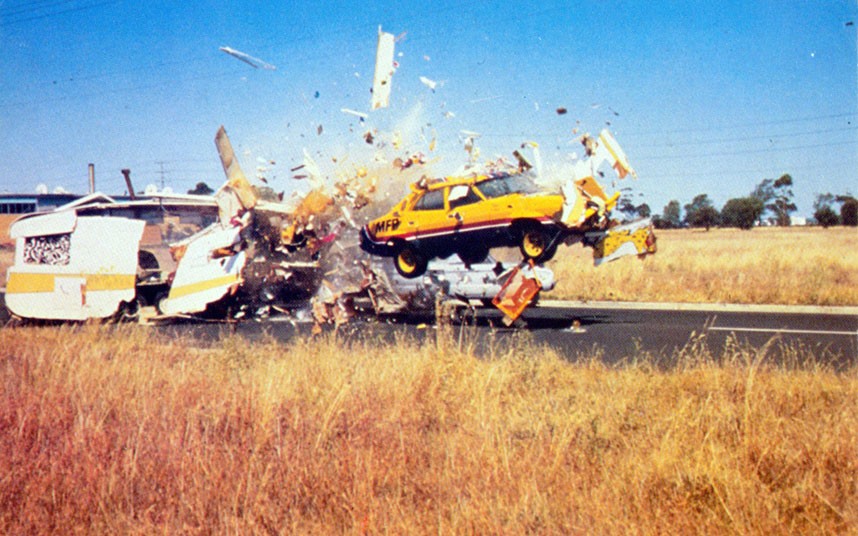
Oh, and Main Force Patrol? Come on, people, that is not what MFP stands for.

EE ‘Doc’ Smith’s, The Skylark of Space (co-written with Mrs Lee Hawkins Garby)

Back in the mists of time, around a decade ago, there was a plan for an ever-expanding online collection of short critical essays on key works of the fantastic. The plan fizzled and died, but not before I wrote nine pieces for it (which I just found). This is another of them.

eeds_theskylaWritten: 1915–1920
First published: Amazing Stories, August-October 1928
First edition: Providence, Rhode Island: Buffalo Book Co., 1946
Edition used: London: Panther, 1974 (revised text of 1958)

Richard Seaton accidentally discovers the ability of ‘X’, a hitherto unknown metal,

to liberate and control the entire constituent energy of metallic copper. (17)

This

pure and total conversion of matter to controllable energy [with] no radiation, no residue, no by-products (17)

062provides the key to space travel. Seaton and his millionaire chum, M Reynolds Crane, set out to exploit this source of virtually free energy. An attempt by rival scientist, Marc ‘Blackie’ DuQuesne, to hold Seaton’s wealthy fiancée, Dorothy Vaneman, ransom in exchange for X goes awry. DuQuesne’s starship is flung across space at an incredible speed. Seaton and Crane pursue them in the eponymous starship. They rescue Dorothy, DuQuesne and another hostage, Margaret Spencer, from the grip of a dead star. On the low-gravity planet Osnome, they take sides in (and win) a genocidal war, before returning to Earth.

Smith was neither the first to write space opera (Robert W Cole’s 1900 The Struggle for Empire is a more likely contender), nor the first American author of space opera (that distinction probably belongs to Ray Cummings), nor indeed the best of the subgenre’s first flourishing in the American pulps (Edmond Hamilton, John W Campbell, Jr and Jack Williamson consistently wrote less infelicitous prose and demonstrated a better grasp of the potential of sf). But Smith’s work remains the best-remembered. Undoubtedly, this is partly a result of being the-skylark-of-space-fffamong the first pulp sf to be reissued in hardback editions in the late 1940s and 1950s, and of the 1960s and 1970s paperback editions finding a substantial following among the fantasy readership created/uncovered by the US paperback editions of JRR Tolkien’s The Lord of the Rings. Although Smith’s space operas often seem excruciatingly naïve by the standards of more contemporary authors (Iain M Banks, Samuel R Delany, Colin Greenland, Ursula Le Guin, M John Harrison, Ken MacLeod, Alastair Reynolds), the continued popularity of the Star Wars movies indicates that juvenile sf of this sort is still attractive; and while it is tempting to read Smith’s sf as camp, this can only partly (if, presumably, increasingly) account for its appeal.

One of Smith’s central achievements is to capture something of the scale of the universe while also rendering it safe, conquerable, human-sized. Despite postulating new technologies and travelling thousands of light years from Earth, the characters and plotting of The Skylark of Space are firmly rooted in familiar romance conventions. Seaton is a working class boy made good, a scientist and athlete

over six feet in height, broad-shouldered, narrow-waisted. (12)

He can withstand higher acceleration than any of his crew, and exercises his super-strength to great effect in Osnome’s low gravity.

Crane,

the multi-millionaire explorer-archaeologist-sportsman’ (12)

is also a businessman, an engineer and

a rocket-instrument man second to none in the world. (13)

Seaton’s love for Dorothy and Crane’s for Margaret is pure, assured, eternal. DuQuesne is

utterly heartless and ruthless, so cold and scientific (90)

003yet strangely honourable in his villainy. And in a world dominated by global corporations, it falls to such individuals to discover, create, explore. Despite such unrealistic characterisations, the very familiarity of these types works to domesticate the universe in which they adventure.

Moreover, the vastness and strangeness of space is also contained by Smith’s repeated failure to depict it. As the crew whiz around the galaxy, they observe it almost entirely through instrument readings, and the few descriptions of what can be seen through the Skylark’s viewports possess a curious contradictory quality:

For the blackness of the black of the interstellar void is not the darkness of an earthly night but the absolute absence of light–a black besides which that of platinum dust is merely gray. Upon this indescribably black backdrop there glowed faint patches which were nebulae; there blazed hard, brilliant, multi-colored, dimensionless points of light which were stars. (88)

In addition to the clumsy simultaneous presence and absence of light in this view, there is blackness to be recognised through its dissimilarity to the blackness with which the reader is familiar.[1] A more telling failure to depict an external view of space comes in the passage in which Crane realises his love for Margaret. Staring out

into infinity, each felt as never before the pitiful smallness of the whole world they had known, and the insignificance of human beings and their works. (91)

As their ‘minds reached out to each other in understanding’, Crane considers Margaret:

He looked up quickly and again studied the stars; but now, in addition to the wonders of space, he saw a mass of wavy black hair, high-piled upon a queenly head; deep brown eyes veiled by long, black lashes; sweet, sensitive lips; a firmly rounded, dimpled chin; and a beautifully formed young body. (91 and 92)

This description[2] displaces that of the view that so enraptures Margaret and prompts her to say

‘How stupendous . . . how unbelievably great this is . . . […]. How vastly greater than any perception one could possibly get on Earth . . . and yet . . . […] doesn’t it seem to you, Mr. Crane, that there is something in man as great as even all this? That there must be, or Dorothy and I could not be sailing out here in such a wonderful things as this Skylark, which you and Dick Seaton have made?’ (92)

This bathetic descent contains and constrains the capacity of the sublime to disorientate and estrange.

Throughout the novel, Smith demonstrates little interest in the implications of his conceits. For example, when a mechanical educator accidentally gives Seaton and Dunark, Kofedix of Kondal, perfect knowledge

down to the finest detail […] of everything that the other had ever learned (117)

it is merely a convenient plot device, enabling Seaton to justify his collaboration with the fascistic social-Darwinist Kondalians against the treacherous Mardonalians (who ‘are the scum of the universe’ (120)).

ill-613Again and again, The Skylark of Space promises novelty but delivers mere novelties.

And herein must lie whatever appeal it has: there is no terrible abyss, just space waiting to be filled should anyone ever look out of the window.

The other eight entries I wrote were:
Voltaire, Candide
Godwin, Caleb Williams
de Maistre, Voyage Around My Chamber
France, Thais
London, The Iron Heel 
Gernsback, Ralph 124C 41+
Schuyler, Black No More
Sturgeon, Venus Plus X

Notes
[1]
This practice of describing the indescribability of a phenomenon rather than the phenomenon itself reaches its glorious nadir in the explosion of a charge of X:

There was a blare of sound that paralyzed their senses, even inside the vessel and in the thin air of that enormous elevation. There was a furiously-boiling, furiously expanding ball of . . . of what? The detonation of a Mark Ten load cannot be described. It must be seen; and even then, it cannot be understood. It can scarcely be believed. (105)

[2]
It is, of course, equally telling of Smith’s lack of interest in his female characters that not only should Margaret be so beautiful as to distract Crane but also so eminently reducible to a list of clichéd fragments. Elsewhere, she champs at the bit to be a secretary (92).

Hugo Gernsback’s Ralph 124C 41+: A Romance of the Year 2660

Back in the mists of time, around a decade ago, there was a plan for an ever-expanding online collection of short critical essays on key works of the fantastic. The plan fizzled and died, but not before I wrote nine pieces for it (which I just found). This is another of them.

200px-ModernElectrics1912-02First published: Modern Electrics, April 1911-March 1912
First edition: Boston: The Stratford Company, 1925
Edition used: Lincoln: University of Nebraska Press, 2000

In the year 2660, when the world’s population has reached 90 billion people, Ralph 124C 41+ is

one of the greatest living scientists and one of the ten men on the whole planet earth permitted to use the Plus sign after his name. (9)

writing5In the opening chapter, a serendipitous malfunction with his Telephot system and some quick thinking enable him to save Alice 212B 423 from an avalanche thousands of miles away. When Alice and her father travel to New York to thank him, Ralph and Alice fall in love. During an extended guided tour of the magnificent future city Alice is kidnapped, rescued and then kidnapped again by Fernand 60O 10. Before Ralph can rescue her, she is again abducted, this time by the Martian Llysanorh’ CK 1618. When Llysanorh’ realises Ralph is about to capture him, he kills Alice. In a desperate gamble, Ralph performs an experimental procedure on her to preserve her body until he can return to Earth and revive her. A week after the emergency operation, Ralph visits his recovering sweetheart:

‘Dearest,’ she said, ‘I have just found out what your name really means.’
Ralph twined a little tendril of her hair around one of his fingers.
‘Yes?’ he asked with a quizzical smile.
‘Well, you see,’ and the lovely color deepened to rose, ‘your name is going to be my name now, so I keep saying it over to myself–’
‘My darling!’
ONE TO FORESEE FOR ONE.
( 1     2     4       C     4       1 )            (293)

As the above plot description suggests, Gernsback’s fix-up novel is deficient as fiction and frequently unspeakably banal. It is nonetheless a major text in the development of the modern American pulp-and-paperback tradition of sf – although arguably more for what it signifies than for what it achieves. As an editor, Gernsback famously advocated a variety of

‘scientifiction’ … the Jules Verne, HG Wells and Edgar Allan Poe type of story – a charming romance intermingled with scientific fact and prophetic vision. (Amazing Stories, 1 (April 1926): 3)

Ralph 124C 41+, written over a decade before the launch of Amazing Stories, is perhaps best understood as an earlier effort by Gernsback to describe that formula. The naïvely-depicted romance between Ralph and Alice, and the various rescues and abductions, alarums and excursions, are the very stuff of Romance, if conceptualised and presented in a cack-handed, juvenile manner. Ralph_Alice_roller+skatesInterspersed among the narrative elements are plenty of scientific facts, pseudo-scientific information, and scientific-sounding patter – including diagrams and footnotes about experiments. And the future New York offered by Gernsback constitutes prophetic vision.

One of the most obvious failings of Gernsback’s prophetic vision is his inability to extend imagined social developments beyond the realm of the technological, to allow for changes in human institutions and ideologies. Thus we get a condemnation of industrial action understood merely in terms of workers’ alleged greed and irresponsibility:

 our governor had some trouble with the four weather-engineers of our district, some months ago, and they struck for better living. They claimed the authorities did not furnish them with sufficient luxuries, and when their demands were refused, they simultaneously turned on the high-depression at the four Meteoro-Towers and then fled, leaving their towers with the high-tension currents escaping at a tremendous rate. (18)

The adulation Ralph receives, and that which is lavished upon the ‘light-picture of the Planet Governor’ (118), indicates that for all the supposed improvements that technological advancement has brought to humanity, society remains deeply hierarchical. Also, the central action of the novel is concerned with Alice being exchanged between men and avoiding miscegenation, culminating in her swapping her father’s name (212B – ‘to want to be’?) for Ralph’s.

This inability to imagine human relationships lies behind not only Gernsback’s utilisation of a debased Romance narrative, but also behind the characters’ suppressed sexuality. This is most obvious in the opening chapter, in which Ralph finds Alice alone, about to be engulfed by an avalanche. Throughout this chapter and its aftermath, we find the kind of fascist body imagery analysed by Klaus Theweleit.[1] Ralph has

a physique much larger than that of the average man of his times and approaching that of the huge Martians. His physical superiority, however, was as nothing to his gigantic mind. (9)

His phallic body is matched by his phallic house,

a round tower, six hundred and fifty feet high, and thirty in diameter, built entirely of crystal glass-bricks and steelonium, … one of the sights of New York. (33)

His body is subordinated to the will of the state, and he demonstrates no interest in the crowd of well-wishers, either individually or collectively. Fluid and tempestuous nature often operates as a metaphor for female sexuality. It is frpaul_02_amazquar_1929win_ralph124csignificant then that Ralph uses all his rational-technological powers to spurt energy from his aerial to melt the tide of snow and ice threatening to overwhelm Alice. This sexual displacement is made obvious (and ridiculous) by Alice’s father simultaneously racing home to ensure nothing untoward befalls her, and by Ralph’s tactful withdrawal when he burst in.

In this context, it is important to take account of the primary characteristic shared by the many inventions, techniques and marvels Ralph shows Alice: flawless steelonium streets, liquidised food, perfect climate control, floodlit sportsfields, the bacillatorium, giant double-glazed geothermically-heated greenhouses, artificial milk produced direct from the grass without having to pass through a cow, a city floating in the sky, an antigravity circus. In all of these, it is possible to see Gernsback’s vision of science as a means of abstracting people from nature, and interposing technology between them so as to keep them Frank-R.-Paul-Ralph-124C41+-Resurrectionseparated. This finds an obvious resonance with the lengths to which Gernsback goes to distance his hero from physical intimacy with Alice, even killing her off so as not to leave her alone with Ralph in a spaceship together for fifty days – she is only permitted to recover when it is possible to banish intimacy beyond the end of the novel.

The other eight entries I wrote were:
Voltaire, Candide
Godwin, Caleb Williams
de Maistre, Voyage Around My Chamber
France, Thais
London, The Iron Heel 
Smith, The Skylark of Space
Schuyler, Black No More
Sturgeon, Venus Plus X

Notes
[1]
See Klaus Theweleit, Male Fantasies, volume 1: Women, Floods, Bodies, History (1977; trans. 1987) and Male Fantasies, Volume 2: Male Bodies: Psychoanalyzing the White Terror (1978; trans. 1989).