The Mad Maxathon, part two: The Road Warrior (1981) mostly

M-0005_Mad_Max_2_The_Road_Warrior_one_sheet_movie_poster_lPart one, part three, part four

Road Warrior might be punk’s Sistine chapel, but it is not without problems.

To be punk at all it has to have problems.

Many of them come from its dependence on colonial adventure narratives, particularly Westerns. There is an enclave of ‘white’ civilisation in the wilderness – a fortress, circled wagons – surrounded by aggressive and highly mobile ‘savages’, who are darker and more ‘tribal’ (some even sport Mohicans), and who rape and murder one of the ‘white’ women.

And as if this racial othering is not enough, many of them also dress as sexual dissidents.

To be honest, I am not sure whether it is because I have cherished this movie since adolescence that I tend to overlook these problems, or whether it is genuinely more complex than this reductive account suggests. Certainly such colonial imagery can be used in different ways. For example, when Starship Troopers (1997) uses the fort under siege scenario, it does so to parody imperialist military aggression. Unlike, say, Zulu (1964), in which post-imperial melancholy works hard to mythologise yet another shabby episode in the history of British imperialism. And unlike the final section of X-Men: The Last Stand (2006), in which Brett Ratner, once more putting the idiot into idiot savant, slanders San Francisco’s queer counterculture.

And Road Warrior does do some interesting things with its colonial set-up.

RoadWarrior_066PyxurzThree of the key ‘white’ people are so white as to become parodic, including their bleached blond leader Pappagallo (Mike Preston, who back in the late 50s recorded ‘Dirty Old Town’ and ‘Whispering Grass’, long before The Pogues and Windsor Davis/Don Estelle). This excess at least suggests a self-consciousness at work, and although it might not be very articulate, it is far more convincing than the post-hoc claims that the Rutger Hauer’s Roy Batty (in that film from the following year about the police flying around over Los Angeles deciding who counts as human) is some kind of ‘ironic Aryan’. (The absence of any actual Aboriginal people helps deracinate the situation, I guess.)

MadMax_VernonWellsRelated to this is the transition from Mad Max’s Tom of Finland coppers to the accoutrements of sexual dissidence worn by the ‘natives’: the studded leather pants, wristbands and harness of The Humugus (Kjell Nilsson), and his Jason Voorhees take on an enclosure mask; the buttocks-flashing chaps of Wez (Vernon Wells) and the cutaway bondage gear of his bleached boytoy, etc, etc. However, I think this works a little differently to Toecutter’s stereotypically jealous (but, come to think of it, not really demonised) blond second-in-command in Mad Max.

it does not mean they are really fond of camping

Yes, the ‘natives’ are queer (except perhaps for the misleadingly credited ‘Tent Lovers’), but they are also charismatic and alive in a way the ‘white’ folks are not.

In Doomsday, the natives’ Glaswegian equivalents – and who would have thought that thirty years after the zombie apocalypse there would be quite so much pristine bondage gear stockpiled in Glasgow? – bear a very specific resonance, as evidenced by the music Sol (Craig Conway) plays to the crowd before they cook and eat Sean Pertwee. Adam and the Ants’ ‘Dog Eat Dog’, the Fine Young Cannibals ‘Good Thing’, Siouxsie and the Banshees’ ‘Spellbound’ and Areil Rechtshaid’s knock-off of Bad Manners’ ‘The Can-Can’ are all part of the anti-Thatcher eighties, and so it comes as no surprise that during the Road Warrior-like climactic chase, we get Frankie Goes to Hollywood’s ‘Two Tribes’. Displaced into the future, this is a culture of political and sexual dissidence being celebrated.

In Road Warrior, the celebration is perhaps less clear, but the film does not despise its ‘natives’. Miller, like Milton, is secretly of Satan’s camp.

And the opposition between the ‘civilisation’ and ‘natives’ is not as secure as one might think. Max lives in the wilderness and only crosses into ‘civilisation’ so he can leave again. The same is true of the Gyro Captain (Bruce Spence). He eventually chooses to stay, but only as ‘civilisation’ begins its long trek through the wilderness. The Feral Kid (Emil Minty) is raised in ‘civilisation’ but looks like one of the ‘natives’, grunts and growls a lot and behaves like some kind of monkey-dog; his finger-slicing boomerang is as close as we get to Aboriginal culture. And of course the opening narration turns out to have been spoken by him in his old age, long after the events of the movie, when he has become the chief of the Great Northern Tribe – a rank and social structure that suggests some retreat from ‘civilisation’.

MCDROWA EC002The bondage gear also provides Humungus’s motivation for besieging the fortified refinery. Clearly, from the way his crew race around everywhere, they are not short of fuel. But in that dry hot sandy environment, leather and rubber are gonna get uncomfortable. They’re gonna chafe. So it is not gasoline Humungus is after. It is some other petroleum-based product. Like, I dunno, vaseline.

Mad Max’s key cinematic innovation was setting the racing cameras so close to the ground. Road Warrior added a couple more things to the language of contemporary cinema.

First, is the long final action sequence. Films did not used to do that, and now they do. Without Road Warrior, the runway during the climax of Fast and Furious 6­ (2013) – a runway so long you begin to suspect they are just gonna drive all the way to the destination airport – would have been a whole lot shorter and much less would have happened on it.

Second, is the radical electro-surgery George Miller performed on the muscles under Mel Gibson’s face, so that in this film it actually moves. Sadly, this experimental procedure was not entirely successful, dooming Gibson to decades of shit-eating glibness and peculiar gurning.

One time it even turned his face blue.

EE ‘Doc’ Smith’s, The Skylark of Space (co-written with Mrs Lee Hawkins Garby)

Back in the mists of time, around a decade ago, there was a plan for an ever-expanding online collection of short critical essays on key works of the fantastic. The plan fizzled and died, but not before I wrote nine pieces for it (which I just found). This is another of them.

eeds_theskylaWritten: 1915–1920
First published: Amazing Stories, August-October 1928
First edition: Providence, Rhode Island: Buffalo Book Co., 1946
Edition used: London: Panther, 1974 (revised text of 1958)

Richard Seaton accidentally discovers the ability of ‘X’, a hitherto unknown metal,

to liberate and control the entire constituent energy of metallic copper. (17)

This

pure and total conversion of matter to controllable energy [with] no radiation, no residue, no by-products (17)

062provides the key to space travel. Seaton and his millionaire chum, M Reynolds Crane, set out to exploit this source of virtually free energy. An attempt by rival scientist, Marc ‘Blackie’ DuQuesne, to hold Seaton’s wealthy fiancée, Dorothy Vaneman, ransom in exchange for X goes awry. DuQuesne’s starship is flung across space at an incredible speed. Seaton and Crane pursue them in the eponymous starship. They rescue Dorothy, DuQuesne and another hostage, Margaret Spencer, from the grip of a dead star. On the low-gravity planet Osnome, they take sides in (and win) a genocidal war, before returning to Earth.

Smith was neither the first to write space opera (Robert W Cole’s 1900 The Struggle for Empire is a more likely contender), nor the first American author of space opera (that distinction probably belongs to Ray Cummings), nor indeed the best of the subgenre’s first flourishing in the American pulps (Edmond Hamilton, John W Campbell, Jr and Jack Williamson consistently wrote less infelicitous prose and demonstrated a better grasp of the potential of sf). But Smith’s work remains the best-remembered. Undoubtedly, this is partly a result of being the-skylark-of-space-fffamong the first pulp sf to be reissued in hardback editions in the late 1940s and 1950s, and of the 1960s and 1970s paperback editions finding a substantial following among the fantasy readership created/uncovered by the US paperback editions of JRR Tolkien’s The Lord of the Rings. Although Smith’s space operas often seem excruciatingly naïve by the standards of more contemporary authors (Iain M Banks, Samuel R Delany, Colin Greenland, Ursula Le Guin, M John Harrison, Ken MacLeod, Alastair Reynolds), the continued popularity of the Star Wars movies indicates that juvenile sf of this sort is still attractive; and while it is tempting to read Smith’s sf as camp, this can only partly (if, presumably, increasingly) account for its appeal.

One of Smith’s central achievements is to capture something of the scale of the universe while also rendering it safe, conquerable, human-sized. Despite postulating new technologies and travelling thousands of light years from Earth, the characters and plotting of The Skylark of Space are firmly rooted in familiar romance conventions. Seaton is a working class boy made good, a scientist and athlete

over six feet in height, broad-shouldered, narrow-waisted. (12)

He can withstand higher acceleration than any of his crew, and exercises his super-strength to great effect in Osnome’s low gravity.

Crane,

the multi-millionaire explorer-archaeologist-sportsman’ (12)

is also a businessman, an engineer and

a rocket-instrument man second to none in the world. (13)

Seaton’s love for Dorothy and Crane’s for Margaret is pure, assured, eternal. DuQuesne is

utterly heartless and ruthless, so cold and scientific (90)

003yet strangely honourable in his villainy. And in a world dominated by global corporations, it falls to such individuals to discover, create, explore. Despite such unrealistic characterisations, the very familiarity of these types works to domesticate the universe in which they adventure.

Moreover, the vastness and strangeness of space is also contained by Smith’s repeated failure to depict it. As the crew whiz around the galaxy, they observe it almost entirely through instrument readings, and the few descriptions of what can be seen through the Skylark’s viewports possess a curious contradictory quality:

For the blackness of the black of the interstellar void is not the darkness of an earthly night but the absolute absence of light–a black besides which that of platinum dust is merely gray. Upon this indescribably black backdrop there glowed faint patches which were nebulae; there blazed hard, brilliant, multi-colored, dimensionless points of light which were stars. (88)

In addition to the clumsy simultaneous presence and absence of light in this view, there is blackness to be recognised through its dissimilarity to the blackness with which the reader is familiar.[1] A more telling failure to depict an external view of space comes in the passage in which Crane realises his love for Margaret. Staring out

into infinity, each felt as never before the pitiful smallness of the whole world they had known, and the insignificance of human beings and their works. (91)

As their ‘minds reached out to each other in understanding’, Crane considers Margaret:

He looked up quickly and again studied the stars; but now, in addition to the wonders of space, he saw a mass of wavy black hair, high-piled upon a queenly head; deep brown eyes veiled by long, black lashes; sweet, sensitive lips; a firmly rounded, dimpled chin; and a beautifully formed young body. (91 and 92)

This description[2] displaces that of the view that so enraptures Margaret and prompts her to say

‘How stupendous . . . how unbelievably great this is . . . […]. How vastly greater than any perception one could possibly get on Earth . . . and yet . . . […] doesn’t it seem to you, Mr. Crane, that there is something in man as great as even all this? That there must be, or Dorothy and I could not be sailing out here in such a wonderful things as this Skylark, which you and Dick Seaton have made?’ (92)

This bathetic descent contains and constrains the capacity of the sublime to disorientate and estrange.

Throughout the novel, Smith demonstrates little interest in the implications of his conceits. For example, when a mechanical educator accidentally gives Seaton and Dunark, Kofedix of Kondal, perfect knowledge

down to the finest detail […] of everything that the other had ever learned (117)

it is merely a convenient plot device, enabling Seaton to justify his collaboration with the fascistic social-Darwinist Kondalians against the treacherous Mardonalians (who ‘are the scum of the universe’ (120)).

ill-613Again and again, The Skylark of Space promises novelty but delivers mere novelties.

And herein must lie whatever appeal it has: there is no terrible abyss, just space waiting to be filled should anyone ever look out of the window.

The other eight entries I wrote were:
Voltaire, Candide
Godwin, Caleb Williams
de Maistre, Voyage Around My Chamber
France, Thais
London, The Iron Heel 
Gernsback, Ralph 124C 41+
Schuyler, Black No More
Sturgeon, Venus Plus X

Notes
[1]
This practice of describing the indescribability of a phenomenon rather than the phenomenon itself reaches its glorious nadir in the explosion of a charge of X:

There was a blare of sound that paralyzed their senses, even inside the vessel and in the thin air of that enormous elevation. There was a furiously-boiling, furiously expanding ball of . . . of what? The detonation of a Mark Ten load cannot be described. It must be seen; and even then, it cannot be understood. It can scarcely be believed. (105)

[2]
It is, of course, equally telling of Smith’s lack of interest in his female characters that not only should Margaret be so beautiful as to distract Crane but also so eminently reducible to a list of clichéd fragments. Elsewhere, she champs at the bit to be a secretary (92).

Hugo Gernsback’s Ralph 124C 41+: A Romance of the Year 2660

Back in the mists of time, around a decade ago, there was a plan for an ever-expanding online collection of short critical essays on key works of the fantastic. The plan fizzled and died, but not before I wrote nine pieces for it (which I just found). This is another of them.

200px-ModernElectrics1912-02First published: Modern Electrics, April 1911-March 1912
First edition: Boston: The Stratford Company, 1925
Edition used: Lincoln: University of Nebraska Press, 2000

In the year 2660, when the world’s population has reached 90 billion people, Ralph 124C 41+ is

one of the greatest living scientists and one of the ten men on the whole planet earth permitted to use the Plus sign after his name. (9)

writing5In the opening chapter, a serendipitous malfunction with his Telephot system and some quick thinking enable him to save Alice 212B 423 from an avalanche thousands of miles away. When Alice and her father travel to New York to thank him, Ralph and Alice fall in love. During an extended guided tour of the magnificent future city Alice is kidnapped, rescued and then kidnapped again by Fernand 60O 10. Before Ralph can rescue her, she is again abducted, this time by the Martian Llysanorh’ CK 1618. When Llysanorh’ realises Ralph is about to capture him, he kills Alice. In a desperate gamble, Ralph performs an experimental procedure on her to preserve her body until he can return to Earth and revive her. A week after the emergency operation, Ralph visits his recovering sweetheart:

‘Dearest,’ she said, ‘I have just found out what your name really means.’
Ralph twined a little tendril of her hair around one of his fingers.
‘Yes?’ he asked with a quizzical smile.
‘Well, you see,’ and the lovely color deepened to rose, ‘your name is going to be my name now, so I keep saying it over to myself–’
‘My darling!’
ONE TO FORESEE FOR ONE.
( 1     2     4       C     4       1 )            (293)

As the above plot description suggests, Gernsback’s fix-up novel is deficient as fiction and frequently unspeakably banal. It is nonetheless a major text in the development of the modern American pulp-and-paperback tradition of sf – although arguably more for what it signifies than for what it achieves. As an editor, Gernsback famously advocated a variety of

‘scientifiction’ … the Jules Verne, HG Wells and Edgar Allan Poe type of story – a charming romance intermingled with scientific fact and prophetic vision. (Amazing Stories, 1 (April 1926): 3)

Ralph 124C 41+, written over a decade before the launch of Amazing Stories, is perhaps best understood as an earlier effort by Gernsback to describe that formula. The naïvely-depicted romance between Ralph and Alice, and the various rescues and abductions, alarums and excursions, are the very stuff of Romance, if conceptualised and presented in a cack-handed, juvenile manner. Ralph_Alice_roller+skatesInterspersed among the narrative elements are plenty of scientific facts, pseudo-scientific information, and scientific-sounding patter – including diagrams and footnotes about experiments. And the future New York offered by Gernsback constitutes prophetic vision.

One of the most obvious failings of Gernsback’s prophetic vision is his inability to extend imagined social developments beyond the realm of the technological, to allow for changes in human institutions and ideologies. Thus we get a condemnation of industrial action understood merely in terms of workers’ alleged greed and irresponsibility:

 our governor had some trouble with the four weather-engineers of our district, some months ago, and they struck for better living. They claimed the authorities did not furnish them with sufficient luxuries, and when their demands were refused, they simultaneously turned on the high-depression at the four Meteoro-Towers and then fled, leaving their towers with the high-tension currents escaping at a tremendous rate. (18)

The adulation Ralph receives, and that which is lavished upon the ‘light-picture of the Planet Governor’ (118), indicates that for all the supposed improvements that technological advancement has brought to humanity, society remains deeply hierarchical. Also, the central action of the novel is concerned with Alice being exchanged between men and avoiding miscegenation, culminating in her swapping her father’s name (212B – ‘to want to be’?) for Ralph’s.

This inability to imagine human relationships lies behind not only Gernsback’s utilisation of a debased Romance narrative, but also behind the characters’ suppressed sexuality. This is most obvious in the opening chapter, in which Ralph finds Alice alone, about to be engulfed by an avalanche. Throughout this chapter and its aftermath, we find the kind of fascist body imagery analysed by Klaus Theweleit.[1] Ralph has

a physique much larger than that of the average man of his times and approaching that of the huge Martians. His physical superiority, however, was as nothing to his gigantic mind. (9)

His phallic body is matched by his phallic house,

a round tower, six hundred and fifty feet high, and thirty in diameter, built entirely of crystal glass-bricks and steelonium, … one of the sights of New York. (33)

His body is subordinated to the will of the state, and he demonstrates no interest in the crowd of well-wishers, either individually or collectively. Fluid and tempestuous nature often operates as a metaphor for female sexuality. It is frpaul_02_amazquar_1929win_ralph124csignificant then that Ralph uses all his rational-technological powers to spurt energy from his aerial to melt the tide of snow and ice threatening to overwhelm Alice. This sexual displacement is made obvious (and ridiculous) by Alice’s father simultaneously racing home to ensure nothing untoward befalls her, and by Ralph’s tactful withdrawal when he burst in.

In this context, it is important to take account of the primary characteristic shared by the many inventions, techniques and marvels Ralph shows Alice: flawless steelonium streets, liquidised food, perfect climate control, floodlit sportsfields, the bacillatorium, giant double-glazed geothermically-heated greenhouses, artificial milk produced direct from the grass without having to pass through a cow, a city floating in the sky, an antigravity circus. In all of these, it is possible to see Gernsback’s vision of science as a means of abstracting people from nature, and interposing technology between them so as to keep them Frank-R.-Paul-Ralph-124C41+-Resurrectionseparated. This finds an obvious resonance with the lengths to which Gernsback goes to distance his hero from physical intimacy with Alice, even killing her off so as not to leave her alone with Ralph in a spaceship together for fifty days – she is only permitted to recover when it is possible to banish intimacy beyond the end of the novel.

The other eight entries I wrote were:
Voltaire, Candide
Godwin, Caleb Williams
de Maistre, Voyage Around My Chamber
France, Thais
London, The Iron Heel 
Smith, The Skylark of Space
Schuyler, Black No More
Sturgeon, Venus Plus X

Notes
[1]
See Klaus Theweleit, Male Fantasies, volume 1: Women, Floods, Bodies, History (1977; trans. 1987) and Male Fantasies, Volume 2: Male Bodies: Psychoanalyzing the White Terror (1978; trans. 1989).

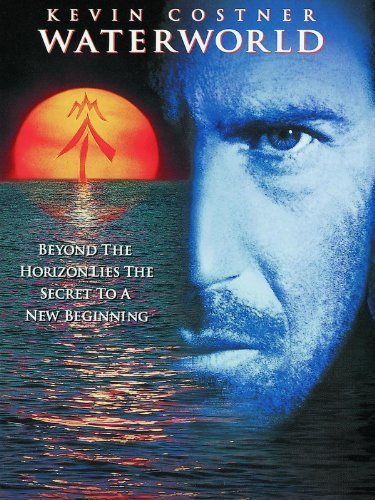
Waterworld (Kevin Reynolds 1995)

MV5BMTA2Nzk3MTgzMTVeQTJeQWpwZ15BbWU3MDgyNTgxNjk@._V1_SX640_SY720_and so anyway it turns out the best thing about Waterworld (1995) is not that it is intermittently far less terrible than I remember it being, though far too intermittently for me to consider rewatching The Postman (1997), the other Kevin Costner post-apocalyptic epic I also saw at the cinema and swore never to watch again, but that Joss Whedon, in his seven weeks of script-doctoring the movie, somehow managed to not ascribe Costner’s character’s gills, webbed toes, Man from Atlantis swimming style, assorted other almost-superpowers and ambiguous motivations to his inability to be a mother…

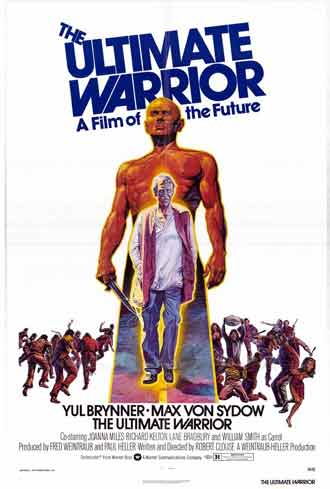
The Ultimate Warrior (Robert Clouse 1975)

Ultimatewarriorand so anyway it turns out the best thing about The Ultimate Warrior (1975) is not the moment when a young mother, safe within Max Von Sydow’s fortified compound,  decides to sneak out into the violent gang-filled streets of post-apocalyptic Manhattan in search of powdered milk rumoured to be hidden in a nearby derelict bakery, nor is it her decision that the best way to do so is to leave via the front door (er, portcullis) with her given-to-squalling infant on her back, but her decision that the best time to do so is under the cover of broad daylight

Oblivion (Joseph Kosinski 2013)

tom_cruise_in_oblivion_movie-2880x1800and so anyway it turns out the best thing about Oblivion (2013), a film which patches together bits from every other science fiction film ever, is the way in which flying spherical robot drones manage to combine 2001: A Space Odyssey’s shuttle pods with RoboCop’s ED209 and with The Black Hole’s V.I.N.CENT and Old Bob, though sadly this also brings us to the worst thing about the movie, the way in which a bunch of cowardly philistine corporate suits lacking Joseph Kosinki’s genius and vision refused to have the drones voiced by Windsor Davies, who voiced Sergeant Major Zero in the key sf text of the late twentieth-century, Terrahawks

Voltaire’s Candide, or Optimism

Back in the mists of time, around a decade ago, there was a plan for an ever-expanding online collection of short critical essays on key works of the fantastic. The plan fizzled and died, but not before I wrote nine pieces for it (which I just found on an old floppy disc – remember them?). This is one of them.

tumblr_m04x7srMbC1r70saro1_500Voltaire (François-Marie Arouet), Candide, or Optimism
Original publication: 1759 (simultaneously on 22nd February in Paris, Geneva, Amsterdam, London and Brussels in order to pre-empt censorship and pirated editions)
Edition used: Candide and Other Stories, translated by Roger Pearson (Oxford: Oxford University Press, 1998)

The innocent Candide is exiled from the Westphalian castle where he was raised when he and the Baron’s daughter, Cunégonde, fall in love. A series of comic, grotesque, satiric and implausible adventures ensue as Candide and various companions trek throughout Western Europe and South America before finally settling, older, battered by experience and possibly wiser, in Turkey.

Candide contains no fantastic elements beyond its use of outrageous coincidence, which might be more properly judged comical than fantastical. Its most obviously science-fictional component is the briefly sketched satirical utopia of Eldorado

‘What! You mean you don’t have any monks to teach and dispute and govern and intrigue and burn people to death who don’t agree with them?’ (49)

which Candide and Cacambo decide to leave because everyone there is wealthy:

‘If we stay on here, we’ll simply be the same as everyone else, whereas if we return to Europe with even a mere dozen sheep loaded up with Eldorado pebbles, then we’ll be richer than all the kings put together’ (51).

However, in terms of the Natural Philosophy of its period of composition, Candide is a profoundly science-fictional novel.

The ‘optimism’ of its sub-title refers to Leibniz’s Principle of Sufficient Reason, an attempt to apply reason to the problem of theodicy, the branch of theology concerned with defending the Christian god against doubts and attacks derived from the existence of physical suffering, misery and evil. Leibniz’s Principle argued that there is always a logical reason for the way things are. Therefore, as god is perfect, then his actions must also always be perfect. In creating the universe, he created something separate from himself which, by the very definition of being separate from god, must be less than perfect. At the moment of creation, he chose between all possible worlds, and from among them he chose the best of all possible worlds – that which, over the course of its entire history, would produce the greatest ratio of good over evil. Therefore, all the evil and misery and suffering that we experience serves a greater good, although perhaps not on a scale we can perceive. Candide’s journeying and education expose him and his companions to monstrous suffering and degradation, prompting him to question the Leibnizian argument espoused by the supposed philosopher Pangloss.

While darkly hilarious, Voltaire’s relentless assault on the Principle of Sufficient Reason might seem too much of its time to possess contemporary relevance. This is not the case. Chaos theory or non-linear dynamics show that, despite living in a determinist universe, the cause-and-effect chains we construct to explain the world are partial narrativisations which do not take account of the state of the total system as it changes from moment to moment. Nevertheless, we continue to rely on such narrativisations and to frequently misunderstand retrospectively-constructed cause-and-effect chains as inevitable processes and history as purposive. It is good then to be reminded of the spurious reasoning thus produced:

‘It is demonstrably true,’ [Pangloss] would say, ‘that things cannot be other than as they are. For, everything having been made for a purpose, everything is necessarily for the best purpose. Observe how noses were made to bear spectacles, and so we have spectacles. Legs are evidently devised to be clad in breeches, and breeches we have. Stones were formed in such a way that they can be hewn and made into castles, and so His Lordship has a very beautiful castle. The greatest baron in the province must be the best lodged. And since pigs were made to be eaten, we eat pork all the year round. Consequently, those who have argued that all is well have been talking nonsense. They should have said that all is for the best.’ (2)

CANDIDE-BESTOWED-A-THOUSAND-EMBRACES-ON-THE-BARON-AND-PANGLOSS-1-q4532The introduction of and justification for a hierarchical power relationships in Pangloss’s ludicrous argument also demonstrates an early awareness of the instrumentalist misuses to which power bends reason into ideology, normalising existing structures of domination.

The other way into the science-fictionality of Candide is through tracing its possible influence on the genre: the Eldorado episode seems to provide a model for HG Wells’s ‘The Country of the Blind’ (1904); the satire on reason became central to US magazine sf in the 1950s. Neal Stephenson’s monumental Baroque Cycle (Quicksilver (2003), The Confusion (2004), The System of the World (2004)) revisits the origins of science-out-of-alchemy and explores the changes wrought on human understanding by the development of reason and empirical observation. In doing so, in reimagining the Europe of, among others, Leibniz, from a perspective derived from information science, Stephenson revisits the origins of sf in the dialectic of materialist and idealist world-views. By depicting capital as an information technology, Stephenson uncovers the central rôle of fantasy – commodity fetishism – in the modern period. The global trekking of The Confusion resembles Candide (although at considerably greater length – Stephenson has not inherited Voltaire’s concision), while the trilogy as a whole concludes on a distinctly Candide-like note:

At some point the whole System will fail, because the flaws that have been wrought into it … But … he has to admit that having some kind of a System, even a flawed and doomed one, is better than to live forever in the poisonous storm-tide of quicksilver that gave birth to all of this.
He has done his job.
‘I’m going home now,’ he says. (System 886)

Perhaps what is most remarkable about Candide is how very modern it seems. From Pangloss

giving a lesson in applied physiology to [a] maid, a very pretty and very receptive little brunette (3)

to its deadpan descriptions of rape, murder, torture, mutilation and slaughter, its ironic distantiation self-deconstructs reason’s fundamental idealism (its belief in its ability to abstract itself from the material world).

And in this time of religious fundamentalism (Christian and otherwise) and militarism, Candide’s anticlericalism, its clear perception of the sheer brutality of warfare and of the instrumentalisation of reason are to be admired, imitated and pursued.

The other eight entries I wrote were:
Godwin, Caleb Williams
de Maistre, Voyage Around My Chamber
France, Thais
London, The Iron Heel 
Gernsback, Ralph 124C 41+
Smith, The Skylark of Space
Schuyler, Black No More
Sturgeon, Venus Plus X

Eden Log (Franck Vestiel France 2007)

[A version of this review appeared in Science Fiction Film and Television 3.1 (2010), 157–61]

edenlogEden Log begins in darkness.

Water drips into water.

Ragged breaths.

Flashes of light reveal a man (Clovis Cornillac), caked in mud, waking, staggering to his feet. (Later, much later, we – and he – will learn that his name is Tolbiac, but for now he has no idea who or where he is.)

He finds a torch on a nearby corpse and in its intermittent light he creeps and crawls and climbs up out of this cave into the lower levels of a seemingly derelict industrial complex. Cables and roots, difficult to tell apart, hang from the ceiling, industrial detritus devolving into, merging with, the subterranean-organic. On the wall behind him, a half-seen diagram describes a process which seems to involve humans descending below ground and then later ascending. He presses through heavy turnstiles and is greeted by projections of half a dozen women, immaculately clothed and coiffed, who address him in multiple languages. In the ominously bland idiolect of a corporate shill, one of them states,

The contract is fair. It is thanks to your work below that you will build your paradise above. Look after the plant and it will look after you.

This pun on plant, which works in French as well as in English, opens up one of the several fields of ambiguity in which this often elliptical film nestles. The plant is both a miraculous tree of vast proportions, its roots reaching far underground, and the industrial complex which extracts sap with ‘infinite energetic properties’ from the tree so as to power a city.

eden-log-clovis-cornillacAs Tolbiac ascends through underground levels – a trajectory that materialises the vertical integration upon which the Eden Log corporation’s gradually unveiled monopoly depends – he encounters various others from whom he begins to piece together the world and its story. One man, suspended from a wall, claims to have brought down the system, but it is not entirely clear where he ends and the plant (in either sense) begins. Tolbiac triggers a recording of the final confrontation between the technicians and the guards: when faced with an information leak over their corporate malfeasance, the nature and extent of which will only later become clear(er), Eden Log overrode all protocols about the relative autonomy of the subterranean levels and sent in guards to destroy the evidence and eradicate the threat.

1242613626_3The plant has been responding to its escalating exploitation by releasing a toxin that mutates the workers into strange, no-longer human creatures. Tolbiac’s struggle against transformation wavers when he finds an uninfected woman (Vimala Pons) and, suddenly abhuman, rapes her. He is appalled by what he has done, and what he is becoming. She elects to accompany him up to the surface, not knowing that he has infected her.

Eventually, having pieced together most of the puzzle, Tolbiac is recognised – and, at last, named – by the guards he used to command. Pretending to be himself, he cons his way past the guards and plugs himself into the plant, which has always been sterile, infecting it with life. It erupts, shattering the dome that contained it, and expands to take over the deserted city, transforming it into a beautiful – and colour-filled – landscape.

Eden Log actually begins not in darkness but with a quotation:

Therefore the Lord God sent him forth from the garden of Eden to till the ground from whence he was taken. (Genesis 3:23)

Tolbiac’s initial emergence from the mud might be taken as a reworking of the creation of Adam in The Bible: In The Beginning… (US/Italy 1966), replacing John Huston’s achingly – and thus camply – tasteful images of an inspirited wind blowing aside yellow sand to reveal the first man with birthing imagery that is rather more fecal, fluid and feminine. Eden Log certainly invites psychoanalytical readings: its setting recalls the maternal interiors of Alien (Scott UK/US 1979), the rape carries strong overtones of a primal scene fantasy, and Tolbiac’s ascent into realms of language and control, the realm from which he fathered himself, plays out an Oedipal entry into the Symbolic.

The biblical quotation can also be interpreted as Vestiel’s announcement of his transition to directing feature films. Previously, he had directed three episodes of the French cop show, Central Nuit (Night Squad 2001– ), and gathered assistant director credits on numerous films, including Blueberry (Renegade; Kounen France/Mexico/UK 2004), adapted from Jean ‘Moebius’ Giraud’s bande desinée, and Ils (Them; Moreau and Palud France/Romania 2006). Such experience undoubtedly prepared him well for shooting a film in the dark, in confined spaces[1] and with an elusive – some have claimed incomprehensible – narrative with religious overtones.[2] Many of the reviews of Eden Log struggled to make sense of a film with the narrative structure of a Paul W.S. Anderson video game adaptation but stripped of his prolonged action sequences and clearly-defined (if one-dimensional) characters, motives and goals. Struggling to make sense of their disappointed expectations, reviewers typically drew fairly insubstantial comparisons with THX 1138 (Lucas US 1971), Le dernier combat (The Last Battle; Besson France 1983), Cube (Natali Canada 1997), Pi (Aronofsky US 1998) and Primer (Carruth US 2004), among others – often for no better reasons than Eden Log being a first film, French, black-and-white (sort of), low-budget, visually striking and/or elliptically plotted.

A more productive comparison might be drawn with Tsukamoto Shinya. Although Eden Log lacks the viscerality of Haze (Japan 2005), in which a man likewise drags himself through a mysterious subterranean location, Vestiel shares Tsukamoto’s eye for post-industrial landscapes – for once-essential components mutating into something almost-organic – along with his taste for apocalyptic rebirth and a posthuman otherness that defies eutopian-dystopian binaries.

Vestiel’s decision to begin the action in overwhelming darkness, with intermittent flashes of light that reveal less than they show, recalls the opening of The Texas Chain Saw Massacre (Hooper US 1974), with which Eden Log shares an energy crisis narrative about the dehumanising effects of capital. But it also announces that Eden Log is self-consciously a film. Garrett Stewart argues that

cinema exists in the interval between two absences, the one whose loss is marked by any and all photographic images and the one brought on by tossing away each image in instantaneous turn. (xi)

For him, the presence of still photographs within the diegesis functions as a reminder of the photogram, the still image that is held in front of the viewer for a twenty-fourth of a second as the film is projected but which is never seen or experienced as a still image. Vestiel’s prolonged stretches of darkness between each flash of light work in a similar manner, to remind us of the unseen dark absence which replaces each photogram in succession.

This filmic self-consciousness is further developed by the projection of images within the diegesis. For example, in the sequence in which Tolbiac replays the recording of the final attempt at negotiation before the guards invaded the subterranean levels, he must scurry to raise into the air a variety of surfaces so that the recorded dialogue can be accompanied by images projected onto these détourned screens, rematerialising a profilmic moment that is no more and reminding us that the

filmic medium is the once having been there of the represented spaces themselves, absented by necessity to make possible the materiality of their moving image on the track. (Stewart 5)

Later, a wizened figure, attached to the plant but slumped as if dead, is eerily animated as an earlier recording of him is projected onto his unmoving face. This play between the inanimate and the animated – which resonates strongly with the decision to strip the film stock of all colour, apart from the occasional revenant touch of red and green[3] – confronts us once more with the interplay between the substrate and the surface of the filmic experience itself. As Stewart notes,

photography engraves the death it resembles, [whereas] cinema defers the death whose escape it simulates. (xi)

Vestiel’s striking use of light and darkness, his flickering between presence and absence, the visible and the invisible, is matched by a refusal fully to explicate the world of the film or the narrative. By adhering to Tolbiac’s amnesiac perspective as he pieces together information from the thinnest and most elusive of expository clues, Vestiel situates the viewer in the space between obscurity and illumination. Even those adept in the relevant genre conventions will find themselves frustrated by Vestiel’s grimly playful evasion of specificity – a strategy clearly announced in the rape scene.

Having raced together into a room-sized elevator, Tolbiac removes his unknown companion’s helmet, revealing that she is a woman. With increasing passion – and apparently in flashforward – they begin to make love. This is soon intercut with another image stream in which the sex is reconfigured as Tolbiac violently raping the woman, and with a third in which he seems to be looking on in disgust at himself. The scene ends with Tolbiac slumped against a wall in dismay, and with the woman curled up in a corner, crying; and yet when he finds a way out, repeating to himself, ‘It’s not me, it’s not me’, she accompanies him.

While it remains unclear what has actually happened between Tolbiac and the woman, the frequent complaint in online commentary that the scene is gratuitous and that it makes no sense for the woman to follow her rapist indicates the extent to which generic framings can override the indeterminacy of the specific. This troubling conjuncture of community and violence, the flicker between affective intersubjectivity and aggressive domination, between what might be and what is, is at the core of the film’s critique of contemporary power.

Eden_LogThe Eden Log corporation’s circular logo which reappears throughout the film contains a diagram of tree as an intricate network, branching out in all directions. This potentially rhizomatic image is disrupted by the corporation’s name, which bisects the circle horizontally, turning the network into a tree with branches above ground and roots below. It forces verticality and thus hierarchy onto the image. The tree, as Deleuze and Guattari argue,

plots a point, fixes an order (7)

even as the rhizome that this tree places under erasure

expose[s] arborescent pseudomultiplicities for what they are. (8)

Indeed, the film’s working title, Network Zero, suggests the point at which vertical hierarchy severs and deforms lateral multiplicity. The plant – both the tree and the factory housing it – is a synecdoche for the Eden Log corporation which owns it, part of the biopolitical order that, according to Michel Foucault, extends and veils the disciplinary sovereign power of the state to

make live and let die. (241)

In the closing minutes of the film it is revealed that Eden Log has promised immigrants who labour in the plant will be rewarded with citizenship, and concealed from the citizens that the plant is feeding on its workers. Eden Log has a vision of ‘a new social order’ built upon this ‘integration’ of non-citizen outsiders into ‘our civilisation’, and believes that when the truth is revealed that ‘our citizens will accept what our needs impose on these populations’. This exemplifies the manner in which biopolitical governance moulds populations to serve the economy. It can be seen as the logic of the Holocaust, in which the

death of the bad race, of the inferior race (or the degenerate, or the abnormal) is something that will make life in general healthier. (Foucault 255)

But it is also the logic of the supposedly free market.

And to this sovereign power Eden Log counterposes zoē, the

simple act of living common to all living beings (Agamben 1)

which is shared by the abhuman not-death-but-continuation of the mutated workers and the plant-human-machines, and by the climactic, uncanny efflorescence of computer-generated nature.

Notes
[1]
Eden Log was shot in a damp, freezing ten-acre mushroom bed sixty feet below ground, as well as water decontamination stations and sewers.

[2]
Vestiel co-authored the screenplay with Pierre Bordage, co-writer of Marc Caro’s less-than-coherent Dante 01 (France 2008), on which Vestiel also worked as assistant director.

[3]
There are two other bursts of (rather artificial-looking) colour when, courtesy of CGI, the plant effloresces. Stewart suggests that

in the second half of this century, science fiction has continued, more and more vividly, to imagine the technologies that would outdo it, do it in. In the digital era, however, futurist cinema has for the first time mobilized rather than merely evoked its own self-anachronizing upgrades. Engineered by computer enhancements, the super-annuation of a suddenly hybrid medium has become manifestly planned obsolescence, performed from within rather than simply foreseen. (222)

Works cited
Agamben, Giorgio. Homo Sacer: Sovereign Power and Bare Life. Trans. Daniel Heller-Roazen, Stanford: Stanford UP, 1998.
Deleuze, Gilles and Félix Guattari. A Thousand Plateaus: Capitalism and Schizophrenia. Trans. Brian Massumi. London: Athlone, 1988.
Foucault, Michel. Society Must Be Defended: Lectures at the Collège de France 1975–1976. Ed. Mauro Bertani. Trans. David Macey. New York: Picador, 2003.
Stewart, Garrett. Between Film and Screen: Modernism’s Photo Synthesis. Chicago: The University of Chicago Press, 1999.

120 years of sf cinema, part nine: 2005-2014

2015 marks the 120th anniversary of sf cinema. This is the ninth part of a year-by-year list of films I’d recommend (not always for the same reasons).

Part one (1895-1914), part two (1915-34), part three (1935-54), part four (1955-1964), part five (1965-74), part six (1975-84), part seven (1985-94), part eight (1994-2004)

200521395_Wild-Blue-Yonder-1
Chetyre/4 (Ilya Khrzhanovskiy)
Pervye na Lune (Aleksey Fedorchenko)
Pyl/Dust (Sergey Loban)
Les saignantes (Jean-Pierre Bekolo)
Tian bian yi duo yun/The Wayward Cloud (Ming-liang Tsai)
The Wild Blue Yonder (Werner Herzog)

2006
Africa Paradis (Sylvestre Amoussou)
Children of Men (Alfonso Cuarón)
Electroma (Thomas Bangalter and Guy-Manuel De Homem-Christo)
Gui si/Silk (Chao-Pin Su)
Gwoemul/The Host (Joon-ho Bong)
Krrish (Rakesh Roshan)
Papurika/Paprika (Satoshi Kon)
Southland Tales (Richard Kelly)
Special (Hal Haberman and Jeremy Passmore)

2007vlcsnap-2010-03-31-22h59m45s74
La Antena (Esteban Sapir)
Bekushiru: 2077 Nihon sakoku/Vexille (Fumihiko Sori)
Los cronocrímenes/Time Crimes (Nacho Vigalondo)
Dai-Nihonjin/Big Man Japan (Hitoshi Matsumoto)
Eden Log (Franck Vestiel)
I Am Legend (Frances Lawrence)
My Winnipeg (Guy Maddin)
Resident Evil: Extinction (Russell Mulcahy)

2008Doomsday(1)
Boku no kanojo wa saibôgu/Cyborg She (Jae-young Kwak)
Doomsday (Neil Marshall)
Mock Up on Mu (Craig Baldwin)
Pontypool (Bruce McDonald)
Sleep Dealer (Alex Rivera)
20-seiki shônen: Honkaku kagaku bôken eiga/20th Century Boys 1: Beginning of the End (Yukihiko Tsutsumi)

2009srs_trailer_sidebar
Fisshu sutôr/Fish Story (Yoshihiro Nakamura)
Gamer (Neveldine + Taylor)
Metropia (Tarik Saleh)
Moon (Duncan Jones)
Mr Nobody (Jaco von Dormael)
Splice (Vincenzo Natali)
Stingray Sam (Cory McAbee)
20-seiki shônen: Dai 2 shô – Saigo no kibô/20th Century Boys 2: The Last Hope (Yukihiko Tsutsumi)
20-seiki shônen: Saishû-shô – Bokura no hata/20th Century Boys 3: Redemption (Yukihiko Tsutsumi)

2010enthiran
Action Replayy (Vipul Amrutlal Shah)
Beyond the Black Rainbow (Panos Cosmatos)
Enthiran (Shankar)
Monsters (Gareth Edwards)
Stake Land (Jim Mickle)

2011
Another Earth (Mike Cahill)
Codependent Lesbian Space Alien Seeks Same (Madeleine Olnek)
Detention (Joseph Kahn)
Fase 7/Phase 7 (Nicolás Goldbart)
In Time (Andrew Niccol)
Juan de los Muertos/Juan of the Dead (Alejandro Brugués)
Love (William Eubank)
Melancholia (Lars von Trier)
Sound of My Voice (Zal Batmanglij)

2012982490_024
Antiviral (Brandon Cronenberg)
Dredd (Pete Travis)
Ghosts with Shit Jobs (Chris McCawley, Jim Morrison, Jim Munroe and Tate Young)
Looper (Rian Johnson)
Robot & Frank (Jake Schreier)
Transfer (Damir Lukacevic)
Universal Soldier: Day of Reckoning (John Hyams)

2013
Snowpiercer (Joon-ho Bong)edge-of-tomorrow_emily-blunt
Trudno byt bogom/Hard To Be a God (Aleksey German)
Under the Skin (Jonathan Glazer)
Upstream Color (Shane Carruth)

2014
Edge of Tomorrow (Doug Liman)
Fehér isten/White God (Kornél Mundruczó)
The Rover (David Michôd)
The Signal (William Eubank)

b9114194-0ea0-4e19-8aa1-312cd5d19455-460x276

120 years of sf cinema, part eight: 1995-2004

2015 marks the 120th anniversary of sf cinema. This is the eighth part of a year-by-year list of films I’d recommend (not always for the same reasons). Part one (1895-1914), part two (1915-34), part three (1935-54), part four (1955-1964), part five (1965-74), part six (1975-84), part seven (1985-94)

1995015-the-city-of-lost-children-theredlist
Atolladero (Óscar Aibar)
La cité des enfants perdus/City of Lost Children (Marc Caro and Jean-Pierre Jeunet)
Kôkaku Kidôtai/Ghost in the Shell (Mamoru Oshii)

1996
Rubber’s Lover (Shozin Fukui)
Space Truckers (Stuart Gordon)

1997event_horizon_gravity_drive
Abre los ojos/Open Your Eyes (Alejandro Amenábar)
Conceiving Ada (Lynn Hershman-Leeson)
Cube (Vincenzo Natali)
Epsilon (Rolf de Heer)
Event Horizon (Paul WS Anderson)
Face/Off (John Woo)
Gattaca (Andrew Niccol)
Nowhere (Gregg Araki)
Smilla’s Sense of Snow (Bille August)
Starship Troopers (Paul Verhoeven)
The Sticky Fingers of Time (Hilary Brougher)

1998movie-of-the-day-blade-L-1tZSBX
Blade (Stephen Norrington)
Dark City (Alex Proyas)
Last Night (Don McKellar)
New Rose Hotel (Abel Ferrara)
Pi (Darren Aronofsky)
La Sonámbula (Fernando Spiner)
Velvet Goldmine (Todd Haynes)

1999Ubergonzo
eXistenZ (David Cronenberg)
Muppets from Space (Tim Hill)
Spectres of the Spectrum (Craig Baldwin)
Wild Zero (Tetsuro Takeuchi)

2000
Batoru rowaiaru/Battle Royale (Kinji Fukasaku)
Donggam/Ditto (Jeong-kwon Kim)
Happy Accidents (Brad Anderson)
Pitch Black (David Twohy)
Possible Worlds (Robert Lepage)

2001billy-zane-and-cq-gallery
The American Astronaut (Cory McAbee)
Avalon (Mamoru Oshii)
CQ (Roman Coppola)
Electric Dragon 80,000 V (Sogo Ishii)
Hey, Happy! (Noam Gonick)
Kairo/Pulse (Kiyoshi Kurosawa)

2002
2009: Lost Memories (Si-myung Lee)
Cypher (Vincenzo Natali)
Rokugatsu no hebi/A Snake of June (Tsukamoto Shinya)
Teknolust (Lynn Hershman-Leeson)

200328sl3
Akarui mirai/Bright Future (Kiyoshi Kurosawa)
Bedwin Hacker (Nadia El Fani)
Dopperugengâ/Doppelganger (Kiyoshi Kurosawa)
Jigureul jikyeora!/Save the Green Planet (Joon-Hwan Jang)
Koi… Mil Gaya (Rakesh Roshan)
Matrubhoomi: A Nation Without Women (Manish Jha)
Patalghar (Abhijit Choudhury)
Le temps du loup/Time of the Wolf (Michael Haneke)

2004
2046 (Wong Kar-wai)
Eternal Sunshine of the Spotless Mind (Michel Gondry)
The Final Cut (Omar Naim)
Ghost in the Shell 2: Innocence (Mamoru Oshii)
G.O.R.A. (Ömer Faruk Sorak)
Primer (Shane Carruth)

part nine, 2005-14

752.original