Crumbs (Miguel Llansó Ethiopia/Spain/Finland 2015)

crumbs-the-first-ever-ethiopian-post-apocalyptic-surreal-sci-fi-feature-length-filmUltimately, the opening text tells us, the war became unnecessary. Perhaps it was a mutation, or perhaps bone-deep ideology just changed. But people gave up on survival, on perpetuating the species. (The cost, after all, had proven terrible.) The remnant population

slowly started to decrease, wane and languish like the dying flame of a candle that barely resists extinguishing itself. … The elderly passed on and the young became elderly. The news of the sporadic birth of a child, probably conceived out of neglect, was received with condescending smiles the same as in those who mock ignorant people who with pride show off their out of style garments.

Crumbs begins with a series of gently floating shots, starting with a broad view of the peculiar mineral structures in volcanic landscape of Dallol,[1] before moving in to detail their folded textures and colours. Water washes over the surface, as in something by Tarkovsky; the shots commute each other, as in something by Kubrick. A desert wind blows, accompanied by Atomizador’s throbbing alien score. There are mountains in the distance. A lone figure in a light shirt and darker trousers, with a satchel slung over his shoulder, makes his way through this alien yet terrestrial landscape. He is dwarfish, hunchbacked, deformed in some way. We will learn he is called Candy (Daniel Tardesse).

Among the rusting vehicle carcasses and other long-abandoned matériel are the remnants of a pipeline. In the ruins of the salt-block buildings he finds an artificial Christmas tree, its spindly green plastic branches still furled close to its metal trunk. In the distance he spots a figure (Quino Piñero). A man in a military uniform: a medal on his chest, a swastika on his armband, and a rat mask covering his head, grey ears visible above the gas mask covering his face. Candy flees. Distortion fills the soundtrack. Above the salt flats across which Candy runs floats a spaceship, an immense citadel hovering in these post-apocalyptic Ethiopian skies.

The tree is a gift for his lover, a young black woman called Sayat or Birdy (Selam Tesfayie) who makes sculptures from salvaged metal. In the derelict bowling alley in which they live – surrounded by fetishes hanging from trees like those in The Texas Chain Saw Massacre (Hooper 1974) – the ball return mechanism has started to activate itself. Sayat suggests that there must be a magnetic field being directed at it, as if someone, maybe the spaceship, which has been ‘rusting in the sky since the beginning of the big war’, is trying to send them a message. When Candy investigates the mechanism – like Henry (Jack Nance) in Eraserhead (Lynch 1977) looking behind the radiator – he finds something unexpected down inside it: a voice, that will later be revealed as that of a skinny black Santa (Tsegaye Abegaz) who might be very small or just a long way away.

Candy undertakes a quest to find out what is going on – a quest that will take him through the stunning green highlands around the Wenchi crater-lake, to a witch who won’t let him pay for her insights with the pristine copy of Michael Jackson’s Dangerous LP which is supposed to finance his wedding, and then on through an abandoned rail depot to the old city, and through it to a derelict lakeside zoo and a violent encounter with Santa Claus…

I have no idea whether there is a specific folktale lurking in the back of all this, an Ethiopian legend akin to the Malian epic of the crippled warrior-king Sundjata, and accounts of  Llansó’s improvisational style of direction – responding to what he finds on location – suggest that while there might be some such narrative armature the final film is unlikely to map onto it with any kind of precision.

It is a film full of allusions: Candy is challenged by a masked warrior on horseback who gallops up like something out of Zardoz (Boorman 1974) or The Planet of the Apes (Schaffner 1968); a bowling ball rolls mysteriously across the floor, like something from The Shining (Kubrick 1980); a rail line subsiding on a narrow stretch of land built across the middle of a lake recalls China Miéville’s Railsea (2012). There are also bits that reminded me of Space is the Place (Coney 1974) and Save the Green Planet! (Joon-Hwan Jang 2003).

There is the detritus of a lost world, given fresh meaning: a plastic figurine of TMNT Donatello, a Max Steel ‘Force Sword’ still attached to its colourful cardboard backing, a Michael Jackson album, a figure of a child asleep on a mattress, all of which are seen within the story world; and then once more, floating in Earth orbit as gracefully as a Kubrick weapons platform or space shuttle, while the voice of the shopkeeper (Mengistu Bermanu) describes them in relation to their production in the pre-apocalypse and their use by the legendary Molegon warriors – an amulet, an instiller of courage before battles, a reminder of the adored Andromeda baby and of its twin who lived in the pyramid of Cheops. There is an altar to Michael Jordan. Sayat, perhaps awaking from a dream, intones a fervent prayer to a string of deities: ‘Einstein IV, San Pablo Picasso, Stephen Hawking III, Justin Bieber VI, Paul McCartney XI, Carrefour!’ (Though the film is as dark as the storm raging outside, and it is possible she is chanting this litany as she masturbates.) There are also a lot of plastic dinosaurs, and a plastic lion. There are children’s superhero costumes. There is a cinema that has screened Süpermen Dönüyor, Kunt Tulgar’s 1979 Turkish Superman knock-off, every day for forty years, including the day on which we get a glimpse inside.

Candy’s quest brings him to a landscape littered with abandoned trains, rusting wheel-less cadavers, somehow both modern and prehistoric – like the rotting symbols of earlier waves of (failed) colonial expansion Conrad describes in Heart of Darkness (1899). Among them he finds a man who used to work for the railway (Girma Gebrehiwot), but the man does not speak. When Candy starts claiming that he is from another world – rocky, frozen, windswept – the man does not hear him; the discordant soundtrack – part Sun Ra, appropriately enough, part Texas Chain Saw Massacre – drowns his voice (a little like the bar scene in Twin Peaks: Fire Walk with Me (Lynch 1992)).

Candy moves on, past corroding watertowers that resemble abandoned Martian war machines. All he wants is to be able to return to his home planet, taking Sayat – and the child he intuits she is carrying – with him.

Some reviews of Crumbs suggest that its elliptical narrative, its congeries and clusters of salvage and allusion, defy meaning. That this rather gentle, beautiful, endearing film is somehow impenetrable. Such reviews are simply and straightforwardly wrong. Crumbs – probably  the best sf film to come out of Africa so far, and by a wide margin the best sf film of 2015 – is as easy to follow as the autobahn down which we are pellmelling to the end of the world.

We are living in the capitalocene moment, the gutted shell that is the present of the future Llansó depicts. The toys and costumes and other absurd relics, some in their original packaging, represent what Evan Calder Williams calls salvagepunk’s returning-repressed ‘idiosyncrasy of outmoded things’.

If I have one anxiety about this film it is that the unfamiliar landscapes it shows us are so beautiful they seem desirable. In this, it speaks to something dark in us. The thanatopic social sadism, recently anatomised by Miéville, the ‘thuggish idiot’s prometheanism’ that proclaims climate change is good for business; that longs with ‘spiteful glee’ for the further ruination of developing countries and the additional edge it will give to first-world corporations.  That yearning to wipe the slate clean. To purge the Earth of the human stain.

[Many thanks to Miguel Llansó, Ewa Bojanowska and New Europe Film Sales for giving me access to a copy of the film; and to China for flexing his celebrity to make it happen.]

Bibliography
Miéville, China. ‘On Social Sadism’, Salvage # 2: Awaiting the Furies. 17-49. 
Williams, Evan Calder. Combined and Uneven Apocalypse: Luciferian Marxism. Ropley: Zero Books, 2010.

[1] A ghost town in northern Ethiopia, build for potash mining in the early twentieth century. Photos here  – also google ‘Dallol’ for images of the astonishing landscape. And while you’re at it, take a look at ‘Wenchi crater-lake’.

Interstellar (Christopher Nolan 2014)

MV5BMjIxNTU4MzY4MF5BMl5BanBnXkFtZTgwMzM4ODI3MjE@._V1_SX640_SY720_and so anyway it turns out that the best thing about Interstellar (2014), a film in which Matthew McConaughey both keeps his shirt on and plays a magical bookcase from a galaxy far, far away, is not that they gave the bloke responsible for Clippy, the annoying Word for Windows Office Assistant, a second chance – this time to design robots – but that, even without a credited science advisor, Christopher Nolan and his brother Jonathan managed to grasp relativistic time-dilation effects with such precise and unrelenting hard-sf rigour that for every hour spent on the sofa watching the movie an eternity seemed to pass…

Afrocyberpunk 2: Bruce Sterling, Islands in the Net (1988), part one

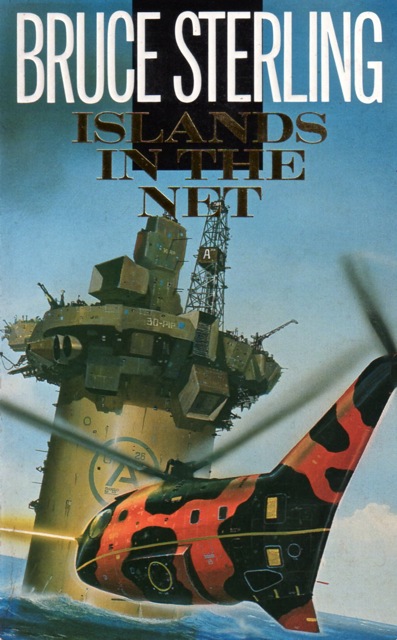
BKTG17418If Gibson’s Neuromancer omits Africa and its peoples, including the diaspora, Bruce Sterling’s Islands in the Net (1988) might seem like a step in the right direction, at least inasmuch as it spends one long section in Grenada and (after visiting Singapore) another in Mali (with a brief snatch of coda passing through Algeria to Morocco). Intended as – or at least praised for being – a more realistic take on a global cyberpunk future, the novel offers an improbable variant on that old saw attributed to Fredric Jameson and Slavoj Žižek: it is easier for Sterling to imagine Americans happily giving up their guns than it is to imagine the end of capitalism. The novel is set in the 2020s, after the ‘Abolition’ (of nuclear weapons and conventional small arms). Under a new world order (that is pretty much the old world order but with fewer issues of national sovereignty getting in the way of a liberal-ish neoliberal hegemony) dominated by the ‘developed world’ which at least makes a point of feeding the ‘developing world’, albeit on ‘scop’, a cheaply produced single cell protein – ‘the national food of the Third World’ (38). If no one is exactly racing home to enjoy their dinner, no one need go hungry any more. Except in Africa, where such ‘aid’ enables the unscrupulous to accumulate power.

And that’s the problem. The future in Sterling’s novel is of the demoralising, predatory kind projected by the futures industry. As Kodwo Eshun writes, in such projections, typically produced by NGOs and multinationals,

African social reality is overdetermined by intimidating global scenarios, doomsday economic projections, weather predictions, medical reports on AIDS, and life-expectancy forecasts, all of which predict decades of immiserization. … Within an economy that runs on SF capital and market futurism, Africa is always the zone of the absolute dystopia. There is always a reliable trade in market projections for Africa’s socioeconomic crises. (291-2)

Such projections usually propose corporate intervention – the extension and intensification of the market – as the only possible solution.

Sterling introduces his future Africa through precisely such a modelling tool, David’s Worldrun game,

a global simulation. Worldrun has been invented as a forecasting tool for development agencies, but a glamorized version had found its way onto the street. … Long strips of the Earth’s surface peeled by in a simulated satellite view. Cities glowed green with health or red with social disruption. Cryptic readouts raced across the bottom of the screen. Africa was a mess. ‘It’s always Africa, isn’t it?’ [Laura] said. (10)

Later, David explains to a Pole called Andrei Tarkovsky (!) that in the game,

Protein tech, like [scop], is one of your major tools for world stability. Without it, there are food riots, cities crumble, governments go down . . . And not just in Africa, either. (137)

The sense, implicit in this comment, of Africa’s desperate exceptionalism, that it is the benchmark against which to measure the extent to which you have escaped disaster, barbarism, backwardness is everywhere in the novel. Describing the wired world of 2020 – a passage which is quite endearingly clunky in so badly missing the extrapolative mark – Sterling notes (more or less focalised through Laura) that ‘Most of the world, even Africa, was wired for telex these days’ (22). Rizome, the multinational for which David and Laura work, has decided to ‘negotiate’ with the data havens; Emerson explains

‘That’s a modern solution. It worked for the arms race, after all. It has been working for the Third World.’
‘Except for Africa,’ David said. (45)

After the lodge David and Laura run near Galveston is attacked, the mayor, Magruder, objects that terrorism ‘isn’t supposed to come down any more. … Maybe in Africa. … Not here.’ (70-71). The spook sent by Vienna (a metonym for the international conventions/agencies keeping the new world order in order) to investigate the attack muses about all ‘of those millions and millions of unfired NATO bullets … Too many even for the African market, eh?’ (77) – a point reiterated when Laura, in a Malian jail, overhears an execution:

They would often shoot a single man with five or six machine guns; their ammunition was old, with a lot of duds that tended to choke up the guns. They had a worldful of ammunition, though. All the ammunition of fifty years of the Cold War had ended up here in African war zones. Along with the rest of the junk. (355)

When Laura speaks obliquely about the attack to a mercenary, saying ‘I saw a man killed by a machine gun, once’, he replies ‘Oh, really? You’ve been to Africa?’ (270). Later, on the rogue nuclear sub that takes her to Mali, another mercenary tells her the story of how he ‘ended up in Africa’:

‘Africa,’ Laura repeated. The very sound of it scared her. (331)

There has also been a devastating AIDS-like retrovirus, spread by horny sailors and ‘harbor hookers’:

But the world had the virus pretty much whipped now. Contained anyway. Under control.
Except in Africa. (334)

When Laura demands that her accidental rescuer Gresham helps Katje, a ‘dying woman’, he replies: ‘You’re in Africa now. Dying women aren’t rare here.’ (382)

Lying behind all the globetrotting shenanigans is a group called FACT (not the Federation Against Copyright Theft, but the Free Army of Counter-Terrorism) who have effectively taken over Mali and are at war with Azania (as South Africa is now called). FACT not only have a nuclear sub, but have tested one of their warheads in the desert and are – with the collusion of an embroiled Vienna – contemplating using it in the war. Laura and Katje were being taken to the test-site to appear in a propaganda video about this nuclear capacity when Gresham and his Tuareg warriors attacked the convoy in which they were prisoners. Fleeing with her unintentional rescuers through the Sahara, Laura eventually looks around her:

Time passed, and the heat mounted sullenly as the miles passed. They were leaving the deep Sahara and crossing country with something more akin to soil. This had been grazing land once – they passed the mummies of dead cattle, ancient bone stick-puppets in cracked rags of leather.
She had never realised the scale of the African disaster. It was continental, plantery. They had travelled hundreds of miles without glimpsing another human being, without seeing anything but a few wheeling birds and the tracks of lizards. She’d though Gresham was being cavalier, deliberately brutal, but she understood now how truly little he must care for FACT and their weaponry. They lived here, it was their home. Atomic bombardment could hardly have made it worse. It would only make more of it. (386-387)

There is more to say about Islands in the Net, and I will do so. But for the moment, let that stand as its futures-industry-style representation of Africa: atomic bombardment could hardly have made it worse.

Works cited
Kodwo Eshun, ‘Further Considerations of Afrofuturism’. CR: The New Centennial Review 3.2 (2003), 287-302.
Bruce Sterling, Islands in the Net. London: Legend, 1989.

Gone Girl (David Fincher 2014)

unnamedand so anyway it turns out that the best thing about Gone Girl (2014) is not the monomaniacal lengths to which Gillian Flynn went, first as novelist and then as screenwriter, just to play an elaborate unfunny homage to Kevin Smith by once more getting Ben Affleck to chase Amy, nor is it the film’s astonishing commitment to demonstrating that, regardless of the PC-gone-madness of SJWs everywhere, women, especially blonde ones, are at the very core of their DNA betrayers, no, the very best thing about the film – all about love, performativity, duplicity, mendacity, treachery, revenge and psychosis – is the way it captures the raw truth of the relationship between Ben Affleck and Matt Damon when they were cowriting Good Will Hunting (1997), except with Rosamund Pike playing Affleck…

The City in Fiction and Film, week 8

CLEO DE 5 A 7 - French Poster 2

week 7

This week we watched Cléo de 5 à 7/Cleo from 5 to 7 (Agnes Varda France/Italy 1962) as a way to begin thinking about human movement in, across and around the city. The plan was to consider the ideas of the flâneur/flâneuse and flânerie, the dérive (with a hint of le Parkour and le traceur) – but some ad hoc essay-writing support took up part of the class, which meant more detailed work on Guy Debord and the dérive had to be bumped to next week’s class.

Our starting point was the opening of Michel de Certeau’s essay ‘Walking in the City’, which begins with an elaborated contrast of viewing New York from the top of the World Trade Center and living at street level. He describes the city, seen from on high, as ‘a texturology in which extremes collide’ – a visual field made up of, on the one hand, the new structures that constantly irrupt into the scene, reeking of ambition, blocking out the rest of the city and challenging the future, and on the other hand, ‘yesterday’s buildings’, degraded,  turned into trashcans, their accomplishments discarded. One intriguing phrase – ‘brutal oppositions of races and styles’ – fuses the architectural diversity of the city (buildings so different from each other that they might belong not just to different styles but to different races) with the racial segregation of the city created by generations of concentrated white wealth and privilege even when de jure segregation is illegal.

To bring this all a little closer to home, we looked at some recent photographs of London’s skyline – the new buildings that tower over St Paul’s cathedral (the Gherkin, the Cheesegrater, the Lingam, the Carbuncle Award-winning Walkie Talkie), and in the distance Canary Wharf, and over the Thames the Shard. Precisely the kind of urban perspective that reveals ‘a city composed of paroxysmal places in monumental reliefs’.

de Certeau makes his first move from thinking of the city as a texturology to thinking of it as a text when he describes New York’s monumental buildings as ‘the tallest letters in the world compos[ing] a gigantic rhetoric of excess in both expenditure and production’.

Rising to the top of the WTC is ‘to be lifted out of the city’s grasp’, to be liberated from the encounters with others, with difference, with the peril and stress of the streets. It is to be separated out from the masses, the supposedly threatening mob. It is to become Icarus, soaring above the labyrinths constructed by Daedalus. (Given Icarus’s fate, this seems at first like a rather odd allusion, and one that is oddly proleptic – like Lizzie Borden’s Born in Flames (US 1983) – of the fate of the WTC. Maybe I should have rewatched Der Himmel über Berlin/Wings of Desire (Wenders West Germany/France 1987) in preparation – or at least subjected the class to some Nicolas Cage from City of Angels (Silberling Germany/US 1998)).

The height of the building distances the viewer from the city and other people, and in a vaguely messianic mode transfigures him into a god-like being, liberated from the ‘bewitching world’ and all its fleshy entanglements. From the perspective of such a deity the city is now merely a text to be read. This consummation represents ‘the exaltation of a scopic and gnostic drive’ to see and to know. Attaining such perfect knowledge (or, rather, the ‘fiction of [such] knowledge’)  is the consequence of a ‘lust to be a viewpoint and nothing more’. Here, lust is a wonderfully embodied term with which to describe the drive for a disembodied seeing and knowing – it reveals the contradiction underpinning it all: the material can never become immaterial, reason can never exist outside of the flesh that reasons.

(This prompted a further digression into our unexpected parallel module on the history of art, describing the development of perspectival art, with the aid of Tintoretto – not Dom from the F&F movies – and Cannaleto; and some gesturing towards the notion of Cartesian space.)

King Kong – especially the poster for the 1976 version, in which he bestrides the WTC with Manhattan spread out behind him as in some of the photos we looked at – brought us back to de Certeau, who asks ‘‘Must one finally fall back into the dark space where crowds move back and forth…?’ In brief, yes. It is why the tallest building always gets the giant ape, why the presence of this simian embodiment of white supremacist fears/stereotypes of black masculinity (clutching a white girl snatched from her bed) – and, some argue, though less persuasively, of bourgeois dread of the impoverished mob – is such a scandal. There are too many ways in which Kong and all the things he represents just do not belong there (which is also what makes him so cool). If, to achieve his perfect vision/knowledge/power, the ‘voyeur-god … must disentangle himself from the murky intertwining daily behaviors and make himself alien to them’, then damn right we want the big monkey dragging him back down. Gotta love us some primate insurrection. And ape it.

de Certeau contrasts the voyeur-god (associated with the city planner, and other modes of top-down power that seek to surveil, know and control urban space) with the ‘ordinary practitioners of the city … “down below”’ – that is, those of us do not rise above the streets but walk them. For de Certeau, our perambulations constitute an alternative city, an ‘urban text’ written by walking. And although, lacking a god’s-eye perspective, we cannot read this text, our paths make up ‘intertwining, unrecognized poems’:

The networks of these moving, intersecting writings compose a manifold story that has neither author nor spectator, shaped out of fragments of trajectories and alterations of spaces: in relation to representations, it remains daily and indefinitely other. … a migrational, or metaphorical, city thus slips into the clear text of the planned and readable city.

Which is all a little abstract, if rather beautiful, so we took a look at the first parkour sequence from Banlieue 13/District 13 (Morel 2004), in which we are introduced to David Belle’s dissident traversals of segregated urban space – a tactics of renegade mobility that counters strategies of urban control and nurtures existence in the the cracks of the world-machine.

Jump back 150 years to the Parisian arcades and to the actual and literary phenomenon of the flâneur (and flâneuse) – the stroller, the urban explorer, the connoisseur of the street. Balzac described flânerie as ‘the gastronomy of the eye’. And Baudelaire, in ‘The Painter of Modern Life’,  describes the flâneur thus:

The crowd is his element, as the air is that of birds and water of fishes. His passion and his profession are to become one flesh with the crowd. For the perfect flâneur, for the passionate spectator, it is an immense joy to set up house in the heart of the multitude, amid the ebb and flow of movement, in the midst of the fugitive and the infinite. To be away from home and yet to feel oneself everywhere at home; to see the world, to be at the centre of the world, and yet to remain hidden from the world … a prince who everywhere rejoices in his incognito … the lover of universal life enters into the crowd as though it were an immense reservoir of electrical energy. Or we might liken him to a mirror as vast as the crowd itself; or to a kaleidoscope gifted with consciousness, responding to each one of its movements and reproducing the multiplicity of life and the flickering grace of all the elements of life.

An intriguing figure, the flâneur obviously recalls Poe’s ‘The Man of the Crowd’ and Woolf’s narrator in ‘Street Haunting: A London Adventure’ (which we studied in week three) but also perhaps Hans Becker, the serial killer in Lang’s (which we studied in week two). He also combines the two identities that de Certeau separates out – he is in the crowd but not of the crowd, he keeps himself sovereign and separate, an observer more than a participant. Because of this detached attitude, he is never overwhelmed by the urban spectacle he observes, and he is able to invest imaginative power in the most banal of sights. And his very existence is threatened by the speed of urban circulation, the exhausting intellectual activity it requires to defeat the boredom of the city, the intoxication of commodities, and the imposition of rationality and order on the city.

Which brought us to Cléo de 5 à 7. 

The film famously opens with colour footage of a tarot reading, shot from directly above the table on which the cards are spread out, before cutting to conventional black-and-white close-ups for inserts of Cléo during the reading; the rest of the film, much of which is spent prowling Paris streets, is also in black-and-white. This resonates strongly with de Certeau, especially as the god’s-eye view of the table is of a tarot reading that gives us a broad outline of the film’s story. Authoritative and transcendent – colour! – it knows everything; but is in such broad strokes that we need to get down onto the level of the streets and the people who walk them to know the story. We need to be immersed in the grasp of the city.

Later, this metatextual commentary is developed in the film-within-the film – in which Jean-Luc Godard, playing a Harold Lloyd figure, chooses between black and white versions of his lover. Inevitably he chooses blonde Anna Karina, after the black one has died. (And Cléo will not die of cancer but find love, or at least a lover.) The association of blackness with death has already been established when Cléo, looking out of a cab, twice starts at seeing African masks displayed in shop windows. This obviously problematic connection fits into the broader opposition between circulation and stasis that structures the film, and is also played out in the oppositions between image and reality.

This is a film full of mirrors and reflections (and great technical virtuosity in terms of how infrequently you can glimpse any sign in the reflecting surface of the film crew). A lot of this is organised around Cléo’s vanity or insecurity or sense of mortality, whatever it is that prompts her to look at her own reflection quite so often (as she becomes less self-obsessed and more open to the world around her, so reflections disappear from the film). It is picked up on in the allusions to fairy-tales (Sleeping Beauty, Snow White), the protagonists of which both spend time in a deathlike condition. And it is there when Cléo’s friend Dorothée (Dorothée Blanck), an artist’s model, explains why she has no problem posing nude: the sculptors do not see her, they see an idea.  And it is there in the film-in-the-film, when women are explicitly compared to dolls or puppets.

In contrast to this material about image/stasis/death, we have long sequences of Cléo, alone and in company, walking or being driven around Paris – part of the intertwining, unrecognized poem of the city. Does this make her a flâneuse?

In some ways, yes. For most of the film she is in the crowd but not of it, holding herself at a distance – perhaps best captured in the sequence in the second half of the film which intercuts between her point-of-view shots (including memories) and those of the pedestrians walking towards her. She also clearly wants to be noticed, to have her distinctiveness acknowledged by others, as in the café sequence when she puts one of her own records on the jukebox and wanders around, hoping that someone will at least recognise her.

But in some ways no. Perhaps most especially in the delirious hat shop sequence, in which she utterly succumbs to the commodity spectacle (and demonstrates her amazing superpower – to make any hat, no matter how ridiculous it looks when on display, appear fabulous the moment she puts it on.)

week 9

Recommended critical reading
AlSayyas, Nezar. Cinematic Urbanism: A History of the Modern from Reel to Real. London: Routledge, 2006. See chapter 1 “Industrial Modernity: the Flaneur and the Tramp in the Early Twentieth Century City.”
Mazlish, Bruce. “The Flâneur: From Spectator to Representation.” The Flâneur. Ed. in Keith Tester. London: Routledge, 1994. 43–60.
Mennel, Barbara. Cities and Cinema. London: Routledge, 2008. See chapter 3, “The City of Love: Paris.”
Pratt, Geraldine and Rose Marie San Juan. Film and Urban Space: Critical Possibilities. Edinburgh: Edinburgh University Press, 2104. On Cléo, see 77–89.
Scalway, Helen. “The Contemporary Flâneuse.” The Invisible Flâneuse: Gender, Public Space, and Visual Culture in Nineteenth-Century Paris. Ed. Aruna D’Souza and Tom McDonough. Manchester: Manchester University Press, 2006. 164–71.
Weihsmann, Helmut. “Ciné-City Strolls: Imagery, Form, Language and Meaning of the City Film.” Urban Cinematics: Understanding Urban Phenomena Through the Moving Image. Ed. François Penz and Andong Lu. Bristol: Intellect, 2011. 23–41.
Wilson, Elizabeth. “The Invisible Flâneur.” New Left Review 191 (1992): 90–110.
Wolff, Janet. “The Invisible Flâneuse: Women and the Literature of Modernity.” Feminine Sentences: Essays on Women and Culture. Cambridge: Polity, 1990. 34–50.
–. “Gender and the Haunting of Cities (or, the retirement of the flâneurThe Invisible Flâneuse: Gender, Public Space, and Visual Culture in Nineteenth-Century Paris. Ed. Aruna D’Souza and Tom McDonough. Manchester: Manchester University Press, 2006. 18–31.

Recommended reading
James Joyce’s Ulysses (1922) and Virginia Woolf’s Mrs Dalloway (1925) are the great modernist novels of walking in the city. Other poetry. fiction and non-fiction about flânerie and about traversing the city by tactical means include Charles Baudelaire’s Paris Spleen (1869), Knut Hamsun’s Hunger (1890), Louis Aragon’s Paris Peasant (1926), Robert Musil’s The Man without Qualities (1930–43), Jean-Paul Sartre’s Nausea (1938), Colin MacInnes’s Absolute Beginners (1959), Raymond Queneau’s Zazie in the Metro (1959), Iain Sinclair’s Lights Out for the Territory: 9 Excursions in the Secret History of London (1997), Edmund White’s The Flâneur: A Stroll Through the Paradoxes of Paris (2001) and Matthew Beaumont’s Nightwalking: A Nocturnal History of London (2014).

Recommended viewing
Films about wandering around the city or traversing the city by tactical means include Zazie dans le metro (Malle 1960), Tokyo Drifter (Suzuki 1966), After Hours (Scorsese 1985), London (Keiller 1994), District 13 (Morel 2004), Adrift in Tokyo (Miki 2007), Enter the Void (Noé 2009) and Holy Motors (Carax 2012).

SPECTRE (Sam Mendes 2015)

MV5BMjM2Nzg4MzkwOF5BMl5BanBnXkFtZTgwNzA0OTE3NjE@._V1_SX640_SY720_and so anyway it turns out that the best thing about SPECTRE (2015) is not that with Sam Mendes’s sprightly directorial style they have found a helmsman as precisely geriatric as this leaden, self-important iteration of the franchise, nor that the atrocious dialogue actually succeeds in making you miss Roger Moore, nor that it spectacularly misrepresents North African rail services so as to set the benchmark for what we should expect from Prime Minister-to-be Jeremy Corbyn’s thankfully renationalised rail service (every carriage first class, with a bar, boutiques and tailors), nor that its title sequence manages to do tentacle hentai as insipidly as it does theme tune, no, the very best thing about SPECTRE is the hidden-in-plain-sight Marcel Proust allusion that is there for no reason other than to remind you of things past, when Bond used to be fun and misogynist rather than just dull and misogynist…

Forgotten Spaces 2013

a_lost_world__draw_2598564kFrom 4 October to 10 November 2013, London’s Somerset House, which stretches from the Strand to the Embankment, was home to Forgotten Spaces 2013, an exhibition showcasing the 26 shortlisted (of 147) entries in the Royal Institute of British Architects’ competition of the same name. Located in the Lightwells (the two meter wide subterranean passageway that runs between three of the House’s inner walls and the sides of the fountain court) and in the Deadhouse (the tunnels beneath the fountain court where gravestones were relocated during the Georgian rebuilding of the House), it is fairly minimalist: a pair of information boards per entry, including artists’ impressions and, perhaps, photographs of the location as it currently appears or as it used to be fifty or a hundred or more years ago; occasional architects’ models or dioramas; several small installations. It is as if William Gibson’s cool hunters raided the Bridge for ideas to commodify but ended up doing school projects instead.

Forgotten Spaces is a rather spectral affair. Ghosts of London’s multiple pasts appear in glimpses; histories that played out differently than expected flicker and flit among the Deadhouse stands; and each display conjures a possible future that, like the dirigible cheekily lofting in the blue evening sky above A Lost World, is never seriously intended to become reality. (Meanwhile, dancing just out of reach are reputation and the possibility of actual commissions.) The exhibition inserts possibility into deeply sedimented urban spacetime. Each entry refuses to accept that a city’s retrofitting must succumb to the dystopianism of Syd Mead’s Blade Runner Los Angeles. But utopian desire is everywhere haunted by the phantasm of corporate co-optation. Neoliberal capital frames every project. Few of them would have any chance without corporate sponsorship, and those that might get by without it—such as Urban Agri-Aqua Culture’s plan to convert an abandoned Kingston Upon Thames sewage works into a fish, fruit and vegetable farm—cannot hope to escape the inertia of property and the menace of land values.

The scale of the projects varies considerably. Bikebox wants to create a network of emergency cycle repair stations from the iconic K6 red telephone boxes falling into relative disuse across the city, while In the Canopy raises ladders up to treetop perches, opening up new vistas for adults reliving childhood tree-climbing antics. The Lepidopterium is an exotic butterfly house, situated on a patch of ground next to a railway line, itself already a haven to native species. Recalling some of London’s earliest streetlights, fuelled by methane from the sewers, Hidden Light imagines pipes that slowly telescope up into the air as they fill with sewer gas and, on reaching their full extension, burn it off in a spectacular flare before telescoping down to ground level once more.

Another piece of outmoded gas technology, the gasometer, fascinates entrants. The Gasworks retains the cylindrical lattice that used to frame the gasholder when it was above ground, and decorates it with panels off which light can be bounced, creating the effect of a giant lantern, while the cavernous space below, which held the retracted gasholder, becomes a gallery, with a long ramp sweeping down around the outer wall. A Lost World envisions several adjacent gasometers housing a zoo and aquarium, with their anaerobically digested waste sustaining a lake and wetlands. Reclaiming the Canalside has its eye on gasometers as the centerpiece of an urban park, while Sculpture & Sons seems happy merely to have a gasometer visible in the background of its five-storey reconfigurable sculpture park.

dwwarmachines1Every bit as iconic as a phone box or gasometer is the BT Tower, which (when it was the Post Office Tower and tallest building in London) housed the megalomaniacal WOTAN supercomputer (at least according to Doctor Who’s “The War Machines” (1966)). It once had a revolving restaurant and viewing galleries open to the public, but for more than thirty years public access to this monument to the 1960s’ optimism of Harold Wilson’s “white heat of technology” has been restricted. An Aerial View wishes to convert the Tower’s aerial platforms into a public space once more, with multi-storey curtains to be pulled back to reveal the city. (Sadly, there is no plan to turn its pinnacle into a mooring mast for A Lost World’s rogue airship.)

Plunging beneath the ground, Museum of Memories is an archive of artifacts situated in the terminus of the old London Necropolis Railway (which, I swear, is, or was, a real thing). With more than a hint of Passport to Pimlico (Cornelius UK 1949) about it, Aldwych Baths is a decommissioned tube station turned swimming baths; Aquadocks is a similar, if rather more up-market, scheme for the airy, columned space fleeting-memories-4orm_webbeneath the Royal Docks. In contrast, Fleeting Memories wants to bring water above ground, returning the River Fleet to the surface near St. Pancras where, according to the crafty artists’ impression, Seurat’s Bathers at Asnières (1884) will idle away London days; and The Centre for Forgotten Beer wants to recover London’s brewing history and bring long abandoned beers—their flavors and smells—back into circulation.

While some projects prioritize recycled and reusable materials, others seem mostly to harvest buzzwords (“responsive,” “innovative,” “permeable public realm”). Some are difficult to distinguish from the ongoing gentrification of Docklands and other rising boroughs. Many of those that want to recover river and canal banks seem little different—give or take a tree or two, some wetlands, or a strip of garden—to the soulless piazza behind the new Paddington Station development. A number of entries seem to belie their nature as hypermodern spaces by imagining themselves as, in Marc Augé’s terms, places. Guerrilla gardening and other urban insubordinations are pre-empted by the occasional bed devoted to urban agriculture, and innovation from below becomes draped in the discourse of increasing “food security” against a backdrop of rising global populations (as if produce from an urban fish farm might actually end up on regular folks’ dinner tables rather than the menu of a boutique restaurant).

Other, related dystopianisms lurk in equally plain view. Many entries talk about providing spaces for “the community,” but no one seems even to have consulted with actually existing communities in which these forgotten spaces exist. Has the ideological commitment to neoliberal regeneration reached the point where “the community” is always-already in the subjunctive tense? Are incoming hipsters always-already gathering, like Hitchcock’s birds? About halfway around the displays, I realized that in all the artists’ impressions there had not been a single person of color, and the only one I subsequently spotted in any of the exhibition’s images was in a “before,” rather than an “after,” picture. Is this the real future of London to be found in Forgotten Spaces 2013?

Artists’ impressions of the 26 shortlisted entries can be seen at the RIBA London website.

A version of this review appeared in Science Fiction Studies 123 (2014): 467–9.

Calixthe Beyala, How to Cook Your Husband the African Way (2002; trans 2013)

51zqAenL6DL._SX360_BO1,204,203,200_Calixthe Beyala, born in Cameroon in 1961 and resident in France since 1978, is generally counted as one of the second generation of African Francophone female writers – a judgment that is not merely to do with when she started publishing fiction (the 1990s) but also a reflection upon her typically feisty, feminist, vulgar subject matter and her eschewal of standard French in favour of a Parisian-African vernacular (not that I can tell, being monolingual). For all that she has won a number of major literary awards, there is a lot of critical commentary (mainly by men, at least from the sample I have been able to access online) that portrays her as, in various ways, not a proper writer. And I guess there are what some might consider improprieties in this novel, but I found them interesting and/or enjoyable rather than shocking or somehow disqualifying.

How to Cook Your Husband the African Way begins with what appears to be a fantastical premiss, with the black protagonist/narrator Aissatou explaining that at some point she became white:

My roots are black. I’m a black woman, but being away from my roots has confused me. Let me be honest. I embraced dissipation. I abandoned myself to it as you abandon yourself to a heavy fog. … I don’t know when I turned from ebony to ivory, but I do know that I smear my hair with a product called White Glow. Guess what it does?

I am, as I said, not sure when I became white. I now smear my skin with Venus de Milo and other cosmetics made for whites. That isn’t the end of it, though. Because to be white you’ve got to be thin. I’ve tortured my body to make it as small as possible. So now, I don’t have any breasts and my thighs are flat geometries – all because the mirror of the world requires that I make my body pleasing to white men. A beautiful woman is flat as a pancake, thin as a rake or a slice of Melba toast. Melba toast snaps easily. Crickle crackle. (7)

However, as soon becomes clear (and is already hinted at in the full version of the quoted paragraphs), this fantastical transformation should not be read literally. This is not like George Schuyler’s Black No More (1931) or Melvin Van Peebles’s Watermelon Man (1970). It is a moment of hyperbole that captures a certain truth of double-consciousness, of a black woman’s conformity to white standards of beauty, of her willed bodily transformation and the abandonment of African aspects of her cultural heritage it entailed:

I am a white negro woman and food poisons my powers of seduction. I make my body sing by peeling my buttocks, by minimizing my breasts, convinced that if I make a martyr of my stomach, I’ll win a great prize. The pores of my trim body will exude divine sensuality. (15)

And apparently, where white Parisian men are concerned, they do. Which is of no help whatsoever when she falls in love/desire/passion with the Malian Suleiman Bolobolo, the new tenant in her building, who lives with his senile mother, who keeps a chicken in their apartment and who thinks she is in contact with the inhabitants of planet Oburne.

Aissatou’s initial approach to winning Bolobolo is to follow her white consciousness:

Rainbows appeared in the sky to answer women’s need to seduce. When a woman wants to seduce a man, she must smell sweet and glitter. Which is why we visit the lingerie shops when we’re in love. The modern knicker is available in all the glorious colours of the universe. These are consolations the gods have granted us to make up for the fact that we are mortal. (28)

But she realises that she is both ‘in Paris and not in Paris’, bilocated between ‘the African jungle’ and ‘a different jungle, the metro’ (33). And although she cannot ‘be bothered’ (40) to return to or embrace some half-remembered/half-invented version of négritude or africanicity, she can follow the advice she imagines her mother would give:  cook for him, cook African meals that awaken his senses and sensuality, and thus capture his heart (and loins).

And in between each short chapter, there is a recipe or two – for meals as varied as paprika ngombo, boa in banana leaves, domba de macabe, mango puree on toast, and crocodile in tchobi sauce.

The novel tacks a course somewhere between essentialism and cultural constructivism, using the later to undermine the former even as it tend to rely on the former to explore notions of identity and hybridity. The tone throughout is a little bit raunchy – or at least blunt about sex – without ever being pornographic (a charge often levelled against Beyala). And while it is never laugh-out-loud funny, it is always comical.

Time heals all wounds though it doesn’t really wound all heels. If only. (9)

The City in Fiction and Film, week seven

man-with-a-movie-camera1week 6

There are three main parts to this week’s class: viewing and discussing Chelovek s kino-apparatom/Man with a Movie Camera (Vertov 1929); reading and discussing Tom Gunning’s ‘Cinema of Attraction[s]: Early Film, Its Spectator and the Avant-Garde’; and essay preparation for next week’s deadline.

In my experience, first year students often struggle with Man with a Movie Camera – very few ever seem to grasp it, let alone like it; and then by the time they are third years, and more used to engaging with a wide variety of films, a number of those who were initially quite negative about it come to appreciate it, even like it. So I did a bit more than I usually would to frame the film – especially as the day before on Cultural Value, Literature, Film and Consumption, they had gone from looking at versions of Sherlock Holmes and James Bond to reading Alain Robbe-Grillet’s Jealousy and watching Last Year at Marienbad (Resnais 1961).

Drawing on some work on film forms from an earlier week on colleague’s Film Style and Meaning module, I framed Man with a Movie Camera as both

  • a documentary, but one that does not use language tell you what its subject matter is or guide you through it
  • an experimental film that requires you to think about the connections between images (one of my favourite gags in the movie depends entirely upon our learned assumptions about narrative and continuity editing: from the right of the screen a football is lobbed into the air; cut to a shot of a man throwing a javelin from the left of the screen – will he puncture the ball in mid-flight?’; cut to a shot of a goalkeeper on the right of the screen – will the javelin impale him?)
  • a self-reflexive film about producing and exhibiting film – all about seeing and being seen, projecting images, filmmaking as an industrial craft among other industrial crafts, film as an industrial product, film as a leisure activity, film as a constructor and conveyor of illusion

and in relation to

  • city symphony films, such as Manhatta (Sheeler and Strand 1921), Berlin: Symphony of a Great City (Ruttman 1927), Moscow (Kaufman 1927), A Bronx Morning (Leyda 1931) and City of Contrasts (Browning 1931) – one of the students later noted formal similarities to films such as Baraka (Fricke 1992)
  • film poems, such as The Bridge (Ivens 1928), La Tour (Clair 1928), Every Day (Richter 1929), Rain (Ivens 1929) and Daybreak Express (Pennebaker 1953) – the latter of which they saw a few weeks ago on Film Style and Meaning

We also had some questions to think about while watching the film:

  • How are shots connected to each other? For what reasons does one follow another?
  • Are there graphic and/or textural matches/contrasts between successive shots?
  • Are there traces of narrative?
  • What thematic connections are elaborated across the film?
  • Think about binary oppositions: male/female, public/private, work/leisure, humans/machines, cameraman/people, capturing the city/intervening in the city

I had to stay for the start of the screening to check something in the first few minutes of the film – and ended up watching the whole thing again for the second time in less than 48 hours. I love this movie more every time I see it.

The lecture began with some more framing of the film (next year, I need to try to get the lecture scheduled before the film, if possible).

Viva Paci describes the emergence of cinema as ‘part of the euphoria of modernity’. Like ‘other fetish phenomena typical of modernity, such as billboards, posters, expositions and store shelves’, cinema is ‘merchandise that makes itself visible, turning its presence into spectacle’ (126).Last week we saw, in Modern Times, the centrality of the department store to modern urban experience, and Man with a Movie Camera directly addresses some of these other phenomena. For example, in the early sequence of a sleeping woman slowly waking, there are  cut-aways to a detail from a poster, which later is revealed as the poster for a film called The Awakening (of a woman).

I outlined some of the ways in which many early actualité films shared the same drive as expositions and world’s fairs to expose mass audiences to new technologies and views/simulations of distant and exotic lands (and as this week is also thinking a little bit more about urban alienation and disorientation, it is not insignificant that the first known US serial killer, HH Holmes, stalked in and around the 1893 Chicago World’s Fair).

Paci also relates cinema to

exoticism (as found in the era’s expositions and in the Paris arcades celebrated by Baudelaire and Benjamin), train journeys (and the new visions of the landscape in movement and the proliferation of perspectives they offered), advances in the faculty of sight (from the air, for example, or with microscopes) and the improvements to fantastic images [that] had already fed the collective imaginative identity extended [and] new aesthetic habits. (125)

Annoyingly, I could not find my copy of The World of Tomorrow (Bird and Johnson 1984) to show off some 1939 New York World’s Fair footage, so instead we focused on the connections to trains and new technologies of vision. An 1861 quote form Benjamin Gastineau best captures train travel as proleptic of watching a programme of short films such as the Lumière brothers first charged an audience to see at Le Salon Indien du Grand Café on 28 December 1895:

Devouring distance at the rate of fifteen leagues an hour, the steam engine, that powerful stage manager, throws the switches, changes the décor, and shifts the point of view every moment; in quick succession it presents the astonished traveller with happy scenes, sad scenes, burlesque interludes, brilliant fireworks, all visions that disappear as soon as they are seen. (Schivelbusch 63)

Hale's_Tours_of_the_WorldWe spoke about Hale’s Tours (launched, of course, at an exposition – the 1904 St Louis Exhibition) and train films and, of course, Edison’s Railroad Smashup (1904), for which the film company bought two decommissioned trains and crashed them into each other. If we had way more time, I would also have shown the remarkable train crashes from Orlacs hände (Wiene 1924) and Spione (Lang 1928), the sequence shot from the front of the train in Bulldog Jack (Forde 1935) and the opening of La bête humaine (Renoir 1938) to show how this fascination continued on into narrative cinema, and is in some ways the visual precursor of the jump to lightspeed/hyperspace, etc.

imagesFor new technologies of vision, we recalled some work from Film Style and Meaning on Eadweard Muybridge’s motion studies and Étienne-Jules Marey’s chronophotography – examples of pre-cinema which also lead to Frederick Taylor’s ‘scientific management’ of the workplace, suggested in both Modern Times and Man with a Movie Camera – and the similarities that can be found in such contemporaneous art as Marcel nude2Duchamp’s Nude Descending a Staircase, no.2 (1912). And, of course, we watched Cheese Mites (Duncan 1903) and Percy Smith’s The Birth of a Flower (1910) and his juggling fly films to see how microscopes and time-lapse photography could show human eyes things our eyes could otherwise not see. We looked at some views of Paris from the top of the Eiffel Tower in Paris qui dort (Clair 1925) – aerial views of a kind previously only accessible to people in aircraft and construction workers – and also at Onésime horloger (Durand 1908), in which the protagonist, frustrated that he cannot get his inheritance until he is older, speeds up the Paris city clock: a series of gags are played out, made funny by the accelerated pace of the action; and undercranked footage played back at regular speed sees pedestrians dash through the city, even more harried than usual by the regulation of life by clocks (which, of course, connects back to railroads, factories and other disciplinary institutions). .

We then turned to Soviet montage, and again I was able to connect back to some work on editing and montage from Film Style and Meaning. I began by introducing the key figures and their most important films:

  • Sergei Eisenstein – Strike (1925), Battleship Potemkin (1925), October (1927), The General Line (1929), Alexander Nevsky (1939), Ivan the Terrible, parts 1 and 2 (1944, 1945)
  • Lev Kuleshov – The Extraordinary Adventures of Mr West in the Land of the Bolsheviks (1924)
  • Vsevolod Pudovkin – Mother (1926), The End of St Petersburg (1927), Storm over Asia (1928)
  • Esfir Shub – The Fall of the Romanov Dynasty (1927), creator of the compilation film – who also fleetingly appears in Man with a Movie Camera
  • Dziga Vertov – Kino-Pravda (1925-28), A Sixth of the World (1926), Man with a Movie Camera (1929), Three Songs of Lenin (1934), Lullaby (1937)
  • Yelizaveta Svilova, who plays the editor in Man with a Movie Camera as well as editing it and others of her husband’s films before becoming a director herself in the 1940s (her brother-in-law, Mikhail Kaufman. also shot several of his brother’s films, including Man with a Movie Camera, in which he also plays the cameraman)

A quick description of the Kuleshov effect gave me the excuse I’ve been looking for to show off the actorly range of lardy racist Steven Seagal, before 715661586edd971305e05f19b5f311b1reminding students of Eisenstein’s theoretical discussion of montage and the analysis they had done of the clash of images in the sequence from Strike in which the assault on the workers is intercut with the slaughter of the bull in the abattoir. Plus, some lions.

We then finally discussed Man with a Movie Camera in some detail, picking out moments such as:

  • the intercutting of the woman rubbing her eyes, the shutters of her window-blinds opening and closing, the camera shutter – associative editing, detecting similarities and differences between phenomena, sketching out relations between organic and mechanical actions
  • the superimposition of the eye on the camera lens – a kind of cyborg melding of mechanical means and human consciousness, emphasising differences in kinds of vision
  • the splitscreens in which the cameraman towers over the city – part of the depiction of the cameraman as an heroic figure that runs throughout the film, and of the celebration of the camera’s ability to see anywhere, but also with a hint of surveillance (there is one shot in the film in which the camera is positioned high above the street and seems to move autonomously, like a CCTV camera)
  • the stop-motion animation of the camera, giving it life – animating it, as the camera/projector does with each still image it captures/projects
  • the shots which show something hurtling towards or passing over the camera, and the following shots which reveal how it is done
  • Svilova editing the film, and the later placement of the frames in the film, animated and given a context
  • industrial footage, especially of rotating devices and interlocking gears that recall the mechanism of the camera/projector – and nice to see a sewing machine included, since the camera/projector borrowed from sewing machine technology the intermittence device that allows individual frames to be held momentarily in place to capture/project each individual image
  • the skill of manual labour, such as the woman making cigarette packages, but also how machine-like it is in its endless speed, precision and repetition
  • the obsession with trains and trams, constantly on the verge of catastrophic collision
  • the shop-window mannequins that wake up and come to life along with the humans, awoken by the presence of the sun (or the camera)
  • the world being captured unawares vs. people’s reactions when they know they are being filmed – and that film is present in the world not just as labour and recorder but also as projection, cinema, leisure activity
  • the use of freezeframes and slow motion, recalling the material basis of film (the photogram), the role of editing, and those early motion studies of Muybridge and Marey

The final section of class was about Tom Gunning’s discussion of the cinema of attractions. Early film history used to be told in terms of a tension or conflict between two approaches to cinema that ultimately and somehow inevitably resulted in the dominance of narrative cinema. These tensions were rooted in a distinction between:

Auguste and Louis Lumière’s ‘realist’ actualité films (i.e., views of the real world or actuality footage), that mostly eschewed anything but the most minimal of narrative form; see Baby’s Breakfast (1895) or Arrival of a Train at La Ciotat (1895) or the non-Lumière Black Diamond Express and Electrocuting an Elephant (1903)

and

Georges Méliès fantastical féerie films (i.e., ‘trick films’ organised around special effects) that, because of the nature of many of his gags and routines, contain some more obvious narrative structuration; see The India Rubber Head (1901) or A Trip to the Moon (1902).

Tom Gunning and others have, over the last thirty years, argued against this view, finding that despite superficial differences both approaches to filmmaking shared something profoundly fundamental in common: a basic exhibitionist impulse to present an audience with ‘a series of views’ that are ‘fascinating because of their illusory power’. Reality/fantasy, actuality/staged, non-narrative/narrative are pretty much red herrings in the first decade of cinema.

We then spend some time working on this long passage to get a better sense of what Gunning means by cinema of attractions:

To summarize, the cinema of attractions directly solicits spectator attention, inciting visual curiosity, and supplying pleasure through an exciting spectacle – a unique event, whether fictional or documentary, that is of interest in itself. The attraction to be displayed may also be of a cinematic nature, such as the early close-ups just described, or trick films in which a cinematic manipulation (slow motion, reverse motion, substitution, multiple exposure) provides the film’s novelty. Fictional situations tend to be restricted to gags, vaudeville numbers or recreations of shocking or curious incidents (executions, current events). It is the direct address of the audience, in which an attraction is offered to the spectator by a cinema showman, that defines this approach to filmmaking. Theatrical display dominates over narrative absorption, emphasizing the direct stimulation of shock or surprise at the expense of unfolding a story or creating a diegetic universe. The cinema of attractions expends little energy creating characters with psychological motivations or individual personality. Making use of both fictional and non-fictional attractions, its energy moves outward towards an acknowledged spectator rather than inward towards the character-based situations essential to classical narrative. … An attraction aggressively subjected the spectator to ‘sensual or psychological impact’. … a montage of such attractions, creat[es] a relation to the spectator entirely different from his absorption in ‘illusory depictions’.

And then it was time to discuss the essay due next week.

Incidentally, 20% of the class really enjoyed Man with a Movie Camera, 20% liked specific parts of it, and 60% declined to comment

week 8

Recommended critical reading
Berman, Berman. All That Is Solid Melts into Air: The Experience of Modernity. London: Penguin, 1998.
–. On the Town: One Hundred Years of Spectacle in Times Square. London: Verso, 2009
Feldman, Seth. “‘Peace Between Man and Machine”: Dziga Vertov’s The Man with the Movie Camera.” Documenting the Documentary: Close Readings of Documentary Film and Video. Ed. Barry Keith Grant and Jeanette Sloniowski. Detroit: Wayne State University Press, 1998. 40–54.
Gunning, Tom. “An Aesthetic of Astonishment: Early Film and the (In)credulous Spectator.” Film Theory and Criticism. 7th ed. Ed. Leo Braudy and Marshall Cohen. New York: Oxford University Press, 2009. 736–750.
Keiller, Patrick. “Urban Space and Early Film.” Cities in Transition: The Moving Image and the Modern Metropolis. Ed. Andrew Webber and Emma Wilson. London: Wallflower, 2008. 29–39.
Paci, Viva. “The Attraction of the Intelligent Eye: Obsessions with the Vision Machine in Early Film Theories.”, The Cinema of Attractions Reloaded. Ed. Wanda Strauven. Amsterdam: Amsterdam University Press, 2006. 121–137.
Roberts, Graham. The Man with the Movie Camera. London: IB Tauris, 2000.
Strathausen, Carsten. “Uncanny Spaces: The City in Ruttmann and Vertov.” Screening the City. Ed. Mark Shiel and Tony Fitzmaurice. London: Verso, 2003. 15–40.
Strauven, Wanda. ed. The Cinema of Attractions Reloaded. Amsterdam: Amsterdam University Press, 2006.
Webber, Andrew. “Symphony of a City: Motion Pictures and Still Lives in Weimar Berlin.” Cities in Transition: The Moving Image and the Modern Metropolis. Ed. Andrew Webber and Emma Wilson. London: Wallflower, 2008. 56–71.

Recommended reading
Cities are often depicted as so alienating and disorienting that their denizens are driven to madness of various sorts, as in Fyodor Dostoevsky’s The Double (1926), Patrick Hamilton’s Hangover Square: A Tale of Darkest Earl’s Court (1941), Ralph Ellison’s Invisible Man (1952), Bret Easton Ellis’s American Psycho (1991) and Erik Larson’s non-fiction The Devil in the White City (2003).

Cities can also offer possibilities for freedom, as in Muriel Sparks’s The Girls of Slender Means (1963) and Patricia Highsmith’s The Price of Salt (1952), and for metamorphosis, as in chapters 6–7 of Stella Gibbons’s Cold Comfort Farm (1932) and chapter 11 of Agatha Christie’s The Moving Finger (1942), in which trips to London transform rural girls into a glamorous ladies.

Recommended viewing
Other city ‘symphony’ films include Manhatta (Sheeler and Strand 1921), Berlin: Symphony of a Great City (Ruttman 1927), Moscow (Kaufman 1927), A Bronx Morning (Leyda 1931) and City of Contrasts (Browning 1931). Some film poems, such as The Bridge (Ivens 1928), La Tour (Clair 1928), Every Day (Richter 1929), Rain (Ivens 1929) and Daybreak Express (Pennebaker 1953), are clearly related, as are such contemporary films as London Orbital (Petit and Sinclair 2002), Finisterre (Evans and Kelly 2003) and What Have You Done Today Mervyn Day? (Evans 2005).
People on Sunday (Siodmak and Ulmer 1930) combines a city symphony with a narrative about a group of young people played by non-professional actors.
Films of urban transformation include Theodora Goes Wild (Boleslawski 1936), Vertigo (Hitchcock 1958), The Apartment (Wilder 1960) and Better than Chocolate (Wheeler 1999).
Films of urban derangement include The Testament of Dr Mabuse (Lang 1933), Repulsion (Polanksi 1965), Taxi Driver (Scorsese 1976) and American Psycho (Harron 2000).
Urban transformation and derangement come together in disturbing ways in Videodrome (Cronenberg 1983), Tetsuo: The Iron Man (Tsukamoto 1989), Tokyo Fist (Tsukamoto 1995), Mulholland Drive (Lynch 2001) and A Snake of June (Tsukamoto 2002).


Nightcrawler (Dan Gilroy 2014)

Nightcrawler-Movie-Posterand so anyway it turns out that the best thing about Nightcrawler (2014) is not that it turns out not to be an X-Men spin-off, though that is a relief, nor is it the always amusing irony of one medium using a slickly seedy story to criticise another medium for being slick and seedy (and to berate the other medium’s audience for their complicity while expecting its own audience not to notice their complicity in watching the film in the first place), no, the best thing about Nightcrawler is Jake Gyllenhaal’s really quite astonishing performance, as if they were after Patrick Bateman but ended up with Sheldon Cooper…