 and so anyway it turns out that the best thing about Ant-Man ( 2015) is not that it lays bare the ways in which all the MCU movies, from phase meh through to phase yawn, are extremely ordinary if intermittently entertaining films, nor is it the inclusion of a Russian (?) in the trio of comedy ethnic sidekicks as if this somehow eliminates the problem of casting actors of colour in comedy sidekick roles, nor is it the casting of Yanis Varoufakis Mark Strong Corey Stoll as the Hood, thus revealing Disney’s plans for an MCU/Thunderbirds crossover, nor is it the fact that every so often you can hear in Paul Rudd’s lines the rhythms of Edgar Wright’s dialogue, thus enabling you to make your own entertainment by recasting Simon Pegg in the lead, no, the best thing about Ant-Man, which is a little weird but also helps to lay bare a bunch of the creepy-ass stuff that often goes on behind that whole parent-child rift/reconciliation screenplay 101 bullshit, is the decision to confuse Michael Douglas by cutting Evangeline Lilly’s hair so as to make Hank Pym’s daughter look as much like Douglas’s wife as possible…
Author: markbould
Zack Snyder to direct Harper Lee adaptation
 It is 1985 in a world subtly different to our own.
Jean Louise Finch (Jennifer Lawrence) returns home from New York to Maycomb, Alabama to visit her family, especially her beloved ailing father, the lawyer and retired state legislator, Atticus Finch (Tommy Lee Jones).
Unknown to them, she is the costumed crimefighter known as Scout, sent by Black Beetle (Chiwetel Ejiofor) to investigate the role played in the death of Edward Black (Michael Jai White) by a secretive organisation calling itself the Citizen’s Council – not suspecting that she will uncover family secrets and a past she did not know.
She is forced to grapple with issues both personal and political as she tries to understand her father’s attitude toward society – and as she comes to realise that former grand wizard Atticus Finch is Rorschach.
Zack Snyder’s Go Set a Watchmen will be in cinemas in 2017.
Alan Moore does not approve.
The Ice Storm (Ang Lee 1997)
 and so anyway it turns out that the best thing about The Ice Storm (1997) – based on Rick Moody’s 1994 novel of the same name, which I didn’t much like – is not the sheer craft and dedication James Schamus brings to his screenplay so as to ensure that Moody’s multiple perspectives and layered temporalities are reduced into such banality that producers elsewhere thought greenlighting American Beauty would be a good idea, but rather the fact that, whatever the film is, it is neither American Beauty nor Revolutionary Road….
Revolutionary Road (Sam Mendes 2008)
 and so anyway it turns out the best thing about Revolutionary Road (2008) is not all the fucking endless acting cluttering up the scenes in which DiCaprio and Winslet, reunited at last, make you root for the iceberg all over again, but the way in which Sam Mendes takes Richard Yates’s novel – which is, whether by accident or design, neatly poised between a sympathetic portrait of white suburbanites turning on each other as they confront the emptiness of their lives and a devastating satire on these awful, self-deluded pricks who should just hurry up and die horribly – and in the adaptation process to so clearly aim for the former but achieve the latter … well, apart from the bit about devastating satire…
American Beauty (Sam Mendes 1999)
 and so anyway it turns out that the best thing about American Beauty (1999) is not (to my surprise) watching it through a low-level but persistent hangover and half-closed eyes which enable you to pretend you are drifting off to sleep rather than watching the film, nor is it Sam Mendes’s cunning bait-and-switch, where the film starts off being less terrible than you have spent the last decade and a half assuming it is but then becomes far more terrible than the darkest nightmares about it which have plagued you for the last decade and a half, no, the best thing about American Beauty is that it is now in my past (I don’t have to finally bring myself to watch it, because I have done that now, unlike Revolutionary Road (2008), the other Sam Mendes movie I have to get through today for work reasons…
Some new vocabulary
Ablyst – the most relentless oppressor of people with disabilities. The ablest ableist. Iain Duncan Smith.
Feminish – something some female commentators consider feminist but about which you are unpersuaded. Jupiter Ascending. Mad Max Fury Road.
Fetminishtic – an adjective to describe pronouncements about female characters by men who fetishise Princess Leia as some kind of epitome of feminist characterisation.
Garrish – an adjective to describe a blog post that quite inexplicably people keep looking at. Also, to describe the act of transparently luring other, completely uninterested people into looking at it.
Ms.Ogyny – the targetting of a specific woman (e.g., Zoe Quinn, Brianna Wu, Anita Sarkeesian) by misogynists.
Nounjitsu – the artful naming of objects. May involve the use of nounchaku.
Rigor mortice – the best kind of lock to have on your door during a zombie apocalypse.
Bernardine Evaristo, Blonde Roots (2008)
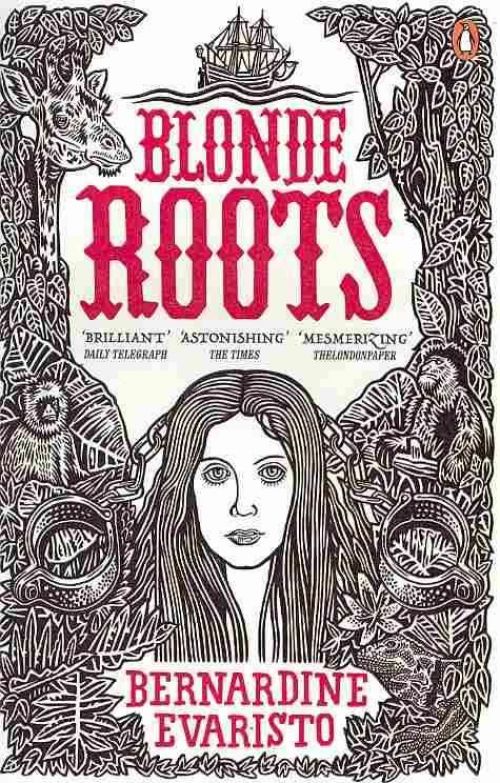 It takes a while to get your head around the generic cues and fictional world of this comical and fantastical neo-slave narrative. It flickers between an alternate history and (race) role-reversal satire, each seeming to conflict with the other. A long succession of gags about Africanised London place names – gags which are not particularly funny (such as Mayfah, Paddinto, Golda’s Green, Brixtane and, settled by Chinese seamen, To Ten Ha Ma) but which ultimately pay off with a geological reference to the Essex massif – clashes with a growing certainty that this Londolo is not in the country called England. And so you turn back to the map in the front-matter and everything becomes clear.
Blonde Roots is not a role-reversal narrative in which everything stays the same apart from race relations, as in, say, Desmond Nakano’s 1995 film, White Man’s Burden. Nor is it an alternate history like, say, Steven Barnes’ Insh’Allah novels (2002–3), in which some not-unreasonable extrapolation underpins a relatively rigorously worked-out world dominated by an Islamic Africa for two millennia, and in which Europeans are the victims of an alternative Triangular Trade, abducted and sold into slavery in Bilalistan (as North America is called).
No, what that map reveals is an alternative terrestrial geography.
An island shaped like Britain (unaccompanied by Ireland), but perhaps larger and called the United Kingdom of Great Ambossa spans the equator off the western coast of north Africa, which is also located further south than in our world. It is not quite clear what has happened to the rest of Africa since it is squeezed off the edge of the map by a Europe, here called Europa, displaced to the south of the Gulf of Guinea. England and Wales, but not Scotland, are wedged into the gap between this relocated northwest Europe and Scandinavia.
While it is entertaining to imagine a seasoned sf pro labouring to establish some geophysical perturbation causing this alternative dispersal of the Pangaea supercontinent, and in turn leading to this inverted social order, that is not where Bernadine Evaristo’s interests lie – nor is doing so as much fun as reading the novel itself.
A comedy about slavery is no easy thing to pull off, as the disastrously misogynist and not terribly funny French timeslip comedy Case départ (2011), directed by Lional Steketee and its co-starring co-writers Fabrice Eboué and Thomas N’Gijol, demonstrates. But it is by no means impossible. Ishmael Reed manages it (more or less) in Flight to Canada (1976), as does Charles Johnson (less than more) in Middle Passage (1990).
From the outset, Blonde Roots has some nice comic touches – in its world, the West Indies are called the ‘West Japanese Islands … because when the “great” explorer and adventurer, Chinua Chikwuemeka, was trying to find a new route to Asia, he mistook those islands for the legendary isles of Japan, and the name stuck’ (5) – but sometimes the comedy sits a little uneasily. For example, the protagonist, Doris Snagglethorpe, abducted from the Cabbage Coast (i.e., Yorkshire), transported to Great Ambossa, sold into slavery and renamed Omorenomwara, is branded with the initials of her owner, Kaga Konata Katamba, and his daughter, her first mistress, Panyin Ige Ghika.
Omorenomwara, who hates Panyin, no doubt gets the PIG half the joke, but the KKK half – and the entire joke, if a white slave being branded KKK PIG is a joke – only works for the reader.
Role reversals and inversions come thick and fast to begin with – monogamy is condemned by the polygamous Ambossans as ‘uneconomical, selfish, typically hypocritical and just plain backwards’ (19); house slaves are known as ‘wiggers’ (24); prosperous Ambrossan urban centres are known as ‘Chocolate Cities’ and ‘the tumbledown ghettos on the outskirts’ where ‘free whytes’ live in ‘squalor’ are called ‘Vanilla Suburbs’ (29) – but as the world is established and the narrative begins to come together, the comedy becomes less gag-oriented and Evaristo expands her comic vision to capture also the pain and tragedy. Misgivings fade.
The novel switches between three strands: Omorenomwara’s present, as she attempts to flee on the Underground Railroad but ends up exiled to a West Japanese sugar plantation and must try to make some kind of life for herself there; Omorenomwara’s memories of her life as Doris and of her years as a house wigger; and an autobiographical pamphlet by Kaga Konata Katamba which includes his justifications for enslaving the self-evidently inferior Caucasians.
Families and lovers long separated by the slave system reunite, sometimes only fleetingly, and a sense of community thrives among brutalised slaves because they are dependent on each other. And in this final section of the novel, Evaristo gets the tone perfect. She reproduces that tired old cliché of slaves singing together in the fields, but makes it clear they do so out of mutual care and to support each other, not because they are happy. She shows them singing on command to welcome their visiting owner, and counterpoints it with them singing for themselves. And she includes the eleven-year-old slave Dingiswayo, ‘strutt[ing] about the quarter in a pair of outsized, hand-me-down cotton pants worn so that the waist hung (somehow) beneath his bum’ (204).
There is always a danger with role-reversal satire that the reader or viewer’s sense of injustice will be aroused for the wrong reason. Not by patriarchy and misogyny, but because men are being treated like women. Not by slavery and racism, but because people of pallor are being treated like people of colour. Blonde Roots’ fractured structure of narrators and temporalities helps it to avoid this pitfall, but for me there was something else, something curious, going on.
I kept forgetting that the slave characters were white.
I suppose this is because the novel mostly uses their Ambossan slave names, rather than their European names; and because so much of the cultural imagery around slavery features enslaved Africans; and because, being a novel rather than a film, there was an absence of concrete visual detail to fix their appearance.
Then every few pages I was brought up short as I remembered, as this potent anamnesis – this remembering of things forgotten – swept over me.
I have no idea whether the novel will work in this way for other people, and I have yet to figure out what it means. But it was powerful and disorientating. The way a good book should affect you.
Paris noir et noir – and hardly morbid at all
Richard Wright was cremated at Père Lachaise.

But before that happened, he used to enjoy hanging out at the Café Tournon with Chester Himes. (You could also find James Baldwin and Ollie Harrington there, and it was where Duke Ellington made his Paris debut.)


Although the management are only interested in letting you know that Joseph Roth lived there. I guess they figure the legend of an unholy drinker is bad for business. (Did you like the literary gag there?)

Somewhere on this street, Chester Himes used to have an apartment.


But when John A. Williams was visiting Paris and dropped by to see him, he found Himes had moved out, leaving the flat to Melvin Van Peebles.
We found Himes still keeping good company in the unexpected book department of Le Bon Marché, the first ever department store.

Another African-American in Paris:

And Harry’s Bar. Where Humphrey Bogart used to hang out.

Their margarita is a damn fine margarita…

…but it is not as good a margarita as their mojito is a mojito.
Paris – mostly revolutionary, mostly morbid, but with a hint of nudity
This statue stands on the spot where the guillotine was erected to execute Louis XVI in January 1793. 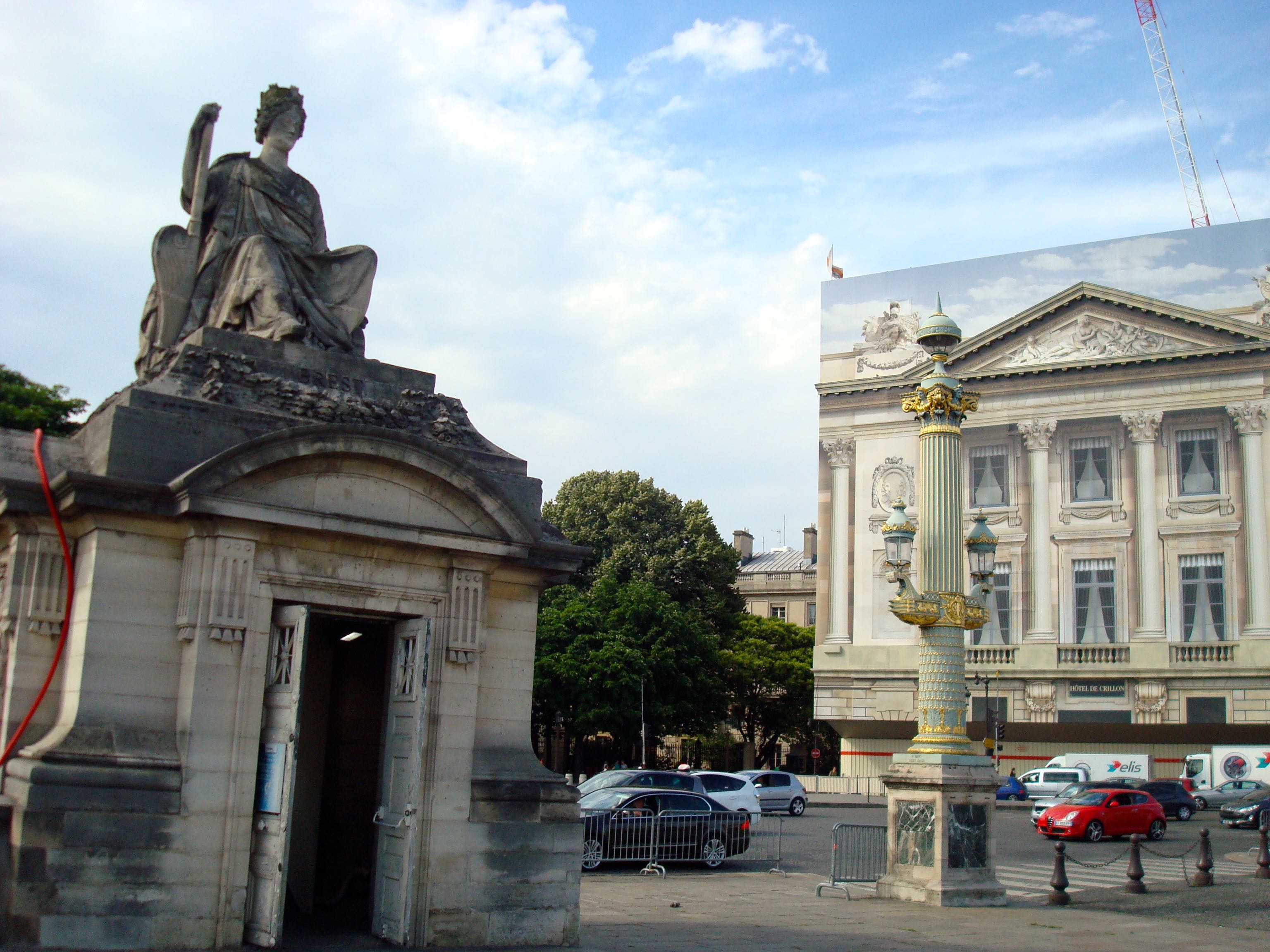 Somewhere near these gates, the guillotine was erected to execute Marie-Antoinette in October 1793.
 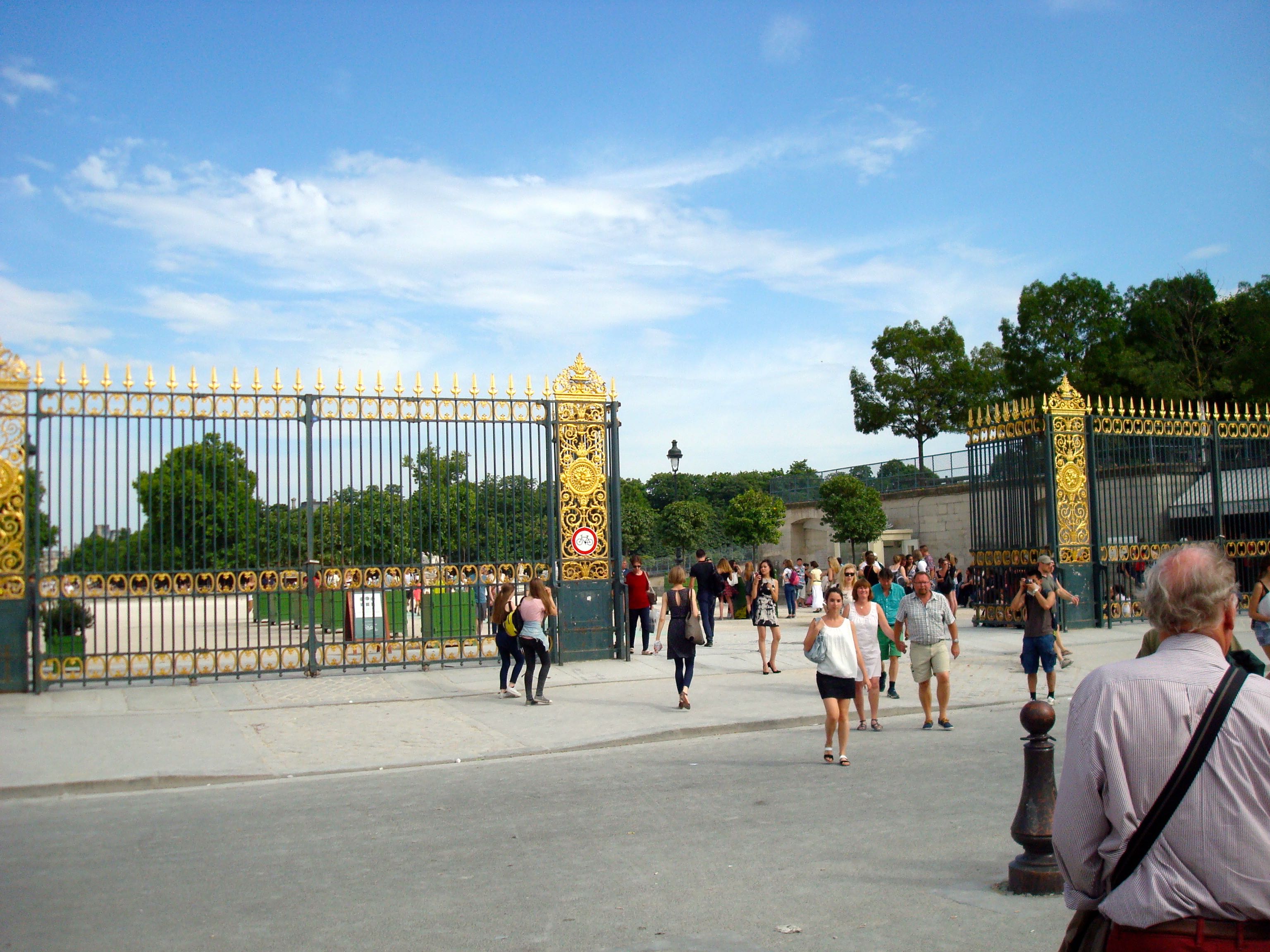 Jean Sylvain Bailly was an early leader of the French Revolution and the first mayor of Paris. He was guillotined during the Reign of Terror.
  In April 1834, a workers uprising broke out against new laws limiting the activities of Republican organisations such as the Society of the Rights of Man. 13,000 police took four days to quell the uprising. On the Rue Transnonain, police massacred all the residents of one apartment building.
  Not even a fucking plaque.
  Honoré Daumier’s lithograph Rue Transnonain, le 15 Avril 1834 appeared in the journal La Caricature. When the original was discovered, he was imprisoned for six months. In the the Musée d’Orsay, we found Maximilien Luce’s Une rue de Paris en mai 1871.
  We also, I kid you not, saw a hipster find a portrait of a 19th century man with a similar beard to his own and take a selfie in front of it. The whole city groaned. In spring 1871, the last of the communards hid out in the Père Lachaise cemetery. The victorious Armée versaillaise put one hundred and forty-seven Fédérés up against the wall and shot them and threw their corpses in a trench by the wall.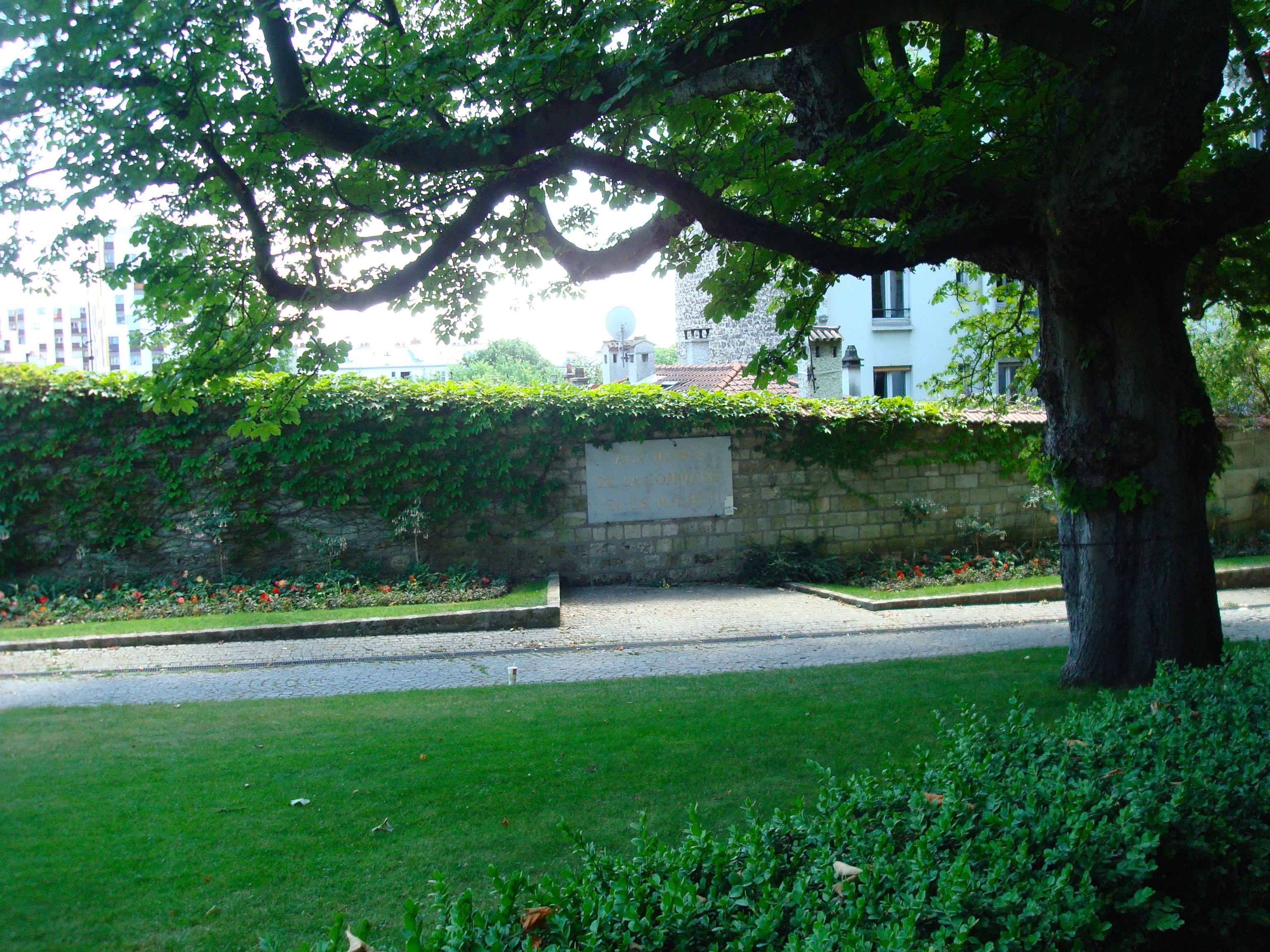
 Opposite this simple memorial is the grave of Marx’s daughter Laura and her husband Paul Lafargue, who wrote among many other things the excellent The Right to Be Lazy. In old age, they committed suicide rather than be a burden on the revolution.
 Nestor Makno, the Ukrainian anarcho-communist revolutionary was cremated here, too.
  I guess I’m wilfully mistranslating/misunderstanding the inscription on this.
  On a cheerier note, this is the bar where Lenin and Trotsky used to hang out in 1915/16 to play chess.
  I guess it was a little less blandly bourgeois back then. The current management are less inclined to recall Bolshevik grandmasters than to boast that Pierce Brosnan once ate there. Lenin, mind you, can pop up in the least expected places (as, indeed, can Stalin).
Paris – mostly science-fictional, mostly morbid


 Mark Bould