 and so anyway it turns out that the best thing about Brick Mansions (2014) is not that it has a piece of good old-fashioned Jean-Claude Van Damme-style hasty exposition about the origins of Lino to explain why someone with a French accent lives in a Detroit ghetto (and then dubs David Belle badly anyway), nor that a film so vastly inferior to its source, Banlieue 13 (2004), has the audacity to insist that ‘different methods can produce the same result’, but that it helped answer a question posed by the old episode of Orange is the New Black I saw just before it – yes, it is actually possible for something to be more depressing than a Tori Amos tribute band…
Author: markbould
Kim Stanley Robinson, The Years of Rice and Salt (London: HarperCollins, 2002)
[A version of this review originally appeared in Foundation 86 (2002), 134-36]
 Bold Bardash, a Mongol horseman in the army of Temur the Lame, crosses through the Moravian Gate and onto the Magyar Plain, and there finds Europe dead, victim of a plague that has killed nearly everyone on the continent. Forced to flee Temur, he heads south to the Mediterranean, where he is captured and sold into slavery. As he sails east to China, he befriends the teenage Kyu, a fellow slave. Various adventures see them become members of the Yongle Emperor’s household, travelling between Nanjing and Beijing. But things end badly, and a tenth of the way through the novel they are dead.
Reunited in bardo, the afterlife, they await rebirth. Bold, Kyu, I-li and several other characters are members of a karmic jati, and when they reincarnate, their lives will again intertwine.
The opening book, ‘Awake to Emptiness’, establishes the basic pattern for the following nine, each of which is written in a slightly different style. For example, ‘Awake to Emptiness’ imitates aspects of Wu Ch’êng-ên’s The Journey to the West, with passages of incidental verse, and narrative hooks at the end of each chapter:
One of the sailors happily names it: ‘Alexandria!’ Bold had heard the name, though he knew nothing about it. Neither do we; but to find out more, you can read the next chapter (23)
whereas Book Six, ‘Widow Kang’, contains marginal commentary, a sometimes sarcastic scholarly exegesis of unfamiliar terminology which also hints at the meaning of the novel’s title (372).
Each book is set in a different period of the seven hundred years following the death of Europe, producing an alternative history centred on Asia, but also including North Africa, colonised Europe, and a North America in which the native American Hodenosaunee League occupies the central region between Chinese invaders on the West Coast and Muslim invaders on the East Coast (one of the novel’s tributes to Dick’s The Man in the High Castle; there are also a couple of references to Tagomi-san). Later books trace the spread of Islam, the temporary establishment of an Islamic utopia, an attempted Chinese invasion of Japan, the discovery of the New World, a revolution in bardo, the birth of empirical science, the establishment of the Hodenosaunee League, attempts at religious co-existence, the industrialisation of warfare and a 70-year long world war, and the gradual development of a world-wide League based on mutual interdependence and responsibility.
Previously, Robinson has deployed various conceits to ensure continuity of viewpoint over a long historical span – such as the Mars trilogy’s anti-agathic drugs, which extend the lives of key members of the First Hundred – or in alternative versions of the same world. In The Years of Rice and Salt, he achieves the latter by doing precisely what Clute suggests he did in the Orange County trilogy, using the same characters under new names (Clute and Nicholls, The Encyclopedia of Science Fiction 1015); and to assist the reader in following them through their multiple incarnations, he uses a naming device ascribed to ‘the Samarqandi anthologist Old Red Ink’ (649). However, as the novel progresses, reincarnation starts to be treated by the characters as a useful metaphor which needs to be reconceptualised in secular terms: humans live again through our children; when we are remembered or when, unremembered, we nonetheless affect the way people behave; when broken down into atoms, ‘we are diffusely reincarnate throughout the universe’ (664). Most importantly, reincarnation can be achieved by thinking of the species as the organism. It lives on, with history or language or DNA as its consciousness and, as Bao Xinhua says,
if we think of it that way, then it might increase feelings of solidarity and obligation to others. It makes it clearer that if there is a part of the body that is suffering, and if at the same time another part commandeers the mouth and laughs and proclaims that everything is really fine … then we understand more clearly that this creature-species or species-creature is insane, and cannot face its own sickness-unto-death. Seen in that sense, more people might understand that the organism must try to keep itself healthy throughout its whole body. (665)
Ultimately, The Years of Rice and Salt tells us not just that other worlds are possible, but that another world is possible.
One of the basic attractions of the alternative history for both reader and writer is the puzzle element: what was the initial moment of divergence from the historical record? For example, the pervasive anachronism in Gibson and Sterling’s The Difference Engine is commonly said to stem from Babbage’s success at transforming his designs for mechanical computers into working machines; but as this could not happen without advances in metals technology and engineering, the authors alter economic, social and political circumstances by positing a revolution in which a coalition of workers, scientists and capitalists overthrew the Duke of Wellington around 1830. Byron’s leadership of this pro-industrial faction is in turn attributed to his wife’s decision in 1815 to stay with him despite his peccadilloes. This event has typically been described as the point of divergence for The Difference Engine, yet there are hints of at least one earlier change to the historical record: the successful establishment by Wordsworth and Coleridge of the Pantisocracy, a utopian community, in North America (that was really proposed by Coleridge and Southey in the 1790s). Did their absence from the British literary scene mean that Romanticism failed to take hold, leading to political rather than poetical careers for both Byron and the Luddite leader, Shelley? Are there even earlier divergences?
This puzzle aspect of the alternative history points to the form’s dependence on a shared epistemic base: we know that the Spanish Armada, the South and the Nazis did not win that vampires do not exist (Roberts’s Pavane, Moore’s Bring the Jubilee, Deighton’s SS-GB, Stableford’s The Empire of Fear, respectively), and, to take an example from Robinson, that America did drop an atom bomb on Hiroshima (‘The Lucky Strike’). Alternative histories then work by establishing how the world created by the alteration differs from our own. This is the other aspect of the shared epistemic base: the reader must be familiar with the historical record that is being changed.
In The Years of Rice and Salt, Robinson offers a magnificent misprision of the form. He has created an intricate alternative history of cultures whose real-world history is largely excluded from Western mass education. This is a profoundly political act, and one which could not be more timely as ignorance of Islamic cultures forms the basis of the stereotyping which is used to justify slaughter of Afghan civilians, oppression of Palestinians and genocidal sanctions on Iraq. Throughout the novel Robinson draws multiple perspectives on the many strands of Islam and the variety of Chinese and Japanese cultures. Sometimes these cultures seem to match stereotypes all too common in the real world – Islam as viciously repressive, the Chinese as yellow peril – but Robinson’s world is too vast and complex to allow these views to go unchallenged. For example, Islam is mourned as a religion with a more or less feminist and egalitarian core in the Quran that has been lost behind the hadith (later teachings which have rather more to do with the subjugation of the people and the maintenance of power); later, other muslims propose looking for what is most buddhist in their religion.
The structure of the novel enables Robinson to demonstrate once more his tremendous skill at novella-length writing, his marvellous economy in creating credible characters, his eye for many different landscapes, and his thematic complexity and coherence over both shorter and longer lengths. He remains a didactic writer, but the various discussions about politics and theories of history that appear throughout The Years and Rice of Salt are vital, integral and invigorating.
It is a work to be pondered, certainly, but more than that, to be savoured.
Caché (Michael Haneke 2005)
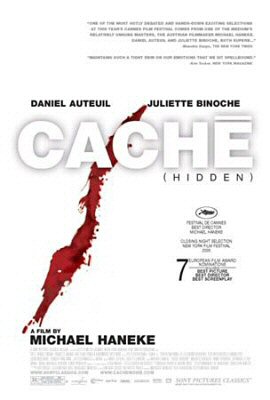 and so anyway it turns out the best thing about Caché (2005) is not the rather effortless manner in which Michael Haneke matches his filmmaking style to the tedious self-regard of his bourgeois protagonists, but the fact that I did not have to pay a penny to watch it since some bloke, never found out who exactly, just left a copy in a supermarket carrier bag on the doorstep…
RoboCop (José Padilha 2014)
 and so anyway it turns out the best thing about RoboCop (2014) is not its astonishing commitment to the lipogrammatic principles of the Oulipo group, going far beyond Georges Perec, for example, who wrote the 300-page novel La Disparition (1969) without using the letter ‘e’, in order to gather together the few surviving remains of a franchise blown apart by lame film sequels, not to mention insipid live-action and animated television incarnations, and from them to build a whole new 117-minute film without using the letters ‘wit’, ‘intelligence’ or ‘decent action choreography’; no, the very best thing is that in the tagline at the top of the poster, very first word, they spelt ‘cinema’ wrong…
Out of the Unknown: ‘Some Lapse of Time’, BBC2 8 December 1965

One of the things ‘Some Lapse of Time’ gets right (and would have probably got right even if it had been a 75-minute episode as originally intended) is selecting to adapt a source of appropriate length – John Brunner’s novella of the same name, originally published in Science Fantasy (February 1963) and reprinted in Brunner’s collection Now Then just a couple of months before the episode aired. A novella has more than sufficient complication for an hour-long drama without any need for additional elaboration (or padding), while also not requiring the compression that adapting a novel might entail, such as season two’s Level Seven, season three’s Immortality, Inc and The Naked Sun or season four’s Deathday.
 Dr Max Harrow – whose young son recently died of a rare disease, heterochylia, the product of a genetic mutation caused by radiation – is plagued by a nightmare of the distant past, of immiserated primitives dominated by a shaman figure. In the small hours of the morning, after the nightmare has woken him once more, a policeman arrives at the door, having found an unconscious tramp outside Harrow’s house. To the doctor’s astonishment, the tramp seems to have survived into his thirties or forties despite suffering from heterochylia, which is every bit as impossible as him even having the disease since he was born long before there were any nuclear weapons. And he somehow found his way to the doorstep of one of the handful of doctors in the country capable of recognising the symptoms…
These are not the only odd thing about the vagrant.
He carries a finger bone with a distinctive curve, he speaks no known language and is, it turns out, radioactive. He is not from the past at all, but from the future. From after the nuclear war. His language is an evolved or, rather devolved, version of English (like in Threads (1985) or Russell Hoban’s Riddley Walker (1980)).
And when Harrow loses the top of one finger – accidentally slammed in a car door during an argument with his wife – and it goes missing, he realises it is the shaman/tramp’s fetish bone, used to focus his journey back in time. (Nigel Kneale’s The Road (1964) relied on a similar reversal of temporal perspective.)
Also being treated at hospital is Wilfred Fitz-Prior, the Minister of War – precisely the kind of person Harrow holds responsible for causing his son’s death. (What choice does Harrow have but to steal the Fitz-Prior’s’s amputated leg and hide it so that it’s bones, too, can become a fetish object for some post-apocalyptic shaman to use to come back and haunt the Minister?) On a rather less macabre note, when Harrow wants to carbon-date the finger bone, he consults with Gerry Anderson (presumably taking a break from filming Supercar or Fireball XL5).
Brunner’s novella is structurally a little clunky, and bows some under the weight of a compositional principle that seems to consist of cramming in everything he could think of, but this does help to generate a sense of inescapable nightmare. (A nightmare that ties in closely with Brunner’s work with the National Council for the Abolition of Nuclear Tests and with the Campaign for Nuclear Disarmament.)
The script by Leon Griffiths – who also wrote John Gillings’ Burke and Hare movie The Flesh and the Fiends (1960), and adapted Raymond F. Jones’s ‘Divided We Fall’ (1950) and Rog Phillips’ ‘The Yellow Pill’ (1958) for Out of this World (25 August and 30 June 1962, respectively, the latter also reworked for Out of the Unknown (25 March 1969)) – cuts away a lot of the clutter. This reduces the nightmarish quality somewhat, even as the pace of the episode teeters on the brink of hysteria.
The production design is by some chap called Ridley Scott, and includes some impressively moderne hospital spaces, especially an angular corridor. The brief exteriors – filmed at the Technical College and the School of Art in (appropriately enough) Harrow – further convey this sense of the very near future; and one shot, in which the camera hurriedly tracks alongside one side of a fence while Dr Harrow races down the other, is especially effective.
Other things to look out for:
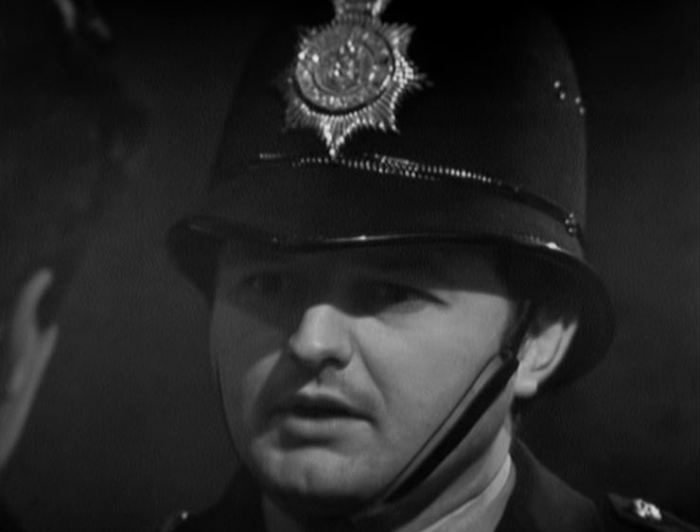
– the copper who finds the tramp is played by a young Peter Bowles, delightfully struggling to do the accent of a rural plod
– one of the medical students lurking in the background is played by Victor Pemberton, who wrote the Doctor Who serial ‘Fury from the Deep’ (1968), as well as episodes of Timeslip (1971) and Ace of Wands (1972)
 Previous episode, ‘Andover and the Android’
Sources
John Brunner, ‘Some Lapse of Time’, Now and Then (London: Mayflower-Dell, 1965)
Mark Ward, Out of the Unknown: A Guide to the Legendary Series (Bristol: Kaleidoscope, 2004)
Out of the Unknown DVD boxset. BFI, 2014.
Theodore Sturgeon’s Venus Plus X
Back in the mists of time, around a decade ago, there was a plan for an ever-expanding online collection of short critical essays on key works of the fantastic. The plan fizzled and died, but not before I wrote nine pieces for it (which I just found). This is the last of them.
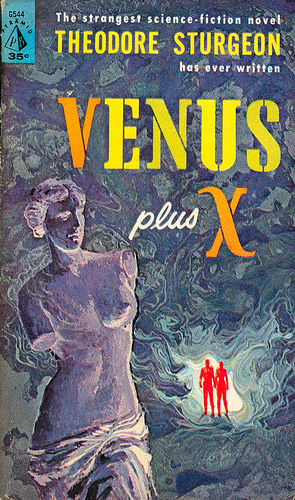 First edition: New York: Pyramid, 1960
Edition used: New York: Pyramid, 1960
Charlie Johns, a contemporary American, mysteriously wakes up in a posthuman future, the apparently utopian society of Ledom (‘model’ backwards). It is home to homo sapiens’ replacements, an androgynous species possessing both male and female genitals. As devoted to the principles of process and change as they are to their children (who symbolise the future and thus change), they live lives of fulfilment and repose. They transported Charlie through time so he can learn about them and offer an ‘objective’ view on their culture and society. Or so he is led to believe…
Interpolated between the chapters charting Charlie’s adventure are shorter ones depicting the life of contemporary suburbanites Herb and Jeanette Raile, and their children, Davy and Karen. These contrapuntal chapters offer sharp satiric insights into gender roles, sexual politics and mores, consumerism, competition, materialistic Protestantism, social hierarchies and child-rearing. Although their tone is very different from that of the Ledom chapters, they offer an essential counterbalance to the more traditionally utopian method of Charlie’s story.
John Clute described Venus Plus X as the novel which
bravely came as close to a traditional utopia as any US genre-sf writer had approached before the efforts of Mack Reynolds.[1]
 This tension – between the utopian guided tour and genre sf’s predominantly action-adventure format – is perhaps most evident in the closing pages of the novel in which a cognitive breakthrough (of sorts) piles fresh revelation on fresh revelation, casting much of what has gone before in a fresh light. A similar tension is effectively balanced in the tonal differences between the Ledom and suburban chapters. Because the utopian form requires expository dialogue to interpose between the utopia and the visitor (including the reader), there is always overt commentary in place of the effect of direct perception. Consequently, in depicting suburban America, Sturgeon is faced with the option of an apparently realistic vision or an expository technique which would parallel (without replicating) the technique used to depict Ledom. Sturgeon’s turn to the satiric, which had become increasingly commonplace in 1950s US magazine sf, is in many ways the more satisfactory method of reconciling the traditional utopian with genre sf, not least of all because it keeps them in constant tension and balance. Venus Plus X, like Ledom, is about ‘passage’ (107) and ‘dynamic imbalance’ (108).
What, then, are the qualities of Ledom that make it utopian? Without biological differentiation in terms of sexual characteristics, and without the fetishisation of particular body parts, there is no basis upon which to construct an ideology of gender differentiation. Biological determinism is invalidated as a concept, replaced by a variety of cultural (including technological) determinism. The Ledom thus express themselves, rather than sexual or gender categories, through their modes of dress, labour and creative activity. Competition has been replaced by harmonious coexistence. Community has replaced suburb.
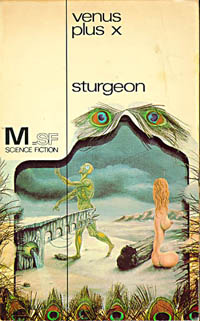 These utopian elements take on greater effect because of their contrast with the harried, frustrated, confused lives of the Raile family. Herb and his neighbour Smitty worry about what they perceive as women taking over in the guise of attaining equality. Where Smitty struggles to maintain masculinist bigotry, Herb struggles to compromise between traditional masculinity and an equal relationship with Jeanette. But Jeanette is not without her own neuroses about sexuality and power relationships. And in a number of comic asides – when Karen touches herself in the bath, when Davy hits her with a pillow for receiving different treatment from their father – it is clear that their children will be caught in similar dilemmas.
The major set of images Sturgeon uses to valorise this distinction between community and suburb is concerned with music. The inspirational, unrehearsed but nonetheless perfect group singing of the Ledom stands in stark contrast to the pop idol Herb and Smitty watch singing ‘Goozle Goozle’ on TV, a polysemic performer targeted at a whole array of market segments:
The words are something about Yee Ooo: I hold Yee Ooo, I kiss Yee Ooo, I love Yee Ooo, Ooo-Ooo. The camera dollies back and the singer is observed in a motion which one might explain by asserting that the singer, with infinite ambition, is attempting to grasp between his buttocks a small doorknob strapped to a metronome. (37)
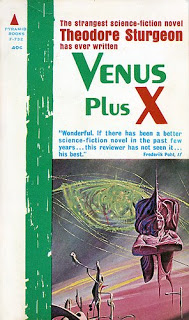 At the core of the novel lie its least novelistic chapters, when Charlie receives a history lesson via the cerebrostyle. The Ledom – and arguably Sturgeon – locate the failure of Western civilisation in the suppression of pre-Christian ecstatic religion and sex and their distortion into instruments of social control:
So sex and religion, the real meaning of human existence, ceased to be meaning and became means. (130)
In the opening chapter, the dislocated Charlie devotes his energy to trying to remember:
He could not stop remembering; dared not, and did not want to stop. Because as long as he kept remembering, he knew he was Charlie Johns; and although he might be in a new place without knowing what time it was, he wasn’t lost, no one is ever lost, as long as he knows who he is. (8)
Continuity of identity here depends not upon name but upon recollection; and what applies to the individual applies to society as a whole. As long as ecstatic religion and sex are repressed, forgotten, Western so-called civilisation is alienated from its true identity.
Central to this repression is an overemphasis
on differences which [are] in themselves not drastic. (61)
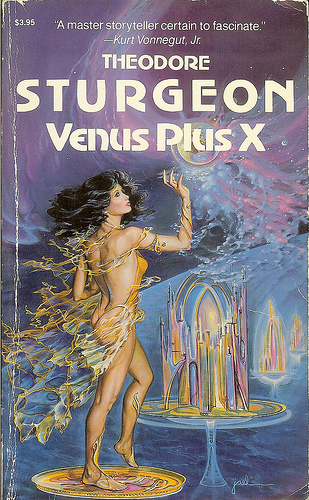 Anticipating Judith Butler’s Gender Trouble: Feminism and the Subversion of Identity (1990), the Ledom argue that differentiation is a product of looking for difference – which is then employed to construct ideologically naturalised hierarchies. Without the deconstruction of sexual differentiation – an act literalised in Ledom – sexual equality will continue to be one of Western literature’s ‘hallucinatory images’, along with
pigs with wings, human freedom, fire-breathing dragons, the wisdom of the majority, the basilisk, the golem. (84)
Notes
[1] John Clute and Peter Nicholls, eds, The Encyclopedia of Science Fiction (London: Orbit, 1993), p.1176.
The other eight entries I wrote were:
Voltaire, Candide
Godwin, Caleb Williams
de Maistre, Voyage Around My Chamber
France, Thais
London, The Iron Heel
Gernsback, Ralph 124C 41+
Smith, The Skylark of Space
Schuyler, Black No More
Bait (Kimble Rendall 2012)
 and so anyway it turns out the best thing about Bait (2012) – the film in which a bunch of young Aussies, most of whom, according to a half-assed imdb search, seem to be stuntmen from Neighbours (!), and that bloke who used to be in Charmed (not the pudding-faced one, the other one) get stranded in a flooded post-tsunami supermarket along with a couple of great white sharks – is the sequence in which one of the kids constructs a shark cage cum body armour out of shopping trolleys and baskets so he can make his way underwater to do something or other (to be honest, I’d stopped paying attention and couldn’t be bothered to rewind it) only to find that his makeshift airtube is too short and he must spit it out in order to reach that little bit further and do that thing, whatever it was, only to then find, when he swims to the surface to breathe in the gap between the water and the ceiling, that the shopping basket over his head is too big and so he drowns, which the film tries to make noble and tragic, and to be honest you would need a heart of stone not to wet yourself laughing….
George S Schuyler’s Black No More. Being an Account of the Strange and Wonderful Workings of Science in the Land of the Free, A.D. 1933-1940
Back in the mists of time, around a decade ago, there was a plan for an ever-expanding online collection of short critical essays on key works of the fantastic. The plan fizzled and died, but not before I wrote nine pieces for it (which I just found). This is another of them.
 First edition: New York: Macaulay, 1931
Edition used: New York: Negro Universities Press, 1969
Frequently praised by HL Mencken as
the most competent Negro journalist […] the most competent editorial writer now in practice in this great free Republic[1]
Schuyler has been largely neglected in histories of sf, partly because of the difficulty of penetrating his pseudonyms (including Samuel I Brooks, Rachel Call, Edgecombe Wright), partly because sf constitutes only a tiny fraction of his massive output, partly because he was published outside of the regular pulp venues, and partly because his politics were somewhat at odds with genre norms. So, for example, his novellas ‘The Black Internationale’ and ‘Black Empire’ (1936–38; later collected as Black Empire), which depict a conspiracy of black professionals manipulating national and international politics to reclaim Africa as a black homeland, did not appear in Amazing or Astounding but in the Pittsburgh Courier – not a publication to which sf historians would necessarily think to turn.
The neglect of Black No More, first published in book form at the tail end of the Harlem Renaissance in 1931 (when sf books were few and far between), is perhaps harder to explain, although it would not have been promoted as sf and many might have found its dedication off-putting:
THIS BOOK IS DEDICATED TO ALL CAUCASIANS IN THE GREAT REPUBLIC WHO CAN TRACE THEIR ANCESTRY BACK TEN GENERATIONS AND CONFIDENTLY ASSERT THAT THERE ARE NO BLACK LEAVES, TWIGS, LIMBS OR BRANCHES ON THEIR FAMILY TREES.
When, on New Year’s Eve 1933, Max Disher is spurned by a white woman at the Honky Tonk Club, he decides to take Dr Junius Crookman’s revolutionary BLACK-NO-MORE treatment to turn him white. Adopting the name Matthew Fisher, he returns to his hometown of Atlanta in pursuit of her. There, pretending to be an anthropologist, he takes up with the Reverend Henry Givens, an ex-officer of the Ku Klux Klan, who is starting up the Knights of Nordica, an organisation of
White Men and Women […] Fight[ing] for White Race Integrity. (60)
 To Max’s delight, the white woman turns out to be Givens’ daughter, Helen. Fearing Max’s growing popularity in his rapidly expanding organisation, Givens is happy to see them married. Meanwhile, Max has been joined by his newly-whitened friend Bunny Brown, and together they make the Knights of Nordica into a major political power, effectively taking over the Anglo-Saxon Association and the Democratic Party. As the black population of America disappears, the central plank of the Knights election strategy is to demand compulsory genealogical testing and race-based social stratification. Crookman and his associates join forces with the Republicans to keep open the BLACK-NO-MORE centres and lying-in hospitals (where any baby born black is turned white so as to avoid social embarrassment). On the eve of the election, Dr Buggerie’s genealogical research – which suggests that if there were as few as one thousand African-Americans who could
pass for white […] fifteen generations ago […] their descendants now number close to fifty million souls (197)
– is stolen, and published in the newspapers:
DEMOCRATIC LEADERS PROVED OF NEGRO DESCENT
Givens, Snobbcraft, Buggerie, Kretin and Others
of Negro Ancestry, According to Old
Records Unearthed by Them. (210)
Max, Bunny and their loved ones manage to escape. Buggerie and Snobbcraft are not so fortunate. Fleeing though Mississippi in blackface disguise, they are nearly lynched; only after they have proven who they are and that they are white, do the newspapers arrive…
 Black No More is a remarkable work of satire, as sprightly and as timely now as when it was written. Its great strength lies in its dyspeptic vision of the absurdity of racism and the hypocrisy with which race is used as a means of obtaining and maintaining power, wealth and influence by some people regardless of colour. This latter is at its most pointed in the sequence in which Max blackmails Blickdoff and Hortzenboff, the owners of Paradise Mill in South Carolina, into paying him to break the imminent strike – a feat he then achieves by seeming to side with the workers, most of them Knights of Nordica who wish to unionise, while hinting that among them are probably some whitened blacks who are constitutionally incapable of not betraying the strike:
Rumor was wafted abroad that the whole idea of a strike was a trick of smart niggers in the North who were in the pay of the Pope. The erstwhile class conscious workers became terror striken by the specter of black blood. You couldn’t, they said, be sure of anybody any more, and it was better to leave things as they were than to take a chance of being led by some nigger. If the colored gentry coudn’t sit in the movies and ride in trains with white folks, it wasn’t right for them to be organizing and leading white folks. (134)
Once the strike is over, the mill owners
took immediate steps to make their workers more satisfied with their pay, their jobs and their little home town. They built a swimming pool, a tennis court, shower baths and a playground for their employees but neglected to shorten their work time so these improvements could be enjoyed. They announced that they would give each worker a bonus of a whole day’s pay at Christmas time, hereafter, and a week’s vacation each year to every employee who had been with them more than ten years. There were no such employees, of course, but the mill hands were overjoyed with their victory. (136)
Because Schuyler’s satire is so wide-ranging, because he treats leaders as cynical manipulators and followers as dupes, because none of his characters seem capable of good or pure motives, it would be easy to label Black No More misanthropic. However, to do so would be to misintepret a comic vision that finds so much humour in venality because those who think they are acting in their own self-interest so frequently are not. Such a perspective produces the kind of absurdism which defines Black No More and which reaches its pinnacle in the last few pages – a few years after the events the novel recounts, it is discovered that those who underwent the BLACK-NO-MORE treatment are in fact lighter in colour than ‘white’ people; consequently, in the desire not to be taken for blacks, people begin to darken their skin colour to look like whites…
The other eight entries I wrote were:
Voltaire, Candide
Godwin, Caleb Williams
de Maistre, Voyage Around My Chamber
France, Thais
London, The Iron Heel
Gernsback, Ralph 124C 41+
Smith, The Skylark of Space
Sturgeon, Venus Plus X
Notes
[1] Both quotations can be found in Schuyler, Black Empire (Boston: Northeaatern University Press, 1991), p.312, n.15.
The Mad Maxathon, part four: Mad Max: Fury Road (2015)

Part one, part two, part three
Let there be no doubt. Mad Max: Fury Road is without question the very best film I saw yesterday (the other one was La momia azteca contra el robot humano (1958)).
It is also the very best Mad Max movie since Road Warrior. And like Road Warrior, it needs to be seen on the big screen (albeit for slightly different reasons, which I will get into below).
I can see George Miller’s pitch even now: Ice Cold in Alex (1958) meets Pumzi (2009), but faster. And we’re gonna steal all that crazy shit about pregnant women and bags of seed from The Ultimate Warrior (1975). And just one more thing from Island of Lost Souls (1932). And Dune (1984) was set on a desert planet, too, so we’ll throw in some of the unsavouriness of the Harkonnens, but without the obvious homophobia.
And, the executives asked, will there be an unexpected homage to Duran Duran and fellow ozploitation alumnus Russell Mulcahy?
You betcha, said George.
But even more unexpected than that there will be, when Max comes to desert after the big sandstorm scene, a tribute to Derek Zoolander’s friends who died in a freak gasoline-fight accident.
Except with supermodels.
Pregnant supermodels.
And water, not guzzle-een. We’ll save the tanks of wet-nurse milk for later. When Max has to wash blood off his face.
But don’t worry, it’s not his blood.
There has been a lot of commentary about how Fury Road gets it right by mostly eschewing CGI in favour of actually staging the action with real vehicles and actual stuntmen. Which is both true and a little misleading. There is quite a bit of CGI, albeit more judiciously deployed than one would expect in a $150 million movie, and there is an awful lot of compositing and post-production digital enhancement. (This is why you need the big screen – not so much for the profilmic car-crunching of Mad Max and Road Warrior, but for the setting of similar action in massively spectacular landscapes.)
There is also – and this is what most people seem to be missing – a lot of attention paid to classical conventions of spatial construction. Unlike in a Christopher Nolan movie, spaces actually make coherent sense, and thanks to John Seale’s camera being held that little bit further from the action and Margaret Sixel’s less-rapid editing you can, unlike in a Michael Bay movies, always tell who is doing what to whom and where they are in relation to each other and their setting.
 Don’t get me wrong, this coherence does not necessarily lead to suspense – Fury Road is no Wages of Fear (1953) or Hell Drivers (1957) or even, though it pains me to say it, Duel (1971) – but it is able to produce an awful lot of tense moments. And this tension stems from the careful thinking-through of the action sequences, from the small scale stuff (Max fighting Furiosa, while he is chained to both a broken-off car door and the unconscious Nux and suffering from the interference of the pregnant supermodels) upwards.
 Is it one long chase sequence? Not exactly. There are moments of pause, moments when the audience can catch their breath, but Miller does something inspired with them. They are character scenes, but so perfunctory – so hilariously badly written, so utterly lacking in the cheesy charm of the Fast and Furious movies – that you are happy for these layovers to be shortened and the chase to start back up again.
The only thing missing is Jerry Reed singing ‘East Bound and Down‘.
Is it the feminist movie those “Men’s Rights” folks seemed so terrified of? (Assuming all that bullshit wasn’t an ingenious piece of viral marketing.)
The answer really depends on how you define feminism. I think it passes the Bechdel test, but there is so little conversation in the movie it is hard to tell.  Charlize Theron, an actress who normally makes me go meh, is implacable as Furiosa and handles a big share of the action every bit as well as the always adorable Tom Hardy. The pregnancy/supermodel/ lactation/seeds conjunction recalls something of that old school hippy female-essentialist feminism. The ageing desert warrior women are just plain brilliant – not exactly 70s lesbian separatists but, in a future where all the men are such dicks, who wouldn’t be in favour of a little wimminz separatism? There is also at times a curious overlaying of female voices, often too quiet to make out many of the words, which made me think of the Kristevan chora –‘Although the chora can be designated and regulated, it can never be definively posited: as a result, one can situate the chora and, if necessary, lend it a topology, but one can never give it axiomatic form’ – which seemed to be pointing towards something interesting to do with desert spaces and, in this company of women, the pre-symbolic (and to pick up on Max’s traumatic flashback instants to events similar, but not identical, to things that happened in the trilogy).
Do these things make it feminist?
Frankly, you’re having a laugh. It is just less intolerant of women than many other movies made on this scale.
But they do give the movie some powerful and intriguing cross-currents and textures. I will have to see it a few more times to even begin to figure it out.
Does Max have a mullet? That would be spoilers.
Is it worth seeing? Absolutely.
Especially if you can dodge the inflation of ticket prices by distributors/exhibitors manipulating 2D and 3D screenings. My local cinema only had the 3D version at £15+ a ticket. The big-ass fancypants cinema in town was charging less for 3D, but had put the 2D version in the “director’s hall”, which made tickets even more expensive than the local 3D. Fortunately, the third-rate cinema in town was showing the 2D at a price which meant two of us could see it for a fraction more than one of us could have seen the local 3D or the fancypants 2D. It is like a temporally-compacted version of classical Hollywood’s system of ‘runs’ is being reintroduced.
And sadly the cinema we saw it in was just a sanitised pathetic relic of its former self, rather than the grunge pit in which ozploitation, however gussied up, should be seen.
The Mad Maxathon, part three: Mad Max Beyond Thunderdome (1985)

This is the one that broke the franchise.
It is the one with the audacity to have a character claim, early on, that ‘We’re dealing with subtlety here’. And the bravery, moments later, to let Aunty (Tina Turner) ask, ‘You can shovel shit, can’t you?’
It is the one featuring the Goonies outback adventure. It is Max Rockatansky’s Kindergarten Cop. His Mr Nanny, his Pacifier, his Game Plan. It is Dad Max.
It is the one that makes Waterworld look not so very terrible after all.
It is a poxalypse, full of pain.
It begins with a drum-machine, for chrissakes.
It is full of other terrible 80s things, such as a shockingly ill-judged Maurice Jarre soundtrack and a dreadful saxophone that, for a moment, fills you with dread  that Aunty will be played not by Tina Turner – whose chainmail shoulderpads are even more awesome now than they were thirty years ago – but by Al Jarreau.
Beyond Thunderdome lays bare the insidious effects of LucasSpielbergianism.
Costing five times as much as the first two films added together, it made rather less than them added together. But a bigger budget meant a drop in the certificate. Which meant replacing innovation with competence. Which meant abandoning crude, robust, imaginative and often very skilful filmmaking in order to imitate the less-than-stellar Indiana Jones and the Temple of Doom. Badly.
It nicks sequences and gags and ideas from HG Wells’s The Island of Doctor Moreau and Island of Lost Souls (1932), from Russell Hoban’s Riddley Walker (1980) but sadly not from William Golding’s Lord of the Flies (1954), from episodes six and seven of Flash Gordon (1936) and episode one of Bret Maverick (1981), from Star Wars (1977) and Apocalypse Now (1979) and Raiders of the Lost Ark (1981) and Mad Max and a whole bunch of westerns. Badly.
 It reworks the climactic chase from Road Warrior.
Badly.
As if Health and Safety finally caught onto some of the crazy shit George Miller was doing.
It is like some Spacehunter: Adventures in the Forbidden Zone (1983) knock off.
While Tina Turner is fabulous as the same-sex-yet-somehow-cross-dressing Aunty, it is disappointing to see the queerness of this future has been muted in the fifteen years since the events of Road Warrior. (I have no idea how the scantily-clad musclemen cranking Bartertown’s elevator managed to sneak unnoticed through the straightening of the post-apocalypse, but I’m glad they made it and are thriving.)
Although there are plenty of stereotypical signifiers of non-white ethnicities – Max’s burnoose and camels, the didgeridoos on the soundtrack early on, Maurice Jarre’s delusion that he is scoring Taras Bulba (1962), the plane-crash-surviving kids’ version of Aboriginal art and make-up – it remains a fairly pallid future in which whitey has learned almost nothing from these cultures about practical fashions for desert environments. One can only assume that Bartertown is built in a quarry (some of the time) because they are mining for sunblock. And talc. And, of course, vaseline.
 When the movie came out, Roger Ebert, who loved it, raved about the Thunderdome fight sequence, calling it ‘the first really original movie idea about how to stage a fight since we got the first karate movies’ and ‘one of the great creative action scenes in the movies’. It was never that good and doesn’t really hold up that well. But it can be made fabulous by taking the time to set up a second screen so you can synch it to the Peter Pan scene from 21 Jump Street (2012).
Much was also made of the alternative Riddley Walker-lite English spoken by the kids who grew up in isolation without any adults around. This linguistic drift, which has none of the post-apocalyptic horror of the final minutes of Threads (1984) either, would have perhaps seem more innovative if a few minutes earlier it hadn’t been revealed that in Bartertown the meaning of the word ‘gulag’ had shifted to mean ‘to be driven into the desert to die while sitting backwards on a horse with a giant papier-mache head on your head’.
So, besides Tina Turner, is there anything good about Beyond Thunderdome?
Well, it provides an opportunity to admire some of the early work by Terese Willis from Neighbours, formerly Sophie Simpson from Home and Away.
It was nice to see Bruce Payne return, playing a character indistinguishable from the one he played in Road Warrior but definitely intended by Miller to be a different character, which doesn’t quite explain how Max recognises him, unless it is a version of that joke in the A-Team title sequence when Face recognises a Cylon.
And it was nice to see the sarlacc pit get work again, even if it never did manage to break free of the way it was typecast by Return of the Jedi…
Oh, and the first thing the kids do after rescuing Max is cut off his mullet. Which at least puts it ahead of Steel Dawn (1987), at the conclusion of which Patrick Swayze is permitted to stride off into the sunset, mane uncropped.
 Mark Bould