Paris noir et noir – and hardly morbid at all

Richard Wright was cremated at Père Lachaise.

wright

But before that happened, he used to enjoy hanging out at the Café Tournon with Chester Himes. (You could also find James Baldwin and Ollie Harrington there, and it was where Duke Ellington made his Paris debut.)

wright a

wright b


Although the management are only interested in letting you know that Joseph Roth lived there. I guess they figure the legend of an unholy drinker is bad for business. (Did you like the literary gag there?)

roth

Somewhere on this street, Chester Himes used to have an apartment.

himes a

himes


But when John A. Williams was visiting Paris and dropped by to see him, he found Himes had moved out, leaving the flat to Melvin Van Peebles.

We found Himes still keeping good company in the unexpected book department of Le Bon Marché, the first ever department store.

himes b

Another African-American in Paris:

baker

And Harry’s Bar. Where Humphrey Bogart used to hang out.

harry's bar

Their margarita is a damn fine margarita…

harry's bar inside

…but it is not as good a margarita as their mojito is a mojito.

The Monuments Men (George Clooney 2014)

MV5BMjMxMjk4NTM1M15BMl5BanBnXkFtZTgwNjg0MjQ3MDE@._V1_SX640_SY720_and so anyway it turns out that the best thing about The Monuments Men (2014), George Clooney’s oddly uninvolving war movie about the unit attempting to retrieve the masterpieces of European art stolen by Nazis before they fall into the filthy red paws of the Soviet army sweeping into Germany from the east, is the long comedy sequence – cut from the cinematic release but now  available as a DVD extra – in which Bill Murray and John Goodman, mangling Gallic vowels in abominable stage French accents, disappear off on a side mission in a valiant effort to recover Van Klomp’s The Fallen Madonna with the Big Boobies…

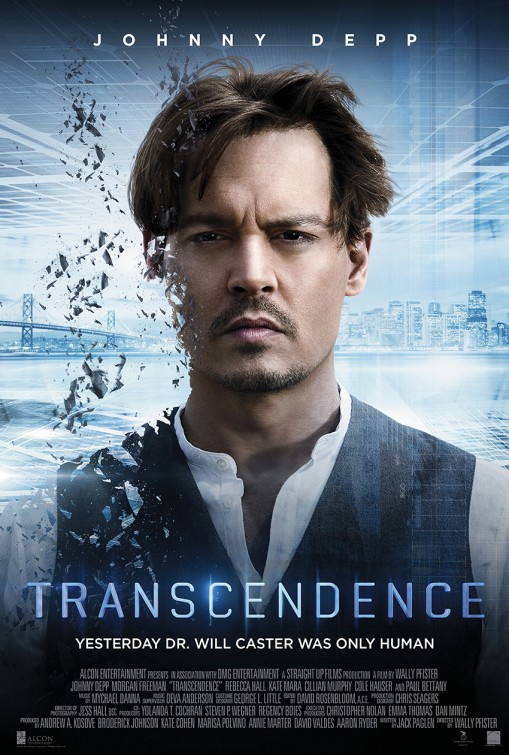
Transcendence (Wally Pfister 2014)

transcendence_ver11and so anyway it turns out that the best thing about Transcendence (2014) is not the sub-Kubrickian but nonetheless quite fascinating commutative editing, which results in a film with only half a dozen scenes dispersed among its 105-minute stream of images replacing one another with no memory of what appeared before each of them and no necessary connection to what appears after each of them, nor is it the the moment when you begin to imagine an alternative version in which Rebecca Hall’s character was played by Miranda Hart, nor the moment when you begin to imagine Johnny Depp’s character was played by an actor and resembled a character, nor the bit when you start aching for the AI, having hooked itself up to the internets, to come across an online copy of Colossus: The Forbin Project and become depressed or The Lawnmower Man and become really depressed or Demon Seed and start building something really nasty in the basement, nor is it the end credit which says ‘A WALLY PFISTER FILM’ when even then surely they must have know it was really a case of ‘THE WALLY PFISTER FILM’, no, the very best thing about Transcendence is the bit right near the end when the soldier played by Cole Hauser exclaims ‘it didn’t kill anyone’, which was basically my complaint, too…


Primer (Shane Carruth USA 2004)

primer-movie-poster-2004-1020241222[A version of this review appeared in Foundation 98 (2006), 152–6]

From a garage in Dallas, four men run a business in their spare time, using scavenged components and their knowledge of physics, computers and engineering to devise patentable tweaks to existing technology in the hope of getting rich. Two years, fourteen patents – and the best they have managed is disenchantment with each other and a marginal mail-order business selling JTAG cards. However, while experimenting with superconductors, Aaron (Shane Carruth) stumbles upon something peculiar – the system they have built puts out more energy than they put into it. He and Abe (David Sullivan) keep it secret from Phillip (Anand Upanhyaya) and Robert (Casey Gooden). They realise that ‘the easiest way to be exploited [is] to sell something they did not understand’ but also, over following weeks and months, that they are ‘out of their depth’. Until one day, Abe takes Aaron step-by-step through what he has learned – they have actually created a kind of time machine. If they switch it on at time A and enter it later at time B, they can return to time A; but this also means that between times A and B there are two of each of them coexisting. Abe is anxious to avoid messing around with causality, but things start to go awry when the much less cautious Aaron begins to fantasise about getting revenge on an investor who messed them around: Aaron imagines assaulting him and then going back in time to tell himself not to do it. He dreams of acting with impunity, of becoming so rich that he is above the law.

Actually, things go awry much sooner (or possibly later) than that: Aaron grasped the machine’s potential more quickly than Abe realised and has been deceiving him, carrying out his own agenda. Aarons and Abes multiply, attacking other versions of themselves. Disagreements escalate. Aaron and Abe appear less frequently in the same shot, and when they do they are often separated not just by distance but by the vertical lines of background architecture or ominous black shapes.

Placing all that has passed under erasure, the story ends – I think – at some point between the start of the film and Abe’s first use of the time machine. An Abe is sabotaging the machine while the original Abe (or possibly the same Abe, only earlier) is building it, in the hope that he will give up (read backwards, his surname, Terger, provides a clue). An Aaron, somewhere overseas and apparently with corporate or state backing, is constructing a much bigger machine, while the original Aaron (or possibly the same Aaron, only earlier) continues to live with his family. I think.

Writer-director-editor and co-star Carruth (he was also responsible for casting, production design, sound design and the film’s original music) is rumoured to have shot a scene in which everything is explained, but if so, he was wise to cut it – and not only because it must have contained long and stilted dialogue (and probably lots of diagrams). The film is effective because of its refusal to clarify what we see and hear. Fresh but often elliptical information demands that we, like the protagonists, revise our understanding of earlier scenes, which in turn alters our understanding of the information. Multiple viewings are required for those who wish to figure it out, but, like Videodrome (1983), I am not certain it can be – and this renders it probably unique among American time-travel fictions. For example, unlike the Back to the Future ( 1985–90) and Terminator (1984–2003) trilogies, it is not easily reducible to an oedipal primal scene fantasy; and however much their final reels might prattle about the future not being fixed, they lack Primer’s more thoroughgoing destabilisation of temporality, duration, narrative, memory and identity. This contingency of meaning and self-conscious ambiguity is more akin to modernist European time-travel fantasies like La jetée (1962), L’anné dernière à Marienbad (1961) and Je t’aime, je t’aime ( 1968) (Primer’s womb imagery, aural rather than visual, seems to allude to the latter in particular).

Like these nouvelle vague films, Primer is also a meditation on cinema itself. Although it is a coincidence that the Lumière brothers ‘invented’ cinema in the same year that Wells published The Time Machine: An Invention (1895), there is a complex interconnection between time-travel and motion pictures that goes beyond the Wells/Paul patent for a never-constructed fairground ride/exhibition space that reconstructed the Time Traveller’s voyage. The projected representation of past moments, undercranking and overcranking the camera so as to produce fast- and slow-motion, editing out frames or editing them together – these are all experiments in altering time, reconstructing it so as to be experienced differently. (And it is worth recalling that Alain Robbe-Grillet’s script for Marienbad was inspired by Aldolfo Bioy Casares’s neglected sf novel La invención de Morel (1940), whose title nods to Wells but whose story of a man who falls in love with an unattainable woman in a virtual projection of a recorded past was itself inspired by the author’s fascination with silent movie actress Louise Brooks.) Early in Primer, when the garage door rolls shut, the inventors remain visible through four windows in it: the image looks like four frames of film unspooled across a black background. In several scenes footage overlaps, repeats from the same and different angles, the action apparently stuttering; perhaps a consequence of shooting insufficient coverage, it nonetheless disrupts and thus becomes instructive about the ways conventional editing creates the illusion of continuous time and space. Elsewhere, jumpcuts compress time, to similar effect. Reality becomes subject to multiple takes, events can be revised and erased; a key incident is ‘reverse-engineered into a perfect moment’.

Technical errors during filming left much of the sound recording unusable; the post-synchronised dialogue and ambient sound often just don’t sound quite right, further alienating the viewer, especially during scenes dominated by hard-sf speak. The film contrives to hold the viewer at a distance while its characters do little to evoke a sympathetic response, making it something to scrutinise rather than wallow in – not that one would want to: the world it creates is far from appealing (shot on super-16mm, and blown up to 35mm via a digital intermediary, it is dominated by sickly greens and yellows), and not just in terms of its appearance.

Roger Luckhurst argues that the figure of the heroic scientist – whether Ralph 124c41+ or Thomas Edison – emerged in popular culture just as the real-world efforts of the latter and his ilk were industrialising and commodifying the processes of technological innovation, effectively removing it from the realm of the individual creator. Just as La invención de Morel explores capital’s colonisation of the unconsconscious in terms of the articulation of desire through the commodified image of an actress, so Primer sees the logic of capital spread into every aspect of its protagonists’ being. They work 30 hours per week in the garage on top of their day jobs. Robert proposes a project which might be fun, but Aaron and Abe dismiss it because it is unlikely to reach a marketable stage. Alienated from their labour and from whatever pleasure they derived from tinkering with things in the garage, all they want to do is produce the tweak that will make them rich. They have instrumentalised their skills and desires, and compartmentalised their lives. Unable to produce a profitable device, they instead use time-travel to pick up information on stocks and shares. The fantasy of free energy (and self-replication) turns into the fantasy of immaterial capital boundlessly reproducing itself. By explicitly rejecting the lottery in favour of the stock market they throw themselves into capital’s annexation of our future.

That their experiment is doomed is suggested throughout by the sense that life cannot be compartmentalised, that causation is complex rather than linear. At one point, Aaron ‘accidentally’ reproduces his cell phone, and when it rings he has to work out whether the network will contact both identical phones or just search grid by grid until it finds one of them. Elsewhere, inexplicably, the father of a girl they know suddenly appears with two or three days of facial hair despite being clean-shaven just a few hours earlier. ‘There’s always leaks,’ Abe tells Aaron, and consequences seem to come not in chains but webs which reach in all directions.

Ultimately, this is where Primer differs from nouvelle vague time travel fantasies. They are primarily backward-looking, concerned with memory and the props which secure bourgeois identity. Primer looks to the future, but instead finds a complex present already out of control. Its garage inventors resemble the utopian writers described in Fredric Jameson’s Archaeologies of the Future (2005), but unlike them Aaron and Abe are unable to imagine change, the radical break – the first negation – that makes utopia possible. They are so woven into the fabric of late-capital that they can only conceptualise using this fabulous new technology to leave everything – apart from their bank balances – exactly the same. The market might pretend it is homeostatic, orderly and inevitable, but a fragment of hope can be found in how thoroughly Aaron and Abe are made to learn that the status quo is complex, dynamic and riddled with contradiction.

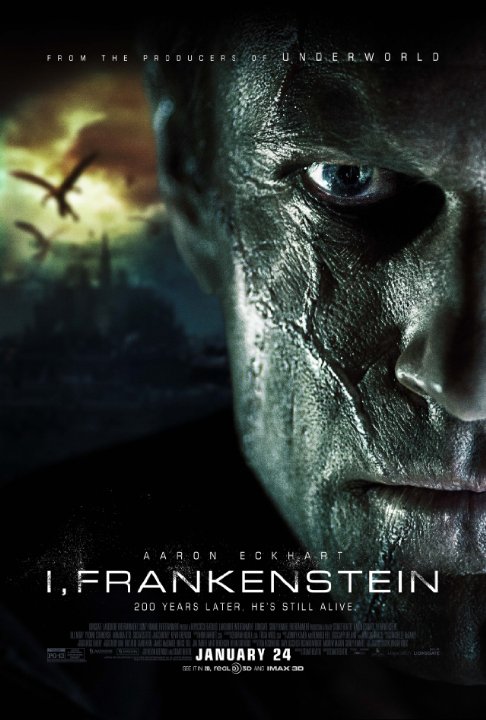
I, Frankenstein (Stuart Beattie 2014)

MV5BMjM3Mzk2MDU3N15BMl5BanBnXkFtZTgwMzg1NTI4MDE@._V1_SX640_SY720_and so anyway it turns out that the best thing about I, Frankenstein (2014) is not (the German) Victor Frankenstein’s misbegotten scheme two centuries ago in Ingolstadt (Germany) to add an extra layer of security to the details of his reanimation process by writing his journal in English so no one could read it, but that very kindly, just over halfway through the movie, Aaron Eckhart takes the time to reassure the viewer that ‘whatever happens, it ends tonight’, which was frankly a relief…

Le temps du loup aka Time of the Wolf (Michael Haneke France/Austria/Germany 2003)

18363600[A version of this review appeared in Foundation 94 (2005): 134-137]

Although it has always produced outstanding sf and fantasy—from Jean Cocteau and Luis Buñuel to Andrei Tarkovsky and Jan Švankmajer—there was a time, back before I was born, when European arthouse cinema was synonymous with both cinematic and science-fictional excellence, when the nouvelle vague gave us Georges Franju’s Les Yeux sans visage (1959), Chris Marker’s La Jetée (1962), Alain Resnais’s L’Année dernière à Marienbad (1961) and Je t’aime, je t’aime (1967), Jean-Luc Godard’s Alphaville (1965) and Weekend (1967). This period is best captured not by Bernardo Bertolucci’s joyless The Dreamers (2003) but, for all its gaucheness, Roman Coppola’s CQ (2001), in which a young American filmmaker in Paris, desperate to be Godard, ends up completing a pop-camp sf movie even more heavily indebted to Mario Bava’s Danger Diabolik (1968) than to Roger Vadim’s Barbarella (1968), in which a sexy space-age spy must infiltrate the lunar base of Billy Zane’s Che-like rebel leader.

Over the last couple of years, European arthouse directors have again been drawn to the fantastic and science-fictional. Thomas Vinterberg’s It’s All About Love (2003), Olivier Assayas’s Demonlover (2002) and Michael Winterbottom’s Code 46 (2004) attempt, with mixed success, to populate their Dickian/cyberpunk-flavoured tales with characters who at least vaguely resemble human beings. Vinterberg manages to produce several genuinely strange and estranging moments, but is undercut by a star-based narrative logic which forestalls complex intersubjectivity and opens the door to the worst kind of greetings card sentimentality; Assayas generates some sense of the perpetual displacement of the subject jetting through the spaces of global capital, but his film is no Pattern Recognition; and Winterbottom’s impressive vision of the future which looks just like the contemporary Third World succumbs to the picturesque (and a really problematic rape scene in which Maria (Samantha Morton) literally asks for it). In Fear X (2002), Nicolas Winding Refn transforms a Wisconsin which already looked pretty alien—positively Canadian—into somewhere distinctly Lynchian, while Mathieu Kassovitz’s Gothika (2003) occasionally rises above the ordinariness required of a Halle Berry vehicle. Although all of these films contain things to recommend them—some more than others—none of them measure up to those of forty years ago or, indeed, to Michael Haneke’s Le temps du loup.

An immaculate MPV glides along a forest road. In it are Georges (Daniel Duval) and Anne (Isabelle Huppert) Laurent, their mid-teens daughter, Eva (Anaïs Demoustier), and her younger brother Ben (Lucas Biscome). Fleeing the city and some never-specified catastrophe, they have calmly made their way to their weekend house in the country; but a family of strangers have already moved in. When the agonisingly reasonable Georges offers them welcome and a share of their supplies, he is killed and Anne and the children are turned away. Despite knowing the Laurents, local villagers refuse them aid or shelter, and so they begin to wander the countryside, first joining up with an unnamed boy (Hakim Taleb) and then with a proto-community dominated by the petty tyranny of property-ownership and commerce—a set-up which does not survive the arrival of a larger group of refugees. Together, these displaced people await the arrival of a train which might take them to somewhere better.

It could be a trick of perspective, but the last few years seem to have produced a number of texts which return to the the kind of post-apocalyptic fiction once dismissed as cosy catastrophes (Wright’s A Scientific Romance (1998), Lovegrove’s Untied Kingdom (2003), Roberts’s The Snow (2004), Robinson’s Forty Signs of Rain (2004); the TV series The Last Train (1999); movies such as Reign of Fire (Bowman 2002), Twenty Eight Days Later (Boyle 2002), The Day After Tomorrow (Emmerich 2004) and Dawn of the Dead (Snyder 2004)), the best of which display at the very least an occasional flash of New Weird vigour, reinflating—with narrative and, occasionally, wit—a subgenre exhausted by the New Wave. What distinguishes Le temps du loup from them is a quite remorseless austerity, first signalled by the opening titles: small white uncluttered text on a black background, without music or sound. There are no CGI dragons. There are no zombies, enRaged or otherwise. There is no Big Weather. Indeed, it is difficult to reconcile the offscreen murder of Georges with the in-yer-face provocations and hi-jinks of Haneke’s earlier home-invasion movie, Funny Games (1997).

In an accompanying interview, Haneke explains Le temps du loup‘s restraint in terms of not wanting to make a generic disaster movie but a film about personal relationships, of wanting to give the comfortable westerners used to watching the unfolding global catastrophe on TV a taste of what it would be like if it happened to them. In this he succeeds, but not necessarily in the way he intends.

The film relies on ellipses. The nature of the catastrophe is never explained (although livestock burning on a pyre in the background of one shot might provide a clue). We do not see Georges’s death or his family having to bury him; we do not see their expulsion from their home or their theft of a bicycle; we do not see Ben’s discovery of his dead budgerigar or a barn going up in flames; we do not see Anne’s response to the letter Eva writes to her dead father, in which she talks about having to careful around her mother as she is on the verge of cracking up; and so on. Along with these omissions, there are also a number of scenes set in a pitch-black night, illuminated intermittently by the flame of a cigarette lighter or a handful of burning straw, and a number of unexplained events. This eschewal extends even to refusing emotional spectacle: when a sick child dies, there is a 30 second shot of hands fashioning a crude cross and placing it on the grave, followed by a two-and-a-half minute shot of the legs of the people gathered around the grave, the only sound being the mourning cries of the child’s out-of-shot mother—and in the extreme distance, as the mourners move off, the flaming torches of an approaching group of refugees creep into shot, blurs of distant light in the falling dark.

The refusal to show does not extend to the characters; rather, all that the camera does is show us their stunned and stunted responses, and in this Haneke seems to be deliberately pursuing the kind of humanist-realism championed half a century ago by André Bazin. The camera’s cool gaze stays resolutely outside of the characters, but frequent long takes provide the time to watch minute gestures and changes of expression and to ponder motivation and meaning. There is, for example, an aching moment when we can see Eva trying to choose between loyalty to a mother ill-equipped to handle the new situation and the teenage boy who has already learned to strip whatever he needs from corpses (and some time later, we see her growing realisation that the boy is differently, but equally, ill-equipped). In the same sequence, a close-up reveals the sorrowful wisdom of the even younger Ben who, unlike his family, knows there is no point running after a passing train, crying for help. This sense of externality counters Haneke’s desire to focus on relationships, and perhaps only twice produces the kind of the effect on the viewer he seeks. First, and overwhelmingly, is the sense of disconnection: just as the family have no idea what has happened or what will happen next, so the film’s omissions and ellipses makes the experience of the narrative an uncertain one; while it grips, the succession of incidents also produces a sense of being stunned, akin to that experienced by the characters. Second, the conclusion that Ben reaches, the sacrifice he decides to make to save his family, simultaneously comes out of the blue and is inevitable. It is a moment every bit as human and as terrible as the scene in Thomas Disch’s ‘The Asian Shore’ about the young boy struggling to carrry two buckets of water whose shoes come off every time he takes a few steps; and the ground is freezing; and every time he puts his shoes back on he spills more of the water over himself; and he is freezing; and just as Disch’s narrator cannot help because he cannot communicate with the boy, so we cannot save Ben from his decision even though we know it will not work and its cost is unimaginably high.

The low-budget Last Night (McKellar 1998), dubbed ‘the Canadian Armageddon’, stands out among the recent ‘not-so-cosy’ catastrophes, not least because it refuses the apocalypse a post-. Similarly, and like Weekend, to which its long tracking shots might pay homage, Le temps du loup is ultimately not about life after the apocalypse—the survivors are numb, powerless; there is no attempt to rebuild civilisation—but about life during the apocalypse going on around us, mostly unseen. Like Benjamin’s angel of history (and, perhaps, Code 46), Haneke’s film sees not progress but one single catastrophe which keeps piling wreckage upon wreckage. The closing shot, which lasts for over two minutes, is filmed, the soundtrack implies, from aboard a train as it races through a verdant French countryside. We do not see the train. We do not know whether it is the one for which the characters have been waiting or, if so, whether it stopped to pick them up. We do not even know whether it is real, or merely a fantasy like the one spoken of in the preceding scene (‘maybe tomorrow, there’ll be … a big car racing up. … And a guy will get out and say everything’s fine again. And water will flow in our mouths with roast pigeons and maybe the dead will come back to life’). And while the final shot shows that the land, like the people whose story we’ve followed, endures, it is a land, perhaps significantly, deserted of people.


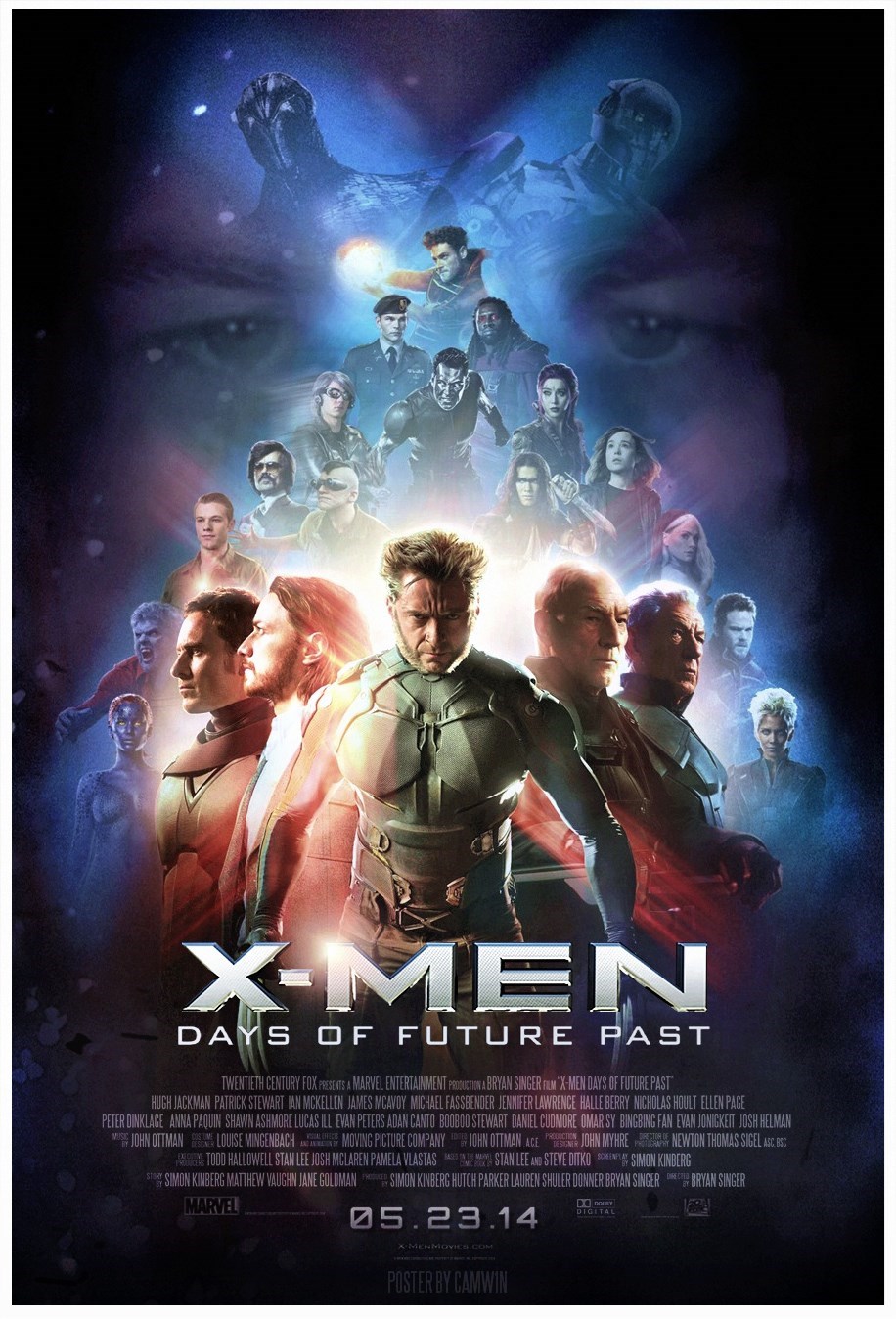
X-Men: Days of Future Past (Bryan Singer 2014)

x-men-days-of-future-past.25428and so anyway it turns out that the best thing about X-Men: Days of Future Past (2014), the sequel to 2011’s queer classic X-Men: First Class aka Brokeback Mutant, is not its inability to work out what to do with female superheroes who aren’t blue and naked – Storm has two whole lines of dialogue, which might be more than Blink does, and one brief meteorological dabble; Rogue, for all that Anna Paquin comes seventh in the credits, gets a two-second wordless cameo; and Kitty Pryde has the clunkiest, most thankless line of exposition in a film full of clunky, thankless and repetitive exposition because if it’s too hard I won’t understand it, and then gets to spend the next two hours kneeling down trying not to stroke Wolverine’s sideburns – nor is it Professor Xavier’s claim that the ‘greatest of powers’ is ‘hope’, when clearly he means ‘cliché’, nor is it that given the opportunity to transport Wolverinator, the huge jackass, back in time to change one thing that will in turn change everything they send him to strut around 1970s New York like some kind of white Shaft rather than to the script conference that set this humdrummery rolling (where he could have killed everyone with impunity because we would never have known this universe containing this dreary mess of a film ever existed – would you like me to exposition that for you a couple of times, or are you keeping up all by yourself?), but the fact that the film is so leaden and uninvolving that nothing, nothing at all, can distract you from coming up with an amusing alternative title for it … although, in a truly damning indictment of just how exhausting work has been the last couple of weeks, the best I, the actual (god’s honest truth) coiner of Brokeback Mutant, could come up with was the half-assed X-Men: Days of Farty Pasta … and in an equally devastating indictment of Fox’s apparent collusion in undermining the one genuinely lucrative Marvel property to which Disney does not own the film rights, it turns out that getting to call this tiresome piece of crap Days of Farty Pasta is actually the very best thing about it…

Brick Mansions (Camille Delamarre 2014)

MV5BOTI0ODQ2MzY5NF5BMl5BanBnXkFtZTgwNTcxNzQxMTE@._V1_SX640_SY720_and so anyway it turns out that the best thing about Brick Mansions (2014) is not that it has a piece of good old-fashioned Jean-Claude Van Damme-style hasty exposition about the origins of Lino to explain why someone with a French accent lives in a Detroit ghetto (and then dubs David Belle badly anyway), nor that a film so vastly inferior to its source, Banlieue 13 (2004), has the audacity to insist that ‘different methods can produce the same result’, but that it helped answer a question posed by the old episode of Orange is the New Black I saw just before it – yes, it is actually possible for something to be more depressing than a Tori Amos tribute band…

Caché (Michael Haneke 2005)

hidden-cache-poster-1and so anyway it turns out the best thing about Caché (2005) is not the rather effortless manner in which Michael Haneke matches his filmmaking style to the tedious self-regard of his bourgeois protagonists, but the fact that I did not have to pay a penny to watch it since some bloke, never found out who exactly, just left a copy in a supermarket carrier bag on the doorstep…

RoboCop (José Padilha 2014)

robocop_ver3and so anyway it turns out the best thing about RoboCop (2014) is not its astonishing commitment to the lipogrammatic principles of the Oulipo group, going far beyond Georges Perec, for example, who wrote the 300-page novel La Disparition (1969) without using the letter ‘e’, in order to gather together the few surviving remains of a franchise blown apart by lame film sequels, not to mention insipid live-action and animated television incarnations, and from them to build a whole new 117-minute film without using the letters ‘wit’, ‘intelligence’ or ‘decent action choreography’; no, the very best thing is that in the tagline at the top of the poster, very first word, they spelt ‘cinema’ wrong…