The City in Fiction and Film, week 22: Zadie Smith’s NW, part one (pp. 1–169)

week 21

Over the last few weeks, we’ve been bandying about the word ‘multiculturalism’ in a pretty loose sense, as if everyone knows and agrees on its meaning. The HarperCollins Dictionary of Sociology (1991) seems pretty clear in its definition:

the acknowledgment and promotion of cultural pluralism … multiculturalism celebrates and seeks to promote cultural variety, for example minority languages. At the same time it focuses on the unequal relationship of minority to mainstream cultures.

But like all dictionary definitions, it obscures the extent to which such terms are politically alive, wrestled over in and by our culture, meaning different things depending on who is saying them, where, when and for what purpose. It is a contested term, with multiple competing meanings, and is often used without any attempt at precision – especially in popular political discourse.

The term dates back to 1960s and 1970s, when – as part of the complex politics of white settler nations within the British Commonwealth – Australia changed its immigration laws to allow entry to previously excluded Asian migrants, and when Canada was not only changing its immigration laws but also wrestling with the relationship between an Anglophone majority and a Francophone minority, primarily Québécois, and with growing First Nations activism. Generally speaking, new migrants were encouraged not to assimilate (as in America’s melting pot, in which everyone is equal so long as they adopt white middle class values) but to integrate (as in Canada’s alternative metaphor of a mosaic of peoples); that is, they were enabled to retain their ‘home’ or ‘natal’ culture, and the development of ethnic community infrastructures was encouraged as a mechanism to foster integration.

In the UK, the then Home Secretary Roy Jenkins, pursuing a similar policy, said in 1966:

Integration is perhaps a rather loose word. I do not regard it as meaning the loss, by immigrants, of their own national characteristics and culture. I do not think we need in this country a ‘melting pot’, which will turn everyone out into a common mould, as one of a series of carbon copies of someone’s misplaced vision of the stereotyped Englishman … I define integration, therefore, not as a flattening process of uniformity, but cultural diversity, coupled with equality of opportunity in an atmosphere of mutual tolerance … If we are to maintain any sort of world reputation for civilised living and social cohesion, we must get far nearer to its achievement than is the case today.

Of course, while this massive conceptual, political and cultural shift was occurring, already discredited ideas of race as a meaningful biological concept still circulated, so it was often still the case that migrant populations were regarded as racially different. For all that ‘multiculturalism’ emphasises culture, this deep-rooted shadow meaning persists (when we hear politicians and others attacking multiculturalism, they are as often as not talking about race).

While there are all kinds of brilliant positive things about integration in contrast to assimilation, it has also been the subject of political manipulation. An approach that encouraged cultural diversity has been blamed for ‘failures of assimilation’ (which were of course never the goal, so they cannot honestly be regarded as failures). Furthermore, it is often retconned into a racist narrative that says multiculturalism was introduced because it is somehow impossible for different races to assimilate. Hostility around perceived racial difference has thus been blamed on the racially other for their failure to be assimilated rather than on the host nation’s inability and frequent unwillingness to integrate properly – which would include the education of the host population around such issues. And while there are often instances of migrant communities being unwilling to relinquish their cultural distinctiveness, that is exactly the point of multiculturalism – it is not a glitch, it’s a feature.

It is also important to remember that multiculturalism is not just about immigrant populations. Yes, it is about immigrant minorities, such as South Asians and Afro-Caribbeans in the UK. But it is also about substate national minorities, such as the Québécois in Canada, and about similar populations more geographically dispersed within a nation, such as African American population. And it is also about indigenous peoples: First Nations in Canada, Native American Indians in the US, Aboriginals in Australia, Maori in New Zealand, and so on. Each of these groups, and each of these kinds of groups, have their own distinctive histories and their own particular needs to be met within a multicultural state.

Keith Banting, Will Kymlicka, Richard Johnston and Stuart Soroka, in a piece of research examining whether multicultural policies have a negative effect on the welfare state across a number of European and other nations, identify eight key kinds of policy that multiculturalism implies:

  • constitutional, legislative or parliamentary affirmation of multiculturalism at the central and/or regional and municipal levels
  • adoption of multiculturalism in the school curriculum
  • inclusion of ethnic minority representation and sensitivity in the mandate of public media or media licensing
  • exemptions from dress codes (e.g., Sikhs wearing turbans rather than crash helmets or school caps), from laws banning Sunday trading, etc.
  • allowing dual citizenship
  • funding ethnic group organisations to support cultural activities
  • funding bilingual education and mother-tongue instruction
  • affirmative action for disadvantaged groups

They then examined their sample nations in terms of their commitment to such policies:

  • Strong adopters (6-8 policies): Australia, Canada
  • Modest adopters (3-5.5 policies): Belgium, Netherlands, Sweden, UK, USA
  • Weak adopters (under 3 policies): Austria, Denmark, Finland, France, Germany, Greece, Ireland, Italy, Norway, Portugal, Spain, Switzerland

So next time you hear a British politician banging on about ‘the failure of the multicultural experiment’, remember the UK falls into the ‘didn’t actually try all that hard’ group.

NW (2012) is Zadie Smith’s fourth novel, following White Teeth (2000), The Autograph Man (2002) and On Beauty (2005). She was born in Brent in London in 1975, to a Jamaican mother and Anglo father; and she wrote much of her first novel in the final year of her English Literature degree at King’s College, Cambridge (at Cambridge, she failed an audition to be in the Footlights, rejected it is said by Mitchell and Webb). Her novels are, among other things, concerned with the matter-of-fact, normalising representation of the multicultural city, especially London. Her work is also defined by a kind of stylistic restlessness, as if each novel is as concerned with finding the voice in which to write as it is with the characters or narrative. This is emphasised in NW by the variety of approaches she brings to third-person narration in each of the novel’s sections – and even sentence-by-sentence as she manipulates the proximity of the narrator’s voice to the viewpoint character’s perspective.

We began by reading the opening chapter together, seeing how Smith establishes setting, mood, atmosphere, character and theme. It begins with a too-hot spring day, the sun altering how the periphery of a Willesden council estate looks from just a few doors down, where Leah, born on the estate, reclines in a hammock in the shared garden behind her basement flat. Significantly, she has moved on in to private accommodation, just not very far. A caricatured sunburned and overweight-in-a-crop-top working class girl smokes a fag on a balcony in the nearby block of flats, talking too loud on her mobile phone. Leah is a second generation Irish immigrant, pale-skinned and red-headed. The gap between her and her loud neighbour troubles her: physical proximity to her past assuages some of the guilt she feels about her class mobility, even though has not ascended the hierarchy that far. She has also just found out she is pregnant by her Nigerian-French husband Michel; he wants kids, she does not.

We also read chapters 9 and 10 of the first section together. The former is a googlemaps-style set of directions to walk from an address in NW8 to another in NW6; the latter is a dérive, a trek along the same route described as a succession of sense impressions – smells, glimpsed commodities, adverts, leaflets, music from passing cars – which capture the experience of moving from bustling, working class streets to the wealthier and more barricaded areas around Regent’s Park and St John’s Wood:

The Arabs, the Israelis, the Russian, the Americans: here united by the furnished penthouse, the private clinic. If we pay enough, if we squint, Kilburn need not exist. (40)

This pair of chapters captures something essential to the novel’s project – the filling in and fleshing out of the city not as an abstract space but as a place (or a nested and interlocking array of places), rich in history and memory, both public and private. The city no more precedes these places than a map precedes the territory.

Branching out from these chapters, we were able to discuss the ways in which Smith captures the ethnic diversity of London, from ‘a life-size porcelain tiger’ to the many various ways in which muslim women observe (or not) strictures about headdress, which bear ‘no relation to the debates in the papers, in Parliament’ (39). It is there in the built environment, too, with ‘the Islamic Centre of England opposite the Queen’s Arms’ (40).

We will return to the novel next week, to consider the ways in which it talks about social and economic class, and suggests that urban identity is not a fixed thing but something that, for all its roots, nonetheless constantly emerges in the moment.

Attack_The_Block_2We also took a look at Attack the Block (Cornish 2011), a British banlieue movie that probably owes more to District 13 (Morel 2004) than La Haine (Kassovitz 1995), and a lot to US hip-hop/ghetto cinema, but which nonetheless has something of Passport to Pimlico (Cornelius 1949) about it. It recalls our work on Boyz N the Hood (Singleton 1991) in its focus on how the protagonists are trapped within their South London estate (filmed on the Heygate estate before it was demolished, complete with multiple scandals) but its greater significance in relation to NW is the way in which it fills in and fleshes out. It starts with a young white woman, Sam (Jodie Whitaker), walking home at night, and being mugged at knifepoint by a gang of youths in hoodies. The gang is multiethnic – and the film never highlights nor makes an issue of this – though no doubt David Starkey would say something racist about them all being ‘culturally black’. At the same time as it invests in a romantic narrative of gang loyalty and redemptive male violence, the film does also work to undermine these ideas. Perhaps the key moment comes at the end, when the Jodie stands by her erstwhile mugger, Moses (John Boyega), when the police arrest him – he is, after all they have gone though, her neighbour. Part of her community. It is all a little too glib and easy, but it hits an affective chord.

We also could not quite figure out what it means that this multicultural gang – a stand-in for a multicultural community – defend the block against violent, featureless black male monsters from outer space. A little too much like Zulu (Endfield 1964) or Black Hawk Down (Scott 2001) in its use of this fundamentally racist colonial adventure narrative set-up.

week 23

Recommended critical reading
Banting, Keith, Will Kymlicka, Richard Johnston and Stuart Soroka ‘Do Multiculturalism Policies Erode the Welfare State: An Empirical Analysis’. Multiculturalism and the Welfare State. Ed. Banting and Kymlicka. Oxford: Oxford University Press, 2006. 49–91.
Duff, Kim. Contemporary British Literature and Urban Space: After Thatcher. Basingstoke: 2014. 87-122.
Groes, Sebastian. The Making of London: London in Contemporary Literature. Basingstoke: Palgrave, 2011. 191–251
James, David. “Wounded Realism.” Contemporary Literature 54.1 (2013): 204–14.
Knepper, Wendy. “Revisionary Modernism and Postmillenial Experimentation in Zadie Smith’s NW.” Reading Zadie Smith: The First Decade and Beyond. Ed. Philip Tew. London: Bloomsbury, 2013. 111–126.
Malik, Sarita. “The Dark Side of Hybridity: Contemporary Black and Asian British Cinema.” in Daniela Berghahn and Claudia Sternberg, eds, European Cinema in Motion: Migrant Diasporic Film in Contemporaary Europe. Basingstoke: Palgrave, 2010. 132–151.
Pope, Ged. Reading London’s Suburbs: From Charles Dickens to Zadie Smith. Basingstoke: Palgrave Macmillan, 2015. Especially 161–202.
Tew, Philip. The Contemporary British Novel. 2nd ed. London: Continuum, 2007.
–. Zadie Smith. Basingstoke: Palgrave Macmillan, 2010.
Wells, Lynn. “The Right to a Secret: Zadie Smith’s NW.” Reading Zadie Smith: The First Decade and Beyond. Ed. Philip Tew. London: Bloomsbury, 2013. 97–110.

Recommended reading
For other contemporary British Afrodiasporic fiction, try Two Fingers and James T. Kirk’s Junglist (1995), Andrea Levy’s Never Far from Nowhere (1996), Courttia Newland’s The Scholar: A West-Side Story (1997), Alex Wheatle’s Brixton Rock (1999), Courttia Newland and Kedija Sesay’s IC3: The Penguin Book of New Black Writing in Britain (2000), Zadie Smith’s White Teeth (2000), Leila Aboulela’s Minaret (2005), Brian Chikwava’s Harare North (2010) or Tendai Huchu’s The Maestro, The Magistrate and the Mathematician (2014).

Recommended viewing
Afrodiasporic British cinema includes Pressure (Ové 1976), Black Joy (Simmons 1977), Dread Beat an’ Blood (Rosso 1979), Babylon (Rosso 1981), Burning An Illusion (Shabazz 1981), The Passion of Remembrance (Blackwood and Julien 1986), Playing Away (Ové 1987), Welcome II the Terrordome (Onwwurah 1995), Dog Eat Dog (Shoaibi 2001), A Way of Life (Asante 2004), Bullet Boy (Dibb 2004), Kidulthood (Huda 2006), Life & Lyrics (Laxton 2006), Rollin’ with the Nines (Gilbey 2006), Adulthood (Clarke 2008), Shame (McQueen 2011) and My Brother the Devil (El Hosaini 2012).

The I Am Legend (2007) haikus

i-am-legend-2-not-happening***************************************************************
***************************************************************
***************************************************************

Manhattan is mine.
Just my dog for company.
And my zombie prey.

***************************************************************

He understands Shrek.
But the point of Bob Marley?
Not a fucking clue.

***************************************************************

He kills the puppy.
Wait! What? He kills the puppy?
Fuck Robert Neville.

Don’t Look Now (Nicolas Roeg 1973) – restored version

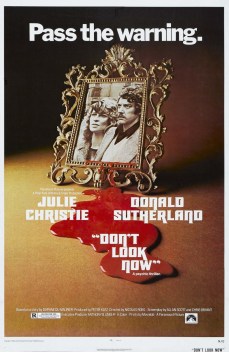
936full-dont-look-now-posterand so anyway it turns out that the best thing about the newly restored version of Don’t Look Now (1973), which incorporates some footage cut at the request of Stephen Murphy, chair of the BBFC, is not the fresh emphasis it places upon Donald Sutherland’s pre-emptive bid to become the new Doctor Who after Jon Pertwee’s departure the following year by dressing up as much like Tom Baker as possible, but the shocking and totally unexpected revelation of who Roeg initially intended to unveil as the diminutive Venetian serial killer…

paddington-bear-and-suitcase


The City in Fiction and Film, week 14

Farenheit451This week we continued our exploration of the US postwar suburbs (see week 13), reading Ray Bradbury’s Fahrenheit 451 (1953) and watching Invasion of the Bodysnatchers (Siegel 1956). Both texts were framed in relation to the period’s culture of affluence and anxiety.
But first we began by placing Bradbury’s novel in relation to genre – specifically the interweaving traditions of utopia/anti-utopia, utopia/dystopia and US magazine sf.

Thomas More coined ‘Utopia’ 500 years ago this year. When spoken aloud, the first syllable is a Latin pun on ou which means no and eu which means good (and topos means place) – so utopia means ‘no place’ but also suggests ‘good place’. Utopia has come to be understood as a description of an imaginary world organised according to a better principle than our own, and to frequently involve not-always-gripping systematic descriptions of economic, social and technical arrangements. We discussed the efflorescence of utopian fiction in the wake of Edward Bellamy’s Looking Backward, 2000-1887 (1888), and mentioned such key utopian authors as William Morris, Charlotte Perkins Gilman, Ursula Le Guin and Kim Stanley Robinson. We also noted the relative scarcity of utopian worlds in cinema – Just Imagine (Butler 1930), Things to Come (Menzies 1936) and Star Trek: The Motion Picture (Wise 1979) being potential examples, but all of them also demonstrating potentially negative elements and being susceptible to against-the-grain readings.

This led us to anti-utopias – texts that are in more or less explicit dialogue with someone else’s utopian vision, exposing its darker, oppressive elements. William Gibson’s ‘The Gernsback Continuum’, which we read last semester, is a kind of compendium anti-utopia, while novels such as Yevgeny Zamyatin’s We (1924), Aldous Huxley’s Brave New World (1932) and George Orwell’s Nineteen Eighty-four (1949) are – among other things – direct responses to the utopian vision of HG Wells, drawing out its more totalitarian elements, as does Metropolis (Lang 1927).

During the 20th century, however, the explicit anti-utopia has given way to the proliferation of dystopias (dys + topia = bad place), dark, often satirical exaggerations of the worst aspects of our world. The dystopia emphasises bad aspects of our own world so as to make them more obvious (in this, they parallel the suburban world of All That Heaven Allows). The dystopia is not an explicit critique of the utopia, but a depiction of a world worse than our own – usually totalitarian, bureaucratic, brutal, dehumanising, and sometimes post-apocalyptic. Between us, we concocted a list of novels and films, including:

Kurt Vonnegut, Player Piano (1952)
Frederik Pohl and Cyril Kornbluth, The Space Merchants (1953)
John Wyndham, The Chrysalids (1955)
Anthony Burgess, A Clockwork Orange (1962), filmed as Clockwork Orange (Kubrick 1971)
Philip K. Dick, Do Androids Dream of Electric Sheep? (1968) filmed as Blade Runner (Scott 1982)
Harry Harrison, Make Room! Make Room! (1966), filmed as Soylent Green (Fleischer 1973)
Punishment Park (Watkins 1971)
THX 1138 (Lucas 1971)
Rollerball (Jewison 1975)
Mad Max (Miller 1979)
William Gibson, Neuromancer (1984)
Brazil (Gilliam 1985)
Margaret Atwood, The Handmaid’s Tale (1985), film (Schlöndorff 1990)
Alan Moore and David Lloyd, V for Vendetta (1988–9), film: (McTeigue 2006)
Robocop (Verhoeven 1987)
PD James, The Children of Men (1992), filmed: (Cuarón 2006)
Octavia Butler, The Parable of the Sower (1993)
Kazuo Ishiguro, Never Let Me Go (2005), filmed: (Romanek 2010)
Gamer (Neveldine+Taylor 2009)
Moon (Jones 2009)
Suzanne Collins, The Hunger Games novels (2008-2010), filmed: Ross and Lawrence 2012-15)
Dredd (Travis 2012), based on Judge Dredd strip (1979–)
Elysium (Blomkamp 2013)

The widespread usage of dystopia and the relative decline of the utopia/anti-utopia tradition has led to an increased use of the eutopia (a term which makes linguistic sense as the opposite of dystopia) to describe imagined worlds that in some ways are better than ours, if still far from perfect. The eutopia imagines a better world, using its differences to indicate the shortcomings of our own world.

Both eutopia and dystopia are, in different ways, about the possibility of change.

We then turned to consider Ray Bradbury in the context of American sf in the 1950s. From the late 1930s, American magazine sf had been dominated by Astounding, edited by John W. Campbell. It was not the best-paying venue, but thanks to the galvanising effect Campbell – and his key authors, such as Robert A Heinlein and Isaac Asimov – had had on the field, it was the most respected and prestigious. That situation began to change after the war, particularly with the launch of The Magazine of Fantasy and Science Fiction and Galaxy, both of which could be characterised as being more literary, as being more interested such things as characterisation, atmosphere, slicker prose and satirical humour. Bradbury could not sell to Campbell, but published in wide range of sf magazines as well as in prestigious non-genre venues, such as Argosy and The Saturday Evening Post.

The reason for his failure with Campbell and success elsewhere has been attributed – by Brian Aldiss? – to him writing science fiction for people who don’t like science fiction (which we might more generously describe as writing non-Campbellian science fiction). Bradbury was championed by critics such as Robert Conquest and Kingsley Amis who, although they occasionally wrote and edited sf, were not sf writers per se. Within the genre community, such writers/editors/critics as James Blish and Damon Knight tended to be more ambivalent – caught between what they saw as Bradbury’ ‘poetic’ writing/ higher literary standards and his apparently blissful ignorance of science.

This ambivalence was mirrored by a number of the class, who found aspects of the novel quite compelling while also being frustrated by the ‘vagueness’ of its world-building. (I am not sure ‘vagueness’ is quite the right term, since it implies there is something that Bradbury should be doing rather than thinking about his preference for imagery over concrete images – and it might also indicate a relative lack of familiarity with sf’s specific reading protocols, which often require the reader to collaborate in building the world from the smallest of hints.)

In considering Fahrenheit 451 as an exaggerated dystopian version of the suburbs it is perhaps useful briefly to put aside its most obvious and striking feature – firemen now burn books – and instead think about the other features of its imagined world, all of which resonate strongly with the affluence and anxieties outlined last week:

  • the overwhelming impact of mass media, on everything from the design of houses  (no front porches, replace windows with TV screens, etc) to the fabric of domestic life, which is organised around consumption and pseudo-participation, and dominates social occasions
  • the alienation from other human beings, from nature, from meaningful labour
  • the reliance on tranquillisers, sleeping and other medication
  • the frequency of divorces and the virtual exile of children
  • women’s rejection of pregnancy and natural childbirth (cast as a negative, although Shulamith Firestone and others would see this as a positive)
  • juvenile delinquents racing cars around night-time streets, dying in crashes and aiming for pedestrians
  • how commonplace deliberate suicides and accidental overdoses have become
  • the absence of an urban centre (there is one, but the emphasis throughout is on seemingly endless suburbs)
  • really long billboards because everyone drives so fast
  • the degradation of language
  • the constant sound of military jets and the ultimate outbreak of the fourth nuclear war since the 1960s
  • the near-universal and – it is made clear – willing abandonment of books and reading
  • the only very occasional spectacle of state power when books are burned

We also thought about the ways in which Bradbury’s prose and imagery are ‘simple’ or ‘child-like’ – the way the novel seems to be the product of a pre-pubertal imagination. This led us in two directions.

First, there are the distinctly Oedipal elements of the novel. While its depiction of women is broadly misogynistic, this is especially focused on Mildred Montag. Cast as a simple-minded and anxious nag, she also comes across as a cold and distant mother figure to her husband, who often seems like a boy in quest of a father figure (Granger replacing Faber replacing Beatty). Mildred is early on associated with the kind of marble figure you might find on a mausoleum – remember the suburban fireplace in All that Heaven Allows – and when Montag turns the flamethrower on their twin beds (after all, there is no reason for mummy and daddy to share a bed, is there?), they ‘went up in a great simmering whisper, with more heat and passion and light than he would have supposed them to contain’ (151).

There is also something just a little bit queer about Montag’s relationship with Faber, the older, educated man who first picked Montag up in a public park, slipping him his phone number even though he knew it would put him in the fireman’s power. Faber  maintains this role of mentor, and shares a strange intimacy with the Montag through the earbug the younger man wears so they can always be together.

The second direction in which this sense of Bradbury’s simplicity went was thinking about the imagery he uses. The opening page introduces, among other images, the series of oppositions between black and white: firemen are always associated with blackness, and sometimes Bradbury seems almost to recognise a racial dimension; readers and women are associated with whiteness, although sometimes this whiteness is sepulchral (Mildred) or diseased (Faber). There is also animal and other nature imagery. Sparks become fireflies, books become pigeons. Later, books will rain down around Montag like pigeons, and he will be infected, losing control over his impulses, his hands becoming like ferrets whose antics he can only observe (this sense of alienation from his self culminates in him watching his own pursuit on television, which ends with his capture being faked). As with the bizarre fantasy about the barn in the final section of the novel, there is a nostalgic current underpinning the animal imagery – making manifest the natural world that the suburban sprawl roots up, tears down, eradicates. The imagery haunts the denatured suburb, reminding us of what has been lost and is constantly being thrown away.

Invasion of the Bodysnatchers shares many of these concerns. While its mood of paranoia might lend credence to the commonplace notion that the film is somehow about fears of communist infiltration, there is in fact little in the film to support reading it that way (just a few years earlier the emotionless nature of the pods would have been projected onto Nazis rather than Commies, primarily as a denial of the profound conformism in American life and in a consumer culture). Similarly, it is not especially easy to read the film as being about fears of racial passing or queer passing, although they too might be argued – the film is certainly about ensuring difference does not intrude onto this white suburban small town. This difference takes the form of two childless, sexually active recent divorcees – former sweethearts and possibly lovers – finding themselves thrown together, and everyone around them assuming they will become involved with each other again (while elsewhere, Oedipal anxieties take the form of children thinking there parents are not their parents). It is a film obsessed with sex – Miles makes constant innuendoes and hits on women all the time; he races over to Becky’s house in his pyjamas (don’t ask what her house is doing in his pyjamas) in the middle of the night and sweeps her off to his house, where the next morning she is wearing some of his clothes and cooking him breakfast, and Jack Belicec seems to assume this is post-coital. There is Becky’s summer dress, which miraculously stays up while emphasising her breasts, and Miles’s ultimate declaration that he did not know the real meaning of fear until he kissed her. Against all this sex is cast not only the asexual reproduction of the pod people but also the mechanical reproduction of commodities and the replacement of culture (a live band) by its simulacrum (the juke box).

And, as that penultimate hurried paragraph suggests, we ran out of time. Next week, Alphaville (Godard 1965).

Week 15

Recommended critical reading
AlSayyas, Nezar. Cinematic Urbanism: A History of the Modern from Reel to Real. London: Routledge, 2006. See chapter 9, “Exurban Postmodernity: Utopia, Simulacra and Hyper-reality.”
Biskind, Peter. Seeing is Believing How Hollywood Taught Us to Stop Worrying and Love the Bomb. London: Pluto, 1983. 102–59.
Bould, Mark. “Burning Too: Consuming Fahrenheit 451.” Literature and the Visual Media. Ed. David Seed. Woodbridge: DS Brewer, 2005. 96–122.
Grant, Barry Keith. Invasion of the Bodysnatchers. London: BFI, 2010.
McGiveron, Rafeeq O. “‘To build a mirror factory’: The Mirror and Self-Examination in Ray Bradbury’s Fahrenheit 451.” Critique: Studies in Contemporary Fiction 39.3 (1998): 282–7.
Seed, David. American Science Fiction and the Cold War: Literature and Film. Edinburgh: Edinburgh University Press, 1999.
–. “The Flight from the Good Life: Fahrenheit 451 in the Context of Postwar American Dystopias.” Journal of American Studies 28.2 (1994): 22–40.
Whalen, Tom. “The Consequences of Passivity: Re-evaluating Truffaut’s Fahrenheit 451.” Literature/Film Quarterly 35.3 (2007): 181–90.

Recommended reading
E.M. Forster’s “The Machine Stops” (1909) anticipates surburban consumerist isolation.
Suburbia became a regular setting for postwar sf: Ray Bradbury’s “There Will Come Soft Rains” (1950) and “The Pedestrian” (1951), Judith Merril’s Shadow on the Hearth (1950), Frederik Pohl’s “The Midas Plague” (1954), Philip K. Dick’s Time Out of Joint (1959) and Pamela Zoline’s “Heat Death of the Universe” (1967).
Examples of suburban horror include Anne Rivers Siddons’s The House Next Door (1978) and M. John Harrison’s subtler “The Incalling” (1978) and The Course of the Heart (1991).

Recommended viewing
Bradbury’s novel was filmed by French New Wave director François Truffaut as Fahrenheit 451 (1966). Other sf and fantasy films depicting the dissatisfactions of suburban living include Invaders from Mars (Menzies 1953), Forbidden Planet (Wilcox 1956), The Stepford Wives (Forbes 1975), E.T. – The Extra-terrestrial (Spielberg 1982), Poltergeist (Hooper 1982), Parents (Balaban 1989), Edward Scissorhands (Burton 1990), Pleasantville (Ross 1998), The Truman Show (Weir 1998) and Donnie Darko (Kelly 2001).


Under the Skin (Glazer 2013)

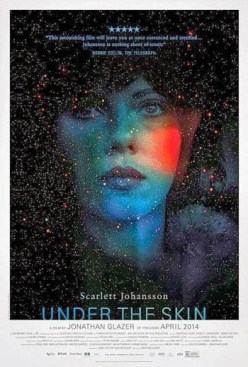
Poster-art-for-Under-the-Skin_event_mainand so anyway it turns out that the best thing about Under the Skin (2013) – the dreary-with-nice-landscapes arthouse remake of Species (Donaldson 1995) that ultimately fails in it valiant attempt at comedy greatness by not crassly letting the dog who caused all the drownings survive after the parents and the Czech guy and the toddler die, though it comes close when the radio news announces that the father, a professor, was reported missing by his university when he failed to turn up to work on Monday morning – is not the perfect casting of blank-faced affectless Scarlett Johansson as the blank-faced affectless alien, nor that you can spend the last part of the movie correcting the typo in its title by chanting Undo the skin! Undo the Johansskin! but the fact that you can spend half the day reading articles that not only praise the film for subverting the male gaze and thus opening up towards otherness but also complain about all the Glaswegian accents

Dracula Untold (Gary Shore 2014)

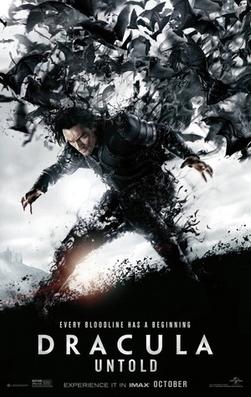
Dracula_Untold_posterand so anyway it turn out that the best thing about Dracula Untold (2014) is not that, despite its title, it begins with extensive voiceover narration, nor that it promptly sets you up to expect a queer vampire western when the first named location is Broketooth Mountain, nor that Luke Evans dies right at the start so that his big brother Jason Statham can take over (mainly because that doesn’t actually happen), nor the Taransylvaniarantula spiders lurking in the ancient vampire’s cave, but the moment when Vlad, his kingdom about to be overrun by Turks (well, they’re Turk-ish), as a last resort goes to implore the ancient vampire master, ‘Save my people – you’re Charles Dance, you’ll do any old shit for money’…

African Science Fiction 101: update 2

The months since my last update have been crazily busy with other things, so there has been little time for research and even less time for actually reading any of the goodies I’ve uncovered. Most of which are annoyingly inconvenient sizes and shapes to lug around with me over my Xmas perambulations. But I thought I would post another list before Xmas (and before that teetering pile of books in the corner falls over on top of me).

First up, I should mention the hugely embarrassing omission of Amos Tutuola from the article that started all this (and my indebtedness to Paul March-Russell for drawing it to my attention   in such a generous way). Truth is, I have never read anything by him, though The Palm-Wine Drinkard (1952), My Life in the Bush of Ghosts (1954) and Feather Woman of the Jungle (1962) may well 51ZoowIE8gL._SY344_BO1,204,203,200_be squeezed into the suitcase. As might D.O. Fagunwa’s Forest of a Thousand Daemons: A Hunter’s Saga (1939), translated by Wole Soyinka(!) – the first Yoruba-language novel, said to be an influence on Tutuola, not least in its fantastical landscape in which the supernatural is as real and present as the natural world.

While we’re in the margins of what might be considered sf, I have had a load of things recommended to me that might be more appropriately labelled ‘weird’ or ‘slipstream’:

  • Tawfiq Al-Hakim, The People of the Cave (1933) – a play based on the seven sleepers of Ephesus, who sleep their way into the future; their story is told in the eighteenth surah of the Qu’ran
  • Bertène Juminer, Bozambo’s Revenge (1968)41yjzEc0m9L._SY344_BO1,204,203,200_ – satirical alternate history in which Africans have colonised a swampy Europe full of idle, childish, pallid natives
  • Gamal al-Ghitani, The Zafarini Files (1976) – in a crowded corner of Sadat-era Cairo, a sheikh uses magic to take away men’s sexual potency
  • Olympe Bhêly-Quénum, Snares without End (1978) – there is an essay about him at Weird Fiction Review
  • Ivan Vladislavić, The Folly (1993), which seems to have a nice salvage vibe to it, if not exactly salvagepunk
  • Calixthe Beyala, How to Cook Your Husband the African Way (2002) – begins with a black woman explaining how she turned white, but not in quite the way I initially thought it was going to go
  • José Eduardo Agualusa, The Book of Chameleons (2004) – a murder mystery involving a trader in memories and identity creation
  • Ondjaki, Granma Nineteen and the Soviet’s Secret (2008) – a wonderful poetic novel, one of the best things I’ve read this year; there is something fantastical about it, but there is not any fantasy in it…
  • Franklin Rosemont and Robin DG Kelley, eds, Black, Brown and Beige: Surrealist Writings from Africa and the Diaspora (2009) – does what it says on the tin
  • Fiston Mwanza Mujilla, Tram 83 (2014)Tram-83-310px-square – according to reviewers it is ‘Blade Runner in Africa with a John Coltrane soundtrack’ that ‘transfigures harsh reality with a bounding, inventive, bebop-style prose’ and depicts ‘a world so anarchic it would leave even Ted Cruz begging for more government’
  • A. Igoni Barrett, Blackass (2015) – Furi Wakiboko wakes up one morning to discover he has turned white; well, all but one part of him has…

The more obviously genre works that have come my way include:

  • Charlie Human, Apocalypse Now Now (2013) – an urban fantasy thriller in Cape Town’s supernatural underworld
  • Masha du Toit, Crooks & Straights (2014)51Jp-br-R1L._SX310_BO1,204,203,200_ – YA urban fantasy in which Cape Town provides a home for magical refugees
  • Sarah Lotz, The Three (2014) – global thriller with horror/fantasy edge
  • SL Grey, Under Ground (2015) – while a lethal virus sweeps the world, the folks hiding out in a plush subterranean survival bunker find they have brought horror with them
  • Rob Boffard, Tracer (2015) – set on the falling-apart space station housing the last of humanity above a devastated Earth
  • Ivor W. Hartmann, ed., AfroSF volume 2 (2015)afrosf2 – contains five novellas by Tade Thompson and Nick Wood, Mame Bougouma Diene, Dilman Dila, Andrew Dakalira, and Efe Tokunbo Okogu
  • Jo Thomas and Margrét Helgadóttir, eds, African Monsters (2015) – contains fifteen stories and a comic strip by, among others, Dilman Dila, Nerine Dorman, Tendai Huchu, Sarah Lotz, Nnedi Okorafor, Tade Thompson, Nick Wood

(Should also mention Tade Thompson’s debut novel, Making Wolf (2015), although it is a crime thriller, not sf/f.)

One of the things I am interested in starting to trace is the role of speculation and futurity in African political discourse, which has recently led me to:

  • JE Casely Hayford (aka Ekra-Agiman), Ethiopia Unbound: Studies in Race Emancipation (1911) – a novel which apparently includes a vision of a future pan-Africa
  • Camara Laye, A Dream of Africa (1966) – a novel which apparently does the same

Taking of awkwardly shaped and sized books, as I was some time back, one final goody I stumbled across, which provides some useful context for thinking about African sf/f is Readings in African Popular Literature (2002), edited by Stephanie Newell. It reprints some critical articles, but also some fiction and comics and various pages from Drum magazine.


Piqued Oil

energy-the-battle-to-keep-alaska-pipelines-flowing_66062_600x450[A version of this piece first appeared in Salvage]
On 28 September 2015, Royal Dutch Shell – suddenly and without warning – announced their withdrawal from exploratory drilling in the Chuckchi Sea. This decision will cost them, depending on who you ask, somewhere between $4-8 billion in terms of money already spent or contractually committed. Many have found reason to celebrate this announcement – especially when it was followed a couple of days later by Alberta’s governor, Rachel Notley, declaring that there was no long-term future for the province or Canada as a whole to be found in the continued exploitation of the Alberta Tar Sands.

But for others, Shell’s press release – a bland technocratic utterance, an oleaginous misdirection, terse, wilfully oblique – was a cause for concern, a weird provocation.

What exactly has Shell done up there off the coast of Alaska? What have they found? Why are they not talking about it?

What haematophagic vegetal Thing from Another World did they accidentally defrost? What therianthropic congeries of cellular neo-liberalism? What ripe metaphor? What ravening alien maw?

How long until our skies are darkened by fleets of Nazi UFOs pouring out from the Hohlweltlehre’s Fourth Reich? How long until our lands are ravaged by their subhuman legions of Dero Sturmtruppen?

Did Shell really mistake that oozing nightmare plastic column of foetid black iridescence for oil? What rough shoggoth, its hour come around at last, is now slouching southwards to consume us? What Hyperborean sleeping abnormalities, what blasphemously surviving entities, have they disturbed? To the attention of what Elder Gods have their clumsy probings brought us?

Did they drill so deep into the crust that the Earth itself screamed?

Or have Shell, rather more mundanely, had a Mitchell-and-Webb epiphany? Did they stare into the abyss and find themselves staring back? Have they realised that they are the bad guys? Are they going to apologise? Are they going to shut down their chunk of the oil industry and devote future revenues from green energy to repairing the environmental destruction for which they are responsible? Does this retreat from the arctic mark the start of a new era that recognises the unsustainability of development? An era in which existing development will be radically redistributed?

If only.

This is not Armageddon. No plucky oilmen and hot-doggin’ roughnecks are going to divert the extinction event coming our way.

This is not The Abyss. Deep-sea drilling operations are not going to uncover some watery alien messiah.

This is not even On Deadly Ground. No possible blend of motivational-poster mysticism, misappropriated indigenous culture, pony tails and lardy kung fu can stop the oil companies.

Shell is clear on this. Like recent similar withdrawals by Exxon and Chevron, this is a temporary, strategic move based on the several variables. Their main concerns at this point are ‘the high costs associated with the project, and the challenging and unpredictable federal regulatory environment in offshore Alaska’. Their announcement must therefore be seen as a statement of intent: they will lobby and exert influence to get those regulations revised in their favour; they will develop and/or await the technologies that will sufficiently lower the cost of drilling, extraction and transportation; they will wait for global warming to make the Arctic more conducive; they will rely upon – and manipulate – oil demand and oil scarcity; and then they will return.

They say they will ‘cease further exploration activity in offshore Alaska for the foreseeable future’. As if they do not foresee this one. As if this is not their plan.

Notley talks about weaning Alberta – and Canada – off fossil fuels over the next century. A timescale which, however well-intentioned, however inadequate, might just coincide with the oil in the tar sands running out anyway, as peak oil gives way to oil depletion.

So while this weird flight from the icy seas might seem like a turning point in the story of peak oil, it is, in truth, more about piqued oil.

The monotonous self-serving corporate drone of Shell’s statement is designed to conceal only one thing: they are just a little bit miffed.

But rest assured. They were already regrouping, strategising, shifting resources and priorities before they even said a word. And remember: they can’t be bargained with; they can’t be reasoned with; they do not feel pity or remorse or fear. And they will absolutely not stop, ever, until the last drop of oil is made profitable and then wrung from the planet.

Tusk (Kevin Smith 2014)

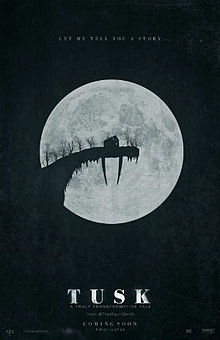
Tusk_(2014_film)_posterand so anyway it turns out that the best thing about Tusk (2014), a film in which an erstwhile mariner turned mad surgeon/serial killer abducts asshole shock-podcaster Justin Long in order to transform him into a walrus fit for gladiatorial combat, is not the spot-on depiction of Canadians in all their native variety, but that moment (and every subsequent moment) that comes several tens of minutes into the film when you go from staring at the screen wondering what you are staring at to staring at the screen wondering whether you are staring at the most expensive movie Frank Henenlotter never made or at a god’s-honest-truth work of genius such as has never actually been made by Wes Anderson…

Crimson Peak (del Toro 2015)

MV5BNTY2OTI5MjAyOV5BMl5BanBnXkFtZTgwNTkzMjQ0NDE@._V1_SX640_SY720_Pretty much all the commentary so far has been about one of two things.

Critics have been unanimous in their praise of how gorgeous the film looks, from its gothicky design to its fabulous frocks and sumptuous colour palette (it also has some nice irises and cunning wipes).

Or they have echoed del Toro’s own point that it is not really a horror movie so much as a gothic romance, full of echoes and allusions, including: Poe’s ‘The Fall of the House of Usher’; the several versions of Jane Eyre and Silence of the Lambs; Du Maurier’s Rebecca; Hitchcock’s Rebecca and Notorious; Medak’s The Changeling; The Haunting, and Wises’s; King’s The Shining, and Kubrick’s; the Coen’s Barton Fink; del Toro’s own Devil’s Backbone; and so on.

All of these critics are right, and yet without exception they overlook del Toro’s major accomplishment.

Somehow, he manages constantly to keep this astonishing overblown confection of evil aristocrats, ghosts, forbidden rooms, gramophone cylinders, automata, letters, keys, ghosts, murder, incest, idiosyncratic grim-up-north grimness, peculiarly hardy Cumberland moths, violent assaults and revolutionary mining technology just this side of hilariously funny. And somehow he makes it a constant delight, grand guignol at its most operatic, all logic subordinated to production design.

But it would take just one person in the auditorium to start laughing, and it could all go disastrously wrong.

It is not the first time del Toro has walked this particular line. Much as I enjoyed them, Hellboy II and  Pacific Rim edge along a similar tightrope, and are rather less successful in keeping it together.

Early in the film, protagonist Edith Cushing (Mia Wasikowska) explains of a story she has written that it is not so much a ghost story as a story with ghosts in it, and that her ghosts are actually metaphors for the past. With the kind of New Weird chutzpah that China Miéville once championed, del Toro’s film takes completely the opposite tack. His ghosts are ghosts, not metaphors.

However, the logic of Miéville’s argument meant that while one should be absolutely committed to treating monsters as monsters rather than as metaphors, this should nonetheless leave their metaphorical potential open and even make for more effective metaphoricity. But with del Toro’s pastiche late-Victorian setting lacking the historical resonances of Devil’s and Pan’s Labyrinth‘s (not unproblematic) Spanish Civil War settings, there is nothing really for his ghosts to gain metaphorical purchase, even if they were so inclined. There is some stuff about aristocrats as parasites, and a whole Blut und Boden thing lying around should anyone want to make something of it, but no one does. And del Toro seems utterly uninterested in the gendered restrictions and sexual repression that seem so fundamental to gothic romance.

It is a film of many layers, all of them on the surface.

On the other hand, I loved every deliriously silly minute of it, and you get the impression del Toro did, too.