My top thirty-two films of 2015

This year, I watched 365 films (though I could not work up the energy to transcribe the incomplete-because-of-system-constraints list from my FB page this morning, so you will have to go dig around there if you really care). Anyways, here are my top nine films which had cinema releases or previews in the UK this year, and the top twenty-three I saw for the first time this year:

maxresdefault

The top nine (in (current) order of preference)
Hard To Be A God (German 2013)
Crumbs (Llansó 2015)
High Rise (Wheatley 2016)
Mad Max Fury Road (Miller 2015)
White God (Mundruczó 2014)
Furious 7 (Wan 2015)
Bone Tomahawk (Zahler 2015)
The Signal (Eubank 2014)
Spy (Feig 2015)

The other top twenty-three (in alphabetical order, ‘cos decisions are too hard and I already made a bunch)
21 Jump Street (Lord/Miller 2012)
Adrift in Tokyo (Satoshi Miki 2007)
The Baader Meinhoff Complex (Edel 2008)
The Babadook (Kent 2014)
Babylon (Rosso 1981)
Beasts of the Southern Wild (Zeitlin 2012)
Black Joy (Simmons 1977)
The Drop (Roskam 2014)
Go For Sisters (Sayles 2013)
A Lonely Place to Die (Gilbey 2011)
Los Angeles Plays Itself (Andersen 2003)
Make Way for Tomorrow (McCarey 1937)
Piccadilly (Dupont 1929)
Pitch Perfect (Moore 2012)
The Rover (Michôd 2014)
The Shining (US cut) (Kubrick 1980)
The Sorcerer’s Apprentice (Zeman 1978)
Stage Struck (Dwan 1925)
The Stolen Airship (Zeman 1967)
This Filthy World (Garlin 2006)
Tiger in the Smoke (Baker 1956)
Tusk (Smith 2014) – though I might be completely wrong about this
Yeelen (Cissé 1987)


My top twenty books of 2015

1144This year, I read 166 books for pleasure. (My definition of ‘pleasure’ here includes background reading for new modules, research projects, reader’s reports, reviews, blurbs, etc, as well as ploughing through books that have been cluttering up the house for years – or decades – before donating them to the local charity shop; hence I am surprised to find four of my top twenty were actually published in 2015).

Portnoy compliance data:
All of the world except… = 87
…straight white men writing in English = 74
plus multi-authored in ways too complex to divide = 5
(but only about 40 by women)

Top twenty titles (excluding books I’ve read before)
Novels

Bernardine Evaristo, Blonde Roots (2008)
Leslie Feinberg, Stone Butch Blues (1993)
Elizabeth Hardwick, Sleepless Nights (1979)
Ondjaki, Granma Nineteen and the Soviet’s Secret (2008)
Richard Powers, Generosity: An Enhancement (2009)
Alain Robbe-Grillet, The Erasers (1953)
Sapphire, Push (1996)
Sam Selvon, The Lonely Londoners (1956)

Short stories
Dilman Dila, A Killing in the Sun (2015)
Nerine Dorman, ed, Terra Incognita: New Speculative Fiction from Africa (2015)
Abdelfattah Kilito, The Clash of Images (1995)
China Miéville, Three Moments of An Explosion (2015)
Sam Selvon, Ways of Sunlight (1957)

Poetry
Sam Greenlee, Ammunition! (1975)

Comics
Tony Puryear and Erika Alexander, Concrete Park: You Send Me (2014)
–. Concrete Park: R.E.S.P.E.C.T. (2015)
Gene Luen Yang, Boxers (2013)

Biography
Isaac Deutscher, The Prophet Armed: Trotsky 1879-1921 (1954)
— The Prophet Unarmed: Trotsky 1921-29 (1959)
The Prophet Outcast: Trotsky 1929-40 (1963)

The full list of books I read this year
Brian Aldiss, Bury My Heart at WH Smith’s
Helliconia Summer
The Twinkling of an Eye
Michelle Alexander and Jeanne Long, How to Lose a Guy in 10 Days: The Universal Don’ts of Dating
Monica Ali, Brick Lane
Nelson Algren, A Walk on the Wild Side
Grant Allen, The Woman Who Did
Margery Allingham, The Tiger in the Smoke
Guillermo Arriaga, The Guillotine Squad
Isaac Asimov and Martin Greenberg, eds, Cosmic Critiques: How and Why Ten Science Fiction Stories Work
Marc Augé, The Future

JG Ballard, High Rise (film reviewed)
The Drowned World
Lynne Reid Banks, The L-Shaped Room
René Barjavel, Ashes, Ashes
Steven Barnes, Streetlethal
Walter Besant, The Revolt of Man
Calixthe Beyala, How to Cook Your Husband the African Way
David Bischoff, Young Sun Ra and the Strange Celestial Roads
Andy Boot, Fragments of Fear: An Illustrated History of British Horror Films
Elizabeth Bowen, The Heat of the Day
Dennis Broe, Maverick
Michael Bronski, Pulp Friction: Uncovering the Golden Age of Gay Male Pulps
Keith Brooke, ed., Strange Divisions and Alien Territories: The Sub-Genres of Science Fiction
Octavia Butler, Dawn
Adulthood Rites
Imago

Brian Chikwava, Harare North
Agatha Christie, The Moving Finger
Teju Cole, Open City
Warwick Collins, Gents
Joseph Conrad, The Secret Agent
Richard Cowper, The Custodians, and Other Stories
The Twilight of Briareus

Chris Darke, La jetée
Isaac Deutscher, The Prophet Armed: Trotsky 1879-1921
— The Prophet Unarmed: Trotsksy 1921-29
The Prophet Outcast: Trotsky 1929-40
Bernard F Dick, The Merchant Prince of Poverty Row: Harry Cohn of Columbia Pictures
Joan Didion, Where I Was From
Dilman Dila, A Killing in the Sun
Brian Dooley, Black and Green: The Fight for Civil Rights in Northern Ireland and Black America
Nerine Dorman, ed, Terra Incognita: New Speculative Fiction from Africa
Fyodor Dostoevksy, Notes from Underground
Arthur Conan Doyle, The Adventures of Sherlock Holmes
–. Uncle Bernac: A Memory of the Empire
David Duffy, Losing the Head of Philip K Dick
Alexandre Dumas, The Count of Monte Cristo
Nell Dunn, Up the Junction

Caroline Edwards and Tony Venezia, eds, China Miéville: Critical Essays
George Alec Effinger, When Gravity Fails
David Eggers, A Hologram for the King
Bernardine Evaristo, Blonde Roots
Allen Eyles, House of Horror: The Complete Hammer Films Story

Michael Fabre, Under the Skin
Hans Fallada, Tales from the Underworld
Leslie Feinberg, Stone Butch Blues
Eric Flint, Gorg Huff and Paula Goodlett, 1636: The Kremlin Games
Karen Joy Fowler and Debbie Norton, 80! Memories and Reflections on Ursula K Le Guin
Carl Freedman, Art and Idea in the Novels of China Miéville

Elizabeth Gaskell, Mary Barton
Stella Gibbons, Cold Comfort Farm
William Gibson, The Peripheral
Jeremy Gilbert, Common Ground: Democracy and Collectivity in an Age of Individualism
Robert SC Gordon, Bicycle Thieves
Joe Gores, Hammett
Graham Greene, Brighton Rock
Karl Taro Greenfield, Speed Tribes: Children of the Japanese Bubble
Sam Greenlee, Ammunition!
Walter Greenwood, Love on the Dole
John Grindrod, Concretopia: A Journey Around the Rebuilding of Postwar Britain

Joe Haldeman, The Long Habit of Living
Sarah Hall, The Carhullan Army
Knut Hamsun, Hunger
Elizabeth Hardwick, Sleepless Nights
Mark Harris, Scenes from a Revolution: The Birth of the New Hollywood
Ivor W Hartmann, ed., AfroSF, volume 2 
Brett Harvey, The Fifties: A Woman’s Oral History
Mary Higgs, Glimpses into the Abyss
Patricia Highsmith, The Price of Salt
Andrew Holleran, Dancer from the Dance
Tendai Huchu, The Maestro, the Magician and the Mathematician
Fergus Hume, The Mystery of a Hansom Cab

CLR James, Letters from London
James Joyce, Dubliners

Anton Kaes, M
Sue Kaufman, The Diary of a Mad Housewife
Gerald Kersh, Night and the City (here and here)
Abdelfattah Kilito, The Clash of Images
Stephen King, Doctor Sleep
The Shining
Cyril M Kornbluth, Not this August
Sigizmund Krzhizhanovsky, Memories of the Future
Hanif Kureishi, The Buddha of Suburbia
Andrei Kurkov, Death and the Penguin
Henry Kuttner, Elak of Atlantis

George Lamming, The Emigrants
Andrea Levy, Small Island
Marina Lewycka, Two Caravans
Megan Lindholm, Wizard of the Pigeons
Kelly Link, Magic for Beginners
Jack London, The People of the Abyss

Neil McAleer, Odyssey: The Authorised Biography of Arthur C Clarke
Arthur Machen, The Great God Pan
The Three Impostors
The Terror
Colin Macinnes, Absolute Beginners
City of Spades
Katherine Mansfield, In a German Pension
Richard Marsh, The Chase of the Ruby
The Datchet Diamonds
Guy de Maupassant, Bel Ami, or the Secret History of a Scoundrel
Quentin Meillassoux, Science Fiction and Extro-Science Fiction
China Miéville, This Census Taker
Three Moments of An Explosion
Rick Moody, The Ice Storm
Alan Moore and Kevin O’Neill, The League of Extraordinary Gentlemen, volume one
Susanna Moore, In the Cut

VS Naipaul, The Mimic Men
Frank Norris, Blix
Moran of the Lady Letty
Sarah Nuttall and Achille Mbembe, eds, Johannesburg: The Elusive Metropolis

Liam O’Flaherty, The Informer
Ondjaki, Granma Nineteen and the Soviet’s Secret

Félix J Palma, The Map of Time
Richard Powers, Generosity
Tony Puryear and Erika Alexander, Concrete Park: You Send Me
–. Concrete Park: R.E.S.P.E.C.T.

Raymond Queneau, Zazie in the Metro

Alain Robbe-Grillet, The Erasers
Jackie Robinson, I Never Had It Made
David S. Roh, Betsey Huang and Greta A. Niu, eds, Techno-Orientalism: Imaging Asia in Speculative Fiction, History, and Media
Satyajit Ray, The Diary of a Space Traveller and Other Stories
Sharifa Rhodes-Pitts, Harlem is Nowhere: A Journey to the Mecca of Black America
Jean Rhys, Voyage in the Dark

Sunjeev Sahota, Ours are the Streets
Sapphire, Push
Sam Selvon, The Lonely Londoners
–. Ways of Sunlight
Khairy Shalaby, The Time-Travels of the Man Who Sold Pickles and Sweets
Patrick Sheeran, The Informer
Anne River Siddons, The House Next Door
Sister Souljah, The Coldest Winter Ever
Muriel Spark, The Ballad of Peckham Rye
The Girls of Slender Means
Colin Spencer, Homosexuality: A History
Bruce Sterling, Islands in the Net
Herbert Strang, Round the World in Seven Days
The Old Man of the Mountain
Mrs Herbert Strang, The Girl Crusoes
Neil Strauss, ed., Radiotext(e)
Boris and Arkaday Strugatsky, Hard to Be a God (film reviewed)
Preston and Sandy Sturges, Preston Sturges on Preston Sturges

Rose Tremain, The Road Home

Jeff Vandermeer, Annihilation
Authority
Acceptance
Dai Vaughan, Odd Man Out
Jules Verne, The Sphinx of the Ice Realm

HG Wells, The Autocracy of Mr Parham
The Time Machine
Brian Willems, Shooting the Moon
Jeanette Winterson, The Stone Gods
Virginia Woolf, Mrs Dalloway

Gene Luen Yang, Boxers
Richard Yates, Revolutionary Road

Yevgeny Zamyatin, We
Benjamin Zephaniah, Refugee Boy

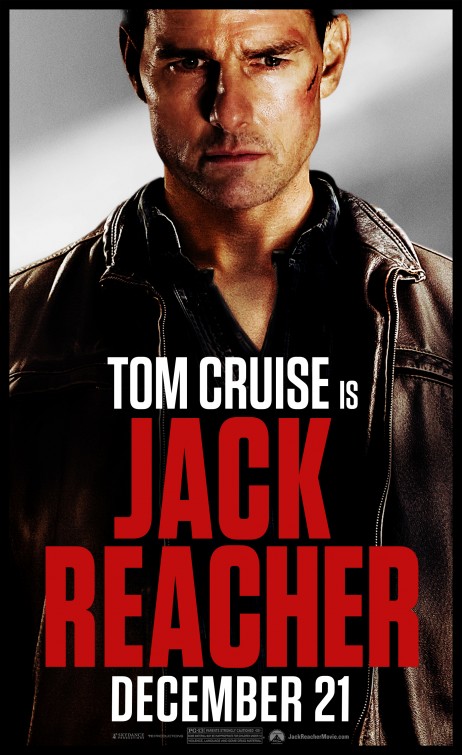
Jack Reacher (Christopher McQuarrie 2012)

Jack-Reacher-Tom-Cruise-Posterand so anyway it turns out that the best thing about Jack Reacher (2012) – especially since diminutive star and producer Tom Cruise either can’t or won’t follow the rather sage advice hidden in the title of the currently-filming sequel Jack Reacher: Don’t Go Back – is not the clattering sub-Bourne car chase in which our tiny hero careens off cars and kerbs because he is not tall enough to simultaneously reach the pedals and see over the dashboard, but the look on the bantam face of the literally pocket-sized Cruise, so tiny you really can pick him up and carry him around in your breast pocket like a half-smoked Panatela or flashlight pen, when, on what was obviously the first day of shooting, it suddenly dawned on him that he had bought the rights to a series of rather ordinary thrillers featuring a six foot five, 220+ pound Aryan wet-dream of a man, rather than the heart-warming (and, to iddy-biddy Tom, profoundly resonant) triumph-over-adversity tale of a small boy who, like the Lilliputian star, would stretch and stretch and stretch but still not be able to get onto the sofa without being lifted…

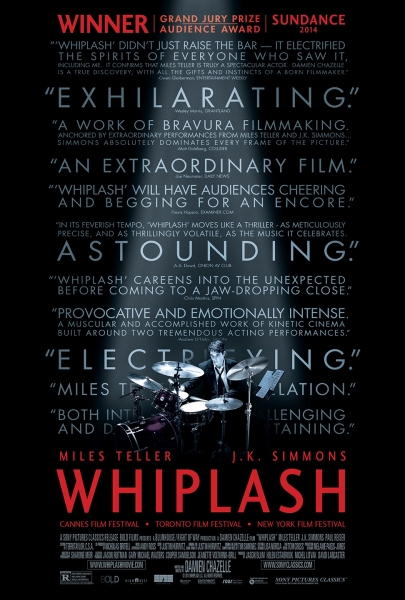
Whiplash (Damien Chazelle 2014)

timthumb.phpand so anyway it turns out that the best thing about multi-Oscar-winning Whiplash (2014) is not that – thanks mainly to the music, the editing and Supergirl’s chin, which once you have seen you will never unsee – it manages to combine being quite enjoyable with being a big pile of totally reprehensible tosh, nor that it got Babylon 5‘s Garibaldi back in shape and won him an Oscar, but that it showed me exactly where I have been going wrong pedagogically for the last 22 years, putting all that effort into not being a complete and utter dick, and made me look forward to turning over a new, abusive leaf when I get back to classes in the new year…

AfroSF volume 2 (2015), edited by Ivor W. Hartmann

afrosf2So much has happened since the appearance of Ivor Hartmann’s AfroSF: Science Fiction by African Writers (2012). It is not just that AfroSF is more visible than it was four years ago, but that the market and venues for it are growing, especially at short story length. This year alone has given us Jalada’s online Afrofuture(s) anthology, Nerine Dorman’s Terra Incognita: New Short Speculative Stories from Africa, Jo Thomas and Margrét Helgadóttir’s African Monsters (2015) and five issues of omenana. This proliferation must have seemed impossible when Hartmann started work on AfroSF 2, but it makes his decision to follow up his anthology of 22 short stories with a collection of just 5 novellas all the more significant.

There is a long tradition of sf writers cutting their teeth on short stories before proceeding, via novella and novelette lengths, to full-length novels. Primarily a peculiar by-product of the demands of mid-twentieth-century US magazine publishing, it nonetheless provided a pragmatic apprenticeship and trajectory. We no longer live in that world (as Eric Flint’s Hugo commentaries spent a bunch of 2015 explaining), and with the majority of sf magazines now electronic rather than hard-copy there is relatively little demand for fiction at those intermediate lengths. But the step-up from short-shorts and shorts and even long-shorts to novels remains a big one. And so AfroSF 2’s change of format represents a conscious commitment to the further development of the field – and of the writers within it. Only two of the six writers in this volume have published a novel before: Nick Wood, whose YA sf The Stone Chameleon appeared all the way back in 2004 (although his sf novel, Azanian Bridges, is due out early next year), and Tade Thompson, whose crime thriller Making Wolf appeared just a couple of months back.

AfroSF 2 opens with Thompson and Wood’s ‘The Last Pantheon’, a sprightly tale of rival African superheroes, called Black-Power and Pan-Africa, that riffs off Luke Cage and Black Panther (and Superman), as well as name-checking Nigeria’s Powerman aka Powerbolt (drawn by a young Dave Gibbons and Brian Bolland) and South Africa’s Mighty Man (but why not Jet Jungle?). Although the backstory covers millions of years, the story itself focuses on their decades-long disagreement over the role they should play in the period of post-WW2 anti-colonial and post-colonial struggle – the assassination of Patrice Lumumba is a watershed moment – and on an attempt to bring them both out of retirement for one last smackdown, to be televised globally. It is all rather canny and quick-moving.

Next up is Mame Bougouma Diene’s ‘Hell Freezes Over’, set in a post-human post-civilisation hanging on in the watery ruins of our world as a new Ice Age advances. The two halves of the story, placed (I think) in reverse chronological order, feature treachery, betrayal, revolution and retribution. Sadly, it is not the kind of story I ever enjoy, regardless of who wrote it (reminded me of Claude Nunes, kinda, but that’s probably too obscure to be helpful), and I read it under considerably less than ideal conditions (involving tube trains, loud drunks, illness and fatigue). But it does contain some quite beautiful passages, such as when the Fish People swim into waters that freeze around them.

I am a big fan of Dilman Dila, and his ‘The Flying Man of Stone’ is for me probably the best piece in the anthology. Like his ‘A Killing in the Sun’, it is about surviving (or not) in the contradictions, uncertainty and sheer randomness of conflicts; like ‘The Healer’ it is about the complex cultural and social identities left in the wake of colonialism; and like ‘Itanda Bridge’ and ‘The Yellow People’ it is about crash-landed aliens living underground and forging ambiguous symbiotic relationships with humans. It is also a superhero story, full of questions about power, responsibility and consequences.

Andrew Dakalira’s ‘VIII’ is set in a near-future Malawi where a series of apparently random killings breaks out just as the world’s population hits eight billion. These attacks turn out to be a global phenomenon, presaging a wider slaughter (there’s a kind of AVP backstory lurking in the backstory). It rattles along at great pace, jumping between multiple viewpoint characters. You wonder how this apocalypse can possibly be averted and, when the story is over, you continue to do so.

Efe Tokunbo Okogu, whose BSFA-nominated ‘Proposition 23’ was one of the highlights of AfroSF, ends the volume with ‘An Indigo Song for Paradise’. It is the longest piece in the anthology, a great big sprawling mess of story that works really well when it does work, but never quite hangs together, especially when it switches from cyberpunkish crime caper action sequences to meandering, sententious speechifying. As with Diene’s ‘Hell Freezes Over’, I found the setting a little too unfocused to get a clear grip on. There is an idyllic Gaia and a post-apocalyptic Terra which also seems to be a post-historical Dying Earth. There is the ironically named Paradise City, presided over by an evil corporation and the remaining few white people (known as vampires), and populated by people of colour who sound a lot like they’ve popped in from the 1990s. And there is a xombie apocalypse. And it might all just be a simulation running on a computer anyway. Everything the author could think of seems to be crammed in somewhere somehow, and some of it might be jokes I just don’t get. But there is no denying the pell-mell energy that dominates stretches of it.

There is, of course, a downside to publishing just novellas. Obviously, Hartmann’s desire to do something new and different with this volume, to help writers step up to the challenges of writing at greater length, means that AfroSF 2 inevitably lacks AfroSF’s wide variety of story types and voices from across the continent and diaspora. This is most obvious in the absence of women writers (discussed with Hartmann and omenana’s editor Chinelo Onwualu on the always fabulous bookshy).

Maybe the next challenge, whether for Hartmann or others, should be an anthology of AfroSF entirely by women writers. It should only be a matter of logistics – as the original AfroSF and other anthologies/magazines clearly demonstrate, there are already more than enough potential contributors out there.

(Many thanks to Ivor for providing me with an ARC.)

Star Wars: The Force Awakens (JJ Abrams 2015)

_1443544274and so anyway it turns out that the best thing about Star Wars: The Force Awakens (2014) is not the way tumbleweed blows across the Tatooine desert when Simon Pegg makes his desperately unfunny ‘Rey gun’ joke, nor is it the revelation that the ‘home’ Han is so glad to be back at is the one in which his grandkids have dumped him, where he rooms with Bruce Campbell’s Elvis and Ossie Davis’s JFK, no, the best thing about the new Star Wars movie is the eighteen months of misdirection during which Channing Tatum and Jonah Hill straight-up straightface lied about the next Jump Street movie cross-over being with the Men in Black franchise…

African Science Fiction 101: update 2

The months since my last update have been crazily busy with other things, so there has been little time for research and even less time for actually reading any of the goodies I’ve uncovered. Most of which are annoyingly inconvenient sizes and shapes to lug around with me over my Xmas perambulations. But I thought I would post another list before Xmas (and before that teetering pile of books in the corner falls over on top of me).

First up, I should mention the hugely embarrassing omission of Amos Tutuola from the article that started all this (and my indebtedness to Paul March-Russell for drawing it to my attention   in such a generous way). Truth is, I have never read anything by him, though The Palm-Wine Drinkard (1952), My Life in the Bush of Ghosts (1954) and Feather Woman of the Jungle (1962) may well 51ZoowIE8gL._SY344_BO1,204,203,200_be squeezed into the suitcase. As might D.O. Fagunwa’s Forest of a Thousand Daemons: A Hunter’s Saga (1939), translated by Wole Soyinka(!) – the first Yoruba-language novel, said to be an influence on Tutuola, not least in its fantastical landscape in which the supernatural is as real and present as the natural world.

While we’re in the margins of what might be considered sf, I have had a load of things recommended to me that might be more appropriately labelled ‘weird’ or ‘slipstream’:

  • Tawfiq Al-Hakim, The People of the Cave (1933) – a play based on the seven sleepers of Ephesus, who sleep their way into the future; their story is told in the eighteenth surah of the Qu’ran
  • Bertène Juminer, Bozambo’s Revenge (1968)41yjzEc0m9L._SY344_BO1,204,203,200_ – satirical alternate history in which Africans have colonised a swampy Europe full of idle, childish, pallid natives
  • Gamal al-Ghitani, The Zafarini Files (1976) – in a crowded corner of Sadat-era Cairo, a sheikh uses magic to take away men’s sexual potency
  • Olympe Bhêly-Quénum, Snares without End (1978) – there is an essay about him at Weird Fiction Review
  • Ivan Vladislavić, The Folly (1993), which seems to have a nice salvage vibe to it, if not exactly salvagepunk
  • Calixthe Beyala, How to Cook Your Husband the African Way (2002) – begins with a black woman explaining how she turned white, but not in quite the way I initially thought it was going to go
  • José Eduardo Agualusa, The Book of Chameleons (2004) – a murder mystery involving a trader in memories and identity creation
  • Ondjaki, Granma Nineteen and the Soviet’s Secret (2008) – a wonderful poetic novel, one of the best things I’ve read this year; there is something fantastical about it, but there is not any fantasy in it…
  • Franklin Rosemont and Robin DG Kelley, eds, Black, Brown and Beige: Surrealist Writings from Africa and the Diaspora (2009) – does what it says on the tin
  • Fiston Mwanza Mujilla, Tram 83 (2014)Tram-83-310px-square – according to reviewers it is ‘Blade Runner in Africa with a John Coltrane soundtrack’ that ‘transfigures harsh reality with a bounding, inventive, bebop-style prose’ and depicts ‘a world so anarchic it would leave even Ted Cruz begging for more government’
  • A. Igoni Barrett, Blackass (2015) – Furi Wakiboko wakes up one morning to discover he has turned white; well, all but one part of him has…

The more obviously genre works that have come my way include:

  • Charlie Human, Apocalypse Now Now (2013) – an urban fantasy thriller in Cape Town’s supernatural underworld
  • Masha du Toit, Crooks & Straights (2014)51Jp-br-R1L._SX310_BO1,204,203,200_ – YA urban fantasy in which Cape Town provides a home for magical refugees
  • Sarah Lotz, The Three (2014) – global thriller with horror/fantasy edge
  • SL Grey, Under Ground (2015) – while a lethal virus sweeps the world, the folks hiding out in a plush subterranean survival bunker find they have brought horror with them
  • Rob Boffard, Tracer (2015) – set on the falling-apart space station housing the last of humanity above a devastated Earth
  • Ivor W. Hartmann, ed., AfroSF volume 2 (2015)afrosf2 – contains five novellas by Tade Thompson and Nick Wood, Mame Bougouma Diene, Dilman Dila, Andrew Dakalira, and Efe Tokunbo Okogu
  • Jo Thomas and Margrét Helgadóttir, eds, African Monsters (2015) – contains fifteen stories and a comic strip by, among others, Dilman Dila, Nerine Dorman, Tendai Huchu, Sarah Lotz, Nnedi Okorafor, Tade Thompson, Nick Wood

(Should also mention Tade Thompson’s debut novel, Making Wolf (2015), although it is a crime thriller, not sf/f.)

One of the things I am interested in starting to trace is the role of speculation and futurity in African political discourse, which has recently led me to:

  • JE Casely Hayford (aka Ekra-Agiman), Ethiopia Unbound: Studies in Race Emancipation (1911) – a novel which apparently includes a vision of a future pan-Africa
  • Camara Laye, A Dream of Africa (1966) – a novel which apparently does the same

Taking of awkwardly shaped and sized books, as I was some time back, one final goody I stumbled across, which provides some useful context for thinking about African sf/f is Readings in African Popular Literature (2002), edited by Stephanie Newell. It reprints some critical articles, but also some fiction and comics and various pages from Drum magazine.


The City in Fiction and Film, week 12

australian_db_passport_to_pimlico_HP07238_Lweek 11

This was a nice gentle week, beginning with watching Passport to Pimlico (Henry Cornelius 1949) and then turning to other matters before discussing it.

First up was some general feedback on the student’s first essays. They all get extensive individual written feedback, but it is good to pool together some more general points, since individual feedback can sometimes feel very isolating – as if you alone are the only person making errors. Overall, though, the class has done pretty well, and we pretty much focused on essay structure, quoting and paraphrasing more effectively, and presentational conventions.

Second, I presented a broad strokes overview of what we have done this semester – it is good to remind students of quite how much ground they have covered, and to make more explicit the connections between weeks, especially if you can also not-so-subtly tailor it towards the upcoming exam in January.

Third, we took a look at the exam paper, ensuring that everyone understood what is required of them – and pointing out that it would be a good idea to ensure they had access to a copy of the film they were going to write about before they go home for the Xmas break.

Then, at last, we discussed Passport to Pimlico – which to my bemusement no-one much liked. So we spent some time off-topic digging into that:

  • partly it was that it is more of a comic film than a comedy, genial rather than guffaw-inducing;
  • partly it was the historical specificity of the film and thus of much of the humour;
  • partly it was that the humour depends so heavily on types which are no longer commonplace, and on the casting of specific actors. For example, if you don’t know Margaret Rutherford, her character is probably quite mystifying, but if you do know her she is a delight to watch because she is up there on the screen being Margaret Rutherford; Basil Radford and Naunton Wayne are only quite so funny because of the way they turn up in yet another film as basically those guys from The Lady Vanishes (Hitchcock 1938); and so on;
  • partly it was a lack of someone to identify with – something I would have liked to have more time to talk about because I am never quite sure a) what it means, and b) why people feel it is necessary to find someone like themselves in a film in order to enjoy it (if that is what it means). It is, however, worth noting that this – whatever this is – is probably compounded by the film being sort of centred on Arthur Pemberton (Stanley Holloway) but dispersing its narrative among an ensemble cast.

It must have all seemed even more baffling when I mentioned that one part of the film – when ordinary Londoners turn up to feed the besieged Burgundians – always chokes me up, the way those I-am- Spartacus moments tend to do (although oddly, not in Spartacus (Kubrick 1960)).

Thank goodness I didn’t get on to talking about the apparent influence of the film on late-60s/early-70s black power sf  – Warren Miller’s The Siege of Harlem (1965) in particular seems to borrow a chunk of it – or to pointing out that when imdb trivia says ‘Some historians, for some reason, have considered this to be a borderline science-fiction film’ I think it is referring to something I once wrote.

So, alone in a room full of people who did not even remotely plain love the movie, I found myself thinking, ‘Blimey, I’m a furriner’. And no one airlifted me a pig for company…

Building on last week’s discussion of Bicycle Thieves, we considered the film in relation to postwar experience and to the emerging conflicted programmes of rebuilding bombed cities and  slum clearance. The film opens with a lovely bit of contrast and misdirection: a dedication to the end of rationing (which would not end for another five years) cuts to a little bit of Latin nightlife, possibly in Havana – only it is not Havana at all, but Pimlico (actually Lambeth), and the music is only ‘Les Norman and his Bethnal Green Bambinos’ on the radio. So we cut from the exotic to the mundane, to a world not of languid plenty but to a period of austerity languishing in a heatwave. (This contrast is returned to throughout the film: when communal eating is instituted, but takes the form of sidewalk cafés, but they don’t like French cuisine; when Shirley Pemberton (Barbara Murray), out courting the impoverished duke (Paul Dupuis), dreams of the orange orchards where he lives, only for him to point our there is really only a cement factory there now; etc.

One of things I like about Passport to Pimlico and Ealing’s Hue and Cry (Charles Crichton 1947) is their willingness to show bomb-damaged London – unlike, say, The Perfect Woman (Knowles 1949), which opts for the rather fantastical London of a West End farce where it seems like there is not a trace of the war (although it too articulates a utopian vision of plenitude in the midst of austerity).

The Pimlico community, a mix of lower middle class shopkeepers and their more working class neighbours, also contrasts well with the working-class communities of Bicycle Thieves. The community is disjointed, primarily along class lines, as the council meeting demonstrates – Arthur presents his lovingly crafted plan to convert the bomb-site into a swimming pool and park so the neighbourhood kids have somewhere safer to play and the adults have somewhere to relax, but the proposal is outvoted by the local bank manager Mr Wix (Raymond Huntley) and others who wish merely to sell the land to the highest bidder. This kind of conflict between a community’s needs/wishes and the (apparently) easy money to be made off property developers forms a pretty constant current in postwar development, including things such as Lambeth councils recent dodgy campaign against the residents of Cressingham Gardens.

The community, however, is brought together by conflict – the film makes very pointed use of WWII imagery, evoking the already-mythologised spirit of the Blitz as much as it does the Berlin airlift. And the film positions us on the side of the community against Whitehall bureaucracy, against jobsworth coppers and customs agents – but also, a little problematically, other Londoners, conceived of as spivs and black-marketeers trespassing on the Burgundians new position of exceptionality and privilege, as too much chaos and disorder, as not-being-from-around-here. Sadly, the film never ceases to be timely in this regard. But on the bright side, a kind of border-defying, working-class internationalism based on sharing breaks out among Londoners (and chokes me up), countering wealth and power, and opening out the Burgundian community once more.

And then it was time for mid-year module evaluation forms, and holiday wishes, and then home for a nice cup of tea (except the central computer controlling the phasing of Bristol’s traffic lights had gone haywire and that nice cup of tea was a couple of hours away).

Week 13


Piqued Oil

energy-the-battle-to-keep-alaska-pipelines-flowing_66062_600x450[A version of this piece first appeared in Salvage]

On 28 September 2015, Royal Dutch Shell – suddenly and without warning – announced their withdrawal from exploratory drilling in the Chuckchi Sea. This decision will cost them, depending on who you ask, somewhere between $4-8 billion in terms of money already spent or contractually committed. Many have found reason to celebrate this announcement – especially when it was followed a couple of days later by Alberta’s governor, Rachel Notley, declaring that there was no long-term future for the province or Canada as a whole to be found in the continued exploitation of the Alberta Tar Sands.

But for others, Shell’s press release – a bland technocratic utterance, an oleaginous misdirection, terse, wilfully oblique – was a cause for concern, a weird provocation.

What exactly has Shell done up there off the coast of Alaska? What have they found? Why are they not talking about it?

What haematophagic vegetal Thing from Another World did they accidentally defrost? What therianthropic congeries of cellular neo-liberalism? What ripe metaphor? What ravening alien maw?

How long until our skies are darkened by fleets of Nazi UFOs pouring out from the Hohlweltlehre’s Fourth Reich? How long until our lands are ravaged by their subhuman legions of Dero Sturmtruppen?

Did Shell really mistake that oozing nightmare plastic column of foetid black iridescence for oil? What rough shoggoth, its hour come around at last, is now slouching southwards to consume us? What Hyperborean sleeping abnormalities, what blasphemously surviving entities, have they disturbed? To the attention of what Elder Gods have their clumsy probings brought us?

Did they drill so deep into the crust that the Earth itself screamed?

Or have Shell, rather more mundanely, had a Mitchell-and-Webb epiphany? Did they stare into the abyss and find themselves staring back? Have they realised that they are the bad guys? Are they going to apologise? Are they going to shut down their chunk of the oil industry and devote future revenues from green energy to repairing the environmental destruction for which they are responsible? Does this retreat from the arctic mark the start of a new era that recognises the unsustainability of development? An era in which existing development will be radically redistributed?

If only.

This is not Armageddon. No plucky oilmen and hot-doggin’ roughnecks are going to divert the extinction event coming our way.

This is not The Abyss. Deep-sea drilling operations are not going to uncover some watery alien messiah.

This is not even On Deadly Ground. No possible blend of motivational-poster mysticism, misappropriated indigenous culture, pony tails and lardy kung fu can stop the oil companies.

Shell is clear on this. Like recent similar withdrawals by Exxon and Chevron, this is a temporary, strategic move based on the several variables. Their main concerns at this point are ‘the high costs associated with the project, and the challenging and unpredictable federal regulatory environment in offshore Alaska’. Their announcement must therefore be seen as a statement of intent: they will lobby and exert influence to get those regulations revised in their favour; they will develop and/or await the technologies that will sufficiently lower the cost of drilling, extraction and transportation; they will wait for global warming to make the Arctic more conducive; they will rely upon – and manipulate – oil demand and oil scarcity; and then they will return.

They say they will ‘cease further exploration activity in offshore Alaska for the foreseeable future’. As if they do not foresee this one. As if this is not their plan.

Notley talks about weaning Alberta – and Canada – off fossil fuels over the next century. A timescale which, however well-intentioned, however inadequate, might just coincide with the oil in the tar sands running out anyway, as peak oil gives way to oil depletion.

So while this weird flight from the icy seas might seem like a turning point in the story of peak oil, it is, in truth, more about piqued oil.

The monotonous self-serving corporate drone of Shell’s statement is designed to conceal only one thing: they are just a little bit miffed.

But rest assured. They were already regrouping, strategising, shifting resources and priorities before they even said a word. And remember: they can’t be bargained with; they can’t be reasoned with; they do not feel pity or remorse or fear. And they will absolutely not stop, ever, until the last drop of oil is made profitable and then wrung from the planet.

Foxcatcher (Bennett Miller 2014)

7735_poster_iphoneand so anyway it turns out that the best thing about Foxcatcher (2014) is not the way it expresses its breathtakingly realist commitment to capturing not only the look of the real people it depicts but also the spirit of a resurgent Reaganite America through the medium of ridiculous but biographically accurate nasal prostheses, but the way in which it enables Mark Ruffalo to again demonstrate his astonishing range as an actor and the Paul Muni-like way he disappears so far into the role screenshot677he is playing so that we barely even see him any longer…Odd-bod_jr